A Multiplexing Design Space: Theory, Method, and Application
Pith reviewed 2026-06-27 08:03 UTC · model grok-4.3
The pith
A design process for visual multiplexing identifies optimal defaults and UI-controllable variations for analyzing multiple 2D scalar fields.
A machine-rendered reading of the paper's core claim, the machinery that carries it, and where it could break.
Core claim
The proposed design method, which includes domain grounding, theoretical analysis, three design steps for visual multiplexing in multiple 2D scalar fields, and expert involvement, enables the identification of relatively optimal default multiplexing designs as well as the need for small variations that domain experts can control through a user interface.
What carries the argument
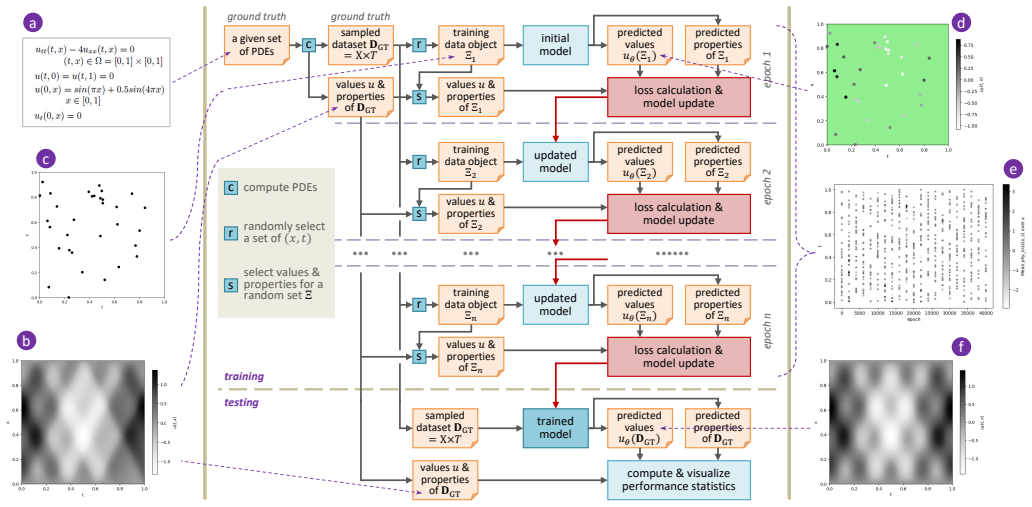
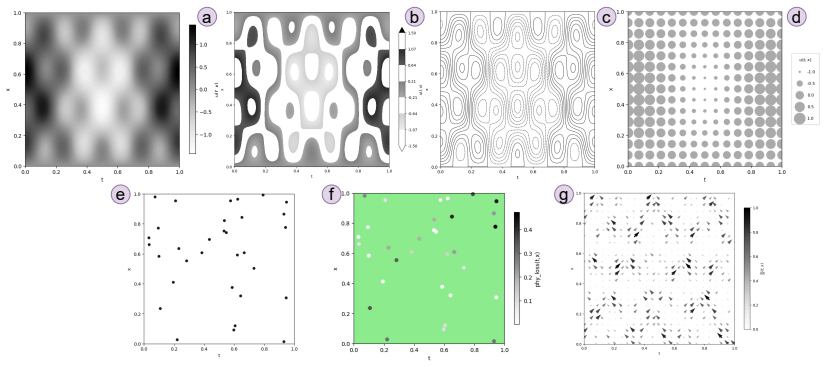
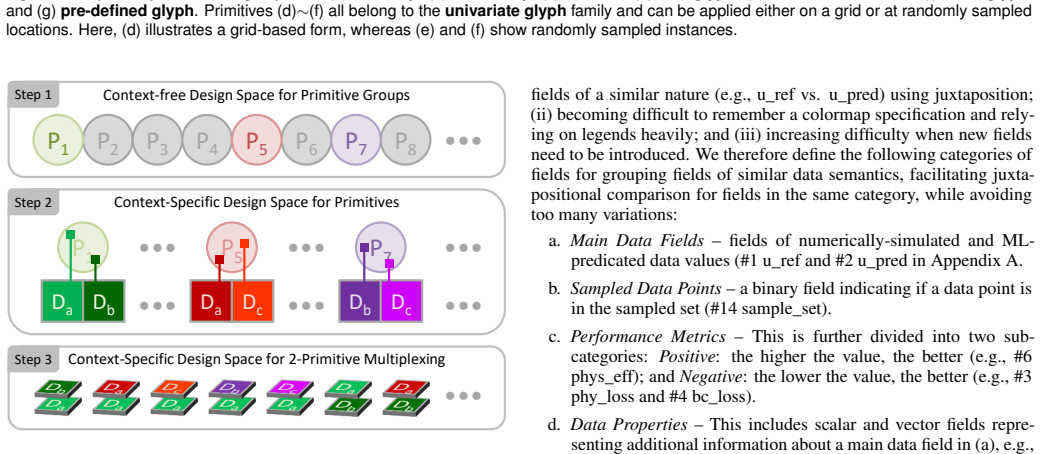
The three design steps that constrain and explore the visual multiplexing design space for multiple 2D scalar fields, preceded by a pre-design step for domain grounding and theoretical analysis.
If this is right
- Relatively optimal default designs for visual multiplexing can be identified for the target application.
- Small variations in the designs are needed and can be made controllable by domain experts via a user interface.
- The method allows systematic exploration of multiplexing rather than unconscious or ad-hoc choices.
- Expert co-design and evaluation activities are integrated into the process to validate the designs.
Where Pith is reading between the lines
- The same constrained exploration approach could be applied to other visualization tasks that layer multiple data representations.
- Interactive controls for small design variations may become useful in other domain-specific scientific tools.
- Patterns identified through repeated application of the method might suggest reusable multiplexing templates across fields.
Load-bearing premise
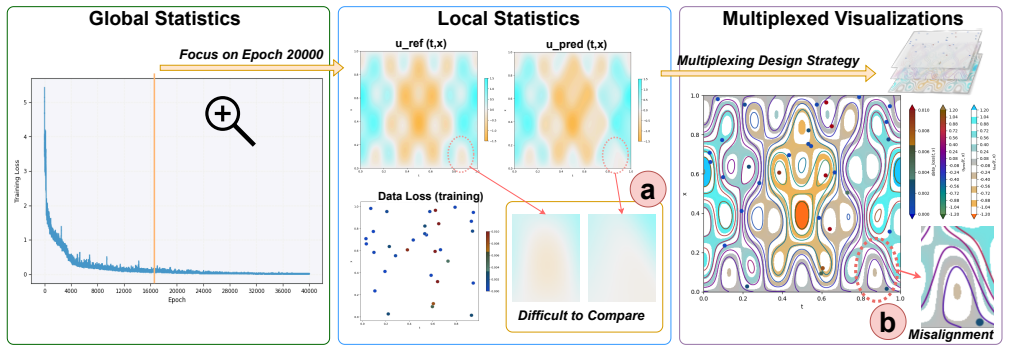
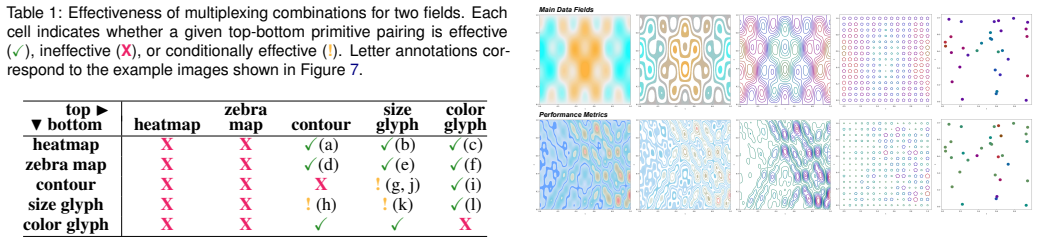
Superimposing one heatmap on top of another is not an effective design for conveying inter-relationships among multiple 2D scalar fields.
What would settle it
A controlled user study with PDE machine-learning researchers in which the identified multiplexing designs show no improvement over overlaid heatmaps for understanding inter-relationships.
Figures

read the original abstract
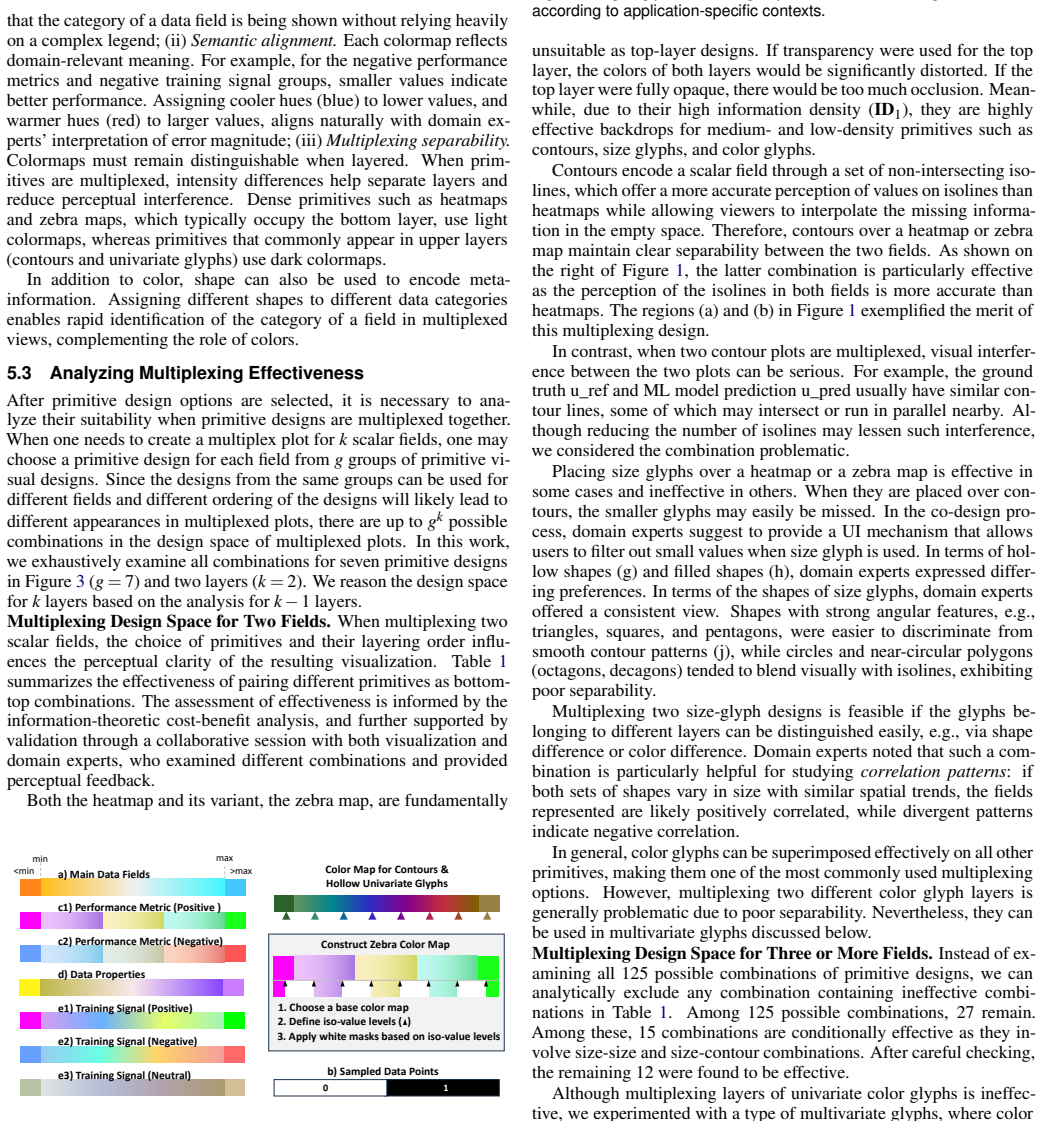
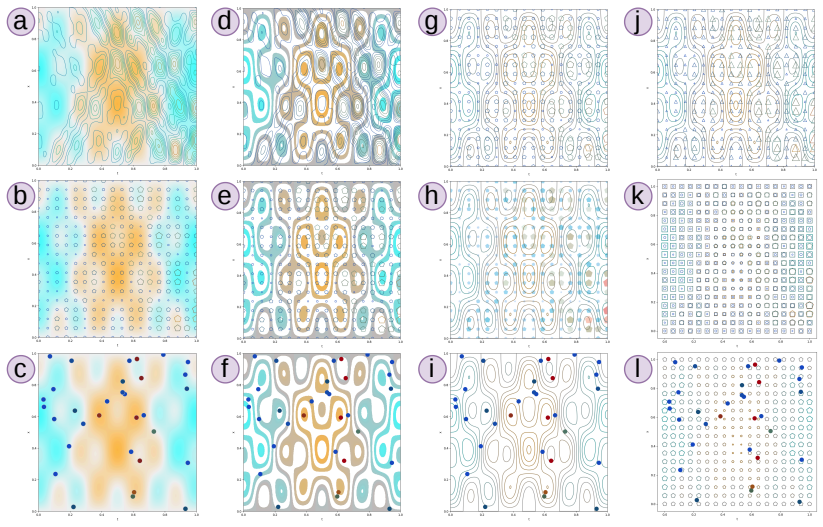
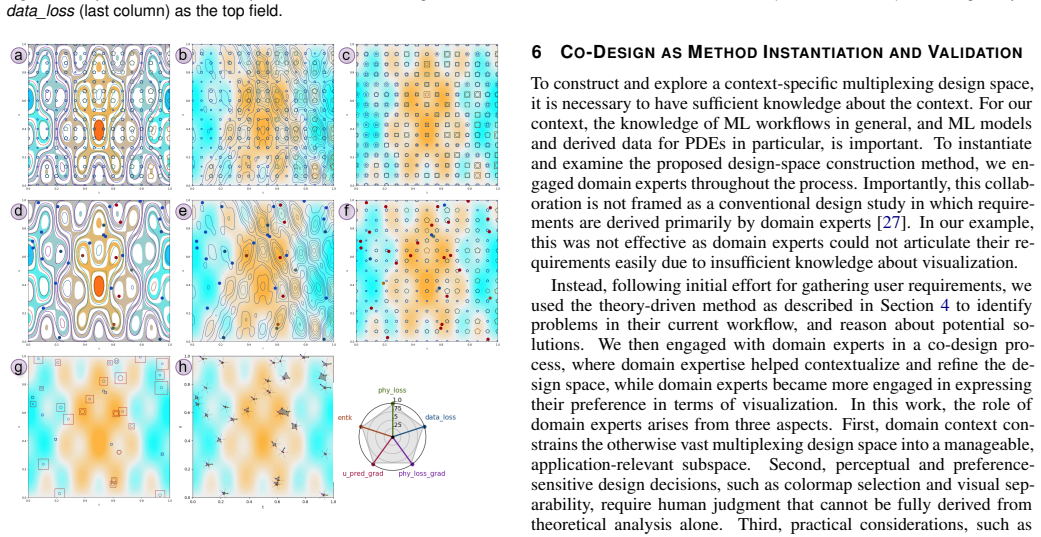
Many visualization designs feature phenomena referred to as ``visual multiplexing'', where multiple pieces of information associated with the same data point are conveyed simultaneously. Although visualization designers are able to bring such phenomena, often unconsciously, into their designs, the design space of visual multiplexing is huge, and it is uncommon to explore visual multiplexing systematically as design patterns. In this paper, we propose a design method for exploring a smaller design space constrained by an application. As an illustrative case study, we focus on machine learning (ML) workflows for developing ML models that approximate partial differential equations (PDEs). In these workflows, ML researchers need to analyze the inter-relationships among multiple 2D scalar fields frequently. Since superimposing one heatmap on top of another is not an effective design, we formulate three design steps to explore the design space of visual multiplexing in the context of multiple 2D scalar fields. Our design method also includes a pre-design step for domain grounding and theoretical analysis, and involves domain experts in both co-design and evaluation activities. The design process enables us to identify relatively optimal default multiplexing designs as well as the need for small variations that domain experts can control through a user interface.
Editorial analysis
A structured set of objections, weighed in public.
Referee Report
Summary. The paper proposes a design method for exploring the visual multiplexing design space when visualizing inter-relationships among multiple 2D scalar fields in ML workflows that approximate PDEs. The method consists of a pre-design grounding and theoretical analysis step plus three design steps; domain experts participate in co-design and evaluation. The process is claimed to yield relatively optimal default multiplexing designs together with small, UI-controllable variations.
Significance. If the identified defaults were shown through controlled evaluation to outperform superposition and other baselines on inter-relationship tasks, the work would supply a reusable, application-constrained method for visual multiplexing that could be adopted in scientific visualization toolkits. The explicit inclusion of domain-expert co-design and evaluation is a constructive element.
major comments (2)
- [Abstract] Abstract: the claim that the three design steps 'enable us to identify relatively optimal default multiplexing designs' is load-bearing yet unsupported; no quantitative optimality criteria, perceptual metrics, task accuracy, or comparative baselines are supplied, leaving the claim dependent on unquantified expert judgment alone.
- [Abstract] Abstract: the motivating premise that 'superimposing one heatmap on top of another is not an effective design' is asserted without reference to prior empirical studies or perceptual evidence, which directly justifies the formulation of the three design steps.
minor comments (1)
- [Abstract] The abstract refers to 'theoretical analysis' in the pre-design step, but the manuscript excerpt does not specify the theoretical framework or axioms employed.
Simulated Author's Rebuttal
We thank the referee for their detailed and constructive feedback. We address each major comment below and indicate where revisions to the manuscript will be made.
read point-by-point responses
-
Referee: [Abstract] Abstract: the claim that the three design steps 'enable us to identify relatively optimal default multiplexing designs' is load-bearing yet unsupported; no quantitative optimality criteria, perceptual metrics, task accuracy, or comparative baselines are supplied, leaving the claim dependent on unquantified expert judgment alone.
Authors: We acknowledge that the phrasing 'relatively optimal' could be interpreted as implying quantitative criteria that are not provided. The defaults are identified via the pre-design grounding, theoretical analysis, and expert co-design/evaluation process described in the paper, which constrains the space to application-specific requirements. We will revise the abstract to replace 'relatively optimal' with language such as 'effective default designs identified through expert evaluation' to more accurately reflect the qualitative, domain-constrained nature of the method. revision: yes
-
Referee: [Abstract] Abstract: the motivating premise that 'superimposing one heatmap on top of another is not an effective design' is asserted without reference to prior empirical studies or perceptual evidence, which directly justifies the formulation of the three design steps.
Authors: This premise is grounded in the pre-design domain analysis step, which includes examination of ML-PDE workflows and direct input from domain experts who reported occlusion and difficulty discerning inter-relationships with superposition. The full manuscript details this grounding. We will revise the abstract to include a brief qualifier or citation to supporting visualization literature on heatmap limitations to strengthen the justification. revision: yes
Circularity Check
No circularity: methodological proposal with independent expert evaluation
full rationale
The paper proposes a design method (pre-design grounding plus three design steps) for visual multiplexing of multiple 2D scalar fields, with optimality assessed via co-design and evaluation with domain experts. No equations, fitted parameters, predictions, or self-citations appear in the provided text. The method is the contribution; its outputs (default designs) are generated by applying the steps rather than being equivalent to the steps by definition. No load-bearing self-citation chains, uniqueness theorems, or ansatzes are present. This is a self-contained methodological paper without quantitative derivations that could reduce to inputs.
Axiom & Free-Parameter Ledger
axioms (1)
- domain assumption Superimposing one heatmap on top of another is not an effective design for conveying inter-relationships among multiple 2D scalar fields.
Reference graph
Works this paper leans on
-
[1]
Albers Szafir
D. Albers Szafir. Modeling color difference for visualization design. IEEE Transactions on Visualization and Computer Graphics , 24(1):392– 401, 2018. 8
2018
-
[2]
R. Borgo, J. Kehrer, D. H. S. Chung, E. Maguire, R. S. Laramee, H. Hauser et al. Glyph-based Visualization: Foundations, Design Guide- lines, Techniques and Applications. In Eurographics 2013 - State of the Art Reports . The Eurographics Association, 2013. doi: 10.2312/conf/ EG2013/stars/039-063 3, 10
-
[4]
Bowman, N
B. Bowman, N. Elmqvist, and T. Jankun-Kelly. Toward visualization for games: Theory, design space, and patterns. IEEE Transactions on Visualization and Computer Graphics , 18(11):1956–1968, 2012. doi: 10. 1109/TVCG.2012.77 2
1956
-
[5]
M. Chen and D. S. Ebert. An ontological framework for supporting the design and evaluation of visual analytics systems. Computer Graphics F orum, 38(3):131–144, 2019. doi: 10.1111/cgf.13677 2, 4
-
[6]
M. Chen and A. Golan. What may visualization processes opti- mize? IEEE Transactions on Visualization and Computer Graphics , 22(12):2619–2632, 2016. doi: 10.1109/TVCG.2015.2513410 1, 3
-
[7]
M. Chen and H. Jänicke. An information-theoretic framework for visu- alization. IEEE Transactions on Visualization and Computer Graphics , 16(6):1206–1215, 2010. doi: 10.1109/TVCG.2010.132 1, 2, 3
-
[8]
M. Chen, S. Walton, K. Berger, J. Thiyagalingam, B. Duffy, H. Fang et al. Visual multiplexing. Computer Graphics F orum, 33(3):241–250, 2014. doi: 10.1111/cgf.12380 1, 2, 3, 7
-
[9]
D. Deng, W. Cui, X. Meng, M. Xu, Y . Liao, H. Zhang et al. Revisiting the design patterns of composite visualizations. IEEE Transactions on Visualization and Computer Graphics , 29(12):5406–5421, 2023. doi: 10. 1109/TVCG.2022.3213565 2
arXiv 2023
-
[10]
Duffy, J
B. Duffy, J. Thiyagalingam, S. Walton, D. J. Smith, A. Trefethen, J. C. Kirkman-Brown et al. Glyph-based video visualization for semen analysis. IEEE Transactions on Visualization and Computer Graphics , 21(8):980–993, 2015. 10
2015
-
[11]
M. A. Elliott, C. Nothelfer, C. Xiong, and D. A. Szafir. A design space of vision science methods for visualization research. IEEE Transactions on Visualization and Computer Graphics , 27(2):1117–1127, 2021. doi: 10. 1109/TVCG.2020.3029413 2
arXiv 2021
-
[12]
A. Farea and M. S. Celebi. Learnable activation functions in physics- informed neural networks for solving partial differential equations. Com- puter Physics Communications , 315:109753, 2025. doi: 10.1016/j.cpc. 2025.109753 2
-
[13]
Farea, S
A. Farea, S. Khan, and M. S. Celebi. Multi-Objective Loss Balancing in Physics-Informed Neural Networks for Fluid Flow Applications. In IEEE 32nd International Conference on High Performance Computing, Data, and Analytics (HiPC) , pp. 108–118, Dec. 2025. 1
2025
-
[14]
M. Gleicher. Considerations for visualizing comparison. IEEE Transac- tions on Visualization and Computer Graphics, 24(1):413–423, 2018. doi: 10.1109/TVCG.2017.2744199 2
-
[15]
H.-P . Hsieh, A. Zavatsky, and M. Chen. Multi-criteria decision analysis for aiding glyph design. IEEE Transactions on Visualization and Com- puter Graphics, 31(10):6705–6718, 2025. doi: 10.1109/TVCG.2025.3526918 10
-
[16]
W. Javed and N. Elmqvist. Exploring the design space of composite visu- alization. In 2012 IEEE Pacific Visualization Symposium , pp. 1–8, 2012. doi: 10.1109/PacificVis.2012.6183556 2
-
[17]
Y . Jin, T. J. A. de Jong, M. Tennekes, and M. Chen. Radial Icicle Tree (RIT): Node separation and area constancy. IEEE Transactions on Visual- ization and Computer Graphics , 30(1):251–261, 2024. doi: 10.1109/TVCG. 2023.3327178 2, 4
-
[18]
N. W. Kim, S. C. Joyner, A. Riegelhuth, and Y . Kim. Accessible visual- ization: Design space, opportunities, and challenges. Computer Graphics F orum, 40(3):173–188, 2021. doi: 10.1111/cgf.14298 2
-
[19]
K. Koffka. Principles of Gestalt Psychology . Harcourt, Brace and Com- pany, New Y ork, NY , 1935.1
1935
-
[20]
I. Lagaris, A. Likas, and D. Fotiadis. Artificial neural networks for solv- ing ordinary and partial differential equations. IEEE Transactions on Neural Networks, 9(5):987–1000, 1998. doi: 10.1109/72.712178 1
-
[21]
B. Lee, M. Cordeil, A. Prouzeau, B. Jenny, and T. Dwyer. A design space for data visualisation transformations between 2d and 3d in mixed- reality environments. In Proceedings of the 2022 CHI Conference on Human Factors in Computing Systems , CHI ’22, art. no. 25. Association for Computing Machinery, 2022. doi: 10.1145/3491102.3501859 2
-
[22]
L. Lu, X. Meng, Z. Mao, and G. E. Karniadakis. DeepXDE: A Deep Learning Library for Solving Differential Equations. SIAM Review , 63(1):208–228, 2021. doi: 10.1137/19M1274067 2
-
[23]
A. M. MacEachren. How maps work: representation, visualization, and design. Guilford Press, 2004. 3
2004
-
[24]
M. Raissi, P . Perdikaris, and G. Karniadakis. Physics-informed neural net- works: A deep learning framework for solving forward and inverse prob- lems involving nonlinear partial differential equations. Journal of Com- putational Physics, 378:686–707, 2019. doi: 10.1016/j.jcp.2018.10.045 1
-
[25]
Saner and M
A. Saner and M. Chen. Music similarity detection through compara- tive imagery data. Applied Sciences , 15(14):7706, 2025. doi: 10.3390/ app15147706 4
2025
-
[26]
H.-J. Schulz, T. Nocke, M. Heitzler, and H. Schumann. A design space of visualization tasks. IEEE Transactions on Visualization and Computer Graphics, 19(12):2366–2375, 2013. doi: 10.1109/TVCG.2013.120 2
-
[27]
Sedlmair, M
M. Sedlmair, M. Meyer, and T. Munzner. Design study methodology: Reflections from the trenches and the stacks. IEEE Transactions on Vi- sualization and Computer Graphics , 18(12):2431–2440, 2012. doi: 10. 1109/TVCG.2012.213 1, 7
2012
-
[28]
S. Simon, S. Mittelstädt, D. A. Keim, and M. Sedlmair. Bridging the gap of domain and visualization experts with a liaison. In Eurographics Conference on Visualization (EuroVis) - Short Papers , pp. 127–131. The Eurographics Association, 2015. doi: 10.2312/eurovisshort.20151137 8
-
[29]
T. A. Slocum, R. B. McMaster, F. C. Kessler, and H. H. Howard. The- matic Cartography and Geovisualization . CRC Press, 4 ed., 2022. doi: 10.1201/9781003150527 3
-
[30]
Solen, M
M. Solen, M. Oddo, and T. Munzner. A design space for multiscale visu- alization, 2025. 2
2025
-
[31]
Tennekes and M
M. Tennekes and M. Chen. Design Space of Origin-Destination Data Visualization. Computer Graphics F orum, 40(3):323–334, 2021. doi: 10. 1111/cgf.14310 2
2021
-
[32]
Tensorboard: Tensorflow’s visualization toolkit
TensorFlow. Tensorboard: Tensorflow’s visualization toolkit. https: //www.tensorflow.org/tensorboard, 2015. Accessed: 2025-11-19. 2
2015
-
[33]
D. G. Tucker. The early history of amplitude modulation, sidebands and frequency-division-multiplex. Radio and Electronic Engineer , 41(1):43– 47, 1971. doi: 10.1049/ree.1971.0008 3
-
[34]
J. Wang, J. Wu, J. Ling, G. Iaccarino, and H. Xiao. Physics-Informed Ma- chine Learning for Predictive Turbulence Modeling: Towards a Complete Framework. Technical report, Sandia National Laboratories, 09 2016. doi: 10.2172/1562229 1
-
[35]
Wang, J.-L
J.-X. Wang, J.-L. Wu, and H. Xiao. Physics-informed machine learn- ing approach for reconstructing Reynolds stress modeling discrepancies based on DNS data. Phys. Rev. Fluids , 2:034603, Mar 2017. doi: 10. 1103/PhysRevFluids.2.034603 1
2017
-
[36]
C. Wu, M. Zhu, Q. Tan, Y . Kartha, and L. Lu. A comprehensive study of non-adaptive and residual-based adaptive sampling for physics-informed neural networks. Computer Methods in Applied Mechanics and Engineer- ing, 403:115671, 2023. doi: 10.1016/j.cma.2022.115671 2
-
[37]
Z. Y e and M. Chen. Visualizing ensemble predictions of music mood. IEEE Transactions on Visualization and Computer Graphics , 29(1):864– 874, 2023. doi: 10.1109/TVCG.2022.3209379 2, 4 APPENDIX A Multiplexing Design Space: Theory, Method, and Application Y . Xing1, A. Farea 2, S. Khan 3, & M. Chen 1 1University of Oxford, UK 2Istanbul Technical University...
discussion (0)
Sign in with ORCID, Apple, or X to comment. Anyone can read and Pith papers without signing in.