Homotopy-Based Re-Initialization for Switched DAEs in Power System Transient Simulation
Pith reviewed 2026-06-27 06:14 UTC · model grok-4.3
The pith
A homotopy-continuation scheme restores solver convergence for switched DAEs after discontinuities when direct post-event initialization fails.
A machine-rendered reading of the paper's core claim, the machinery that carries it, and where it could break.
Core claim
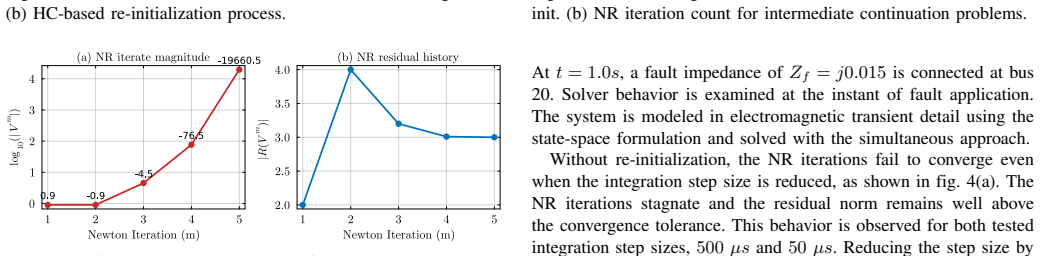
The proposed homotopy-continuation based globalized re-initialization scheme can reliably recover convergence in the cases where direct post-event solution fails, as shown by numerical tests on representative power-system discontinuities.
What carries the argument
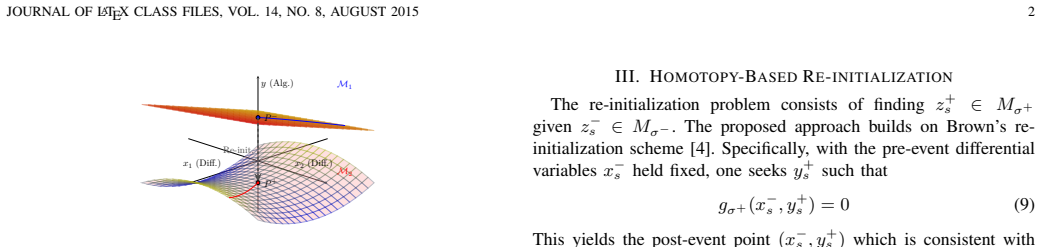
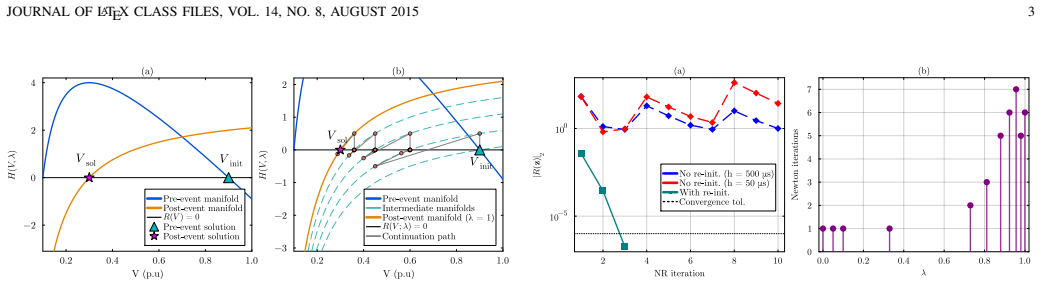
The homotopy-continuation based globalized re-initialization scheme, which constructs a continuous path through the solution manifold to reach a valid post-event algebraic solution from the pre-event state.
If this is right
- Transient simulations can continue through sequences of switching events without manual restarts or solver divergence.
- The approach targets the specific algebraic structures that appear in power-system DAE models.
- It supplies an explicit reason for the observed breakdown of Newton-type solvers immediately after discontinuities.
Where Pith is reading between the lines
- The same geometric view of manifold jumps could guide re-initialization strategies in other switched DAE applications outside power systems.
- Because path continuation adds computational steps, the method implies a trade-off between robustness and speed that would need benchmarking on large network models.
- If the homotopy remains tractable, it could be embedded inside existing commercial simulators as an automatic fallback when the direct solve reports non-convergence.
Load-bearing premise
The geometric framework correctly explains why standard methods lose convergence at discontinuities and that a numerically tractable homotopy path exists for the algebraic equations that arise in power-system models.
What would settle it
A recorded simulation of a power-system switching event in which the homotopy path itself fails to reach a convergent solution or produces a result inconsistent with the expected post-event operating point.
Figures
read the original abstract
The simultaneous solution of switched differential-algebraic equations (DAEs) in power system transient simulation may suffer convergence loss following discontinuous events. This difficulty is typically interpreted as a poor post-event initialization problem. This letter presents a geometric framework that explains the underlying convergence mechanism and clarifies why standard convergence-restoration methods may fail at discontinuities. Based on this interpretation, a homotopy-continuation based globalized re-initialization scheme is developed to restore convergence. The proposed method is validated through numerical simulations of representative discontinuities in power system transient simulation. Results show that in the cases where direct post-event solution fails, the proposed scheme can reliably recover convergence.
Editorial analysis
A structured set of objections, weighed in public.
Referee Report
Summary. The manuscript develops a geometric framework to explain convergence loss when solving switched DAEs for power-system transient simulation after discontinuous events. It proposes a homotopy-continuation-based globalized re-initialization scheme to restore convergence and reports that numerical simulations on representative discontinuities demonstrate reliable recovery in cases where direct post-event solution fails.
Significance. If the geometric interpretation and the homotopy scheme prove correct and numerically tractable, the work would address a recurring practical difficulty in power-system simulation tools. The geometric view of why standard restoration methods fail at discontinuities and the explicit validation on representative cases are positive elements; however, the absence of quantitative metrics limits the ability to judge the practical advance.
major comments (1)
- [Abstract] Abstract: the statement that 'numerical simulations validate the method' and that the scheme 'can reliably recover convergence' is unsupported by any equations, error metrics, test-system descriptions, or baseline comparisons in the manuscript. This absence makes the central claim of reliable recovery an uninspectable assertion and is load-bearing for the paper's contribution.
Simulated Author's Rebuttal
We thank the referee for the constructive feedback. We address the single major comment below and will revise the manuscript to strengthen the presentation of the numerical validation.
read point-by-point responses
-
Referee: [Abstract] Abstract: the statement that 'numerical simulations validate the method' and that the scheme 'can reliably recover convergence' is unsupported by any equations, error metrics, test-system descriptions, or baseline comparisons in the manuscript. This absence makes the central claim of reliable recovery an uninspectable assertion and is load-bearing for the paper's contribution.
Authors: We agree that the abstract's validation statement would be more robust with explicit quantitative support. The manuscript does describe the numerical experiments on representative discontinuities and reports qualitative recovery of convergence, but we acknowledge the absence of detailed error metrics, full test-system parameters, and baseline comparisons. In the revised version we will expand the numerical results section to include residual norms, iteration counts, explicit system data, and direct comparisons with standard post-event initialization. We will also revise the abstract wording to align precisely with the augmented evidence. These additions will render the claims inspectable and address the concern. revision: yes
Circularity Check
No significant circularity identified
full rationale
The paper introduces a geometric framework for convergence loss at DAE discontinuities and proposes a homotopy-continuation re-initialization scheme, validated via numerical simulations on representative power-system cases. No equations, fitted parameters, self-citations, or ansatzes are shown in the supplied text that would reduce any claimed derivation or prediction to its own inputs by construction. The central claim is scoped to recovering convergence where direct methods fail and is supported by external simulation evidence rather than internal redefinition or load-bearing self-reference. The derivation chain is therefore self-contained against the listed circularity patterns.
Axiom & Free-Parameter Ledger
Reference graph
Works this paper leans on
-
[1]
Alvarado, Fernando L. and Lasseter, Robert H. and Sanchez, Juan J. , date =. Testing. doi:10.1109/TPAS.1983.317872 , url =
-
[2]
and Petzold, Linda R
Ascher, Uri M. and Petzold, Linda R. , date =. Computer. 2iXovtfcL74C , eprinttype =
-
[3]
A First Course on Numerical Methods , author =
-
[4]
Astic, J.Y. and Bihain, A. and Jerosolimski, M. , date =. The Mixed. doi:10.1109/59.317654 , url =
-
[5]
Baeckeland, Nathan and Chatterjee, Debjyoti and Lu, Minghui and Johnson, Brian and Seo, Gab-Su , date =. Overcurrent. doi:10.1109/TPEL.2024.3430316 , url =
-
[6]
doi:10.1016/0168-9274(89)90038-X , url =
Developing Software for Time-Dependent Problems Using the Method of Lines and Differential-Algebraic Integrators , author =. doi:10.1016/0168-9274(89)90038-X , url =
-
[7]
Brenan, K. E. and Campbell, S. L. and Petzold, L. R. , date =. Numerical. o_bd8PBZMkkC , eprinttype =
-
[8]
Consistent Initial Condition Calculation for Differential-Algebraic Systems , author =
-
[9]
and Sanchez-Gasca, Juan J
Chow, Joe H. and Sanchez-Gasca, Juan J. , date =. Power. M8G_DwAAQBAJ , eprinttype =
-
[10]
Simulating Fast and Slow Dynamic Effects in Power Systems , author =. doi:10.1109/67.143272 , url =
-
[11]
Gear, C. , date =. Simultaneous. doi:10.1109/TCT.1971.1083221 , url =
-
[12]
Solvability and Stability of a Power System
Groß, Tjorben and Trenn, Stephan and Wirsen, Andreas , date =. Solvability and Stability of a Power System
-
[13]
Hairer, Ernst , langid =. Solving
-
[14]
Hairer, Ernst and Nørsett, Syvert Paul and Wanner, Gerhard , date =. Solving. m7c8nNLPwaIC , eprinttype =
-
[15]
and Wanner, Gerhard , date =
Hairer, Ernst and Nørsett, Syvert P. and Wanner, Gerhard , date =. Solving. F93u7VcSRyYC , eprinttype =
-
[16]
doi:10.1016/S0098-1354(09)80015-X , url =
Computing Consistent Initial Conditions for Differential-Algebraic Equations , author =. doi:10.1016/S0098-1354(09)80015-X , url =
-
[17]
Revisiting Power Systems Time-Domain Simulation Methods and Models , author =
-
[18]
Step-by-Step Design Procedure for a Grid-Connected Three-Phase
Liserre *, Marco and Blaabjerg, Frede and Dell’Aquila, Antonio , date =. Step-by-Step Design Procedure for a Grid-Connected Three-Phase. doi:10.1080/00207210412331306186 , url =
-
[19]
Liu, Yang and Sun, Kai , date =. Solving. doi:10.1109/TPWRS.2019.2945512 , url =
-
[20]
Milano, Federico , date =. Power. doi:10.1007/978-3-642-13669-6 , url =
-
[21]
Rackauckas, Christopher and Nie, Qing , date =. doi:10.5334/jors.151 , url =
-
[22]
Adaptive Time-Stepping and Computational Stability , author =
-
[23]
doi:10.1109/PROC.1979.11233 , url =
Power System Dynamic Response Calculations , author =. doi:10.1109/PROC.1979.11233 , url =
-
[24]
Valli, A. M. P. and Elias, R. N. and Carey, G. F. and Coutinho, A. L. G. A. , date =. doi:10.1002/fld.1998 , url =
-
[25]
Analysis and Numerical Solution of Structured and Switched Differential-Algebraic Systems , author =
-
[26]
doi:10.1016/j.epsr.2005.12.019 , url =
Interpolation and Reinitialization in Time-Domain Simulation of Power Electronic Circuits , author =. doi:10.1016/j.epsr.2005.12.019 , url =
-
[27]
Energy Reports , volume=
Federated learning and conditional diffusion model for privacy-preserving short-term voltage stability assessment in multi-region power systems , author=. Energy Reports , volume=. 2025 , publisher=
2025
discussion (0)
Sign in with ORCID, Apple, or X to comment. Anyone can read and Pith papers without signing in.