Monochromatic k in a row
Pith reviewed 2026-06-27 06:43 UTC · model grok-4.3
The pith
The maximum density of k-in-a-row avoiding sets on the integer grid equals exactly 1 minus 2 over k when 3 does not divide k.
A machine-rendered reading of the paper's core claim, the machinery that carries it, and where it could break.
Core claim
We establish that D(k,ℤ²)=1−2/k whenever 3∤k, and both D(3,ℤ²) and d(3,ℤ²) are determined exactly; we also bound the minimum density d(k,ℤ²) up to a gap of (8+o(1))k^{-1}. For hypercubes [k]^d we derive asymptotic bounds on D(k,[k]^d) up to order k^{-2} and obtain the exact value of d(k,[k]^d).
What carries the argument
The extremal densities D(k, board) and d(k, board) of sets whose claimed positions contain no k-in-a-row.
If this is right
- When 3 does not divide k the largest possible density of a k-in-a-row avoiding set on Z² is exactly 1-2/k.
- Both the maximum and minimum densities are known exactly when k equals 3.
- The gap between upper and lower bounds for d(k,Z²) is at most (8+o(1))/k.
- On the hypercube [k]^d the minimum density d(k,[k]^d) is known exactly and the maximum density is pinned down to within an additive error of order k^{-2}.
Where Pith is reading between the lines
- The exact minimum density on hypercubes may suggest a canonical construction that could be lifted to the infinite grid for small k.
- The contrast drawn with the classical no-(k+1)-in-line problem indicates that the choice of constraint (all claimed points versus only one color) changes which bounds are attainable.
- The counting arguments used on Z² might extend directly to other periodic lattices such as the triangular grid.
Load-bearing premise
The variant game produces a well-defined notion of k-in-a-row avoiding configurations whose extremal densities can be bounded by standard combinatorial constructions and counting arguments on Z^2 and [k]^d.
What would settle it
An explicit subset of Z² whose density exceeds 1-2/k yet contains no k collinear points, for any k not divisible by 3, would falsify the claimed upper bound on D.
Figures
read the original abstract
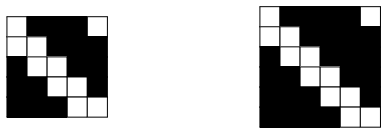
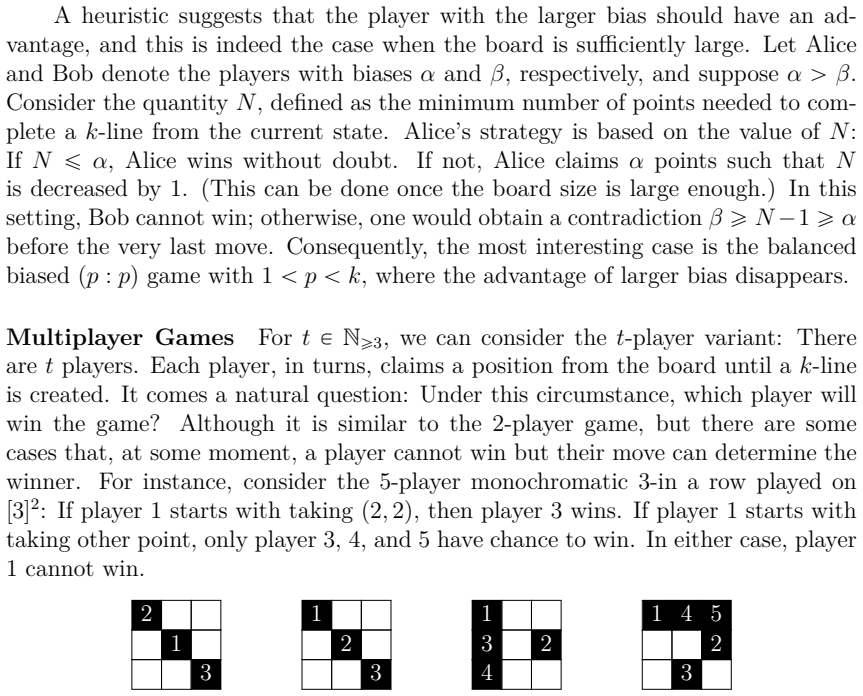
We study a variant of the $k$-in-a-row game in which players alternatively claim positions until a $k$-in-a-row is created among all claimed positions. This leads to the constraint near $k$-in-a-row avoiding on configurations and the associated problem of determining their extremal densities of such configurations. We investigate this problem on two types of boards: the grid $\mathbb{Z}^2$ and hypercubes $[k]^d$. For the grid $\mathbb{Z}^2$, we establish nearly tight bounds on the maximum density $D(k,\mathbb{Z}^2)$, showing that $D(k,\mathbb{Z}^2)=1-\frac{2}{k}$ whenever $3\nmid k$, and determine both $D(3,\mathbb{Z}^2)$ and $d(3,\mathbb{Z}^2)$ exactly. We also bound the minimum density $d(k,\mathbb{Z}^2)$ up to a gap of $(8+o(1))k^{-1}$. For hypercubes $[k]^d$, we derive asymptotic bounds on $D(k,[k]^d)$ up to order $k^{-2}$ and obtain the exact value of $d(k,[k]^d)$. Our results contrast with the classical no-$(k+1)$-in-line problem, a similar problem imposing different constraint, where the trivial upper bound is conjectured to be attainable.
Editorial analysis
A structured set of objections, weighed in public.
Referee Report
Summary. The manuscript examines extremal densities of k-in-a-row avoiding sets arising from a variant game on the integer grid ℤ² and on the discrete hypercubes [k]^d. It claims that the maximum density satisfies D(k,ℤ²)=1−2/k exactly whenever 3 does not divide k, determines both D(3,ℤ²) and d(3,ℤ²) exactly, bounds the minimum density d(k,ℤ²) within a gap of (8+o(1))k^{-1}, and obtains asymptotic bounds on D(k,[k]^d) to order k^{-2} together with the exact value of d(k,[k]^d). These are derived via periodic tilings for the upper bounds and explicit constructions for the matching lower bounds, contrasting with the classical no-(k+1)-in-line problem.
Significance. If the periodic counting arguments and constructions hold, the work supplies nearly tight, explicit densities for a natural avoidance problem in combinatorial extremal theory. The matching upper and lower bounds for all k not divisible by 3, the separate exact computation for k=3, and the parameter-free nature of the periodic averaging are concrete strengths that advance the quantitative understanding of line-avoiding configurations.
minor comments (3)
- [Introduction] §1 (Introduction): the precise definition of the allowed directions for k-in-a-row should be stated explicitly before the density statements, as the abstract leaves the line orientations implicit.
- [Abstract] The o(1) term in the gap for d(k,ℤ²) is stated without an explicit reference to the section deriving the 8/k coefficient; adding a forward pointer would improve readability.
- [Section 2] Notation for D versus d is introduced without a dedicated sentence contrasting maximum versus minimum density; a single clarifying sentence early in §2 would prevent reader confusion.
Simulated Author's Rebuttal
We thank the referee for their positive summary, recognition of the strengths of the periodic arguments and constructions, and recommendation of minor revision.
Circularity Check
No significant circularity
full rationale
The paper derives D(k,ℤ²)=1-2/k (for 3∤k) via an explicit periodic tiling upper bound that counts forbidden k-tuples per cell and a matching (k,2)-periodic construction for the lower bound; the k=3 case is handled by separate explicit computation. These are standard self-contained combinatorial arguments on the grid and hypercube that do not reduce to fitted parameters, self-definitions, or load-bearing self-citations. The abstract and skeptic analysis confirm the results contrast with prior work without internal reduction to inputs.
Axiom & Free-Parameter Ledger
axioms (2)
- standard math Asymptotic density is well-defined for subsets of ℤ² and [k]^d
- standard math Standard double-counting and construction techniques apply to line-avoiding sets
Reference graph
Works this paper leans on
-
[1]
SIAM Journal on Discrete Mathematics , volume=
Incidence bounds for block designs , author=. SIAM Journal on Discrete Mathematics , volume=. 2016 , publisher=
2016
-
[2]
SIAM Journal on Discrete Mathematics , volume=
Finite field Kakeya and Nikodym sets in three dimensions , author=. SIAM Journal on Discrete Mathematics , volume=. 2018 , publisher=
2018
-
[3]
Hefetz, Dan and Krivelevich, Michael and Stojakovi \' c , Milo s and Szab \'o , Tibor. Positional Games. 2014. doi:10.1007/978-3-0348-0825-5_1
-
[4]
Sharp density bounds on the finite field
Bukh, Boris and Chao, Ting-Wei , journal =. Sharp density bounds on the finite field. doi:10.19086/da.30707 , year =
-
[5]
arXiv preprint arXiv:2502.17655 , year=
Volume estimates for unions of convex sets, and the Kakeya set conjecture in three dimensions , author=. arXiv preprint arXiv:2502.17655 , year=
-
[6]
arXiv preprint arXiv:0803.3525 , year=
On the size of Nikodym sets in finite fields , author=. arXiv preprint arXiv:0803.3525 , year=
-
[7]
Combinatorial Games: Tic-Tac-Toe Theory , isbn =
Beck, József , publisher =. Combinatorial Games: Tic-Tac-Toe Theory , isbn =. 2008 , pages =
2008
-
[9]
Some advances in the no-three-in-line problem , journal =
R.R Hall and T.H Jackson and A Sudbery and K Wild , abstract =. Some advances in the no-three-in-line problem , journal =. 1975 , issn =. doi:https://doi.org/10.1016/0097-3165(75)90043-6 , url =
-
[10]
Update on the no-three-in-line problem , journal =
David Brent Anderson , abstract =. Update on the no-three-in-line problem , journal =. 1979 , issn =. doi:https://doi.org/10.1016/0097-3165(79)90025-6 , url =
-
[11]
Progress in the no-three-in-line-problem , journal =
Achim Flammenkamp , abstract =. Progress in the no-three-in-line-problem , journal =. 1992 , issn =. doi:https://doi.org/10.1016/0097-3165(92)90012-J , url =
-
[12]
Progress in the No-Three-in-Line Problem, II , journal =
Achim Flammenkamp , keywords =. Progress in the No-Three-in-Line Problem, II , journal =. 1998 , issn =. doi:https://doi.org/10.1006/jcta.1997.2829 , url =
-
[13]
L.V. Allis. Searching for solutions in games and artificial intelligence. 1994. doi:10.26481/dis.19940923la
-
[14]
Kuo-Han Ku , title =. 2025 , type =. doi:10.6342/NTU202501210 , url =
-
[15]
L.V. Allis. Searching for solutions in games and artificial intelligence . PhD thesis, Maastricht University, January 1994
1994
-
[16]
Update on the no-three-in-line problem
David Brent Anderson. Update on the no-three-in-line problem. Journal of Combinatorial Theory, Series A , 27(3):365--366, 1979
1979
-
[17]
Combinatorial Games: Tic-Tac-Toe Theory , pages 159--161
József Beck. Combinatorial Games: Tic-Tac-Toe Theory , pages 159--161. Cambridge University Press, 01 2008
2008
-
[18]
Progress in the no-three-in-line-problem
Achim Flammenkamp. Progress in the no-three-in-line-problem. Journal of Combinatorial Theory, Series A , 60(2):305--311, 1992
1992
-
[19]
Progress in the no-three-in-line problem, ii
Achim Flammenkamp. Progress in the no-three-in-line problem, ii. Journal of Combinatorial Theory, Series A , 81(1):108--113, 1998
1998
-
[20]
No- (k+ 1) -in-line problem for large constant k
Alexandr Grebennikov and Matthew Kwan. No- (k+ 1) -in-line problem for large constant k . arXiv preprint arXiv:2510.17743 , 2025
arXiv 2025
-
[21]
Some advances in the no-three-in-line problem
R.R Hall, T.H Jackson, A Sudbery, and K Wild. Some advances in the no-three-in-line problem. Journal of Combinatorial Theory, Series A , 18(3):336--341, 1975
1975
-
[22]
Monochromatic k in a row
Kuo-Han Ku. Monochromatic k in a row. Master's thesis, National Taiwan University, 2025
2025
discussion (0)
Sign in with ORCID, Apple, or X to comment. Anyone can read and Pith papers without signing in.