Optimization of muon suppression using sweeper magnets for the Forward Physics Facility at the HL-LHC
Pith reviewed 2026-06-27 05:22 UTC · model grok-4.3
The pith
A multi-stage sweeper magnet system reduces forward muon flux at the FPF from 3.8×10³ to 1.5×10³ cm⁻² per fb⁻¹.
A machine-rendered reading of the paper's core claim, the machinery that carries it, and where it could break.
Core claim
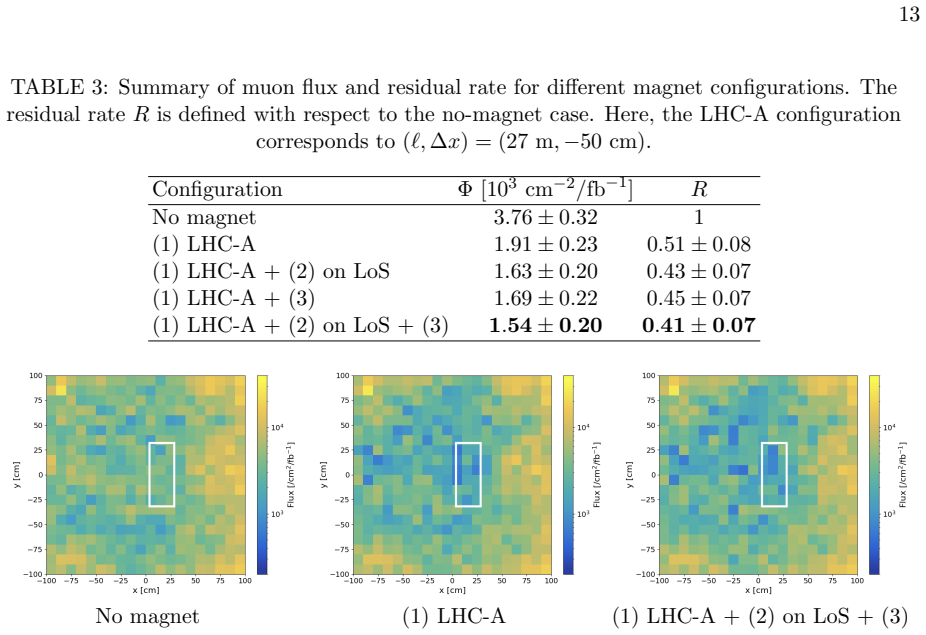
Starting from a muon flux of 3.8×10³ cm⁻² per fb⁻¹ without magnets, a magnet in the LHC tunnel alone achieves the target level of 2×10³ cm⁻² per fb⁻¹. Additional magnets at the TI18 tunnel and FPF entrance further reduce the flux to 1.5×10³ cm⁻² per fb⁻¹ in the optimized configuration. These results demonstrate that a properly optimized multi-stage sweeper magnet system can significantly reduce the forward muon background, while also highlighting the importance of realistic transport simulations and geometrical constraints in achieving further suppression.
What carries the argument
A multi-stage sweeper magnet system evaluated through a chained simulation of SIBYLL event generation, BDSIM beam transport, Geant4 tracking, and measured magnetic field maps.
If this is right
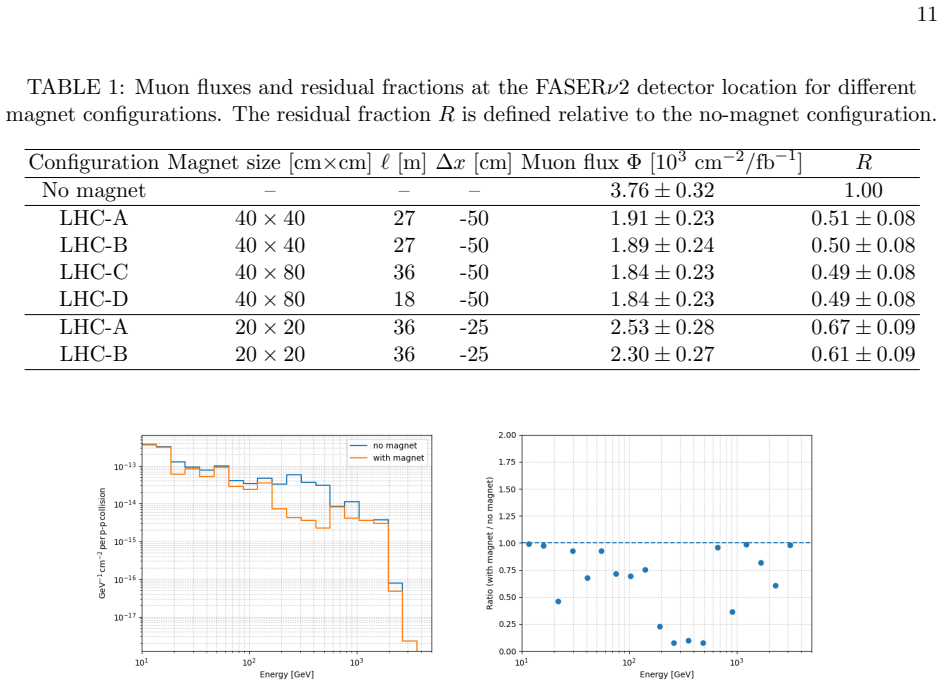
- A single magnet in the LHC tunnel meets the minimum target flux of 2×10³ cm⁻² per fb⁻¹.
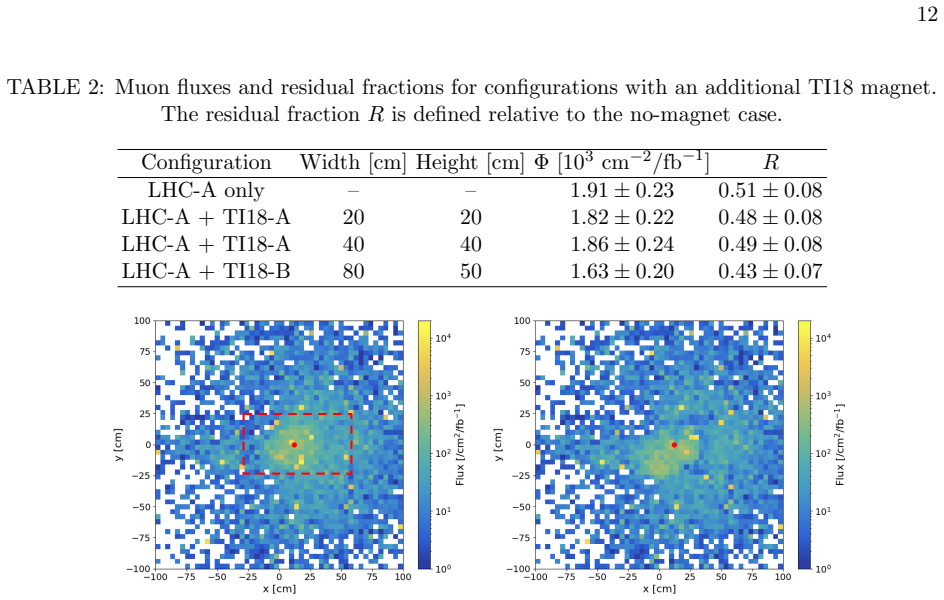
- Two additional magnets at the TI18 tunnel and FPF entrance produce an extra 25 percent reduction.
- Geometrical constraints of the existing tunnels limit how much further suppression is possible.
- Realistic magnetic field maps and transport modeling are essential for reliable predictions.
- The optimized layout enables high-statistics TeV neutrino measurements without excessive muon background.
Where Pith is reading between the lines
- The same multi-stage deflection approach could be adapted for other forward detectors at hadron colliders facing similar muon backgrounds.
- Refining magnet strengths or adding passive shielding might yield further reductions beyond the three-magnet baseline.
- If the simulation overestimates deflection efficiency, actual performance could fall short of the reported 1.5×10³ value.
Load-bearing premise
The combined simulation framework accurately predicts the actual muon flux and suppression inside the real FPF geometry and tunnel layout.
What would settle it
Direct measurement of the muon flux at the FPF detector location after installation of the three-magnet configuration, compared against the simulated value of 1.5×10³ cm⁻² per fb⁻¹.
Figures
read the original abstract
The Forward Physics Facility (FPF) at the High-Luminosity LHC (HL-LHC) will enable high-statistics measurements of TeV-scale neutrinos, but the intense flux of forward muons poses a major challenge for neutrino detectors in the far-forward region. We investigate the suppression of background muons using sweeper magnets with a simulation framework combining SIBYLL event generation, BDSIM beam transport, Geant4 particle tracking, and realistic magnetic field maps. Starting from a muon flux of $3.8\times10^3~\mathrm{cm^{-2}}$ per $\mathrm{fb^{-1}}$ without magnets, a magnet in the LHC tunnel alone achieves the target level of $2\times10^3~\mathrm{cm^{-2}}$ per $\mathrm{fb^{-1}}$. Additional magnets at the TI18 tunnel and FPF entrance further reduce the flux to $1.5\times10^3~\mathrm{cm^{-2}}$ per $\mathrm{fb^{-1}}$ in the optimized configuration. These results demonstrate that a properly optimized multi-stage sweeper magnet system can significantly reduce the forward muon background, while also highlighting the importance of realistic transport simulations and geometrical constraints in achieving further suppression.
Editorial analysis
A structured set of objections, weighed in public.
Referee Report
Summary. The manuscript presents a simulation study optimizing sweeper magnets to suppress forward muon background for the FPF at HL-LHC. Combining SIBYLL event generation, BDSIM beam transport, Geant4 tracking, and realistic field maps, it reports that a magnet in the LHC tunnel alone reduces the muon flux from 3.8×10³ to the target 2×10³ cm^{-2} fb^{-1}, while an optimized multi-stage system with additional magnets in TI18 and at the FPF entrance achieves 1.5×10³ cm^{-2} fb^{-1}.
Significance. If the simulation chain proves accurate, the results are significant for enabling the FPF neutrino program by quantifying a practical background mitigation strategy. The emphasis on multi-stage placement and geometrical constraints adds value beyond single-magnet studies. The use of established codes with realistic maps is a methodological strength.
major comments (2)
- [Abstract] Abstract: the headline flux reductions (3.8×10³ → 1.5×10³ cm^{-2} fb^{-1}) are reported without uncertainties, error bars, or sensitivity studies to SIBYLL/BDSIM/Geant4 modeling choices; this directly limits in the quantitative suppression factors.
- [Simulation framework] Simulation framework section: no validation of the combined SIBYLL+BDSIM+Geant4 chain against existing forward muon data or alternative codes is described, leaving the load-bearing assumption that the model accurately predicts real muon transport in the LHC tunnel/TI18/FPF geometry untested.
minor comments (1)
- Consider adding a summary table of flux values for each magnet configuration to improve readability of the optimization results.
Simulated Author's Rebuttal
We thank the referee for the detailed review and constructive comments on our simulation study. We address each major comment below, indicating where revisions will be made to strengthen the manuscript.
read point-by-point responses
-
Referee: [Abstract] Abstract: the headline flux reductions (3.8×10³ → 1.5×10³ cm^{-2} fb^{-1}) are reported without uncertainties, error bars, or sensitivity studies to SIBYLL/BDSIM/Geant4 modeling choices; this directly limits in the quantitative suppression factors.
Authors: We agree that the absence of uncertainties and sensitivity studies limits the strength of the quantitative claims. The reported fluxes are the direct outputs from the baseline simulation configuration. In the revised manuscript we will add statistical uncertainties from the Monte Carlo samples, perform limited sensitivity studies by varying key parameters (e.g., muon spectrum in SIBYLL and transport cuts in BDSIM/Geant4), and update the abstract and results section accordingly. revision: yes
-
Referee: [Simulation framework] Simulation framework section: no validation of the combined SIBYLL+BDSIM+Geant4 chain against existing forward muon data or alternative codes is described, leaving the load-bearing assumption that the model accurately predicts real muon transport in the LHC tunnel/TI18/FPF geometry untested.
Authors: We acknowledge that an integrated validation of the full chain is not presented. Individual components have been validated in the literature (SIBYLL for forward production, BDSIM for beam transport, Geant4 for tracking), but end-to-end validation against forward muon data is limited by the lack of existing measurements in this geometry. In revision we will expand the simulation framework section with references to prior component validations, a brief discussion of potential systematic uncertainties, and a note on this limitation. revision: partial
Circularity Check
No significant circularity; results are direct simulation outputs
full rationale
The paper's central results are quantitative muon flux reductions obtained from a chained simulation pipeline (SIBYLL event generation + BDSIM transport + Geant4 tracking with supplied field maps). These outputs do not reduce to fitted parameters, self-definitions, or self-citation chains; the suppression factors are computed forward from the input geometry and physics models without any reported parameter tuning that would make the headline numbers tautological. No load-bearing uniqueness theorems, ansatzes, or renamings of known results are invoked. The derivation is therefore self-contained against external benchmarks.
Axiom & Free-Parameter Ledger
free parameters (1)
- magnet positions and field strengths
axioms (1)
- domain assumption SIBYLL, BDSIM, and Geant4 models plus supplied magnetic field maps correctly describe muon production, transport, and deflection in the LHC forward region and TI18/FPF geometry.
Reference graph
Works this paper leans on
-
[1]
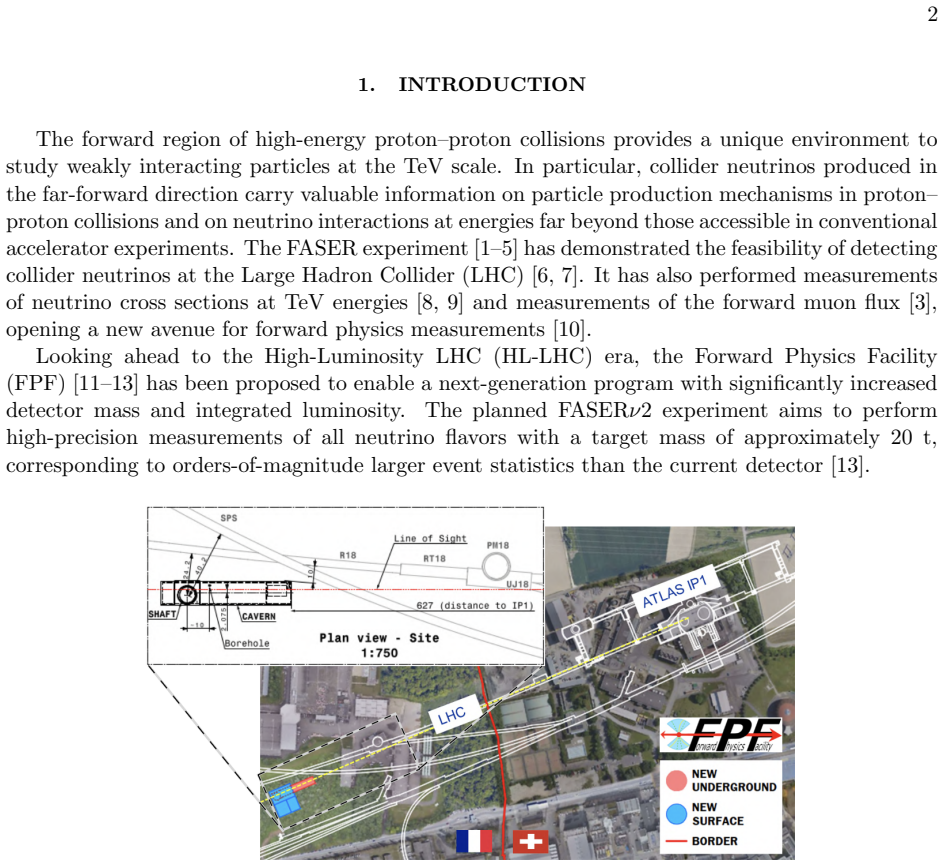
INTRODUCTION The forward region of high-energy proton–proton collisions provides a unique environment to study weakly interacting particles at the TeV scale. In particular, collider neutrinos produced in the far-forward direction carry valuable information on particle production mechanisms in proton– proton collisions and on neutrino interactions at energ...
-
[2]
The simulation consists of a multi-stage chain combining proton–proton collision event generation, beamline transport, particle tracking, and magnetic field modeling
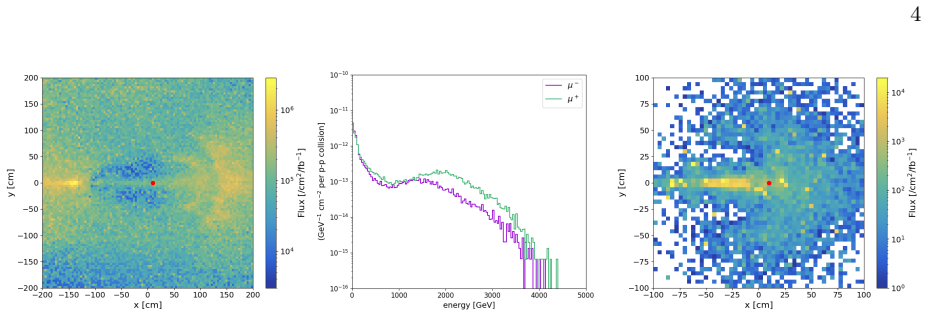
SIMULATION FRAMEWORK A comprehensive simulation framework is developed to evaluate the suppression of background muons by a sweeper magnet system. The simulation consists of a multi-stage chain combining proton–proton collision event generation, beamline transport, particle tracking, and magnetic field modeling. The initial particle distributions are gene...
-
[3]
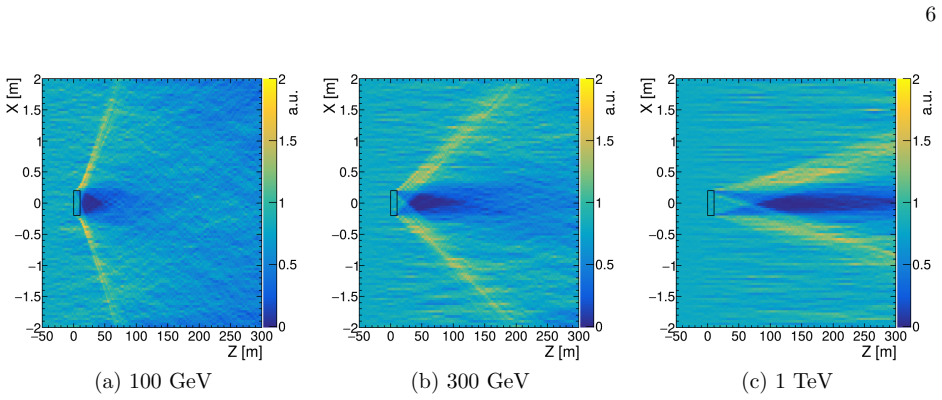
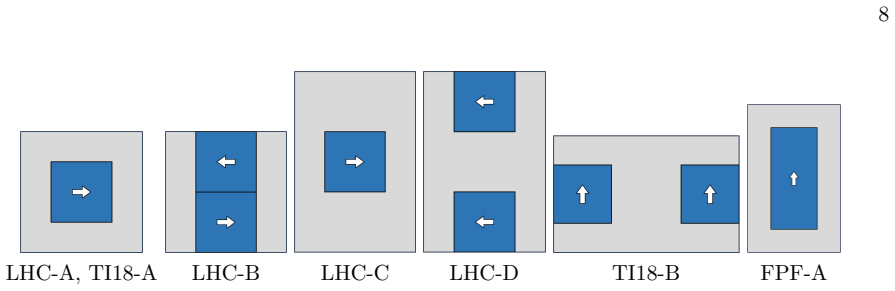
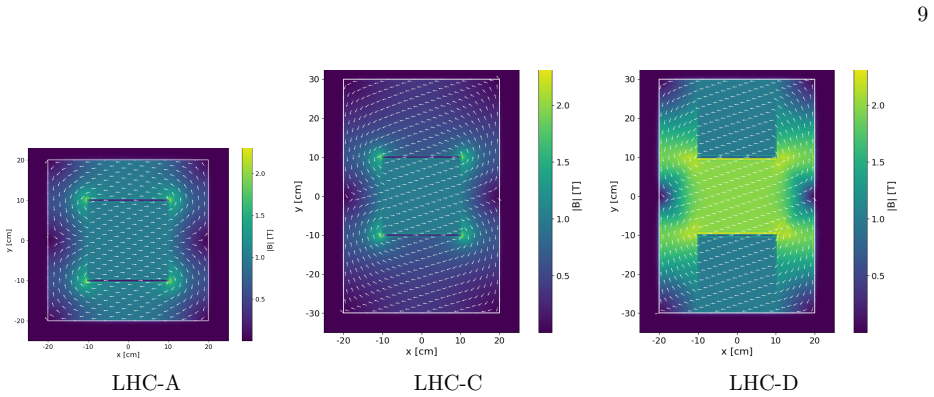
MAGNET SYSTEM 3.1. Conceptual study of muon deflection and scattering To gain qualitative insight into the interplay between magnetic deflection and multiple scat- tering, a simplified toy Monte Carlo study was performed. Muons were generated with a uniform distribution in the transverse (x) direction and propagated along thez-axis. In this study, only ma...
-
[4]
Unless otherwise noted, the evaluation region corresponds to the current detector geometry of 25 cm×64 cm
EVALUATION METRICS The performance of the sweeper magnet configurations is evaluated at the upstream surface of the FASERν2 detector (z= 641 m). Unless otherwise noted, the evaluation region corresponds to the current detector geometry of 25 cm×64 cm. For each configuration, the weighted muon yield in the evaluation region is calculated asN=P i wi, wherew...
-
[5]
Muon suppression with magnets in the LHC tunnel We first evaluate the suppression of background muons using magnets installed in the LHC tunnel
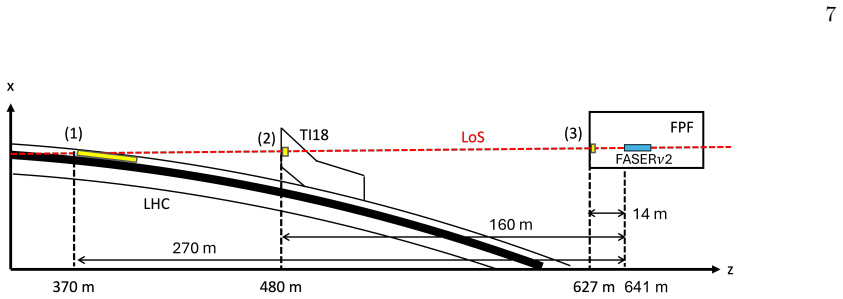
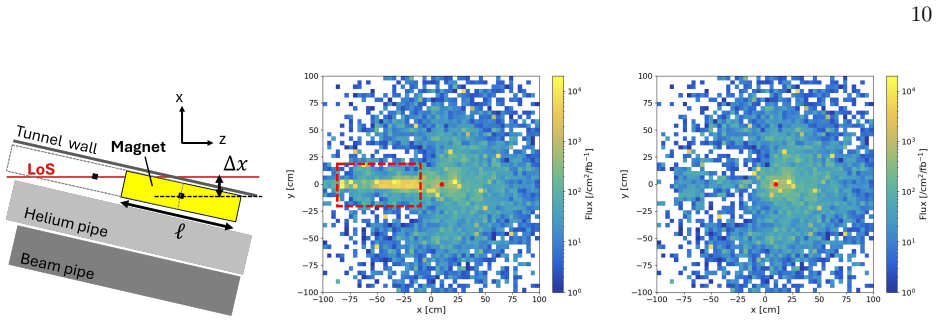
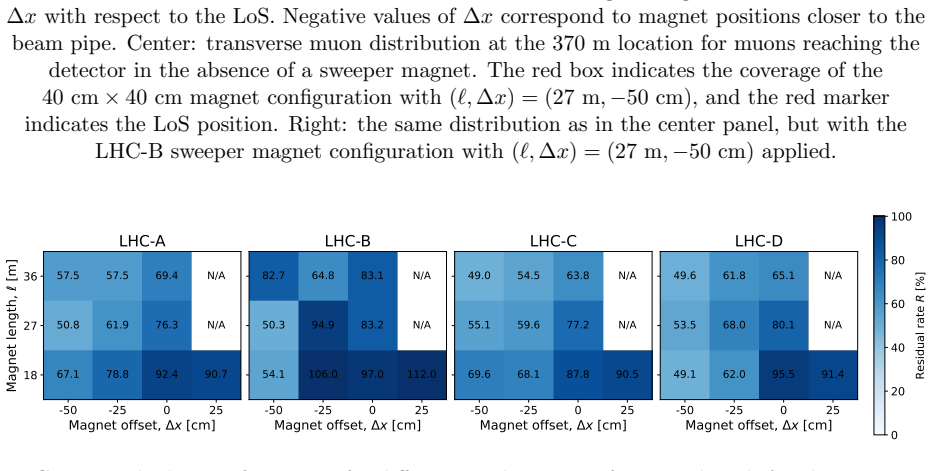
RESULTS 5.1. Muon suppression with magnets in the LHC tunnel We first evaluate the suppression of background muons using magnets installed in the LHC tunnel. Four magnet configurations, denoted LHC-A to LHC-D, are studied by varying the magnet lengthℓand transverse offset ∆x. The magnets are installed parallel to the tunnel axis, as illustrated in Fig. 7....
-
[6]
CONCLUSION In this study, we investigated the suppression of background muons for the FASERν2 experiment using sweeper magnet systems installed upstream of the detector. A comprehensive simulation framework was developed by combining SIBYLL event generation, BDSIM beam transport, Geant4 particle tracking, and realistic magnetic field maps calculated with ...
2018
-
[7]
FASER: ForwArd Search ExpeRiment at the LHC
J. L. Feng, I. Galon, F. Kling, and S. Trojanowski, “ForwArd Search ExpeRiment at the LHC,”Phys. Rev. D97(2018) no. 3, 035001,arXiv:1708.09389 [hep-ph]. [2]FASERCollaboration, “Technical Proposal for FASER: ForwArd Search ExpeRiment at the LHC,” arXiv:1812.09139 [physics.ins-det]. [3]FASERCollaboration, “Detecting and Studying High-Energy Collider Neutrin...
work page internal anchor Pith review Pith/arXiv arXiv 2018
-
[8]
Neutrino Experiments at the Large Hadron Collider,
A. Ariga, J. Boyd, F. Kling, and A. De Roeck, “Neutrino Experiments at the Large Hadron Collider,” Ann. Rev. Nucl. Part. Sci.75(2025) no. 1, 57–81,arXiv:2501.10078 [hep-ex]
-
[9]
The Forward Physics Facility: Sites, experiments, and physics potential,
L. A. Anchordoquiet al., “The Forward Physics Facility: Sites, experiments, and physics potential,” Phys. Rept.968(2022) 1–50,arXiv:2109.10905 [hep-ph]
-
[10]
The Forward Physics Facility at the High-Luminosity LHC,
J. L. Fenget al., “The Forward Physics Facility at the High-Luminosity LHC,”J. Phys. G50(2023) no. 3, 030501,arXiv:2203.05090 [hep-ex]
-
[11]
The forward physics facility: Physics opportunities and conceptual design,
L. A. Anchordoquiet al., “The forward physics facility: Physics opportunities and conceptual design,”Nuclear Physics B1026(2026) 117398. https://www.sciencedirect.com/science/article/pii/S0550321326001069
2026
-
[12]
Nuclear emulsions,
A. Ariga, T. Ariga, G. D. Lellis, A. Ereditato, and K. Niwa, “Nuclear emulsions,”Particle Physics Reference Library: Volume 2: Detectors for Particles and Radiation(2020) 383–438
2020
-
[13]
BDSIM: An accelerator tracking code with particle–matter interactions,
L. J. Nevay, S. T. Boogert, J. Snuverink, A. Abramov, L. C. Deacon, H. Garcia-Morales, H. Lefebvre, S. M. Gibson, R. Kwee-Hinzmann, W. Shields, and S. D. Walker, “BDSIM: An accelerator tracking code with particle–matter interactions,”Comput. Phys. Commun.252(2020) 107200
2020
-
[14]
Overview of the FLUKA code,
G. Battistoniet al., “Overview of the FLUKA code,”Annals Nucl. Energy82(2015) 10–18
2015
-
[15]
Comparison Between Run 2 TID Measurements and FLUKA Simulations in the CERN LHC Tunnel of the Atlas Insertion Region,
D. Prelipcean, K. Bi lko, F. Cerutti, A. Ciccotelli, D. Di Francesca, R. Garc´ ıa Al´ ıa, B. Humann, G. Lerner, D. Ricci, and M. Sabat´ e-Gilarte, “Comparison Between Run 2 TID Measurements and FLUKA Simulations in the CERN LHC Tunnel of the Atlas Insertion Region,”JACoWIPAC2022 (2022) 732–735
2022
-
[16]
Update on the FPF Facility technical studies
J. Boydet al., “Update on the FPF Facility technical studies.” CERN-PBC-Notes-2023-002, 2023. Available at https://cds.cern.ch/record/2851822. [19]Geant4Collaboration, S. Agostinelliet al., “Geant4-a simulation toolkit,”Nuclear Instruments and Methods in Physics Research Section A: Accelerators, Spectrometers, Detectors and Associated Equipment506(2003) n...
-
[17]
Hadronic interaction model Sibyll 2.3d and extensive air showers,
F. Riehn, R. Engel, A. Fedynitch, T. K. Gaisser, and T. Stanev, “Hadronic interaction model Sibyll 2.3d and extensive air showers,”Phys. Rev. D102(2020) no. 6, 063002,arXiv:1912.03300 [hep-ph]
-
[18]
Cosmic Ray Monte Carlo Package, CRMC
R. Ulrich, T. Pierog, and C. Baus, “Cosmic Ray Monte Carlo Package, CRMC.” Zenodo, Aug., 2021. https://doi.org/10.5281/zenodo.5270381. [22]FASERCollaboration, “Measurement of the flux, spatial, angular, and momentum distributions of muons with FASER experiment at the LHC.” CERN-FASER-2025-002. To be published
-
[19]
SND@HL-LHC, Scattering and Neutrino Detector in Run 4 of the LHC,
D. Abbaneoet al., “SND@HL-LHC, Scattering and Neutrino Detector in Run 4 of the LHC,” tech. rep., CERN, Geneva, 2025.https://cds.cern.ch/record/2926288
-
[20]
Elmer finite element software
CSC – IT Center for Science, “Elmer finite element software.”https://www.csc.fi/web/elmer. Accessed: 2026-05-05
2026
discussion (0)
Sign in with ORCID, Apple, or X to comment. Anyone can read and Pith papers without signing in.