MIDSim: Simulating Multi-Channel Information Diffusion in Social Media with LLM-Powered Multi-Agent System
Pith reviewed 2026-06-27 05:23 UTC · model grok-4.3
The pith
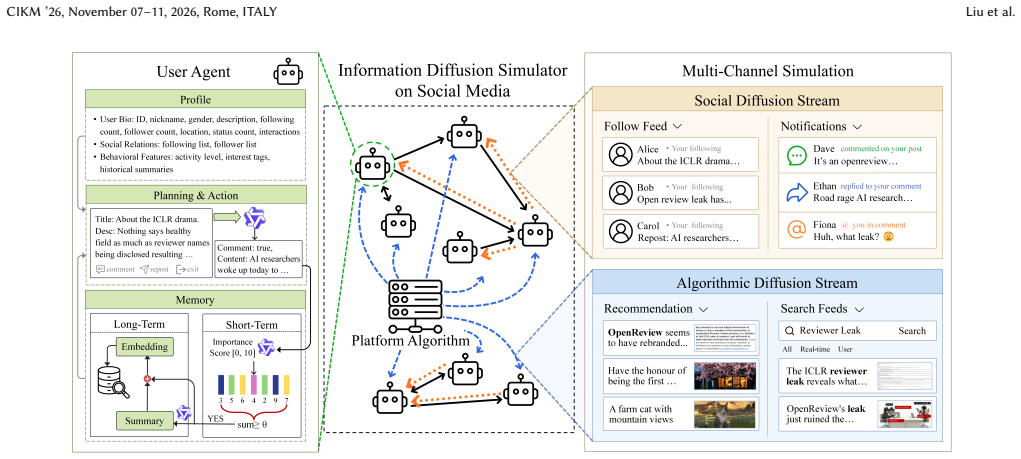
An LLM-powered multi-agent system simulates multi-channel information diffusion by jointly modeling social links and algorithmic exposures.
A machine-rendered reading of the paper's core claim, the machinery that carries it, and where it could break.
Core claim
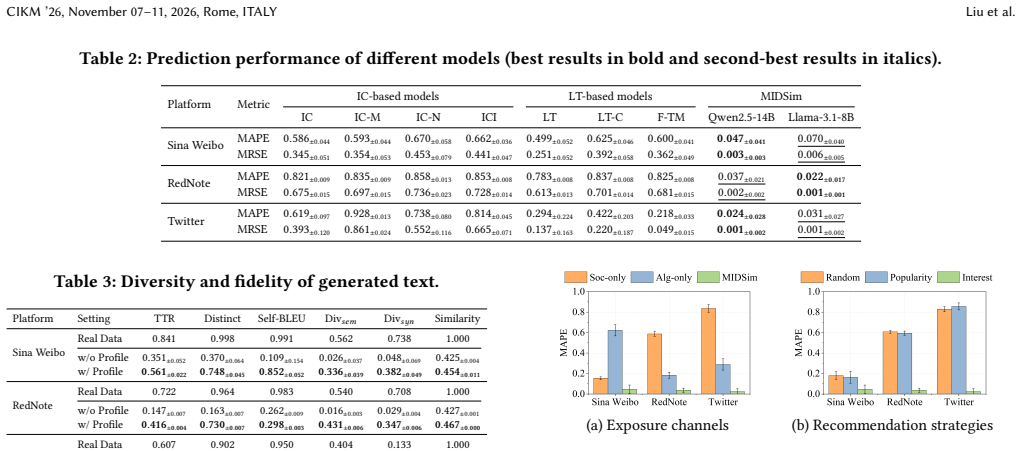
The central claim is that instantiating personalized user agents with large language models and letting the diffusion process jointly track social and algorithmic exposure streams produces simulations whose macro-level spread curves and generated comments align with real events on three platforms, outperforming prior modeling approaches.
What carries the argument
LLM-instantiated personalized user agents whose interactions jointly model social-link and algorithmic-exposure streams.
If this is right
- Simulations can now incorporate the effects of recommender systems on content reach.
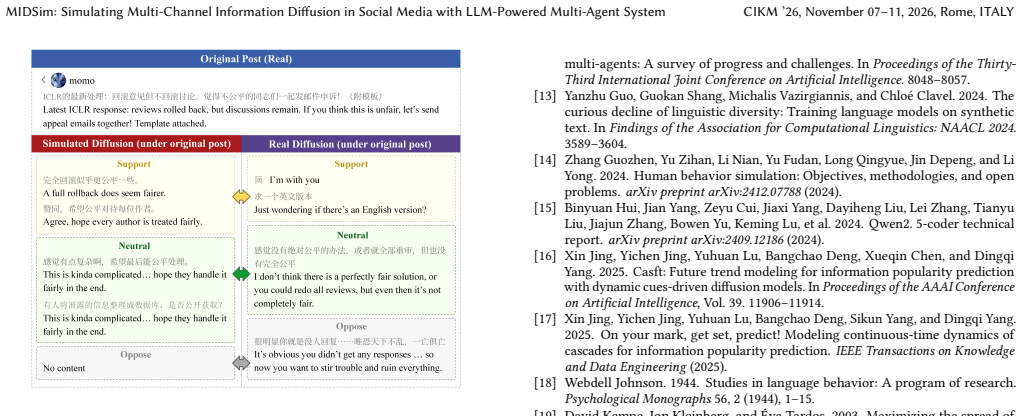
- Generated comments exhibit variety comparable to observed user replies.
- The same datasets and agent framework support cross-platform comparisons of diffusion dynamics.
- Traditional single-channel models are shown to underperform when algorithmic streams are present.
Where Pith is reading between the lines
- Platform designers could use the system to preview how algorithm tweaks alter information reach before deployment.
- The approach opens a route to controlled experiments on misinformation or polarization that would be difficult to run on live platforms.
- Accuracy may depend on how well the chosen LLMs generalize across cultural or linguistic user groups not represented in the training data.
Load-bearing premise
Large language models can create agents that faithfully reproduce the complex behavioral responses real users show to different exposure streams.
What would settle it
On a held-out set of diffusion events from the same platforms, the simulated reach curves or comment distributions deviate significantly from the recorded data under standard statistical tests.
Figures
read the original abstract
Information diffusion in social media shapes public opinion and collective behavior, making its modeling and simulation an important research problem. Existing studies have investigated information diffusion through epidemic-based, cascade-based, and point process models. However, they predominantly focus on diffusion through social links, overlooking other diffusion channels enabled by platform algorithms (e.g., recommender systems) and failing to capture user behavioral complexity. To address these limitations, we propose an LLM-powered multi-agent system for simulating multi-channel information diffusion, where large language models instantiate personalized user agents and the diffusion process jointly models social and algorithmic exposure streams. We further construct three real-world diffusion dataset spanning Sina Weibo, RedNote, and Twitter, containing diffusion records, user profiles, historical posts, and social relationships. Experimental results on real diffusion events show that our proposed framework realistically simulate macro diffusion phenomenon and generate diverse comment content, significantly outperforming baselines.
Editorial analysis
A structured set of objections, weighed in public.
Referee Report
Summary. The paper proposes MIDSim, an LLM-powered multi-agent system for simulating multi-channel information diffusion in social media. It models both social links and algorithmic exposure streams using personalized LLM agents. The authors construct three real-world datasets from Sina Weibo, RedNote, and Twitter, and claim that experimental results on real diffusion events demonstrate that the framework realistically simulates macro diffusion phenomena and generates diverse comment content, significantly outperforming baselines.
Significance. If the empirical claims hold under rigorous evaluation, this work could be significant as it addresses limitations in existing diffusion models by incorporating algorithmic channels and user behavioral complexity via LLMs. The multi-platform datasets could serve as a valuable resource for the community. However, the significance is currently difficult to assess due to lack of detailed evaluation in the provided abstract.
major comments (1)
- [Abstract] Abstract: The abstract asserts that the framework 'significantly outperforming baselines' on real diffusion events but provides no details on evaluation metrics (e.g., for macro diffusion like spread size or temporal dynamics), the specific baselines used, statistical tests, or experimental controls. This omission is load-bearing for the central claim of outperformance and realistic simulation, preventing verification of soundness.
minor comments (1)
- [Abstract] Grammatical issues: 'three real-world diffusion dataset' should be 'datasets'; 'realistically simulate' should be 'simulates' for subject-verb agreement.
Simulated Author's Rebuttal
We thank the referee for their review and the opportunity to clarify the evaluation details supporting our claims. We address the single major comment below.
read point-by-point responses
-
Referee: [Abstract] Abstract: The abstract asserts that the framework 'significantly outperforming baselines' on real diffusion events but provides no details on evaluation metrics (e.g., for macro diffusion like spread size or temporal dynamics), the specific baselines used, statistical tests, or experimental controls. This omission is load-bearing for the central claim of outperformance and realistic simulation, preventing verification of soundness.
Authors: We agree that the abstract is concise and does not enumerate specific metrics, baselines, or statistical procedures. These details appear in the full manuscript: Section 4 describes the three real-world datasets and the macro-level metrics (spread size, temporal dynamics, and comment diversity), Section 5 specifies the baselines (including epidemic, cascade, and point-process models), the evaluation protocol, and the statistical tests used to establish significance. The abstract's summary claim is therefore grounded in those results. We can revise the abstract to include one additional sentence naming the primary metrics and noting that results are statistically significant, subject to length constraints. revision: partial
Circularity Check
No significant circularity
full rationale
The paper presents an LLM-based multi-agent simulation framework evaluated empirically on three newly constructed real-world datasets (Sina Weibo, RedNote, Twitter). The abstract and available description contain no equations, fitted parameters renamed as predictions, self-definitional loops, or load-bearing self-citations that reduce the central claims to inputs by construction. Claims of outperforming baselines rest on experimental comparison rather than any derivation that collapses into its own definitions or prior author work. This is the normal case of an empirical systems paper whose validity is externally falsifiable via replication on the stated datasets.
Axiom & Free-Parameter Ledger
Reference graph
Works this paper leans on
-
[1]
Nicola Barbieri and Francesco Bonchi. 2014. Influence maximization with viral product design. InProceedings of the 2014 SIAM International Conference on Data Mining. 55–63
2014
-
[2]
Smriti Bhagat, Amit Goyal, and Laks VS Lakshmanan. 2012. Maximizing prod- uct adoption in social networks. InProceedings of the Fifth ACM International Conference on Web Search and Data Mining. 603–612
2012
-
[3]
Qi Cao, Huawei Shen, Jinhua Gao, Bingzheng Wei, and Xueqi Cheng. 2020. Popularity prediction on social platforms with coupled graph neural networks. InProceedings of the 13th international conference on web search and data mining. 70–78
2020
-
[4]
Wei Chen, Alex Collins, Rachel Cummings, Te Ke, Zhenming Liu, David Rincon, Xiaorui Sun, Yajun Wang, Wei Wei, and Yifei Yuan. 2011. Influence maximiza- tion in social networks when negative opinions may emerge and propagate. In Proceedings of the 2011 SIAM International Conference on Data Mining. 379–390
2011
-
[5]
Wei Chen, Wei Lu, and Ning Zhang. 2012. Time-critical influence maximization in social networks with time-delayed diffusion process. InProceedings of the AAAI Conference on Artificial Intelligence. 591–598
2012
-
[6]
Zhangtao Cheng, Fan Zhou, Xovee Xu, Kunpeng Zhang, Goce Trajcevski, Ting Zhong, and Philip S Yu. 2024. Information cascade popularity prediction via probabilistic diffusion.IEEE Transactions on Knowledge and Data Engineering36, 12 (2024), 8541–8555
2024
-
[7]
Chen Gao, Xiaochong Lan, Zhihong Lu, Jinzhu Mao, Jinghua Piao, Huandong Wang, Depeng Jin, and Yong Li. 2023. S3: Social-network simulation system with large language model-empowered agents.arXiv preprint arXiv:2307.14984(2023)
work page internal anchor Pith review Pith/arXiv arXiv 2023
-
[8]
Jacob Goldenberg, Barak Libai, and Eitan Muller. 2001. Talk of the network: A complex systems look at the underlying process of word-of-mouth.Marketing letters12, 3 (2001), 211–223
2001
-
[9]
Sreeraag Govindankutty and Shynu Padinjappurath Gopalan. 2024. Epidemic modeling for misinformation spread in digital networks through a social intelli- gence approach.Scientific Reports14, 1 (2024), 19100
2024
-
[10]
Mark Granovetter. 1978. Threshold models of collective behavior.American journal of sociology83, 6 (1978), 1420–1443
1978
-
[11]
Aaron Grattafiori, Abhimanyu Dubey, Abhinav Jauhri, Abhinav Pandey, Abhishek Kadian, Ahmad Al-Dahle, Aiesha Letman, Akhil Mathur, Alan Schelten, Alex Vaughan, et al. 2024. The llama 3 herd of models.arXiv preprint arXiv:2407.21783 (2024)
work page internal anchor Pith review Pith/arXiv arXiv 2024
-
[12]
Taicheng Guo, Xiuying Chen, Yaqi Wang, Ruidi Chang, Shichao Pei, Nitesh V Chawla, Olaf Wiest, and Xiangliang Zhang. 2024. Large language model based multi-agents: A survey of progress and challenges. InProceedings of the Thirty- Third International Joint Conference on Artificial Intelligence. 8048–8057
2024
-
[13]
Yanzhu Guo, Guokan Shang, Michalis Vazirgiannis, and Chloé Clavel. 2024. The curious decline of linguistic diversity: Training language models on synthetic text. InFindings of the Association for Computational Linguistics: NAACL 2024. 3589–3604
2024
- [14]
-
[15]
Binyuan Hui, Jian Yang, Zeyu Cui, Jiaxi Yang, Dayiheng Liu, Lei Zhang, Tianyu Liu, Jiajun Zhang, Bowen Yu, Keming Lu, et al. 2024. Qwen2. 5-coder technical report.arXiv preprint arXiv:2409.12186(2024)
work page internal anchor Pith review Pith/arXiv arXiv 2024
-
[16]
Xin Jing, Yichen Jing, Yuhuan Lu, Bangchao Deng, Xueqin Chen, and Dingqi Yang. 2025. Casft: Future trend modeling for information popularity prediction with dynamic cues-driven diffusion models. InProceedings of the AAAI Conference on Artificial Intelligence, Vol. 39. 11906–11914
2025
-
[17]
Xin Jing, Yichen Jing, Yuhuan Lu, Bangchao Deng, Sikun Yang, and Dingqi Yang
-
[18]
On your mark, get set, predict! Modeling continuous-time dynamics of cascades for information popularity prediction.IEEE Transactions on Knowledge and Data Engineering(2025)
2025
-
[19]
Webdell Johnson. 1944. Studies in language behavior: A program of research. Psychological Monographs56, 2 (1944), 1–15
1944
-
[20]
David Kempe, Jon Kleinberg, and Éva Tardos. 2003. Maximizing the spread of influence through a social network. InProceedings of the ninth ACM SIGKDD International Conference on Knowledge Discovery and Data Mining. 137–146
2003
-
[21]
Jiwei Li, Michel Galley, Chris Brockett, Jianfeng Gao, and William B Dolan. 2016. A diversity-promoting objective function for neural conversation models. In Proceedings of the 2016 Conference of the North American Chapter of the Association for Computational Linguistics: Human Language Technologies. 110–119
2016
-
[22]
Nian Li, Chen Gao, Mingyu Li, Yong Li, and Qingmin Liao. 2024. Econagent: Large language model-empowered agents for simulating macroeconomic activities. In Proceedings of the 62nd Annual Meeting of the Association for Computational Linguistics (Volume 1: Long Papers). 15523–15536
2024
-
[23]
Ziyue Lin, Yi Shan, Lin Gao, Xinghua Jia, and Siming Chen. 2025. Simspark: Interactive simulation of social media behaviors.Proceedings of the ACM on Human-Computer Interaction(2025), 1–32
2025
-
[24]
Zewen Liu, Guancheng Wan, B Aditya Prakash, Max SY Lau, and Wei Jin. 2024. A review of graph neural networks in epidemic modeling. InProceedings of the 30th ACM SIGKDD Conference on Knowledge Discovery and Data Mining. 6577–6587
2024
-
[25]
Xinyi Mou, Zhongyu Wei, and Xuan-Jing Huang. 2024. Unveiling the truth and facilitating change: Towards agent-based large-scale social movement simulation. InFindings of the Association for Computational Linguistics: ACL 2024. 4789–4809
2024
-
[26]
Joon Sung Park, Joseph O’Brien, Carrie Jun Cai, Meredith Ringel Morris, Percy Liang, and Michael S Bernstein. 2023. Generative agents: Interactive simulacra of human behavior. InProceedings of the 36th Annual ACM Symposium on User Interface Software and Technology. 1–22
2023
-
[27]
Jinghua Piao, Yuwei Yan, Jun Zhang, Nian Li, Junbo Yan, Xiaochong Lan, Zhihong Lu, Zhiheng Zheng, Jing Yi Wang, Di Zhou, et al. 2025. AgentSociety: Large-scale simulation of LLM-driven generative agents advances understanding of human behaviors and society.arXiv preprint arXiv:2502.08691(2025)
work page internal anchor Pith review Pith/arXiv arXiv 2025
- [28]
-
[29]
Lei Wang, Heyang Gao, Xiaohe Bo, Xu Chen, and Ji-Rong Wen. 2025. Yulan- onesim: Towards the next generation of social simulator with large language models. InWorkshop on Scaling Environments for Agents
2025
-
[30]
Shitao Xiao, Zheng Liu, Peitian Zhang, Niklas Muennighoff, Defu Lian, and Jian-Yun Nie. 2024. C-pack: Packed resources for general chinese embeddings. InProceedings of the 47th international ACM SIGIR conference on research and development in information retrieval. 641–649
2024
- [31]
-
[32]
Shiqi Zhang, Jiachen Sun, Wenqing Lin, Xiaokui Xiao, Yiqian Huang, and Bo Tang. 2024. Information diffusion meets invitation mechanism. InCompanion Proceedings of the ACM Web Conference 2024. 383–392
2024
-
[33]
Shuai Zhang, Chuan Zhou, Yang Aron Liu, Peng Zhang, Xixun Lin, and Zhi- Ming Ma. 2024. Neural jump-diffusion temporal point processes. InForty-first International Conference on Machine Learning
2024
-
[34]
Xi Zhang, Akshay Aravamudan, and Georgios C Anagnostopoulos. 2022. Any- time information cascade popularity prediction via self-exciting processes. In International Conference on Machine Learning. 26028–26047
2022
-
[35]
Yaoming Zhu, Sidi Lu, Lei Zheng, Jiaxian Guo, Weinan Zhang, Jun Wang, and Yong Yu. 2018. Texygen: A benchmarking platform for text generation models. InThe 41st International ACM SIGIR Conference on Research and Development in Information Retrieval. 1097–1100
2018
discussion (0)
Sign in with ORCID, Apple, or X to comment. Anyone can read and Pith papers without signing in.