Robustness against disorder in topological fibre lasers with explicitly broken PT symmetry
Pith reviewed 2026-06-27 06:07 UTC · model grok-4.3
The pith
A topological boundary mode in a fibre laser stays robust to disorder even after saturable gain is added.
A machine-rendered reading of the paper's core claim, the machinery that carries it, and where it could break.
Core claim
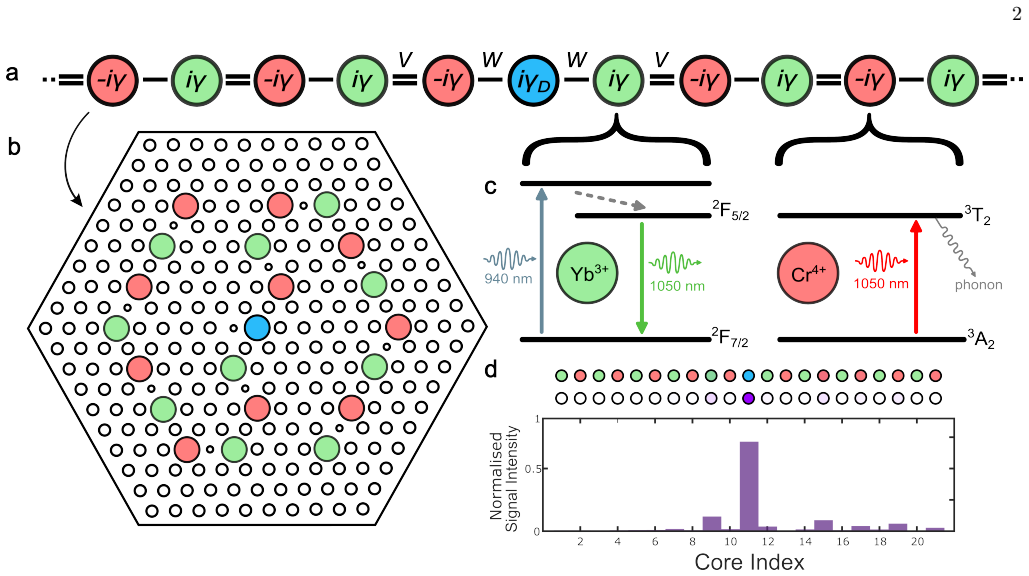
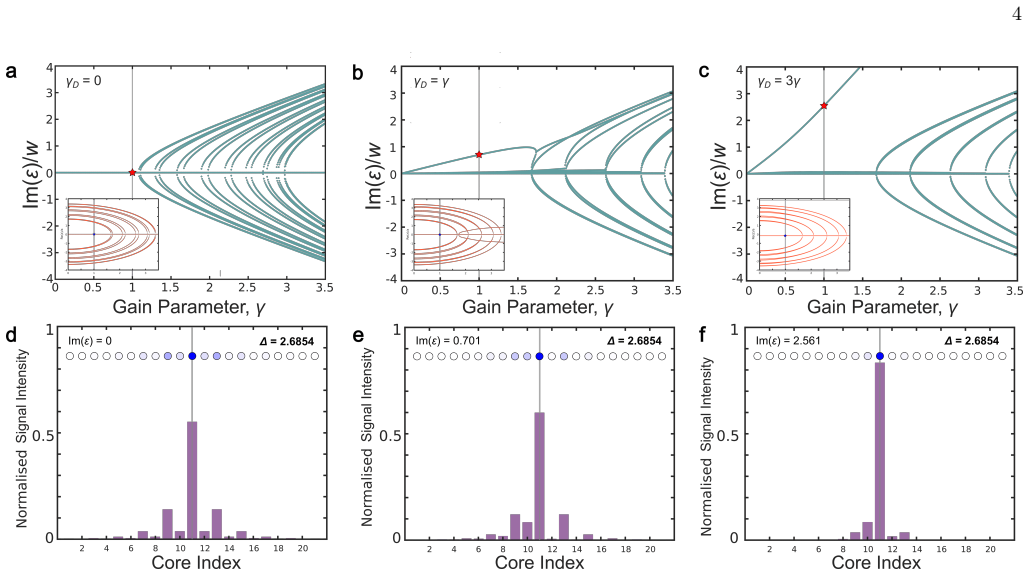
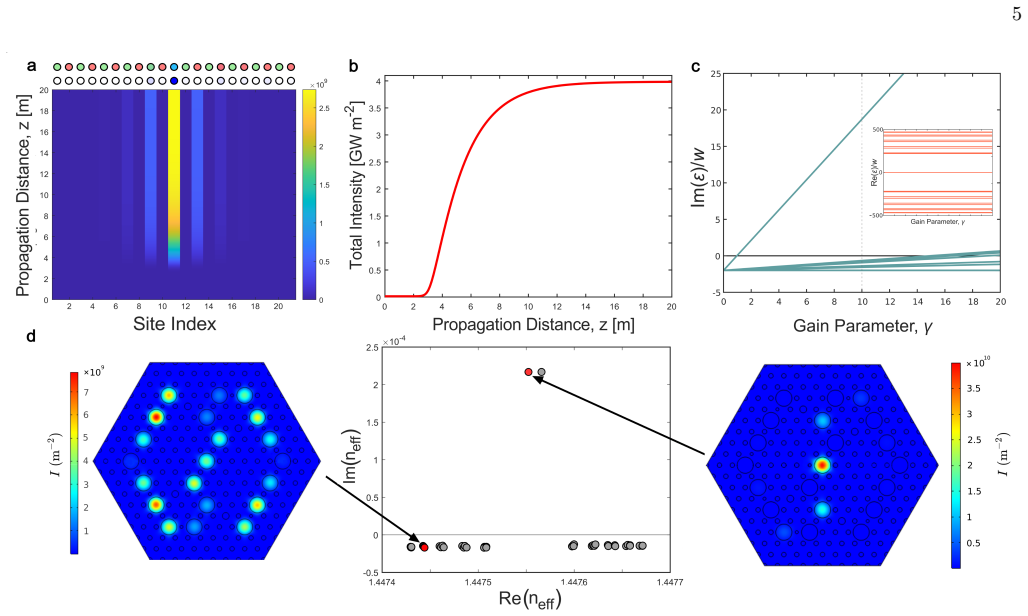
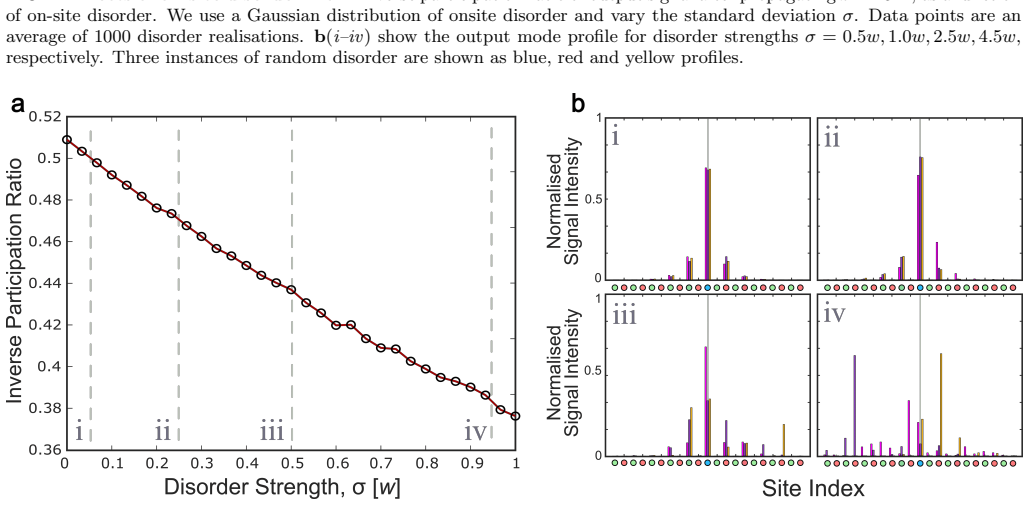
The topological boundary mode is selectively amplified when extra gain is added at the topological interface. Even with nonlinearity added through saturable gain, the lasing supermode retains its robustness against disorder.
What carries the argument
winding-number invariant combined with a PT-symmetric SSH bulk that enforces selective amplification at the boundary
If this is right
- Selective amplification occurs only at the designed topological interface.
- Robustness survives both linear mode-coupling theory and full finite-element modelling with nonlinearity.
- A practical fibre can be made with existing doped-core stack-and-draw methods.
- The same protection principle can be applied to other non-Hermitian photonic devices.
Where Pith is reading between the lines
- Multi-core fibre lasers could become more stable for classical or quantum signal transmission.
- The approach may extend to other gain media or resonator geometries where disorder is a practical limit.
- Direct fabrication and testing of the proposed doped-core design would check whether the modelled protection survives real fabrication variations.
Load-bearing premise
The winding-number invariant and PT-symmetric SSH bulk continue to select and protect the boundary mode once saturable gain and realistic fibre disorder enter the mode-coupling and finite-element models.
What would settle it
A simulation or measurement in which the lasing supermode stops preferring the boundary location or loses its disorder robustness once the modelled disorder reaches the level expected from stack-and-draw fabrication.
Figures

read the original abstract
Fibre lasers realise a large gain medium in a compactly coiled fibre. Disorder due to fabrication can negatively impact the stability of their lasing modes, especially in multi-core fibres. Recently, topological fibres (without gain) have been experimentally demonstrated to be robust against fabrication disorder, but topological fibre lasers have not yet been designed or modelled. Here, we use a combination of mode-coupling theory and finite-element simulations to design and model a topological laser based on a non-Hermitian Su-Schrieffer-Heeger (SSH) chain embedded in a photonic crystal fibre. Our design is based on a winding-number invariant in combination with a PT-symmetric SSH bulk. We show that the topological boundary mode is selectively amplified when extra gain is added at the topological interface. Even with nonlinearity added through saturable gain, the lasing supermode retains its robustness against disorder. We present a realistic design for a topologically robust fibre laser using readily available stack-and-draw methods with doped cores. This work establishes a new approach for imbuing non-Hermitian photonic systems with topological protection, with technological implications towards generating robust quantum and classical signals.
Editorial analysis
A structured set of objections, weighed in public.
Referee Report
Summary. The manuscript designs a topological fibre laser by embedding a non-Hermitian Su-Schrieffer-Heeger (SSH) chain in a photonic crystal fibre, employing a winding-number invariant together with a PT-symmetric bulk to achieve selective amplification of the topological interface mode. Using mode-coupling theory and finite-element simulations, it reports that this mode remains robust to disorder even after saturable gain is introduced to model nonlinearity, and outlines a realistic doped-core stack-and-draw fabrication route.
Significance. If the numerical evidence is confirmed, the work would demonstrate a concrete route to topological protection in non-Hermitian fibre lasers, offering a fabrication-tolerant platform for stable classical and quantum light sources.
major comments (2)
- [Nonlinear simulations (mode-coupling and FEM sections)] The central claim that the linear winding-number invariant continues to enforce selective amplification and disorder robustness once saturable gain is added rests entirely on the specific numerical implementations chosen for the mode-coupling equations and the finite-element discretizations. No analytic continuation or independent cross-validation (e.g., comparison of gain-saturation effects on inter-core coupling between the two models) is supplied, so any mismatch would remove the reported nonlinear robustness.
- [Finite-element model description] Details of how disorder is implemented (random perturbations to core positions, refractive indices, or gain), the convergence criteria for the finite-element mesh, and the precise functional form of the saturable-gain term are not visible; without these, the quantitative robustness statements cannot be reproduced or stress-tested.
minor comments (2)
- [Abstract and introduction] The title states 'explicitly broken PT symmetry' while the abstract and body refer to a 'PT-symmetric SSH bulk'; a brief clarification of how the explicit breaking is introduced would remove ambiguity.
- [Figure captions] Figure captions should explicitly state the disorder strength (standard deviation) and the saturation intensity used in each panel so that the robustness curves can be compared directly to the linear case.
Simulated Author's Rebuttal
We thank the referee for their detailed and constructive comments on our manuscript. We address each of the major comments below and outline the revisions we plan to make to strengthen the paper.
read point-by-point responses
-
Referee: [Nonlinear simulations (mode-coupling and FEM sections)] The central claim that the linear winding-number invariant continues to enforce selective amplification and disorder robustness once saturable gain is added rests entirely on the specific numerical implementations chosen for the mode-coupling equations and the finite-element discretizations. No analytic continuation or independent cross-validation (e.g., comparison of gain-saturation effects on inter-core coupling between the two models) is supplied, so any mismatch would remove the reported nonlinear robustness.
Authors: We agree that providing cross-validation between the mode-coupling theory and finite-element simulations in the nonlinear regime would strengthen the central claim. In the revised manuscript, we will include a direct comparison of the gain-saturation effects on the inter-core coupling coefficients as obtained from both numerical approaches. This will serve as an independent check on the consistency of the reported robustness. revision: yes
-
Referee: [Finite-element model description] Details of how disorder is implemented (random perturbations to core positions, refractive indices, or gain), the convergence criteria for the finite-element mesh, and the precise functional form of the saturable-gain term are not visible; without these, the quantitative robustness statements cannot be reproduced or stress-tested.
Authors: We acknowledge that the current manuscript lacks sufficient detail on the numerical implementation. In the revised version, we will expand the methods section to explicitly describe: the implementation of disorder through random perturbations to core positions and refractive indices (with the specific ranges and distributions used), the finite-element mesh convergence criteria (including element size and residual error thresholds), and the exact functional form of the saturable-gain term (including any parameters such as saturation intensity). These additions will enable reproducibility of the results. revision: yes
Circularity Check
No significant circularity detected
full rationale
The paper's central claims rest on explicit numerical implementations of mode-coupling theory and finite-element simulations that incorporate saturable gain and disorder into a PT-symmetric SSH model. These simulations are independent of the target robustness result and do not reduce any prediction to a fitted parameter or self-citation by construction. The winding-number invariant is applied from linear theory to the nonlinear regime via direct modeling, with no quoted step showing self-definitional equivalence or load-bearing self-citation chain. The derivation chain is therefore self-contained against external benchmarks.
Axiom & Free-Parameter Ledger
axioms (1)
- domain assumption Winding-number invariant protects the boundary mode in the non-Hermitian PT-symmetric SSH chain
Reference graph
Works this paper leans on
-
[1]
L. Yamauchi, T. Hayata, M. Uwamichi, T. Ozawa, and K. Kawaguchi, Chirality-driven edge flow and non- hermitian topology in active nematic cells, arXiv preprint arXiv:2008.10852 (2020)
-
[2]
K. Sone, Y. Ashida, and T. Sagawa, Exceptional non- hermitian topological edge mode and its application to active matter, Nature communications11, 5745 (2020)
2020
-
[3]
Ghatak, M
A. Ghatak, M. Brandenbourger, J. Van Wezel, and C. Coulais, Observation of non-hermitian topology and its bulk–edge correspondence in an active mechanical metamaterial, Proceedings of the National Academy of Sciences117, 29561 (2020)
2020
-
[4]
Shankar, A
S. Shankar, A. Souslov, M. J. Bowick, M. C. Marchetti, and V. Vitelli, Topological active matter, Nature Reviews Physics4, 380 (2022)
2022
-
[5]
D. C. Ohnmacht, V. Wilhelm, H. Weisbrich, and W. Belzig, Non-hermitian topology in multiterminal su- perconducting junctions, Physical Review Letters134, 156601 (2025)
2025
-
[6]
X. Ji, W. Ding, Y. Chen, and X. Yang, Non-hermitian second-order topological superconductors, Physical Re- view B109, 125420 (2024)
2024
-
[7]
Z.-H. Wang, F. Xu, L. Li, D.-H. Xu, W.-Q. Chen, and B. Wang, Majorana polarization in non-hermitian topo- logical superconductors, Physical Review B103, 134507 (2021)
2021
-
[8]
H. Xue, Y. Yang, and B. Zhang, Topological acoustics, Nature Reviews Materials7, 974 (2022)
2022
-
[9]
W. Zhu, X. Fang, D. Li, Y. Sun, Y. Li, Y. Jing, and H. Chen, Simultaneous observation of a topological edge state and exceptional point in an open and non-hermitian acoustic system, Physical review letters121, 124501 (2018)
2018
-
[10]
Zhang, M
Z. Zhang, M. Rosendo Lopez, Y. Cheng, X. Liu, and J. Christensen, Non-hermitian sonic second-order topo- logical insulator, Physical review letters122, 195501 (2019)
2019
-
[11]
St-Jean, V
P. St-Jean, V. Goblot, E. Galopin, A. Lemaˆ ıtre, T. Ozawa, L. Le Gratiet, I. Sagnes, J. Bloch, and A. Amo, Lasing in topological edge states of a one-dimensional lat- tice, Nature Photonics11, 651 (2017)
2017
-
[12]
Y. V. Kartashov and D. V. Skryabin, Two-dimensional topological polariton laser, Physical review letters122, 083902 (2019)
2019
-
[13]
N. A. Veretenov, N. N. Rosanov, and S. V. Fedorov, Laser solitons: topological and quantum phenomena, Physics- Uspekhi65, 131 (2022)
2022
-
[14]
Z. Fan, D. N. Puzyrev, and D. V. Skryabin, Topologi- cal soliton metacrystals, Communications Physics5, 248 (2022)
2022
-
[15]
M. A. Bandres, S. Wittek, G. Harari, M. Parto, J. Ren, M. Segev, D. N. Christodoulides, and M. Khajavikhan, Topological insulator laser: Experiments, Science359, eaar4005 (2018)
2018
-
[16]
Harari, M
G. Harari, M. A. Bandres, Y. Lumer, M. C. Rechtsman, Y. D. Chong, M. Khajavikhan, D. N. Christodoulides, and M. Segev, Topological insulator laser: Theory, Sci- ence359, eaar4003 (2018)
2018
-
[17]
Hodaei, A
H. Hodaei, A. U. Hassan, S. Wittek, H. Garcia-Gracia, R. El-Ganainy, D. N. Christodoulides, and M. Kha- javikhan, Enhanced sensitivity at higher-order excep- tional points, Nature548, 187 (2017)
2017
-
[18]
Michaille, C
L. Michaille, C. R. Bennett, D. M. Taylor, and T. J. Shepherd, Multicore photonic crystal fiber lasers for high power/energy applications, IEEE journal of selected top- ics in quantum electronics15, 328 (2009)
2009
-
[19]
Klenke, C
A. Klenke, C. Jauregui, A. Steinkopff, C. Aleshire, and J. Limpert, High-power multicore fiber laser systems, Progress in Quantum Electronics84, 100412 (2022)
2022
-
[20]
Kochanowicz, D
M. Kochanowicz, D. Dorosz, J. ˙Zmojda, and J. Dorosz, Beam quality of multicore fibre lasers, Acta Physica Polonica A118, 1177 (2010)
2010
-
[21]
M. N. Zervas, Transverse mode instability, thermal lens- ing and power scaling in yb3+-doped high-power fiber amplifiers, Optics express27, 19019 (2019)
2019
-
[22]
Roberts, G
N. Roberts, G. Baardink, J. Nunn, P. J. Mosley, and A. Souslov, Topological supermodes in photonic crystal fiber, Science Advances8, eadd3522 (2022)
2022
-
[23]
N. Roberts, B. Salter, J. Binysh, P. J. Mosley, and A. Souslov, Twisted fibre: a photonic topological insu- lator, arXiv preprint arXiv:2411.13064 (2024)
-
[24]
El-Ganainy, K
R. El-Ganainy, K. G. Makris, M. Khajavikhan, Z. H. Musslimani, S. Rotter, and D. N. Christodoulides, Non- hermitian physics and pt symmetry, Nature Physics14, 11 (2018)
2018
-
[25]
V. V. Konotop, J. Yang, and D. A. Zezyulin, Nonlin- ear waves in pt-symmetric systems, Reviews of Modern Physics88, 035002 (2016)
2016
-
[26]
C. M. Bender and S. Boettcher, Real spectra in non- hermitian hamiltonians having p t symmetry, Physical review letters80, 5243 (1998)
1998
-
[27]
M. Lax, W. H. Louisell, and W. B. McKnight, From maxwell to paraxial wave optics, Physical Review A11, 1365 (1975)
1975
-
[28]
Coutant, A
A. Coutant, A. Sivadon, L. Zheng, V. Achilleos, O. Ri- choux, G. Theocharis, and V. Pagneux, Acoustic su- schrieffer-heeger lattice: Direct mapping of acoustic waveguides to the su-schrieffer-heeger model, Physical Review B103, 224309 (2021)
2021
-
[29]
E. J. Meier, F. A. An, and B. Gadway, Observation of the topological soliton state in the su–schrieffer–heeger model, Nature communications7, 13986 (2016)
2016
-
[30]
Ma and H
Y.-P. Ma and H. Susanto, Topological edge solitons and their stability in a nonlinear su-schrieffer-heeger model, Physical Review E104, 054206 (2021)
2021
- [31]
-
[32]
Lieu, Topological phases in the non-hermitian su- 10 schrieffer-heeger model, Physical Review B97, 045106 (2018)
S. Lieu, Topological phases in the non-hermitian su- 10 schrieffer-heeger model, Physical Review B97, 045106 (2018)
2018
-
[33]
Y. Han, J. Liu, and C. Liu, The topological counterparts of non-hermitian ssh models, New Journal of Physics23, 123029 (2021)
2021
-
[34]
P. M. Gunnink, B. Flebus, H. M. Hurst, and R. A. Duine, Nonlinear dynamics of the non-hermitian su-schrieffer- heeger model, Physical Review B105, 104433 (2022)
2022
-
[35]
Schomerus, Topologically protected midgap states in complex photonic lattices, Optics letters38, 1912 (2013)
H. Schomerus, Topologically protected midgap states in complex photonic lattices, Optics letters38, 1912 (2013)
1912
-
[36]
B. Zhu, R. L¨ u, and S. Chen, Pt symmetry in the non-hermitian su-schrieffer-heeger model with complex boundary potentials, Physical Review A89, 062102 (2014)
2014
-
[37]
L.-J. Lang, Y. Wang, H. Wang, and Y. D. Chong, Effects of non-hermiticity on su-schrieffer-heeger defect states, Physical Review B98, 094307 (2018)
2018
-
[38]
Weimann, M
S. Weimann, M. Kremer, Y. Plotnik, Y. Lumer, S. Nolte, K. G. Makris, M. Segev, M. C. Rechtsman, and A. Sza- meit, Topologically protected bound states in photonic parity–time-symmetric crystals, Nature materials16, 433 (2017)
2017
-
[39]
M. Pan, H. Zhao, P. Miao, S. Longhi, and L. Feng, Pho- tonic zero mode in a non-hermitian photonic lattice, Na- ture communications9, 1308 (2018)
2018
-
[40]
A. Li, H. Wei, M. Cotrufo, W. Chen, S. Mann, X. Ni, B. Xu, J. Chen, J. Wang, S. Fan,et al., Exceptional points and non-hermitian photonics at the nanoscale, Na- ture Nanotechnology18, 706 (2023)
2023
-
[41]
H. Zhao, P. Miao, M. H. Teimourpour, S. Malzard, R. El- Ganainy, H. Schomerus, and L. Feng, Topological hy- brid silicon microlasers, Nature communications9, 981 (2018)
2018
-
[42]
Smirnova, D
D. Smirnova, D. Leykam, Y. Chong, and Y. Kivshar, Nonlinear topological photonics, Applied Physics Re- views7(2020)
2020
-
[43]
Huang and L
J. Huang and L. W. Casperson, Gain and saturation in semiconductor lasers, Optical and quantum electronics 25, 369 (1993)
1993
-
[44]
P. C. Schultz, Optical absorption of the transition ele- ments in vitreous silica, Journal of the American Ceramic Society57, 309 (1974)
1974
-
[45]
Dussardier, W
B. Dussardier, W. Blanc, and P. Peterka, Tailoring of the local environment of active ions in rare-earth-and transition-metal-doped optical fibres, and potential ap- plications, Selected topics on optical fiber technology , 97 (2012)
2012
-
[46]
Barua, E
P. Barua, E. H. Sekiya, K. Saito, and A. Ikushima, In- fluences of yb3+ ion concentration on the spectroscopic properties of silica glass, Journal of non-crystalline solids 354, 4760 (2008)
2008
-
[47]
B. Salter, H. Rostami, N. Roberts, P. Mosley, and A. Souslov, Robustness against disorder in topologi- cal fibre lasers with explicitly broken pt symmetry, 10.5281/zenodo.20832636 (2025)
discussion (0)
Sign in with ORCID, Apple, or X to comment. Anyone can read and Pith papers without signing in.