Embedded Trefftz DG method for steady Navier-Stokes flow. Part II: Nonlinear problem
Pith reviewed 2026-06-27 06:07 UTC · model grok-4.3
The pith
Projections between convection-dependent Trefftz spaces allow proofs of existence, uniqueness and Picard convergence for an embedded Trefftz DG discretization of the steady Navier-Stokes equations.
A machine-rendered reading of the paper's core claim, the machinery that carries it, and where it could break.
Core claim
The central claim is that suitable projections between the convection-dependent Trefftz spaces permit an analysis of the nonlinear problem by controlling the reduced Oseen solution map, thereby proving existence of discrete solutions, uniqueness, convergence of the Picard iteration, and an a priori error estimate that inherits the convergence properties of the underlying DG discretization.
What carries the argument
Projections between convection-dependent Trefftz spaces used to control the reduced Oseen solution map.
If this is right
- Discrete solutions exist and are unique under the stated resolution and small-data assumptions.
- The Picard iteration converges to the unique discrete solution.
- An a priori error bound holds by direct comparison with a compatible DG Navier-Stokes discretization.
- The numerical method performs as predicted on standard benchmark problems for incompressible flow.
Where Pith is reading between the lines
- This projection technique could apply to other discretizations where the finite-element space depends on the current solution iterate.
- Extending the method to time-dependent or three-dimensional flows would require analogous control of the space changes across time steps.
- The stability of the projections might be verified computationally on specific meshes to confirm the analysis assumptions hold in practice.
Load-bearing premise
The projections between the convection-dependent Trefftz spaces exist and are stable with bounds independent of the convection field.
What would settle it
Numerical computation showing that the norm of the projection operator between two Trefftz spaces for nearby convection fields grows unboundedly as the mesh is refined would falsify the stability assumption needed for the proofs.
Figures
read the original abstract
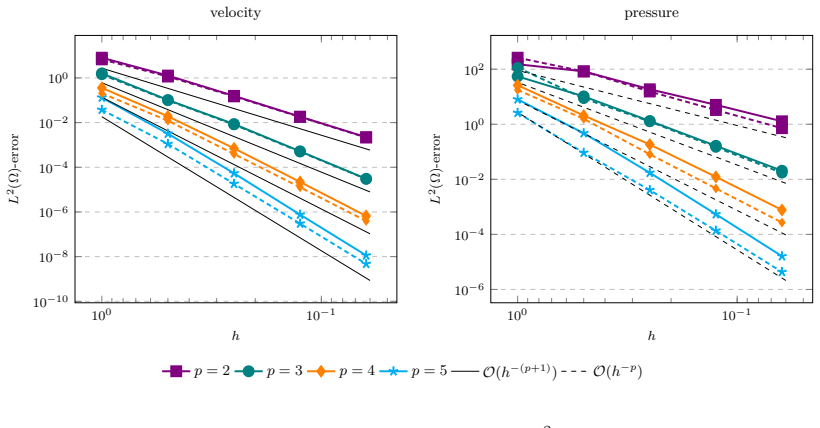
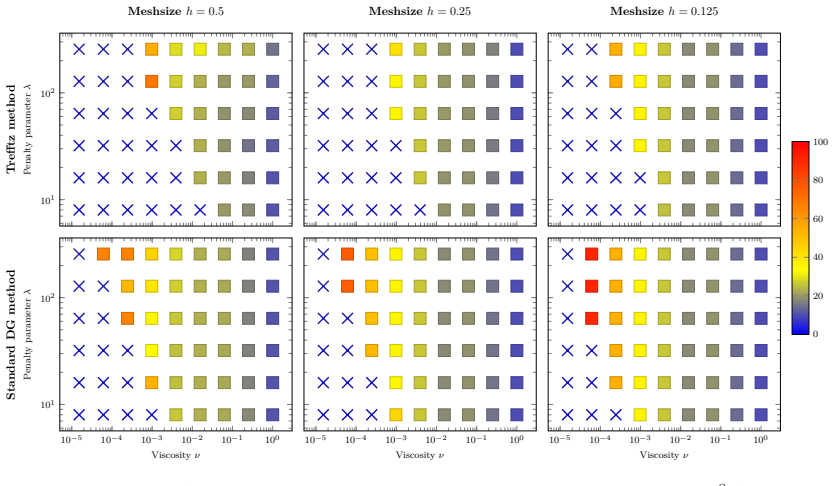
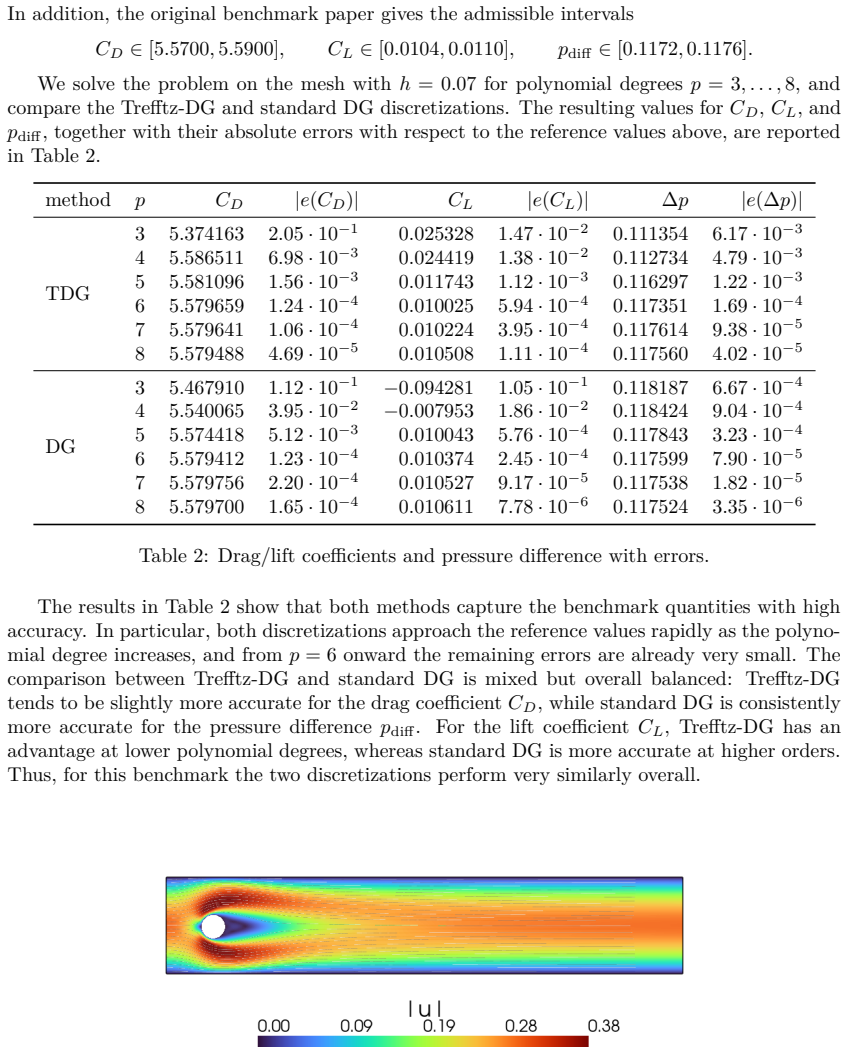
We develop and analyze an embedded Trefftz-DG method for the steady incompressible Navier-Stokes equations, based on the reduced Oseen discretization from Part I. The main difficulty is that the reduced Trefftz space depends on the convection field, so successive Picard iterates live in different discrete spaces. We address this by constructing projections between convection-dependent Trefftz spaces and using them to control the reduced Oseen solution map. Under suitable resolution and small-data assumptions, we prove existence of discrete solutions, uniqueness, and convergence of the Picard iteration. We also derive an a priori error analysis by relating the method to the underlying DG discretization, thereby inheriting convergence properties from compatible DG Navier-Stokes analyses. Numerical experiments on standard incompressible-flow benchmarks illustrate the theory.
Editorial analysis
A structured set of objections, weighed in public.
Referee Report
Summary. The manuscript develops an embedded Trefftz DG method for the steady incompressible Navier-Stokes equations, extending the reduced Oseen discretization from Part I. The central technical step is the construction of projections between convection-dependent Trefftz spaces to accommodate the space dependence arising in the Picard iteration. Under small-data and resolution assumptions, the paper proves existence and uniqueness of discrete solutions, convergence of the Picard iteration, and an a priori error bound obtained by relating the method to an underlying standard DG discretization. Numerical experiments on incompressible-flow benchmarks are included to support the analysis.
Significance. If the projection construction and its stability properties hold with constants independent of the convection field, the work would provide a rigorous route to apply Trefftz DG methods to nonlinear problems while inheriting convergence rates from established DG Navier-Stokes theory. The explicit handling of space dependence via projections and the reduction to a compatible DG analysis are the main strengths; the numerical results on standard benchmarks add concrete validation.
major comments (2)
- [§3.3] §3.3 (Projection construction): The maps Π_{k,k+1} : V_h(β^k) → V_h(β^{k+1}) are asserted to be stable in the DG norm and to satisfy an approximation property, yet the proof supplies no explicit bound on the operator norm that is independent of ||β^k||_{L^∞}. This bound is load-bearing for the contraction-mapping argument that closes existence and convergence of the Picard iteration under the stated small-data assumption.
- [§4.2, Eq. (4.8)] §4.2, Eq. (4.8): The a priori error analysis reduces the Trefftz solution to the underlying DG solution plus projection errors; however, the approximation property used for the convection-dependent spaces is only stated qualitatively, without a quantitative estimate that would guarantee the same convergence rate as the reference DG method when the convection field varies between iterates.
minor comments (2)
- [§2] The notation for the reduced Trefftz spaces V_h(β) is introduced without a compact reference table listing the precise polynomial degree and embedding conditions; adding such a table would improve readability.
- [§5] Figure 5.1 caption does not state the mesh size or polynomial degree used for the lid-driven cavity example, making direct comparison with the theory difficult.
Simulated Author's Rebuttal
We thank the referee for the careful reading and constructive comments on the manuscript. The two major comments raise important points about the explicit stability and approximation properties of the projections between convection-dependent Trefftz spaces. We address each below and will incorporate the requested clarifications and quantitative estimates into a revised version.
read point-by-point responses
-
Referee: [§3.3] §3.3 (Projection construction): The maps Π_{k,k+1} : V_h(β^k) → V_h(β^{k+1}) are asserted to be stable in the DG norm and to satisfy an approximation property, yet the proof supplies no explicit bound on the operator norm that is independent of ||β^k||_{L^∞}. This bound is load-bearing for the contraction-mapping argument that closes existence and convergence of the Picard iteration under the stated small-data assumption.
Authors: We agree that an explicit operator-norm bound independent of ||β^k||_{L^∞} is necessary to close the contraction-mapping argument rigorously. Under the small-data assumption the velocity fields remain uniformly bounded in L^∞ independently of the iteration index, but this control was only used implicitly. In the revision we will insert a new lemma in §3.3 that derives the bound ||Π_{k,k+1} v||_{DG} ≤ C ||v||_{DG} with C depending only on the mesh regularity, polynomial degree, and the small-data constant, thereby making the independence explicit and completing the contraction estimate. revision: yes
-
Referee: [§4.2, Eq. (4.8)] §4.2, Eq. (4.8): The a priori error analysis reduces the Trefftz solution to the underlying DG solution plus projection errors; however, the approximation property used for the convection-dependent spaces is only stated qualitatively, without a quantitative estimate that would guarantee the same convergence rate as the reference DG method when the convection field varies between iterates.
Authors: The referee correctly identifies that the current statement of the approximation property is qualitative. Because the projections are constructed from the same underlying polynomial spaces and the convection fields are controlled by the small-data assumption, the projection error admits the same order as the standard DG approximation error. We will add a quantitative lemma (with constants independent of the particular β^k) immediately before Eq. (4.8) and substitute it into the error decomposition; this will confirm that the Trefftz method inherits the optimal rate of the reference DG scheme without degradation. revision: yes
Circularity Check
Derivation self-contained; no reduction to inputs by construction
full rationale
The paper explicitly constructs projections between convection-dependent Trefftz spaces to control the reduced Oseen map across Picard iterates and derives a priori error estimates by relating the embedded Trefftz method to an underlying DG discretization whose stability and approximation properties are invoked as external. No equation or claim reduces a main result (existence, uniqueness, Picard convergence) to a fitted parameter, self-definition, or prior self-citation by construction; the Part I reference supplies the linear reduced Oseen scheme but is not load-bearing for the nonlinear analysis under the stated small-data and resolution assumptions. The derivation chain therefore remains independent of its own outputs.
Axiom & Free-Parameter Ledger
axioms (2)
- domain assumption Standard mathematical assumptions guaranteeing well-posedness of the continuous Navier-Stokes problem under small data
- ad hoc to paper Existence and boundedness of projections between distinct convection-dependent Trefftz spaces
Reference graph
Works this paper leans on
-
[1]
B. Cockburn, G. Kanschat, and D. Schötzau. A locally conservative LDG method for the incompressible Navier-Stokes equations.Math. Comput., 74(251):1067–1095, 2005.doi: 10.1090/S0025-5718-04-01718-1
-
[2]
D. A. Di Pietro and A. Ern. Discrete functional analysis tools for discontinuous Galerkin methods with application to the incompressible Navier-Stokes equations.Math. Comput., 79(271):1303–1330, 2010.doi:10.1090/S0025-5718-10-02333-1
-
[3]
D. A. Di Pietro and A. Ern.Mathematical aspects of discontinuous Galerkin meth- ods, volume 69. Springer Science & Business Media, Heidelberg, 2011.doi:10.1007/ 978-3-642-22980-0
2011
-
[4]
S. Gómez, C. Perinati, and P. Stocker. Inf-sup stable space-time local discontinuous Galerkin method for the heat equation.Journal of Scientific Computing, 106(1):22, 2025.doi: 10.1007/s10915-025-03121-7
-
[5]
C. Heil. Space-time Trefftz DG methods for parabolic PDEs.GRO.data, 2024.doi: 10.25625/ZSA8UU
-
[6]
F. Heimann, C. Lehrenfeld, P. Stocker, and H. von Wahl. Unfitted Trefftz discontinuous Galerkin methods for elliptic boundary value problems.ESAIM: M2AN, 2023.doi:10. 1051/m2an/2023064
arXiv 2023
-
[7]
L.-M. Imbert-Gérard, A. Moiola, C. Perinati, and P. Stocker. Polynomial quasi-Trefftz DG for PDEs with smooth coefficients: elliptic problems.IMA Journal of Numerical Analysis, page drae094, 2025.doi:10.1093/imanum/drae094
-
[8]
P. L. Lederer, C. Lehrenfeld, and P. Stocker. Trefftz discontinuous Galerkin discretization for the Stokes problem.Numerische Mathematik, 2024.doi:10.1007/s00211-024-01404-z
-
[9]
C. Lehrenfeld and P. Stocker. Embedded Trefftz discontinuous Galerkin methods.Int. J. Numer. Methods Eng., 124(17):3637–3661, 2023.doi:10.1002/nme.7258
-
[10]
C. Lehrenfeld, P. Stocker, and M. Zienecker. Sparsity comparison of polytopal finite element methods.PAMM, 24(3):e202400150, 2024.doi:10.1002/pamm.202400150
-
[11]
A. Lozinski. A primal discontinuous Galerkin method with static condensation on very general meshes.Numer. Math., 143(3):583–604, 2019.doi:10.1007/s00211-019-01067-1
-
[12]
J. C. Meyer, C. Lehrenfeld, and I. Voulis. On the conforming trefftz finite element method and applications.Zenodo, Oct. 2025.doi:10.5281/zenodo.17307511
-
[13]
A. Montlaur, S. Fernandez-Mendez, and A. Huerta. Discontinuous Galerkin methods for the Stokes equations using divergence-free approximations.International Journal for Numerical Methods in Fluids, 57(9):1071–1092, 2008.doi:10.1002/fld.1716. 22
-
[14]
Montlaur, S
A. Montlaur, S. Fernandez-Mendez, J. Peraire, and A. Huerta. Discontinuous Galerkin methods for the Navier–Stokes equations using solenoidal approximations.International Journal for Numerical Methods in Fluids, 64(5):549–564, 2010
2010
-
[15]
Heidelberg: Univ
G.Nabh.On higher order methods for the stationary incompressible Navier-Stokes equations. Heidelberg: Univ. Heidelberg, Naturwissenschaftlich-Mathematische Gesamtfakultät, 1998
1998
-
[16]
A discontinuous Galerkin method for elliptic-hyperbolic equations
C. Perinati, L.-M. Imbert-Gérard, A. Moiola, and P. Stocker. A discontinuous Galerkin method for elliptic-hyperbolic equations.arXiv preprint arXiv:2604.06910, 2026. URL: https://arxiv.org/abs/2604.06910,doi:10.48550/arXiv.2604.06910
work page internal anchor Pith review Pith/arXiv arXiv doi:10.48550/arxiv.2604.06910 2026
-
[17]
Schäfer and S
M. Schäfer and S. Turek. Benchmark computations of laminar flow around a cylinder. (With support by F. Durst, E. Krause and R. Rannacher). InFlow simulation with high- performance computers II. DFG priority research programme results 1993 - 1995, pages 547–566. Wiesbaden: Vieweg, 1996
1993
-
[18]
E. Schlesinger. Embedded Trefftz Trace DG Methods for PDEs on unfitted Surfaces. GRO.data, 2023.doi:10.25625/QTOPWD
-
[19]
Schöberl
J. Schöberl. C++ 11 implementation of finite elements in NGSolve.Institute for analysis and scientific computing, Vienna University of Technology, 30, 2014
2014
-
[20]
P. Stocker. NGSTrefftz: Add-on to NGSolve for Trefftz methods.J. Open Source Softw., 7(71):4135, 2022.doi:10.21105/joss.04135
-
[21]
P. Stocker and I. Voulis. Embedded Trefftz DG method for the Helmholtz equation.arXiv preprint arXiv:2603.13034, 2026.doi:10.48550/arXiv.2603.13034
-
[22]
Stocker, I
P. Stocker, I. Voulis, P. L. Lederer, and C. Lehrenfeld. Embedded Trefftz DG method for steady Navier–Stokes flow. Part I: Oseen linearization.arXiv preprint, 2026
2026
-
[23]
https://doi.org/10.5281/zenodo
P. Stocker, I. Voulis, C. Lehrenfeld, and P. L. Lederer. Replication Data for: Embed- ded Trefftz DG method for steady Navier–Stokes flow, June 2026.doi:10.5281/zenodo. 20490547
-
[24]
E. Trefftz. Ein Gegenstück zum Ritzschen Verfahren.Proc. 2nd Int. Cong. Appl. Mech., Zurich, 1926, pages 131–137, 1926
1926
-
[25]
J. Yang, M. Potier-Ferry, K. Akpama, H. Hu, Y. Koutsawa, H. Tian, and D. S. Zézé. Trefftz methods and Taylor series.Arch. Comput. Methods Eng., 27(3):673–690, 2020
2020
-
[26]
Zeidler.Nonlinear Functional Analysis and its Applications I: Fixed-Point Theorems
E. Zeidler.Nonlinear Functional Analysis and its Applications I: Fixed-Point Theorems. Springer, New York, 1986. 23
1986
discussion (0)
Sign in with ORCID, Apple, or X to comment. Anyone can read and Pith papers without signing in.