Embedded Trefftz DG method for steady Navier-Stokes flow. Part I: Oseen linearization
Pith reviewed 2026-06-27 06:03 UTC · model grok-4.3
The pith
An embedded Trefftz-DG method for the Oseen problem achieves stability and quasi-optimality via a local complement space where the Oseen operator is stably invertible.
A machine-rendered reading of the paper's core claim, the machinery that carries it, and where it could break.
Core claim
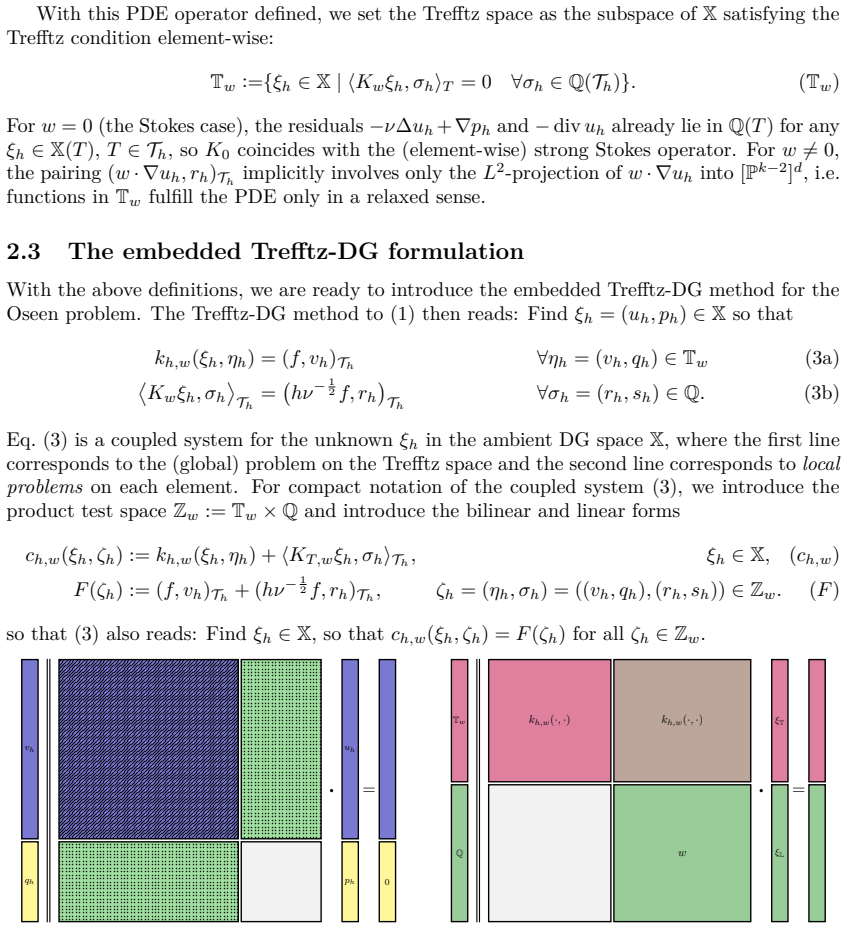
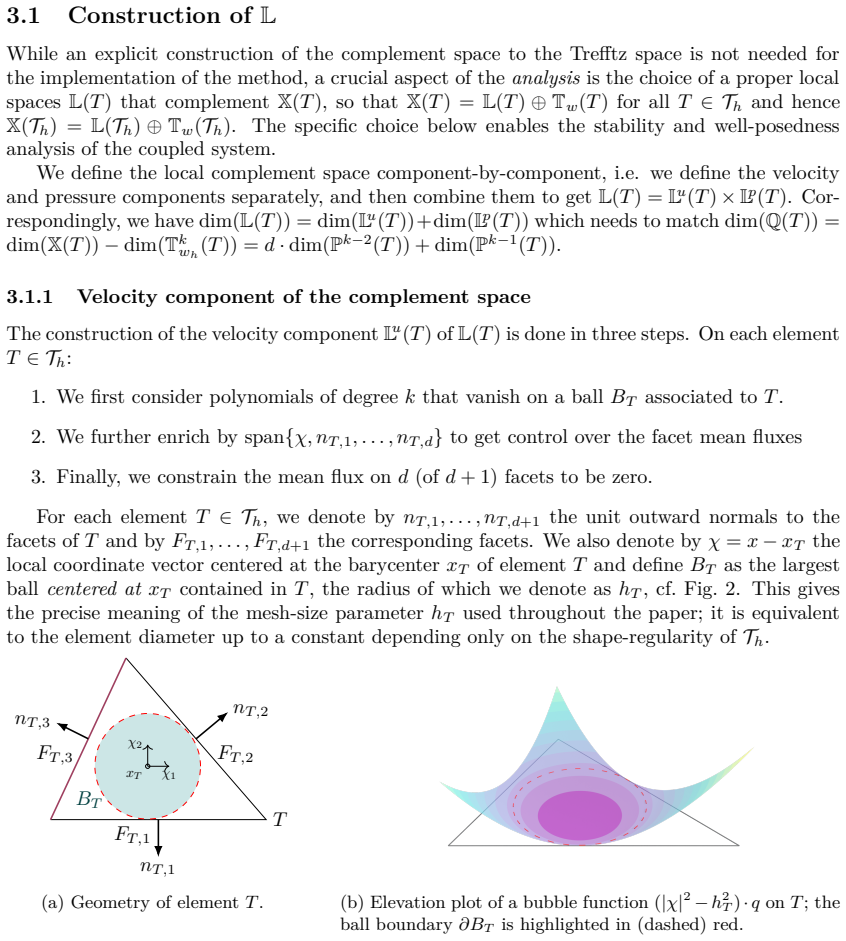
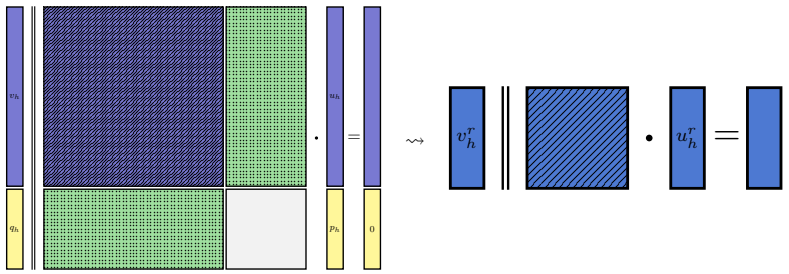
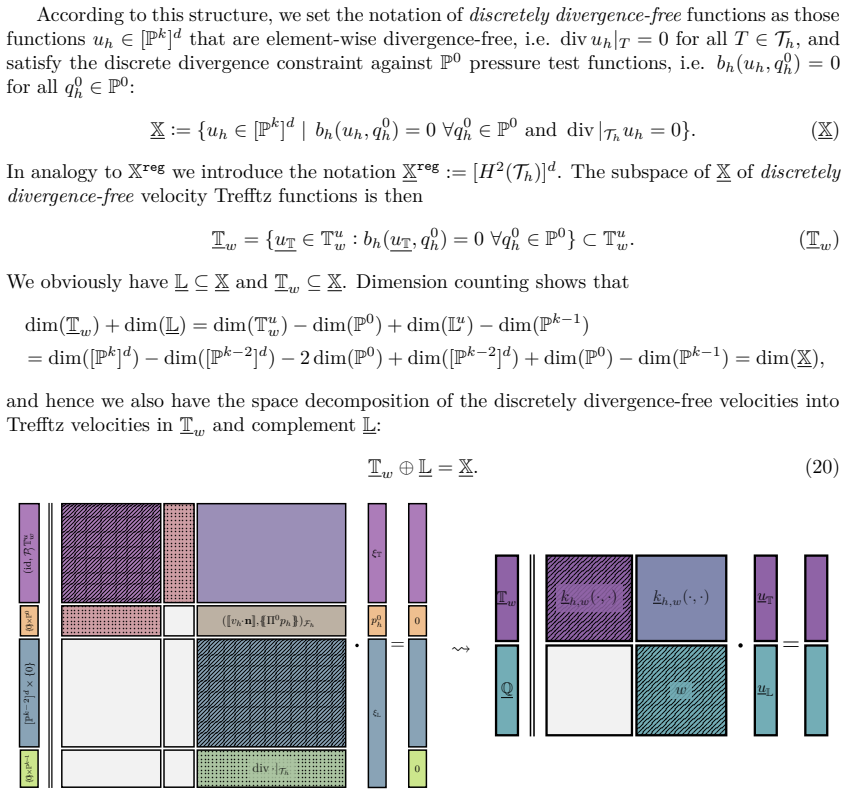
We develop an embedded Trefftz-DG method for the Oseen problem and prove a complete stability and quasi-optimality theory in standard DG norms. The key ingredient is a construction of a suitable local complement space to the Trefftz space, on which the Oseen operator is stably invertible. We also derive a reduced formulation of the method, the resulting system is posed in terms of the velocity unknown only, a crucial step in the analysis especially for the nonlinear Navier-Stokes problem in Part II.
What carries the argument
Embedded Trefftz-DG method with a constructed local complement space to the Trefftz space on which the Oseen operator is stably invertible.
If this is right
- Stability holds in standard DG norms for the Oseen problem.
- Quasi-optimal error estimates are obtained in those norms.
- The discrete system reduces to a velocity-only formulation.
- The construction supplies the linear analysis needed for the nonlinear Navier-Stokes extension.
Where Pith is reading between the lines
- The complement-space technique may transfer to other linearized transport or convection-dominated problems.
- Velocity-only reduction could simplify implementation in codes that already handle pure velocity discretizations.
- Numerical tests on the complement-space construction would directly verify the invertibility assumption for practical Oseen coefficients.
Load-bearing premise
A suitable local complement space to the Trefftz space exists on which the Oseen operator remains stably invertible.
What would settle it
A concrete Oseen parameter set or mesh configuration where no local complement space can be built while preserving stable invertibility of the Oseen operator.
Figures
read the original abstract
We develop an embedded Trefftz-DG method for the Oseen problem and prove a complete stability and quasi-optimality theory in standard DG norms. The key ingredient is a construction of a suitable local complement space to the Trefftz space, on which the Oseen operator is stably invertible. We also derive a reduced formulation of the method, the resulting system is posed in terms of the velocity unknown only, a crucial step in the analysis especially for the nonlinear Navier-Stokes problem in Part II.
Editorial analysis
A structured set of objections, weighed in public.
Referee Report
Summary. The manuscript develops an embedded Trefftz discontinuous Galerkin method for the Oseen linearization of the steady Navier-Stokes equations. The central claim is the explicit construction of a local complement space to the Trefftz space on which the Oseen operator remains stably invertible; this construction is used to prove complete stability and quasi-optimality in standard DG norms. A reduced velocity-only formulation is also derived as a key step toward the nonlinear analysis in Part II.
Significance. If the claimed construction and proofs are carried through rigorously, the work would supply a solid theoretical foundation for Trefftz-type DG discretizations of linearized incompressible flow, with the reduced formulation offering a practical advantage for the nonlinear extension. The explicit local complement space is a potentially load-bearing technical contribution in the area of structure-preserving DG methods.
major comments (2)
- Abstract (and opening paragraphs): the manuscript asserts 'complete stability and quasi-optimality theory' and 'a construction of a suitable local complement space' yet provides neither the explicit form of the complement space nor any derivation steps for the stability estimates; without these the central claim cannot be verified from the supplied text.
- Abstract, paragraph 2: the stable invertibility of the Oseen operator on the complement space is stated as the key ingredient, but no concrete construction, dimension count, or invertibility argument is supplied, leaving the weakest assumption unexamined.
Simulated Author's Rebuttal
We thank the referee for their thoughtful review of our manuscript. The comments focus on the presentation of the central technical contribution. We provide point-by-point responses below and indicate where revisions will be made to address the concerns.
read point-by-point responses
-
Referee: Abstract (and opening paragraphs): the manuscript asserts 'complete stability and quasi-optimality theory' and 'a construction of a suitable local complement space' yet provides neither the explicit form of the complement space nor any derivation steps for the stability estimates; without these the central claim cannot be verified from the supplied text.
Authors: The full manuscript does contain the explicit construction and the derivation steps for the stability estimates. The local complement space is constructed in Section 3 by augmenting the Trefftz space with a specific set of local basis functions that ensure the Oseen operator is invertible on this complement. The dimension count is provided in Lemma 3.5, and the stable invertibility is proved in Theorem 4.1 using a combination of the Trefftz property and the properties of the complement. The quasi-optimality follows from the stability in Theorem 4.3. We will revise the abstract and opening paragraphs to include references to these sections for easier verification. revision: partial
-
Referee: Abstract, paragraph 2: the stable invertibility of the Oseen operator on the complement space is stated as the key ingredient, but no concrete construction, dimension count, or invertibility argument is supplied, leaving the weakest assumption unexamined.
Authors: As noted above, the concrete construction, dimension count, and invertibility argument are supplied in Sections 3 and 4 of the manuscript. The assumption is examined through the explicit construction and the subsequent proof. We will make the abstract more precise by adding a sentence pointing to the relevant sections. revision: yes
Circularity Check
No significant circularity; derivation self-contained
full rationale
The paper's central claims rest on an explicit construction of a local complement space to the Trefftz space (on which the Oseen operator is stably invertible) followed by a stability and quasi-optimality proof in DG norms. No equations, fitted parameters, or self-citations appear in the provided abstract or description that reduce any prediction or uniqueness result to its own inputs by construction. The reduced velocity-only formulation is presented as a derived consequence rather than an input. No load-bearing self-citation chains, ansatz smuggling, or renaming of known results are identified. This is the expected honest non-finding for a purely analytical construction paper whose assumptions and proofs are stated as independent mathematical content.
Axiom & Free-Parameter Ledger
Reference graph
Works this paper leans on
-
[1]
Banjai, E
L. Banjai, E. H. Georgoulis, and O. Lijoka. A Trefftz polynomial space-time discontinuous Galerkin method for the second order wave equation.SIAM J. Numer. Anal., 55(1):63–86, 2017
2017
-
[2]
Barucq, H
H. Barucq, H. Calandra, J. Diaz, and E. Shishenina. Space–time Trefftz-DG approximation for elasto-acoustics.Appl. Anal., 99(5):747–760, 2020
2020
-
[3]
Bouberbachene, C
M. Bouberbachene, C. Hochard, and A. Poitou. Domain optimisation using Trefftz functions - application to free boundaries.Computer Assisted Mechanics and Engineering Sciences, 4, 01 1997
1997
-
[4]
Cockburn, J
B. Cockburn, J. Gopalakrishnan, and R. Lazarov. Unified hybridization of discontinuous Galerkin, mixed, and continuous Galerkin methods for second order elliptic problems.SIAM J. Numer. Anal., 47(2):1319–1365, 2009
2009
-
[5]
Cockburn, G
B. Cockburn, G. Kanschat, and D. Schötzau. A locally conservative LDG method for the incompressible Navier-Stokes equations.Math. Comput., 74(251):1067–1095, 2005
2005
-
[6]
D. A. Di Pietro and A. Ern. Discrete functional analysis tools for discontinuous Galerkin methods with application to the incompressible Navier-Stokes equations.Math. Comput., 79(271):1303–1330, 2010
2010
-
[7]
D. A. Di Pietro and A. Ern.Mathematical aspects of discontinuous Galerkin methods, volume 69. Springer Science & Business Media, Heidelberg, 2011
2011
-
[8]
Egger, F
H. Egger, F. Kretzschmar, S. M. Schnepp, and T. Weiland. A space-time discontinuous Galerkin Trefftz method for time dependent Maxwell’s equations.SIAM J. Sci. Comput., 37(5):B689–B711, 2015
2015
-
[9]
Gómez and A
S. Gómez and A. Moiola. A space-time Trefftz discontinuous Galerkin method for the linear Schrödinger equation.SIAM Journal on Numerical Analysis, 60(2):688–714, 2022
2022
-
[10]
Gómez, A
S. Gómez, A. Moiola, I. Perugia, and P. Stocker. On polynomial Trefftz spaces for the linear time-dependent Schrödinger equation.Applied Mathematics Letters, 146:108824, 2023
2023
-
[11]
Gómez, C
S. Gómez, C. Perinati, and P. Stocker. Inf-sup stable space-time local discontinuous Galerkin method for the heat equation.Journal of Scientific Computing, 106(1):22, 2025
2025
-
[12]
C. Heil. Space-time Trefftz DG methods for parabolic PDEs.GRO.data, 2024
2024
-
[13]
Heimann, C
F. Heimann, C. Lehrenfeld, P. Stocker, and H. von Wahl. Unfitted Trefftz discontinuous Galerkin methods for elliptic boundary value problems.ESAIM: M2AN, 2023
2023
-
[14]
Hiptmair, A
R. Hiptmair, A. Moiola, and I. Perugia. A survey of Trefftz methods for the Helmholtz equa- tion. InBuilding Bridges: Connections and Challenges in Modern Approaches to Numerical PDEs, Lect. Notes Comput. Sci. Eng., pages 237–278, Cham., 2016. Springer
2016
-
[15]
Approximationbyharmonicpolynomials in star-shaped domains and exponential convergence of Trefftzhp-dGFEM.ESAIM Math
R.Hiptmair, A.Moiola, I.Perugia, andC.Schwab. Approximationbyharmonicpolynomials in star-shaped domains and exponential convergence of Trefftzhp-dGFEM.ESAIM Math. Model. Num. Anal., 48:727–752, 5 2014
2014
-
[16]
Huttunen, M
T. Huttunen, M. Malinen, and P. Monk. Solving Maxwell’s equations using the ultra weak variational formulation.Journal of Computational Physics, 223(2):731–758, 2007. 32
2007
-
[17]
Kretzschmar, A
F. Kretzschmar, A. Moiola, I. Perugia, and S. M. Schnepp. A priori error analysis of space- time Trefftz discontinuous Galerkin methods for wave problems.IMA J. Numer. Anal., 36(4):1599–1635, 2016
2016
-
[18]
Kretzschmar, S
F. Kretzschmar, S. M. Schnepp, I. Tsukerman, and T. Weiland. Discontinuous Galerkin methods with Trefftz approximations.J. Comput. Appl. Math., 270:211–222, 2014
2014
-
[19]
P. L. Lederer, C. Lehrenfeld, and P. Stocker. Trefftz discontinuous Galerkin discretization for the Stokes problem.Numerische Mathematik, 2024
2024
-
[20]
P. L. Lederer, C. Lehrenfeld, P. Stocker, and I. Voulis. A unified framework for Trefftz-like discretization methods.arXiv preprint arxiv:2412.00806, 2024
arXiv 2024
-
[21]
Lehrenfeld and J
C. Lehrenfeld and J. Schöberl. High order exactly divergence-free hybrid discontinuous Galerkin methods for unsteady incompressible flows.Computer Methods in Applied Mech- anics and Engineering, 307:339 – 361, 2016
2016
-
[22]
Lehrenfeld and P
C. Lehrenfeld and P. Stocker. Embedded Trefftz discontinuous Galerkin methods.Int. J. Numer. Methods Eng., 124(17):3637–3661, 2023
2023
-
[23]
Lehrenfeld, P
C. Lehrenfeld, P. Stocker, and M. Zienecker. Sparsity comparison of polytopal finite element methods.PAMM, 24(3):e202400150, 2024
2024
-
[24]
Li, M.-G
Z.-C. Li, M.-G. Lee, and J. Y. Chiang. Collocation Trefftz methods for the Stokes equations with singularity.Numerical Methods for Partial Differential Equations, 29(2):361–395, 2013
2013
-
[25]
S. A. Lifits, S. Y. Reutskiy, G. Pontrelli, and B. Tirozzi. Quasi Trefftz spectral method for Stokes problem.Mathematical Models and Methods in Applied Sciences, 07(08):1187–1212, 1997
1997
-
[26]
Lozinski
A. Lozinski. A primal discontinuous Galerkin method with static condensation on very general meshes.Numer. Math., 143(3):583–604, 2019
2019
-
[27]
J. C. Meyer, C. Lehrenfeld, and I. Voulis. On the conforming trefftz finite element method and applications.Zenodo, Oct. 2025
2025
-
[28]
Moiola and I
A. Moiola and I. Perugia. A space–time Trefftz discontinuous Galerkin method for the acoustic wave equation in first-order formulation.Numer. Math., 138(2):389–435, 2018
2018
-
[29]
Montlaur, S
A. Montlaur, S. Fernandez-Mendez, and A. Huerta. Discontinuous Galerkin methods for the Stokes equations using divergence-free approximations.International Journal for Numerical Methods in Fluids, 57(9):1071–1092, 2008
2008
-
[30]
Montlaur, S
A. Montlaur, S. Fernandez-Mendez, J. Peraire, and A. Huerta. Discontinuous Galerkin methods for the Navier–Stokes equations using solenoidal approximations.International Journal for Numerical Methods in Fluids, 64(5):549–564, 2010
2010
-
[31]
C. Perinati, L.-M. Imbert-Gérard, A. Moiola, and P. Stocker. A discontinuous Galerkin method for elliptic-hyperbolic equations.arXiv preprint arXiv:2604.06910, 2026
Pith/arXiv arXiv 2026
-
[32]
Perugia, J
I. Perugia, J. Schöberl, P. Stocker, and C. Wintersteiger. Tent pitching and Trefftz-DG method for the acoustic wave equation.Comput. Math. Appl., 79(10):2987–3000, 2020
2020
-
[33]
Poitou, M
A. Poitou, M. Bouberbachene, and C. Hochard. Resolution of three-dimensional Stokes fluid flows using a Trefftz method.Computer Methods in Applied Mechanics and Engineering, 190(5):561–578, 2000. 33
2000
-
[34]
Schlesinger
E. Schlesinger. Embedded Trefftz Trace DG Methods for PDEs on unfitted Surfaces. GRO.data, 2023
2023
-
[35]
Schöberl
J. Schöberl. C++ 11 implementation of finite elements in NGSolve.Institute for analysis and scientific computing, Vienna University of Technology, 30, 2014
2014
-
[36]
P. Stocker. NGSTrefftz: Add-on to NGSolve for Trefftz methods.J. Open Source Softw., 7(71):4135, 2022
2022
-
[37]
P. Stocker and I. Voulis. Embedded Trefftz DG method for the Helmholtz equation.arXiv preprint arXiv:2603.13034, 2026
arXiv 2026
-
[38]
Stocker, I
P. Stocker, I. Voulis, P. L. Lederer, and C. Lehrenfeld. Embedded Trefftz DG method for steady Navier–Stokes flow. Part II: Nonlinear problem.arXiv preprint, 2026
2026
-
[39]
Stocker, I
P. Stocker, I. Voulis, C. Lehrenfeld, and P. L. Lederer. Replication Data for: Embedded Trefftz DG method for steady Navier–Stokes flow, June 2026
2026
-
[40]
E. Trefftz. Ein Gegenstück zum Ritzschen Verfahren.Proc. 2nd Int. Cong. Appl. Mech., Zurich, 1926, pages 131–137, 1926. 34
1926
discussion (0)
Sign in with ORCID, Apple, or X to comment. Anyone can read and Pith papers without signing in.