REVIEW 2 major objections 1 minor 14 references
On 3d Quantum Trace Maps
T0 review · 2 major / 1 minor · reviewed 2026-06-27 · grok-4.3
Pith's one-line read A third construction of the 3d quantum trace map agrees with one prior version and relates exactly to the second via common subdivisions.
desk verdict Chen and Kricker supply a third construction of the 3d quantum trace map that matches Garoufalidis-Yu and then use subdivision to produce an explicit relation to the Panitch-Park version. read the letter →
The pith
A machine-rendered reading of the paper's core claim, the machinery that carries it, and where it could break.
The reading
What carries the argument
Subdivision of ideal tetrahedra and face suspensions into a common subdivision based on face cones to relate different 3d quantum trace maps.
What would settle it
A calculation of the trace map on an explicit ideally triangulated 3-manifold, such as the complement of a simple knot, that shows mismatch between the constructions after the subdivision relation is applied.
Extended reading notes
Core claim
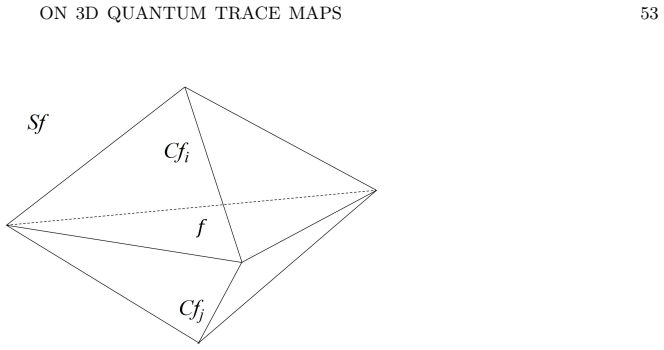
We propose a third construction of the 3d quantum trace map which agrees with one of the two existing constructions, and extends to certain types of manifolds with ideally triangulated boundaries. Our 3d quantum trace map can be compared with the other construction relatively easily by subdividing the face suspensions and the ideal tetrahedra into a common subdivision based on face cones. This allows us to give an exact relation between the definitions, which partially addresses the equivalence between the two constructions.
Load-bearing premise
Subdividing the structures from the different constructions into a common subdivision based on face cones is sufficient to preserve the homomorphism properties and establish an exact relation.
Editorial extensions
If this is right
- The new construction extends the 3d quantum trace map to manifolds with ideally triangulated boundaries.
- An exact relation is established between this construction and the second prior construction.
- The relation partially confirms the equivalence of the two original constructions.
- The quantization property of the classical trace map holds consistently under this relation.
Reading between the lines
- This approach of using common subdivisions could be applied to reconcile other differing definitions of quantum invariants in three-dimensional topology.
- The extension to boundary triangulations opens the possibility of defining trace maps for more general classes of 3-manifolds.
- Further subdivisions or refinements might allow direct comparisons without referencing specific constructions.
Editorial analysis
A structured set of objections, weighed in public.
Referee Report
Summary. The manuscript proposes a third construction of the 3d quantum trace map, a homomorphism from the skein module of an ideally triangulated 3-manifold to its quantum gluing module. It claims this new map agrees with the Garoufalidis-Yu construction in [GY], extends to certain manifolds with ideally triangulated boundaries, and yields an exact relation to the Panitch-Park construction in [PP1] by subdividing the face suspensions of [PP1] and the ideal tetrahedra into a common face-cone subdivision.
Significance. If the claims are established with full definitions and verifications, the work would clarify the relationship between two existing constructions of quantum trace maps and partially resolve questions of equivalence between [GY] and [PP1]. The boundary extension is a useful addition to the literature on skein modules and quantum invariants.
major comments (2)
- [Abstract (comparison paragraph)] The central claim that the subdivision into a common face-cone refinement induces an exact relation between the maps requires explicit confirmation that the induced map on skein modules commutes with both trace maps without extra factors, sign changes, or loss of the homomorphism property. No such verification on generators or a single tetrahedron is indicated in the abstract.
- [Abstract] The assertion that the new construction agrees with [GY] is stated without reference to the explicit map or the section where the agreement is proved; the abstract provides no definitions of the new map, so it is impossible to assess whether the agreement holds independently of the subdivision argument.
minor comments (1)
- The manuscript would benefit from a concrete low-dimensional example (e.g., a single ideal tetrahedron) showing the new map on generators of the skein module.
Simulated Author's Rebuttal
We thank the referee for their careful reading and for highlighting ways to strengthen the abstract. We address the two major comments point by point below. In each case we agree that the abstract can be improved by adding explicit references to the relevant sections and verifications already present in the body of the manuscript.
read point-by-point responses
-
Referee: [Abstract (comparison paragraph)] The central claim that the subdivision into a common face-cone refinement induces an exact relation between the maps requires explicit confirmation that the induced map on skein modules commutes with both trace maps without extra factors, sign changes, or loss of the homomorphism property. No such verification on generators or a single tetrahedron is indicated in the abstract.
Authors: The explicit verification that the induced map on skein modules commutes with both trace maps, without extra factors, sign changes, or loss of the homomorphism property, is carried out in Section 4 by direct computation on the generators for a single tetrahedron and its face-cone subdivision. We agree that the abstract does not currently point to this verification and will revise the comparison paragraph to include a reference to Section 4. revision: yes
-
Referee: [Abstract] The assertion that the new construction agrees with [GY] is stated without reference to the explicit map or the section where the agreement is proved; the abstract provides no definitions of the new map, so it is impossible to assess whether the agreement holds independently of the subdivision argument.
Authors: The agreement between our third construction and the Garoufalidis-Yu map is proved in Section 3 by showing that both maps satisfy the same quantum gluing equations and skein relations on the generators; this proof is independent of the subdivision argument used later for the comparison with [PP1]. While the abstract is necessarily concise and omits definitions, we will revise it to cite Section 3 so that readers can locate the independent verification of agreement with [GY]. revision: yes
Circularity Check
Independent third construction; agreement and relation established via explicit geometric comparison without definitional reduction.
full rationale
The paper defines a new 3d quantum trace map on ideally triangulated 3-manifolds using ideal tetrahedra and shows it agrees with the [GY] construction while relating to [PP1] via subdivision into a common face-cone refinement. No equations, definitions, or self-citations reduce the claimed homomorphism or the exact relation to quantities defined in terms of the outputs themselves. Citations are to independent prior works by other authors. The derivation chain relies on standard properties of skein modules and quantum gluing modules and remains self-contained against external benchmarks.
Assumptions & free parameters
Cite this review
Pith. "Pith review of On 3d Quantum Trace Maps." pith.science (2026). https://pith.science/paper/XYXZI2JM
@misc{pith2026260613268,
  author       = {Pith},
  title        = {Pith review of: On 3d Quantum Trace Maps},
  year         = {2026},
  howpublished = {\url{https://pith.science/paper/XYXZI2JM}},
  note         = {Machine review of arXiv:2606.13268}
}
read the original abstract
A 3d quantum trace map is a homomorphism from the skein module of an ideally triangulated 3-manifold to its quantum gluing module that quantizes the classical trace map. There are two constructions of such maps, one by Garoufalidis and Yu in [GY], and the other by Panitch and Park in [PP1]. However, the relationship between these two constructions was unknown. We propose a third construction of the 3d quantum trace map which agrees with the one given by Garoufalidis and Yu, and extends to certain types of manifolds with ideally triangulated boundaries. Our 3d quantum trace map can be compared with that of [PP1] relatively easily by subdividing the face suspensions of [PP1] and the ideal tetrahedra of our definition into a common subdivision based on face cones. This allows us to give an exact relation between the definitions, which partially addresses the equivalence between the constructions of [GY] and [PP1].
Figures


Figures from the paper (28 more)






Reference graph
Works this paper leans on
-
[1]
Quantum trace map for 3-manifolds and a length conjecture , 2022, arXiv:2203.15985
Prarit Agarwal, Dongmin Gang, Sangmin Lee, and Mauricio Romo. Quantum trace map for 3-manifolds and a length conjecture , 2022, arXiv:2203.15985
-
[2]
4: 521-542
Doug Bullock, Rings of SL _ 2 ( C ) -characters and the kauffman bracket skein module, Commentarii Mathematici Helvetici, 72 (1997), no. 4: 521-542
1997
-
[3]
Francis Bonahon and Helen Wong, Quantum traces for representations of surface groups in SL _ 2 ( C ) , Geom. Topol. 15 (2011), no. 3, 1569-1615
2011
-
[4]
Francesco Costantino and Thang T. Q. L\^e, Stated skein algebras of surfaces, J. Eur. Math. Soc. (JEMS), 24 (2022), no. 12, 4063-4142
2022
-
[5]
Francesco Costantino and Thang T. Q. L\^e, Stated skein modules of 3-manifolds and TQFT, Journal of the Institute of Mathematics of Jussieu. 2025;24(3):663-703
2025
-
[6]
Tudor Dimofte, Quantum Riemann surfaces in Chern-Simons theory, Adv. Theor. Math. Phys. 17 (2013), no. 3, 479-599
2013
-
[7]
Stavros Garoufalidis and Tao Yu, A quantum trace map for 3-manifolds, Advances in Mathematics, Volume 486, 2026, 110735
2026
-
[8]
L\^e and Tao Yu, Quantum traces and embeddings of stated skein algebras into quantum tori, Selecta Math
Thang T.Q. L\^e and Tao Yu, Quantum traces and embeddings of stated skein algebras into quantum tori, Selecta Math. (N.S.) 28 (2022), no. 4, Paper No. 66, 48
2022
Show all 14 references
-
[9]
3, 307-332
Walter Neumann and Don Zagier, Volumes of hyperbolic three-manifolds, Topology 24 (1985), no. 3, 307-332
1985
-
[10]
Samuel Panitch and Sunghyuk Park, 3d Quantum Trace Map, Preprint 2024, arXiv:2403.12850
2024
-
[11]
0.5in 0.3pt , Compatibility of quantum trace and UV-IR maps, Preprint 2025, arXiv:2509.09100
2025
-
[12]
Przytycki , Fundamentals of Kauffman bracket skein modules, Kobe J
J\'ozef H. Przytycki , Fundamentals of Kauffman bracket skein modules, Kobe J. Math. 16 (1999), no. 1, 45-66
1999
-
[13]
William Thurston, The Geometry and Topology of Three-Manifolds, 1980
1980
-
[14]
Turaev, Skein quantization of Poisson algebras of loops on surfaces, Annales scientifiques de l Ecole Normale Sup\'erieure 24 (1991), no
Vladimir G. Turaev, Skein quantization of Poisson algebras of loops on surfaces, Annales scientifiques de l Ecole Normale Sup\'erieure 24 (1991), no. 6: 635-704
1991
Reviewed June 27, 2026 · model on record in the stance chip above.
Discussion (0). Continue with ORCID to comment.