The dual Artin isomorphism for Artin groups of XXL type
Pith reviewed 2026-06-27 05:34 UTC · model grok-4.3
The pith
Artin groups of XXL type are isomorphic to their dual Artin groups for any Coxeter element.
A machine-rendered reading of the paper's core claim, the machinery that carries it, and where it could break.
Core claim
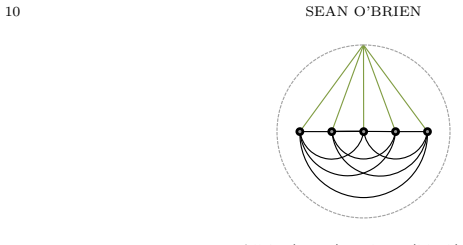
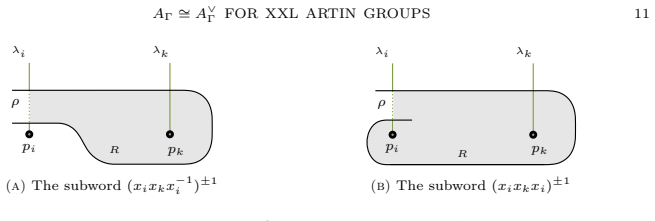
We show that an Artin group A_Γ of XXL type (with all defining integers satisfying m_ij ≥ 5) is isomorphic to the corresponding dual Artin group for any choice of Coxeter element. Our proof involves the set of Hurwitz words Q which arise from the Hurwitz action on tuples of elements of the free group. We show that the canonical epimorphism from A_Γ to the dual Artin group is an isomorphism if and only if the projection from A_Γ to the Coxeter group is injective on the image of Q. Then, using geometric properties of Q and the solution to the word problem for Coxeter groups, we show this to be the case when all m_ij ≥ 5.
What carries the argument
The set Q of Hurwitz words from the Hurwitz action on free-group tuples, together with the injectivity of the projection A_Γ to the Coxeter group on the image of Q.
If this is right
- The canonical epimorphism from A_Γ onto the dual Artin group is an isomorphism.
- The isomorphism holds for every possible choice of Coxeter element.
- Any structural property established for the dual presentation transfers directly to the standard Artin group.
- The verification relies only on the word problem solution already known for Coxeter groups and on geometric features of the Hurwitz words.
Where Pith is reading between the lines
- Results previously proved only for dual Artin groups can now be applied to the standard presentation of these XXL-type groups without additional work.
- The same injectivity test on Q could be checked by other means for Artin groups that contain some m_ij smaller than 5.
- The unification may simplify calculations of invariants such as cohomology or representation varieties that are easier to access in one presentation than the other.
Load-bearing premise
The projection from the Artin group to the Coxeter group is injective on the image of the set Q of Hurwitz words.
What would settle it
A single word from the image of Q that is nontrivial in A_Γ but maps to the identity in the associated Coxeter group, for some defining graph with every m_ij at least 5.
Figures
read the original abstract
We show that an Artin group $A_\Gamma$ of XXL type (with all defining integers satisfying $m_{ij}\geq 5$) is isomorphic to the corresponding dual Artin group for any choice of Coxeter element. Our proof involves the set of Hurwitz words $Q$ which arise from the Hurwitz action on tuples of elements of the free group. We show that the canonical epimorphism from $A_\Gamma$ to the dual Artin group is an isomorphism if and only if the projection from $A_\Gamma$ to the Coxeter group is injective on the image of $Q$. Then, using geometric properties of $Q$ and the solution to the word problem for Coxeter groups, we show this to be the case when all $m_{ij} \geq 5$.
Editorial analysis
A structured set of objections, weighed in public.
Referee Report
Summary. The manuscript proves that an Artin group A_Γ of XXL type (all m_ij ≥ 5) is isomorphic to the corresponding dual Artin group for any choice of Coxeter element. The central argument reduces the isomorphism to an explicit criterion: the canonical epimorphism A_Γ → dual Artin group is an isomorphism if and only if the projection A_Γ → W_Γ is injective on the image of the set Q of Hurwitz words arising from the Hurwitz action on tuples in the free group. This injectivity is then established for m_ij ≥ 5 by invoking geometric properties of Q together with the standard solution to the word problem in Coxeter groups.
Significance. If the result holds, it establishes the dual Artin isomorphism for all Artin groups of XXL type, substantially enlarging the known cases beyond spherical and other previously treated families. The reduction to a concrete injectivity condition on the Hurwitz set Q supplies an explicit, checkable criterion that is independent of ad-hoc parameters and may be reusable for other Artin-group isomorphism questions.
minor comments (1)
- [Abstract] The abstract states that geometric properties of Q are used to verify injectivity but does not name the specific properties (e.g., any particular lemma or proposition); a one-sentence pointer would improve readability for readers who consult only the abstract.
Simulated Author's Rebuttal
We thank the referee for their positive report, accurate summary of the main result, and recommendation to accept the manuscript. No major comments were raised.
Circularity Check
No circularity: derivation uses external word-problem solution
full rationale
The paper reduces the dual Artin isomorphism to an explicit iff criterion (the projection A_Γ → W_Γ is injective on the image of the Hurwitz set Q) and verifies the criterion for m_ij ≥ 5 by invoking geometric properties of Q together with the standard solution to the word problem in Coxeter groups. This solution is independent prior literature, not a self-citation or internal fit. No load-bearing step reduces by definition or by construction to the paper's own inputs.
Axiom & Free-Parameter Ledger
axioms (1)
- standard math The word problem for Coxeter groups is solvable
Reference graph
Works this paper leans on
-
[1]
[BDSW14] Barbara Baumeister, Matthew Dyer, Christian Stump, and Patrick Wegener
https://doi.org/10.1007/BF02950718. [BDSW14] Barbara Baumeister, Matthew Dyer, Christian Stump, and Patrick Wegener. A note on the transitive Hurwitz action on decompositions of parabolic Coxeter elements. Proceedings of the American Mathematical Society, Series B, 1(13):149–154, December 2014.https://doi.org/10.1090/S2330-1511-2014-00017-1. [Bes03] David...
-
[2]
A dual braid monoid for the free group
https://doi.org/10.1016/j.ansens.2003.01.001. [Bes04] David Bessis. A dual braid monoid for the free group. http://arxiv.org/abs/math/0401324, January
work page internal anchor Pith review Pith/arXiv arXiv doi:10.1016/j.ansens.2003.01.001 2003
-
[3]
[Bes06] David Bessis. A dual braid monoid for the free group.Journal of Algebra, 302(1):55–69, August 2006.https://doi.org/10.1016/j.jalgebra.2005.10.025. [Bes15] David Bessis. Finite complex reflection arrangements areK(π,1).Annals of Mathematics, 181(3):809–904, May
-
[4]
[BKL98] Joan Birman, Ki Hyoung Ko, and Sang Jin Lee
https://doi.org/10.4007/annals.2015.181.3.1. [BKL98] Joan Birman, Ki Hyoung Ko, and Sang Jin Lee. A new approach to the word and conjugacy problems in the braid groups.Advances in Mathematics, 139(2):322–353, November 1998.https://doi.org/10.1006/aima.1998.1761. [Boy26] Rachael Boyd. An introduction to the geometric and combinatorial group theory of Artin...
-
[5]
https://doi.org/10.1307/mmj/1030132536. [Bri88] E. Brieskorn. Automorphic sets and braids and singularities. In Joan S. Birman and Anatoly Libgober, editors,Contemporary Mathematics, volume 78, pages 45–115. American Mathematical Society, Providence, Rhode Island,
-
[6]
[BW02] Thomas Brady and Colum Watt.K(π,1)’s for Artin groups of finite type
https://doi.org/10.1090/conm/078/975077. [BW02] Thomas Brady and Colum Watt.K(π,1)’s for Artin groups of finite type. Geometriae Dedicata, 94(1):225–250, October
-
[7]
[CD22] Guillaume Chapuy and Theo Douvropoulos
https://doi.org/10.1023/A:1020902610809. [CD22] Guillaume Chapuy and Theo Douvropoulos. Counting chains in the noncrossing partition lattice via theW-Laplacian.Journal of Algebra, 602:381–404, July
-
[8]
https://doi.org/10.1016/j.jalgebra.2022.02.023. [Dav25] Michael W. Davis.The Geometry and Topology of Coxeter Groups. Springer Monographs in Mathematics. Springer Nature Switzerland, Cham,
-
[9]
[DPS24] Emanuele Delucchi, Giovanni Paolini, and Mario Salvetti
https://doi.org/10.1007/978-3-031-91303-7. [DPS24] Emanuele Delucchi, Giovanni Paolini, and Mario Salvetti. Dual structures on Coxeter and Artin groups of rank three.Geometry & Topology, 28(9):4295–4336, December 2024.https://doi.org/10.2140/gt.2024.28.4295. [FM11] Benson Farb and Dan Margalit.A Primer on Mapping Class Groups (PMS-49). Princeton Universit...
-
[10]
https://doi.org/10.23943/princeton/9780691147949.001.0001. [Hae22] Thomas Haettel. XXL type Artin groups are CAT(0) and acylindrically hyperbolic. Annales de l’Institut Fourier, 72(6):2541–2555, October
-
[11]
https://doi.org/10.5802/aif.3524. [Hur91] A. Hurwitz. Ueber Riemann’sche Fl¨ achen mit gegebenen Verzweigungspunkten. Mathematische Annalen, 39(1):1–60, March
-
[12]
[IS10] Kiyoshi Igusa and Ralf Schiffler
https://doi.org/10.1007/BF01199469. [IS10] Kiyoshi Igusa and Ralf Schiffler. Exceptional sequences and clusters.Journal of Algebra, 323(8):2183–2202, April
-
[13]
AΓ ∼= A∨ Γ FOR XXL ARTIN GROUPS 29 [McC05] Jon McCammond
https://doi.org/10.1016/j.jalgebra.2010.02.003. AΓ ∼= A∨ Γ FOR XXL ARTIN GROUPS 29 [McC05] Jon McCammond. An Introduction to Garside structures. https://web.math.ucsb.edu/~jon.mccammond/papers/intro-garside.pdf,
-
[14]
[MS17] Jon McCammond and Robert Sulway
https://doi.org/10.1016/j.jalgebra.2015.04.021. [MS17] Jon McCammond and Robert Sulway. Artin groups of Euclidean type.Inventiones mathematicae, 210(1):231–282, October
-
[15]
[PS21] Giovanni Paolini and Mario Salvetti
https://doi.org/10.1007/s00222-017-0728-2. [PS21] Giovanni Paolini and Mario Salvetti. Proof of theK(π,1) conjecture for affine Artin groups.Inventiones mathematicae, 224(2):487–572, May
-
[16]
https://doi.org/10.1007/s00222-020-01016-y. [Res24] Sirio Resteghini. Free products and the isomorphism between standard and dual Artin groups.http://arxiv.org/abs/2410.17724, October
discussion (0)
Sign in with ORCID, Apple, or X to comment. Anyone can read and Pith papers without signing in.