Feasibility of a Flexible, Hybrid Tokamak-Stellarator Experiment using an Axisymmetric Dipole Coil Array
Pith reviewed 2026-06-27 05:23 UTC · model grok-4.3
The pith
A single axisymmetric array of planar dipole coils can generate tokamak, stellarator, and hybrid plasma equilibria within engineering limits.
A machine-rendered reading of the paper's core claim, the machinery that carries it, and where it could break.
Core claim
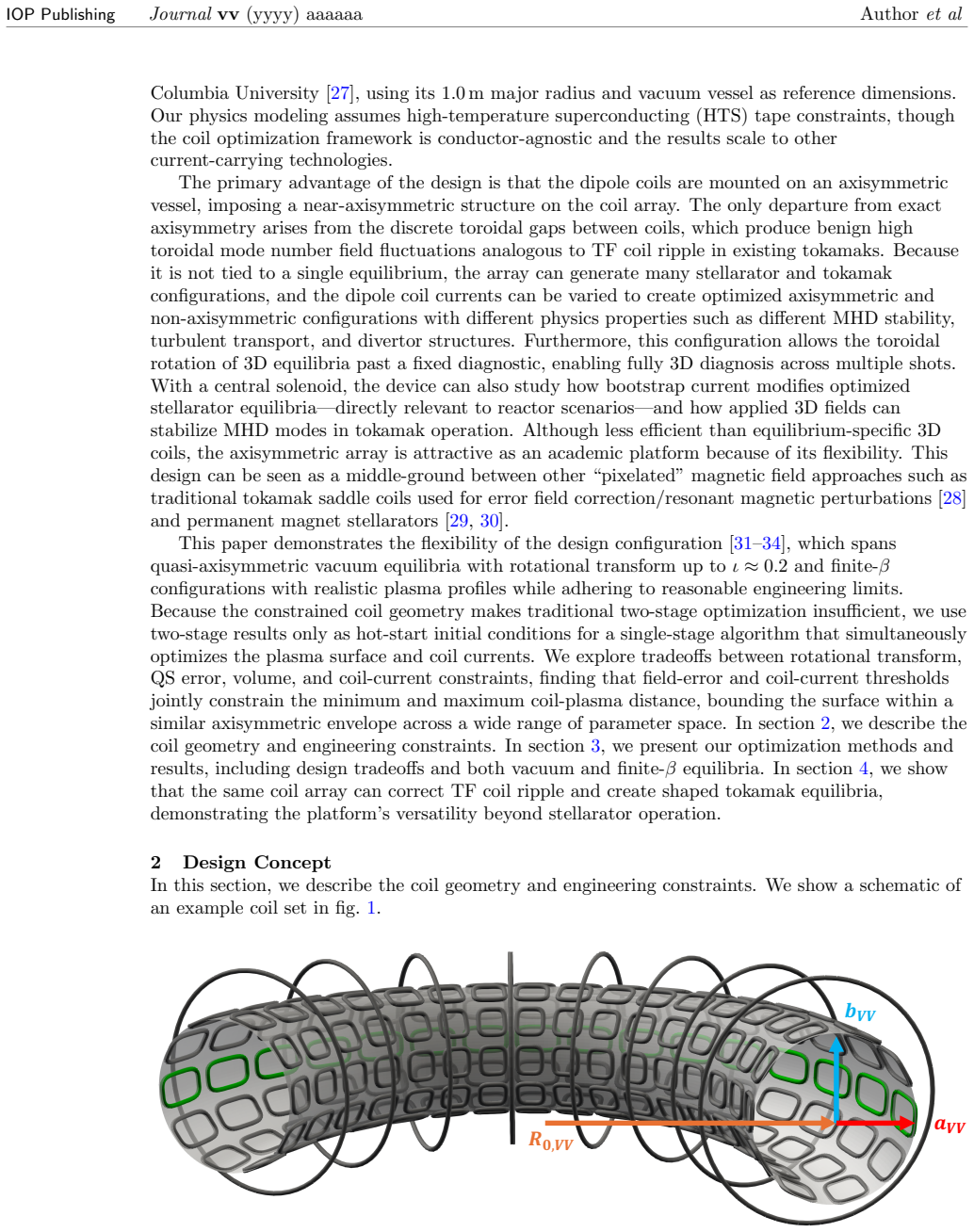
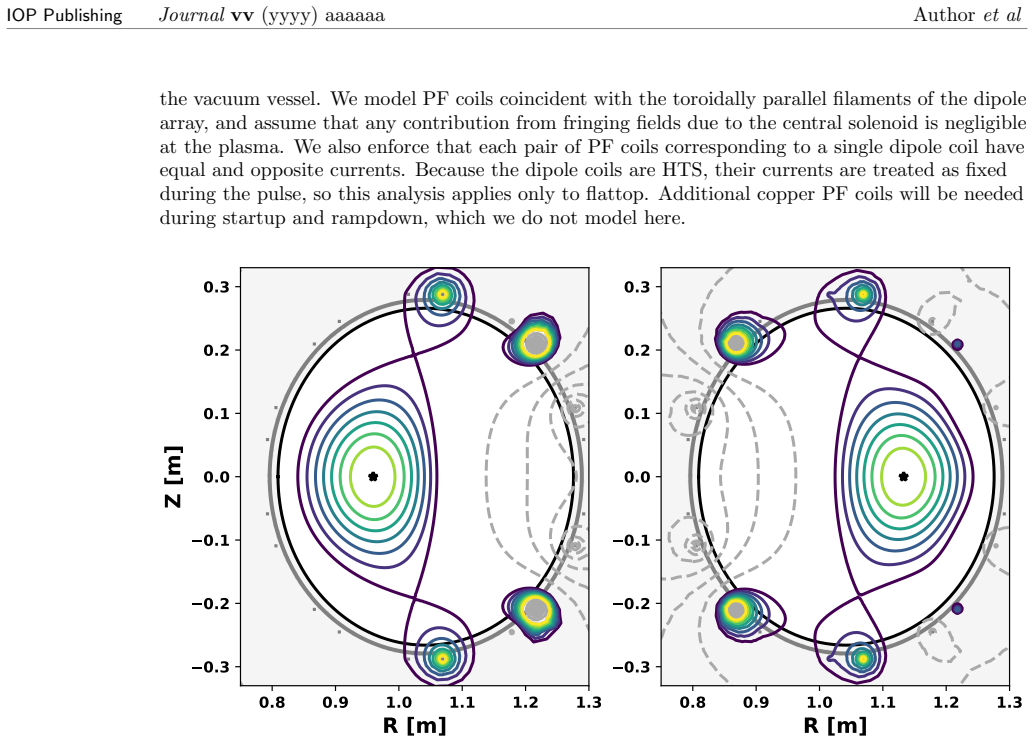
We demonstrate the design of a flexible, university-scale hybrid tokamak-stellarator experiment based on an axisymmetric array of planar HTS dipole coils. Because the coil array has few geometric degrees of freedom, we use single-stage optimization of the coil currents initialized from two-stage solutions to obtain mutually consistent equilibria and coil sets within realistic engineering limits. From this single coil array we obtain a broad range of equilibria—quasi-axisymmetric vacuum stellarators with ι up to 0.2, finite-β hybrids with realistic profiles reaching on-axis ι ≈ 1 and vacuum transform relevant for MHD stabilization, and strongly shaped tokamaks with elongation κ = 1.7 and tria
What carries the argument
Axisymmetric array of planar HTS dipole coils whose currents are optimized in a single stage, which confines the boundary to a roughly fixed axisymmetric envelope while allowing trade-offs among rotational transform, volume, coil current, and quasi-symmetry error.
Load-bearing premise
Single-stage optimization of coil currents initialized from two-stage solutions will produce mutually consistent plasma equilibria and coil sets that remain inside realistic limits on field error and forces.
What would settle it
If an optimized current set for a target hybrid equilibrium produces measured pointwise coil forces above HTS tolerance or field errors that eliminate the intended iota profile, the feasibility result would be falsified.
Figures
read the original abstract
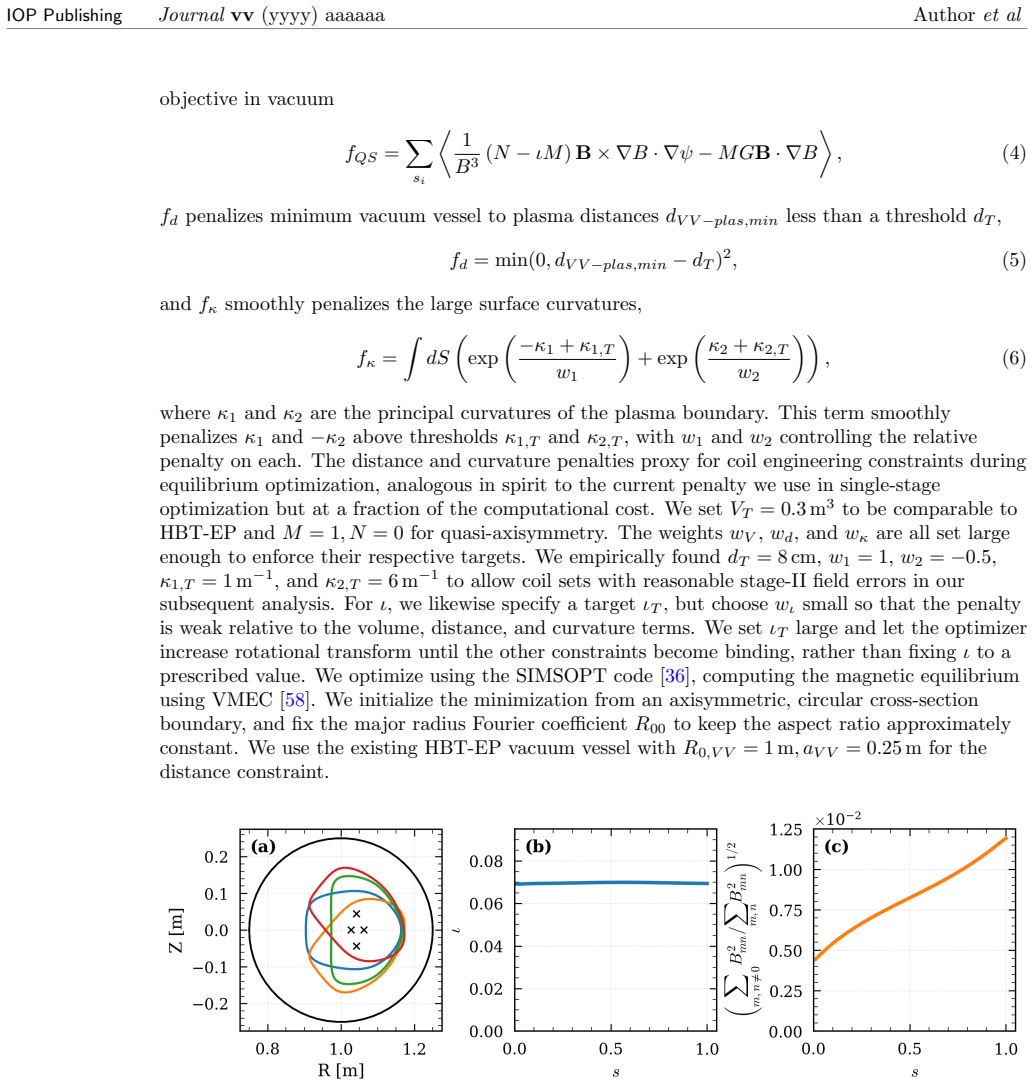
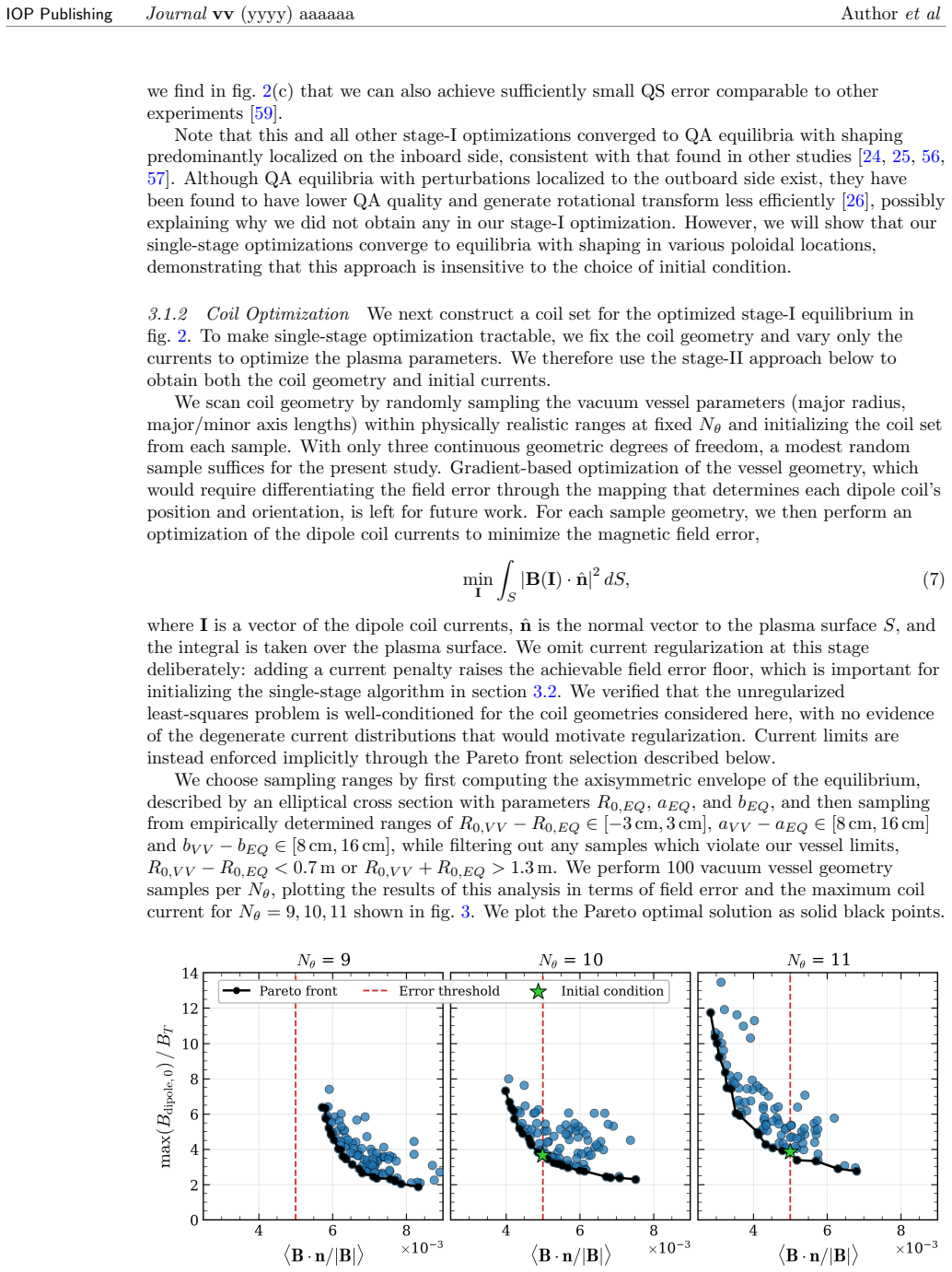
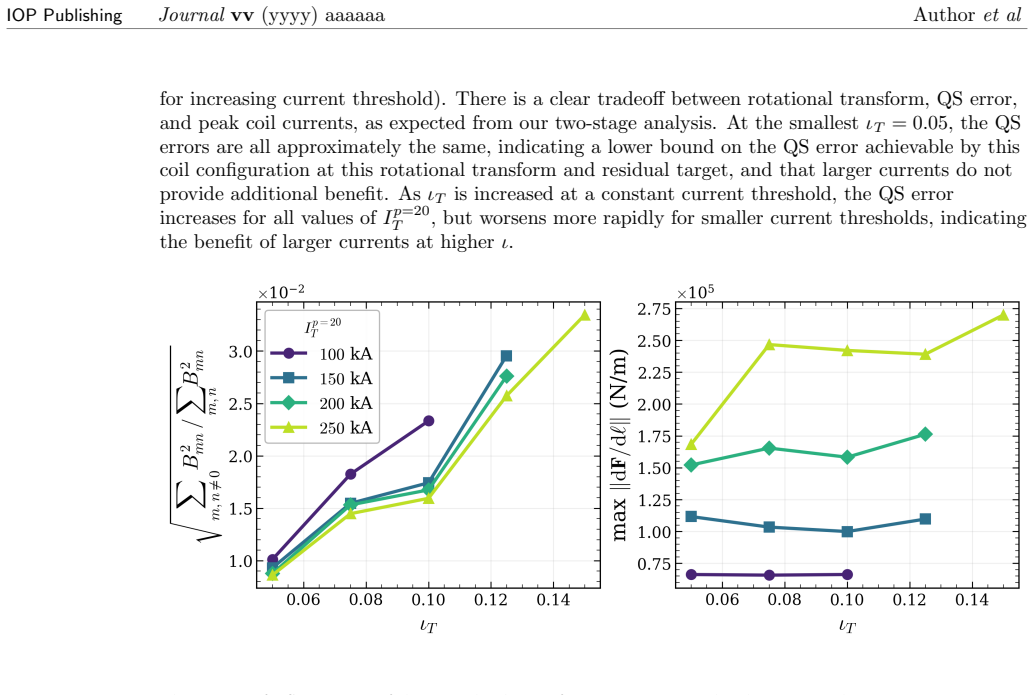
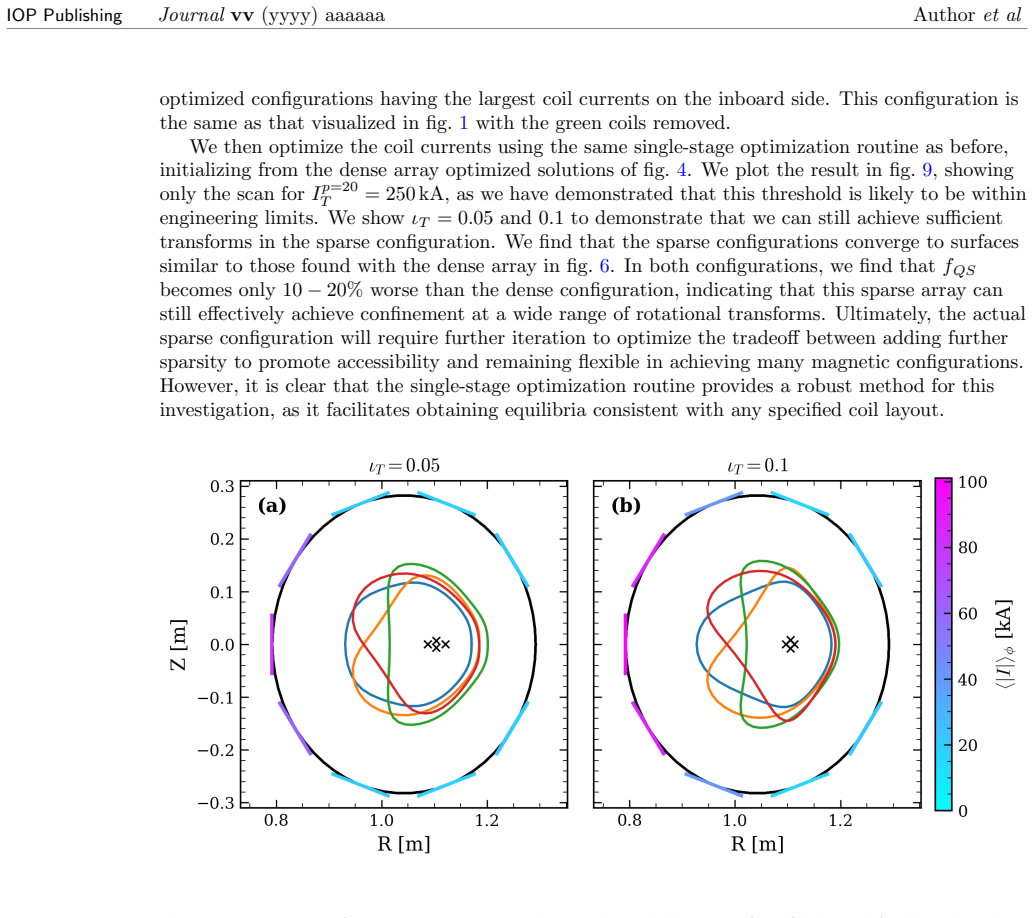
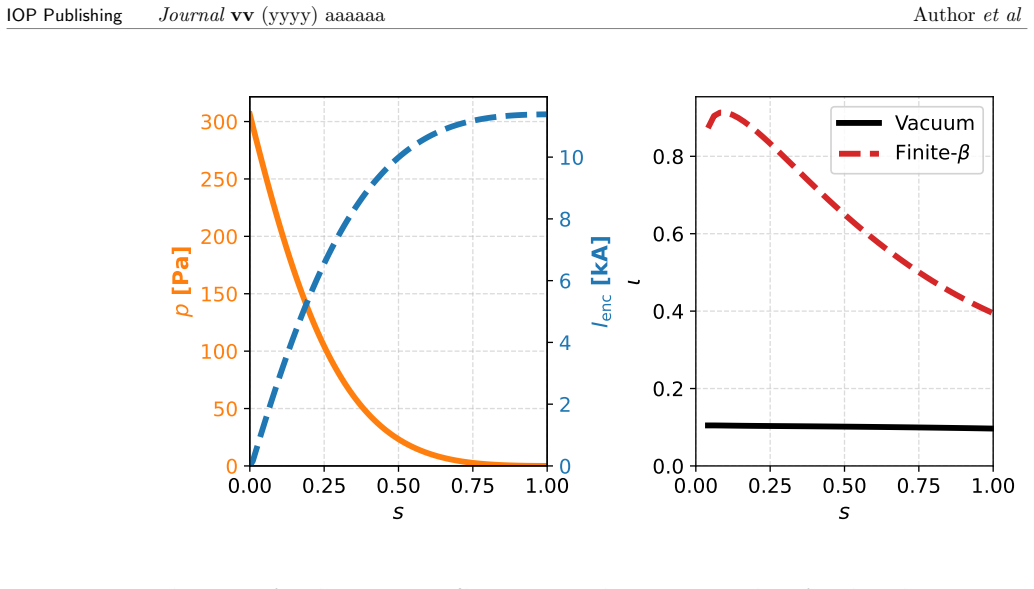
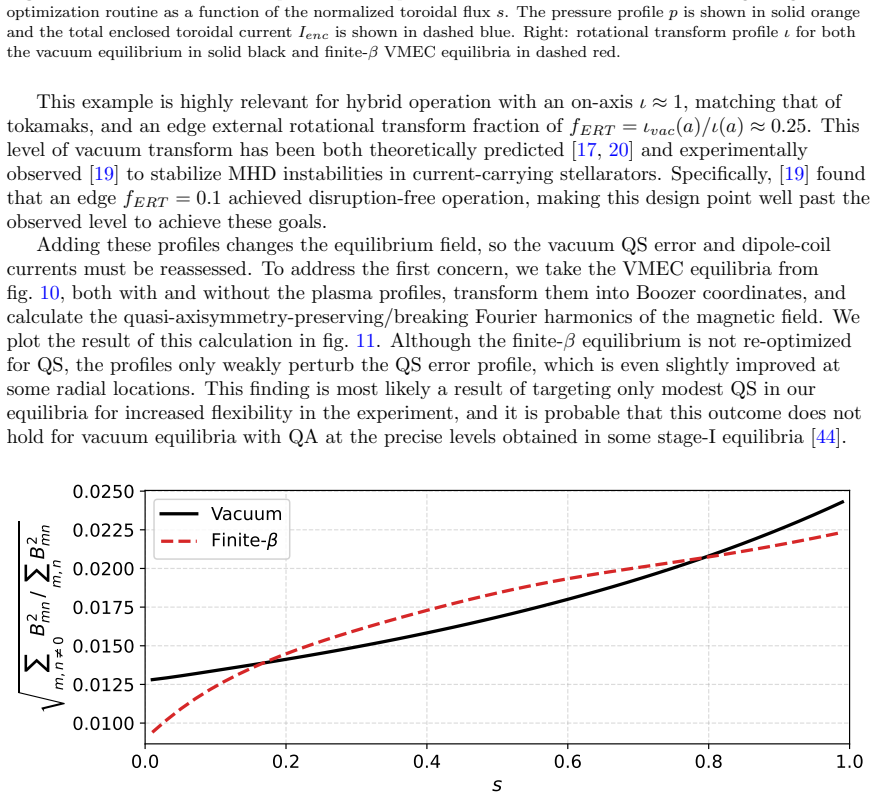
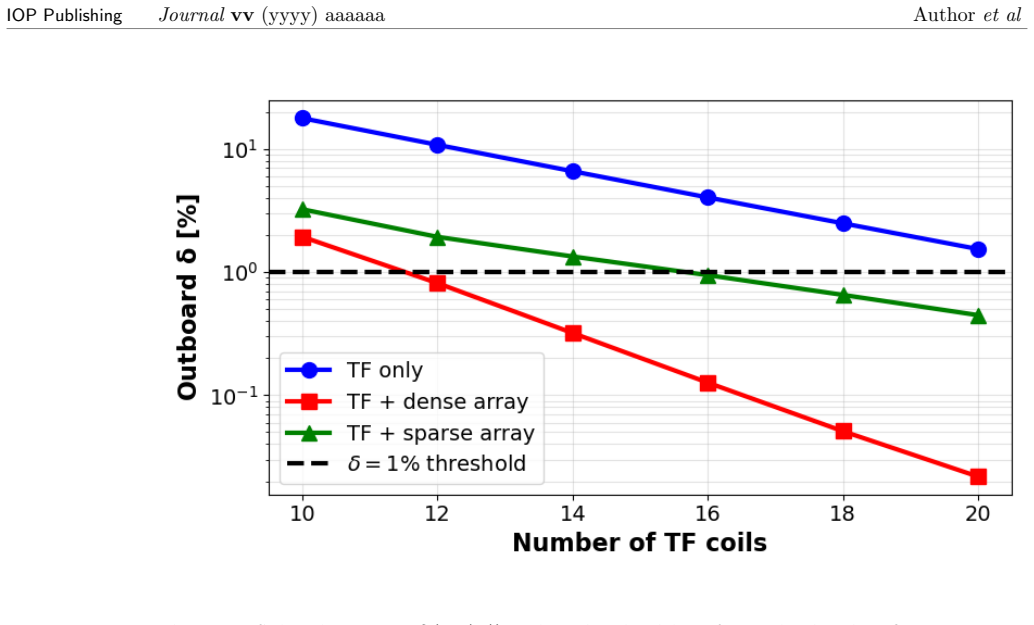
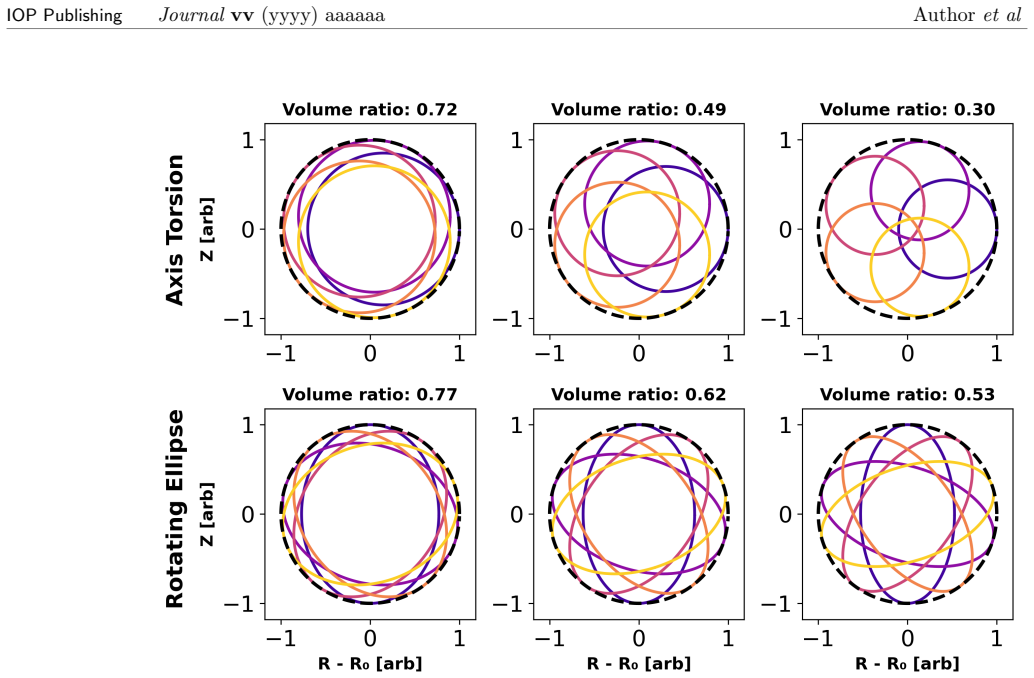
We demonstrate the design of a flexible, university-scale hybrid tokamak-stellarator experiment based on an axisymmetric array of planar HTS dipole coils. Because the coil array has few geometric degrees of freedom, we use single-stage optimization of the coil currents initialized from two-stage solutions to obtain mutually consistent equilibria and coil sets within realistic engineering limits. We find that the field error and coil current thresholds set minimum and maximum coil-plasma distances that confine the boundary to a roughly fixed axisymmetric envelope, within which rotational transform, volume, coil current, and quasi-symmetry (QS) error trade off against one another. Tighter current limits delocalize the non-axisymmetric shaping and raise QS error at fixed transform. From this single coil array we obtain a broad range of equilibria-quasi-axisymmetric vacuum stellarators with $\iota$ up to 0.2, finite-$\beta$ hybrids with realistic profiles reaching on-axis $\iota$ $\approx$ 1 and vacuum transform relevant for MHD stabilization, and strongly shaped tokamaks with elongation $\kappa$ = 1.7 and triangularity $\delta$ = $\pm$0.6, all at peak pointwise coil forces well below the HTS tolerance. We show the same array can additionally correct toroidal field (TF) coil ripple, reducing the number of TF coils required compared to the equivalent tokamak. These results establish the design as a promising platform for hybrid tokamak-stellarator research.
Editorial analysis
A structured set of objections, weighed in public.
Referee Report
Summary. The manuscript claims that a single axisymmetric array of planar HTS dipole coils, with currents optimized in a single-stage procedure initialized from two-stage solutions, can produce a broad family of mutually consistent plasma equilibria inside realistic engineering limits. These include quasi-axisymmetric vacuum stellarators (ι up to 0.2), finite-β hybrids (on-axis ι ≈ 1 with vacuum transform for MHD stabilization), and strongly shaped tokamaks (κ = 1.7, δ = ±0.6), all at peak coil forces below HTS tolerance; the same array can also reduce TF-coil ripple. The field-error and current thresholds are said to confine the plasma boundary to a fixed axisymmetric envelope within which ι, volume, current, and QS error trade off.
Significance. If the numerical results are shown to be robust, the work would establish a compact, university-scale platform capable of exploring hybrid tokamak-stellarator physics in a single device. The use of a geometrically simple HTS coil set with demonstrated flexibility across vacuum, finite-β, and tokamak regimes, together with ripple-correction capability, would be a notable engineering and physics contribution to the design of flexible stellarator-tokamak experiments.
major comments (2)
- [Abstract (optimization paragraph)] Abstract, paragraph on optimization approach: the central feasibility claim rests on single-stage current optimization (initialized from two-stage solutions) yielding mutually consistent equilibria and coil sets inside field-error and force limits, yet no quantitative error bars, convergence diagnostics, validation against independent equilibrium codes, or sensitivity analysis on the post-hoc distance constraints are supplied; without these the reported ι ≈ 1 hybrids and κ = 1.7 tokamaks cannot be assessed for robustness.
- [Abstract and optimization section] Abstract and optimization description: the reported values of ι, κ, and δ are outputs of the same current-fitting procedure that defines the design; while external HTS force limits are invoked, the manuscript does not demonstrate that the achieved metrics remain inside those limits independently of the fitting targets, creating a circularity burden for the “broad range of equilibria” claim.
minor comments (2)
- [Notation and definitions] Notation for quasi-symmetry error and the precise definition of the axisymmetric envelope should be stated explicitly in the main text rather than left to figure captions.
- [Results presentation] The manuscript would benefit from a short table summarizing the achieved ι, κ, δ, QS error, and peak force for each class of equilibrium together with the corresponding coil-plasma distance bounds.
Simulated Author's Rebuttal
We thank the referee for their careful review and for identifying areas where the robustness of the optimization results could be presented more clearly. We address each major comment below and have revised the manuscript to incorporate additional diagnostics and clarifications.
read point-by-point responses
-
Referee: [Abstract (optimization paragraph)] Abstract, paragraph on optimization approach: the central feasibility claim rests on single-stage current optimization (initialized from two-stage solutions) yielding mutually consistent equilibria and coil sets inside field-error and force limits, yet no quantitative error bars, convergence diagnostics, validation against independent equilibrium codes, or sensitivity analysis on the post-hoc distance constraints are supplied; without these the reported ι ≈ 1 hybrids and κ = 1.7 tokamaks cannot be assessed for robustness.
Authors: We agree that the original manuscript lacks explicit convergence diagnostics, error bars, and sensitivity analysis. In the revised version we add a dedicated subsection on optimization convergence, including residual norms across multiple initializations, a sensitivity study varying the post-hoc distance constraints by ±10%, and cross-validation of selected equilibria against an independent VMEC run. These additions directly support the robustness of the ι ≈ 1 hybrid and κ = 1.7 tokamak cases. revision: yes
-
Referee: [Abstract and optimization section] Abstract and optimization description: the reported values of ι, κ, and δ are outputs of the same current-fitting procedure that defines the design; while external HTS force limits are invoked, the manuscript does not demonstrate that the achieved metrics remain inside those limits independently of the fitting targets, creating a circularity burden for the “broad range of equilibria” claim.
Authors: The HTS force limits are fixed external engineering constraints applied uniformly during every optimization run, independent of the target rotational transform or boundary shape. The single-stage procedure minimizes field error subject to these fixed current and force bounds; the resulting ι, κ, and δ values are therefore outcomes, not inputs. We have revised the optimization section to separate the constraint-enforcement step from the achieved plasma metrics and to tabulate the peak forces for each equilibrium class, confirming they remain below the HTS threshold irrespective of the target values. revision: yes
Circularity Check
No significant circularity; results are direct outputs of stated optimization method
full rationale
The paper is an engineering design study that optimizes coil currents (free parameters) to achieve target equilibria and then reports the achieved ι, κ, δ, and force values. This is the explicit method, not a first-principles derivation that reduces to its inputs by construction. No self-citations, uniqueness theorems, or ansatzes are invoked in the provided text. External HTS force limits serve as independent benchmarks. The central feasibility claim rests on the optimization outputs satisfying those limits, which does not constitute circularity under the defined patterns.
Axiom & Free-Parameter Ledger
free parameters (2)
- coil currents
- coil-plasma distance bounds
axioms (2)
- standard math MHD force balance and Grad-Shafranov or 3D equilibrium equations hold for the target plasmas
- domain assumption HTS coil force tolerance is known and fixed from material data
Reference graph
Works this paper leans on
-
[1]
Suppression of Vertical Instability in Elongated Current-Carrying Plasmas by Applying Stellarator Rotational Transform , author =. Physics of Plasmas , volume =. doi:10.1063/1.4878615 , urldate =
-
[2]
Enhancing Stellarator Accessibility through Port Size Optimization , author =. Nuclear Fusion , volume =. doi:10.1088/1741-4326/adf11e , urldate =
-
[3]
Baillod, A. and Paul, E.J. and Rawlinson, G. and Haque, M. and Freiberger, S.W. and Thapa, S. , year = 2025, month = jan, journal =. Integrating Novel Stellarator Single-Stage Optimization Algorithms to Design the. doi:10.1088/1741-4326/ada6dd , urldate =
-
[4]
Baillod, Antoine and Veksler, Avigdor and Lopez, Rohan and Schmeling, Dylan and Campagna, Michael and Paul, Elizabeth and Knyazev, Alexey , year = 2026, month = jan, number =. Update on the Design of the. doi:10.48550/arXiv.2601.00673 , urldate =. arXiv , keywords =:2601.00673 , primaryclass =
-
[5]
Bandyopadhyay, I. and Igochine, V. and Sauter, O. and Sabbagh, S.A. and Park, J.-K. and Nardon, E. and Villone, F. and Maraschek, M. and Pautasso, G. and Eidietis, N. and Jardin, S.C. and Humphreys, D.A. and Dubrov, M. and Artola, F.J. and. Nuclear Fusion , volume =. doi:10.1088/1741-4326/ade7a0 , urldate =
-
[6]
Journal of Plasma Physics , volume =
Understanding Trade-Offs in Stellarator Design with Multi-Objective Optimization , author =. Journal of Plasma Physics , volume =. doi:10.1017/S0022377823000788 , urldate =
-
[7]
Needed Computations and Computational Capabilities for Stellarators , author =. Physics of Plasmas , volume =. doi:10.1063/5.0211063 , urldate =
-
[8]
Stellarators and the Path from
Boozer, Allen H , year = 2008, month = nov, journal =. Stellarators and the Path from. doi:10.1088/0741-3335/50/12/124005 , urldate =
-
[9]
Use of Nonaxisymmetric Shaping in Magnetic Fusiona) , author =. Physics of Plasmas , volume =. doi:10.1063/1.3099330 , urldate =
-
[10]
Bosch, H.-S. and Andreeva, T. and Brakel, R. and Br. Engineering. IEEE Transactions on Plasma Science , volume =. doi:10.1109/TPS.2018.2818934 , urldate =
-
[11]
arXiv , keywords =:2401.09021 , primaryclass =
A Family of Quasi-Axisymmetric Stellarators with Varied Rotational Transform , author =. arXiv , keywords =:2401.09021 , primaryclass =
-
[12]
Clark, A. W. and Doumet, M. and Hammond, K. C. and Kornbluth, Y. and Spong, D. A. and Sweeney, R. and Volpe, F. A. , year = 2014, month = nov, journal =. Proto-. doi:10.1016/j.fusengdes.2014.07.012 , urldate =
-
[13]
Effect of Toroidal Field Ripple on Plasma Rotation in. Nuclear Fusion , volume =. doi:10.1088/0029-5515/48/3/035007 , urldate =
-
[14]
Current Potential Patches , author =. Physics of Plasmas , volume =. doi:10.1063/5.0218972 , urldate =
-
[15]
Global Stellarator Coil Optimization with Quadratic Constraints and Objectives , author =. Nuclear Fusion , volume =. doi:10.1088/1741-4326/ada810 , urldate =
-
[16]
Vertical Stability in a Current-Carrying Stellarator , author =. Physics of Plasmas , volume =. doi:10.1063/1.873916 , urldate =
-
[17]
Stellarator Fusion Systems Enabled by Arrays of Planar Coils , author =. Nuclear Fusion , volume =. doi:10.1088/1741-4326/ada56c , urldate =
-
[18]
Direct Stellarator Coil Optimization for Nested Magnetic Surfaces with Precise Quasi-Symmetry , author =. Physics of Plasmas , volume =. doi:10.1063/5.0129716 , urldate =
-
[19]
Single-Stage Gradient-Based Stellarator Coil Design:
Giuliani, Andrew and Wechsung, Florian and Cerfon, Antoine and Stadler, Georg and Landreman, Matt , year = 2022, month = jun, journal =. Single-Stage Gradient-Based Stellarator Coil Design:. doi:10.1016/j.jcp.2022.111147 , urldate =
-
[20]
Plasma Physics and Controlled Fusion , volume =
Including the Vacuum Energy in Stellarator Coil Design , author =. Plasma Physics and Controlled Fusion , volume =. doi:10.1088/1361-6587/adb789 , urldate =
-
[21]
doi:10.48550/arXiv.2412.00267 , urldate =
A Framework for Discrete Optimization of Stellarator Coils , author =. doi:10.48550/arXiv.2412.00267 , urldate =. arXiv , keywords =:2412.00267 , publisher =
-
[22]
Hansen, C. and Stewart, I. G. and Burgess, D. and Pharr, M. and Guizzo, S. and Logak, F. and Nelson, A. O. and. Computer Physics Communications , volume =. doi:10.1016/j.cpc.2024.109111 , urldate =
-
[23]
Hartwell, G. J. and Knowlton, S. F. and Hanson, J. D. and Ennis, D. A. and Maurer, D. A. , year = 2017, month = jul, journal =. Design,. doi:10.1080/15361055.2017.1291046 , urldate =
-
[24]
Hartwig, Zachary S. and Vieira, Rui F. and Dunn, Darby and Golfinopoulos, Theodore and LaBombard, Brian and Lammi, Christopher J. and Michael, Philip C. and Agabian, Susan and Arsenault, David and Barnett, Raheem and Barry, Mike and Bartoszek, Larry and Beck, William K. and Bellofatto, David and Brunner, Daniel and Burke, William and Burrows, Jason and By...
-
[25]
Stellarator and Tokamak Plasmas: A Comparison , shorttitle =
Helander, P and Beidler, C D and Bird, T M and Drevlak, M and Feng, Y and Hatzky, R and Jenko, F and Kleiber, R and Proll, J H E and Turkin, Yu and Xanthopoulos, P , year = 2012, month = nov, journal =. Stellarator and Tokamak Plasmas: A Comparison , shorttitle =. doi:10.1088/0741-3335/54/12/124009 , urldate =
-
[26]
Journal of Plasma Physics , volume =
Combined Plasma--Coil Optimization Algorithms , author =. Journal of Plasma Physics , volume =. doi:10.1017/S0022377821000271 , urldate =
-
[27]
Physical Review Research , volume =
Compact Stellarator-Tokamak Hybrid , author =. Physical Review Research , volume =. doi:10.1103/PhysRevResearch.6.L022052 , urldate =
-
[28]
Plasma Physics and Controlled Fusion , volume =
Variety of Coil Sets for the Compact Stellarator-Tokamak Hybrid , author =. Plasma Physics and Controlled Fusion , volume =. doi:10.1088/1361-6587/add763 , urldate =
-
[29]
The Physics of Fluids , volume =
Steepest-descent Moment Method for Three-dimensional Magnetohydrodynamic Equilibria , author =. The Physics of Fluids , volume =. doi:10.1063/1.864116 , urldate =
-
[30]
, year = 2024, month = nov, journal =
Hurwitz, Siena and Landreman, Matt and Antonsen, Thomas M. , year = 2024, month = nov, journal =. Efficient. doi:10.1109/TMAG.2024.3455946 , urldate =
-
[31]
Electromagnetic Coil Optimization for Reduced
Hurwitz, Siena and Landreman, Matt and Huslage, Paul and Kaptanoglu, Alan , year = 2025, month = apr, journal =. Electromagnetic Coil Optimization for Reduced. doi:10.1088/1741-4326/adc9bf , urldate =
-
[32]
doi:10.1137/1.9781611978223 , urldate =
An. doi:10.1137/1.9781611978223 , urldate =
-
[33]
Single-Stage Stellarator Optimization: Combining Coils with Fixed Boundary Equilibria , shorttitle =
Jorge, R and Goodman, A and Landreman, M and Rodrigues, J and Wechsung, F , year = 2023, month = jun, journal =. Single-Stage Stellarator Optimization: Combining Coils with Fixed Boundary Equilibria , shorttitle =. doi:10.1088/1361-6587/acd957 , urldate =
-
[34]
Plasma Physics and Controlled Fusion , volume =
The Magnetic Gradient Scale Length Explains Why Certain Plasmas Require Close External Magnetic Coils , author =. Plasma Physics and Controlled Fusion , volume =. doi:10.1088/1361-6587/ad1a3e , urldate =
-
[35]
Greedy Permanent Magnet Optimization , author =. Nuclear Fusion , volume =. doi:10.1088/1741-4326/acb4a9 , urldate =
-
[36]
and Qian, Tony and Wechsung, Florian and Landreman, Matt , year = 2022, month = oct, journal =
Kaptanoglu, Alan A. and Qian, Tony and Wechsung, Florian and Landreman, Matt , year = 2022, month = oct, journal =. Permanent-. doi:10.1103/PhysRevApplied.18.044006 , urldate =
-
[37]
Reactor-Scale Stellarators with Force and Torque Minimized Dipole Coils , author =. Nuclear Fusion , volume =. doi:10.1088/1741-4326/adc318 , urldate =
-
[38]
Sparse Regression for Plasma Physics , author =. Physics of Plasmas , volume =. doi:10.1063/5.0139039 , urldate =
-
[39]
Toroidal Magnetic Field Ripple in the Presence of Misaligned Toroidal Field Coils on the
Kripner, Lukas and Krbec, Jaroslav and Zelda, Jan and Markovic, Tomas and Titus, Peter and Vondracek, Petr and Ficker, Ondrej and Hron, Martin , year = 2023, month = feb, journal =. Toroidal Magnetic Field Ripple in the Presence of Misaligned Toroidal Field Coils on the. doi:10.1016/j.fusengdes.2022.113378 , urldate =
-
[40]
Coil Optimization Methods for a Planar Coil Stellarator , author =. Nuclear Fusion , volume =. doi:10.1088/1741-4326/ada56b , urldate =
-
[41]
Nonaxisymmetric Shaping of Tokamaks Preserving Quasiaxisymmetry , author =. Physics of Plasmas , volume =. doi:10.1063/1.3207010 , urldate =
-
[42]
Landreman, Matt and Sengupta, Wrick , year = 2018, month = dec, journal =. Direct Construction of Optimized Stellarator Shapes. doi:10.1017/S0022377818001289 , urldate =
-
[43]
Efficient Calculation of Self Magnetic Field, Self-Force, and Self-Inductance for Electromagnetic Coils with Rectangular Cross-Section , author =. Nuclear Fusion , volume =. doi:10.1088/1741-4326/adb04e , urldate =
-
[44]
Efficient Magnetic Fields for Supporting Toroidal Plasmas , author =. Physics of Plasmas , volume =. doi:10.1063/1.4943201 , urldate =
-
[45]
An Improved Current Potential Method for Fast Computation of Stellarator Coil Shapes , author =. Nuclear Fusion , volume =. doi:10.1088/1741-4326/aa57d4 , urldate =
-
[46]
Landreman, Matt and Paul, Elizabeth , year = 2022, month = jan, journal =. Magnetic. doi:10.1103/PhysRevLett.128.035001 , urldate =
-
[47]
Optimization of Quasi-Symmetric Stellarators with Self-Consistent Bootstrap Current and Energetic Particle Confinement , author =. Physics of Plasmas , volume =. doi:10.1063/5.0098166 , urldate =
-
[48]
doi:10.21105/joss.03525 , urldate =
Landreman, Matt and Medasani, Bharat and Wechsung, Florian and Giuliani, Andrew and Jorge, Rogerio and Zhu, Caoxiang , year = 2021, month = sep, journal =. doi:10.21105/joss.03525 , urldate =
-
[49]
From tokamaks to stellarators: understanding the role of 3D shaping
Lazerson, Samuel A. and Schmitt, John C. , year = 2017, month = jul, number =. From Tokamaks to Stellarators: Understanding the Role of. arXiv , keywords =:1705.00517 , publisher =
work page internal anchor Pith review Pith/arXiv arXiv 2017
-
[50]
The Virtual-Casing Principle for
Lazerson, S A , year = 2012, month = dec, journal =. The Virtual-Casing Principle for. doi:10.1088/0741-3335/54/12/122002 , urldate =
-
[51]
Stellarator Coil Optimization Supporting Multiple Magnetic Configurations , author =. Nuclear Fusion , volume =. doi:10.1088/1741-4326/aca10d , urldate =
-
[52]
Liang, Yihui and Zhou, Yao and Dong, Fanghao and Zhu, Caoxiang and Yu, Guodong and Zhao, Yuansheng and Dong, Ge , year = 2025, month = jan, journal =. Design of. doi:10.1088/1741-4326/ada2a9 , urldate =
-
[53]
The Design of the External Rotational Transform Coil on the
Li, Yangbo and Rao, Bo and Mao, Feiyue and Zhou, Song and Li, Keze and Zhao, Chuanxu and Ren, Zhengkang and Li, Da and Huang, Zhuo and He, Ying and Hu, Bo and Huang, Jie and Wang, Nengchao and Jiang, Zhonghe and Ding, Yonghua and Suzuki, Yasuhiro , year = 2024, month = sep, journal =. The Design of the External Rotational Transform Coil on the. doi:10.101...
-
[54]
Suppression of Tearing Modes by
Li, Yangbo and Wang, Nengchao and Rao, Bo and Mao, Feiyue and Zhao, Chuanxu and Ren, Zhengkang and Meng, Z Y and Xuan, Zijian and Zhou, Song and Wang, Ruomu and Chen, Xixuan and Zheng, Wei and Suzuki, Yasuhiro and Jiang, Zhonghe , year = 2026, journal =. Suppression of Tearing Modes by. doi:10.1088/1741-4326/ae51a5 , urldate =
-
[55]
Stellarator Coil Optimization towards Higher Engineering Tolerances , author =. Nuclear Fusion , volume =. doi:10.1088/1741-4326/aad431 , urldate =
-
[56]
Loizu, J. and Hudson, S. R. and N. Verification of the. Physics of Plasmas , volume =. doi:10.1063/1.4967709 , urldate =
-
[57]
Plasma Physics and Controlled Fusion , volume =
The High Beta Tokamak-Extended Pulse Magnetohydrodynamic Mode Control Research Program , author =. Plasma Physics and Controlled Fusion , volume =. doi:10.1088/0741-3335/53/7/074016 , urldate =
-
[58]
Solution of Stellarator Boundary Value Problems with External Currents , author =. Nuclear Fusion , volume =. doi:10.1088/0029-5515/27/5/018 , urldate =
-
[59]
Plasma Physics and Controlled Fusion , volume =
Low-Aspect-Ratio Stellarators with Planar Coils , author =. Plasma Physics and Controlled Fusion , volume =. doi:10.1088/0741-3335/39/11/006 , urldate =
-
[60]
and Chen, Brian and Dickerson, Matthew and Gates, David A
Nash, Daniel and Cate, Andy D. and Chen, Brian and Dickerson, Matthew and Gates, David A. and Harris, William and Khera, Udyaaksh and Korman, Milo and Olatunji, Jamal and Slepchenkov, Misha and Srinivasan, Santhosh and Swanson, Charles P.S. and. Prototyping and. IEEE Transactions on Applied Superconductivity , volume =. doi:10.1109/TASC.2025.3594533 , urldate =
-
[61]
Construction of a Plasma Confinement Device
Oishi, T and Yamazaki, K and Arimoto, H and Baba, K and Hasegawa, M and Shoji, T , year = 2014, month = may, journal =. Construction of a Plasma Confinement Device. doi:10.1088/1742-6596/511/1/012042 , urldate =
-
[62]
Low Edge Safety Factor Operation and Passive Disruption Avoidance in Current Carrying Plasmas by the Addition of Stellarator Rotational Transform , author =. Physics of Plasmas , volume =. doi:10.1063/1.4935396 , urldate =
-
[63]
Parra, F. I. and Baek, S.-G. and Churchill, M. and Demers, D. R. and Dudson, B. and Ferraro, N. M. and Geiger, B. and Gerhardt, S. and Hammond, K. C. and Hudson, S. and Jorge, R. and Kolemen, E. and Kriete, D. M. and Kumar, S. T. A. and Landreman, M. and Lowe, C. and Maurer, D. A. and Nespoli, F. and Pablant, N. and Pueschel, M. J. and Punjabi, A. and Sch...
-
[64]
Experimental Demonstration of a Compact Stellarator Magnetic Trap Using Four Circular Coils , author =. Physics of Plasmas , volume =. doi:10.1063/1.2149313 , urldate =
-
[65]
Journal of Plasma Physics , volume =
Perturbing an Axisymmetric Magnetic Equilibrium to Obtain a Quasi-Axisymmetric Stellarator , author =. Journal of Plasma Physics , volume =. doi:10.1017/S0022377820000902 , urldate =
-
[66]
Plunk, G. G. and Helander, Per , year = 2018, month = apr, journal =. Quasi-Axisymmetric Magnetic Fields: Weakly Non-Axisymmetric Case in a Vacuum , shorttitle =. doi:10.1017/S0022377818000259 , urldate =
-
[67]
Qian, T. M. and Chu, X. and Pagano, C. and Patch, D. and Zarnstorff, M. C. and Berlinger, B. and Bishop, D. and Chambliss, A. and Haque, M. and Seidita, D. and Zhu, C. , year = 2023, month = oct, journal =. Design and Construction of the. doi:10.1017/S0022377823000880 , urldate =
-
[68]
Simpler Optimized Stellarators Using Permanent Magnets , author =. Nuclear Fusion , volume =. doi:10.1088/1741-4326/ac6c99 , urldate =
-
[69]
Development of the First Non-Planar
Riva, Nicol. Development of the First Non-Planar. Superconductor Science and Technology , volume =
-
[70]
Scott, S. D. and Kramer, G. J. and Tolman, E. A. and Snicker, A. and Varje, J. and S. Fast-Ion Physics in. Journal of Plasma Physics , volume =. doi:10.1017/S0022377820001087 , urldate =
-
[71]
Use of the Virtual-Casing Principle in Calculating the Containing Magnetic Field in Toroidal Plasma Systems , author =. Nuclear Fusion , volume =. doi:10.1088/0029-5515/12/5/009 , urldate =
-
[72]
Strickler, Dennis J. and Berry, Lee A. and Hirshman, Steven P. , year = 2002, month = mar, journal =. Designing. doi:10.13182/FST02-A206 , urldate =
-
[73]
Fusion Engineering and Design , volume =
Design of Simple Stellarator Using Tilted Toroidal Field Coils , author =. Fusion Engineering and Design , volume =. doi:10.1016/j.fusengdes.2021.112843 , urldate =
-
[74]
Swanson, C. P. S. and Kumar, S. T. A. and Dudt, D. W. and Flom, E. R. and Kalb, W. B. and Kruger, T. G. and Martin, M. F. and Olatunji, J. R. and Pasmann, S. and Tang, L. Z. and von der Linden, J. and Wasserman, J. and Avida, M. and Basurto, A. S. and Dickerson, M. and de Boer, N. and Donovan, M. J. and Cate, A. H. Doudna and Fort, D. and Harris, W. and K...
-
[75]
Team, W. VII-A. , year = 1980, month = sep, journal =. Stabilization of the (2, 1) Tearing Mode and of the Current Disruption in the. doi:10.1088/0029-5515/20/9/008 , urldate =
-
[76]
Proceedings of the National Academy of Sciences , volume =
Precise Stellarator Quasi-Symmetry Can Be Achieved with Electromagnetic Coils , author =. Proceedings of the National Academy of Sciences , volume =. doi:10.1073/pnas.2202084119 , urldate =
-
[77]
Journal of Plasma Physics , volume =
Coil Optimization for Quasi-Helically Symmetric Stellarator Configurations , author =. Journal of Plasma Physics , volume =. doi:10.1017/S0022377824000540 , urldate =
-
[78]
Planar Coil Optimization for the
Wu, Ryan and Kruger, Thomas and Swanson, Charles , year = 2025, month = feb, journal =. Planar Coil Optimization for the. doi:10.1088/1361-6587/adb5b7 , urldate =
-
[79]
Wurzel, Samuel E. and Hsu, Scott C. , year = 2025, month = nov, journal =. Continuing Progress toward Fusion Energy Breakeven and Gain as Measured against the. doi:10.1063/5.0297357 , urldate =
-
[80]
Yamaguchi, H and Shimizu, A and Isobe, M and Ogawa, K and Osakabe, M and Takahashi, H and Satake, S and Ichiguchi, K and Murase, T and Tanoue, H and Nakagawa, S and Yanai, R and Sato, M and Seki, R and Toda, S and Nunami, M and Sakai, T , year = 2025, month = sep, address =. An. 9th
2025
discussion (0)
Sign in with ORCID, Apple, or X to comment. Anyone can read and Pith papers without signing in.