HoloPathTracer: Fast and Accurate Wave Path Tracing for Holography
Pith reviewed 2026-06-27 05:02 UTC · model grok-4.3
The pith
A Monte Carlo path tracer jointly solves the rendering equation and Rayleigh-Sommerfeld integral to encode full 3D cues and complex materials into phase holograms.
A machine-rendered reading of the paper's core claim, the machinery that carries it, and where it could break.
Core claim
The central claim is that Monte Carlo path tracing can be applied directly to the combined radiometric and wave-optical problem, yielding coherent wave fields that already contain realistic focus cues and material appearance; these fields are then converted to phase-only holograms under complex-amplitude supervision, with path reuse and an ambient cache supplying the necessary speed.
What carries the argument
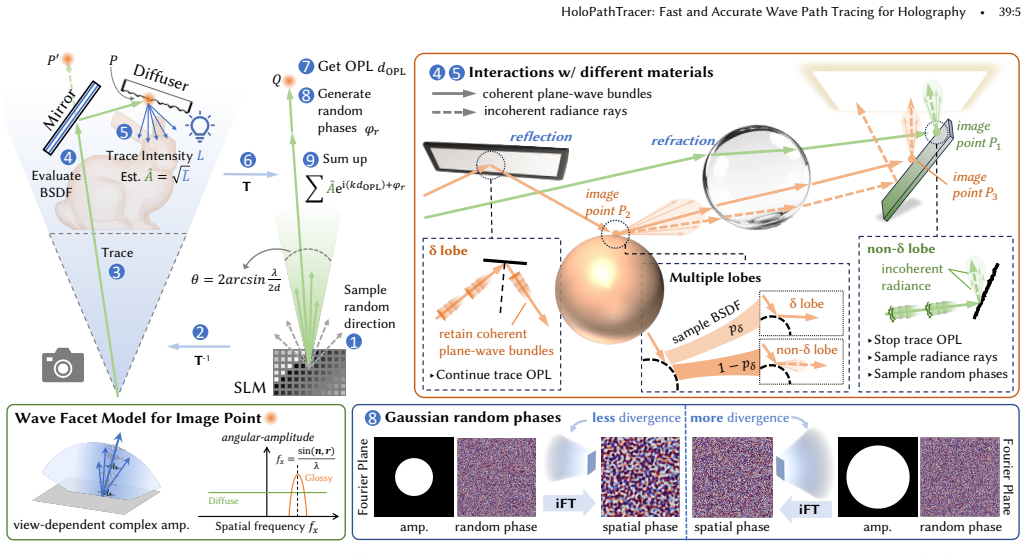
Monte Carlo path tracing that simultaneously approximates both the rendering equation and the Rayleigh-Sommerfeld integral, with path reuse across multiplexed holograms and an ambient radiance cache for variance reduction.
If this is right
- Holograms can display depth-continuous focus and view-dependent reflections without pre-baking radiance on discretized sectors.
- Existing graphics pipelines that already implement path tracing become directly usable for hologram generation.
- Multiple random phase holograms can be produced at little extra cost once the path cache is built.
- An order-of-magnitude reduction in samples is achieved while the physical link between radiance and diffraction is retained.
Where Pith is reading between the lines
- The same joint-sampling idea could be tested on other coherent displays such as light-field or volumetric projectors.
- If variance remains controllable, the approach might allow real-time hologram updates for dynamic scenes once hardware acceleration for the cache is added.
- Material models already validated in path tracers (measured BRDFs, participating media) would transfer to holography without new wave-specific derivations.
Load-bearing premise
Monte Carlo sampling of light paths can approximate the wave integral to the hologram plane with low enough bias and variance that the final phase pattern still reproduces the intended visual effects.
What would settle it
A side-by-side capture in which a scene with known glossy reflection and a known focal plane is reconstructed from the generated hologram and the observed blur and highlight shapes deviate measurably from the same scene rendered with a conventional wave-optics simulator.
Figures

read the original abstract
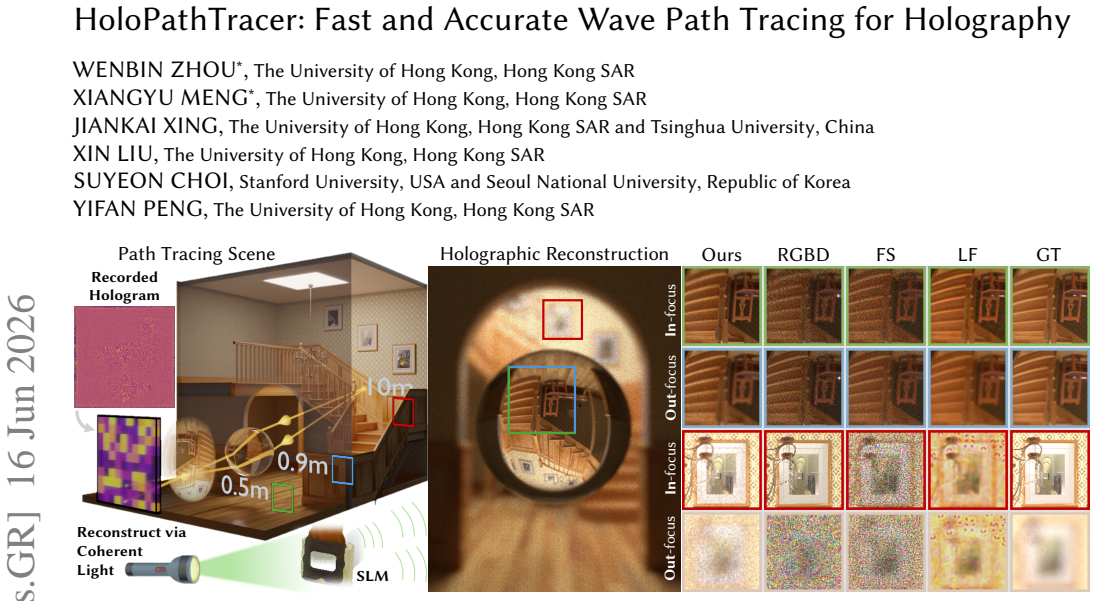
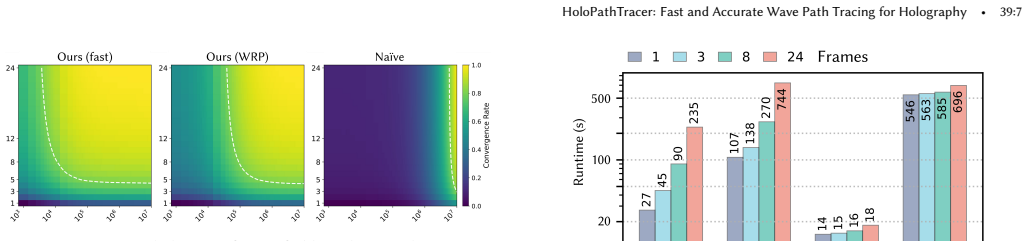
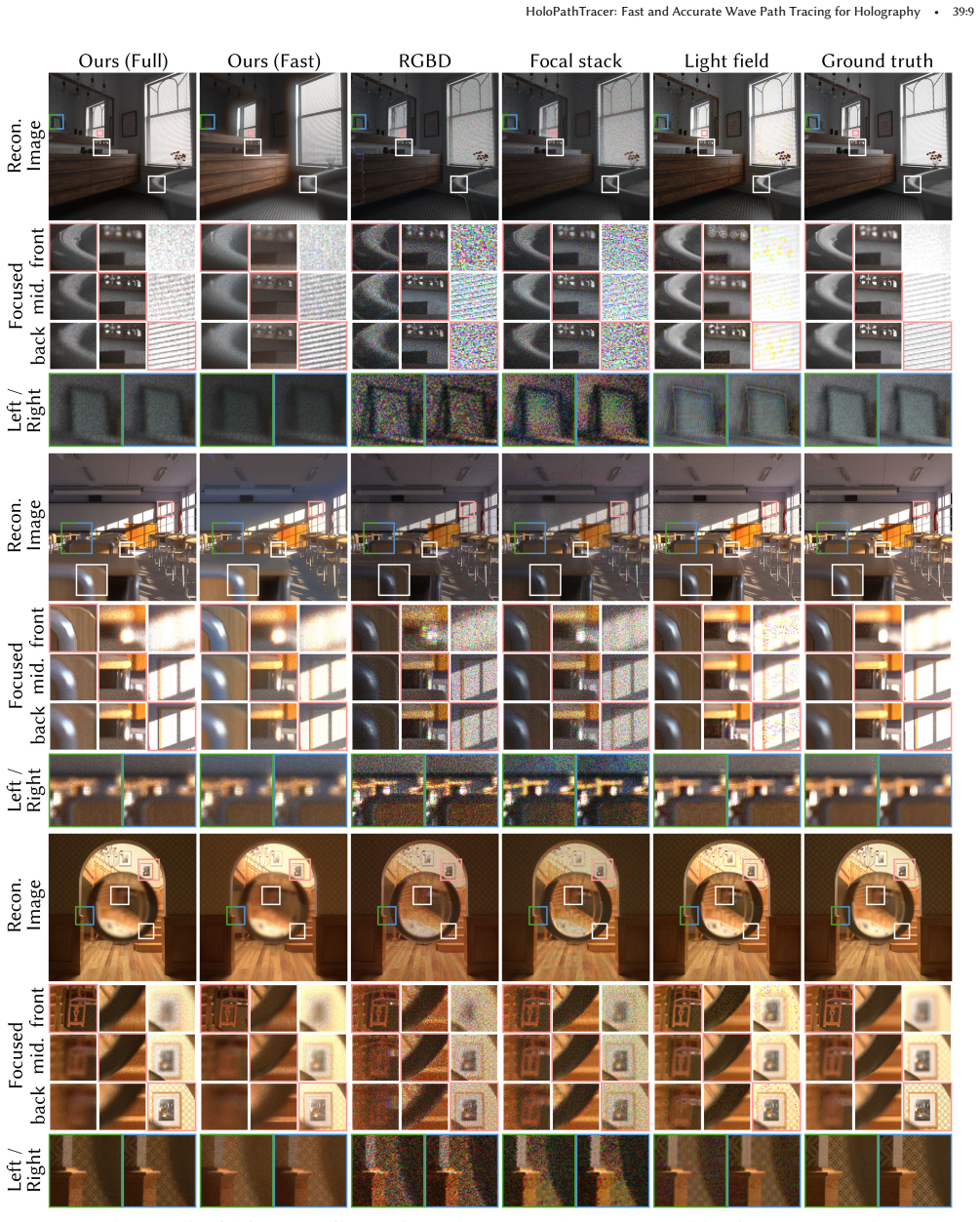
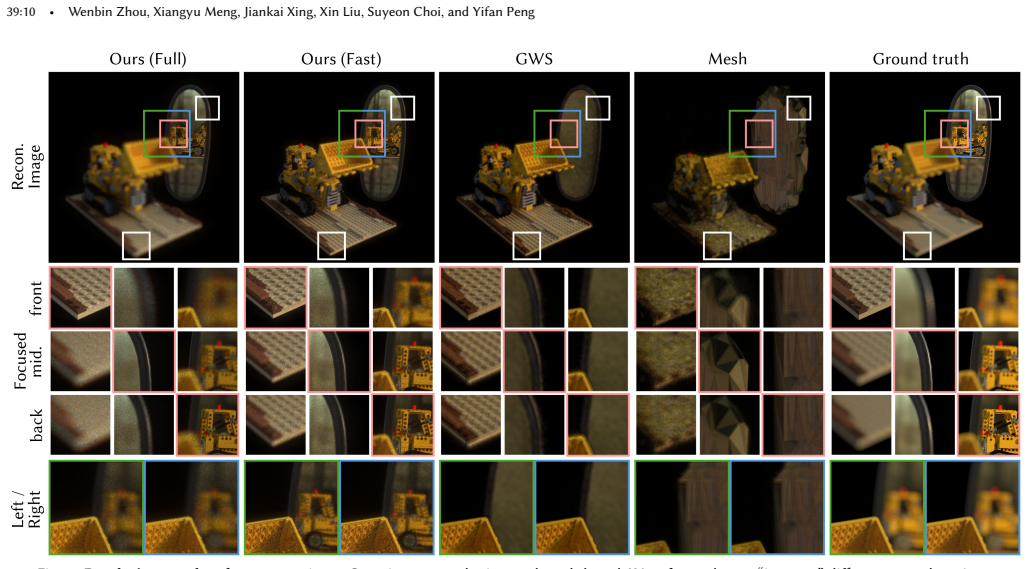
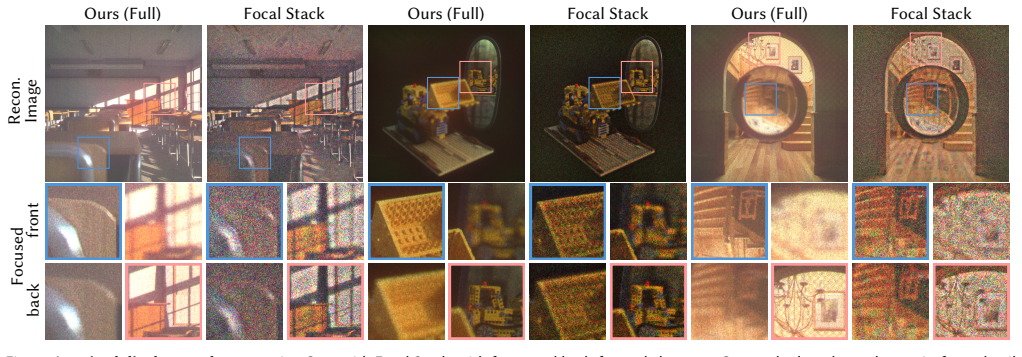
Holography offers unique advantages for delivering perceptual realism while preserving compact form factors in VR/AR. Its perceptual quality, however, hinges on encoding rich wavefronts of photorealistic scenes into interference patterns and then incoherently multiplexing the resulting wave fields for perception. Existing CGH paradigms decouple radiance estimation from wave propagation by pre-rendering radiance on discretized scene sectors. This separation between radiometric and wave-optical computation inherently limits the range of focus cues and visual effects that can be faithfully reproduced, including depth- and view-continuity, and physically based material behaviors such as glossy or mirror-like reflection and refraction. We present a physically accurate yet computationally efficient wave optics rendering framework leveraging path tracing to encode full 3D visual cues into phase holograms. Specifically, we employ a Monte Carlo method to solve both the rendering equation and the Rayleigh--Sommerfeld integral simultaneously. Our algorithm is fully compatible with modern graphics techniques and can generate multiple time-multiplexed random holograms with minimal additional time cost via Path Reuse. By employing a fast approximation with an ambient radiance cache, we realize an order of magnitude convergence speed improvement. The resulting coherent wave fields that inherently encode comprehensive visual effects are converted into phase-only holograms under complex-amplitude supervision. Through extensive simulations and experimental validations on a spatial light modulator-based display prototype, we demonstrate faithful holographic reconstructions of natural 3D cues and complex materials, including realistic defocus blur, view-dependent effects, as well as appearance highlights and reflections.
Editorial analysis
A structured set of objections, weighed in public.
Referee Report
Summary. The manuscript presents HoloPathTracer, a Monte Carlo wave path tracing framework that jointly solves the rendering equation and Rayleigh-Sommerfeld integral to encode full 3D visual cues (defocus blur, view-dependent effects, highlights, reflections) directly into phase-only holograms. It incorporates path reuse for time-multiplexed holograms and an ambient radiance cache for an order-of-magnitude speedup, with claims of physical accuracy, compatibility with modern graphics techniques, and validation via simulations plus an SLM-based display prototype.
Significance. If the quantitative results and error analysis support the claims, the work would be significant for unifying radiometric rendering with wave optics in a single path-tracing pipeline, overcoming the decoupling limitation of prior CGH methods and enabling more faithful reproduction of complex materials and continuous focus cues in holographic VR/AR displays. The path-reuse and caching strategies, if shown to preserve fidelity, would be practical contributions.
major comments (2)
- [Abstract] Abstract: the central claims of 'order of magnitude convergence speed improvement' and 'faithful holographic reconstructions' of natural 3D cues and complex materials rest on high-level description only; no quantitative metrics (e.g., PSNR/SSIM vs. baselines, runtime tables, error bars, or variance analysis) are supplied to substantiate the speedup or accuracy assertions.
- [Method] Method description (Monte Carlo joint solver and ambient radiance cache): the assumption that Monte Carlo sampling can simultaneously approximate both the rendering equation and Rayleigh-Sommerfeld integral without prohibitive variance or bias, and that the cache preserves physical fidelity, is load-bearing for the accuracy claim but lacks supporting analysis, bias/variance bounds, or ablation results.
minor comments (2)
- Notation for the joint integral and path-reuse mechanism should be defined with explicit equations rather than prose only.
- The experimental validation paragraph would benefit from a table summarizing quantitative comparisons to prior CGH methods.
Simulated Author's Rebuttal
We thank the referee for the constructive feedback. We address each major comment below and describe the planned revisions.
read point-by-point responses
-
Referee: [Abstract] Abstract: the central claims of 'order of magnitude convergence speed improvement' and 'faithful holographic reconstructions' of natural 3D cues and complex materials rest on high-level description only; no quantitative metrics (e.g., PSNR/SSIM vs. baselines, runtime tables, error bars, or variance analysis) are supplied to substantiate the speedup or accuracy assertions.
Authors: The abstract is written at a high level per convention, while the manuscript body reports runtime comparisons, PSNR/SSIM metrics against baselines, and experimental results from the SLM prototype that support the claims. To address the concern, we will revise the abstract to include explicit quantitative highlights drawn from those results. revision: yes
-
Referee: [Method] Method description (Monte Carlo joint solver and ambient radiance cache): the assumption that Monte Carlo sampling can simultaneously approximate both the rendering equation and Rayleigh-Sommerfeld integral without prohibitive variance or bias, and that the cache preserves physical fidelity, is load-bearing for the accuracy claim but lacks supporting analysis, bias/variance bounds, or ablation results.
Authors: The joint Monte Carlo estimator follows from linearity of expectation applied to the two integrals, permitting unbiased sampling of paths that contribute to both radiometric and wave quantities. The ambient radiance cache is presented as a practical low-variance approximation whose effect on fidelity is assessed via the reported simulations and physical experiments. We will expand the method section with ablation studies on the cache and additional variance statistics in the revision. revision: partial
Circularity Check
No significant circularity identified
full rationale
The paper's central contribution is a new algorithmic integration: a Monte Carlo path-tracing method that simultaneously solves the rendering equation and the Rayleigh-Sommerfeld integral, augmented by path reuse for time-multiplexed holograms and an ambient radiance cache for speed. The abstract and description frame this as a compatible extension of existing graphics techniques, with the resulting wave fields converted to phase-only holograms under complex-amplitude supervision. No equations, fitted parameters, or load-bearing premises are shown reducing the claimed results to prior self-citations, self-definitions, or input data by construction. The approach remains self-contained against external benchmarks of path tracing and wave propagation, with experimental validation on an SLM prototype providing independent falsifiability.
Axiom & Free-Parameter Ledger
axioms (2)
- domain assumption Monte Carlo sampling converges to the joint solution of the rendering equation and Rayleigh-Sommerfeld integral.
- ad hoc to paper The ambient radiance cache approximation maintains physical accuracy for the targeted visual effects.
Reference graph
Works this paper leans on
-
[1]
ACM Transactions on Graphics (TOG) , volume=
Rendering of subjective speckle formed by rough statistical surfaces , author=. ACM Transactions on Graphics (TOG) , volume=. 2022 , publisher=
2022
-
[2]
ACM Transactions on Graphics (TOG) , volume=
A Monte Carlo Rendering Framework for Simulating Optical Heterodyne Detection , author=. ACM Transactions on Graphics (TOG) , volume=. 2025 , publisher=
2025
-
[3]
ACM Transactions on Graphics (TOG) , volume=
A Monte Carlo framework for rendering speckle statistics in scattering media , author=. ACM Transactions on Graphics (TOG) , volume=. 2019 , publisher=
2019
-
[4]
SN Computer Science , volume=
SLM simulation and MonteCarlo path tracing for computer-generated holograms , author=. SN Computer Science , volume=. 2021 , publisher=
2021
-
[5]
SID Symposium Digest of Technical Papers , volume=
83-4: Invited Paper: Filter-Free 3D HoloNet with Hardware-Aware Calibration , author=. SID Symposium Digest of Technical Papers , volume=. 2025 , organization=
2025
-
[6]
Computational Visual Media , year=
Multi-color compressive hologram synthesis with learned wave propagation , author=. Computational Visual Media , year=
-
[7]
Proceedings of the SIGGRAPH Asia 2025 Emerging Technologies , pages=
Empowering Head-up AR: Leveraging Holographic Display Engine, Geometry Optical Combiner, and Learned Calibration , author=. Proceedings of the SIGGRAPH Asia 2025 Emerging Technologies , pages=. 2025 , doi =
2025
-
[8]
IEEE Transactions on Visualization and Computer Graphics , year=
Towards Edge Holography via Implicit Neural Representation and Compression , author=. IEEE Transactions on Visualization and Computer Graphics , year=
-
[9]
Comparison of Wavefront Recording Plane-Based Hologram Calculations: Ray-Tracing Method versus Look-up Table Method , shorttitle =
Yanagihara, Hidenari and Shimobaba, Tomoyoshi and Kakue, Takashi and Ito, Tomoyoshi , year = 2020, journal =. Comparison of Wavefront Recording Plane-Based Hologram Calculations: Ray-Tracing Method versus Look-up Table Method , shorttitle =
2020
-
[10]
2009 , journal =
Simple and Fast Calculation Algorithm for Computer-Generated Hologram with Wavefront Recording Plane , author =. 2009 , journal =
2009
-
[11]
Benedikt Bitterli , Year =
-
[12]
Mitchell, Jason and McTaggart, Gary and Green, Chris , title =. 2006 , isbn =. doi:10.1145/1185657.1185832 , booktitle =
-
[13]
2023 , journal =
Modeling Off-Axis Diffraction with the Least-Sampling Angular Spectrum Method , author =. 2023 , journal =
2023
-
[14]
Review of scientific instruments , volume=
An interferometric method for local phase modulation calibration of LC-SLM using self-generated phase grating , author=. Review of scientific instruments , volume=. 2018 , publisher=
2018
-
[15]
ACM Transactions on Graphics (TOG) , volume=
Gaussian wave splatting for computer-generated holography , author=. ACM Transactions on Graphics (TOG) , volume=. 2025 , doi =
2025
-
[16]
Multi-depth hologram generation using stochastic gradient descent algorithm with complex loss function , volume =
Chun Chen and Byounghyo Lee and Nan-Nan Li and Minseok Chae and Di Wang and Qiong-Hua Wang and Byoungho Lee , journal =. Multi-depth hologram generation using stochastic gradient descent algorithm with complex loss function , volume =. 2021 , url =
2021
-
[17]
Synthetic aperture waveguide holography for compact mixed-reality displays with large
Choi, Suyeon and Jang, Changwon and Lanman, Douglas and Wetzstein, Gordon , journal=. Synthetic aperture waveguide holography for compact mixed-reality displays with large. 2025 , publisher=
2025
-
[18]
IEEE Transactions on Computational Imaging , volume=
do: A differentiable engine for deep lens design of computational imaging systems , author=. IEEE Transactions on Computational Imaging , volume=. 2022 , publisher=
2022
-
[19]
ACM Transactions on Graphics (TOG) , volume=
Artifact-Resilient Real-Time Holography , author=. ACM Transactions on Graphics (TOG) , volume=. 2025 , publisher=
2025
-
[20]
IEEE Transactions on Visualization and Computer Graphics , year=
Multi-illumination-interfered Neural Holography with Expanded Eyebox , author=. IEEE Transactions on Visualization and Computer Graphics , year=
-
[21]
Optics Letters , volume=
3D-HoloNet: fast, unfiltered, 3D hologram generation with camera-calibrated network learning , author=. Optics Letters , volume=. 2025 , publisher=
2025
-
[22]
ACM Transactions on Graphics (TOG) , volume=
Holographic parallax improves 3D perceptual realism , author=. ACM Transactions on Graphics (TOG) , volume=. 2024 , publisher=
2024
-
[23]
Nature , pages=
Full-colour 3D holographic augmented-reality displays with metasurface waveguides , author=. Nature , pages=. 2024 , publisher=
2024
-
[24]
Nature communications , volume=
Propagation-adaptive 4K computer-generated holography using physics-constrained spatial and Fourier neural operator , author=. Nature communications , volume=. 2025 , publisher=
2025
-
[25]
2023 IEEE International Conference on Computational Photography (ICCP) , pages=
Stochastic light field holography , author=. 2023 IEEE International Conference on Computational Photography (ICCP) , pages=. 2023 , organization=
2023
-
[26]
2023 IEEE Conference Virtual Reality and 3D User Interfaces (VR) , pages=
Realistic defocus blur for multiplane computer-generated holography , author=. 2023 IEEE Conference Virtual Reality and 3D User Interfaces (VR) , pages=. 2023 , organization=
2023
-
[27]
Tseng, Ethan and Kuo, Grace and Baek, Seung-Hwan and Matsuda, Nathan and Maimone, Andrew and Schiffers, Florian and Chakravarthula, Praneeth and Fu, Qiang and Heidrich, Wolfgang and Lanman, Douglas and others , journal=. Neural. 2024 , publisher=
2024
-
[28]
ACM Transactions on Graphics (TOG) , volume=
Accommodative holography: improving accommodation response for perceptually realistic holographic displays , author=. ACM Transactions on Graphics (TOG) , volume=. 2022 , publisher=
2022
-
[29]
IEEE Photonics Journal , volume=
Photorealistic rapid computer-generated holography employing an enhanced path tracing technique with sequence generated trial , author=. IEEE Photonics Journal , volume=. 2023 , publisher=
2023
-
[30]
Light: Advanced Manufacturing , volume=
The state-of-the-art in computer generated holography for 3D display , author=. Light: Advanced Manufacturing , volume=. 2022 , publisher=
2022
-
[31]
Photonics Research , volume=
Review of fast methods for point-based computer-generated holography , author=. Photonics Research , volume=. 2018 , publisher=
2018
-
[32]
ACM Transactions on Graphics (TOG) , volume=
Path-space manipulation of physically-based light transport , author=. ACM Transactions on Graphics (TOG) , volume=. 2013 , publisher=
2013
-
[33]
ACM Transactions on Graphics (TOG) , volume=
Renderman: An advanced path-tracing architecture for movie rendering , author=. ACM Transactions on Graphics (TOG) , volume=. 2018 , publisher=
2018
-
[34]
IEEE Transactions on Pattern Analysis and Machine Intelligence , year=
Learned off-aperture Encoding for Wide Field-of-view RGBD Imaging , author=. IEEE Transactions on Pattern Analysis and Machine Intelligence , year=
-
[35]
ACM Transactions on Graphics (TOG) , volume=
Rendering specular microgeometry with wave optics , author=. ACM Transactions on Graphics (TOG) , volume=. 2018 , publisher=
2018
-
[36]
ACM Transactions on Graphics (TOG) , volume=
A generic framework for physical light transport , author=. ACM Transactions on Graphics (TOG) , volume=. 2021 , publisher=
2021
-
[37]
Computers in Physics , volume=
Computer-generated holograms: A simplified ray-tracing approach , author=. Computers in Physics , volume=. 1992 , publisher=
1992
-
[38]
Applied Optics , volume=
Realistic rendering method for specular reflections with continuous motion parallax in a computer-generated hologram , author=. Applied Optics , volume=. 2024 , publisher=
2024
-
[39]
ACM Transactions on Graphics (TOG) , volume=
Designing and Fabricating Color BRDFs with Differentiable Wave Optics , author=. ACM Transactions on Graphics (TOG) , volume=. 2025 , publisher=
2025
-
[40]
ACM Transactions on Graphics (TOG) , volume=
A Fully-statistical Wave Scattering Model for Heterogeneous Surfaces , author=. ACM Transactions on Graphics (TOG) , volume=. 2025 , publisher=
2025
-
[41]
ACM Transactions on Graphics (TOG) , volume=
A full-wave reference simulator for computing surface reflectance , author=. ACM Transactions on Graphics (TOG) , volume=. 2023 , publisher=
2023
-
[42]
Optics Letters , volume=
Photorealistic computer generated holography with global illumination and path tracing , author=. Optics Letters , volume=. 2021 , publisher=
2021
-
[43]
Optics Express , volume=
Acceleration and expansion of a photorealistic computer-generated hologram using backward ray tracing and multiple off-axis wavefront recording plane methods , author=. Optics Express , volume=. 2020 , publisher=
2020
-
[44]
IEEE Transactions on Industrial Informatics , volume=
Review of fast algorithms and hardware implementations on computer holography , author=. IEEE Transactions on Industrial Informatics , volume=. 2015 , publisher=
2015
-
[45]
Applied Optics , volume=
Extremely high-definition full-parallax computer-generated hologram created by the polygon-based method , author=. Applied Optics , volume=. 2009 , publisher=
2009
-
[46]
Accurate Encoding of Arbitrary Complex Fields with Amplitude-Only Liquid Crystal Spatial Light Modulators , author =. 2005 , journal =. doi:10.1364/OPEX.13.007913 , urldate =
-
[47]
2019 , journal =
Wirtinger Holography for Near-Eye Displays , author =. 2019 , journal =
2019
-
[48]
Chakravarthula, Praneeth and Tseng, Ethan and Fuchs, Henry and Heide, Felix , year =. Hogel-. ACM Transactions on Graphics (TOG) , volume =. doi:10.1145/3516428 , urldate =
-
[49]
Optics express , volume=
Roadmap on digital holography , author=. Optics express , volume=. 2021 , publisher=
2021
-
[50]
Advances in Optics and Photonics , volume=
AR/VR light engines: perspectives and challenges , author=. Advances in Optics and Photonics , volume=. 2022 , publisher=
2022
-
[51]
Light: Science & Applications , volume=
Advanced liquid crystal devices for augmented reality and virtual reality displays: principles and applications , author=. Light: Science & Applications , volume=. 2022 , publisher=
2022
-
[52]
Optics Letters , volume=
Optimization of computer-generated holograms featuring phase randomness control , author=. Optics Letters , volume=. 2021 , publisher=
2021
-
[53]
Proceedings of the 33rd ACM International Conference on Multimedia , pages=
Phase Distribution Matters: On the Importance of Phase Distribution Alignment (PDA) in Holographic Applications , author=. Proceedings of the 33rd ACM International Conference on Multimedia , pages=. 2025 , doi =
2025
-
[54]
Light: Science & Applications , volume=
Non-convex optimization for inverse problem solving in computer-generated holography , author=. Light: Science & Applications , volume=. 2024 , publisher=
2024
-
[55]
Holographic Multiplane Near-Eye Display Based on Amplitude-Only Wavefront Modulation , author =. 2019 , journal =. doi:10.1364/OE.27.030960 , urldate =
-
[56]
Toward the Next-Generation
Chang, Chenliang and Bang, Kiseung and Wetzstein, Gordon and Lee, Byoungho and Gao, Liang , year =. Toward the Next-Generation. Optica , volume =
-
[57]
2021 , journal =
Phase Hologram Optimization with Bandwidth Constraint Strategy for Speckle-Free Optical Reconstruction , author =. 2021 , journal =
2021
-
[58]
Choi, Suyeon and Gopakumar, Manu and Peng, Yifan and Kim, Jonghyun and Wetzstein, Gordon , year =. Neural. ACM Transactions on Graphics (TOG) , volume =
-
[59]
Optimizing Image Quality for Holographic Near-Eye Displays with
Choi, Suyeon and Kim, Jonghyun and Peng, Yifan and Wetzstein, Gordon , year =. Optimizing Image Quality for Holographic Near-Eye Displays with. Optica , volume =. doi:10.1364/OPTICA.410622 , urldate =
-
[60]
ACM SIGGRAPH 2022 Conference Proceedings , pages=
Time-multiplexed neural holography: a flexible framework for holographic near-eye displays with fast heavily-quantized spatial light modulators , author=. ACM SIGGRAPH 2022 Conference Proceedings , pages=. 2022 , doi =
2022
-
[61]
Fienup, J. R. , year =. Reconstruction of an Object from the Modulus of Its. Optics Letters , volume =
-
[62]
Phase Retrieval Algorithms: A Comparison , author =. 1982 , journal =. doi:10.1364/AO.21.002758 , urldate =
-
[63]
Gao, Qiankun and Liu, Juan and Han, Jian and Li, Xin , year =. Monocular. Optics Express , volume =. doi:10.1364/OE.24.017372 , urldate =
-
[64]
, year =
Goodman, Joseph W. , year =. Introduction to
-
[65]
Unfiltered Holography: Optimizing High Diffraction Orders without Optical Filtering for Compact Holographic Displays , author =. 2021 , journal =. doi:10.1364/OL.442851 , urldate =
-
[66]
Waveguide Holography for
Jang, Changwon and Bang, Kiseung and Chae, Minseok and Lee, Byoungho and Lanman, Douglas , year =. Waveguide Holography for. Nature Communications , volume =
-
[67]
Biomedical Optics Express , volume=
Vision-correcting holographic display: evaluation of aberration correcting hologram , author=. Biomedical Optics Express , volume=. 2021 , publisher=
2021
-
[68]
Space Bandwidth Product Enhancement of Holographic Display Using High-Order Diffraction Guided by Holographic Optical Element , author =. 2015 , journal =. doi:10.1364/OE.23.033170 , urldate =
-
[69]
Liu, Ninghe and Huang, Zhengzhong and He, Zehao and Cao, Liangcai , year =. Optics Express , volume =. doi:10.1364/OE.489639 , urldate =
-
[70]
Holographic Near-Eye Displays for Virtual and Augmented Reality , author =. 2017 , journal =. doi:10.1145/3072959.3073624 , urldate =
-
[71]
Markley, Eric and Matsuda, Nathan and Schiffers, Florian and Cossairt, Oliver and Kuo, Grace , year =. Simultaneous. doi:10.1145/3610548.3618250 , urldate =
-
[72]
Model-Based Compensation of Pixel Crosstalk in Liquid Crystal Spatial Light Modulators , author =. 2019 , journal =. doi:10.1364/OE.27.025046 , urldate =
-
[73]
Nam, Seung-Woo and Kim, Youngjin and Kim, Dongyeon and Jeong, Yoonchan , year =. Depolarized. ACM Transactions on Graphics , volume =. doi:10.1145/3618395 , urldate =
-
[74]
2019 , journal =
Holographic Near-Eye Displays Based on Overlap-Add Stereograms , author =. 2019 , journal =
2019
-
[75]
Characteristics of Complex Light Modulation through an Amplitude-Phase Double-Layer Spatial Light Modulator , author =. 2017 , journal =. doi:10.1364/OE.25.003469 , urldate =
-
[76]
2020 , journal =
Neural Holography with Camera-in-the-Loop Training , author =. 2020 , journal =
2020
-
[77]
2021 , journal =
Speckle-Free Holography with Partially Coherent Light Sources and Camera-in-the-Loop Calibration , author =. 2021 , journal =
2021
-
[78]
Reducing the Effect of Pixel Crosstalk in Phase Only Spatial Light Modulators , author =. 2012 , journal =. doi:10.1364/OE.20.022334 , urldate =
-
[79]
Phase Recovery and Holographic Image Reconstruction Using Deep Learning in Neural Networks , author =. 2018 , journal =. doi:10.1038/lsa.2017.141 , urldate =
-
[81]
Near-Eye Light Field Holographic Rendering with Spherical Waves for Wide Field of View Interactive
Shi, Liang and Huang, Fu-Chung and Lopes, Ward and Matusik, Wojciech and Luebke, David , year =. Near-Eye Light Field Holographic Rendering with Spherical Waves for Wide Field of View Interactive. ACM Trans. Graph. , volume =. doi:10.1145/3130800.3130832 , urldate =
discussion (0)
Sign in with ORCID, Apple, or X to comment. Anyone can read and Pith papers without signing in.