Zeros of the partition function for 12 flavor QCD
Pith reviewed 2026-06-27 05:02 UTC · model grok-4.3
The pith
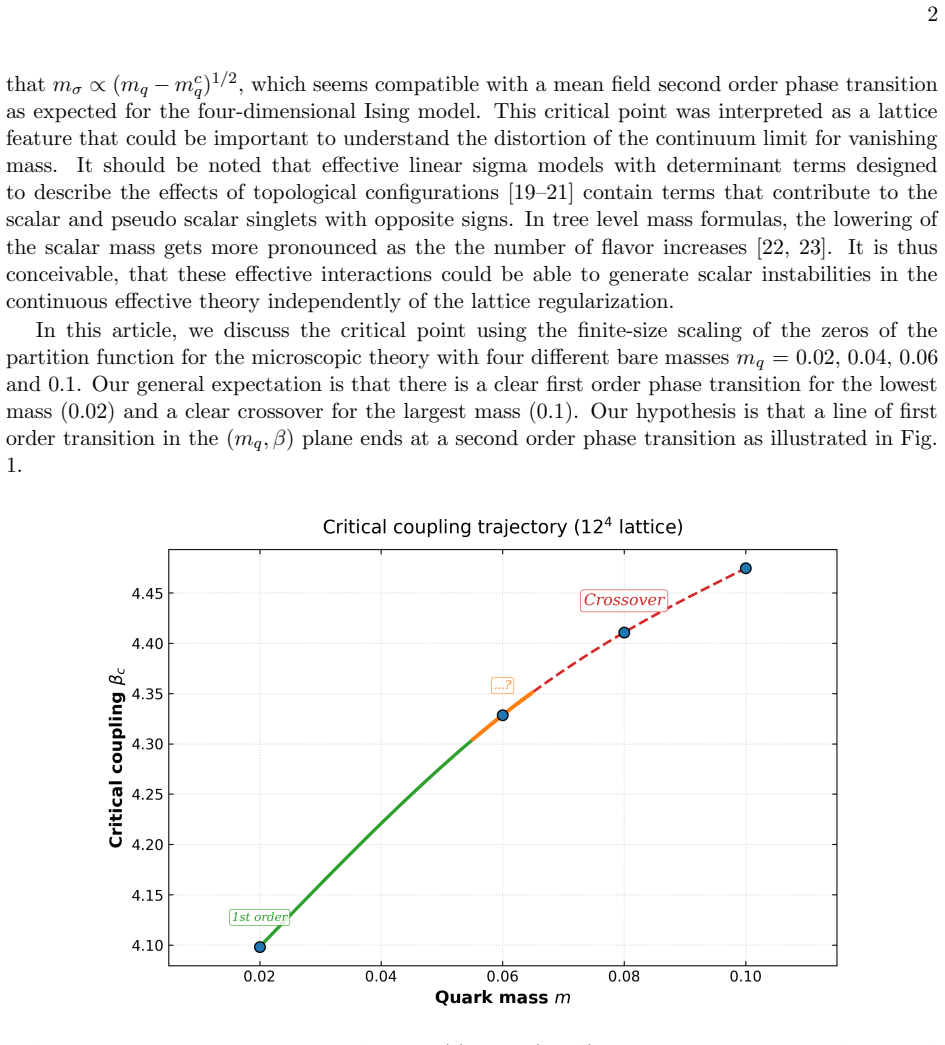
The zeros of the partition function indicate a first-order phase transition for small quark masses in 12-flavor lattice QCD that ends at a critical point near mq=0.05.
A machine-rendered reading of the paper's core claim, the machinery that carries it, and where it could break.
Core claim
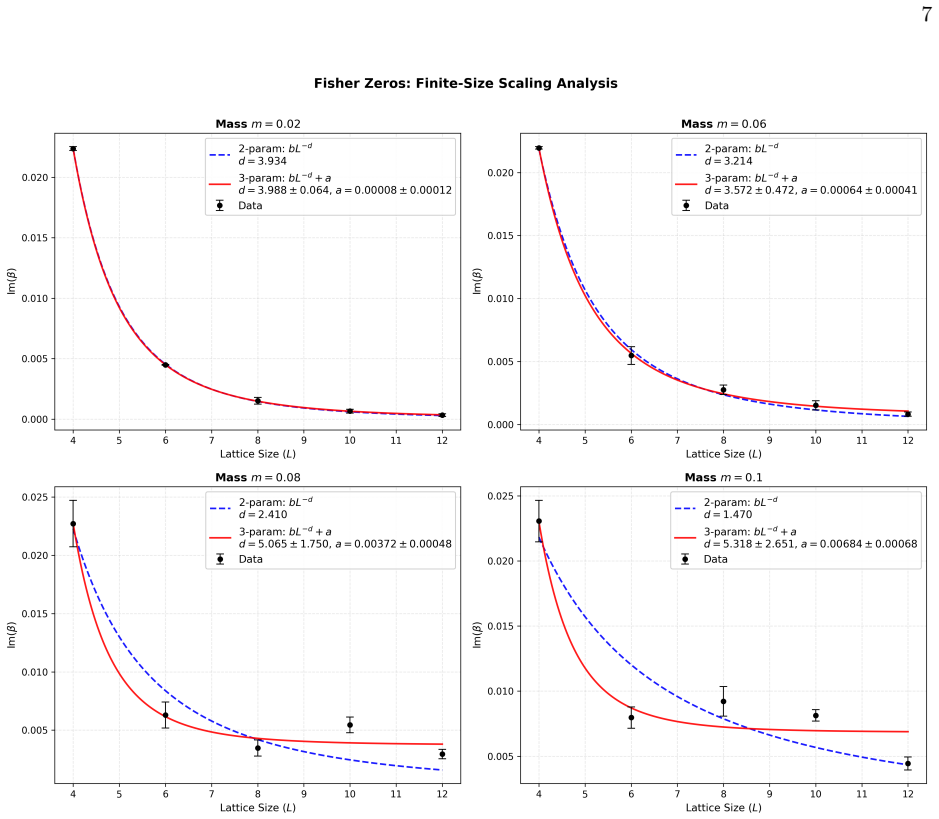
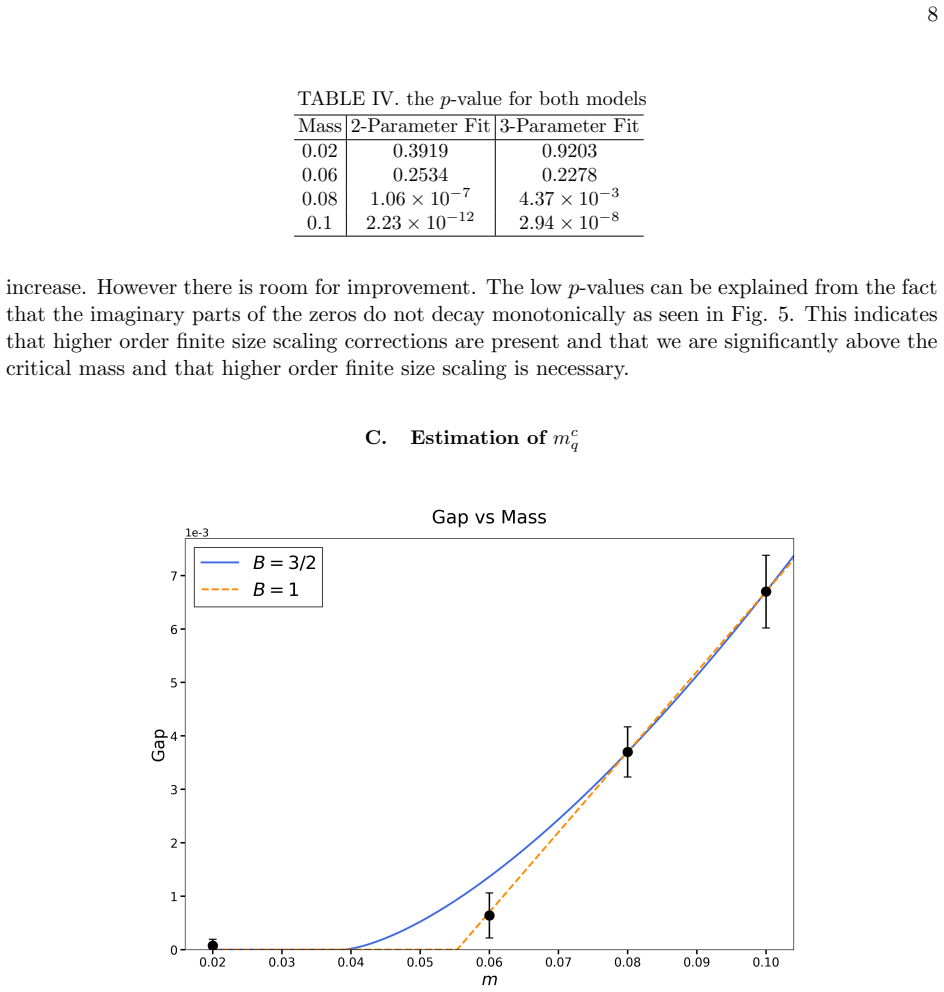
Fits of the lowest imaginary-part zero to y = b L^{-d} and y = a + b L^{-d} give d=3.98(6) and a statistically compatible with zero at mq=0.02, indicating a first-order transition. The three higher masses lie above the critical value mq^c. The infinite-volume gaps a are represented as a ≃ A (mq − mq^c)^B with mq^c ∼ 0.05 and B ∼ 1. Combined with spectroscopic results, the real-axis gap scales roughly as m_sigma^2 where m_sigma is the 0++ scalar mass.
What carries the argument
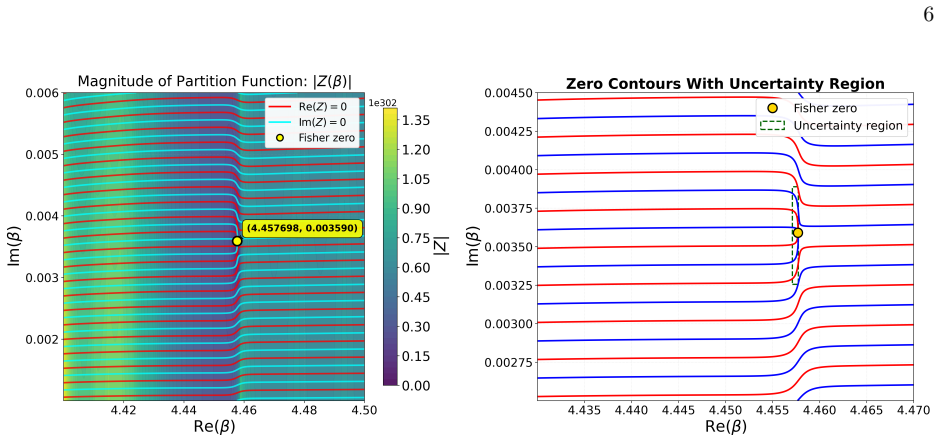
The lowest imaginary-part zeros of the partition function in the complex beta plane and their finite-size scaling with lattice linear size L.
If this is right
- A first-order transition occurs for mq below approximately 0.05.
- The critical mass separating first-order from crossover behavior is near 0.05.
- The infinite-volume gap follows a power law with exponent near 1.
- The real-axis gap scales approximately as the square of the lightest scalar mass.
Where Pith is reading between the lines
- The endpoint of the first-order line lies near mq=0.05 in the phase diagram.
- A value of B near 1 rather than the mean-field 3/2 may reflect corrections or a different effective exponent.
- The reported scaling with m_sigma^2 ties the gap directly to the lightest excitation in the spectrum.
Load-bearing premise
The imaginary part of the lowest zero obeys the two- or three-parameter scaling forms in L, and the resulting infinite-volume gaps follow a simple power law fitted to only three data points.
What would settle it
A computation of the same zeros on lattices larger than L=12 at mq=0.02 that yields an exponent clearly different from 4 or a clearly nonzero infinite-volume intercept a.
Figures
read the original abstract
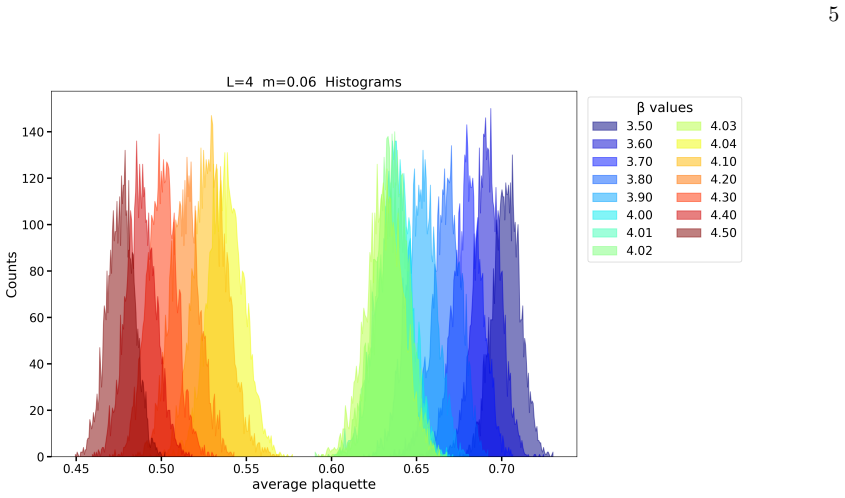
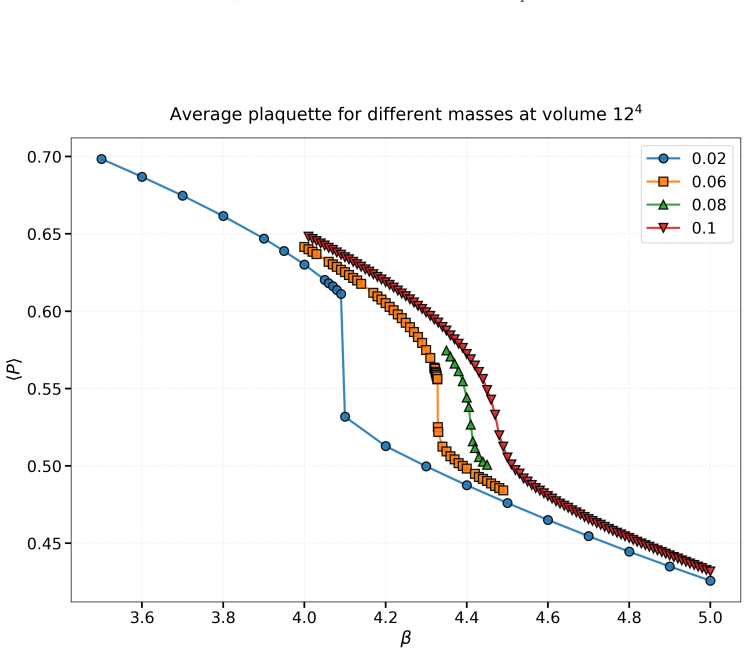
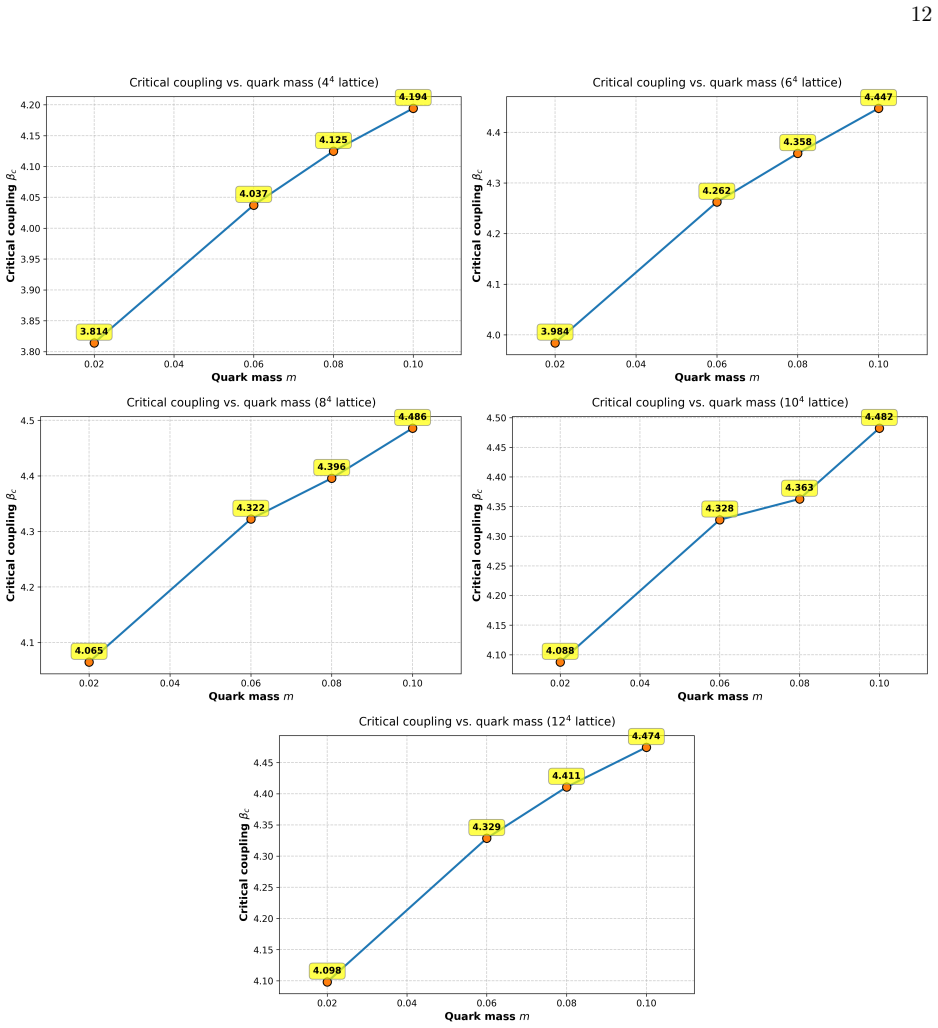
We consider a four dimensional $SU(3)$ lattice gauge theory with 12 staggered fermions having identical masses and an unimproved action. Using sets of plaquette distributions for various inverse bare couplings $\beta$, we reconstruct the density of states with the Ferrenberg -Swendsen method and calculate the zeros of the partition in the complex $\beta$ plane with bare quark masses $m_q$ = 0.02, 0.06, 0.08 and 0.1 for hypercubes of linear size $L$= 4, 6, 8, 10, and 12. Our hypothesis is that there is a line of first order transitions in the $(m_q,\beta)$ plane ending at a second order phase transition. We expect this transition to be in the 4D Ising, mean field, universality class. We fit the $L$ dependence of the zeros with the lowest imaginary part using two ($y = bL^{-d}$) and three ($y = a + bL^{-d}$) parameter fits. For $m_q$ = 0.02 the results provide strong support for a first order phase transition ($d=3.98(6)$, and $a$ statistically compatible with 0). The results also indicate, with less statistical significance for $m_q=0.06$, that the three other masses are above the critical value $m_q^c$. In addition, we suggest that the infinite volume gap for the lowest zero $a$, can be represented as $a\simeq A(m_q-m_q^c)^{B}$ with $m_q^c\sim 0.05$ and $B\sim 1$. Given that there are only three data points with significant error bars, it is difficult to rule out the mean field value $B=3/2$. Combining this result with spectroscopic results by Jin and Mawhinney, indicates that the gap with real axis (Lee-Yang edge) scales roughly like $m_\sigma ^2$, where $m_\sigma $ is the mass of the $0^{++}$ scalar which is also the lowest excitation.
Editorial analysis
A structured set of objections, weighed in public.
Referee Report
Summary. The manuscript studies 12-flavor SU(3) lattice QCD with staggered fermions using the Ferrenberg-Swendsen reweighting method to reconstruct the density of states from plaquette histograms. It locates the zeros of the partition function in the complex β-plane for mq = 0.02, 0.06, 0.08, 0.1 on L = 4–12 lattices, performs two- and three-parameter finite-size scaling fits (y = b L^{-d} and y = a + b L^{-d}) to the lowest imaginary-part zero, and reports d = 3.98(6) with a consistent with zero at mq = 0.02 as evidence for a first-order transition. It further proposes that the infinite-volume gap a obeys a ≃ A (mq − mq^c)^B with mq^c ∼ 0.05 and B ∼ 1, and combines this with spectroscopic data to relate the gap to m_σ².
Significance. If the scaling results hold, the work would supply direct lattice evidence via partition-function zeros for a line of first-order transitions in the (mq, β) plane that terminates at a second-order endpoint, with implications for the conformal window in many-flavor QCD. The approach is standard in the field and the reported d ≈ 4 for mq = 0.02 is internally consistent with the first-order hypothesis, but the quantitative extraction of mq^c and B rests on limited data.
major comments (3)
- [L-dependence fits for mq=0.02] Finite-size scaling analysis for mq = 0.02: the three-parameter fit y = a + b L^{-d} that yields d = 3.98(6) and a statistically compatible with zero is performed on L = 4,6,8,10,12; with these modest volumes, O(L^{-d-1}) or analytic corrections can bias the extracted d and a, yet no systematic study of fit stability, χ² values, or alternative correction terms is presented.
- [suggested infinite volume gap scaling a ≃ A(mq−mq^c)^B] Infinite-volume gap scaling: the power-law form a ≃ A (mq − mq^c)^B is fitted directly to the three available points (mq = 0.02, 0.06, 0.08) with their reported error bars to obtain mq^c ∼ 0.05 and B ∼ 1; this underconstrained three-parameter fit is sensitive to which points are retained and to the size of the uncertainties on a, rendering both mq^c and the distinction from the mean-field value B = 3/2 (explicitly noted as difficult to rule out) dependent on the fit details rather than an independent prediction.
- [results for mq=0.06] Statistical robustness for mq = 0.06: the claim that this mass lies above mq^c rests on the same L-scaling procedure but with lower statistical significance; the text does not quantify how the reweighting accuracy or histogram overlap affects the error bars on the extracted a values used in the subsequent power-law fit.
minor comments (2)
- The abstract omits any mention of statistical errors on the fitted parameters, the accuracy or overlap quality of the Ferrenberg-Swendsen reweighting, or criteria for data exclusion in the fits.
- Notation for the scaling forms y = b L^{-d} and y = a + b L^{-d} is introduced without an explicit equation number or table summarizing the fit parameters and χ² for all mq values.
Simulated Author's Rebuttal
We thank the referee for the careful reading and constructive comments on our manuscript. We address each major comment point by point below.
read point-by-point responses
-
Referee: [L-dependence fits for mq=0.02] Finite-size scaling analysis for mq = 0.02: the three-parameter fit y = a + b L^{-d} that yields d = 3.98(6) and a statistically compatible with zero is performed on L = 4,6,8,10,12; with these modest volumes, O(L^{-d-1}) or analytic corrections can bias the extracted d and a, yet no systematic study of fit stability, χ² values, or alternative correction terms is presented.
Authors: We agree that the modest volumes call for additional diagnostics. In the revised manuscript we will report χ²/dof for both the two- and three-parameter fits and present results of fits that exclude the L=4 data to test stability. The value of d remains consistent with 4 in the two-parameter fit as well. Adding explicit correction terms would over-parameterize the available data points. revision: yes
-
Referee: [suggested infinite volume gap scaling a ≃ A(mq−mq^c)^B] Infinite-volume gap scaling: the power-law form a ≃ A (mq − mq^c)^B is fitted directly to the three available points (mq = 0.02, 0.06, 0.08) with their reported error bars to obtain mq^c ∼ 0.05 and B ∼ 1; this underconstrained three-parameter fit is sensitive to which points are retained and to the size of the uncertainties on a, rendering both mq^c and the distinction from the mean-field value B = 3/2 (explicitly noted as difficult to rule out) dependent on the fit details rather than an independent prediction.
Authors: We agree the three-point fit is underconstrained. The manuscript already states that distinguishing B ∼ 1 from the mean-field value 3/2 is difficult. We will revise the text to stress that the parametrization is phenomenological and sensitive to the limited data, without claiming it constitutes an independent prediction. revision: partial
-
Referee: [results for mq=0.06] Statistical robustness for mq = 0.06: the claim that this mass lies above mq^c rests on the same L-scaling procedure but with lower statistical significance; the text does not quantify how the reweighting accuracy or histogram overlap affects the error bars on the extracted a values used in the subsequent power-law fit.
Authors: The lower significance for mq = 0.06 is already noted. In revision we will add a brief description of the β-range used for reweighting and the histogram overlap for the mq = 0.06 ensembles to clarify how these affect the uncertainties on the extracted zeros. revision: yes
Circularity Check
No significant circularity; direct numerical fits to lattice data
full rationale
The paper computes partition function zeros from plaquette distributions on L=4..12 lattices using the Ferrenberg-Swendsen method, then performs explicit two- and three-parameter fits (y = b L^{-d} or y = a + b L^{-d}) to the lowest imaginary-part zero for each mq. The reported d≈3.98(6) and a≈0 for mq=0.02, as well as the subsequent suggestion a ≃ A(mq−mq^c)^B fitted to the three extracted a values, are direct outputs of these fits to the computed data rather than any self-definitional loop, renamed prediction, or load-bearing self-citation. The text explicitly notes the limited number of mq points and difficulty distinguishing B=1 from 3/2, confirming the results remain data-driven without reduction to inputs by construction.
Axiom & Free-Parameter Ledger
free parameters (3)
- d =
3.98(6)
- mq^c =
~0.05
- B =
~1
axioms (2)
- domain assumption The second-order endpoint belongs to the 4D Ising mean-field universality class
- domain assumption Ferrenberg-Swendsen reweighting from plaquette distributions accurately reconstructs the density of states in the complex beta plane
Reference graph
Works this paper leans on
-
[1]
Our hypothesis is that there is a line of first order transitions in the (m q, β) plane ending at a second order phase transition. We expect this transition to be in the 4D Ising, mean field, universality class. We fit theLdependence of the zeros with the lowest imaginary part using two (y=bL −d) and three (y=a+bL −d) parameter fits. Form q = 0.02 the res...
Pith/arXiv arXiv 2026
-
[2]
G. Aadet al.(ATLAS), Observation of a new particle in the search for the Standard Model Higgs boson with the ATLAS detector at the LHC, Phys. Lett. B716, 1 (2012), arXiv:1207.7214 [hep-ex]
Pith/arXiv arXiv 2012
-
[3]
S. Chatrchyanet al.(CMS), Observation of a New Boson at a Mass of 125 GeV with the CMS Exper- iment at the LHC, Phys. Lett. B716, 30 (2012), arXiv:1207.7235 [hep-ex]
Pith/arXiv arXiv 2012
-
[4]
Craig, Naturalness: past, present, and future, Eur
N. Craig, Naturalness: past, present, and future, Eur. Phys. J. C83, 825 (2023), arXiv:2205.05708 [hep-ph]
arXiv 2023
-
[5]
X.-Y. Jin and R. D. Mawhinney, Lattice QCD with 8 and 12 degenerate quark flavors, PoSLA T2009, 049 (2009), arXiv:0910.3216 [hep-lat]
Pith/arXiv arXiv 2009
-
[6]
X.-Y. Jin and R. D. Mawhinney, Lattice QCD with 12 Degenerate Quark Flavors, PoSLA TTICE2011, 066 (2011), arXiv:1203.5855 [hep-lat]
Pith/arXiv arXiv 2011
-
[7]
Z. Fodor, K. Holland, J. Kuti, D. Nogradi, C. Schroeder, K. Holland, J. Kuti, D. Nogradi, and C. Schroeder, Twelve massless flavors and three colors below the conformal window, Phys. Lett. B 703, 348 (2011), arXiv:1104.3124 [hep-lat]
Pith/arXiv arXiv 2011
-
[8]
T. Appelquist, G. T. Fleming, M. F. Lin, E. T. Neil, and D. A. Schaich, Lattice Simulations and Infrared Conformality, Phys. Rev. D84, 054501 (2011), arXiv:1106.2148 [hep-lat]
Pith/arXiv arXiv 2011
-
[9]
A. Deuzeman, M. P. Lombardo, T. Nunes da Silva, and E. Pallante, Bulk transitions of twelve flavor QCD andU A(1) symmetry, PoSLA TTICE2011, 321 (2011), arXiv:1111.2590 [hep-lat]
Pith/arXiv arXiv 2011
-
[10]
Y. Aoki, T. Aoyama, M. Kurachi, T. Maskawa, K.-i. Nagai, H. Ohki, A. Shibata, K. Yamawaki, and T. Yamazaki, Lattice study of conformality in twelve-flavor QCD, Phys. Rev. D86, 054506 (2012), arXiv:1207.3060 [hep-lat]
Pith/arXiv arXiv 2012
-
[11]
Kuti, The Higgs particle and the lattice, PoSLA TTICE2013, 004 (2014)
J. Kuti, The Higgs particle and the lattice, PoSLA TTICE2013, 004 (2014)
2014
-
[12]
DeGrand, Lattice tests of beyond Standard Model dynamics, Rev
T. DeGrand, Lattice tests of beyond Standard Model dynamics, Rev. Mod. Phys.88, 015001 (2016), arXiv:1510.05018 [hep-ph]
Pith/arXiv arXiv 2016
-
[13]
A. Hasenfratz and C. T. Peterson, Infrared fixed point in the massless twelve-flavor SU(3) gauge-fermion system, Phys. Rev. D109, 114507 (2024), arXiv:2402.18038 [hep-lat]
arXiv 2024
-
[14]
Y. Aoki, T. Aoyama, E. Bennett, T. Maskawa, K. Miura, H. Ohki, E. Rinaldi, A. Shibata, K. Yamawaki, and T. Yamazaki (LatKMI), Novel view of the flavor-singlet spectrum from multi-flavor QCD on the lattice, Phys. Rev. D112, 114503 (2025), arXiv:2505.08658 [hep-lat]
arXiv 2025
-
[15]
Z. Fodor, K. Holland, J. Kuti, D. Nogradi, and C. H. Wong, Extended investigation of the twelve-flavor β-function, Phys. Lett. B779, 230 (2018), arXiv:1710.09262 [hep-lat]
Pith/arXiv arXiv 2018
-
[16]
J. P. Klinger, R. Kaiser, O. Philipsen, and J. Schaible, On the phase structure of massless many-flavour qcd with staggered fermions (2026), arXiv:2603.20099 [hep-lat]
arXiv 2026
-
[17]
A. Cheng, A. Hasenfratz, and D. Schaich, Novel phase in SU(3) lattice gauge theory with 12 light fermions, Phys. Rev. D85, 094509 (2012), arXiv:1111.2317 [hep-lat]
Pith/arXiv arXiv 2012
-
[18]
X.-Y. Jin and R. D. Mawhinney, Lattice QCD with 12 Quark Flavors: A Careful Scrutiny, inKMI- GCOE Workshop on Strong Coupling Gauge Theories in the LHC Perspective(2014) pp. 96–102, arXiv:1304.0312 [hep-lat]
Pith/arXiv arXiv 2014
-
[19]
Y. Aoki, T. Aoyama, M. Kurachi, T. Maskawa, K.-i. Nagai, H. Ohki, E. Rinaldi, A. Shibata, K. Ya- mawaki, and T. Yamazaki (LatKMI), Light composite scalar in twelve-flavor QCD on the lattice, Phys. Rev. Lett.111, 162001 (2013), arXiv:1305.6006 [hep-lat]
Pith/arXiv arXiv 2013
-
[20]
Rosenzweig, J
C. Rosenzweig, J. Schechter, and C. G. Trahern, Is the effective lagrangian for quantum chromody- namics aσmodel?, Phys. Rev. D21, 3388 (1980). 14
1980
-
[21]
’t Hooft, How Instantons Solve the U(1) Problem, Phys
G. ’t Hooft, How Instantons Solve the U(1) Problem, Phys. Rept.142, 357 (1986)
1986
-
[22]
Meurice, Breaking the Axial U(1) Does Not Enhance Second Class Decays, Mod
Y. Meurice, Breaking the Axial U(1) Does Not Enhance Second Class Decays, Mod. Phys. Lett.A2, 699 (1987)
1987
-
[23]
Meurice, Linear sigma model for multiflavor gauge theories, Phys
Y. Meurice, Linear sigma model for multiflavor gauge theories, Phys. Rev. D96, 114507 (2017), arXiv:1709.09264 [hep-lat]
Pith/arXiv arXiv 2017
-
[24]
Floor, E
D. Floor, E. Gustafson, and Y. Meurice, Phase structure of multiflavor gauge theories: Critical expo- nents of Fisher zeros near the endpoint, PoSLA TTICE2018, 206 (2018)
2018
-
[25]
Z. Gelzer, Y. Liu, Y. Meurice, and D. Sinclair, Fisher zeros and rg flows forsu(3) withn f flavors (2013), arXiv:1312.3906 [hep-lat]
Pith/arXiv arXiv 2013
-
[26]
Z. Gelzer, Y. Liu, and Y. Meurice, Exploring the phase structure of 12-flavorsu(3) (2014), arXiv:1411.3360 [hep-lat]
Pith/arXiv arXiv 2014
-
[27]
D. d. F. e Silva,Critical behavior of multiflavor gauge theories, Ph.D. thesis, The University of Iowa (2018)
2018
-
[28]
W. Janke and R. Kenna, The Strength of first and second order phase transitions from partition function zeroes, J. Statist. Phys.102, 1211 (2001), arXiv:cond-mat/0012026
Pith/arXiv arXiv 2001
-
[29]
Itzykson, R
C. Itzykson, R. B. Pearson, and J. B. Zuber, Distribution of Zeros in Ising and Gauge Models, Nucl. Phys. B220, 415 (1983)
1983
-
[30]
T. D. Lee and C. N. Yang, Statistical theory of equations of state and phase transitions. ii. lattice gas and ising model, Phys. Rev.87, 410 (1952)
1952
-
[31]
Kogut and L
J. Kogut and L. Susskind, Hamiltonian formulation of wilson’s lattice gauge theories, Phys. Rev. D11, 395 (1975)
1975
-
[32]
A. M. Ferrenberg and R. H. Swendsen, Optimized monte carlo data analysis, Phys. Rev. Lett.63, 1195 (1989)
1989
-
[33]
M. E. Fisher, Yang-Lee Edge Singularity and phi**3 Field Theory, Phys. Rev. Lett.40, 1610 (1978)
1978
-
[34]
Wolff, A
U. Wolff, A. Collaboration,et al., Monte carlo errors with less errors, Computer Physics Communica- tions156, 143 (2004)
2004
-
[35]
W. E. Lorensen and H. E. Cline, Marching cubes: A high resolution 3d surface construction algorithm, inSeminal graphics: pioneering efforts that shaped the field(1998) pp. 347–353
1998
-
[36]
J. L. Bentley, Multidimensional binary search trees used for associative searching, Communications of the ACM18, 509 (1975)
1975
discussion (0)
Sign in with ORCID, Apple, or X to comment. Anyone can read and Pith papers without signing in.