Scalable Probabilistic Program Verification via Typed Extended Decision Diagrams
Pith reviewed 2026-06-27 04:38 UTC · model grok-4.3
The pith
Typed extended decision diagrams let deductive verification of probabilistic programs scale by orders of magnitude.
A machine-rendered reading of the paper's core claim, the machinery that carries it, and where it could break.
Core claim
Typed extended decision diagrams (TEDDs) are introduced as a representation for weakest pre-expectations on partially unrolled loops; they are computed directly, pruned via SMT solvers, and used as the domain for lifted proof rules, yielding orders-of-magnitude gains in scalability over prior deductive approaches.
What carries the argument
Typed extended decision diagrams (TEDDs), an extension of binary decision diagrams that encodes typed expressions for quantitative expectations and permits both pruning and rule application without loss of precision.
If this is right
- Verification succeeds on programs whose loop unrollings produce expectations too large for earlier representations.
- SMT pruning becomes effective on a much wider range of partially unrolled loops.
- Existing proof rules for expectations can be reused directly on the diagram representation.
- Automation covers a broader class of discrete probabilistic programs without manual intervention.
Where Pith is reading between the lines
- The same diagram technique could be tested on quantitative properties beyond expectations, such as variance or tail bounds.
- TEDDs might serve as an intermediate format for exchanging results between different probabilistic verifiers.
- If the diagrams remain compact under further unrollings, the method could reduce reliance on loop invariants in some cases.
Load-bearing premise
The size explosion in logical representations of weakest pre-expectations on loops can be avoided by a compact diagram representation that still allows exact SMT pruning and rule lifting.
What would settle it
A set of benchmark programs where the TEDD size after pruning is no smaller than the size of the corresponding explicit or BDD-based representation and verification time shows no improvement.
Figures
read the original abstract
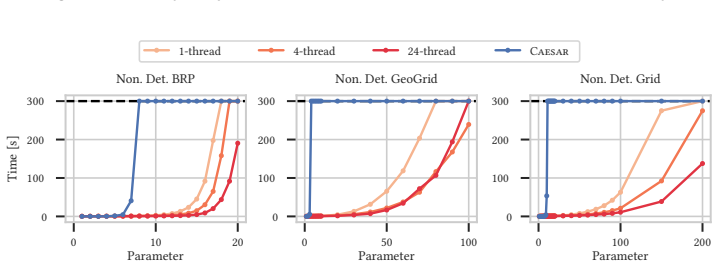
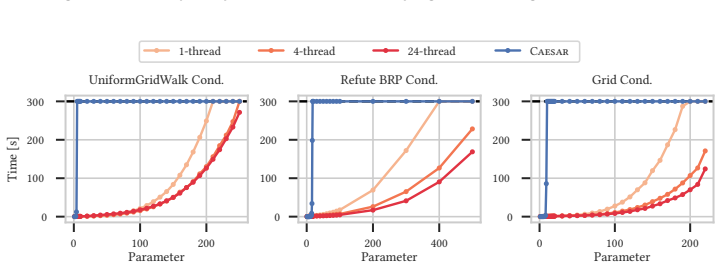
Weakest pre-expectations are the probabilistic program analogue to weakest preconditions in classical programs. Deductive verification approaches aim to establish bounds on these quantitative expectations. Their automation has been successful in analysing a variety of discrete probabilistic programs. Key routines in that automation require reasoning about (partially unrolled) loops, however, the logical representation of weakest pre-expectations on such unrollings often explodes. In this paper, we develop typed extended decision diagrams (TEDDs), inspired by various extensions to binary decision diagrams. We demonstrate computing WPs represented as TEDDs, SMT-based pruning to further shrink their representation, and we lift some proof rules to operate on TEDDs. Finally, we demonstrate that TEDDs boost the scalability of deductive probabilistic program verification by orders of magnitudes over the state of the art.
Editorial analysis
A structured set of objections, weighed in public.
Referee Report
Summary. The paper introduces typed extended decision diagrams (TEDDs) as a representation for weakest pre-expectations arising in deductive verification of discrete probabilistic programs. It describes how to compute WPs directly as TEDDs, apply SMT-based pruning to shrink representations, lift selected proof rules to operate on TEDDs, and claims that the resulting pipeline yields orders-of-magnitude scalability gains over prior state-of-the-art methods when reasoning about partially unrolled loops.
Significance. If the claimed scalability improvements are substantiated by concrete evidence, the work would meaningfully advance automated quantitative verification by mitigating the representation-size explosion that currently limits analysis of loops. The combination of typed decision-diagram extensions with SMT pruning and lifted rules constitutes a technically coherent contribution that builds directly on existing BDD and expectation-calculus literature.
major comments (1)
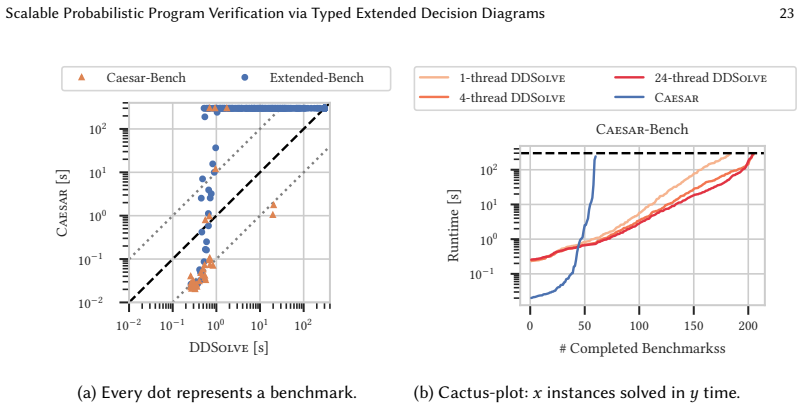
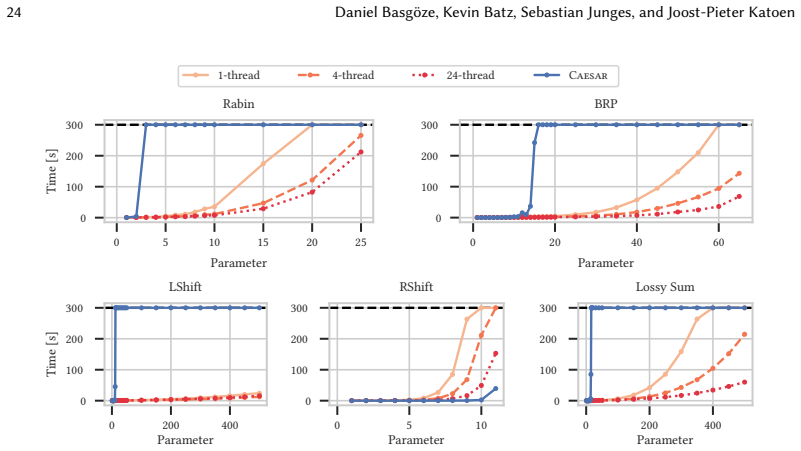
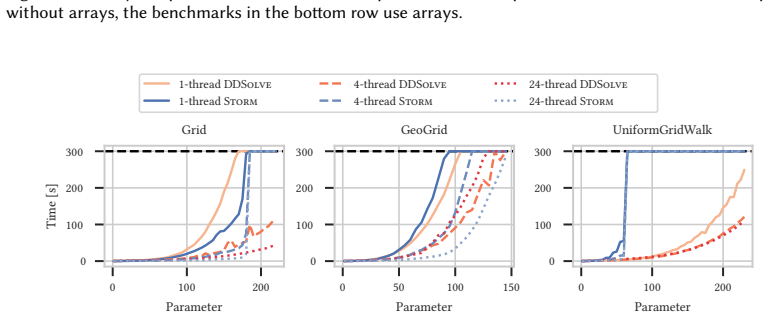
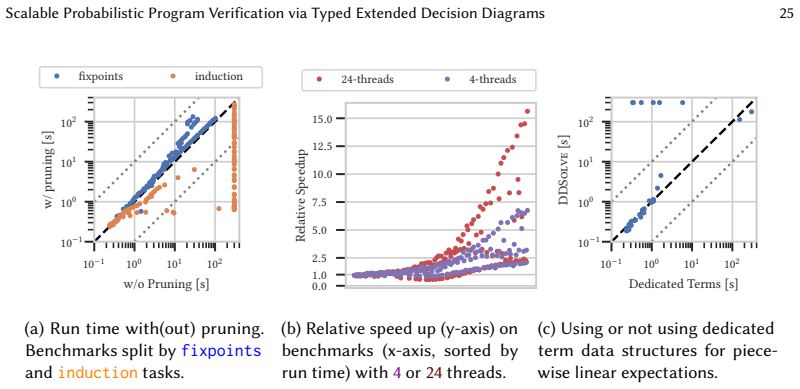
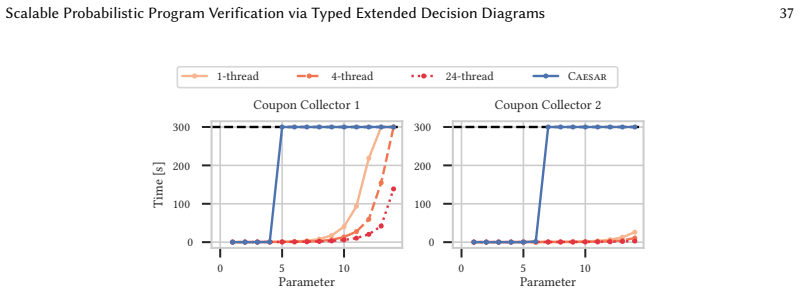
- [Abstract] Abstract: the central claim that TEDDs 'boost the scalability ... by orders of magnitudes' is load-bearing for the paper's contribution yet is stated without any quantitative support (no runtimes, no program sizes, no comparison tables). The experimental evaluation must supply concrete measurements (e.g., wall-clock ratios, maximum loop-unrolling depths handled, and baseline comparisons) to make the claim evaluable.
Simulated Author's Rebuttal
We thank the referee for the constructive feedback. We address the major comment on the abstract below and will revise the manuscript accordingly.
read point-by-point responses
-
Referee: [Abstract] Abstract: the central claim that TEDDs 'boost the scalability ... by orders of magnitudes' is load-bearing for the paper's contribution yet is stated without any quantitative support (no runtimes, no program sizes, no comparison tables). The experimental evaluation must supply concrete measurements (e.g., wall-clock ratios, maximum loop-unrolling depths handled, and baseline comparisons) to make the claim evaluable.
Authors: We agree that the abstract would benefit from a brief quantitative anchor for the scalability claim. The experimental evaluation in Section 5 already contains the requested concrete measurements, including wall-clock runtimes, program sizes, maximum loop-unrolling depths, and direct comparisons against the prior state-of-the-art on the same benchmarks. In the revised manuscript we will update the abstract to include a short summary sentence referencing these results (e.g., “TEDDs enable verification of loops unrolled up to depth 2^10 where prior representations time out, yielding speed-ups of up to three orders of magnitude”). revision: yes
Circularity Check
No significant circularity
full rationale
The paper introduces typed extended decision diagrams (TEDDs) as a new representation for weakest pre-expectations in probabilistic program verification. The abstract and described pipeline (WP computation on partial unrollings, TEDD representation, SMT pruning, lifted proof rules) present a constructive technical development without any equations, fitted parameters, or self-citations that reduce the central claims to their own inputs by definition. No self-definitional steps, fitted-input predictions, or load-bearing self-citation chains are present in the provided material; the scalability claim is an empirical assertion about the new artifact rather than a derivation that collapses to prior fitted values or renamed inputs.
Axiom & Free-Parameter Ledger
Reference graph
Works this paper leans on
-
[1]
Step-indexed logical relations for countable nondeterminism and probabilistic choice.Proc
Alejandro Aguirre and Lars Birkedal. Step-indexed logical relations for countable nondeterminism and probabilistic choice.Proc. ACM Program. Lang., 7(POPL):33–60, 2023. doi: 10.1145/3571195. URL https://doi.org/10.1145/3571195
-
[2]
Alejandro Aguirre, Philipp G. Haselwarter, Markus de Medeiros, Kwing Hei Li, Simon Oddershede Gregersen, Joseph Tassarotti, and Lars Birkedal. Error credits: Resourceful reasoning about error bounds for higher-order probabilistic programs.Proc. ACM Program. Lang., 8(ICFP):284–316, 2024. doi: 10.1145/3674635. URL https://doi.org/10.1145/ 3674635
-
[3]
Constraint-based synthesis of coupling proofs
Aws Albarghouthi and Justin Hsu. Constraint-based synthesis of coupling proofs. InCA V (1), pages 327–346, 2018. doi: 10.1007/978-3-319-96145-3\_18. URL https://dblp.org/rec/conf/cav/AlbarghouthiH18
-
[4]
Synthesizing coupling proofs of differential privacy.Proc
Aws Albarghouthi and Justin Hsu. Synthesizing coupling proofs of differential privacy.Proc. ACM Program. Lang., 2 (POPL):58:1–58:30, 2018. doi: 10.1145/3158146. URL https://dblp.org/rec/journals/pacmpl/AlbarghouthiH18
-
[5]
Modular runtime complexity analysis of probabilistic while programs.CoRR, abs/1908.11343, 2019
Martin Avanzini, Michael Schaper, and Georg Moser. Modular runtime complexity analysis of probabilistic while programs.CoRR, abs/1908.11343, 2019. URL https://dblp.org/rec/journals/corr/abs-1908-11343
arXiv 1908
-
[6]
A modular cost analysis for probabilistic programs.Proc
Martin Avanzini, Georg Moser, and Michael Schaper. A modular cost analysis for probabilistic programs.Proc. ACM Program. Lang., 4(OOPSLA):172:1–172:30, 2020. doi: 10.1145/3428240. URL https://dblp.org/rec/journals/pacmpl/ AvanziniMS20
-
[7]
Automated expected value analysis of recursive programs
Martin Avanzini, Georg Moser, and Michael Schaper. Automated expected value analysis of recursive programs. Proc. ACM Program. Lang., 7(PLDI):1050–1072, 2023. doi: 10.1145/3591263. URL https://dblp.org/rec/journals/pacmpl/ AvanziniMS23
-
[8]
Bahar, E.A
R.I. Bahar, E.A. Frohm, C.M. Gaona, G.D. Hachtel, E. Macii, A. Pardo, and F. Somenzi. Algebraic decision diagrams and their applications. InProceedings of 1993 International Conference on Computer Aided Design (ICCAD), pages 188–191, 1993
1993
-
[9]
MIT Press, 2008
Christel Baier and Joost-Pieter Katoen.Principles of model checking. MIT Press, 2008
2008
-
[10]
Clarke, Vasiliki Hartonas-Garmhausen, Marta Z
Christel Baier, Edmund M. Clarke, Vasiliki Hartonas-Garmhausen, Marta Z. Kwiatkowska, and Mark Ryan. Symbolic model checking for probabilistic processes. InICALP, volume 1256 ofLecture Notes in Computer Science, pages 430–440. Springer, 1997
1997
-
[11]
Data-driven invariant learning for probabilistic programs
Jialu Bao, Nitesh Trivedi, Drashti Pathak, Justin Hsu, and Subhajit Roy. Data-driven invariant learning for probabilistic programs. InCA V (1), pages 33–54, 2022. doi: 10.1007/978-3-031-13185-1\_3. URL https://dblp.org/rec/conf/cav/ BaoTPHR22
-
[12]
Data-driven invariant learning for probabilistic programs (extended abstract)
Jialu Bao, Nitesh Trivedi, Drashti Pathak, Justin Hsu, and Subhajit Roy. Data-driven invariant learning for probabilistic programs (extended abstract). InIJCAI, pages 6415–6419, 2023. doi: 10.24963/ijcai.2023/712. URL https://dblp.org/ rec/conf/ijcai/BaoTPH023
-
[13]
Bluebell: An alliance of relational lifting and independence for probabilistic reasoning.Proc
Jialu Bao, Emanuele D’Osualdo, and Azadeh Farzan. Bluebell: An alliance of relational lifting and independence for probabilistic reasoning.Proc. ACM Program. Lang., 9(POPL):1719–1749, 2025. doi: 10.1145/3704894. URL https://dblp.org/rec/journals/pacmpl/BaoDF25
-
[14]
Data-driven invariant learning for probabilistic programs.Formal Methods Syst
Jialu Bao, Nitesh Trivedi, Drashti Pathak, Justin Hsu, and Subhajit Roy. Data-driven invariant learning for probabilistic programs.Formal Methods Syst. Des., 66(2):278–306, 2025. doi: 10.1007/s10703-024-00466-x. URL https://dblp.org/rec/ journals/fmsd/BaoTPHR25
-
[15]
Haniel Barbosa, Clark W. Barrett, Martin Brain, Gereon Kremer, Hanna Lachnitt, Makai Mann, Abdalrhman Mohamed, Mudathir Mohamed, Aina Niemetz, Andres Nötzli, Alex Ozdemir, Mathias Preiner, Andrew Reynolds, Ying Sheng, Cesare Tinelli, and Yoni Zohar. cvc5: A versatile and industrial-strength SMT solver. InTACAS (1), volume 13243 of Lecture Notes in Compute...
2022
-
[16]
The Satisfiability Modulo Theories Library (SMT-LIB)
Clark Barrett, Pascal Fontaine, and Cesare Tinelli. The Satisfiability Modulo Theories Library (SMT-LIB). www.SMT-LIB.org, 2016
2016
-
[17]
Barrett, Aaron Stump, and Cesare Tinelli
Clark W. Barrett, Aaron Stump, and Cesare Tinelli. The smt-lib standard version 2.0. 2010. URL https://api. semanticscholar.org/CorpusID:7943149. Scalable Probabilistic Program Verification via Typed Extended Decision Diagrams 27
2010
-
[18]
Barrett, Roberto Sebastiani, Sanjit A
Clark W. Barrett, Roberto Sebastiani, Sanjit A. Seshia, and Cesare Tinelli. Satisfiability modulo theories. InHandbook of Satisfiability, Frontiers in Artificial Intelligence and Applications, pages 1267–1329. IOS Press, 2021
2021
-
[19]
Probabilistic relational reasoning for differential privacy
Gilles Barthe, Boris Köpf, Federico Olmedo, and Santiago Zanella-Béguelin. Probabilistic relational reasoning for differential privacy. InPOPL, pages 97–110, 2012. doi: 10.1145/2103656.2103670. URL https://dblp.org/rec/conf/popl/ BartheKOB12
-
[21]
Coupling proofs are probabilistic product programs
Gilles Barthe, Benjamin Grégoire, Justin Hsu, and Pierre-Yves Strub. Coupling proofs are probabilistic product programs. InPOPL, pages 161–174, 2017. doi: 10.1145/3009837.3009896. URL https://dblp.org/rec/conf/popl/ BartheGHS17
-
[22]
A probabilistic separation logic.Proc
Gilles Barthe, Justin Hsu, and Kevin Liao. A probabilistic separation logic.Proc. ACM Program. Lang., 4(POPL): 55:1–55:30, 2020
2020
-
[23]
Latticed k-induction with an application to probabilistic programs
Kevin Batz, Mingshuai Chen, Benjamin Lucien Kaminski, Joost-Pieter Katoen, Christoph Matheja, and Philipp Schröer. Latticed k-induction with an application to probabilistic programs. InCA V (2), volume 12760 ofLecture Notes in Computer Science, pages 524–549. Springer, 2021
2021
-
[24]
Probabilistic program verification via inductive synthesis of inductive invariants
Kevin Batz, Mingshuai Chen, Sebastian Junges, Benjamin Lucien Kaminski, Joost-Pieter Katoen, and Christoph Matheja. Probabilistic program verification via inductive synthesis of inductive invariants. InTACAS (2), volume 13994 ofLecture Notes in Computer Science, pages 410–429. Springer, 2023
2023
-
[25]
A calculus for amortized expected runtimes.Proc
Kevin Batz, Benjamin Lucien Kaminski, Joost-Pieter Katoen, Christoph Matheja, and Lena Verscht. A calculus for amortized expected runtimes.Proc. ACM Program. Lang., 7(POPL):1957–1986, 2023
1957
-
[26]
Foundations for deductive verification of continuous probabilistic programs: From lebesgue to riemann and back.Proc
Kevin Batz, Joost-Pieter Katoen, Francesca Randone, and Tobias Winkler. Foundations for deductive verification of continuous probabilistic programs: From lebesgue to riemann and back.Proc. ACM Program. Lang., 9(OOPSLA1): 421–448, 2025
2025
-
[27]
Boosting k-induction with continuously-refined invariants
Dirk Beyer, Matthias Dangl, and Philipp Wendler. Boosting k-induction with continuously-refined invariants. In CA V (1), volume 9206 ofLecture Notes in Computer Science, pages 622–640. Springer, 2015
2015
-
[28]
Randal E. Bryant. Graph-based algorithms for boolean function manipulation.IEEE Trans. Computers, 35(8):677–691, 1986
1986
-
[29]
Burch, Edmund M
Jerry R. Burch, Edmund M. Clarke, Kenneth L. McMillan, David L. Dill, and L. J. Hwang. Symbolic model checking: 10ˆ20 states and beyond.Inf. Comput., 98(2):142–170, 1992
1992
-
[30]
Termination analysis of probabilistic programs through positivstellensatz’s
Krishnendu Chatterjee, Hongfei Fu, and Amir Kafshdar Goharshady. Termination analysis of probabilistic programs through positivstellensatz’s. InCA V (1), pages 3–22, 2016. doi: 10.1007/978-3-319-41528-4\_1. URL https://dblp.org/ rec/conf/cav/ChatterjeeFG16
-
[31]
Sound and complete certificates for quantitative termination analysis of probabilistic programs
Krishnendu Chatterjee, Amir Kafshdar Goharshady, Tobias Meggendorfer, and Dorde Zikelic. Sound and complete certificates for quantitative termination analysis of probabilistic programs. InCA V (1), volume 13371 ofLecture Notes in Computer Science, pages 55–78. Springer, 2022
2022
-
[32]
Quantitative bounds on resource usage of probabilistic programs.Proc
Krishnendu Chatterjee, Amir Kafshdar Goharshady, Tobias Meggendorfer, and Dorde Zikelic. Quantitative bounds on resource usage of probabilistic programs.Proc. ACM Program. Lang., 8(OOPSLA1):362–391, 2024. doi: 10.1145/3649824. URL https://dblp.org/rec/journals/pacmpl/ChatterjeeGMZ24
-
[33]
Proving almost-sure termination by omega-regular decomposition
Jianhui Chen and Fei He. Proving almost-sure termination by omega-regular decomposition. InPLDI, pages 869–882,
-
[34]
Reactive Probabilistic Programming , booktitle =
doi: 10.1145/3385412.3386002. URL https://dblp.org/rec/conf/pldi/ChenH20
-
[35]
Counterexample-guided polynomial loop invariant generation by lagrange interpolation
Yu-Fang Chen, Chih-Duo Hong, Bow-Yaw Wang, and Lijun Zhang. Counterexample-guided polynomial loop invariant generation by lagrange interpolation. InCA V (1), volume 9206 ofLecture Notes in Computer Science, pages 658–674. Springer, 2015
2015
-
[36]
Dmitry Chistikov, Rayna Dimitrova, and Rupak Majumdar. Approximate counting in smt and value estimation for probabilistic programs. InTACAS, pages 320–334, 2015. doi: 10.1007/978-3-662-46681-0\_26. URL https: //dblp.org/rec/conf/tacas/ChistikovDM15
-
[37]
Dmitry Chistikov, Rayna Dimitrova, and Rupak Majumdar. Approximate counting in smt and value estimation for probabilistic programs.Acta Informatica, 54(8):729–764, 2017. doi: 10.1007/s00236-017-0297-2. URL https: //dblp.org/rec/journals/acta/ChistikovDM17
-
[38]
D’Argenio, Bertrand Jeannet, Henrik Ejersbo Jensen, and Kim Guldstrand Larsen
Pedro R. D’Argenio, Bertrand Jeannet, Henrik Ejersbo Jensen, and Kim Guldstrand Larsen. Reachability analysis of probabilistic systems by successive refinements. InPAPM-PROBMIV, volume 2165 ofLecture Notes in Computer Science, pages 39–56. Springer, 2001
2001
-
[39]
Leonardo Mendonça de Moura and Nikolaj S. Bjørner. Z3: an efficient SMT solver. InTACAS, volume 4963 ofLecture Notes in Computer Science, pages 337–340. Springer, 2008
2008
-
[40]
Dijkstra.A Discipline of Programming
Edsger W. Dijkstra.A Discipline of Programming. Prentice-Hall, 1976. 28 Daniel Basgöze, Kevin Batz, Sebastian Junges, and Joost-Pieter Katoen
1976
-
[41]
Donaldson, Leopold Haller, Daniel Kroening, and Philipp Rümmer
Alastair F. Donaldson, Leopold Haller, Daniel Kroening, and Philipp Rümmer. Software verification using k-induction. InSAS, volume 6887 ofLecture Notes in Computer Science, pages 351–368. Springer, 2011
2011
-
[42]
Constantin Enea, Rupak Majumdar, Harshit Jitendra Motwani, and V. R. Sathiyanarayana. Verifying almost-sure termination for randomized distributed algorithms.Proc. ACM Program. Lang., 10(POPL):1412–1441, 2026. doi: 10.1145/3776691. URL https://dblp.org/rec/journals/pacmpl/EneaMMS26
-
[43]
Nate Foster, Dexter Kozen, Konstantinos Mamouras, Mark Reitblatt, and Alexandra Silva. Probabilistic netkat. In Peter Thiemann, editor,Programming Languages and Systems - 25th European Symposium on Programming, ESOP 2016, Held as Part of the European Joint Conferences on Theory and Practice of Software, ETAPS 2016, Eindhoven, The Netherlands, April 2-8, 2...
-
[44]
Gallier.Logic for Computer Science: Foundations of Automatic Theorem Proving
Jean H. Gallier.Logic for Computer Science: Foundations of Automatic Theorem Proving. Wiley, 1987
1987
-
[45]
Timon Gehr, Sasa Misailovic, and Martin T. Vechev. PSI: exact symbolic inference for probabilistic programs. InCA V (1), volume 9779 ofLecture Notes in Computer Science, pages 62–83. Springer, 2016
2016
-
[46]
Timon Gehr, Sasa Misailovic, Petar Tsankov, Laurent Vanbever, Pascal Wiesmann, and Martin T. Vechev. Bayonet: probabilistic inference for networks. InPLDI, pages 586–602. ACM, 2018
2018
-
[47]
Probnv: probabilistic verification of network control planes
Nick Giannarakis, Alexandra Silva, and David Walker. Probnv: probabilistic verification of network control planes. Proc. ACM Program. Lang., 5(ICFP):1–30, 2021. doi: 10.1145/3473595. URL https://doi.org/10.1145/3473595
-
[48]
Gordon, Thomas A
Andrew D. Gordon, Thomas A. Henzinger, Aditya V. Nori, and Sriram K. Rajamani. Probabilistic programming. In FOSE, pages 167–181. ACM, 2014
2014
-
[49]
Haselwarter, Joseph Tassarotti, and Lars Birkedal
Simon Oddershede Gregersen, Alejandro Aguirre, Philipp G. Haselwarter, Joseph Tassarotti, and Lars Birkedal. Almost- sure termination by guarded refinement.Proc. ACM Program. Lang., 8(ICFP):203–233, 2024. doi: 10.1145/3674632. URL https://doi.org/10.1145/3674632
-
[50]
Haselwarter, Joseph Tassarotti, and Lars Birkedal
Simon Oddershede Gregersen, Alejandro Aguirre, Philipp G. Haselwarter, Joseph Tassarotti, and Lars Birkedal. Asynchronous probabilistic couplings in higher-order separation logic.Proc. ACM Program. Lang., 8(POPL):753–784, 2024
2024
-
[51]
Prinsys - on a quest for probabilistic loop invariants
Friedrich Gretz, Joost-Pieter Katoen, and Annabelle McIver. Prinsys - on a quest for probabilistic loop invariants. In Kaustubh R. Joshi, Markus Siegle, Mariëlle Stoelinga, and Pedro R. D’Argenio, editors,Quantitative Evaluation of Systems - 10th International Conference, QEST 2013, Buenos Aires, Argentina, August 27-30, 2013. Proceedings, Lecture Notes i...
-
[52]
Jan Friso Groote and Erik P. de Vink. Problem solving using process algebra considered insightful. In Joost-Pieter Katoen, Rom Langerak, and Arend Rensink, editors,ModelEd, TestEd, TrustEd - Essays Dedicated to Ed Brinksma on the Occasion of His 60th Birthday, volume 10500 ofLecture Notes in Computer Science, pages 48–63. Springer, 2017. doi: 10.1007/978-...
-
[53]
Binary decision diagrams for first-order predicate logic.J
Jan Friso Groote and Olga Tveretina. Binary decision diagrams for first-order predicate logic.J. Log. Algebraic Methods Program., 57(1-2):1–22, 2003
2003
-
[54]
K-induction without unrolling
Arie Gurfinkel and Alexander Ivrii. K-induction without unrolling. InFMCAD, pages 148–155. IEEE, 2017
2017
-
[55]
Philipp G. Haselwarter, Kwing Hei Li, Markus de Medeiros, Simon Oddershede Gregersen, Alejandro Aguirre, Joseph Tassarotti, and Lars Birkedal. Tachis: Higher-order separation logic with credits for expected costs.Proc. ACM Program. Lang., 8(OOPSLA2):1189–1218, 2024. doi: 10.1145/3689753. URL https://doi.org/10.1145/3689753
-
[56]
Philipp G. Haselwarter, Kwing Hei Li, Alejandro Aguirre, Simon Oddershede Gregersen, Joseph Tassarotti, and Lars Birkedal. Approximate relational reasoning for higher-order probabilistic programs.Proc. ACM Program. Lang., 9 (POPL):1196–1226, 2025. doi: 10.1145/3704877. URL https://doi.org/10.1145/3704877
-
[57]
Philipp G. Haselwarter, Alejandro Aguirre, Simon Oddershede Gregersen, Kwing Hei Li, Joseph Tassarotti, and Lars Birkedal. Modular verification of differential privacy in probabilistic higher-order separation logic (extended version). CoRR, abs/2604.12713, 2026. doi: 10.48550/ARXIV.2604.12713. URL https://doi.org/10.48550/arXiv.2604.12713
work page internal anchor Pith review Pith/arXiv arXiv doi:10.48550/arxiv.2604.12713 2026
-
[58]
The probabilistic model checker storm.Int
Christian Hensel, Sebastian Junges, Joost-Pieter Katoen, Tim Quatmann, and Matthias Volk. The probabilistic model checker storm.Int. J. Softw. Tools Technol. Transf., 24(4):589–610, 2022
2022
-
[59]
Shing Hin Ho, Nicolas Wu, and Azalea Raad. Bayesian separation logic: A logical foundation and axiomatic semantics for probabilistic programming.Proc. ACM Program. Lang., 10(POPL):1557–1585, 2026. doi: 10.1145/3776696. URL https://dblp.org/rec/journals/pacmpl/HoWR26
-
[60]
Millstein
Steven Holtzen, Guy Van den Broeck, and Todd D. Millstein. Scaling exact inference for discrete probabilistic programs.Proc. ACM Program. Lang., 4(OOPSLA):140:1–140:31, 2020
2020
-
[61]
Modular verification for almost-sure termination of probabilistic programs.Proc
Mingzhang Huang, Hongfei Fu, Krishnendu Chatterjee, and Amir Kafshdar Goharshady. Modular verification for almost-sure termination of probabilistic programs.Proc. ACM Program. Lang., 3(OOPSLA):129:1–129:29, 2019. doi: 10.1145/3360555. URL https://dblp.org/rec/journals/pacmpl/Huang0CG19
-
[62]
Property-directed k-induction
Dejan Jovanovic and Bruno Dutertre. Property-directed k-induction. InFMCAD, pages 85–92. IEEE, 2016. Scalable Probabilistic Program Verification via Typed Extended Decision Diagrams 29
2016
-
[63]
PhD thesis, RWTH Aachen University, Germany, 2019
Benjamin Lucien Kaminski.Advanced Weakest Precondition Calculi for Probabilistic Programs. PhD thesis, RWTH Aachen University, Germany, 2019
2019
-
[64]
Weakest precondition reasoning for expected runtimes of randomized algorithms.J
Benjamin Lucien Kaminski, Joost-Pieter Katoen, Christoph Matheja, and Federico Olmedo. Weakest precondition reasoning for expected runtimes of randomized algorithms.J. ACM, 65(5):30:1–30:68, 2018
2018
-
[65]
On the hardness of analyzing probabilistic programs.Acta Informatica, 56(3):255–285, 2019
Benjamin Lucien Kaminski, Joost-Pieter Katoen, and Christoph Matheja. On the hardness of analyzing probabilistic programs.Acta Informatica, 56(3):255–285, 2019
2019
-
[66]
Joost-Pieter Katoen, Annabelle McIver, Larissa Meinicke, and Carroll C. Morgan. Linear-invariant generation for probabilistic programs: - automated support for proof-based methods. In Radhia Cousot and Matthieu Martel, editors,Static Analysis - 17th International Symposium, SAS 2010, Perpignan, France, September 14-16, 2010. Proceedings, Lecture Notes in ...
-
[67]
Barrett, and Cesare Tinelli
Tim King, Clark W. Barrett, and Cesare Tinelli. Leveraging linear and mixed integer programming for SMT. In FMCAD, pages 139–146. IEEE, 2014
2014
-
[68]
Satoshi Kura and Hiroshi Unno. Automated verification of higher-order probabilistic programs via a dependent refinement type system.Proc. ACM Program. Lang., 8(ICFP):973–1002, 2024. doi: 10.1145/3674662. URL https: //dblp.org/rec/journals/pacmpl/0001024
-
[69]
A hierarchy of supermartingales for 𝜔-regular verification
Satoshi Kura and Hiroshi Unno. A hierarchy of supermartingales for 𝜔-regular verification. 10(PLDI), June 2026. doi: 10.1145/3808257
-
[70]
Satoshi Kura, Hiroshi Unno, and Takeshi Tsukada. Ranking and invariants for lower-bound inference in quantitative verification of probabilistic programs.CoRR, abs/2504.04132, 2025
Pith/arXiv arXiv 2025
-
[71]
Supermartingales for unique fixed points: A unified approach to lower bound verification.Proc
Satoshi Kura, Hiroshi Unno, and Takeshi Tsukada. Supermartingales for unique fixed points: A unified approach to lower bound verification.Proc. ACM Program. Lang., 10(PLDI), June 2026. doi: 10.1145/3808348
-
[72]
Eyal Kushilevitz and Michael O. Rabin. Randomized mutual exclusion algorithms revisited. InPODC, pages 275–283. ACM, 1992
1992
-
[73]
Probta: A sound and complete proof rule for probabilistic verification.CoRR, abs/2203.04422, 2022
Guanyan Li, Zhilei Han, and Fei He. Probta: A sound and complete proof rule for probabilistic verification.CoRR, abs/2203.04422, 2022. doi: 10.48550/arXiv.2203.04422. URL https://dblp.org/rec/journals/corr/abs-2203-04422
-
[74]
Structural abstraction and refinement for probabilistic programs.CoRR, abs/2508.12344, 2025
Guanyan Li, Juanen Li, Zhilei Han, Peixin Wang, Hongfei Fu, and Fei He. Structural abstraction and refinement for probabilistic programs.CoRR, abs/2508.12344, 2025
arXiv 2025
-
[75]
Structural abstraction and refinement for probabilistic programs.Proc
Guanyan Li, Juanen Li, Zhilei Han, Peixin Wang, Hongfei Fu, and Fei He. Structural abstraction and refinement for probabilistic programs.Proc. ACM Program. Lang., 9(OOPSLA2):1809–1836, 2025. doi: 10.1145/3763115. URL https://dblp.org/rec/journals/pacmpl/LiLHW0025
-
[76]
Haselwarter, Joseph Tassarotti, and Lars Birkedal
Kwing Hei Li, Alejandro Aguirre, Simon Oddershede Gregersen, Philipp G. Haselwarter, Joseph Tassarotti, and Lars Birkedal. Modular reasoning about error bounds for concurrent probabilistic programs.Proc. ACM Program. Lang., 9 (ICFP):276–305, 2025. doi: 10.1145/3747514. URL https://doi.org/10.1145/3747514
-
[77]
Contextual Refinement of Higher-Order Concurrent Probabilistic Programs (Extended Version)
Kwing Hei Li, Alejandro Aguirre, Joseph Tassarotti, and Lars Birkedal. Contextual refinement of higher-order concurrent probabilistic programs.CoRR, abs/2511.10135, 2025. doi: 10.48550/ARXIV.2511.10135. URL https: //doi.org/10.48550/arXiv.2511.10135
work page internal anchor Pith review Pith/arXiv arXiv doi:10.48550/arxiv.2511.10135 2025
-
[78]
Rupak Majumdar and V. R. Sathiyanarayana. Positive almost-sure termination: Complexity and proof rules.Proc. ACM Program. Lang., 8(POPL):1089–1117, 2024. doi: 10.1145/3632879. URL https://dblp.org/rec/journals/pacmpl/ MajumdarS24
-
[79]
Rupak Majumdar and V. R. Sathiyanarayana. Sound and complete proof rules for probabilistic termination.Proc. ACM Program. Lang., 9(POPL):1871–1902, 2025. doi: 10.1145/3704899. URL https://dblp.org/rec/journals/pacmpl/ MajumdarS25
-
[80]
Modular specifications and implemen- tations of random samplers in higher-order separation logic
Virgil Marionneau, Félix Sassus Bourda, Alejandro Aguirre, and Lars Birkedal. Modular specifications and implemen- tations of random samplers in higher-order separation logic. In Kathrin Stark, Yannick Zakowski, Nikhil Swamy, and Nicolas Tabareau, editors,Proceedings of the 15th ACM SIGPLAN International Conference on Certified Programs and Proofs, CPP 20...
-
[81]
Monographs in Computer Science
Annabelle McIver and Carroll Morgan.Abstraction, Refinement and Proof for Probabilistic Systems. Monographs in Computer Science. Springer, 2005
2005
discussion (0)
Sign in with ORCID, Apple, or X to comment. Anyone can read and Pith papers without signing in.