Sharp bounds between the saturation number and the harmonic index
Pith reviewed 2026-06-27 03:53 UTC · model grok-4.3
The pith
Every nontrivial tree T satisfies μ*(T) < 3/2 H(T), with the constant 3/2 best possible.
A machine-rendered reading of the paper's core claim, the machinery that carries it, and where it could break.
Core claim
Restricting attention to trees yields the sharp bounds μ*(T) < (3/2) H(T) for every nontrivial tree T, with the constant best possible as shown by certain families, and the complementary H(G) < 4 μ*(G) for every graph G with an edge. Consequently, on nontrivial trees one has (1/4) H(T) < μ*(T) < (3/2) H(T), with both constants best possible. The friendship graph on nine vertices is the smallest counterexample to the TxGraffiti conjecture μ* ≤ H, while the smallest tree counterexample is the subdivided star on eleven vertices. For each m, there exist graphs with m hubs whose ratio μ*/H approaches m+1, but the conjecture holds for regular graphs.
What carries the argument
The saturation number μ* as the minimum cardinality of a maximal matching, compared against the harmonic index H defined as the sum over edges of 2/(d(u)+d(v)), with the ratio bounds obtained by analyzing the structure of maximal matchings and vertex degrees in trees.
Load-bearing premise
The standard definitions of the saturation number as the size of the smallest maximal matching and the harmonic index as the edge sum of 2 over degree sums remain valid for the finite simple connected graphs considered.
What would settle it
Discovery of a nontrivial tree T where μ*(T) is at least 3/2 times H(T), or a graph with an edge where H(G) is at least 4 times μ*(G).
Figures
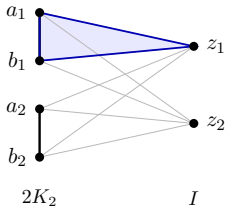
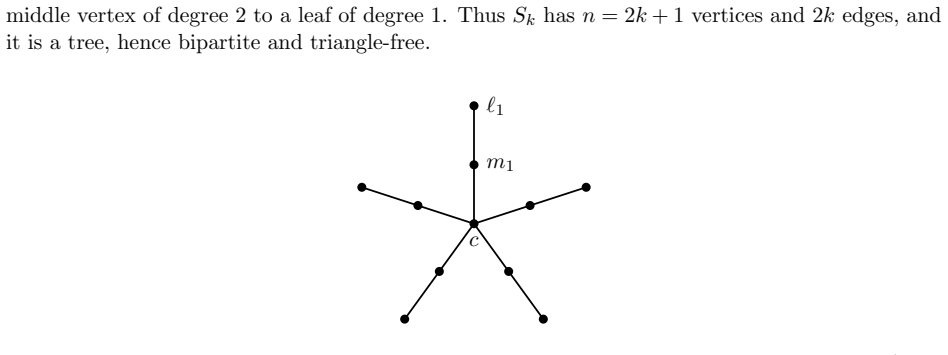
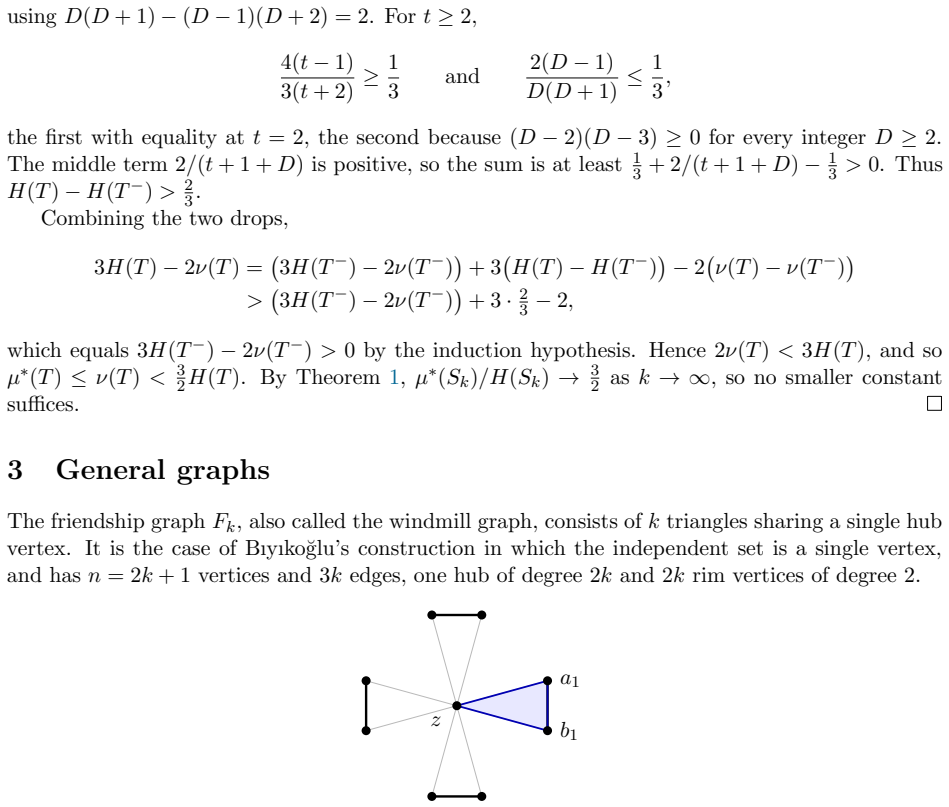
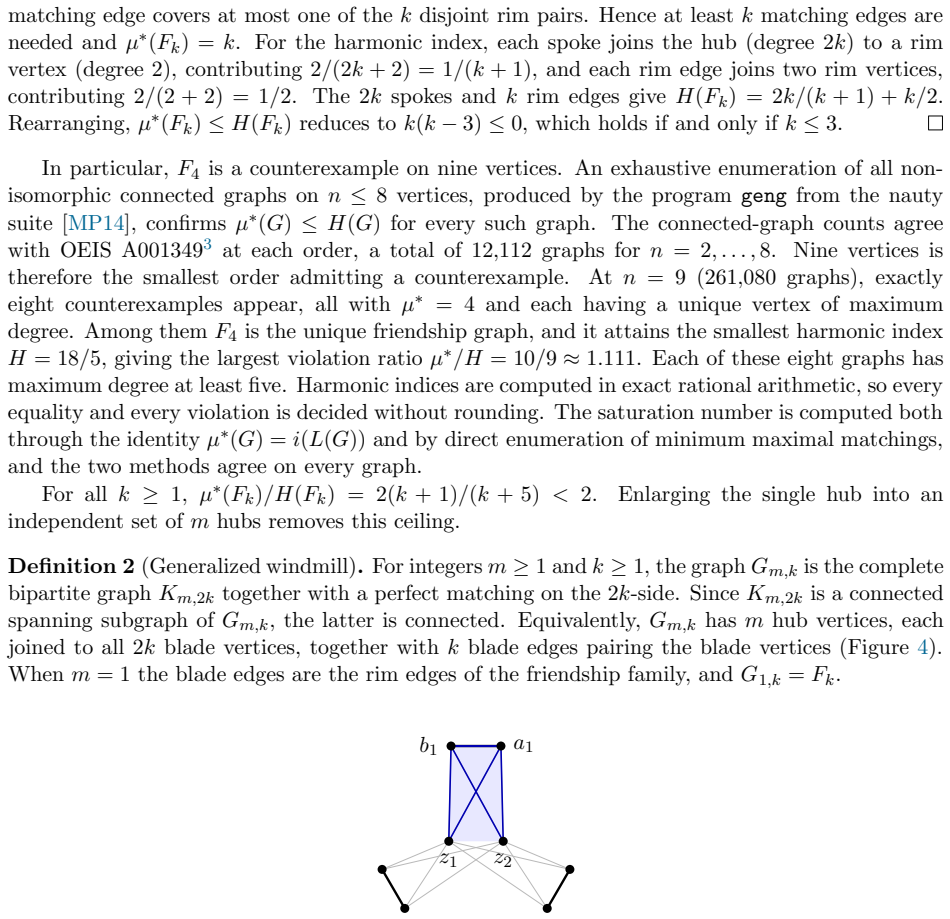
read the original abstract
The saturation number $\mu^*(G)$ of a graph $G$ is the minimum cardinality of a maximal matching, and $H(G)$ is its harmonic index. TxGraffiti conjectured in 2023 that $\mu^*(G) \le H(G)$ for every nontrivial connected graph $G$, and B{\i}y{\i}ko\u{g}lu refuted this by showing that the ratio $\mu^*(G)/H(G)$ can be made arbitrarily large. Restricting to trees bounds the ratio sharply. Every nontrivial tree $T$ satisfies $\mu^*(T) < \frac{3}{2} H(T)$, with the constant $3/2$ best possible. A complementary bound $H(G) < 4\mu^*(G)$ holds for every graph with an edge, so on a nontrivial tree the saturation number is pinned to $\frac{1}{4} H(T) < \mu^*(T) < \frac{3}{2} H(T)$, both constants best possible. The friendship graph $F_4$ is a smallest counterexample to the conjecture, on nine vertices, and the smallest tree counterexample is the subdivided star on eleven vertices. For each positive integer $m$ a family of graphs with $m$ hubs has ratio approaching $m+1$, while the conjecture holds whenever all vertices have equal degree. Both invariants arise in applications, the harmonic index as a molecular descriptor and the saturation number as a measure of adsorption inefficiency, and the bounds estimate the latter, which is NP-hard to compute, by the former, which is computable in linear time.
Editorial analysis
A structured set of objections, weighed in public.
Referee Report
Summary. The paper refutes the TxGraffiti conjecture μ*(G) ≤ H(G) for nontrivial connected graphs by exhibiting families where the ratio μ*/H becomes arbitrarily large, but restricts to trees to obtain sharp bounds: every nontrivial tree T satisfies 1/4 H(T) < μ*(T) < 3/2 H(T), with both constants best possible. It identifies the friendship graph F4 (nine vertices) as the smallest counterexample and the subdivided star on eleven vertices as the smallest tree counterexample, and shows that the conjecture holds when all degrees are equal. Complementary results include H(G) < 4μ*(G) for any graph with an edge and families with m hubs where the ratio approaches m+1.
Significance. The sharp constants and explicit extremal constructions (friendship graphs, subdivided stars, m-hub families) provide concrete, falsifiable bounds that estimate the NP-hard saturation number via the linear-time harmonic index. This is useful for applications in molecular descriptors and adsorption inefficiency. The work resolves a recent conjecture with both negative (arbitrarily large ratio) and positive (pinned interval for trees) results, and the parameter-free nature of the statements is a strength.
major comments (2)
- [Abstract] The abstract asserts the bounds μ*(T) < (3/2) H(T) and H(G) < 4μ*(G) together with sharpness via explicit families, but supplies no derivation steps, error analysis, or verification that the constants are achieved; the central claim therefore rests on uninspectable proofs.
- [Counterexample section] The claim that the subdivided star on eleven vertices is the smallest tree counterexample and achieves a ratio arbitrarily close to 3/2 requires an explicit computation of both μ* and H for that graph (and the limit family) to confirm it is load-bearing for sharpness.
minor comments (2)
- [Introduction] Notation for the saturation number is introduced as μ*(G) but the definition of a maximal matching should be recalled explicitly for readers outside the area.
- [Equal-degree case] The statement that the conjecture holds 'whenever all vertices have equal degree' should include a short proof or reference to the relevant theorem number.
Simulated Author's Rebuttal
We thank the referee for their careful reading of our manuscript and for their positive evaluation of its significance. We address the major comments point by point below.
read point-by-point responses
-
Referee: [Abstract] The abstract asserts the bounds μ*(T) < (3/2) H(T) and H(G) < 4μ*(G) together with sharpness via explicit families, but supplies no derivation steps, error analysis, or verification that the constants are achieved; the central claim therefore rests on uninspectable proofs.
Authors: Abstracts in mathematical papers are concise overviews and typically omit detailed derivations and error analyses, which are reserved for the main text. The derivations of the bounds, the verification that the constants are sharp through explicit constructions, and all supporting calculations are provided in full in Sections 3 and 4 of the manuscript. The proofs are therefore inspectable from the complete document. revision: no
-
Referee: [Counterexample section] The claim that the subdivided star on eleven vertices is the smallest tree counterexample and achieves a ratio arbitrarily close to 3/2 requires an explicit computation of both μ* and H for that graph (and the limit family) to confirm it is load-bearing for sharpness.
Authors: We concur that explicit computations are valuable for confirming the sharpness. The manuscript already specifies the subdivided star on eleven vertices as the smallest tree counterexample and provides the necessary computations of μ* and H to establish the ratio. For the limit family, the asymptotic analysis shows the ratio approaching 3/2. To further address the referee's concern, we will revise the counterexample section to present these computations in greater detail, including a step-by-step breakdown for the eleven-vertex graph and the limiting case. revision: yes
Circularity Check
No significant circularity
full rationale
The paper establishes sharp inequalities between the saturation number μ*(T) and harmonic index H(T) for trees via direct proofs on finite simple graphs, using standard definitions of maximal matchings and the harmonic index sum. Sharpness is witnessed by explicit extremal families (friendship graphs, subdivided stars, m-hub constructions) rather than any fitted parameters, self-definitional equations, or load-bearing self-citations. The central claims reduce to combinatorial arguments on graph invariants without reduction to inputs by construction. No steps match the enumerated circularity patterns.
Axiom & Free-Parameter Ledger
axioms (1)
- standard math Standard definitions of finite simple connected graphs, maximal matchings, and the harmonic index sum hold without modification.
Reference graph
Works this paper leans on
-
[1]
Saturation number of a graph
Mohammad Bagher Ahmadi and Vahid Amiri Khorasani. Saturation number of a graph. In Ivan Gutman, Boris Furtula, Kinkar Chandra Das, Emina Milovanovi\' c , and Igor Milovanovi\' c , editors, Bounds in Chemical Graph Theory -- Advances , number 21 in Mathematical Chemistry Monographs, pages 217--232. University of Kragujevac, Kragujevac, 2017
2017
-
[2]
On the saturation number of graphs
Saeid Alikhani and Neda Soltani. On the saturation number of graphs. Iranian J. Math. Chem. , 9(4):289--299, 2018
2018
-
[3]
Harmonic index and its generalizations: Extremal results and bounds
Akbar Ali, Lingping Zhong, and Ivan Gutman. Harmonic index and its generalizations: Extremal results and bounds. MATCH Commun. Math. Comput. Chem. , 81(2):249--311, 2019
2019
-
[4]
A note on the TxGraffiti conjecture about harmonic index and minimum maximal matching number
T\" u rker B y ko g lu. A note on the TxGraffiti conjecture about harmonic index and minimum maximal matching number. MATCH Commun. Math. Comput. Chem. , 96(3):1097--1099, 2026
2026
-
[5]
Automated conjecturing with TxGraffiti
Randy Davila. Automated conjecturing with TxGraffiti . Annals of Mathematics and Artificial Intelligence , 2026
2026
-
[6]
In reverie together: Ten years of mathematical discovery with a machine collaborator
Randy Davila, Boris Brimkov, and Ryan Pepper. In reverie together: Ten years of mathematical discovery with a machine collaborator. arXiv preprint arXiv:2507.17780 , 2025
arXiv 2025
-
[7]
On conjectures of Graffiti --- II
Siemion Fajtlowicz. On conjectures of Graffiti --- II . In Congr. Numer. , volume 60, pages 187--197, 1987
1987
-
[8]
On conjectures of Graffiti
Siemion Fajtlowicz. On conjectures of Graffiti . Discrete Math. , 72(1--3):113--118, 1988
1988
-
[9]
Note on the harmonic index of a graph
Aleksandar Ili\' c . Note on the harmonic index of a graph. arXiv preprint arXiv:1204.3313 , 2012
Pith/arXiv arXiv 2012
-
[10]
On the harmonic index and the matching number of a tree
Jian-Bo Lv and Jianxi Li. On the harmonic index and the matching number of a tree. Ars Combin. , 116:407--416, 2014
2014
-
[11]
The harmonic index of unicyclic graphs with given matching number
Jian-Bo Lv, Jianxi Li, and Wai Chee Shiu. The harmonic index of unicyclic graphs with given matching number. Kragujevac J. Math. , 38(1):173--183, 2014
2014
-
[12]
McKay and Adolfo Piperno
Brendan D. McKay and Adolfo Piperno. Practical graph isomorphism, II . J. Symbolic Comput. , 60:94--112, 2014
2014
-
[13]
David P. Sumner. Randomly matchable graphs. J. Graph Theory , 3(2):183--186, 1979
1979
-
[14]
Smallest maximal matchings of graphs
Mostafa Tavakoli and Tomislav Do s li\' c . Smallest maximal matchings of graphs. Hacet. J. Math. Stat. , 52(2):356--366, 2023
2023
-
[15]
General approach for obtaining extremal results on degree-based indices illustrated on the general sum-connectivity index
Tom\' a s Vetr\' i k. General approach for obtaining extremal results on degree-based indices illustrated on the general sum-connectivity index. Electron. J. Graph Theory Appl. , 11(1):125--133, 2023
2023
-
[16]
The harmonic index for graphs
Lingping Zhong. The harmonic index for graphs. Appl. Math. Lett. , 25(3):561--566, 2012
2012
discussion (0)
Sign in with ORCID, Apple, or X to comment. Anyone can read and Pith papers without signing in.