Artificial Intelligence for Power-Converter-Rich Electrical Systems: A Review
Pith reviewed 2026-06-27 03:43 UTC · model grok-4.3
The pith
A life-cycle review organizes AI methods for power-converter-rich electrical systems and flags deployment gaps in stability, safety and standards.
A machine-rendered reading of the paper's core claim, the machinery that carries it, and where it could break.
Core claim
The literature on AI for power-converter-rich electrical systems can be partitioned into converter design, real-time control, system-level operation, and compliance-oriented governance, with deployment-critical gaps including stability certification, constraint satisfaction, interpretability, extrapolation, data efficiency, sim-to-real transfer, embedded latency, cybersecurity, privacy, and standards alignment remaining before full adoption.
What carries the argument
The life-cycle and deployment-readiness perspective used to organize applications and highlight gaps.
If this is right
- Surrogate modeling aids converter design under multi-physics tradeoffs.
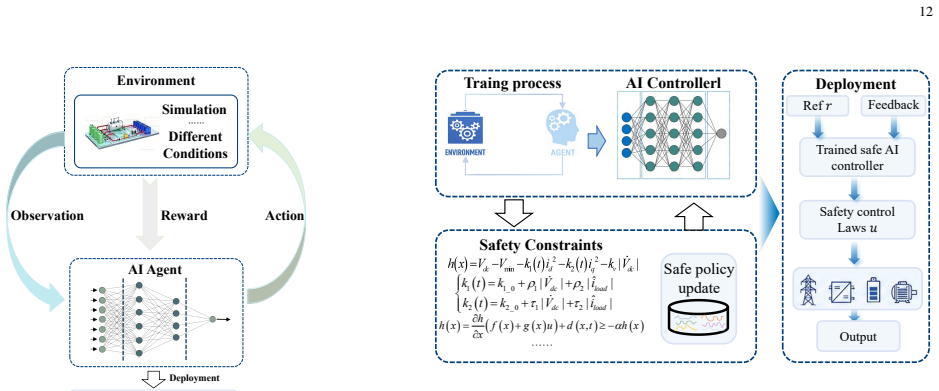
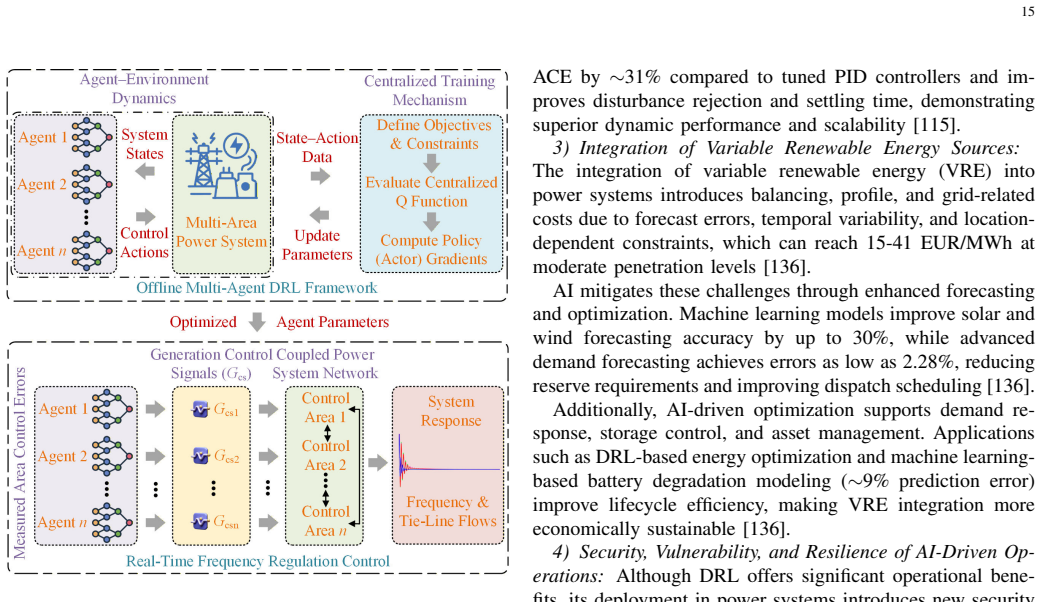
- Reinforcement learning and safety-constrained methods enable closed-loop control.
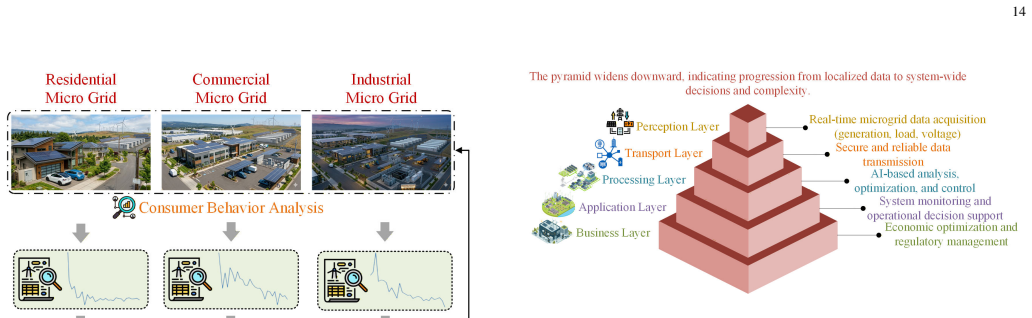
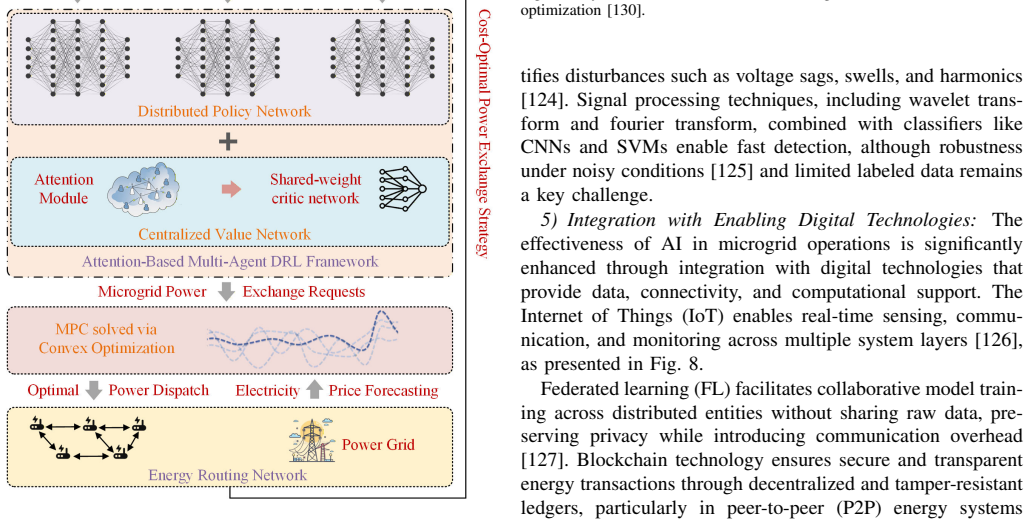
- Forecasting and privacy-preserving methods support microgrid coordination.
- Emphasis on gaps means further work is needed in certification and standards.
- AI serves as support tool now, with autonomous deployment requiring validation.
Where Pith is reading between the lines
- The four-stage taxonomy could be applied to assess readiness of specific AI techniques in other engineering domains.
- Gaps like sim-to-real transfer connect to broader challenges in applying machine learning to physical systems.
- A testable extension would be to survey recent papers to check if the identified gaps have been addressed since the review.
Load-bearing premise
That the body of literature reviewed can be cleanly partitioned into the four life-cycle stages and that the enumerated gaps are the most critical barriers to deployment.
What would settle it
A comprehensive search of the literature revealing that key papers on AI for these systems do not fit the four stages or that practical deployments have succeeded despite the listed gaps.
Figures
read the original abstract
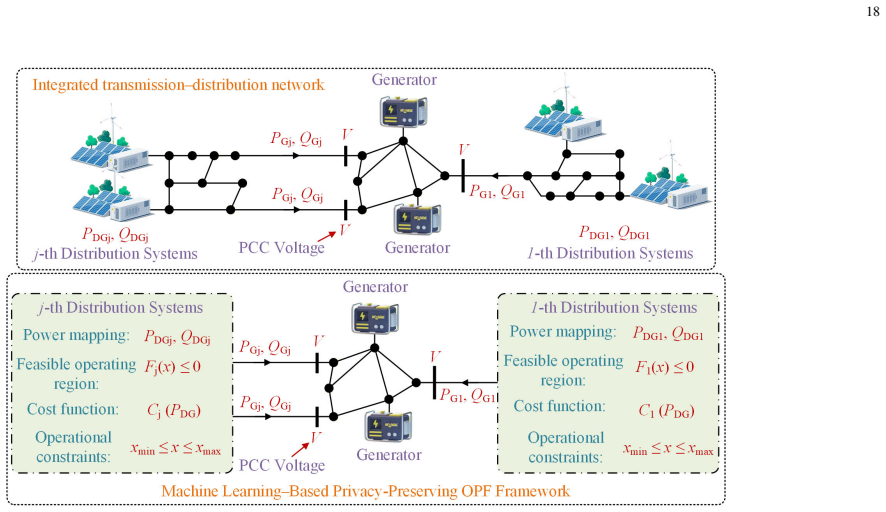
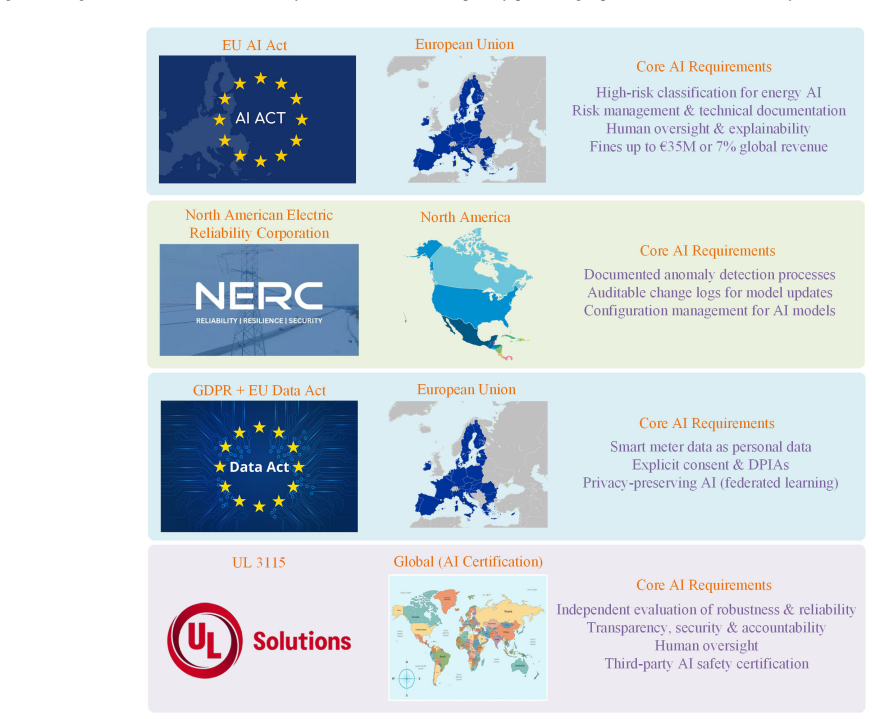
Power-converter-rich electrical systems, formed by renewable generation, electrified transportation, and inverter-based resources, exhibit strongly nonlinear dynamics, multi-physics design tradeoffs, fast control requirements, and growing reliability and cybersecurity constraints. These characteristics strain workflows that rely only on physics-based modeling, sequential optimization, and rule-based operation. This paper reviews artificial intelligence (AI) for power-converter-rich electrical systems through a life-cycle and deployment-readiness perspective. The literature is organized across converter design, real-time control, system-level operation, and compliance-oriented governance. For design, we examine surrogate modeling, topology and parameter synthesis, EMI/EMC-aware optimization, reliability-oriented design, and knowledge-assisted workflows. For control, we compare supervised learning, reinforcement learning, learning-augmented predictive control, and safety-constrained learning according to their role in closed-loop implementation. For operations, we focus on microgrid coordination, forecasting, distribution-system observability, privacy-preserving coordination, and cyber-resilient operation where converter-interfaced resources shape the operating problem. Across these stages, the review emphasizes deployment-critical gaps, including stability certification, constraint satisfaction, interpretability, extrapolation, data efficiency, sim-to-real transfer, embedded latency, cybersecurity, privacy, and standards alignment. The resulting taxonomy is intended to clarify where AI is already useful as an engineering support tool and where further validation is needed before autonomous or safety-critical deployment.
Editorial analysis
A structured set of objections, weighed in public.
Referee Report
Summary. The paper reviews AI methods for power-converter-rich electrical systems (renewables, electrified transport, inverter-based resources) through a life-cycle lens. It partitions the literature into four stages—converter design (surrogate modeling, topology synthesis, EMI/EMC optimization, reliability), real-time control (supervised/RL, learning-augmented MPC, safety-constrained learning), system-level operation (microgrid coordination, forecasting, observability, privacy-preserving and cyber-resilient schemes), and compliance-oriented governance—while cataloguing deployment gaps including stability certification, constraint satisfaction, interpretability, extrapolation, data efficiency, sim-to-real transfer, embedded latency, cybersecurity, privacy, and standards alignment.
Significance. A well-executed taxonomy of this form could serve as a reference map for researchers and engineers working on AI integration in converter-dominated grids, clarifying the boundary between currently deployable support tools and areas still requiring rigorous validation before safety-critical use.
major comments (2)
- [Abstract and §1–§5] Abstract and §1–§5: the manuscript asserts that the literature can be partitioned into the four stated life-cycle stages and that the enumerated deployment gaps are the most critical, yet provides no search strategy, database sources, inclusion/exclusion criteria, or quantitative coverage metric (e.g., paper counts per stage). This absence makes it impossible to verify representativeness or to confirm that the listed gaps are load-bearing rather than an author-selected subset.
- [Abstract] Abstract: the claim that the review “emphasizes deployment-critical gaps” is presented without an explicit argument or evidence showing why stability certification, interpretability, sim-to-real transfer, etc., are prioritized over other plausible concerns (e.g., hardware-in-the-loop validation cost or regulatory acceptance timelines).
minor comments (2)
- Ensure that every cited work is accompanied by a brief statement of its specific contribution to the stage under discussion rather than a generic reference.
- Clarify whether the taxonomy is intended to be exhaustive or illustrative; if illustrative, state the selection rationale explicitly.
Simulated Author's Rebuttal
We thank the referee for the constructive comments. We address each major comment below and will make revisions to enhance the transparency of our review methodology and the justification of the highlighted gaps.
read point-by-point responses
-
Referee: [Abstract and §1–§5] Abstract and §1–§5: the manuscript asserts that the literature can be partitioned into the four stated life-cycle stages and that the enumerated deployment gaps are the most critical, yet provides no search strategy, database sources, inclusion/exclusion criteria, or quantitative coverage metric (e.g., paper counts per stage). This absence makes it impossible to verify representativeness or to confirm that the listed gaps are load-bearing rather than an author-selected subset.
Authors: We agree that providing details on the literature selection would improve the review's rigor. Although this work is a perspective-driven taxonomy rather than a formal systematic review, we will add a new subsection at the beginning of §1 that outlines the search strategy, including the primary databases (IEEE Xplore, Google Scholar), key search terms, time frame considered, and approximate paper counts per life-cycle stage to offer quantitative coverage metrics. This addition will allow readers to better assess representativeness. revision: yes
-
Referee: [Abstract] Abstract: the claim that the review “emphasizes deployment-critical gaps” is presented without an explicit argument or evidence showing why stability certification, interpretability, sim-to-real transfer, etc., are prioritized over other plausible concerns (e.g., hardware-in-the-loop validation cost or regulatory acceptance timelines).
Authors: The selection of these gaps is motivated by their fundamental role in enabling safe deployment in safety-critical power systems, as evidenced by the challenges discussed throughout the manuscript (e.g., the need for stability guarantees in real-time control). We will revise the abstract and add a short paragraph in §1 to explicitly argue why these gaps are prioritized, drawing on their prevalence in the literature and their alignment with industry standards for grid integration. Concerns such as HIL validation costs are valid but are more implementation-specific and less central to the AI methodological barriers. revision: yes
Circularity Check
Review paper performs no derivations, predictions, or fitted modeling
full rationale
This manuscript is a literature review that partitions existing work into four life-cycle stages (design, control, operations, governance) and enumerates deployment gaps. It contains no equations, no parameter fitting, no predictions derived from models, and no self-citation chains invoked as uniqueness theorems or ansatzes. The taxonomy and gap list are presented as an organizational framework rather than a derived result that reduces to its own inputs by construction. No load-bearing step matches any of the enumerated circularity patterns; the paper is self-contained as a survey without internal reduction.
Axiom & Free-Parameter Ledger
Reference graph
Works this paper leans on
-
[1]
Advances in reliability and artificial intelligence for power electronic systems,
F. Blaabjerg, K. Zhang, Y . Song, and Y . Zhang, “Advances in reliability and artificial intelligence for power electronic systems,”IEEE Transac- tions on Power Electronics, vol. 41, DOI 10.1109/TPEL.2026.3675661, no. 3, pp. 2890–2905, 2026
-
[2]
Applications of data-driven dynamic modeling of power converters in power systems: An overview,
S. Subedi, Y . Gui, and Y . Xue, “Applications of data-driven dynamic modeling of power converters in power systems: An overview,”IEEE Transactions on Industry Applications, vol. 61, DOI 10.1109/TIA.2025.3529797, no. 1, pp. 112–125, 2025
-
[3]
An overview of artificial intelligence applications for power electronics,
S. Zhao, F. Blaabjerg, and H. Wang, “An overview of artificial intelligence applications for power electronics,”IEEE Transactions on Power Electronics, vol. 68, DOI 10.1109/TPEL.2020.3024914, no. 4, pp. 3029–3045, 2021
-
[5]
A review of recent ai applications in next-generation power electronics,
A. Safari, A. Oshnoei, and F. Blaabjerg, “A review of recent ai applications in next-generation power electronics,”Applied Energy, vol. 402, DOI 10.1016/j.apenergy.2025.126923, p. 126923, 2025. 20
-
[6]
Deep learning in power systems research: A review,
M. Khodayar, G. Liu, J. Wang, and M. E. Khodayar, “Deep learning in power systems research: A review,”CSEE Journal of Power and Energy Systems, vol. 7, DOI 10.17775/CSEEJPES.2020.02700, no. 2, pp. 209–220, 2021
-
[7]
A review on application of artificial intelligence techniques in microgrids,
E. Mohammadiet al., “A review on application of artificial intelligence techniques in microgrids,”IEEE Journal of Emerg- ing and Selected Topics in Industrial Electronics, vol. 3, DOI 10.1109/JESTIE.2022.3198504, no. 4, pp. 878–890, 2022
-
[8]
Generalizable cross-graph embedding for gnn-based congestion prediction,
S. Fanet al., “From specification to topology: Automatic power converter design via reinforcement learning,” inProc. IEEE/ACM International Conference on Computer-Aided Design (ICCAD), DOI 10.1109/ICCAD51958.2021.9643548, pp. 1–9, 2021
-
[9]
Applications of physics-informed neural networks in power systems - a review,
B. Huang and J. Wang, “Applications of physics-informed neural networks in power systems - a review,”IEEE Transactions on Power Systems, vol. 38, DOI 10.1109/TPWRS.2022.3162473, no. 1, pp. 572– 588, 2023
-
[10]
A. Selimet al., “Safe deep reinforcement learning for robust frequency and voltage-constrained networked microgrid restora- tion,”IEEE Transactions on Industry Applications, vol. 62, DOI 10.1109/TIA.2025.3626472, no. 2, pp. 3635–3647, 2026
-
[11]
A. Rajamallaiahet al., “Deep reinforcement learning for power con- verter control: A comprehensive review of applications and chal- lenges,”IEEE Open Journal of Power Electronics, vol. 13, DOI 10.1109/OJPEL.2025.3619673, pp. 111 976–111 995, 2025
-
[12]
Z. Fenget al., “Deep reinforcement learning assisted hybrid five- variable modulation scheme for dab converters to reduce rms current and expand zvs operation,”IEEE Transactions on Power Electronics, vol. 39, DOI 10.1109/TPEL.2024.3358912, no. 7, pp. 8114–8128, 2024
-
[14]
D. Gebbranet al., “Cloud and edge computing for smart management of power electronic converter fleets: A key connective fabric to enable the green transition,”IEEE Industrial Electronics Magazine, vol. 17, DOI 10.1109/MIE.2022.3211125, no. 2, pp. 6–19, 2022
-
[16]
An edge- ai based forecasting approach for improving smart microgrid effi- ciency,
L. Lv, Z. Wu, L. Zhang, B. B. Gupta, and Z. Tian, “An edge- ai based forecasting approach for improving smart microgrid effi- ciency,”IEEE Transactions on Industrial Informatics, vol. 18, DOI 10.1109/TII.2022.3163137, no. 11, pp. 7946–7954, 2022
-
[17]
M. Sayaket al., “Resilient control of networked microgrids using vertical federated reinforcement learning: Designs and real-time test- bed validations,”IEEE Transactions on Smart Grid, vol. 16, DOI 10.1109/TSG.2024.3466768, no. 2, pp. 1897–1910, 2025
-
[18]
Y . Li, S. He, Y . Li, Y . Shi, and Z. Zeng, “Federated multi- agent deep reinforcement learning approach via physics-informed reward for multimicrogrid energy management,”IEEE Transac- tions on Neural Networks and Learning Systems, vol. 35, DOI 10.1109/TNNLS.2022.3232630, no. 5, pp. 5902–5915, 2024
-
[19]
P. Luet al., “Hierarchical reserve-based distributionally ro- bust chance-constrained optimization for integrated electricity-heat systems during cold waves,”Applied Energy, vol. 402, DOI 10.1016/j.apenergy.2025.126900, p. 126900, 2026
-
[20]
Novel ai based energy management system for smart grid with res integration,
A. Kumar, M. Alaraj, M. Rizwan, and U. Nangia, “Novel ai based energy management system for smart grid with res integration,”IEEE Access, vol. 9, DOI 10.1109/ACCESS.2021.3131502, pp. 162 530– 162 542, 2021
-
[21]
M. Farajzadeh-Zanjani, E. Hallaji, R. Razavi-Far, and M. Saif, “Generative-adversarial class-imbalance learning for classifying cyber- attacks and faults - a cyber-physical power system,”IEEE Trans- actions on Dependable and Secure Computing, vol. 19, DOI 10.1109/TDSC.2021.3118636, no. 6, pp. 4068–4081, 2022
-
[22]
S. Zhaoet al., “Physics-informed machine learning for pa- rameter estimation of dc-dc converter,” in2022 IEEE Ap- plied Power Electronics Conference and Exposition (APEC), DOI 10.1109/APEC43599.2022.9773482, 2022
-
[23]
A review of microgrid energy management and control strategies,
S. Ahmad, M. Shafiullah, C. B. Ahmed, and M. Alowaifeer, “A review of microgrid energy management and control strategies,”IEEE Access, vol. 11, DOI 10.1109/ACCESS.2023.3248511, pp. 21 733– 21 757, 2023
-
[24]
Survey on ai and machine learning techniques for microgrid energy management systems,
A. Joshi, S. Capezza, A. Alhaji, and M.-Y . Chow, “Survey on ai and machine learning techniques for microgrid energy management systems,”IEEE/CAA Journal of Automatica Sinica, vol. 10, DOI 10.1109/JAS.2023.123657, no. 7, pp. 1513–1529, 2023
-
[25]
A review of data-driven prognostic for IGBT remaining use- ful life,
X. Fang, S. Lin, X. Huang, F. Lin, Z. Yang, and S. Igarashi, “A review of data-driven prognostic for IGBT remaining use- ful life,”IEEE Transactions on Power Electronics, vol. 33, DOI 10.1109/TPEL.2017.2785441, no. 11, pp. 9844–9855, 2018
-
[26]
CONGO: Scal- able online anomaly detection and localization in power elec- tronics networks,
J. Yu, A. Alqahtani, and A. P. Meliopoulos, “CONGO: Scal- able online anomaly detection and localization in power elec- tronics networks,”IEEE Internet of Things Journal, vol. 9, DOI 10.1109/JIOT.2022.3143123, no. 16, pp. 14 754–14 765, 2022
-
[27]
J. Cui, G. Shi, and C. Gong, “A fast classification method of faults in power electronic circuits based on support vector machines,”Metrology and Measurement Systems, vol. 24, DOI 10.1515/mms-2017-0056, no. 4, pp. 701–720, 2017
-
[28]
C. Ren, T. Wang, Z. Y . Dong, and R. Zhang, “Transfer extreme learning machine for power system cross-fault and cross-scale stability assessment with limited guide instances,”IEEE Transactions on Power Systems, vol. 39, DOI 10.1109/TPWRS.2024.3366433, no. 3, pp. 5431– 5434, 2024
-
[29]
Decision tree-based online voltage security assessment using PMU measurements,
R. Diao, K. Sun, V . Vittal, R. J. O’Keefe, M. R. Richardson, N. Bhatt, D. Stradford, and S. K. Sarawgi, “Decision tree-based online voltage security assessment using PMU measurements,”IEEE Transactions on Power Systems, vol. 24, DOI 10.1109/TPWRS.2009.2016528, no. 2, pp. 832–839, 2009
-
[30]
Maximum power point tracking scheme for PV systems operating under partially shaded condi- tions,
H. Patel and V . Agarwal, “Maximum power point tracking scheme for PV systems operating under partially shaded condi- tions,”IEEE Transactions on Industrial Electronics, vol. 55, DOI 10.1109/TIE.2008.917118, no. 4, pp. 1689–1698, 2008
-
[31]
S. Hochreiter and J. Schmidhuber, “Long short-term memory,”Neural Computation, vol. 9, DOI 10.1162/neco.1997.9.8.1735, no. 8, pp. 1735–1780, 1997
-
[32]
Learning phrase representations using RNN encoder–decoder for statistical machine translation
K. Cho, B. van Merri ¨enboer, C ¸ . G¨ulc ¸ehre, D. Bahdanau, F. Bougares, H. Schwenk, and Y . Bengio, “Learning phrase representations using RNN encoder–decoder for statistical machine translation,” inPro- ceedings of the 2014 Conference on Empirical Methods in Natural Language Processing (EMNLP), DOI 10.3115/v1/D14-1179, pp. 1724–
-
[33]
Doha, Qatar: Association for Computational Linguistics, 2014
2014
-
[34]
Z. Y . Xue, K. S. Xiahou, M. S. Li, T. Y . Ji, and Q. H. Wu, “Diagnosis of multiple open-circuit switch faults based on long short-term memory network for DFIG-based wind turbine systems,”IEEE Journal of Emerging and Selected Topics in Power Electronics, vol. 8, DOI 10.1109/JESTPE.2019.2908981, no. 3, pp. 2600–2610, 2020
-
[35]
Imagenet classification with deep convolutional neural networks,
A. Krizhevsky, I. Sutskever, and G. E. Hinton, “Imagenet classification with deep convolutional neural networks,” inAdvances in Neural Information Processing Systems 25, pp. 1097–1105, 2012
2012
-
[36]
J. Hang, X. Shu, S. Ding, and Y . Huang, “Robust open-circuit fault diagnosis for PMSM drives using wavelet convolutional neural network with small samples of normalized current vector trajectory graph,”IEEE Transactions on Industrial Electronics, vol. 70, DOI 10.1109/TIE.2022.3231304, no. 8, pp. 7653–7663, 2023
-
[37]
Attention is all you need,
A. Vaswani, N. Shazeer, N. Parmar, J. Uszkoreit, L. Jones, A. N. Gomez, Ł. Kaiser, and I. Polosukhin, “Attention is all you need,” in Advances in Neural Information Processing Systems 30, pp. 5998– 6008, 2017
2017
-
[38]
A review of graph neural networks and their applications in power systems,
W. Liao, B. Bak-Jensen, J. R. Pillai, Y . Wang, and Y . Wang, “A review of graph neural networks and their applications in power systems,” Journal of Modern Power Systems and Clean Energy, vol. 10, DOI 10.35833/MPCE.2021.000058, no. 2, pp. 345–360, 2022
-
[39]
R. S. Sutton and A. G. Barto,Reinforcement Learning: An Introduction, 2nd ed. Cambridge, MA: MIT Press, 2018
2018
-
[40]
J. Ye, W. Xuan, Q. Guo, Y . Liu, B. Wang, X. Zhang, and H. H. C. Iu, “An overview of reinforcement learning for power electronic converters: Topology derivation, parameter design, and control imple- mentation,”Renewable and Sustainable Energy Reviews, vol. 228, DOI 10.1016/j.rser.2025.116591, p. 116591, 2026
-
[41]
Y . Gao, S. Wang, T. Dragicevic, P. Wheeler, and P. Zanchetta, “Artificial intelligence techniques for enhancing the performance of controllers in power converter-based system: An overview,”IEEE Open Journal of Industry Applications, vol. 4, DOI 10.1109/OJIA.2023.3338534, pp. 366–375, 2023
-
[42]
V . Mnih, K. Kavukcuoglu, D. Silver, A. A. Rusu, J. Veness, M. G. Bellemare, A. Graves, M. Riedmiller, A. K. Fidjeland, G. Ostro- vski, S. Petersen, C. Beattie, A. Sadik, I. Antonoglou, H. King, D. Kumaran, D. Wierstra, S. Legg, and D. Hassabis, “Human-level 21 control through deep reinforcement learning,”Nature, vol. 518, DOI 10.1038/nature14236, no. 754...
-
[43]
Continuous control with deep reinforcement learning
T. P. Lillicrap, J. J. Hunt, A. Pritzel, N. Heess, T. Erez, Y . Tassa, D. Silver, and D. Wierstra, “Continuous control with deep reinforcement learning,”arXiv preprint arXiv:1509.02971, DOI 10.48550/arXiv.1509.02971, 2015
work page internal anchor Pith review Pith/arXiv arXiv doi:10.48550/arxiv.1509.02971 2015
-
[44]
Soft actor-critic: Off- policy maximum entropy deep reinforcement learning with a stochastic actor,
T. Haarnoja, A. Zhou, P. Abbeel, and S. Levine, “Soft actor-critic: Off- policy maximum entropy deep reinforcement learning with a stochastic actor,” inProceedings of the 35th International Conference on Machine Learning, ser. Proceedings of Machine Learning Research, vol. 80, pp. 1861–1870. PMLR, 2018
2018
-
[45]
Language models are few- shot learners,
T. B. Brown, B. Mann, N. Ryder, M. Subbiah, J. Kaplan, P. Dhari- wal, A. Neelakantan, P. Shyam, G. Sastry, A. Askell, S. Agarwal, A. Herbert-V oss, G. Krueger, T. Henighan, R. Child, A. Ramesh, D. M. Ziegler, J. Wu, C. Winter, C. Hesse, M. Chen, E. Sigler, M. Litwin, S. Gray, B. Chess, J. Clark, C. Berner, S. McCandlish, A. Radford, I. Sutskever, and D. A...
-
[46]
Exploring the limits of transfer learning with a unified text-to-text transformer,
C. Raffel, N. Shazeer, A. Roberts, K. Lee, S. Narang, M. Matena, Y . Zhou, W. Li, and P. J. Liu, “Exploring the limits of transfer learning with a unified text-to-text transformer,”Journal of Machine Learning Research, vol. 21, no. 140, pp. 1–67, 2020. [Online]. Available:https://jmlr.org/papers/v21/20-074.html
2020
-
[47]
Training language models to follow instructions with human feedback,
L. Ouyang, J. Wu, X. Jiang, D. Almeida, C. Wainwright, P. Mishkin, C. Zhang, S. Agarwal, K. Slama, A. Ray, J. Schulman, J. Hilton, F. Kelton, L. Miller, M. Simens, A. Askell, P. Welinder, P. Christiano, J. Leike, and R. Lowe, “Training language models to follow instructions with human feedback,” inAdvances in Neural Information Processing Systems 35, DOI ...
-
[48]
In: Advances in Neural Information Processing Systems
P. Lewis, E. Perez, A. Piktus, F. Petroni, V . Karpukhin, N. Goyal, H. K ¨uttler, M. Lewis, W.-t. Yih, T. Rockt ¨aschel, S. Riedel, and D. Kiela, “Retrieval-augmented generation for knowledge-intensive nlp tasks,” inAdvances in Neural Information Processing Systems 33, DOI 10.5555/3495724.3496517, pp. 9459–9474, 2020
-
[49]
Agentic ai: a com- prehensive survey of architectures, applications, and future directions,
M. Abou Ali, F. Dornaika, and J. Charafeddine, “Agentic ai: a com- prehensive survey of architectures, applications, and future directions,” Artificial Intelligence Review, vol. 59, DOI 10.1007/s10462-025-11422- 4, no. 11, 2026
-
[50]
ReAct: Synergizing Reasoning and Acting in Language Models
S. Yao, J. Zhao, D. Yu, N. Du, I. Shafran, K. R. Narasimhan, and Y . Cao, “React: Synergizing reasoning and acting in language models,” inThe Eleventh International Conference on Learning Representations (ICLR), DOI 10.48550/arXiv.2210.03629, 2023. [Online]. Available: https://openreview.net/forum?id=WE_vluYUL-X
work page internal anchor Pith review Pith/arXiv arXiv doi:10.48550/arxiv.2210.03629 2023
-
[51]
Toolformer: Lan- guage models can teach themselves to use tools,
T. Schick, J. Dwivedi-Yu, R. Dessi, R. Raileanu, M. Lomeli, E. Ham- bro, L. Zettlemoyer, N. Cancedda, and T. Scialom, “Toolformer: Lan- guage models can teach themselves to use tools,” inAdvances in Neural Information Processing Systems 36, DOI 10.5555/3666122.3668384, 2023
-
[52]
J. S. Park, J. C. O’Brien, C. J. Cai, M. R. Morris, P. Liang, and M. S. Bernstein, “Generative agents: Interactive simulacra of human behavior,” inUIST ’23: Proceedings of the 36th Annual ACM Symposium on User Interface Software and Technology, DOI 10.1145/3586183.3606763, pp. 1–22, 2023
-
[53]
AutoGen: Enabling Next-Gen LLM Applications via Multi-Agent Conversation
Q. Wu, G. Bansal, J. Zhang, Y . Wu, B. Li, E. Zhu, L. Jiang, X. Zhang, S. Zhang, J. Liu, A. H. Awadallah, R. W. White, D. Burger, and C. Wang, “Autogen: Enabling next-gen llm applications via multi-agent conversations,” in Proceedings of the First Conference on Language Modeling (COLM), DOI 10.48550/arXiv.2308.08155, 2024. [Online]. Available: https://ope...
work page internal anchor Pith review Pith/arXiv arXiv doi:10.48550/arxiv.2308.08155 2024
-
[54]
Physics-informed neural networks for magne- tostatic problems on axisymmetric transformer geometries,
Fraunhofer Institute, “Physics-informed neural networks for magne- tostatic problems on axisymmetric transformer geometries,” 2024, fraunhofer Publica
2024
-
[55]
X. Chenet al., “Optimal parameter design for power electronic con- verters using a probabilistic learning-based stochastic surrogate model,” Next Energy, vol. 9, DOI 10.1016/j.nenergy.2025.100464, p. 100464, 2025
-
[56]
Optimizing chip area in power module design: Com- parison of traditional and AI surrogate models for thermal resistance calculation,
Anonymous, “Optimizing chip area in power module design: Com- parison of traditional and AI surrogate models for thermal resistance calculation,” inVDE Conference Proceedings. VDE Verlag, 2025
2025
-
[57]
Machine learning-based design tool for magnetic components in power electronics,
I. Viarougeet al., “Machine learning-based design tool for magnetic components in power electronics,” inProceedings of IPAC’23, 2024, jACoW Publishing
2024
-
[58]
F. Lin, X. Li, W. Lei, J. J. Rodriguez-Andina, J. M. Guerrero, C. Wen, X. Zhang, and H. Ma, “PE-GPT: A new paradigm for power electronics design,”IEEE Transactions on Industrial Electronics, vol. 72, DOI 10.1109/TIE.2024.3454408, no. 4, pp. 3778–3791, 2025
-
[59]
S. Wang, G. Calderon-Lopez, and W. Ming, “Artificial neural networks- based multi-objective design methodology for wide-bandgap power electronics converters,”IEEE Open Journal of Power Electronics, vol. 3, DOI 10.1109/OJPEL.2022.3204630, pp. 664–678, 2022
-
[60]
X. Shen, S. Zhao, H. Wang, and F. Blaabjerg, “Artificial intelligence applications in high-frequency magnetic components design for power electronics systems: An overview,”IEEE Transactions on Power Elec- tronics, vol. 39, DOI 10.1109/TPEL.2024.3381431, no. 7, pp. 8478– 8496, 2024
-
[61]
Y . Liet al., “Frequency-band-aware physics-informed generative ad- versarial network for EMI prediction and adaptive suppression in SiC power converters,”Electronics, vol. 15, DOI 10.3390/electron- ics15081560, no. 8, p. 1560, 2026
-
[62]
Comparative study of AI methods for EMC prediction in power electronics applications,
M. Tlig, M. Kadi, and Z. Riah, “Comparative study of AI methods for EMC prediction in power electronics applications,”Electronics, vol. 15, DOI 10.3390/electronics15010165, no. 1, p. 165, 2026
-
[63]
M. Lu, K. Jia, R. Goswami, and Y . Hu, “Intelligent self-tuning active EMI filtering for electrified automotive power systems using reinforcement learning,” 2026, arXiv preprint arXiv:2604.28084
Pith/arXiv arXiv 2026
-
[64]
A. M. Halidu, S. Nunoo, and J. C. Attachie, “ANN optimised RPWM technique for minimisation of conducted EMI in three-phase volt- age source inverters,”Power Electronics and Drives, vol. 10, DOI 10.2478/pead-2025-0028, no. 1, pp. 406–423, 2025
-
[65]
Electromagnetic interference mitigation toolset for power electronic systems,
Anonymous, “Electromagnetic interference mitigation toolset for power electronic systems,” Master’s thesis, University of Wisconsin–Madison, 2025, available via Minds@UW
2025
-
[66]
Automatic power electronic PCB layout design based on generative AI: The pathway towards next-generation hardware compiler,
X. Yang, Y . Xiao, L. Shu, W. Taborsky, and D. Yang, “Automatic power electronic PCB layout design based on generative AI: The pathway towards next-generation hardware compiler,” in2025 Energy Conversion Congress & Expo Europe (ECCE Europe), pp. 1–5, 2025
2025
-
[67]
PCB power design with AI,
“PCB power design with AI,” EMA Design Automation, 2025, webi- nar; accessed 2025
2025
-
[68]
C. Chenet al., “D2S-FLOW: Automated parameter extraction from datasheets for SPICE model generation using large language models,” 2025, arXiv preprint arXiv:2502.16540
arXiv 2025
-
[69]
Engineers can ditch datasheets with Flux generative AI tool,
“Engineers can ditch datasheets with Flux generative AI tool,” EE Power, 2023, online; accessed 2025
2023
-
[70]
Graphwise-Statnett project: Democratizing the use of power system models,
“Graphwise-Statnett project: Democratizing the use of power system models,” Graphwise.ai, 2025, online; accessed 2025
2025
-
[71]
Evaluating LLM- based workflows for switched-mode power supply design,
S. Nau, J. Krummenauer, and A. Zimmermann, “Evaluating LLM- based workflows for switched-mode power supply design,” 2025, arXiv preprint arXiv:2507.10639v2
arXiv 2025
-
[72]
Y . Chen, Y . Shang, Y . Mo, and X. Jin, “Intelligent power electronics design: A collaborative framework of deep reinforcement learning and large language models with applications,”Journal of Electrical Engineering, vol. 20, DOI 10.11985/2025.05.003, no. 5, pp. 24–34, 2025
-
[73]
HeaRT: A hierarchical circuit reasoning tree-based agentic framework for AMS design optimization,
S. Poddaret al., “HeaRT: A hierarchical circuit reasoning tree-based agentic framework for AMS design optimization,” 2026, arXiv preprint arXiv:2511.19669v2
arXiv 2026
-
[74]
PCB design time savings with AI: Qualcomm case story,
“PCB design time savings with AI: Qualcomm case story,” EMA Design Automation, 2025, online; accessed 2025
2025
-
[75]
Artificial intelli- gence aided automated design for reliability of power electronic systems,
T. Dragicevic, P. Wheeler, and F. Blaabjerg, “Artificial intelli- gence aided automated design for reliability of power electronic systems,”IEEE Transactions on Power Electronics, vol. 34, DOI 10.1109/TPEL.2018.2883947, no. 8, pp. 7161–7171, 2019
-
[76]
IEEE Transactions on Intelligent Transportation Systems22, 6 (2021), 3214–3233
M. Hajihosseini, M. Andalibi, M. Gheisarnejad, H. Farsizadeh, and M.-H. Khooban, “Dc/dc power converter control-based deep machine learning techniques: Real-time implementation,”IEEE Transactions on Power Electronics, vol. 35, DOI 10.1109/TPEL.2020.2977765, no. 10, pp. 9971–9977, 2020
-
[77]
Deep learning-based model predictive control for resonant power convert- ers,
S. Lucia, D. Navarro, B. Karg, H. Sarnago, and ´O. Luc ´ıa, “Deep learning-based model predictive control for resonant power convert- ers,”IEEE Transactions on Industrial Informatics, vol. 17, DOI 10.1109/TII.2020.2969729, no. 1, pp. 409–420, 2021
-
[78]
K. Yu, F. Zhuo, F. Wang, and X. Jiang, “Deep-learning-based steady-state modeling and model predictive control for cllc dc-dc resonant converter in dc distribution system,” in2022 IEEE Ap- plied Power Electronics Conference and Exposition (APEC), DOI 10.1109/APEC43599.2022.9773436, pp. 1–5, 2022
-
[79]
M. Abu-Ali, F. Berkel, M. Manderla, S. Reimann, R. Kennel, and M. Abdelrahem, “Deep learning-based long-horizon mpc: Robust, high performing, and computationally efficient control for pmsm 22 drives,”IEEE Transactions on Power Electronics, vol. 37, DOI 10.1109/TPEL.2022.3172681, no. 10, pp. 12 486–12 501, 2022
-
[80]
Machine learning emulation of model predictive control for modular multilevel converters,
S. Wang, T. Dragicevic, G. F. Gontijo, S. K. Chaudhary, and R. Teodor- escu, “Machine learning emulation of model predictive control for modular multilevel converters,”IEEE Transactions on Industrial Elec- tronics, vol. 68, DOI 10.1109/TIE.2020.3038064, no. 11, pp. 11 628– 11 634, 2021
-
[81]
Model predictive control using artificial neural network for power converters,
D. Wang, Z. J. Shen, X. Yin, S. Tang, X. Liu, C. Zhang, J. Wang, J. Rodriguez, and M. Norambuena, “Model predictive control using artificial neural network for power converters,”IEEE Transactions on Industrial Electronics, vol. 69, DOI 10.1109/TIE.2021.3076721, no. 4, pp. 3689–3699, 2022
-
[82]
X. Liu, L. Qiu, Y . Fang, and J. Rodr ´ıguez, “Predictor-based data- driven model-free adaptive predictive control of power converters using machine learning,”IEEE Transactions on Industrial Electronics, vol. 70, DOI 10.1109/TIE.2022.3208594, no. 8, pp. 7591–7603, 2023
-
[83]
Finite control-set learning predictive control for power convert- ers,
X. Liu, L. Qiu, Y . Fang, K. Wang, Y . Li, and J. Rodr ´ıguez, “Finite control-set learning predictive control for power convert- ers,”IEEE Transactions on Industrial Electronics, vol. 71, DOI 10.1109/TIE.2023.3303646, no. 7, pp. 8190–8196, 2024
discussion (0)
Sign in with ORCID, Apple, or X to comment. Anyone can read and Pith papers without signing in.