REVIEW 3 major objections 4 minor 9 references
Satellites and telescopes: a concordance formula for bordered Floer homology
T0 review · 3 major / 4 minor · reviewed 2026-08-02 · deepseek-v4-flash
Pith's one-line read Knot Floer concordance maps determine bordered Floer cobordism maps combinatorially.
desk verdict Serious morphism-level extension of the LOT correspondence with a satellite formula; the main proof leans on imported kernel/multiplicativity facts from the authors' own prior paper. read the letter →
The pith
A machine-rendered reading of the paper's core claim, the machinery that carries it, and where it could break.
The reading
What carries the argument
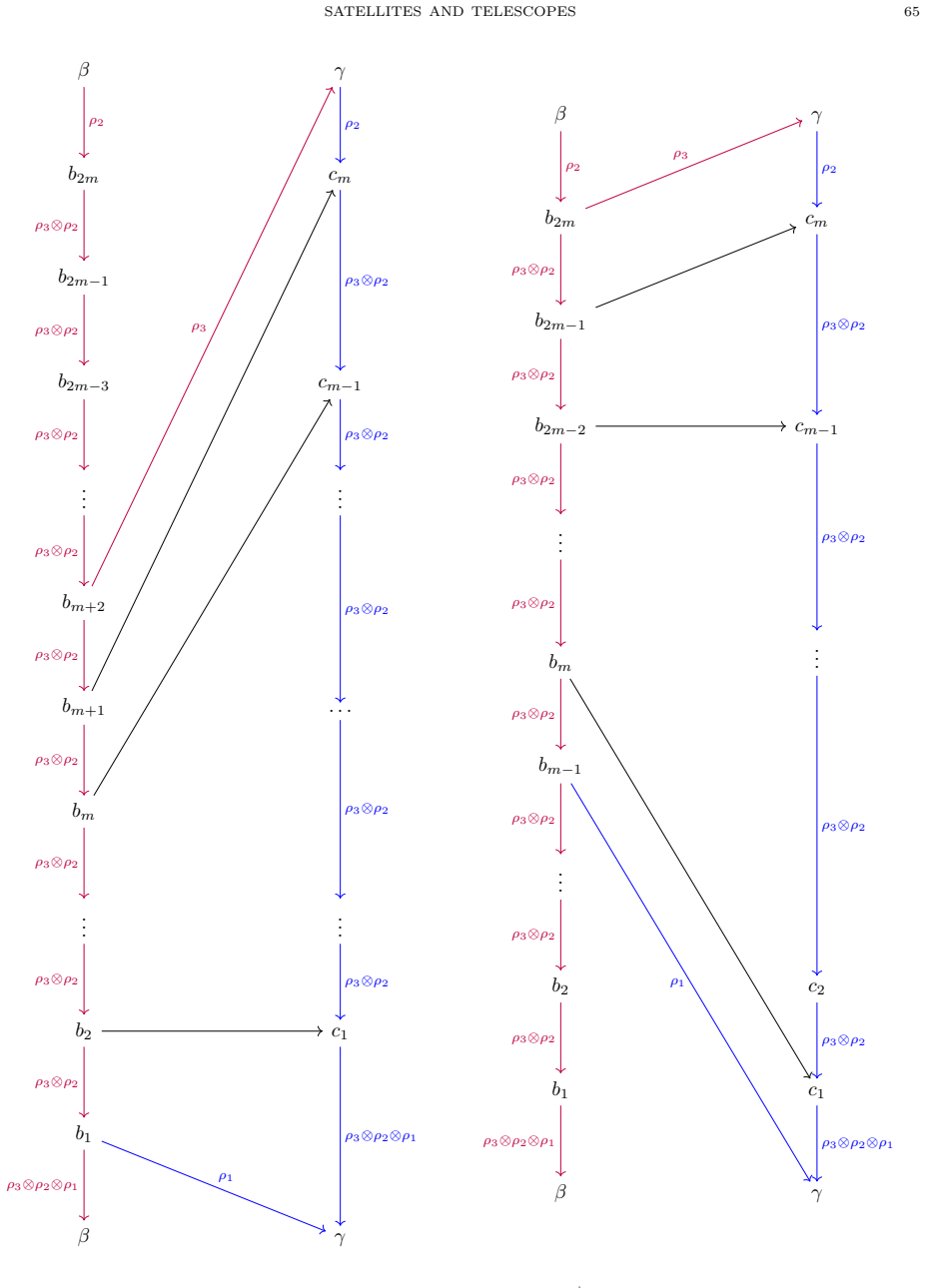
The load-bearing device is a pair of inverse-style functors between hypercube/telescope models over F[U,V] and bordered type-D modules over the torus algebra. The proof assembles infinitely many large-surgery models dCF(S^3_n(K)) into a mapping telescope whose U and V actions come from a framing hypercube of attaching curves; this telescope is shown to be homotopy equivalent to CFK^R(S^3,K). On the bordered side, the basis-free model is built from horizontal, vertical, unstable, and knot regions of the big knot Floer complex. Omega is defined by applying a locally symmetric endomorphism to these regions and correcting label changes, while theta^-_K is the generator of the kernel of the rever
What would settle it
Compute the kernel of Lambda for a small knot such as the trefoil using a combinatorial model of CFK^R(S^3,K) and an explicit bordered type-D module: if any homogeneous type-D endomorphism other than multiples of theta^-_K lies in the kernel, Theorem 1 fails. Equivalently, verify directly that Lambda(fg) and Lambda(f)Lambda(g) are homotopic for a spanning set of type-D endomorphisms of a locally trivial knot complement.
Extended reading notes
Core claim
The central discovery is that the standard basis-free construction of bordered Floer homology from knot Floer data is functorial for a restricted class of endomorphisms. Specifically, the paper builds a map Omega from homotopy classes of locally symmetric R-linear self-maps of CFK^R(S^3,K) to homotopy classes of type-D endomorphisms of the bordered complement, and proves that Omega is an isomorphism of F2-algebras onto End^h(CFD(S^3∖K)) modulo the ideal generated by a class theta^-_K. The class theta^-_K is defined as the generator of the kernel of the reverse map Lambda, which recovers locally symmetric R-endomorphisms from type-D endomorphisms; the paper proves theta^-_K squares to zero an
Load-bearing premise
The proof relies on the previously established fact that the map Lambda from bordered type-D endomorphisms to R-coefficient knot Floer endomorphisms is multiplicative up to homotopy and has kernel spanned exactly by the single class theta^-_K; if the kernel were larger or Lambda failed to be multiplicative, the isomorphism Omega would collapse.
Editorial extensions
If this is right
- For any self-concordance C of a pointed knot, the bordered cobordism map of S^3×I∖ν(C) is determined combinatorially by the knot Floer cobordism map F^R_{C,a}, without holomorphic curve counts.
- For any satellite pattern P, the knot Floer cobordism map of the satellite concordance P(C) can be computed from F^R_{C,a} and a finite model of the pattern's bordered bimodule, up to conjugation.
- The correspondence is an isomorphism of F2-algebras after quotienting by the square-zero class theta^-_K, so locally symmetric knot Floer endomorphisms are determined by bordered data modulo one dimension.
- The framework extends to concordances between distinct knots, where determinacy holds up to pre- and post-composition with homotopy autoequivalences, and to concordances in certain twice-punctured Spinc 4-manifolds.
Reading between the lines
- Editorial inference: the one-dimensional ambiguity theta^-_K likely reflects the extra U and V symmetry of CFK^R that a single boundary circle in bordered Floer cannot see; analogous one-dimensional corrections may appear in other relative bordered correspondences.
- Editorial inference: because theta^-_K squares to zero, the quotient endomorphism algebra may carry a canonical Z/2-graded structure, suggesting that concordance satellite maps could be refined to detect information invisible to the plain endomorphism algebra.
- Editorial inference: a direct computational consequence is that two self-concordances with homotopic knot Floer maps should produce satellite concordances with homotopic knot Floer maps for every pattern; this is testable on small knots using only combinatorial models.
- Editorial inference: removing the 'up to conjugation' clause in the satellite theorem may require a canonical parametrization of the pattern complement, or a naturality statement for the conjugation class, which the paper leaves implicit.
Editorial analysis
A structured set of objections, weighed in public.
Referee Report
Summary. The paper develops an endomorphism-level analogue of the Lipshitz–Ozsváth–Thurston formula relating knot Floer homology to bordered Floer homology. The main object is a combinatorially defined map Ω from locally symmetric R-linear endomorphisms of CFK^R(S^3,K) to type-D endomorphisms of \widehat{CFD}(S^3∖K), and Theorem 1 asserts that Ω is a ring isomorphism onto End^h/⟨θ^-_K⟩ with θ^-_K a computable one-dimensional ambiguity class. Theorem 2 applies this to compute knot Floer cobordism maps of satellite concordances from the concordance map and the bordered pattern bimodule. The proof is organized around hypercube and telescope models for large surgeries (§§2–5), a basis-free LOT object/morphism construction (§§6–7), an identification of the box-tensor surgery hypercube with truncations of the big knot Floer complex (§7), an End-module structure on the telescope model (§8), an extension of the Λ map to all Spin^c structures (§9), and a final argument (§11) in which Ω is shown to be a right inverse of Λ.
Significance. If the main theorem is correct, it provides a genuinely useful bridge: concordance maps in knot Floer homology can be converted, with a controlled one-dimensional ambiguity, into bordered type-D endomorphisms, and satellite concordance maps become combinatorially computable from the pattern bimodule. This is a natural and potentially influential continuation of [LOT18, KWZ23, GK24]. The paper contains a large amount of original technical apparatus, including explicit hypercube/telescope constructions, box-tensor surgery hypercubes, and detailed triangle-count computations; these are strengths and the main computational strategy is credible. However, the central isomorphism is not as self-contained as Theorem 1 suggests: it inherits load-bearing algebraic facts about Λ from the authors' prior work [GK24], and the extension of those facts to all Spin^c structures is only sketched. There is also an orientation/notation issue in the claim that K#K is slice. These points are localizable and fixable, so the appropriate outcome is major revision.
major comments (3)
- [§9.2–9.3 and Theorem 11.7] The isomorphism in Theorem 1 depends on two properties of Λ that are not proved in this paper: Λ is multiplicative up to homotopy, and ker(Λ) is exactly the one-dimensional span of θ^-_K on the full Spin^c-graded End^h(\widehat{CFD}). The text says immediately after Lemma 9.12 that the kernel is 1-dimensional, but Lemma 9.1 only proves injectivity of f^K_{0,N;s} for s≠0 (plus [GK24, Prop. 5.2] for s=0). The surjectivity of Ω in §11 is then obtained by writing Ω(Λ(φ))−φ ∈ ker Λ = ⟨θ^-_K⟩. If ker Λ were larger, that conclusion fails; if Λ were not multiplicative, the quotient by ⟨θ^-_K⟩ would not be a ring quotient and θ^2∈ker Λ would not be automatic. Please either include full proofs of these facts for the extended Λ or state precisely which theorems from [GK24] are being imported and why they apply verbatim to all Spin^c structures.
- [§9.3, 'Since K#K is smoothly slice'] With the usual knot-theoretic convention, K#K is the connected sum of K with itself in the same orientation, and this is not smoothly slice for general K (e.g. K the trefoil). The statement needed for Lemma 9.6, and for the identification End^h(\widehat{CFD}(S^3∖K)) ≅ \widehat{HF}(S^3_0(K#\overline{K})), is the connected sum with the mirror. If the paper's convention is K#K := K#\overline{K}, this must be stated explicitly at first use. As written, the absolute K-Maslov grading construction and the one-dimensional kernel statement rest on an ambiguous or false assertion.
- [Lemma 6.10] Lemma 6.10 asserts that Ω([f∘g]) = Ω([f])∘Ω([g]), i.e. that Ω is an F2-algebra homomorphism, with the proof declared a 'straightforward computation' and left to the reader. This is a load-bearing statement because Theorem 1 says Ω is a ring isomorphism. The composition computation involves the pieces f∅, f2, label-change homotopies, and the quotient identifications; it should be written out or, at minimum, an outline with the exact cancellation mechanism should be provided.
minor comments (4)
- [§9, equation (37)] The reference to equation (37) appears before the displayed definition of Ω is introduced; please renumber or move the reference.
- [Lemma 7.6] The phrase 'This can be arranged by choosing m sufficiently large' should be quantified: for each fixed s and k, specify how large m must be relative to the constants m_C, M_C, N, and the Alexander gradings involved.
- [Definition 6.7 / 6.8] The notation alternates between CFK(S^3,K), CFK^R(S^3,K), and CK. Please standardize, especially in the definitions of End^{h,ls}_R and in the statement of Theorem 1.
- [General] Theorems 1 and 2 say 'combinatorially computed,' but Section 5 uses holomorphic curve counts and surgery cobordism maps. A short remark clarifying the precise sense of 'combinatorial' (finite combinatorial input plus standard invariants, modulo choices of Heegaard diagrams) would be helpful.
Circularity Check
The Ω-isomorphism in Theorem 1 leans on imported [GK24] claims that Λ is multiplicative and has 1-dimensional kernel; the telescope/satellite machinery itself is not circular.
-
uniqueness imported from authors
[Lemma 9.1 and Section 9.3 (kernel of Λ)]
"The case s = 0 was already proven in [GK24, Proposition 5.2]. ... According to Lemma 9.1, the kernel of this map is 1-dimensional, generated by a class θ−K..."
Theorem 1 identifies End^h(CFD)/<θ−K> with End^ls_R(CFK). The proof of this identification uses Ω as a right inverse of Λ and then concludes surjectivity by asserting ker Λ = <θ−K>. The crucial s = 0 (degree-preserving) case of the 1-dimensional kernel is not proved here; it is cited to [GK24] by the same authors. If ker Λ were larger, the quotient would not be End^ls_R, and the isomorphism would fail. Thus the central structural fact behind the main theorem is imported from the authors' prior work rather than independently established in this paper.
-
self citation load bearing
[Lemma 9.14 proof / Section 9.3]
"The first homotopy follows from the fact that ΛK is ring map (up to homotopy) and the second follows from the fact that ΛK respects projections [GK24, Lemma 5.7, Proposition 5.2]."
The ring structure on the quotient in Theorem 1 requires <θ−K> to be an ideal, which in turn requires Λ to be multiplicative. Multiplicativity of Λ is also needed for Ω to be a ring map and for the right-inverse argument to give a ring isomorphism. This multiplicativity is cited from [GK24] rather than proved here. If Λ were not multiplicative, ker Λ would not be an ideal and Ω(Λ(φ)) would not behave as needed. The proof of the main theorem therefore rests on a load-bearing self-citation for a property that is not independently verified in this paper.
full rationale
Most of the paper is a genuine, self-contained construction: the telescopes and hypercube machinery, the LOT-type model for CFD, the definition of Ω from locally symmetric endomorphisms, the class θ−K, and the satellite concordance formula are derived within the paper rather than assumed. No fitted parameter is renamed as a prediction, and the satellite formula does not reduce by construction. The circularity burden is confined to Theorem 11.7's dependence on [GK24] for two structural facts about Λ: that it is a ring map up to homotopy and that its kernel is exactly one-dimensional, spanned by θ−K. These facts are load-bearing for the isomorphism in Theorem 1, and they are imported from the authors' prior work rather than reproved here. Because the present paper supplies independent content (notably the Ω construction, the s≠0 kernel argument, and the combinatorial formula for θ−K), the central claim still has substantial independent substance. This warrants a score of 4 rather than a higher score, but the self-citation dependence is real and should be flagged.
Assumptions & free parameters
free parameters (3)
- LOT framing N
- Box module size m
- Labels (x,y) of the LOT model
assumptions (8)
- domain assumption Large surgery formula: for N > g3(K)+|s|, F_{D_{K,N},[s]} is a homotopy equivalence (Theorem 5.1)
- domain assumption LOT object-level formula: CFK^R(S^3,K) determines CFD(S^3∖K,n) combinatorially ([LOT18, Theorem 11.36])
- domain assumption Quasi-stabilization splitting: holomorphic polygon counts split as tensor products under connected sum ([MO24, Proposition 6.18])
- domain assumption Decomposition of finitely generated free R-complexes into snake complexes, local systems, and zero complexes ([Pop23, Theorem 4.1])
- domain assumption Connected-sum splitting of holomorphic m-gon counts ([HHSZ22b, Proposition 6.5])
- domain assumption Properties of Lambda: ring map up to homotopy with 1-dimensional kernel <theta^-_K> ([GK24] extended in §9)
- domain assumption Pairing theorem for bordered Floer homology and invariance of F^D_{S^3×I∖ν(C),a} ([LOT15, LOT16]; [Gut22, Theorem 2]; [GK24])
- standard math Hilbert syzygy theorem (finite projective dimension of bigraded module categories)
invented entities (2)
-
theta^-_K : canonical generator of ker Lambda
-
Absolute K-Maslov grading on dHF(S^3_0(K),[s])
Cite this review
Pith. "Pith review of Satellites and telescopes: a concordance formula for bordered Floer homology." pith.science (2026). https://pith.science/paper/KZDGLH3O
@misc{pith2026260616120,
  author       = {Pith},
  title        = {Pith review of: Satellites and telescopes: a concordance formula for bordered Floer homology},
  year         = {2026},
  howpublished = {\url{https://pith.science/paper/KZDGLH3O}},
  note         = {Machine review of arXiv:2606.16120}
}
abstract
Given a knot $K$ in $S^3$, its knot Floer completely determines the bordered Floer homology of its complement by a work of Lipshitz--Ozsv\'{a}th--Thurston. Furthermore, the determination is combinatorial: given a model for $CFK(S^3, K)$ there is a method for producing an explicit model for $\widehat{CFD}(S^3 \smallsetminus \nu(K))$. In this paper, we show that a similar formula holds between certain classes of chain endomorphisms of knot Floer chain complex and type D endomorphisms of bordered Floer homology, up to a 1-dimensional ambiguity in the type D side; both the formula and the ambiguity can be computed combinatorially. It follows that, for any concordance from a knot to itself and any satellite pattern, we can combinatorially compute the knot Floer cobordism map of the satellite concordance (up to conjugation) from the knot Floer cobordism map of the given concordance and the bordered Floer homology of the pattern complement.
Figures


Figures from the paper (13 more)





Reference graph
Works this paper leans on
-
[3]
Invariant splitting principles for the Lipshitz–Ozsv´ ath–Thurston correspondence
[GK24] Gary Guth and Sungkyung Kang. Invariant splitting principles for the Lipshitz–Ozsv´ ath–Thurston correspondence. arXiv:2404.06618,
-
[1989]
For exotic surfaces with boundary, one stabilization is not enough
[Gut22] Gary Guth. For exotic surfaces with boundary, one stabilization is not enough. arXiv:2207.11847,
-
[2017]
Link Floer homology splits into snake complexes and local systems.arXiv preprint arXiv:2306.05546,
[Pop23] David Popovi´ c. Link Floer homology splits into snake complexes and local systems.arXiv preprint arXiv:2306.05546,
-
[2018]
Heegaard Floer homology and integer surgeries on links
[MO24] Ciprian Manolescu and Peter Ozsv´ ath. Heegaard Floer homology and integer surgeries on links. arXiv:1011.1317,
-
[2020]
An involutive dual knot surgery formula
[HHSZ22a] Kristen Hendricks, Jennifer Hom, Matthew Stoffregen, and Ian Zemke. An involutive dual knot surgery formula. arXiv:2205.12798,
-
[2021]
Bordered manifolds with torus boundary and the link surgery formula
[Zem23] Ian Zemke. Bordered manifolds with torus boundary and the link surgery formula. arXiv:2109.11520,
-
[2022]
Surgery exact triangles in involutive Heegaard Floer homology
[HHSZ20] Kristen Hendricks, Jennifer Hom, Matthew Stoffregen, and Ian Zemke. Surgery exact triangles in involutive Heegaard Floer homology. arXiv:2011.00113,
arXiv 2011
-
[2023]
Doubled disks and satellite surfaces
[GHKP23] Gary Guth, Kyle Hayden, Sungkyung Kang, and JungHwan Park. Doubled disks and satellite surfaces. arXiv preprint arXiv:2310.19713,
Show all 9 references
-
[2025]
Composition maps in Heegaard Floer homology
[Coh23] Jesse Cohen. Composition maps in Heegaard Floer homology. arXiv:2301.08882,
Reviewed August 2, 2026 · model on record in the stance chip above.
Discussion (0). Continue with ORCID to comment.