Walking on Heat Stars for Parabolic Heat Equations with Neumann Boundary Conditions
Pith reviewed 2026-06-30 11:29 UTC · model grok-4.3
The pith
A logarithmic time and direction parameterization of heat balls factorizes the double-layer kernel into independent Gamma and uniform parts, enabling exact importance sampling for unbiased Monte Carlo solutions of parabolic heat equations.
A machine-rendered reading of the paper's core claim, the machinery that carries it, and where it could break.
Core claim
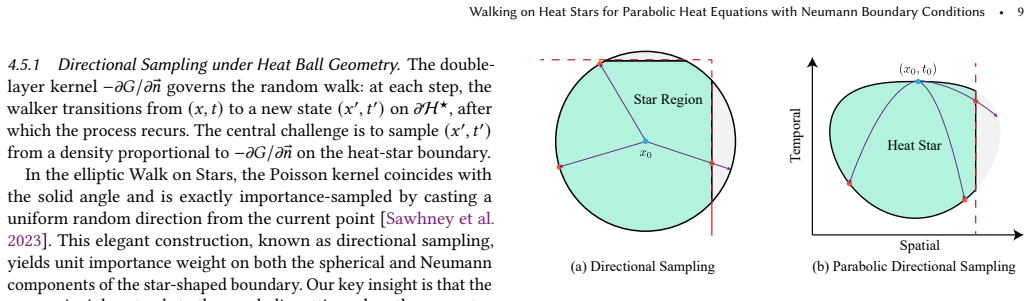
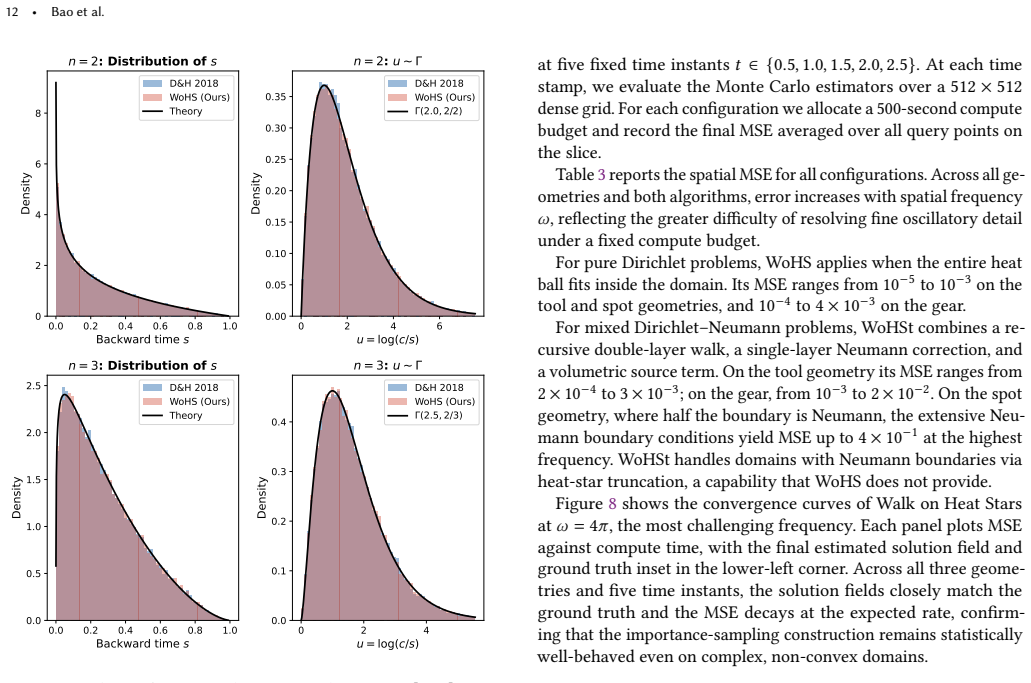
Walk on Heat Stars closes the gap for transient parabolic equations by introducing a parameterization of the heat ball geometry using a logarithmic time coordinate and a spatial direction that reveals the double-layer kernel factorizes into independent Gamma and uniform components, enabling exact directional importance sampling of the recursive next walk position, the Neumann flux contribution, and the volumetric source term.
What carries the argument
The logarithmic-time and directional parameterization of the heat ball geometry that factorizes the double-layer kernel into independent Gamma and uniform components.
If this is right
- Unbiased Monte Carlo estimators become available for the solution value, Neumann flux, and volumetric source at any query point.
- The method handles both pure and mixed Neumann boundary conditions without requiring Dirichlet data.
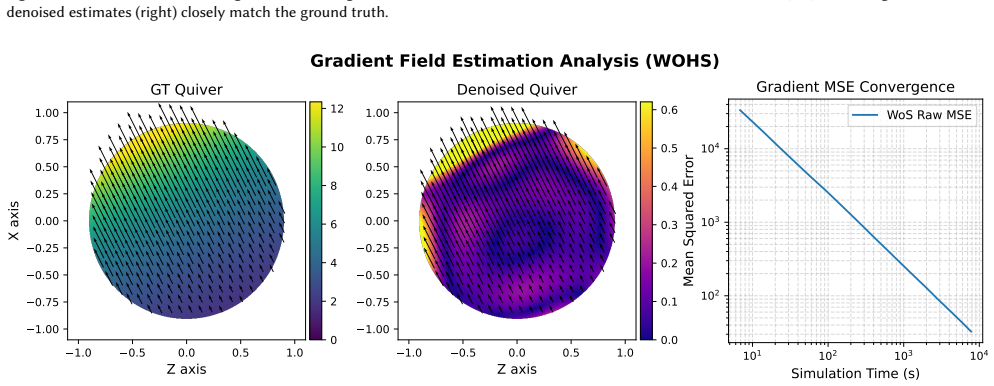
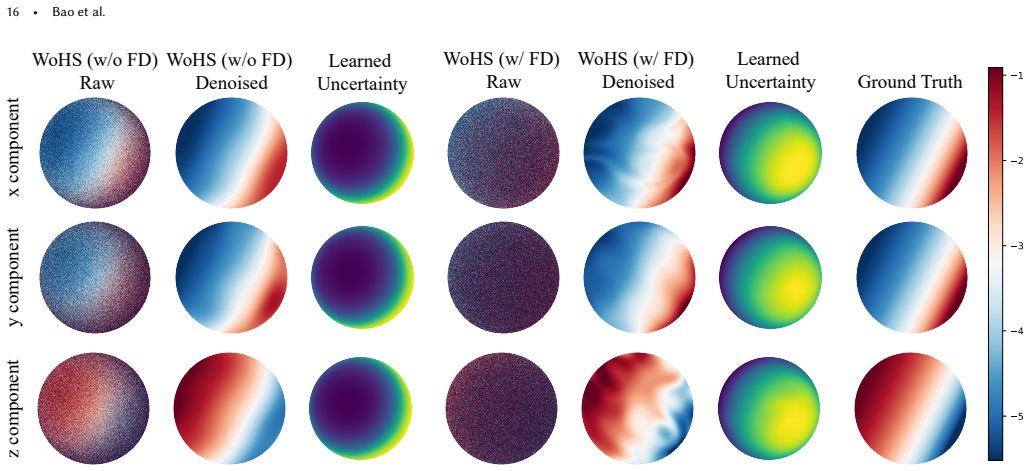
- Spatial derivatives of the solution can be estimated directly as weighted boundary integrals without recursive differentiation.
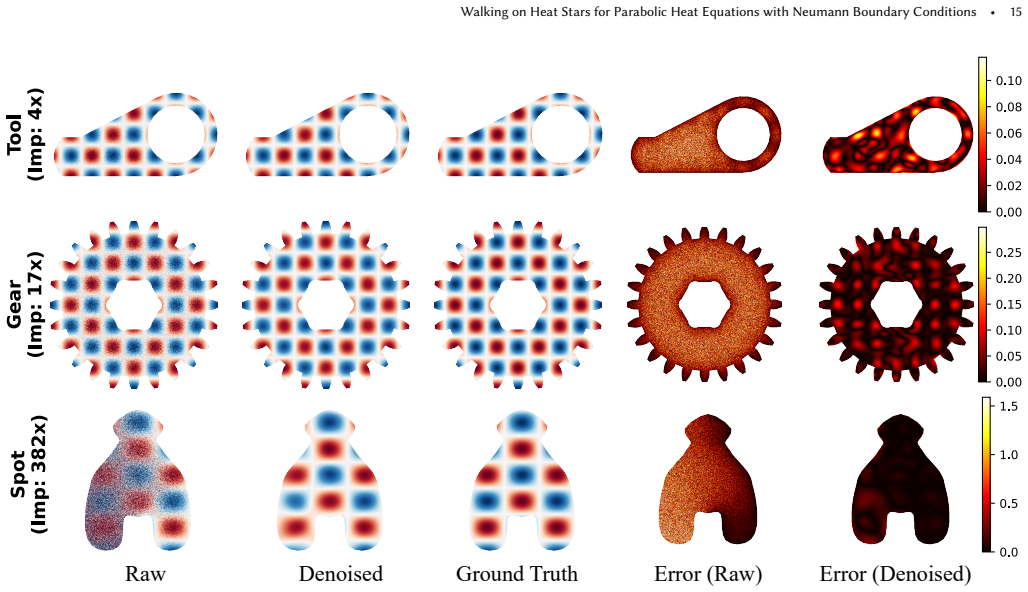
- A heteroscedastic regression denoiser adapted to space-time reduces variance while preserving the unbiased property.
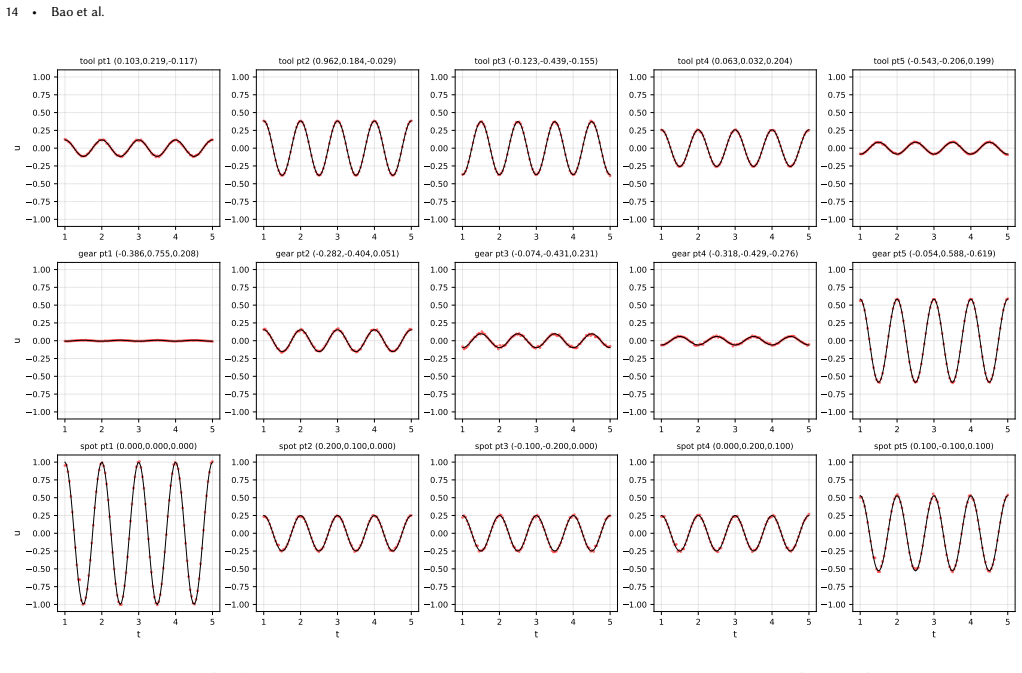
- The approach converges at the standard Monte Carlo rate on analytic solutions across varied geometries and frequencies.
Where Pith is reading between the lines
- The same factorization technique could be tested on other parabolic operators whose fundamental solutions admit analogous scaling.
- Practical thermal simulations in graphics could avoid meshing overhead for dynamic heat-sink and cooling problems.
- The separation into Gamma time and uniform direction suggests possible extensions to anisotropic diffusion or moving-boundary problems.
- Gradient estimators that avoid recursion may reduce variance in optimization loops that rely on solution sensitivities.
Load-bearing premise
The double-layer kernel on a heat ball separates cleanly into independent Gamma and uniform factors once the ball is parameterized by logarithmic time and spatial direction.
What would settle it
A direct numerical quadrature check on a simple heat ball showing that the proposed Gamma-uniform sampling distribution does not reproduce the exact integral of the double-layer kernel.
Figures
read the original abstract
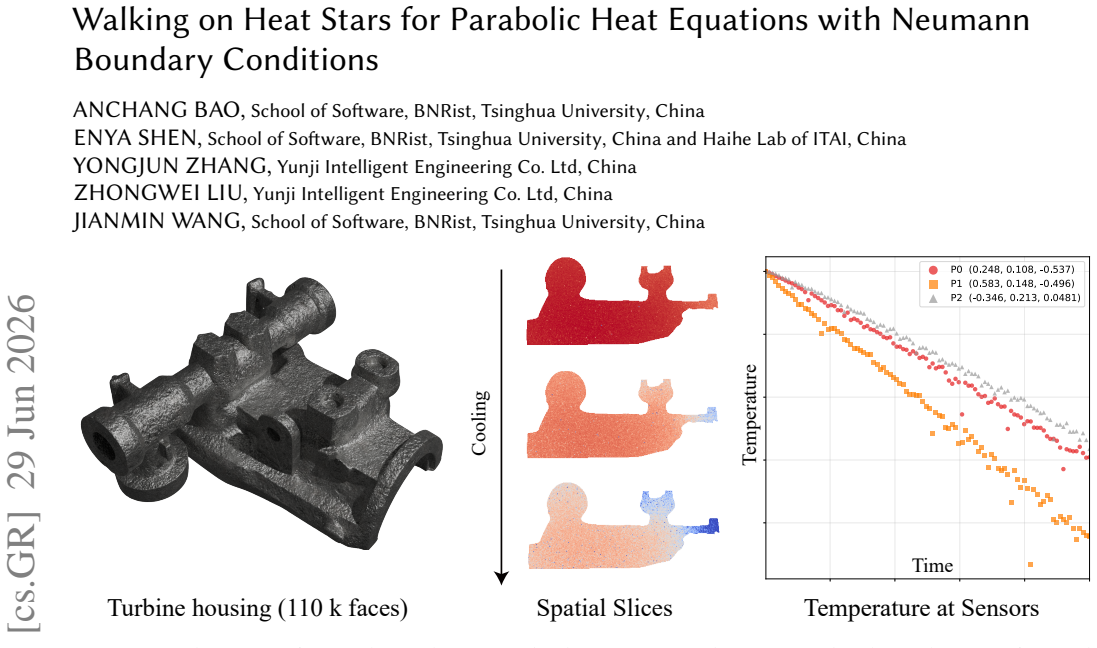
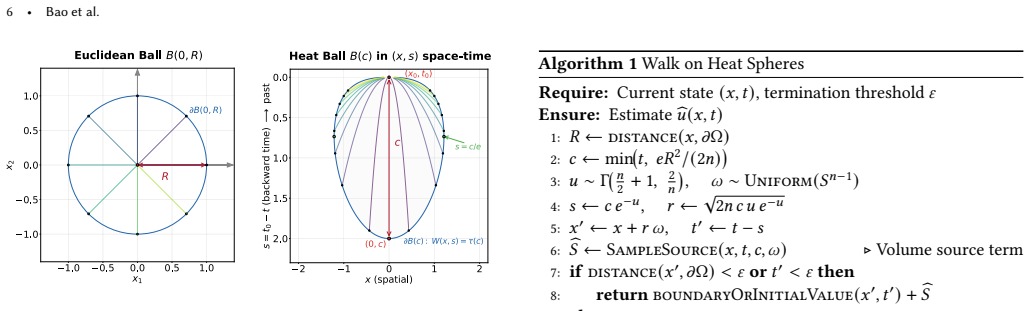
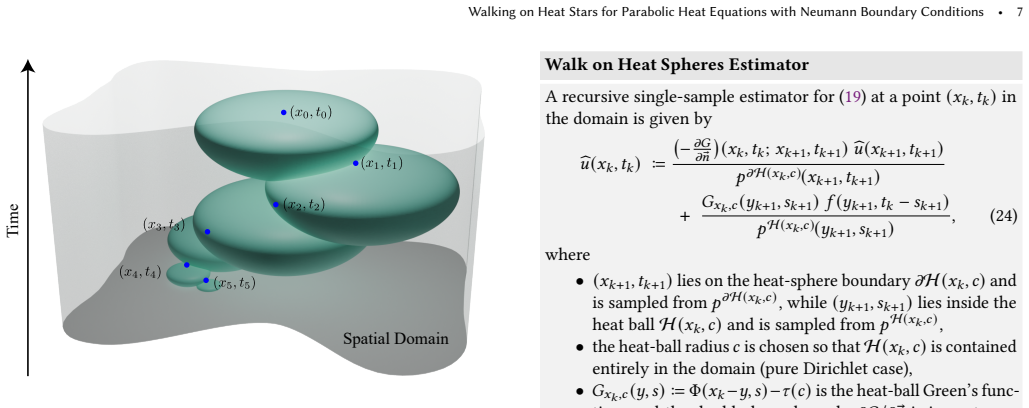
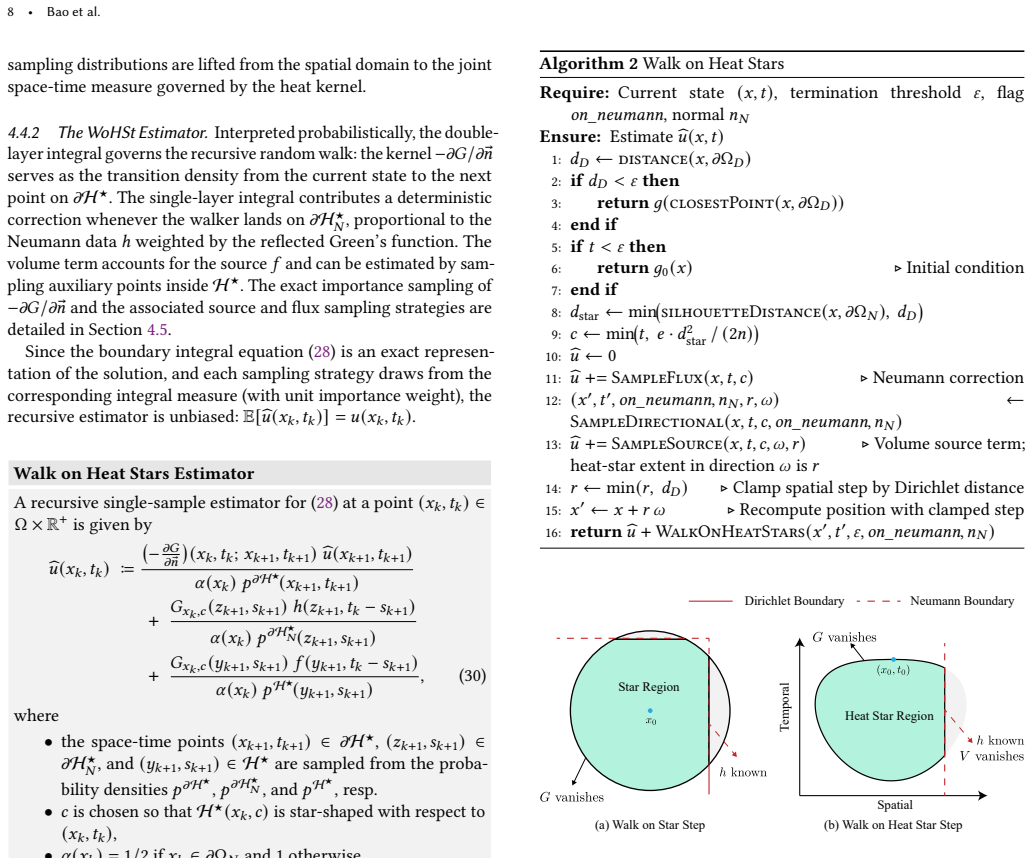
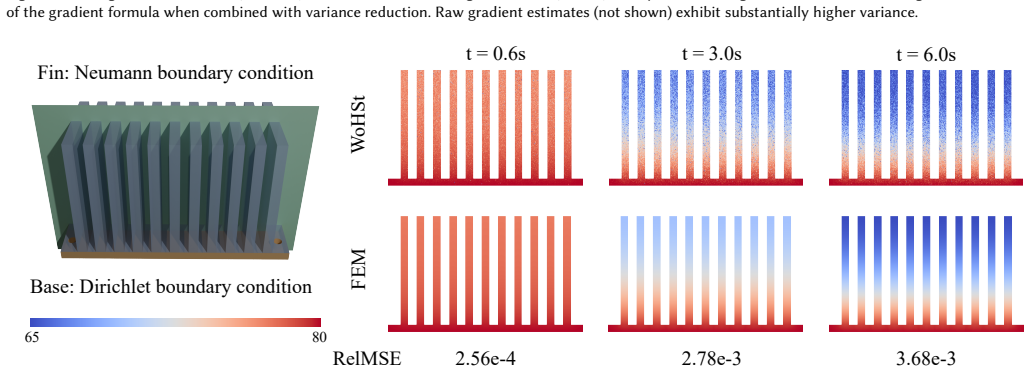
Monte Carlo methods have proven highly effective for elliptic partial differential equations through algorithms such as Walk on Spheres and Walk on Stars, which evaluate solutions at individual points without volumetric meshing or global linear solves. Extending these methods to the transient regime has remained an open challenge: parabolic equations couple space and time through an anisotropic scaling, requiring joint sampling of spatial displacements and backward time steps whose distribution was not previously available in a unified, exact form. We present Walk on Heat Stars, a grid-free Monte Carlo solver that closes this gap by extending the boundary integral framework of Walk on Stars to the parabolic setting. Our method introduces a non-cylindrical boundary integral formulation that accommodates the time-varying domains induced by heat-ball sampling. The heat ball geometry is parameterized by a logarithmic time coordinate and a spatial direction, revealing that the double-layer kernel factorizes into independent Gamma and uniform components. This parameterization enables exact directional importance sampling of the recursive next walk position, the Neumann flux contribution, and the volumetric source term, yielding unbiased Monte Carlo estimators for all three components. We additionally derive a preliminary gradient estimator that expresses spatial derivatives as weighted boundary integrals of the solution, requiring no recursion on the gradient, and adapt a heteroscedastic regression-based denoiser to the space-time domain for variance reduction. We validate our method on analytical solutions across a range of geometries and spatial frequencies, confirm convergence at the expected Monte Carlo rate, and demonstrate practical applicability on heat sink and cooling scenes with mixed or pure Neumann boundary conditions.
Editorial analysis
A structured set of objections, weighed in public.
Referee Report
Summary. The paper introduces Walk on Heat Stars, a grid-free Monte Carlo method extending Walk on Stars to parabolic heat equations with Neumann boundary conditions. It uses a non-cylindrical boundary integral formulation to handle time-varying domains from heat-ball sampling. The heat ball is parameterized by logarithmic time coordinate and spatial direction, allowing the double-layer kernel to factorize into independent Gamma (time) and uniform (direction) components. This enables exact directional importance sampling for recursive walk positions, Neumann flux, and volumetric sources, producing unbiased estimators. Additional elements include a non-recursive gradient estimator as weighted boundary integrals and a heteroscedastic regression denoiser adapted to space-time; validation is reported on analytical solutions, convergence rates, and practical heat sink/cooling scenes.
Significance. If the central factorization and unbiasedness claims hold, the work is significant for closing a longstanding gap in extending elliptic Monte Carlo PDE solvers (Walk on Spheres/Stars) to the parabolic regime without meshing or global solves. Strengths include the exact, parameter-free factorization into Gamma and uniform factors (enabling unbiased sampling of all three components), the non-cylindrical formulation for time-varying domains, and the preliminary gradient estimator. These could enable new applications in transient heat transfer simulations in graphics and engineering.
major comments (1)
- [Abstract] The central claim of exact unbiased Monte Carlo estimators rests on the heat-ball parameterization and double-layer kernel factorization (abstract). Without the explicit derivation, error analysis, or validation details visible, the support for unbiasedness across the Neumann parabolic case cannot be verified at this stage.
Simulated Author's Rebuttal
We thank the referee for their summary and for highlighting the potential significance of the work if the central claims hold. We address the single major comment below.
read point-by-point responses
-
Referee: [Abstract] The central claim of exact unbiased Monte Carlo estimators rests on the heat-ball parameterization and double-layer kernel factorization (abstract). Without the explicit derivation, error analysis, or validation details visible, the support for unbiasedness across the Neumann parabolic case cannot be verified at this stage.
Authors: The abstract summarizes the contributions at a high level, as is conventional. The explicit derivation of the non-cylindrical boundary integral formulation, the heat-ball parameterization by logarithmic time coordinate and spatial direction, and the resulting factorization of the double-layer kernel into independent Gamma (time) and uniform (direction) components appears in Section 3 of the full manuscript. This factorization directly enables the exact directional importance sampling for the recursive walk position, Neumann flux, and volumetric sources, establishing unbiasedness. Error analysis and convergence rates are derived in Section 4. Validation on analytical solutions (including convergence at the Monte Carlo rate) and practical scenes appears in Section 5. These sections supply the requested support for the Neumann parabolic case. revision: no
Circularity Check
No significant circularity; derivation introduces independent parameterization
full rationale
The paper's central step is introducing a logarithmic-time + direction parameterization of the heat ball, from which the double-layer kernel factorization into Gamma(time) and uniform(direction) factors is derived. This is presented as a new geometric observation enabling exact sampling, not a redefinition or fit of the target quantities. No self-citations, fitted inputs renamed as predictions, or uniqueness theorems imported from prior author work appear in the provided text. The claimed unbiased estimators follow directly from the factorization rather than reducing to the inputs by construction. This is the expected non-finding for a methods paper whose novelty lies in an explicit kernel decomposition.
Axiom & Free-Parameter Ledger
Reference graph
Works this paper leans on
-
[1]
The deal. II library, version 9.7
The deal.II library, Version 9.7.Journal of Numerical Mathematics33, 4 (2025), 403–415. doi:10.1515/jnma-2025-0115 Ghada Bakbouk and Pieter Peers
-
[2]
Mean Value Caching for Walk on Spheres. (2023). Anchang Bao, Enya Shen, and Jianmin Wang
2023
-
[3]
Monte Carlo PDE Solvers for Nonlinear Radiative Boundary Conditions
Monte Carlo PDE Solvers for Nonlinear Radiative Boundary Conditions.arXiv preprint arXiv:2604.21717(2026). Anchang Bao, Jie Xu, Enya Shen, and Jianmin Wang
work page internal anchor Pith review Pith/arXiv arXiv 2026
-
[4]
InProceedings of the SIGGRAPH Asia 2025 Con- ference Papers
Off-Centered WoS-Type Solvers with Statistical Weighting. InProceedings of the SIGGRAPH Asia 2025 Con- ference Papers. 1–11. Mégane Bati, Stéphane Blanco, Christophe Coustet, Vincent Eymet, Vincent Forest, Richard Fournier, Jacques Gautrais, Nicolas Mellado, Mathias Paulin, and Benjamin Piaud
2025
-
[5]
Rahel Brügger, Helmut Harbrecht, and Johannes Tausch
Coupling Conduction, Convection and Radiative Transfer in a Single Path-Space: Application to Infrared Rendering.ACM Transactions on Graphics (TOG) 42, 4 (2023), 1–20. Rahel Brügger, Helmut Harbrecht, and Johannes Tausch
2023
-
[6]
Boundary inte- gral operators for the heat equation in time-dependent domains.arXiv preprint arXiv:2010.04934(2020). Martin Costabel
-
[7]
Michael Czekanski, Benjamin Faber, Margaret Fairborn, Adelle Wright, and David Bindel
Boundary integral operators for the heat equation.Integral Equations and Operator Theory13, 4 (1990), 498–552. Michael Czekanski, Benjamin Faber, Margaret Fairborn, Adelle Wright, and David Bindel
1990
-
[8]
Fernando de Goes and Mathieu Desbrun
Walking on Spheres and Talking to Neighbors: Variance Reduction for Laplace’s Equation.arXiv preprint arXiv:2404.17692(2024). Fernando de Goes and Mathieu Desbrun
-
[9]
Stochastic Computation of Barycentric Coordinates.ACM Transactions on Graphics43, 4 (2024),
2024
-
[10]
Madalina Deaconu and Samuel Herrmann
Hitting time for Bessel processes— Walk on moving spheres algorithm (WoMS).The Annals of Applied Probability23, 6 (2013), 2259–2289. Madalina Deaconu and Samuel Herrmann
2013
-
[11]
Initial-boundary value problem for the heat equation—A stochastic algorithm.The Annals of Applied Probability28, 3 (2018), 1943–1976. M. Deaconu, S. Herrmann, and S. Maire
2018
-
[12]
Yixin Hu, Teseo Schneider, Bolun Wang, Denis Zorin, and Daniele Panozzo
The walk on moving spheres: A new tool for simulating Brownian motion’s exit time from a domain.Mathematics and Computers in Simulation135 (2017), 28–38. Yixin Hu, Teseo Schneider, Bolun Wang, Denis Zorin, and Daniele Panozzo
2017
-
[13]
Tianyu Huang
Fast tetrahedral meshing in the wild.ACM Transactions on Graphics (ToG)39, 4 (2020), 117–1. Tianyu Huang
2020
-
[14]
InProceedings of the SIGGRAPH Asia 2025 Technical Communications
Geometric Queries on Closed Implicit Surfaces for Walk on Stars. InProceedings of the SIGGRAPH Asia 2025 Technical Communications. 1–4. Tianyu Huang, Jingwang Ling, Shuang Zhao, and Feng Xu
2025
-
[15]
Proceedings of the Imperial Academy20, 10 (1944), 706–714
two-dimensional brownian motion and harmonic functions. Proceedings of the Imperial Academy20, 10 (1944), 706–714. Zilu Li, Guandao Yang, Xi Deng, Christopher De Sa, Bharath Hariharan, and Steve Marschner
1944
-
[16]
InSIGGRAPH Asia 2023 Conference Papers
Neural Caches for Monte Carlo Partial Differential Equation Solvers. InSIGGRAPH Asia 2023 Conference Papers. 1–10. Zilu Li, Guandao Yang, Qingqing Zhao, Xi Deng, Leonidas Guibas, Bharath Hariharan, and Gordon Wetzstein
2023
-
[17]
InACM SIGGRAPH 2024 Conference Papers
Neural Control Variates with Automatic Integration. InACM SIGGRAPH 2024 Conference Papers. 1–9. Bailey Miller, Rohan Sawhney, Keenan Crane, and Ioannis Gkioulekas
2024
-
[18]
Bailey Miller, Rohan Sawhney, Keenan Crane, and Ioannis Gkioulekas
Boundary Value Caching for Walk on Spheres.ACM Transactions on Graphics (TOG)42, 4 (2023), 1–11. Bailey Miller, Rohan Sawhney, Keenan Crane, and Ioannis Gkioulekas. 2024a. Differen- tial Walk on Spheres.ACM Transactions on Graphics (TOG)43, 6 (2024), 1–18. Bailey Miller, Rohan Sawhney, Keenan Crane, and Ioannis Gkioulekas. 2024b. Walkin’Robin: Walk on Sta...
2023
-
[19]
Mervin E Muller
Solving partial differential equations in participating media.ACM Transactions on Graphics (TOG)44, 4 (2025), 1–21. Mervin E Muller
2025
-
[20]
The Annals of Mathematical Statistics(1956), 569–589
Some continuous Monte Carlo methods for the Dirichlet problem. The Annals of Mathematical Statistics(1956), 569–589. Yang Qi, Dario Seyb, Benedikt Bitterli, and Wojciech Jarosz
1956
-
[21]
Karl K Sabelfeld
A monte carlo method for fluid simulation.ACM Transactions on Graphics (TOG)41, 6 (2022), 1–16. Karl K Sabelfeld
2022
-
[22]
Karl K Sabelfeld
Random walk on spheres algorithm for solving transient drift- diffusion-reaction problems.Monte Carlo Methods and Applications23, 3 (2017), 189–212. Karl K Sabelfeld
2017
-
[23]
Rohan Sawhney
A global random walk on spheres algorithm for transient heat equation and some extensions.Monte Carlo Methods and Applications25, 4 (2019), 301–316. Rohan Sawhney. 2021.FCPW: Fastest Closest Points in the West. Rohan Sawhney and Keenan Crane
2019
-
[24]
Rohan Sawhney, Bailey Miller, Ioannis Gkioulekas, and Keenan Crane
Monte Carlo geometry processing: A grid- free approach to PDE-based methods on volumetric domains.ACM Transactions on Graphics39, 4 (2020). Rohan Sawhney, Bailey Miller, Ioannis Gkioulekas, and Keenan Crane
2020
-
[25]
arXiv preprint arXiv:2302.11815(2023)
Walk on stars: A grid-free monte carlo method for pdes with neumann boundary conditions. arXiv preprint arXiv:2302.11815(2023). Rohan Sawhney, Dario Seyb, Wojciech Jarosz, and Keenan Crane
-
[26]
Maximilian Seitzer, Arash Tavakoli, Dimitrije Antic, and Georg Martius
Grid-free Monte Carlo for PDEs with spatially varying coefficients.ACM Transactions on Graphics (TOG)41, 4 (2022), 1–17. Maximilian Seitzer, Arash Tavakoli, Dimitrije Antic, and Georg Martius
2022
-
[27]
arXiv preprint arXiv:2203.09168(2022)
On the pitfalls of heteroscedastic uncertainty estimation with probabilistic neural networks. arXiv preprint arXiv:2203.09168(2022). Vincent Sitzmann, Julien Martel, Alexander Bergman, David Lindell, and Gordon Wetzstein
-
[28]
Advances in neural information processing systems33 (2020), 7462–7473
Implicit neural representations with periodic activation functions. Advances in neural information processing systems33 (2020), 7462–7473. Ryusuke Sugimoto, Christopher Batty, and Toshiya Hachisuka
2020
-
[29]
InACM SIGGRAPH 2024 Conference Papers
Velocity-Based Monte Carlo Fluids. InACM SIGGRAPH 2024 Conference Papers. 1–11. Ryusuke Sugimoto, Terry Chen, Yiti Jiang, Christopher Batty, and Toshiya Hachisuka
2024
-
[30]
Neil A Watson
A practical walk-on-boundary method for boundary value problems.ACM Transactions on Graphics (TOG)42, 4 (2023), 1–16. Neil A Watson. 2012.Introduction to heat potential theory. Number
2023
-
[31]
Zihan Yu, Rohan Sawhney, Bailey Miller, Lifan Wu, and Shuang Zhao
Solving inverse PDE problems using grid-free Monte Carlo estimators.ACM Transactions on Graphics (TOG)43, 6 (2024), 1–18. Zihan Yu, Rohan Sawhney, Bailey Miller, Lifan Wu, and Shuang Zhao
2024
-
[32]
Zihan Yu, Lifan Wu, Zhiqian Zhou, and Shuang Zhao
Robust Derivative Estimation with Walk on Stars.ACM Transactions on Graphics (TOG)44, 6 (2025), 1–16. Zihan Yu, Lifan Wu, Zhiqian Zhou, and Shuang Zhao
2025
-
[33]
InACM SIGGRAPH 2024 Conference Papers
A Differential Monte Carlo Solver For the Poisson Equation. InACM SIGGRAPH 2024 Conference Papers. 1–10. Zihong Zhou, Eugene d’Eon, Rohan Sawhney, and Wojciech Jarosz
2024
-
[34]
A Derivation of the Non-Cylindrical Boundary Integral Equation We derive the non-cylindrical boundary integral representation(11) from first principles
Harmonic Caching for Walk on Spheres.ACM Transactions on Graphics (TOG)44, 6 (2025), 1–15. A Derivation of the Non-Cylindrical Boundary Integral Equation We derive the non-cylindrical boundary integral representation(11) from first principles. The proof combines three classical ingredients: Green’s second identity (spatial), the Reynolds transport theorem...
2025
-
[35]
Walking on Heat Stars for Parabolic Heat Equations with Neumann Boundary Conditions•19 maps to the wall component of the caloric measure with no addi- tional correction
When the ray strikes𝜕Ω 𝑁 at distance 𝜌 before the heat-sphere surface, the inversion 𝑐wall =𝜌 2/(2𝑛𝑢𝑒 −𝑢) Conference acronym ’XX, June 03–05, 2018, Woodstock, NY. Walking on Heat Stars for Parabolic Heat Equations with Neumann Boundary Conditions•19 maps to the wall component of the caloric measure with no addi- tional correction. B.2 Source Term Sampling...
2018
-
[36]
The direction 𝜔 is reused from the directional sampling step (Section 4.5.1), requiring no ad- ditional random variate
The temporal coordinate 𝑢 is drawn directly from the Gamma distribution. The direction 𝜔 is reused from the directional sampling step (Section 4.5.1), requiring no ad- ditional random variate. The point (𝑦, 𝑠) is then mapped via (58); if 𝑦∉H ★ the contribution is zero. The estimator isb𝐼𝑓 =𝑍·𝑓(𝑦, 𝑡−𝑠) , with no explicit evaluation of𝐺required. C Gradient ...
2012
-
[37]
Conference acronym ’XX, June 03–05, 2018, Woodstock, NY
The critical difference from the Laplace case is that 𝑤(𝑟) is non-constant, so ∇𝑦𝑤≠ 0and the volume term survives. Conference acronym ’XX, June 03–05, 2018, Woodstock, NY. 20•Bao et al. With 𝜔𝑖 =(𝑦 𝑖 −𝑥 0𝑖)/𝑟, the surface and volume terms separate as 𝑆𝑖 =𝜏(𝑐) ∫ 𝑐 0 𝑟(𝑠) 𝑛+1 4𝑠2 ∫ 𝑆𝑛−1 𝑢(𝑥 0 +𝑟(𝑠)𝜔, 𝑡 0 −𝑠)𝜔 𝑖 d𝜔d𝑠,(74) 𝑉𝑖 =−𝜏(𝑐) ∫ 𝑐 0 1 2𝑠2 ∫ 𝑟(𝑠) 0 𝑟 𝑛 ∫...
2018
discussion (0)
Sign in with ORCID, Apple, or X to comment. Anyone can read and Pith papers without signing in.