The quantitative isoperimetric inequality: A calibration argument
Pith reviewed 2026-06-27 03:00 UTC · model grok-4.3
The pith
Quantitative calibrations give a direct proof of the quantitative isoperimetric inequality.
A machine-rendered reading of the paper's core claim, the machinery that carries it, and where it could break.
Core claim
The authors prove the quantitative isoperimetric inequality by constructing quantitative calibrations whose induced distance controls both Fraenkel asymmetry and tilt excess; the key technical result is a nonlinear geometric version of Fuglede's result in BV that is proved directly and without any appeal to regularity theory for almost minimizers.
What carries the argument
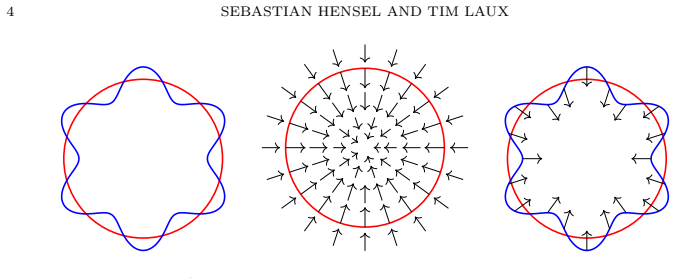
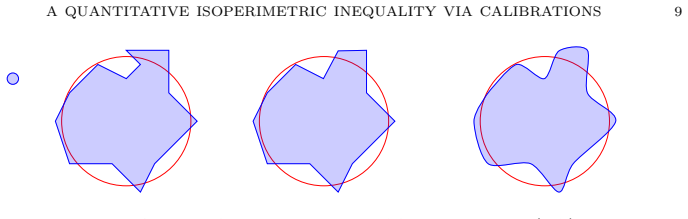
Quantitative calibrations, which induce a natural distance simultaneously controlling Fraenkel asymmetry and tilt excess.
If this is right
- The quantitative isoperimetric inequality follows from the existence of these calibrations.
- One distance simultaneously controls both volume asymmetry and boundary tilt.
- The proof avoids all regularity theory for almost-minimizers.
- The argument applies in the setting of sets of finite perimeter in Euclidean space.
Where Pith is reading between the lines
- The same calibration distance might serve as a Lyapunov functional for curvature flows that improve isoperimetric deficit.
- The method could be adapted to prove quantitative versions of other geometric inequalities that currently rely on regularity.
- Explicit constants in the inequality might be read off from the calibration construction itself.
Load-bearing premise
The nonlinear geometric version of Fuglede's result in BV admits a direct self-contained proof that does not rely on regularity theory.
What would settle it
A sequence of sets for which the quantitative-calibration distance tends to zero while either the Fraenkel asymmetry or the tilt excess stays bounded away from zero would disprove the key result.
Figures
read the original abstract
We give a short proof of the quantitative isoperimetric inequality. Our argument is based on a notion of quantitative calibrations which induce a natural distance controlling both the Fraenkel asymmetry and the tilt excess. The proof of our key result which can be viewed as a nonlinear, geometric version of Fuglede's result in $BV$ is direct and self-contained. In particular, we do not make any use of regularity theory for almost minimizers.
Editorial analysis
A structured set of objections, weighed in public.
Referee Report
Summary. The manuscript presents a short proof of the quantitative isoperimetric inequality. The argument relies on a new notion of quantitative calibrations that induce a distance controlling both the Fraenkel asymmetry and the tilt excess. The central result is framed as a nonlinear geometric analogue of Fuglede's theorem in BV and is claimed to be direct and self-contained, with no appeal to regularity theory for almost-minimizers.
Significance. If the claimed direct proof holds, the work would supply a calibration-based route to quantitative isoperimetric inequalities that bypasses regularity theory, a notable technical strength. The introduction of quantitative calibrations as a tool that simultaneously controls asymmetry and tilt excess could prove useful in other variational problems in geometric measure theory.
minor comments (3)
- [§2] The definition of quantitative calibrations (introduced to induce the controlling distance) should be stated with full precision in §2 before the main theorem is stated, to make the subsequent estimates self-contained.
- [Theorem 1.1] Notation for the induced distance (presumably denoted d or similar) is used in the abstract and key result but should be fixed with an explicit formula or inequality relating it to Fraenkel asymmetry and tilt excess in the statement of the main theorem.
- [Introduction] A brief comparison paragraph with the classical Fuglede result in BV would help readers see exactly where the nonlinear geometric adaptation occurs.
Simulated Author's Rebuttal
We thank the referee for their positive summary of the manuscript, recognition of the significance of the quantitative calibration approach, and recommendation of minor revision. No major comments were raised in the report.
Circularity Check
No significant circularity; derivation presented as self-contained
full rationale
The paper's central claim is a direct, self-contained proof of the quantitative isoperimetric inequality via a notion of quantitative calibrations controlling Fraenkel asymmetry and tilt excess, explicitly framed as a nonlinear geometric analogue of Fuglede's BV result. The abstract states the key result admits a direct proof without any use of regularity theory for almost minimizers, and no load-bearing steps reduce to self-citations, fitted inputs renamed as predictions, or ansatzes smuggled via prior work by the same authors. The provided description contains no equations or claims that equate outputs to inputs by construction, satisfying the criteria for an independent derivation.
Axiom & Free-Parameter Ledger
axioms (1)
- standard math Standard properties of sets of finite perimeter and functions of bounded variation
invented entities (1)
-
quantitative calibrations
no independent evidence
Reference graph
Works this paper leans on
-
[1]
Ambrosio, N
L. Ambrosio, N. Fusco, and D. Pallara.Functions of Bounded Variation and Free Disconti- nuity Problems (Oxford Mathematical Monographs). Oxford University Press, 2000
2000
-
[2]
M. Cicalese and G. P. Leonardi. A selection principle for the sharp quantitative isoperimetric inequality.Arch. Ration. Mech. Anal., 206(2):617–643, 2012. DOI:10.1007/s00205-012-0544- 1
-
[3]
De Giorgi
E. De Giorgi. Sulla propriet` a isoperimetrica dell’ipersfera, nella classe degli insiemi aventi frontiera orientata di misura finita.Atti Accad. Naz. Lincei Mem. Cl. Sci. Fis. Mat. Natur. Sez. Ia (8), 5:33–44, 1958
1958
-
[4]
G. de Rham. On the area of complex manifolds. InGlobal Analysis (Papers in Honor of K. Kodaira), pages 141–148. Univ. Tokyo Press, Tokyo, 1969
1969
-
[5]
A. Figalli, F. Maggi, and A. Pratelli. A mass transportation approach to quantitative isoperi- metric inequalities.Invent. Math., 182(1):167–211, 2010. DOI:10.1007/s00222-010-0261-z
-
[6]
Sharp stability of Alexandrov's theorem for $C^1$ domains in the small-excess regime
A. Figalli and Y. R.-Y. Zhang. Sharp stability of Alexandrov’s theorem forC 1 domains in the small-excess regime, 2026. arXiv:2606.13335[math.DG]
work page internal anchor Pith review Pith/arXiv arXiv 2026
-
[7]
Boundary regularity of rotating vortex patches
J. Fischer and S. Hensel. Weak-strong uniqueness for the Navier-Stokes equation for two fluids with surface tension.Arch. Ration. Mech. Anal., 236(2):967–1087, 2020. DOI:10.1007/s00205- 019-01486-2
-
[8]
J. Fischer, S. Hensel, T. Laux, and T. M. Simon. Local minimizers of the interface length functional based on a concept of local paired calibrations. 2023. arXiv:2212.11840[math.AP]
-
[9]
J. Fischer, S. Hensel, T. Laux, and T. M. Simon. The local structure of the energy landscape in multiphase mean curvature flow: Weak-strong uniqueness and stability of evolutions.J. Eur. Math. Soc. (JEMS), 2025. DOI:10.4171/JEMS/15772
-
[10]
B. Fuglede. Stability in the isoperimetric problem.Bull. London Math. Soc., 18(6):599–605,
-
[11]
DOI:10.1112/blms/18.6.599
-
[12]
N. Fusco and V. Julin. A strong form of the quantitative isoperimetric inequality.Calc. Var. Partial Differential Equations, 50(3-4):925–937, 2014. DOI:10.1007/s00526-013-0661-1
-
[13]
N. Fusco, F. Maggi, and A. Pratelli. The sharp quantitative isoperimetric inequality.Ann. Math., 168(3):941–980, 2008. DOI:10.4007/annals.2008.168.941
-
[14]
F. H´ elein. In´ egalit´ e isop´ erim´ etrique et calibration.Ann. Inst. Fourier (Grenoble), 44(4):1211– 1218, 1994. DOI:10.5802/aif.1430
-
[15]
Maggi.Sets of Finite Perimeter and Geometric Variational Problems: An Introduction to Geometric Measure Theory
F. Maggi.Sets of Finite Perimeter and Geometric Variational Problems: An Introduction to Geometric Measure Theory. Cambridge University Press, 2012
2012
-
[16]
V. D. Milman and G. Schechtman.Asymptotic theory of finite-dimensional normed spaces, volume 1200 ofLecture Notes in Mathematics. Springer-Verlag, Berlin, 1986. With an ap- pendix by M. Gromov
1986
-
[17]
Wirtinger
W. Wirtinger. Eine Determinantenidentit¨ at und ihre Anwendung auf analytische Gebilde in euklidischer und hermitescher Maßbestimmung.Monatsh. Math. Phys., 44(1):343–365, 1936. Universit¨at Leipzig, F akult ¨at f ¨ur Mathematik und Informatik, Neues Augusteum, Augustusplatz 10, 04109 Leipzig, Germany Email address:sebastian.hensel@uni-leipzig.de Universit...
1936
discussion (0)
Sign in with ORCID, Apple, or X to comment. Anyone can read and Pith papers without signing in.