Renderable Partial Representations for Dynamic Gaussian Splatting under Incomplete Delivery
Pith reviewed 2026-06-27 01:51 UTC · model grok-4.3
The pith
Dynamic Gaussian splatting representations remain renderable under partial network delivery when refinements are ordered by their marginal contribution to the rendered image.
A machine-rendered reading of the paper's core claim, the machinery that carries it, and where it could break.
Core claim
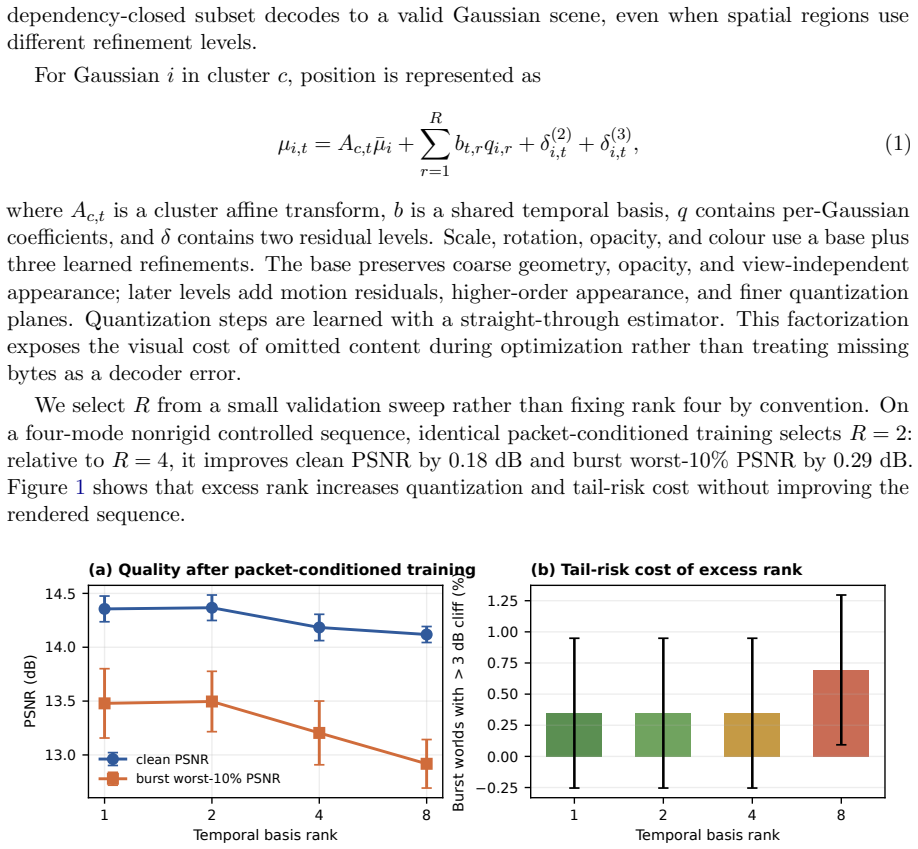
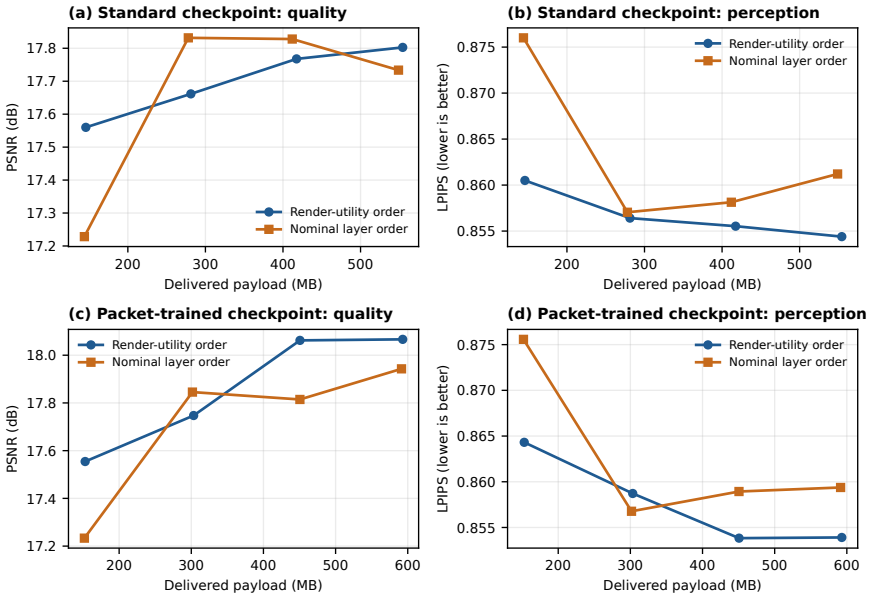
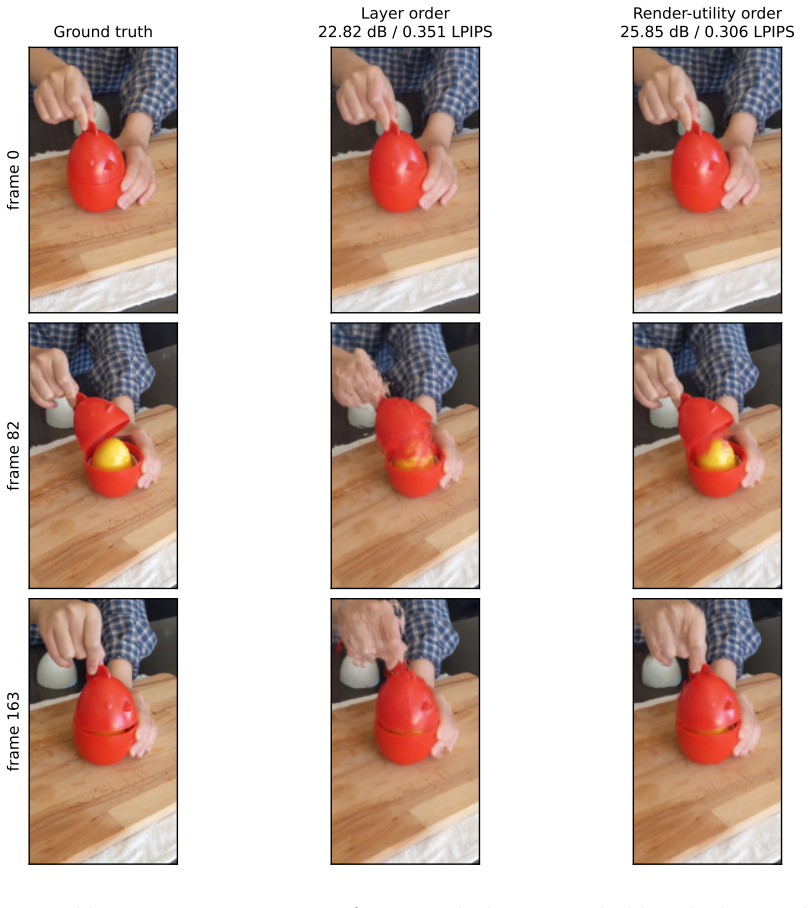
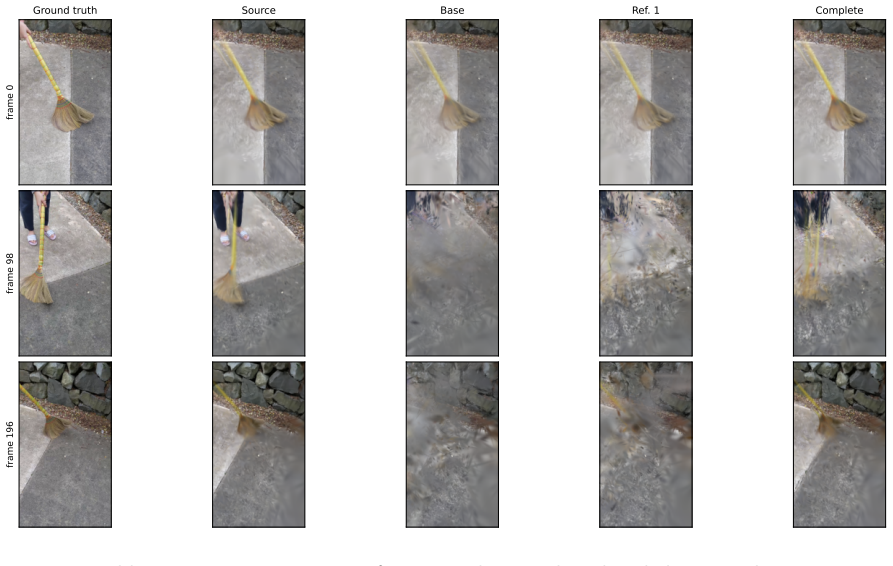
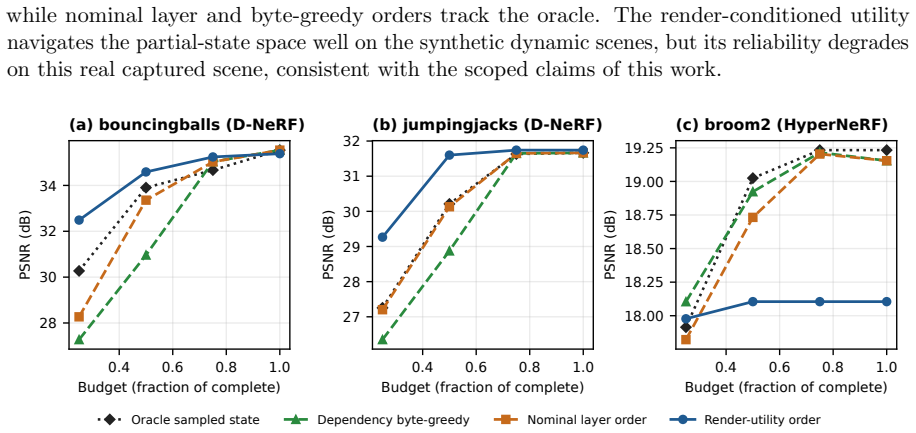
Gaussian primitives are organized into independently addressable spatiotemporal clusters with a base level and three refinements. Training samples partial dependency graphs, renders many counterfactual states in one GPU batch, and minimizes expected distortion, tail distortion, temporal inconsistency, rate, and prefix regressions. A counterfactual utility layer measures the marginal render contribution of each completion group across valid receiver contexts. On held-out views the finest refinement exhibits negative mean marginal utility in many clusters, and render-utility ordering removes PSNR regressions that appear under nominal layer order at matched byte budgets.
What carries the argument
Counterfactual utility layer that measures the marginal render contribution of each completion group across valid receiver contexts
If this is right
- On broom2, render-utility ordering removes both PSNR regressions produced by nominal layer order at matched byte budgets.
- On chicken, utilities measured on disjoint training cameras improve held-out PSNR by 3.03 dB at the lowest matched budget.
- The finest refinement has negative mean marginal utility in 3/32 D-NeRF bouncingballs, 49/64 HyperNeRF broom2, and 28/64 HyperNeRF chicken clusters.
- Its lower-tail utility is negative in 21/32, 61/64, and 42/64 clusters respectively.
Where Pith is reading between the lines
- The same sampling and utility-ranking procedure could be applied to static Gaussian scenes or other point-based representations to produce delivery-aware orderings.
- Negative utility for the finest refinement in many clusters implies that bandwidth-limited receivers may obtain better quality by skipping that refinement entirely for selected clusters.
- The MTU-bounded chunk delivery and deadline-aware scheduling described in the paper provide a concrete path to test whether the learned order generalizes outside the training distribution of partial graphs.
Load-bearing premise
The distribution of partial delivery states encountered in real networks can be adequately approximated during training by sampling partial dependency graphs and rendering counterfactual states in batch.
What would settle it
Compare PSNR on held-out views when the same clusters are delivered over an actual network trace using the learned utility order versus nominal layer order, at identical byte budgets.
Figures
read the original abstract
Dynamic Gaussian compression is normally optimized for complete files or complete progressive prefixes, but interactive rendering encounters partial representations: some spatiotemporal regions are present, others missing, and late refinements cannot affect the displayed frame. We study dynamic Gaussian representations whose incomplete delivery states remain directly renderable and whose degradation is optimized in image space. Gaussian primitives are organized into independently addressable spatiotemporal clusters with a base level and three refinements; training samples partial dependency graphs, renders many counterfactual states in one GPU batch, and minimizes expected distortion, tail distortion, temporal inconsistency, rate, and prefix regressions. A counterfactual utility layer measures the marginal render contribution of each completion group across valid receiver contexts. The same graph admits a concrete delivery realization with MTU-bounded entropy-coded chunks, deadline-aware scheduling, and receiver-side dependency closure. On held-out views, the finest refinement has negative mean marginal utility in 3/32 D-NeRF bouncingballs, 49/64 HyperNeRF broom2, and 28/64 HyperNeRF chicken clusters; its lower-tail utility is negative in 21/32, 61/64, and 42/64 clusters, respectively. On broom2, render-utility ordering removes both PSNR regressions produced by nominal layer order at matched byte budgets; on chicken, utilities measured on disjoint training cameras improve held-out PSNR by 3.03 dB at the lowest matched budget. These scoped results show why nominal refinement order cannot substitute for render-conditioned utility: the formulation treats network delivery as a distribution over renderable scene states rather than as an external wrapper around a graphics codec.
Editorial analysis
A structured set of objections, weighed in public.
Referee Report
Summary. The paper claims that dynamic Gaussian splatting representations can be made directly renderable under partial delivery by organizing primitives into spatiotemporal clusters with a base level and three refinements; training samples partial dependency graphs, renders counterfactual states in batch, and minimizes expected/tail distortion, temporal inconsistency, rate, and regressions. A counterfactual utility layer then supplies marginal render contributions for ordering refinements. On held-out views the finest refinement shows negative mean marginal utility in many clusters (3/32, 49/64, 28/64 across scenes), and utility ordering eliminates PSNR regressions on broom2 while yielding +3.03 dB on chicken at the lowest matched budget, demonstrating that nominal layer order cannot substitute for render-conditioned utility.
Significance. If the training distribution over partial graphs adequately approximates real network delivery, the work supplies a principled, image-space treatment of incomplete representations that directly improves rendered quality at fixed byte budgets. The explicit reporting of negative-utility refinements and the concrete PSNR deltas provide falsifiable evidence that render utility can outperform standard progressive ordering, addressing a practical gap between graphics codecs and network-constrained interactive rendering.
major comments (2)
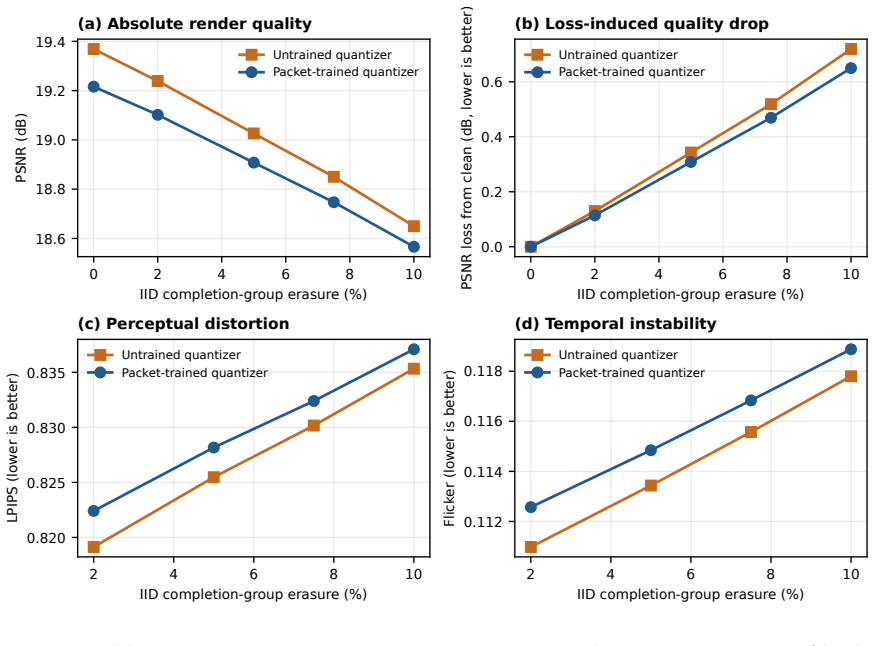
- [Abstract] Abstract: the central claim that the derived utility ordering improves PSNR under actual delivery rests on the unverified assumption that sampling partial dependency graphs during training reproduces the joint statistics of MTU-bounded chunk losses, deadline-aware scheduling, and spatiotemporal correlations; no experiments compare the training distribution to network traces or alternative loss models, which is load-bearing for generalization beyond held-out views.
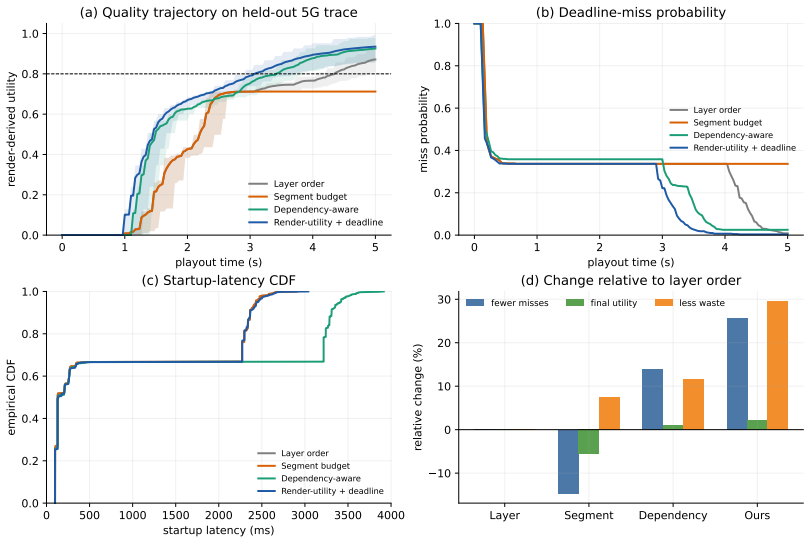
- [Abstract] Abstract (results paragraph): while utility ordering is shown to remove regressions and improve held-out PSNR, the evaluation does not report results under the concrete delivery realization (MTU-bounded entropy-coded chunks, deadline-aware scheduling, receiver-side dependency closure) that the manuscript states the graph admits; this leaves the practical benefit under realistic conditions untested.
minor comments (1)
- [Abstract] The abstract reports precise cluster fractions (e.g., 49/64) and a 3.03 dB gain but does not define how the number of refinement levels or spatiotemporal cluster parameters are chosen; a brief methods paragraph or table would improve reproducibility.
Simulated Author's Rebuttal
We thank the referee for the careful identification of load-bearing assumptions in our evaluation protocol. We respond to each major comment below.
read point-by-point responses
-
Referee: [Abstract] Abstract: the central claim that the derived utility ordering improves PSNR under actual delivery rests on the unverified assumption that sampling partial dependency graphs during training reproduces the joint statistics of MTU-bounded chunk losses, deadline-aware scheduling, and spatiotemporal correlations; no experiments compare the training distribution to network traces or alternative loss models, which is load-bearing for generalization beyond held-out views.
Authors: We agree that the manuscript does not include experiments validating the training distribution of partial dependency graphs against real MTU-bounded chunk losses, deadline-aware scheduling, or network traces. The sampling is constructed from the explicit spatiotemporal and refinement dependency structure to produce renderable incomplete states, but the statistical match to concrete network behavior remains an unverified modeling assumption. We will revise the abstract and method sections to state this limitation explicitly and discuss its implications for generalization. revision: partial
-
Referee: [Abstract] Abstract (results paragraph): while utility ordering is shown to remove regressions and improve held-out PSNR, the evaluation does not report results under the concrete delivery realization (MTU-bounded entropy-coded chunks, deadline-aware scheduling, receiver-side dependency closure) that the manuscript states the graph admits; this leaves the practical benefit under realistic conditions untested.
Authors: The referee correctly notes that the reported PSNR results are obtained under the distribution of partial states used during training and counterfactual utility measurement, rather than a full simulation of MTU-bounded entropy-coded chunks, deadline-aware scheduling, and receiver-side dependency closure. Although the dependency graph is constructed to admit such a realization, we did not execute or report end-to-end delivery experiments. We will revise the abstract and evaluation sections to clarify the current scope and identify the missing simulation as future work. revision: partial
Circularity Check
No circularity; utilities computed from independent renders
full rationale
The derivation computes marginal utilities directly from batched counterfactual renders of sampled partial dependency graphs, measuring actual image-space contributions rather than fitting to the target PSNR or assuming the ordering by construction. The reported gains (e.g., removal of regressions on broom2, +3.03 dB on chicken) are measured on held-out views and disjoint training cameras, providing external grounding. No self-citations, uniqueness theorems, or ansatzes are invoked to force the result; the sampling approximates delivery states but the evaluation remains independent of the fitted values. The method is therefore self-contained against external benchmarks.
Axiom & Free-Parameter Ledger
free parameters (2)
- number of refinement levels =
3
- spatiotemporal cluster parameters
axioms (1)
- domain assumption Sampling partial dependency graphs during training produces a representative distribution of incomplete delivery states for optimization.
invented entities (1)
-
counterfactual utility layer
no independent evidence
Reference graph
Works this paper leans on
-
[1]
Calculation of average PSNR differences between RD-curves
Gisle Bjøntegaard. Calculation of average PSNR differences between RD-curves. Technical Report VCEG-M33, ITU-T Video Coding Experts Group, 2001
2001
-
[2]
Madhyastha, Antonio Ortega, and Ramesh Govindan
Rajrup Ghosh, Haodong Wang, Haoran Hong, Eduardo Pavez, Amartya Chaudhuri, Weiwu Pang, Harsha V. Madhyastha, Antonio Ortega, and Ramesh Govindan. Gs-nfs: Bandwidth-adaptive streaming of dynamic gaussian splats and point clouds.arXiv preprint arXiv:2606.05650, 2026
Pith/arXiv arXiv 2026
-
[3]
QUEEN: Quantized efficient encoding of dynamic gaussians for streaming free-viewpoint videos
Sharath Girish, Tianye Li, Amrita Mazumdar, Abhinav Shrivastava, David Luebke, and Shalini De Mello. QUEEN: Quantized efficient encoding of dynamic gaussians for streaming free-viewpoint videos. InNeurIPS, 2024
2024
-
[4]
QUIC loss detection and congestion control
Jana Iyengar and Ian Swett. QUIC loss detection and congestion control. Technical Report RFC 9002, RFC Editor, 2021
2021
-
[5]
QUIC: A udp-based multiplexed and secure transport
Jana Iyengar and Martin Thomson. QUIC: A udp-based multiplexed and secure transport. Technical Report RFC 9000, RFC Editor, 2021. 17
2021
-
[6]
Progressive decomposition of dynamic gaussian splatting for bandwidth-adaptive scene streaming
Jiachen Li, Guangzhi Han, Jin Wan, Delong Han, Yuan Gao, Min Li, Mingle Zhou, and Gang Li. Progressive decomposition of dynamic gaussian splatting for bandwidth-adaptive scene streaming. arXiv preprint arXiv:2605.11427, 2026
Pith/arXiv arXiv 2026
-
[7]
Mufan Liu, Qi Yang, He Huang, Wenjie Huang, Zhenlong Yuan, Zhu Li, and Yiling Xu. Light4gs: Lightweight compact 4d gaussian splatting generation via context model.arXiv preprint arXiv:2503.13948, 2025
arXiv 2025
-
[8]
MLPerf training benchmark.Proceedings of Machine Learning and Systems, 2:336–349, 2020
Peter Mattson, Christine Cheng, Cody Coleman, Greg Diamos, Paulius Micikevicius, David Patterson, et al. MLPerf training benchmark.Proceedings of Machine Learning and Systems, 2:336–349, 2020
2020
-
[9]
An unreliable datagram extension to QUIC
Tommy Pauly, Eric Kinnear, and David Schinazi. An unreliable datagram extension to QUIC. Technical Report RFC 9221, RFC Editor, 2022
2022
-
[10]
Darijo Raca, Dylan Leahy, Cormac J. Sreenan, and Jason J. Quinlan. Beyond throughput, the next generation: A 5g dataset with channel and context metrics. InACM Multimedia Systems Conference, pages 303–308, 2020. doi: 10.1145/3339825.3394938
-
[11]
MLPerf inference benchmark
Vijay Janapa Reddi, Christine Cheng, David Kanter, Peter Mattson, Guenther Schmuelling, Carole- Jean Wu, et al. MLPerf inference benchmark. InACM/IEEE International Symposium on Computer Architecture, pages 446–459, 2020
2020
-
[12]
Brighten Godfrey, and Haitham Hassanieh
William Sentosa, Balakrishnan Chandrasekaran, P. Brighten Godfrey, and Haitham Hassanieh. CellReplay: Towards accurate record-and-replay for cellular networks. InUSENIX Symposium on Networked Systems Design and Implementation, 2025
2025
-
[13]
Yuang Shi, Geraldine Morin, Simone Gasparini, and Wei Tsang Ooi. Lapisgs: Layered progressive 3d gaussian splatting for adaptive streaming.arXiv preprint arXiv:2408.14823, 2025
arXiv 2025
-
[14]
LTS: A dash streaming system for dynamic multi-layer 3d gaussian splatting scenes
Yi-Chun Sun, Yuang Shi, Chia-Tai Lee, Ming Zhu, Wei Tsang Ooi, Yu Liu, Cheng-Yang Huang, and Cheng-Hsin Hsu. LTS: A dash streaming system for dynamic multi-layer 3d gaussian splatting scenes. InACM Multimedia Systems Conference, pages 136–147, 2025
2025
-
[15]
4d gaussian splatting for real-time dynamic scene rendering
Guanjun Wu, Taoran Yi, Jiemin Fang, Lingxi Xie, Xiaopeng Zhang, Wei Wei, Wenyu Liu, Qi Tian, and Xinggang Wang. 4d gaussian splatting for real-time dynamic scene rendering. InCVPR, pages 20310–20320, 2024
2024
-
[16]
gsplat: An open-source library for gaussian splatting.Journal of Machine Learning Research, 2025
Vickie Ye, Ruilong Li, Justin Kerr, Matias Turkulainen, Brent Yi, et al. gsplat: An open-source library for gaussian splatting.Journal of Machine Learning Research, 2025
2025
-
[17]
Efros, Eli Shechtman, and Oliver Wang
Richard Zhang, Phillip Isola, Alexei A. Efros, Eli Shechtman, and Oliver Wang. The unreasonable effectiveness of deep features as a perceptual metric. InIEEE Conference on Computer Vision and Pattern Recognition, pages 586–595, 2018. Appendix: Worker Storage and Source-Archive Protocol The H100 worker used for the real-scene runs exposes fast GPU memory a...
2018
discussion (0)
Sign in with ORCID, Apple, or X to comment. Anyone can read and Pith papers without signing in.