220-GBd optical coherent waveform generation using temporal unitary transforms
Pith reviewed 2026-06-27 02:10 UTC · model grok-4.3
The pith
Temporal unitary transforms generate 220-GBd 16-QAM signals using only 50-GHz electrical bandwidth.
A machine-rendered reading of the paper's core claim, the machinery that carries it, and where it could break.
Core claim
The authors establish that temporal unitary transforms enable generation of 16-QAM constellations reaching 220 GBd while using only 50-GHz electrical bandwidth from the constituent modulators. The technique is stated to be theoretically lossless and able to synthesize arbitrary optical waveforms that would otherwise require modulators with higher bandwidth.
What carries the argument
Temporal unitary transforms: linear operations that redistribute signal energy across time while preserving total energy, allowing the effective bandwidth to exceed that of any single modulator.
If this is right
- 220-GBd signals become feasible using modulators whose electrical bandwidth is only 50 GHz.
- Waveform generation incurs no theoretical power or fidelity loss.
- The same method can produce arbitrary optical waveforms beyond modulator bandwidth limits.
- Coherent transmission systems can achieve higher baud rates without faster electronics.
Where Pith is reading between the lines
- Existing lower-speed modulator hardware could be repurposed for higher-rate links via software-defined transforms.
- Real deployments would still require calibration or compensation for modulator imperfections not analyzed in the abstract.
- The underlying redistribution principle might extend to other waveform domains such as wireless or acoustic signals.
Load-bearing premise
The transforms can be realized in real modulators and channels with enough precision to avoid uncompensated distortions or losses.
What would settle it
Experimental measurement of the received 220-GBd 16-QAM constellation or error vector magnitude after applying the transforms through actual 50-GHz modulators and a transmission channel, checking whether performance matches the theoretical lossless prediction.
Figures


read the original abstract
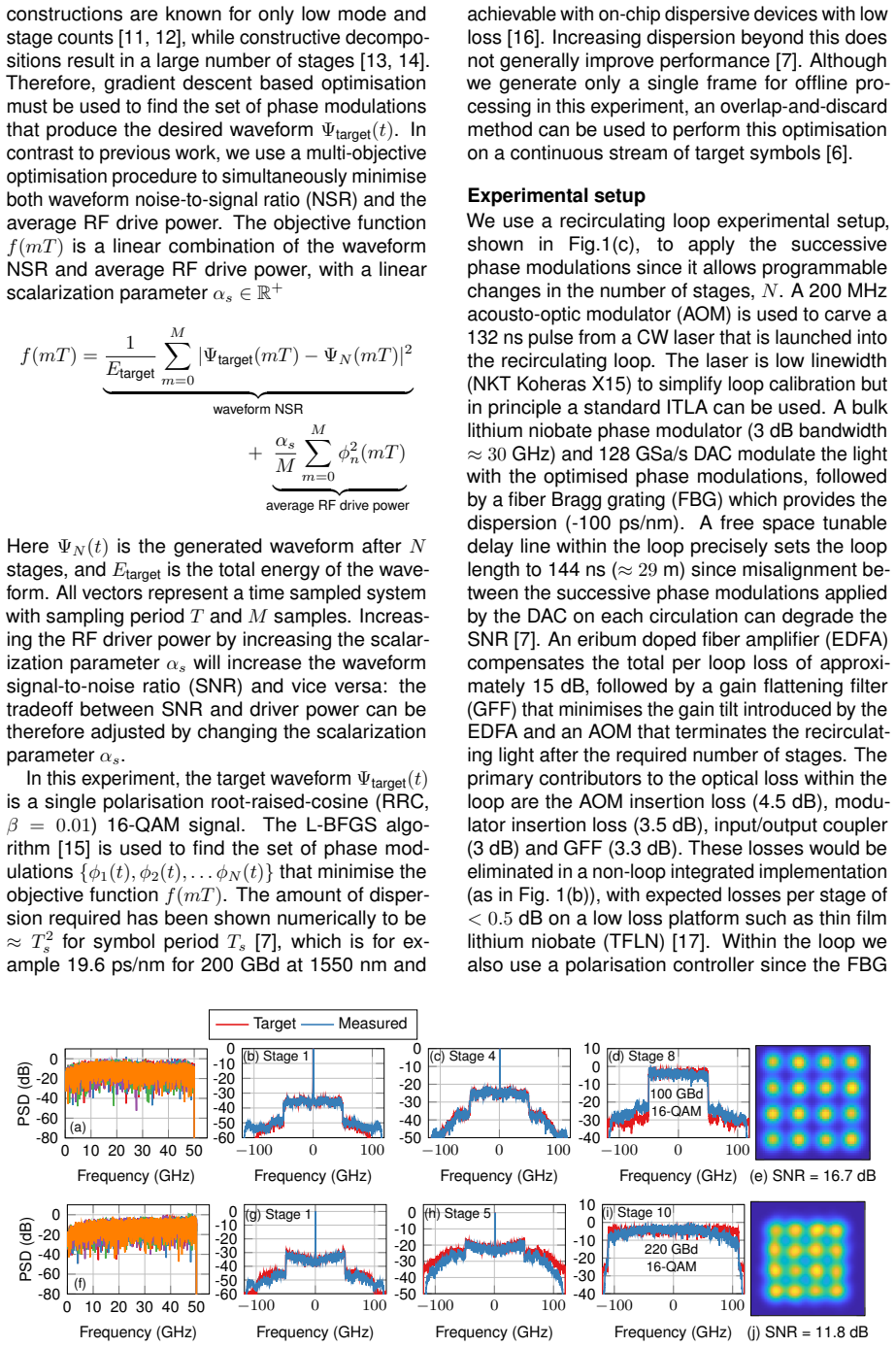
We use temporal unitary transforms to generate 16-QAM up to 220 GBd using only 50-GHz electrical bandwidth. The technique is theoretically lossless and can generate arbitrary optical waveforms beyond the bandwidth of the constituent modulators.
Editorial analysis
A structured set of objections, weighed in public.
Referee Report
Summary. The manuscript claims that temporal unitary transforms enable generation of 16-QAM optical signals at baud rates up to 220 GBd using only 50-GHz electrical bandwidth. The approach is asserted to be theoretically lossless and to support arbitrary optical waveform generation that exceeds the bandwidth limits of the constituent modulators.
Significance. If the central claims hold, the work would offer a meaningful route to scaling coherent optical data rates without proportional increases in electrical bandwidth or added loss, which is relevant to high-speed optical communications. The theoretical losslessness and bandwidth-extension property are potentially valuable if accompanied by a rigorous construction and validation.
Simulated Author's Rebuttal
We thank the referee for reviewing our manuscript on temporal unitary transforms for high-baud-rate optical waveform generation. The report highlights the potential significance if the claims of theoretical losslessness and bandwidth extension hold, while expressing uncertainty. Since no specific major comments were enumerated in the report, we note that our manuscript already provides the rigorous construction, theoretical analysis, and experimental validation supporting these properties. We are prepared to address any additional points the referee may wish to raise.
Circularity Check
No significant circularity
full rationale
The abstract states the use of temporal unitary transforms to generate 16-QAM at 220 GBd from 50-GHz bandwidth, claiming the technique is theoretically lossless and capable of arbitrary waveforms. No equations, fitted parameters, self-citations, or derivation steps are present in the supplied text. Without any visible mathematical construction that reduces a claimed prediction or result to its own inputs by definition or fitting, the central claim does not exhibit any of the enumerated circularity patterns. The argument as presented is self-contained and does not rely on internal redefinitions or load-bearing self-references.
Axiom & Free-Parameter Ledger
Reference graph
Works this paper leans on
-
[1]
The complementary FET (CFET) for CMOS scaling beyond N3
J. Ryckaert et al., “The complementary FET (CFET) for CMOS scaling beyond N3”, inVLSI Symp., 2018, T13– 3
2018
-
[2]
Gigahertz and terahertz transistors for 5G, 6G, and beyond mobile com- munication systems
J. J. Liou, M. Ziegler, and F . Schwierz, “Gigahertz and terahertz transistors for 5G, 6G, and beyond mobile com- munication systems”,Applied Physics Reviews, vol. 11, no. 3, 2024
2024
-
[3]
Programmable unitary transformation of spectro- temporal modes
V. Thiel, A. O. Davis, P . d’Ornellas, N. Treps, and B. J. Smith, “Programmable unitary transformation of spectro- temporal modes”, inLaser Science, 2017, JW4A–5
2017
-
[4]
Optical arbitrary waveform generator based on time-domain multiplane light conversion
M. Mazur et al., “Optical arbitrary waveform generator based on time-domain multiplane light conversion”, in OFC, 2019, M1B.3
2019
-
[5]
Performance limits of spectro- temporal unitary transformations for coherent modula- tion
C. Deakin and X. Chen, “Performance limits of spectro- temporal unitary transformations for coherent modula- tion”, inOFC, 2025, Tu3C.1.DOI: 10.1364/OFC.2025. Tu3C.1
-
[6]
Performance compari- son between all-pass and IQ optical modulation
B. Saxena, K. Farley, M. A. Reimer, M. Hubbard, M. O’Sullivan, and A. K. Khandani, “Performance compari- son between all-pass and IQ optical modulation”,Jour- nal of Lightwave Technology, vol. 42, no. 1, pp. 201–207, 2023
2023
-
[7]
C. Deakin and X. Chen, “Spectro-temporal unitary trans- formations for coherent modulation: Design trade-offs and practical considerations”,arXiv:2512.17890, 2025
Pith/arXiv arXiv 2025
-
[8]
Multi-wavelength arbitrary waveform generation through spectro-temporal unitary transforma- tions
M. Mazur et al., “Multi-wavelength arbitrary waveform generation through spectro-temporal unitary transforma- tions”,arXiv preprint arXiv:1907.02595, 2019
arXiv 1907
-
[9]
Temporal mode transformations by sequential time and frequency phase modulation for applications in quantum information science
J. Ashby, V. Thiel, M. Allgaier, P . d’Ornellas, A. O. C. Davis, and B. J. Smith, “Temporal mode transformations by sequential time and frequency phase modulation for applications in quantum information science”,Optics Express, vol. 28, no. 25, pp. 38 376–38 389, 2020
2020
-
[10]
Picosecond-resolution single-photon time lens for temporal mode quantum processing
C. Joshi et al., “Picosecond-resolution single-photon time lens for temporal mode quantum processing”,Op- tica, vol. 9, no. 4, pp. 364–373, 2022
2022
-
[11]
Quantum field theory universality criterion for layered programmable decom- positions
J. Álvarez-Vizoso and D. Barral, “Quantum field theory universality criterion for layered programmable decom- positions”,arXiv preprint arXiv:2510.19397, 2025
arXiv 2025
-
[12]
Compactifying linear optical unitaries using multiport beamsplitters
P . A. Y asir and P . van Loock, “Compactifying linear optical unitaries using multiport beamsplitters”,arXiv preprint arXiv:2505.11371, 2025
arXiv 2025
-
[13]
Arbitrary optical wave evolution with fourier transforms and phase masks
V. López Pastor, J. Lundeen, and F . Marquardt, “Arbitrary optical wave evolution with fourier transforms and phase masks”,Optics Express, vol. 29, no. 23, pp. 38 441– 38 450, 2021
2021
-
[14]
V. Girouard and N. Quesada, “Near-optimal decomposi- tion of unitary matrices using phase masks and the dis- crete fourier transform”,arXiv preprint arXiv:2508.20010, 2025
arXiv 2025
-
[15]
A limited memory algorithm for bound constrained optimization
R. H. Byrd, P . Lu, J. Nocedal, and C. Zhu, “A limited memory algorithm for bound constrained optimization”, SIAM Journal on scientific computing, vol. 16, no. 5, pp. 1190–1208, 1995
1995
-
[16]
Silicon photonic direct-detection phase retrieval receiver
B. Stern, H. Chen, K. Kim, H. Huang, J. Zhao, and M. H. Idjadi, “Silicon photonic direct-detection phase retrieval receiver”, inECOC 2023, 2023, M.A.2.2
2023
-
[17]
Integrated photonics on thin-film lithium niobate
D. Zhu et al., “Integrated photonics on thin-film lithium niobate”,Advances in Optics and Photonics, vol. 13, no. 2, pp. 242–352, 2021
2021
-
[18]
C+L-band InP-based coherent driver modulator enabled net-1.8 Tbps/λ transmission
J. Ozaki et al., “C+L-band InP-based coherent driver modulator enabled net-1.8 Tbps/λ transmission”,Jour- nal of Lightwave Technology, vol. 43, no. 4, pp. 1972– 1978, 2025
1972
-
[19]
Experimental demonstration of widely tun- able rate/reach adaptation from 80 km to 12,000 km using probabilistic constellation shaping
J. M. Gené, X. Chen, J. Cho, S. Chandrasekhar, and P . Winzer, “Experimental demonstration of widely tun- able rate/reach adaptation from 80 km to 12,000 km using probabilistic constellation shaping”, inOFC, 2020, M3G.3
2020
discussion (0)
Sign in with ORCID, Apple, or X to comment. Anyone can read and Pith papers without signing in.