Dust-Embedded Star Formation: Bridging Magellanic Cloud Studies of Massive Young Stellar Objects to Nearby Spiral Galaxies
Pith reviewed 2026-06-27 02:29 UTC · model grok-4.3
The pith
JWST color-magnitude cuts for massive young stellar objects remain stable from 1 to 5 Mpc, with a 10um luminosity function slope near -2, though resolution limits individual studies beyond 3 Mpc.
A machine-rendered reading of the paper's core claim, the machinery that carries it, and where it could break.
Core claim
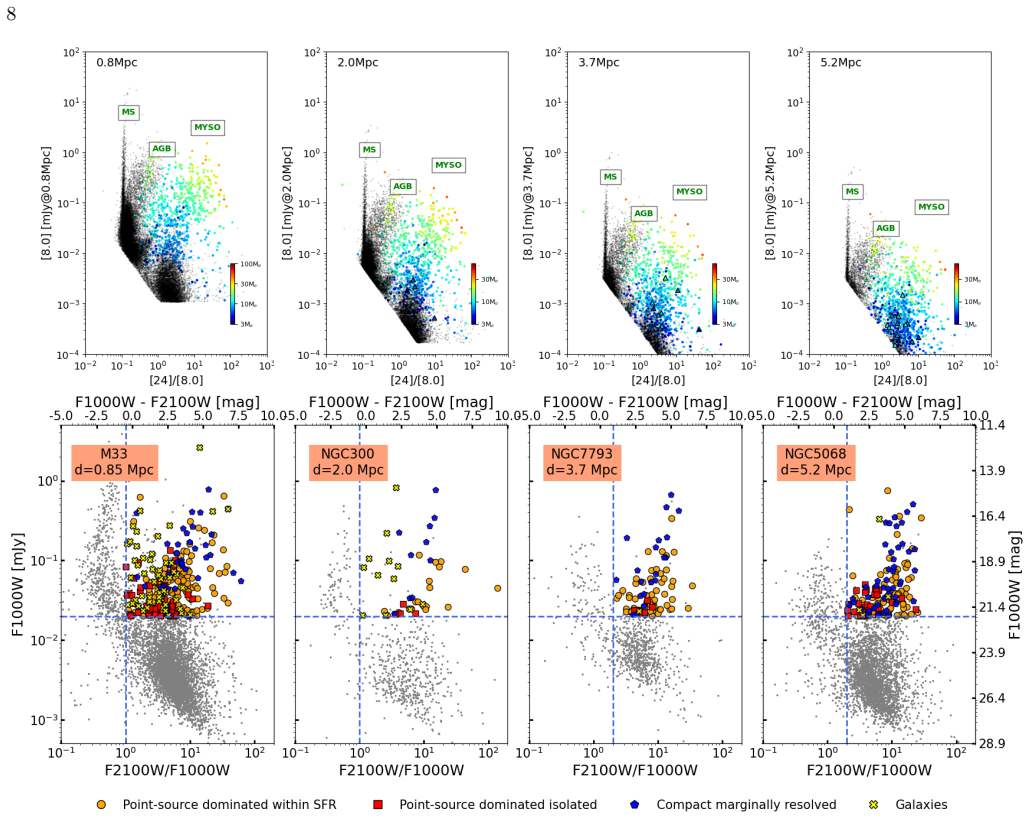
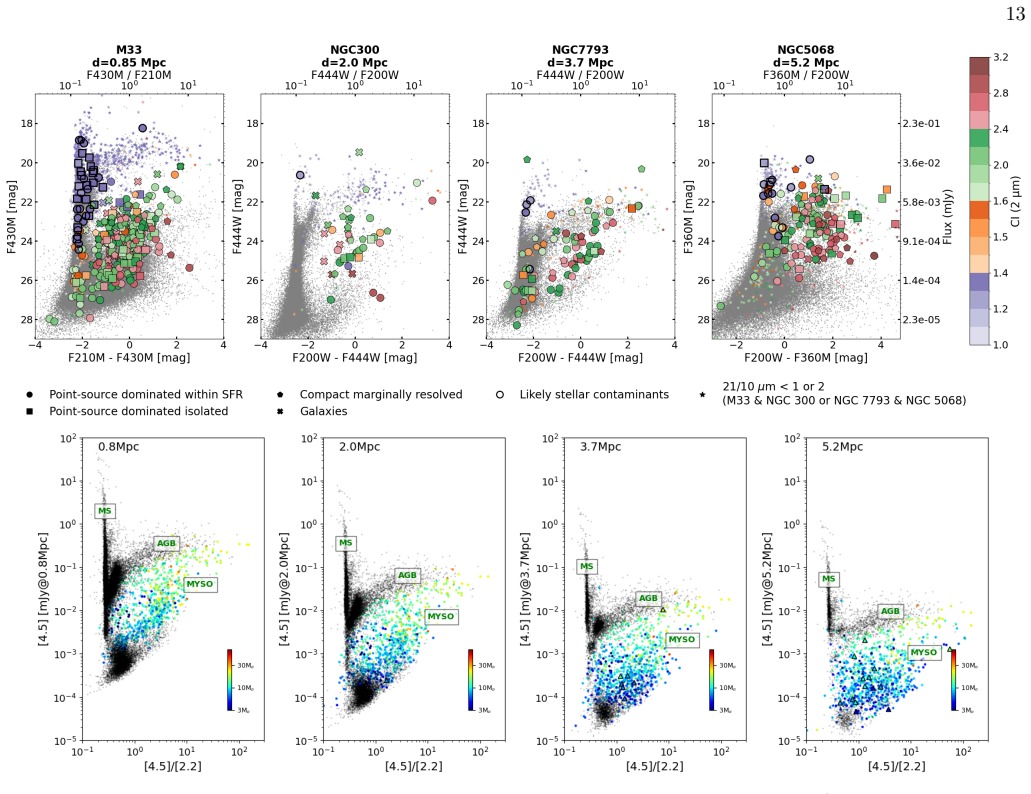
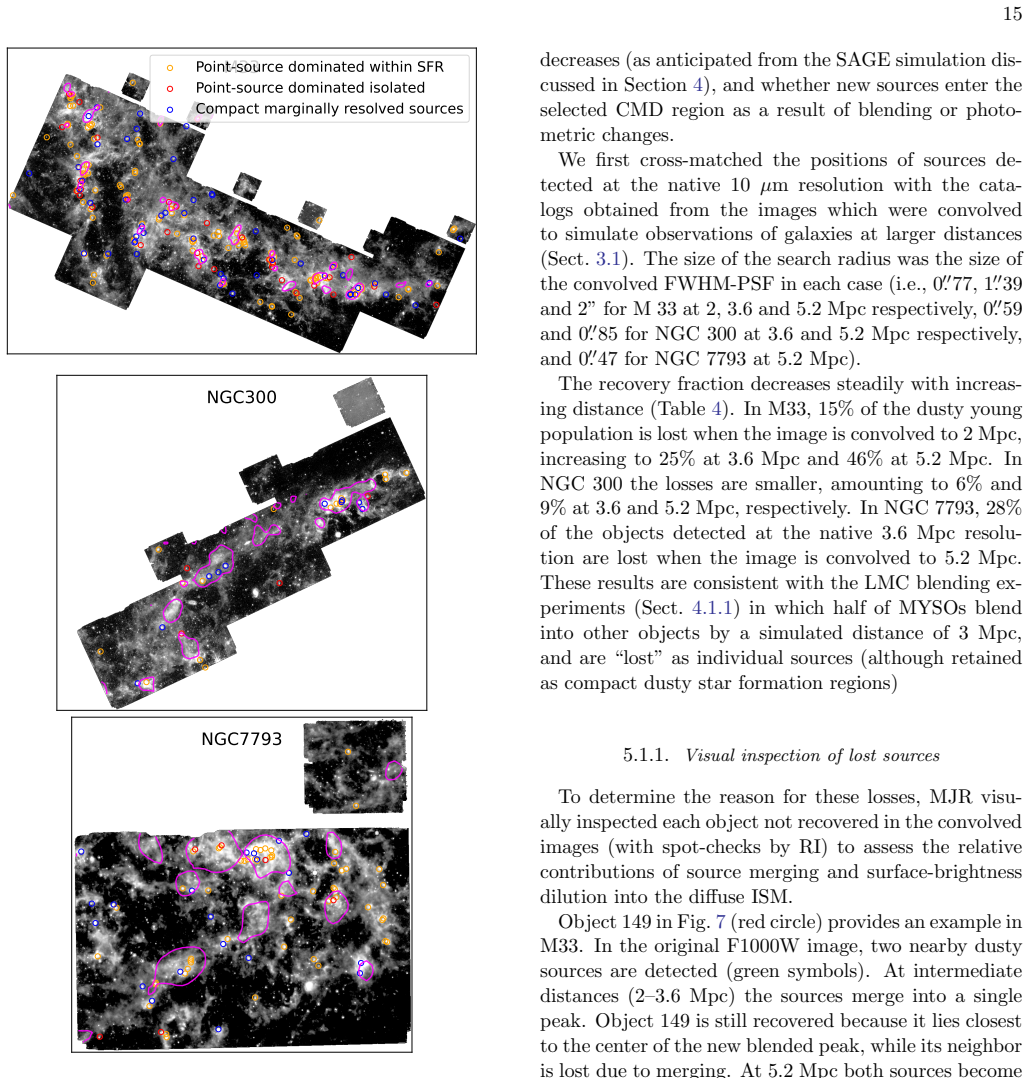
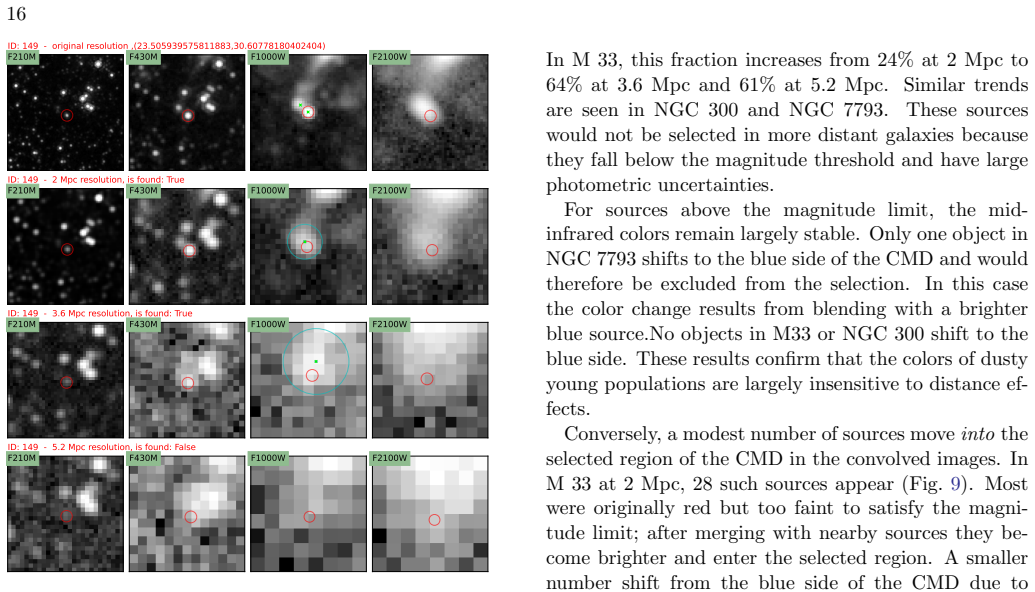
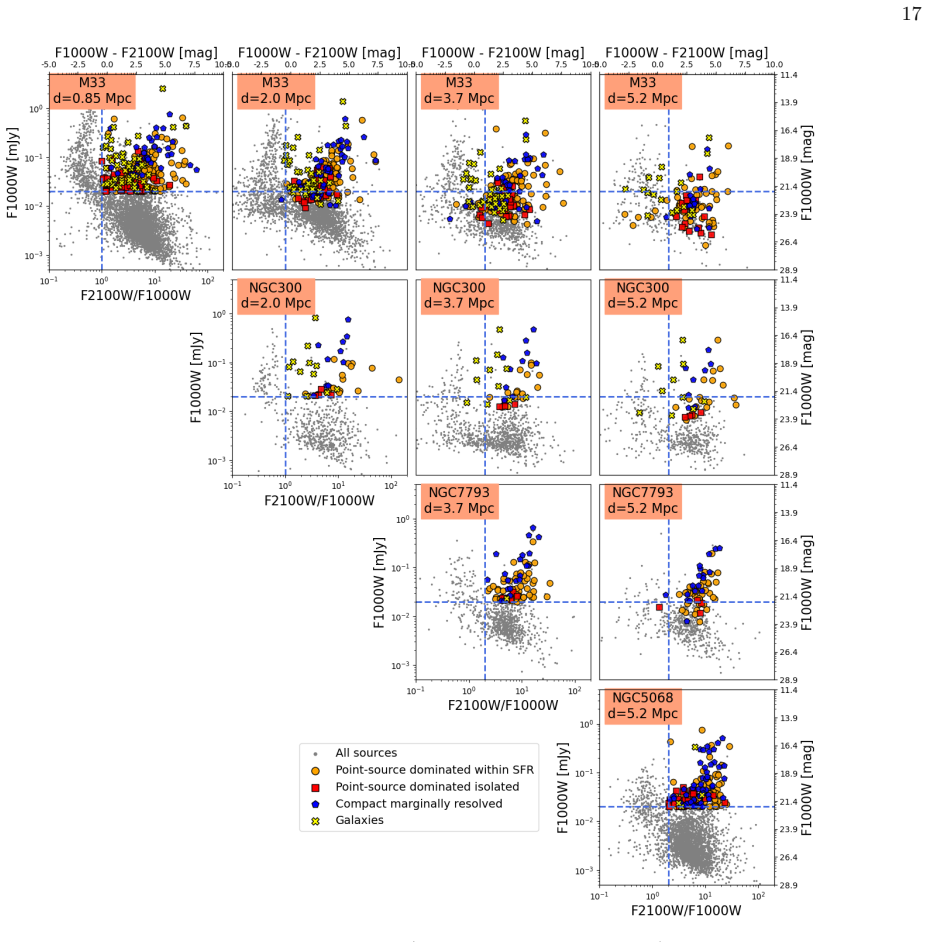
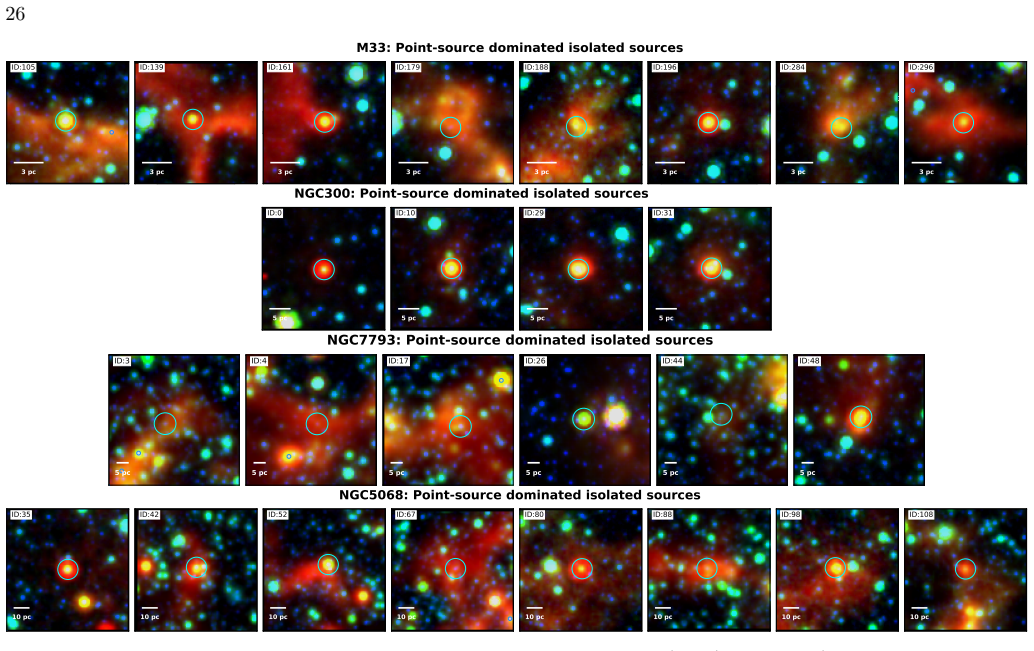
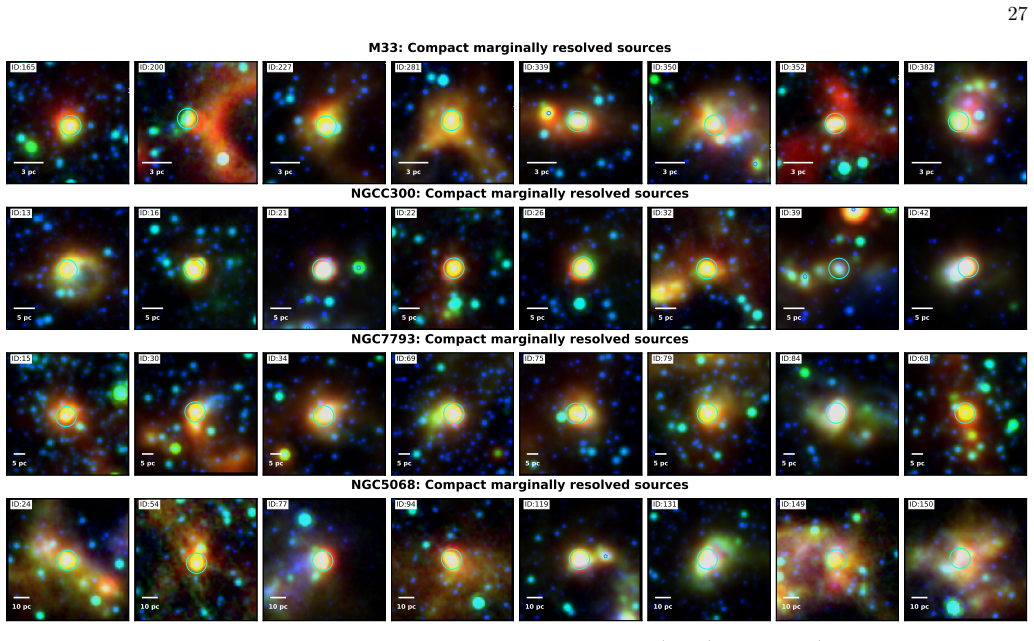
Guided by the SAGE-LMC catalog, the authors define JWST color-magnitude selection criteria and apply them to NIRCam and MIRI imaging of M33, NGC 300, NGC 7793, and NGC 5068. They recover 216, 32, 80, and 139 dusty young objects respectively; the selection remains stable across 1-5 Mpc, the 10um luminosity function retains a slope of alpha ~ -2, and comparisons with PAH-selected clusters recover ~80 percent of sources, while blending causes up to 50 percent incompleteness at 5.2 Mpc and biases toward brighter objects.
What carries the argument
JWST color-magnitude selection criteria (F1000W versus F1000W-F2100W) derived from the SAGE-LMC catalog of massive young stellar objects, tested via resolution-degradation experiments.
Load-bearing premise
The color-magnitude cuts defined from the SAGE-LMC catalog apply directly to the target galaxies without major adjustments for differences in dust properties, metallicity, or star-formation conditions.
What would settle it
Finding that the fraction of sources selected by the F1000W versus F1000W-F2100W cuts, or the recovered luminosity function slope, changes substantially when the same criteria are applied to a galaxy whose metallicity or dust-to-gas ratio differs markedly from the LMC.
Figures
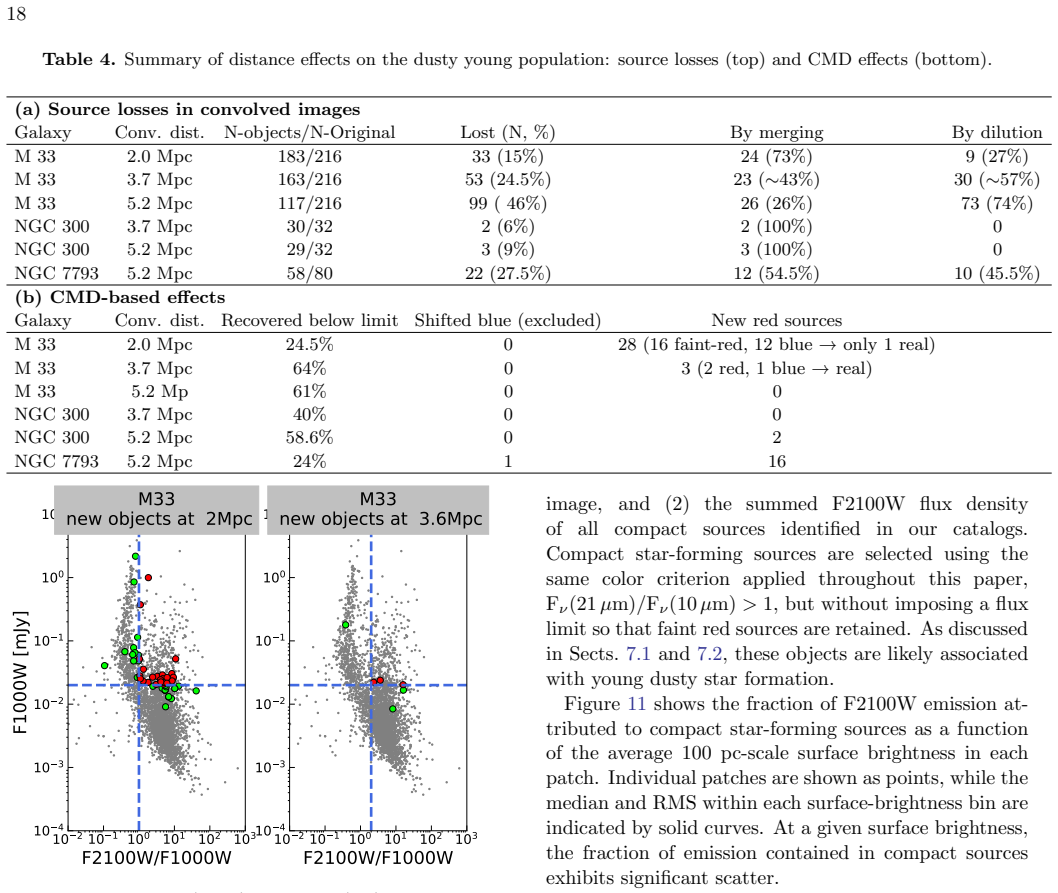
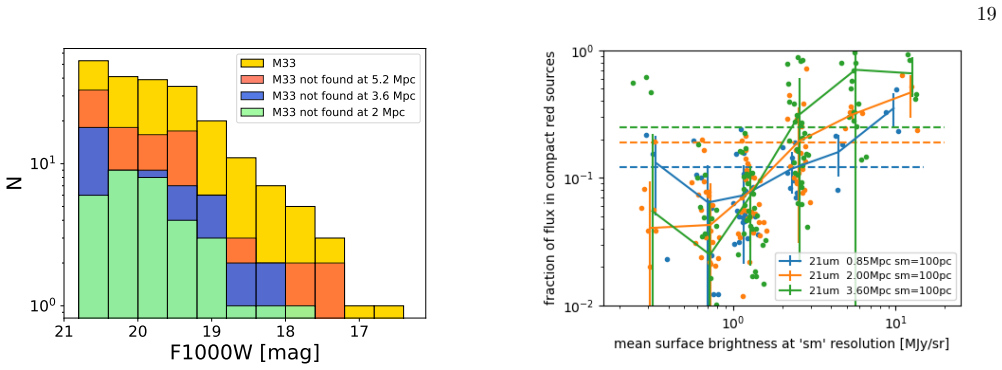
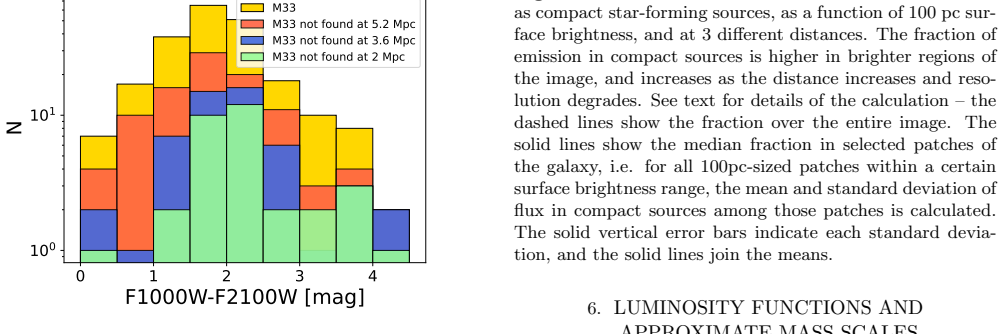
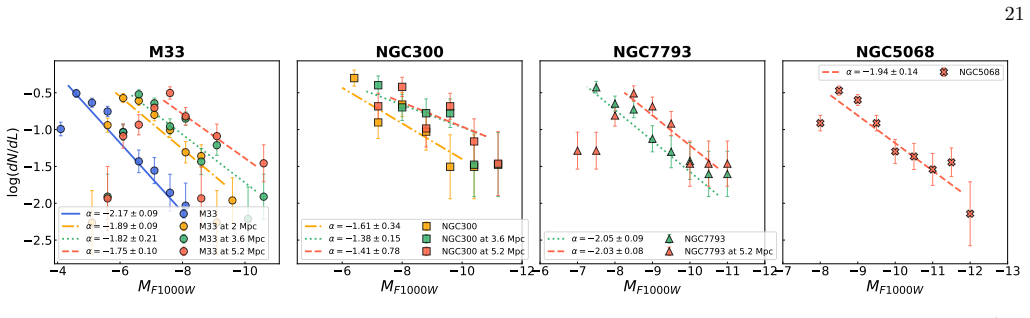
read the original abstract
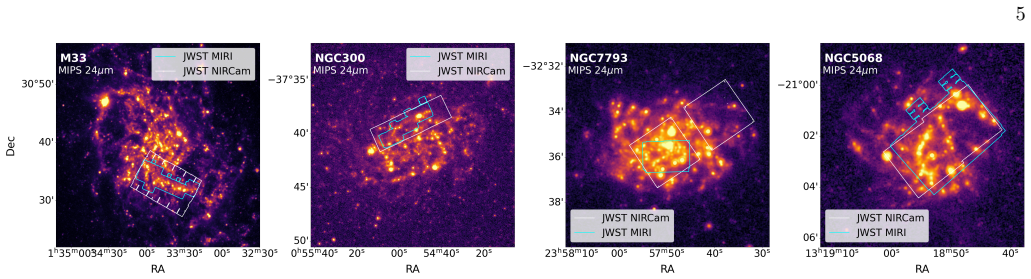
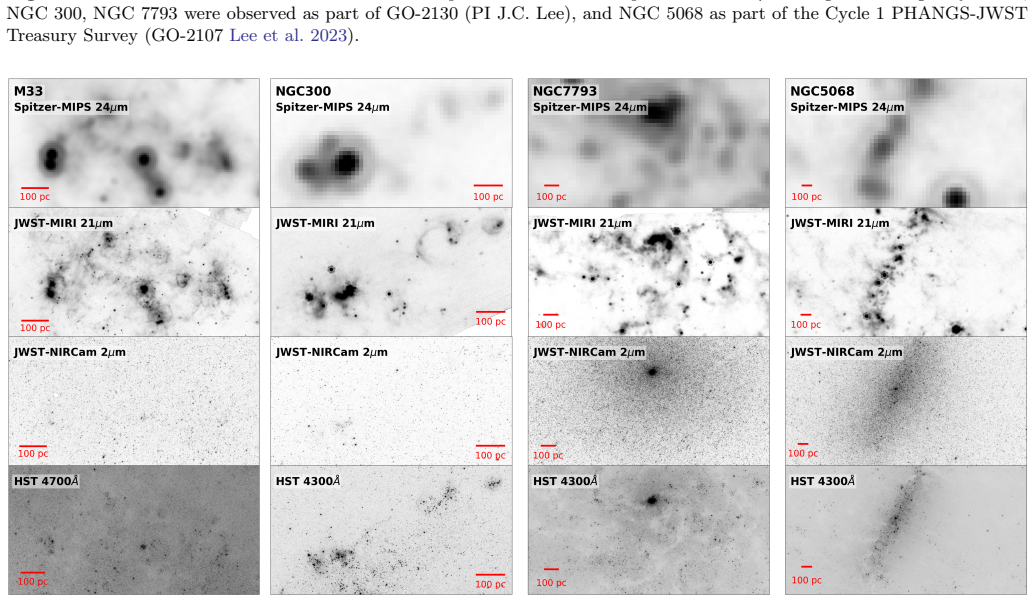
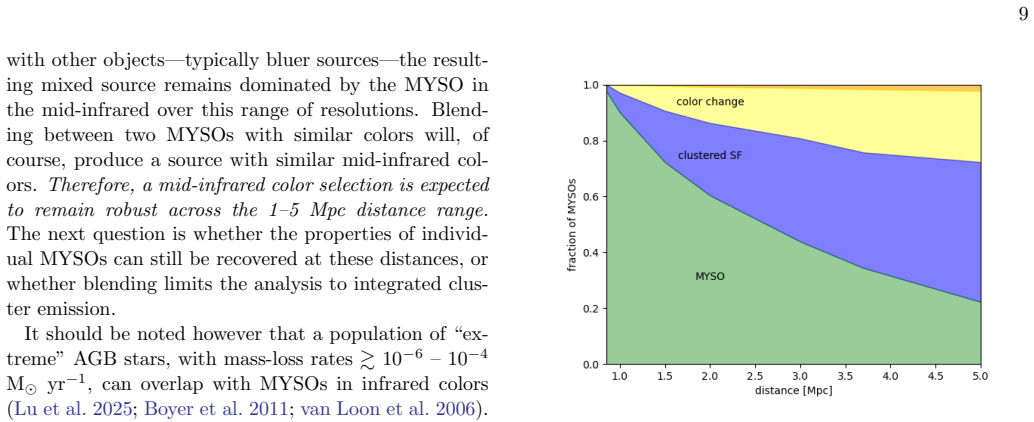
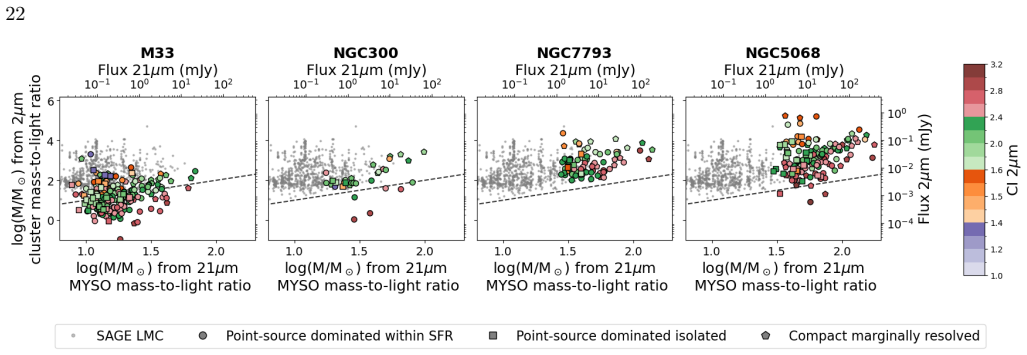
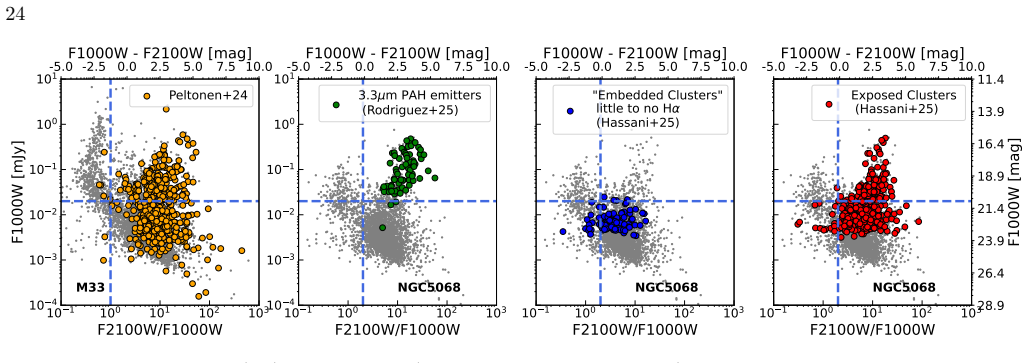
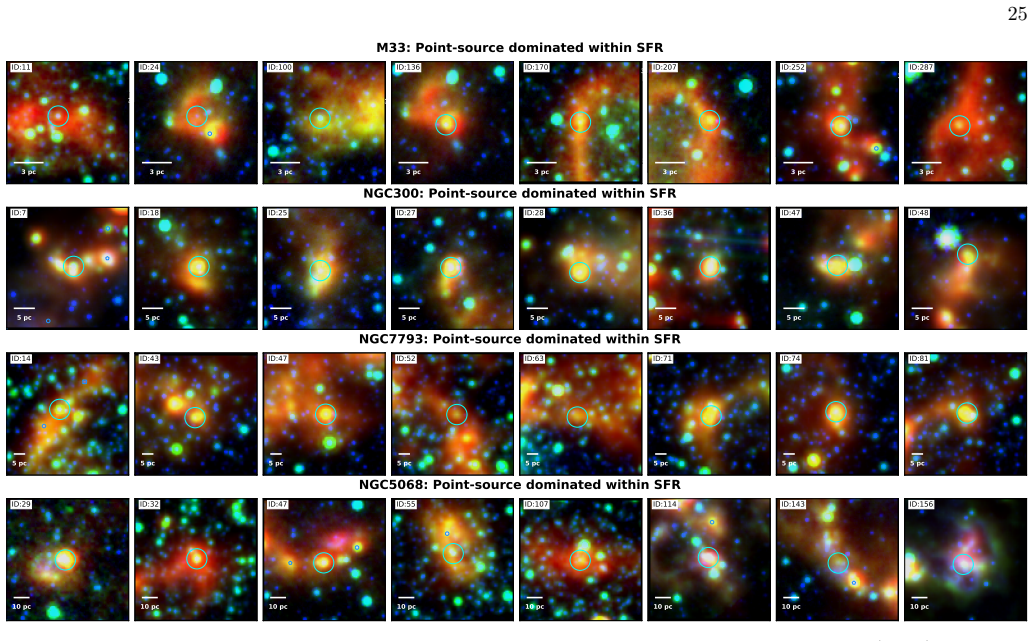
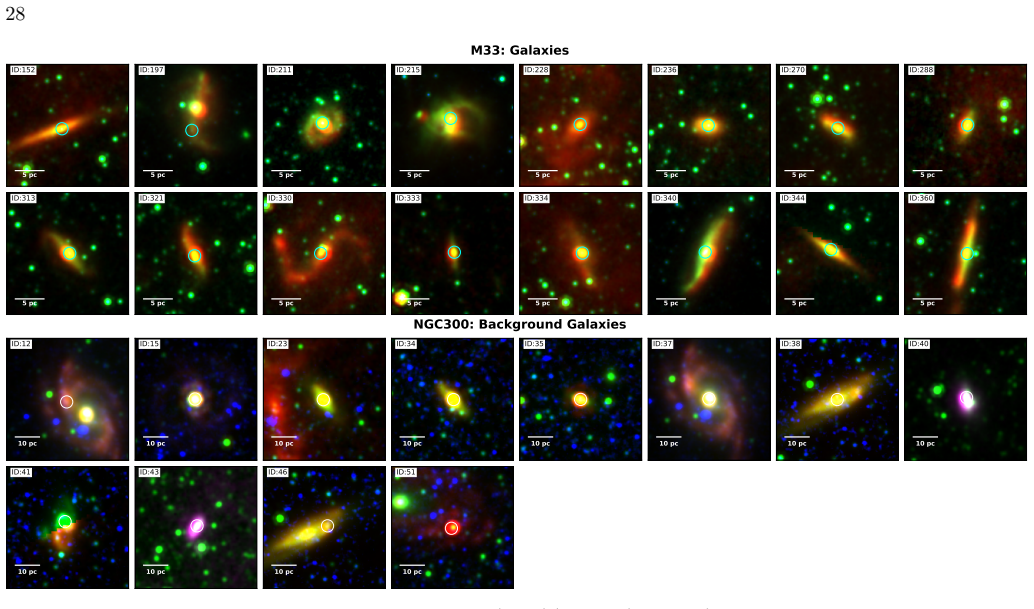
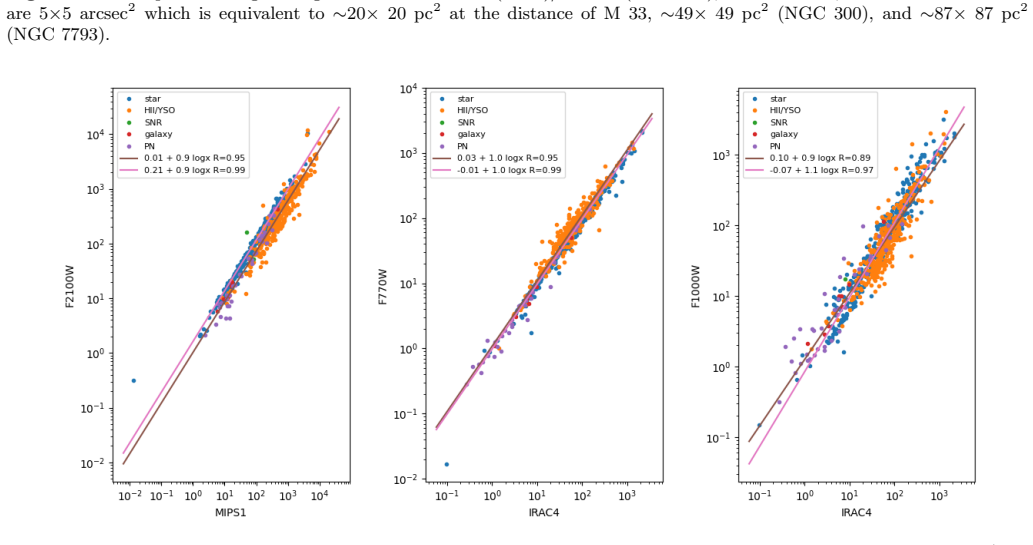
We use JWST NIRCam and MIRI imaging at 2, 4, 10, and 21 um to study young, dusty compact sources in four nearby galaxies at distances of ~ 1-5Mpc (M33, NGC300, NGC7793, and NGC5068). This work bridges well-characterized massive young stellar objects (MYSOs) in the Magellanic Clouds from the Spitzer SAGE survey to new studies of embedded clusters in more distant galaxies with JWST. Guided by the SAGE-LMC catalog, we define JWST color-magnitude selection criteria (F1000W versus F1000W-F2100W) and test them using resolution-degradation experiments. We identify 216, 32, 80 and 139 dusty young objects in the four galaxies, respectively. The selected population spans sources from systems dominated by a single MYSO to compact marginally resolved sources hosting multiple MYSOs. The color selection remains stable across 1-5 Mpc, and the 10um luminosity function retains a slope of alpha~ -2. However, blending and surface-brightness dilution remove fainter sources, leading to incompleteness of up to ~ 50% at 5.2 Mpc and biasing the sample toward brighter objects (F1000W < 19 mag). The sample spans approximate stellar masses of ~10-2 X 10^5 Mo. Spatial resolution affects the interpretation of mid-infrared emission: clustering increases the fraction of emission attributed to compact sources in active regions, while blending into diffuse emission dominates in quiescent environments. Comparisons with PAH-selected young clusters in the PHANGS galaxy NGC5068 show that our selection recovers ~ 80% of the PAH-selected sources. We show that the practical limit for studying individual MYSOs with JWST is ~3 Mpc. The resulting catalog provides a foundation for future resolved studies of star formation rates and early cluster evolution.
Editorial analysis
A structured set of objections, weighed in public.
Referee Report
Summary. The manuscript applies JWST NIRCam/MIRI imaging at 2, 4, 10, and 21 μm to four galaxies at 1–5 Mpc (M33, NGC 300, NGC 7793, NGC 5068). Using fixed F1000W vs. F1000W–F2100W color-magnitude cuts derived from the SAGE-LMC catalog, it identifies 216, 32, 80, and 139 dusty compact sources. Resolution-degradation experiments are used to test distance effects; the paper claims the selection remains stable, the 10 μm luminosity function slope is α ≈ –2, incompleteness reaches ~50% at 5.2 Mpc, and the practical limit for individual MYSO studies is ~3 Mpc. The catalog is positioned as a bridge to future resolved SFR and cluster-evolution studies.
Significance. If the transferability of the LMC-derived cuts holds, the work supplies an observationally grounded catalog linking Magellanic-Cloud MYSO studies to spiral-galaxy embedded populations and quantifies practical JWST distance limits via resolution tests. The resolution-degradation approach is a concrete methodological strength.
major comments (1)
- [Abstract / Selection criteria] Abstract and § on selection criteria: the central stability claim ('color selection remains stable across 1–5 Mpc') and the reported α ≈ –2 slope rest on applying fixed SAGE-LMC cuts without testing for shifts arising from metallicity or dust-property differences between the LMC and the target galaxies. The resolution-degradation experiments address only blending and surface-brightness dilution; they do not constrain possible color-locus offsets from PAH or grain-emissivity variations. This assumption is load-bearing for both the distance-stability and luminosity-function results.
minor comments (1)
- [Abstract] Abstract: the mass range '~10-2 X 10^5 Mo' is unclear; rephrase for precision (e.g., 10–2×10^5 M⊙).
Simulated Author's Rebuttal
We thank the referee for their detailed review and for highlighting this important assumption in our analysis. We address the major comment below.
read point-by-point responses
-
Referee: [Abstract / Selection criteria] Abstract and § on selection criteria: the central stability claim ('color selection remains stable across 1–5 Mpc') and the reported α ≈ –2 slope rest on applying fixed SAGE-LMC cuts without testing for shifts arising from metallicity or dust-property differences between the LMC and the target galaxies. The resolution-degradation experiments address only blending and surface-brightness dilution; they do not constrain possible color-locus offsets from PAH or grain-emissivity variations. This assumption is load-bearing for both the distance-stability and luminosity-function results.
Authors: We agree that the resolution-degradation experiments address only the effects of distance on spatial resolution, blending, and surface-brightness dilution, and do not test for possible shifts in the color locus arising from differences in metallicity or dust properties (e.g., PAH emission or grain emissivity) between the LMC and the target galaxies. The manuscript applies fixed cuts derived from the SAGE-LMC catalog without explicit tests for such offsets. The target galaxies span metallicities of roughly 0.4–1.0 Z⊙, comparable to the LMC, but this does not substitute for a direct test. We will revise the abstract, selection-criteria section, and discussion to (i) qualify the stability claim as referring specifically to resolution and distance effects under the assumption of similar dust/metallicity properties, (ii) add a dedicated paragraph discussing this assumption and citing literature on MYSO SED variations with environment, and (iii) note the potential impact on the reported luminosity-function slope. These changes will be made in the revised manuscript. revision: yes
Circularity Check
No circularity: LMC catalog provides independent external template; counts and slope are direct measurements on new data.
full rationale
The paper defines JWST color-magnitude cuts from the external SAGE-LMC catalog (an independent Spitzer survey) and applies them to new JWST observations of M33, NGC 300, NGC 7793 and NGC 5068. Reported source counts, the α ≈ -2 slope of the 10 μm luminosity function, and completeness estimates are obtained by direct application and measurement on the target-galaxy photometry; no equation or fit reduces these quantities to parameters derived from the same target data. Resolution-degradation tests address only distance effects and do not create a self-referential loop. No load-bearing self-citation chain or ansatz smuggling is present. The derivation chain is therefore self-contained against external benchmarks.
Axiom & Free-Parameter Ledger
free parameters (1)
- JWST color-magnitude selection cuts
axioms (1)
- domain assumption Distances to M33, NGC300, NGC7793 and NGC5068 are known to sufficient accuracy to convert angular scales into physical distances and to model blending at 1-5 Mpc.
Reference graph
Works this paper leans on
-
[1]
PHANGS-ALMA Data Processing and Pipeline. , keywords =. doi:10.3847/1538-4365/abec80 , archivePrefix =. 2104.07665 , primaryClass =
-
[2]
PHANGS-ALMA: Arcsecond CO(2-1) Imaging of Nearby Star-forming Galaxies. , keywords =. doi:10.3847/1538-4365/ac17f3 , archivePrefix =. 2104.07739 , primaryClass =
-
[3]
Larry Bradley and Brigitta Sipőcz and Thomas Robitaille and Erik Tollerud and Zé Vinícius and Christoph Deil and Kyle Barbary and Tom J Wilson and Ivo Busko and Axel Donath and Hans Moritz Günther and Mihai Cara and P. L. Lim and Sebastian Meßlinger and Simon Conseil and Azalee Bostroem and Michael Droettboom and E. M. Bray and Lars Andersen Bratholm and ...
-
[4]
High and Intermediate-Mass Young Stellar Objects in the Large Magellanic Cloud
High- and Intermediate-Mass Young Stellar Objects in the Large Magellanic Cloud. , keywords =. doi:10.1088/0067-0049/184/1/172 , archivePrefix =. 0908.0347 , primaryClass =
work page internal anchor Pith review Pith/arXiv arXiv doi:10.1088/0067-0049/184/1/172
-
[5]
Probing the dusty stellar populations of the Local Volume Galaxies with JWST/MIRI
Probing the Dusty Stellar Populations of the Local Volume Galaxies with JWST/MIRI. , keywords =. doi:10.3847/1538-4357/aa6bf6 , archivePrefix =. 1703.08997 , primaryClass =
work page internal anchor Pith review Pith/arXiv arXiv doi:10.3847/1538-4357/aa6bf6
-
[6]
Spitzer Survey of the Large Magellanic Cloud: Surveying the Agents of a Galaxy's Evolution (SAGE). I. Overview and Initial Results. , keywords =. doi:10.1086/508185 , archivePrefix =. astro-ph/0606356 , primaryClass =
work page internal anchor Pith review Pith/arXiv arXiv doi:10.1086/508185
-
[7]
Disentangling the independently controllable factors of variation by interacting with the world
Embedded Clusters in Molecular Clouds. , keywords =. doi:10.1146/annurev.astro.41.011802.094844 , archivePrefix =. astro-ph/0301540 , primaryClass =
work page internal anchor Pith review Pith/arXiv arXiv doi:10.1146/annurev.astro.41.011802.094844
-
[8]
The HERSCHEL Inventory of The Agents of Galaxy Evolution in the Magellanic Clouds, a Herschel Open Time Key Program. , keywords =. doi:10.1088/0004-6256/146/3/62 , adsurl =
-
[9]
Ages and Masses of Star Clusters in M33: a Multiwavelength Study. , keywords =. doi:10.3847/1538-3881/ac324e , archivePrefix =. 2111.00046 , primaryClass =
-
[10]
Red Supergiants in M31 and M33. I. The Complete Sample. , keywords =. doi:10.3847/1538-4357/abcda5 , archivePrefix =. 2011.12051 , primaryClass =
-
[11]
Interpreting Spectral Energy Distributions from Young Stellar Objects. I. A Grid of 200,000 YSO Model SEDs. , keywords =. doi:10.1086/508424 , archivePrefix =. astro-ph/0608234 , primaryClass =
work page internal anchor Pith review Pith/arXiv arXiv doi:10.1086/508424
-
[12]
A Catalog of Star Cluster Candidates in M33
A Catalog of Star Cluster Candidates in M33. , keywords =. doi:10.1086/518835 , archivePrefix =. 0704.1576 , primaryClass =
work page internal anchor Pith review Pith/arXiv arXiv doi:10.1086/518835
-
[13]
Herschel Key Program Heritage: a Far-Infrared Source Catalog for the Magellanic Clouds. , keywords =. doi:10.1088/0004-6256/148/6/124 , adsurl =
-
[14]
A JWST/MIRI and NIRCam Analysis of the Young Stellar Object Population in the Spitzer I Region of NGC 6822. , keywords =. doi:10.3847/1538-4357/ad3f90 , archivePrefix =. 2307.15704 , primaryClass =
-
[15]
FEAST: JWST Uncovers the Emerging Timescales of Young Star Clusters in M83. , keywords =. doi:10.3847/1538-4357/ae018c , archivePrefix =. 2505.08874 , primaryClass =
-
[16]
The Present-Day Star Formation Rate of the Milky Way Determined from Spitzer-Detected Young Stellar Objects. , keywords =. doi:10.1088/2041-8205/710/1/L11 , archivePrefix =. 1001.3672 , primaryClass =
work page internal anchor Pith review Pith/arXiv arXiv doi:10.1088/2041-8205/710/1/l11 2041
-
[17]
Spitzer Sage Survey of the Large Magellanic Cloud. III. Star Formation and -0.5ex 1000 New Candidate Young Stellar Objects. , keywords =. doi:10.1088/0004-6256/136/1/18 , adsurl =
-
[18]
The Star Formation Rate and Gas Surface Density Relation in the Milky Way: Implications for Extragalactic Studies. , keywords =. doi:10.1088/0004-637X/723/2/1019 , archivePrefix =. 1009.1621 , primaryClass =
work page internal anchor Pith review Pith/arXiv arXiv doi:10.1088/0004-637x/723/2/1019
-
[19]
Tracing the Earliest Stages of Star and Cluster Formation in 19 Nearby Galaxies with PHANGS-JWST and HST: Compact 3.3 m Polycyclic Aromatic Hydrocarbon Emitters and Their Relation to the Optical Census of Star Clusters. , keywords =. doi:10.3847/1538-4357/adbb69 , archivePrefix =. 2412.07862 , primaryClass =
-
[20]
GOALS-JWST: Constraining the Emergence Timescale for Massive Star Clusters in NGC 3256. , keywords =. doi:10.3847/2041-8213/ad7eae , archivePrefix =. 2409.16503 , primaryClass =
-
[21]
The Evolution Of Massive Young Stellar Objects in the Large Magellanic Cloud. I. Identification and Spectral Classification. , keywords =. doi:10.1088/0004-637X/699/1/150 , archivePrefix =. 0904.1825 , primaryClass =
work page internal anchor Pith review Pith/arXiv arXiv doi:10.1088/0004-637x/699/1/150
-
[22]
The PHANGS-JWST Treasury Survey: Star Formation, Feedback, and Dust Physics at High Angular Resolution in Nearby GalaxieS. , keywords =. doi:10.3847/2041-8213/acaaae , archivePrefix =. 2212.02667 , primaryClass =
-
[23]
PHANGS-JWST First Results: Massive Young Star Clusters and New Insights from JWST Observations of NGC 1365. , keywords =. doi:10.3847/2041-8213/acae94 , archivePrefix =. 2212.12039 , primaryClass =
-
[24]
Hidden Gems on a Ring: Infant Massive Clusters and Their Formation Timeline Unveiled by ALMA, HST, and JWST in NGC 3351. , keywords =. doi:10.3847/1538-4357/ad3de6 , archivePrefix =. 2401.14453 , primaryClass =
-
[25]
The Hidden Life of Stars: Embedded Beginnings to AGB Endings in the PHANGS-JWST Sample. I. Catalog of Mid-IR Sources. arXiv e-prints , keywords =
-
[26]
FEAST: Feedback in Emerging extragAlactic Star ClusTers: JWST Spots Polycyclic Aromatic Hydrocarbon Destruction in NGC 628 during the Emerging Phase of Star Formation. , keywords =. doi:10.3847/1538-4357/ad534d , archivePrefix =. 2406.01666 , primaryClass =
-
[27]
PHANGS-JWST First Results: Dust-embedded Star Clusters in NGC 7496 Selected via 3.3 m PAH Emission. , keywords =. doi:10.3847/2041-8213/aca653 , archivePrefix =. 2211.13426 , primaryClass =
-
[28]
PHANGS-HST: new methods for star cluster identification in nearby galaxies. , keywords =. doi:10.1093/mnras/stab3183 , archivePrefix =. 2106.13366 , primaryClass =
-
[29]
, archivePrefix = "arXiv", eprint =
The Luminosity, Mass, and Age Distributions of Compact Star Clusters in M83 Based on Hubble Space Telescope/Wide Field Camera 3 Observations. , archivePrefix = "arXiv", eprint =. doi:10.1088/0004-637X/719/1/966 , adsurl =
-
[30]
ALMA Observations of the Antennae Galaxies. I. A New Window on a Prototypical Merger. , archivePrefix = "arXiv", eprint =. doi:10.1088/0004-637X/795/2/156 , adsurl =
-
[31]
Monthly Notices of the Royal Astronomical Society , author =
Star cluster catalogues for the LEGUS dwarf galaxies. , archivePrefix = "arXiv", eprint =. doi:10.1093/mnras/stz331 , adsurl =
-
[32]
Bright, relatively isolated star clusters in PHANGS-HST galaxies: Aperture corrections, quantitative morphologies, and comparison with synthetic stellar population models. , keywords =. doi:10.1093/mnras/stab3213 , archivePrefix =. 2110.10708 , primaryClass =
-
[33]
Surveying the Agents of Galaxy Evolution in the Tidally Stripped, Low Metallicity Small Magellanic Cloud (SAGE-SMC). II. Cool Evolved Stars. , keywords =. doi:10.1088/0004-6256/142/4/103 , archivePrefix =. 1106.5026 , primaryClass =
work page internal anchor Pith review Pith/arXiv arXiv doi:10.1088/0004-6256/142/4/103
-
[34]
The Panchromatic Hubble Andromeda Treasury: Triangulum Extended Region (PHATTER). I. Ultraviolet to Infrared Photometry of 22 Million Stars in M33. , keywords =. doi:10.3847/1538-4365/abdf4e , archivePrefix =. 2101.01293 , primaryClass =
-
[35]
Legacy Extragalactic UV Survey (LEGUS) With the Hubble Space Telescope. I. Survey Description. , keywords =. doi:10.1088/0004-6256/149/2/51 , archivePrefix =. 1410.7456 , primaryClass =
work page internal anchor Pith review Pith/arXiv arXiv doi:10.1088/0004-6256/149/2/51
-
[36]
Spitzer View of Young Massive Stars in the Large Magellanic Cloud H II Complexes. II. N 159. , keywords =. doi:10.1088/0004-637X/721/2/1206 , archivePrefix =. 1007.5326 , primaryClass =
work page internal anchor Pith review Pith/arXiv arXiv doi:10.1088/0004-637x/721/2/1206
-
[37]
JWST Mid-infrared Spectroscopy Resolves Gas, Dust, and Ice in Young Stellar Objects in the Large Magellanic Cloud. , keywords =. doi:10.3847/1538-4357/ad18bc , adsurl =
-
[38]
Stellar clusterings around "Isolated" Massive YSOs in the LMC
Stellar Clusterings around ``Isolated'' Massive YSOs in the LMC. , keywords =. doi:10.3847/1538-4357/834/1/94 , archivePrefix =. 1609.04399 , primaryClass =
work page internal anchor Pith review Pith/arXiv arXiv doi:10.3847/1538-4357/834/1/94
-
[39]
Young Stellar Objects in NGC 346: A JWST NIRCam/MIRI Imaging Survey. , keywords =. doi:10.3847/1538-4357/ad5343 , archivePrefix =. 2404.16242 , primaryClass =
-
[40]
PHANGS-JWST: Data-processing Pipeline and First Full Public Data Release. , keywords =. doi:10.3847/1538-4365/ad4be5 , archivePrefix =. 2401.15142 , primaryClass =
-
[41]
The Spitzer Survey of the Small Magellanic Cloud: S ^ 3 MC Imaging and Photometry in the Mid- and Far-Infrared Wave Bands. , keywords =. doi:10.1086/509104 , archivePrefix =. astro-ph/0608561 , primaryClass =
work page internal anchor Pith review Pith/arXiv arXiv doi:10.1086/509104
-
[42]
JWST MIRI and NIRCam unveil previously unseen infrared stellar populations in NGC 6822. , keywords =. doi:10.1093/mnras/stae1163 , archivePrefix =. 2309.13521 , primaryClass =
-
[43]
The Panchromatic Hubble Andromeda Treasury: Triangulum Extended Region (PHATTER). IV. Star Cluster Catalog. , keywords =. doi:10.3847/1538-4357/ac8def , archivePrefix =. 2208.11760 , primaryClass =
-
[44]
Simulating point spread functions for the James Webb Space Telescope with WebbPSF. Space Telescopes and Instrumentation 2012: Optical, Infrared, and Millimeter Wave , year = 2012, editor =. doi:10.1117/12.925230 , adsurl =
-
[45]
Common-Resolution Convolution Kernels for Space- and Ground-Based Telescopes
Common-Resolution Convolution Kernels for Space- and Ground-Based Telescopes. , keywords =. doi:10.1086/662219 , archivePrefix =. 1106.5065 , primaryClass =
work page internal anchor Pith review Pith/arXiv arXiv doi:10.1086/662219
-
[46]
Very Large Telescope three micron spectra of dust-enshrouded red giants in the Large Magellanic Cloud. , keywords =. doi:10.1051/0004-6361:20054222 , archivePrefix =. astro-ph/0510510 , primaryClass =
work page internal anchor Pith review Pith/arXiv arXiv doi:10.1051/0004-6361:20054222
-
[47]
The PHANGS-HST-H Survey: Warm Ionized Gas Physics at High Angular Resolution in Nearby Galaxies with the Hubble Space Telescope. , keywords =. doi:10.3847/1538-3881/adaa80 , archivePrefix =. 2503.18791 , primaryClass =
-
[48]
The SAGE-Spec Spitzer Legacy program: The life-cycle of dust and gas in the Large Magellanic Cloud
The SAGE-Spec Spitzer Legacy Program: The Life Cycle of Dust and Gas in the Large Magellanic Cloud. , keywords =. doi:10.1086/653438 , archivePrefix =. 1004.1142 , primaryClass =
work page internal anchor Pith review Pith/arXiv arXiv doi:10.1086/653438
-
[49]
The PHANGS-HST Survey: Physics at High Angular Resolution in Nearby Galaxies with the Hubble Space Telescope. , keywords =. doi:10.3847/1538-4365/ac1fe5 , archivePrefix =. 2101.02855 , primaryClass =
-
[50]
Star Clusters Across Cosmic Time. , keywords =. doi:10.1146/annurev-astro-091918-104430 , archivePrefix =. 1812.01615 , primaryClass =
-
[51]
The Luminosity Function of Star Clusters in 20 Star-forming Galaxies Based on Hubble Legacy Archive Photometry. , keywords =. doi:10.1088/0004-6256/147/4/78 , archivePrefix =. 1404.0301 , primaryClass =
work page internal anchor Pith review Pith/arXiv arXiv doi:10.1088/0004-6256/147/4/78
-
[52]
, archivePrefix = "arXiv", eprint =
Legacy ExtraGalactic UV Survey with The Hubble Space Telescope: Stellar Cluster Catalogs and First Insights Into Cluster Formation and Evolution in NGC 628. , archivePrefix = "arXiv", eprint =. doi:10.3847/1538-4357/aa7132 , adsurl =
-
[53]
Relations between the Luminosity, Mass, and Age Distributions of Young Star Clusters. , eprint =. doi:10.1086/508404 , adsurl =
-
[54]
The Luminosity Function of Young Star Clusters In "The Antennae" Galaxies (NGC 4038/4039)
The Luminosity Function of Young Star Clusters in ``the Antennae'' Galaxies (NGC 4038-4039). , keywords =. doi:10.1086/301041 , archivePrefix =. astro-ph/9907430 , primaryClass =
work page internal anchor Pith review Pith/arXiv arXiv doi:10.1086/301041
-
[55]
The Panchromatic Hubble Andromeda Treasury: Triangulum Extended Region (PHATTER). III. The Mass Function of Young Stellar Clusters in M33. , keywords =. doi:10.3847/1538-4357/ac51cf , archivePrefix =. 2201.04161 , primaryClass =
-
[56]
JWST Reveals Star Formation Across a Spiral Arm in M33
JWST reveals star formation across a spiral arm in M33. , keywords =. doi:10.1093/mnras/stad3879 , archivePrefix =. 2312.09188 , primaryClass =
work page internal anchor Pith review Pith/arXiv arXiv doi:10.1093/mnras/stad3879
-
[57]
The Astronomical Journal , author =
The Two Micron All Sky Survey (2MASS). , keywords =. doi:10.1086/498708 , adsurl =
-
[58]
Identifying young stellar objects in nine Large Magellanic Cloud star-forming regions. , keywords =. doi:10.1051/0004-6361/201118627 , adsurl =
-
[59]
Sequential Star Formation in the Young SMC Region NGC 602: Insights from ALMA. , keywords =. doi:10.3847/1538-4357/ac8d93 , archivePrefix =. 2208.13768 , primaryClass =
-
[60]
Young Massive Star Clusters. , keywords =. doi:10.1146/annurev-astro-081309-130834 , archivePrefix =. 1002.1961 , primaryClass =
work page internal anchor Pith review Pith/arXiv arXiv doi:10.1146/annurev-astro-081309-130834 1961
-
[61]
Effective Radii of Young, Massive Star Clusters in Two LEGUS Galaxies
Effective Radii of Young, Massive Star Clusters in Two LEGUS Galaxies. , keywords =. doi:10.3847/1538-4357/aa719e , archivePrefix =. 1705.02692 , primaryClass =
work page internal anchor Pith review Pith/arXiv arXiv doi:10.3847/1538-4357/aa719e
-
[62]
Winds and radiation in unison: a new semi-analytic feedback model for cloud dissolution
Winds and radiation in unison: a new semi-analytic feedback model for cloud dissolution. , keywords =. doi:10.1093/mnras/stx1532 , archivePrefix =. 1704.04240 , primaryClass =
work page internal anchor Pith review Pith/arXiv arXiv doi:10.1093/mnras/stx1532
-
[63]
Star Clusters in the Near-ultraviolet-optical-near-infrared: Spectral Energy Distribution Modeling with Direct Markers of Gas and Dust Emission. , keywords =. doi:10.3847/1538-4357/ade440 , adsurl =
-
[64]
The Near Infrared Spectral Energy Distribution of Young Star Clusters in the FEAST Galaxies: Missing Ingredients at 1─5 m. , keywords =. doi:10.3847/1538-4357/ae0182 , archivePrefix =. 2509.01670 , primaryClass =
-
[65]
Frontiers in Astronomy and Space Sciences , keywords =
A review of the search for AGB stars. Frontiers in Astronomy and Space Sciences , keywords =. doi:10.3389/fspas.2025.1587415 , adsurl =
-
[66]
Physics at High Angular resolution in Nearby GalaxieS - HST ("PHANGS-HST") , publisher =. doi:10.17909/T9-R08F-DQ31 , url =
-
[67]
Physics at High Angular resolution in Nearby GalaxieS - JWST ("PHANGS-JWST") , publisher =. doi:10.17909/EW88-JT15 , url =
-
[68]
doi:10.17909/T9-KSYP-NA40 , url =
Durbin, Meredith and Williams, Benjamin , title =. doi:10.17909/T9-KSYP-NA40 , url =
-
[69]
Calzetti, Daniela , title =. doi:10.17909/T9J01Z , url =
-
[70]
Surveying the Agents of a Galaxy's Evolution (SAGE) , publisher =. doi:10.26131/IRSA404 , url =
discussion (0)
Sign in with ORCID, Apple, or X to comment. Anyone can read and Pith papers without signing in.