Bayesian Poisson-Randomized Gamma Tensor Factorization with Application to International Trade Flows
Pith reviewed 2026-06-27 02:09 UTC · model grok-4.3
The pith
A Bayesian tensor factorization places low-rank CP structure on a latent Poisson rate tensor and couples it to a conditional Gamma model with slice-specific rates to separate occurrence from magnitude in zero-heavy trade data.
A machine-rendered reading of the paper's core claim, the machinery that carries it, and where it could break.
Core claim
The central claim is that a low-rank CP factorization on a latent Poisson rate tensor, paired with a conditional Gamma model whose rates vary by slice, provides a scalable Bayesian representation for sparse semi-continuous four-way tensors; the shared latent structure allows the model to borrow strength across exporters, importers, products, and years while explicitly separating the occurrence and magnitude of positive flows.
What carries the argument
Low-rank CP structure on a latent Poisson rate tensor coupled to a conditional Gamma observation model with slice-specific rates.
If this is right
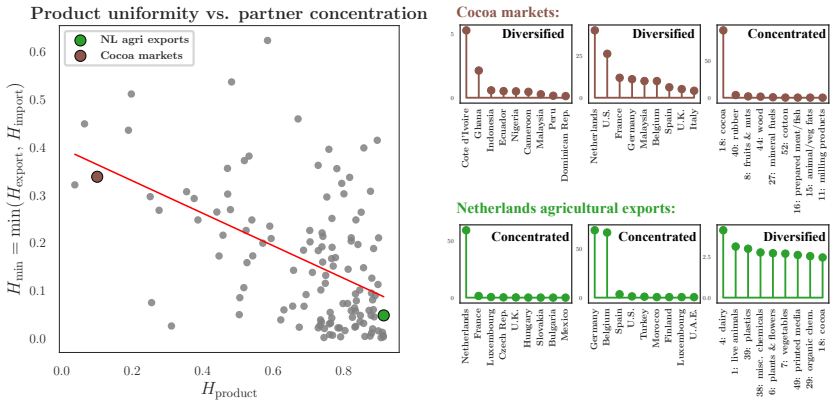
- The model separates the probability of a zero observation from the conditional distribution of positive values while sharing parameters across all tensor modes.
- Slice-specific Gamma rates allow dispersion to differ across years or products without breaking the low-rank borrowing of strength.
- The hybrid variational-Monte Carlo algorithm makes posterior inference feasible for tensors with tens of millions of entries.
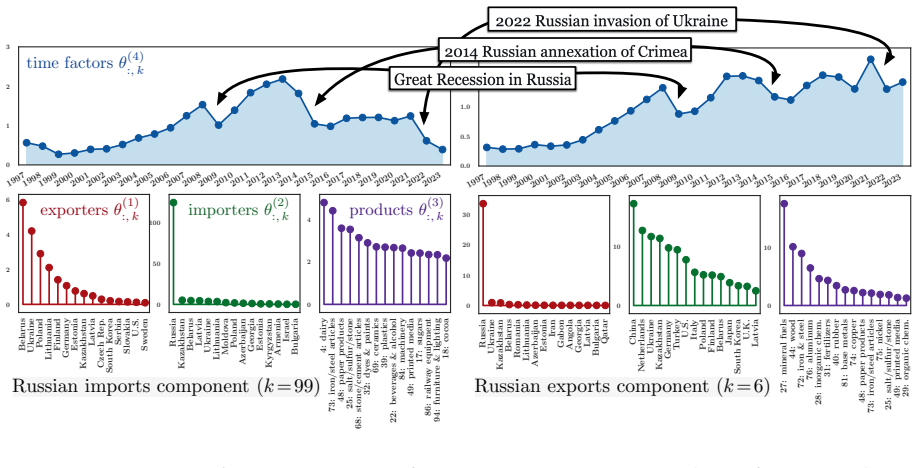
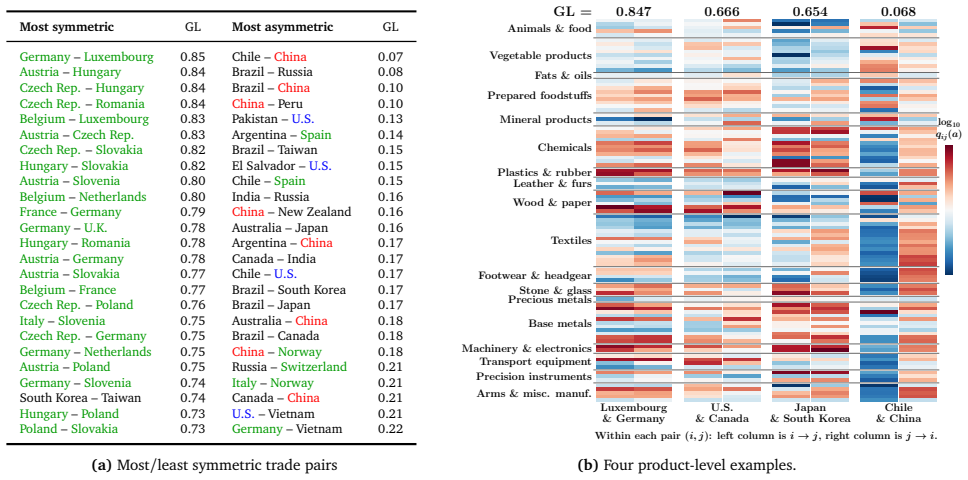
- Multiway dependence patterns across exporters, importers, products, and years become recoverable from the fitted factors.
Where Pith is reading between the lines
- The same separation of occurrence and magnitude could be applied to other monetary-valued tensors such as firm-to-firm transaction data or government procurement records.
- Because the model explicitly includes the temporal mode, it could be used to test whether trade shocks propagate through specific product categories rather than through aggregate country pairs.
- The low-rank Poisson rate could be replaced by other count distributions if future data exhibit different zero-inflation mechanisms.
Load-bearing premise
The data-generating process for the trade tensor admits a low-rank CP decomposition on the latent Poisson rate tensor and the conditional Gamma model with slice-specific rates adequately captures the heavy tails and slice-specific dispersion.
What would settle it
If posterior predictive checks on held-out trade flows show that the model fails to reproduce the observed joint distribution of zeros and positive magnitudes across the four modes better than a gravity-style model that ignores the product and year dimensions, the claimed advantage of the joint low-rank structure would be falsified.
Figures
read the original abstract
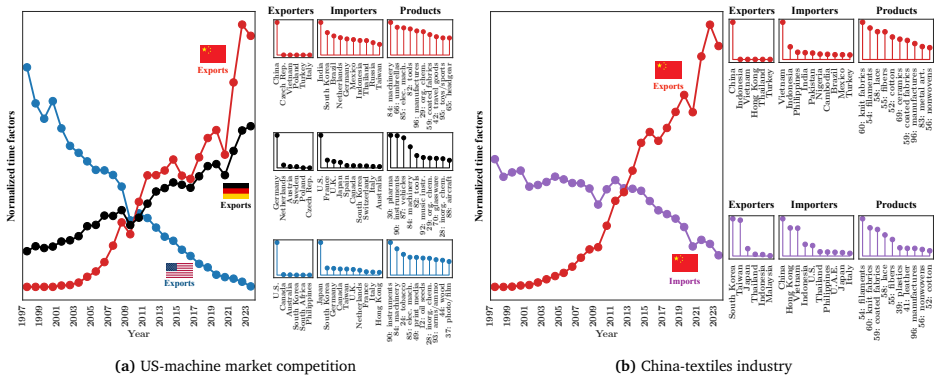
We study sparse semi-continuous tensor data with excess zeros, heavy right tails, and slice-specific dispersion. Such features arise naturally in monetary-valued multi-way data, such as international trade, where most exporter--importer--product--year cells are zero while positive values are continuous and highly variable. To model these data, we propose a Bayesian hierarchical tensor factorization model that places a low-rank CP structure on a latent Poisson rate tensor and couples it with a conditional Gamma model for positive outcomes, with rate parameters that can vary across slices within a mode. The model therefore separates the occurrence and magnitude of positive observations while borrowing strength across all tensor dimensions through a shared low-rank latent structure. To scale posterior inference to large arrays, we develop a hybrid variational--Monte Carlo algorithm that combines efficient coordinate ascent updates with a partially collapsed augmented-data sampler. Applied to approximately 60 million trade flows, the method surfaces multiway dependence across exporters, importers, products, and years that is difficult to recover from gravity-type or pairwise network analyses, which do not jointly model the product and temporal dimensions.
Editorial analysis
A structured set of objections, weighed in public.
Referee Report
Summary. The paper proposes a Bayesian hierarchical tensor factorization model for sparse semi-continuous data with excess zeros and heavy tails, such as international trade flows. A low-rank CP structure is placed on a latent Poisson rate tensor, coupled with a conditional Gamma model for positive outcomes that allows slice-specific rates; this separates occurrence from magnitude while borrowing strength across all modes. A hybrid variational-Monte Carlo inference procedure is developed for scalability, and the model is applied to approximately 60 million trade flows to extract multiway dependence across exporters, importers, products, and years that is not recoverable from gravity-type or pairwise analyses.
Significance. If the low-rank Poisson-Gamma structure is a reasonable approximation, the framework offers a principled way to jointly model four-way interactions in large sparse tensors while handling semi-continuous features, which could advance analysis of international trade and similar multiway datasets. The hybrid inference algorithm is a practical contribution for scaling Bayesian tensor models.
major comments (2)
- [Application and results (likely §5)] The headline empirical claim (multiway dependence difficult to recover from gravity or pairwise methods) is load-bearing on the low-rank CP assumption for the latent Poisson rate tensor. No rank-selection diagnostics, posterior-predictive checks against gravity baselines, or simulation recovery experiments are referenced that would confirm the assumption holds at the scale of the 60 M trade tensor; without these, the extracted factors may reflect the imposed structure rather than recoverable signal.
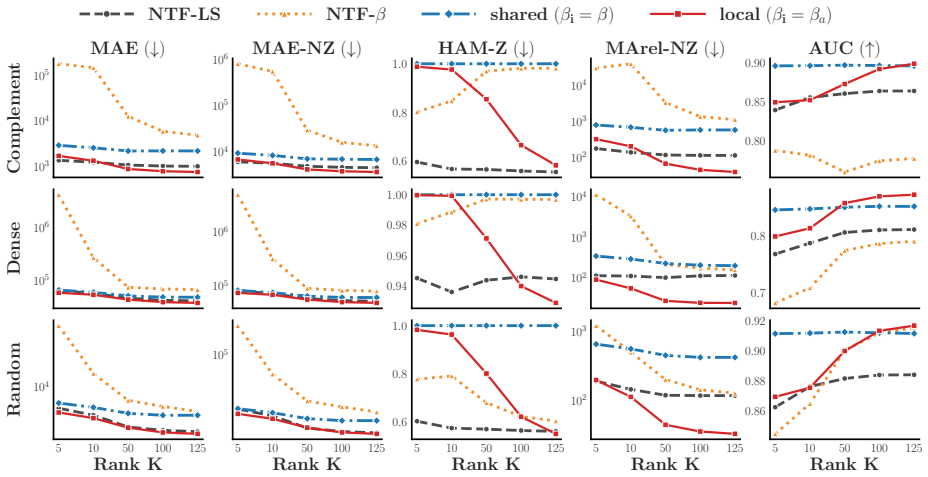
- [Model definition (likely §2)] The conditional Gamma component with slice-specific rates is presented as capturing heavy tails and dispersion, but the manuscript supplies no explicit comparison of marginal predictive distributions or sensitivity analysis to the choice of slice-specific versus shared rates that would demonstrate this separation is necessary for the multiway claim.
minor comments (2)
- [Introduction] Notation for the four tensor modes (exporter, importer, product, year) and the distinction between the Poisson rate tensor and the observed data tensor should be introduced earlier and used consistently.
- [Inference section] The description of the hybrid inference algorithm would benefit from a short pseudocode outline or explicit statement of which variables are updated variationally versus via the augmented-data sampler.
Simulated Author's Rebuttal
Thank you for the constructive review and for recognizing the potential of the proposed framework. We address each major comment below. Where the manuscript is missing supporting analyses, we agree that revisions are warranted and will incorporate them.
read point-by-point responses
-
Referee: [Application and results (likely §5)] The headline empirical claim (multiway dependence difficult to recover from gravity or pairwise methods) is load-bearing on the low-rank CP assumption for the latent Poisson rate tensor. No rank-selection diagnostics, posterior-predictive checks against gravity baselines, or simulation recovery experiments are referenced that would confirm the assumption holds at the scale of the 60 M trade tensor; without these, the extracted factors may reflect the imposed structure rather than recoverable signal.
Authors: We agree that the headline claim depends on the validity of the low-rank CP structure and that explicit validation would strengthen the paper. The current version emphasizes model formulation, scalable inference, and the trade application but does not include dedicated rank-selection diagnostics, posterior-predictive checks versus gravity baselines, or large-scale simulation recovery experiments. We will add a new subsection with (i) simulation studies that recover planted multiway structure at scales comparable to the trade tensor, (ii) rank-selection criteria (e.g., held-out predictive log-likelihood and WAIC), and (iii) direct predictive comparisons against gravity-type and pairwise baselines. These additions will be placed in §5 and the supplement. revision: yes
-
Referee: [Model definition (likely §2)] The conditional Gamma component with slice-specific rates is presented as capturing heavy tails and dispersion, but the manuscript supplies no explicit comparison of marginal predictive distributions or sensitivity analysis to the choice of slice-specific versus shared rates that would demonstrate this separation is necessary for the multiway claim.
Authors: The slice-specific rates are motivated by the need to accommodate heterogeneous dispersion across slices (e.g., different products or years). The manuscript does not, however, supply explicit marginal predictive distribution comparisons or sensitivity analyses contrasting slice-specific versus shared rates. We will add these analyses—both analytic marginals under the Poisson-Gamma hierarchy and numerical sensitivity experiments on held-out trade data—to §2 and the supplement to demonstrate that the slice-specific formulation improves tail behavior and is material to the multiway dependence results. revision: yes
Circularity Check
No circularity; new model construction with independent content
full rationale
The paper introduces a novel Bayesian hierarchical tensor factorization that places a low-rank CP structure on a latent Poisson rate tensor and couples it to a conditional Gamma model for positive values, with slice-specific rates. This is presented as a modeling proposal to handle sparse semi-continuous tensor data, not as a derivation that reduces to previously fitted quantities or self-citations. The application to trade flows extracts factors under the stated low-rank Poisson-Gamma assumptions, but the multiway dependence claim is an output of fitting the model rather than a tautological restatement of inputs. No load-bearing step equates a prediction to its own fit by construction, and the provided text contains no self-citation chains or ansatz smuggling. The derivation is therefore self-contained as a new statistical construction.
Axiom & Free-Parameter Ledger
free parameters (2)
- CP rank
- slice-specific Gamma rate parameters
axioms (2)
- domain assumption The occurrence of positive trade flows is governed by a low-rank CP structure on a latent Poisson rate tensor.
- domain assumption Positive outcomes follow a conditional Gamma distribution whose rate can vary by slice.
Reference graph
Works this paper leans on
-
[1]
Anjali N Albert, Patrick Flaherty, and Aaron Schein. Doubly non-central beta matrix factor- ization for stable dimensionality reduction of bounded support matrix data.arXiv preprint arXiv:2410.18425,
-
[2]
Matteo Barigozzi, Giorgio Fagiolo, and Diego Garlaschelli
doi: 10.1016/j.jeconom.2025.106077. Matteo Barigozzi, Giorgio Fagiolo, and Diego Garlaschelli. Multinetwork of international trade: A commodity-specific analysis.Physical Review E, 81(4):046104,
-
[3]
Journal of Business & Economic Statistics , volume =
doi: 10.1080/07350015.2022.2032721. David M Blei, Alp Kucukelbir, and Jon D McAuliffe. Variational inference: A review for statisti- cians.Journal of the American Statistical Association, 112(518):859–877,
-
[4]
Bayesian inference for nonnegative matrix factorisation models.Computa- tional Intelligence and Neuroscience, 2009(1):785152,
Ali Taylan Cemgil. Bayesian inference for nonnegative matrix factorisation models.Computa- tional Intelligence and Neuroscience, 2009(1):785152,
2009
-
[5]
25 Rong Chen, Dan Yang, and Cun-Hui Zhang
doi: 10.1002/ecy .2063. 25 Rong Chen, Dan Yang, and Cun-Hui Zhang. Factor models for high-dimensional tensor time series.Journal of the American Statistical Association, 117(537):94–116,
work page doi:10.1002/ecy 2063
-
[6]
doi: 10.1080/ 01621459.2021.1912757. Eric C Chi and Tamara G Kolda. On tensors, sparsity, and nonnegative factorizations.SIAM Journal on Matrix Analysis and Applications, 33(4):1272–1299,
arXiv 2021
-
[7]
doi: 10.1103/PhysRevX.3.041022. Peter K. Dunn and Gordon K. Smyth. Series evaluation of Tweedie exponential dispersion model densities.Statistics and Computing, 15(4):267–280,
-
[8]
doi: 10.1007/s11222-005-4070-y. David B. Dunson and Chuanhua Xing. Nonparametric bayes modeling of multivariate categorical data.Journal of the American Statistical Association, 104(487):1042–1051,
-
[9]
doi: 10.1198/jasa.2009.tm08439. Thibault Fally and James Sayre. Commodity trade matters. Technical report, National Bureau of Economic Research,
-
[10]
ISBN 978-1-611976-40-3. doi: 10.1137/1. 9781611976410. Prem Gopalan, Jake M Hofman, and David M Blei. Scalable recommendation with hierarchical Poisson factorization. InUAI, pages 326–335,
-
[11]
doi: 10.1162/qjec.2008.123.2.441. Cesar A. Hidalgo and Ricardo Hausmann. The building blocks of economic complex- ity.Proceedings of the National Academy of Sciences, 106(26):10570–10575,
-
[12]
doi: 10.1073/pnas.0900943106. 26 César A. Hidalgo, Bailey Klinger, Albert-László Barabási, and Ricardo Hausmann. The product space conditions the development of nations.Science, 317(5837):482–487, July
-
[13]
doi: 10.1126/science.1144581. John Hood and Aaron Schein. Near-universal multiplicative updates for nonnegative ein- sum factorization. InProceedings of the 43rd International Conference on Machine Learning, Proceedings of Machine Learning Research. PMLR,
-
[14]
Michael I Jordan, Zoubin Ghahramani, Tommi S Jaakkola, and Lawrence K Saul
doi: 10.1002/cjs.70012. Michael I Jordan, Zoubin Ghahramani, Tommi S Jaakkola, and Lawrence K Saul. An introduction to variational methods for graphical models.Machine learning, 37(2):183–233,
-
[15]
Tensor Decompositions and Applica- tions
doi: 10.1137/07070111X. Jean Kossaifi, Yannis Panagakis, Anima Anandkumar, and Maja Pantic. Tensorly: Tensor learning in python.Journal of Machine Learning Research, 20(26):1–6,
-
[16]
Linear Algebra and its Applications , author =
doi: 10.1016/0024-3795(77)90069-6. Daniel D Lee and H Sebastian Seung. Learning the parts of objects by non-negative matrix factorization.Nature, 401(6755):788–791,
-
[17]
Benjamin M
URLhttps://www.ers.usda.gov/amber-waves/2006/february/ the-world-bids-farewell-to-the-multifiber-arrangement. Benjamin M. Marlin. Collaborative filtering: A machine learning perspective. Master’s thesis, University of Toronto, Toronto, Canada,
2006
-
[18]
doi: 10.1257/aer. 20131578. 27 James E. Rauch. Networks versus markets in international trade.Journal of International Economics, 48(1):7–35,
-
[19]
Aaron Schein, John Paisley , David M Blei, and Hanna Wallach
doi: 10.1016/S0022-1996(98)00009-9. Aaron Schein, John Paisley , David M Blei, and Hanna Wallach. Bayesian Poisson tensor factor- ization for inferring multilateral relations from sparse dyadic event counts. InProceedings of the 21th ACM SIGKDD International Conference on Knowledge Discovery and Data Mining, pages 1045–1054,
-
[20]
Accessed: 2026-03-03
URLhttps://docs.scipy.org/doc/scipy/reference/ generated/scipy.special.ive.html. Accessed: 2026-03-03. Amnon Shashua and Tamir Hazan. Non-negative tensor factorization with applications to statistics and computer vision. InProceedings of the 22nd International Conference on Machine Learning (ICML), pages 792–799, Bonn, Germany ,
2026
-
[21]
doi: 10.1145/1102351.1102451. Nicholas D. Sidiropoulos and Rasmus Bro. On the uniqueness of multilinear decomposition of N-way arrays.Journal of Chemometrics, 14(3):229–239,
-
[22]
doi: 10.2143/AST .32.1.1020. Trade and Industry Department. Hong Kong–mainland trade relations (overview/fact- sheet).https://www.tid.gov.hk/en/our_work/trade_relations/mainland/overview. html,
-
[23]
Compilation of bilateral trade database by industry and end-use category
Shiguang Zhu, Norihiko Yamano, and Agnès Cimper. Compilation of bilateral trade database by industry and end-use category . Technical Report 2011/06, OECD Publishing, Paris,
2011
-
[24]
29 S1 Proof of identifiability Proof of Lemma 3.1 in the main text.SupposeF λ,β =F λ′,β ′
URLhttps://doi.org/10.1787/5k9h6vx2z07f-en. 29 S1 Proof of identifiability Proof of Lemma 3.1 in the main text.SupposeF λ,β =F λ′,β ′. First, by the definition of PRG(λ,β), η|λ∼Pois(λ),Y|η,β∼ ( δ0,η=0, Gamma(η,β),η >0, (S1) we have P(Y=0|λ,β) =P(η=0|λ) =e −λ, and similarly P(Y =0 |λ ′,β ′) = e−λ′ . Equality in distribution implies e−λ = e−λ′ , hence λ = λ...
-
[25]
In such cases, we treat the entire exporter-year block as missing rather than as genuine zero trade
=0. In such cases, we treat the entire exporter-year block as missing rather than as genuine zero trade. For each( i,j,a )series, we impute short internal gaps of length at most two years by linear interpolation in levels between the nearest observed years. If a single missing value occurs at the beginning or end of the sample window, we fill it using the...
arXiv 1997
-
[26]
Hong Kong has long served as an entrepôt for Mainland trade[Trade and Industry Department, 2026], and a large share of China’s exports historically passed through Hong Kong intermediaries in light manufactures[Hanson and Feenstra, 2001]. The decline coincides with the expiry of the WTO Agreement on Textiles and Clothing (ATC) on 1 January 2005[World Trade...
2026
discussion (0)
Sign in with ORCID, Apple, or X to comment. Anyone can read and Pith papers without signing in.