II. Exploring the role of the Crystal Electric Field in the vicinity of a Quantum Critical Point
Pith reviewed 2026-06-27 02:12 UTC · model grok-4.3
The pith
Accounting for crystal electric field effects shows no specific heat divergence at the QCP in Yb compounds.
A machine-rendered reading of the paper's core claim, the machinery that carries it, and where it could break.
Core claim
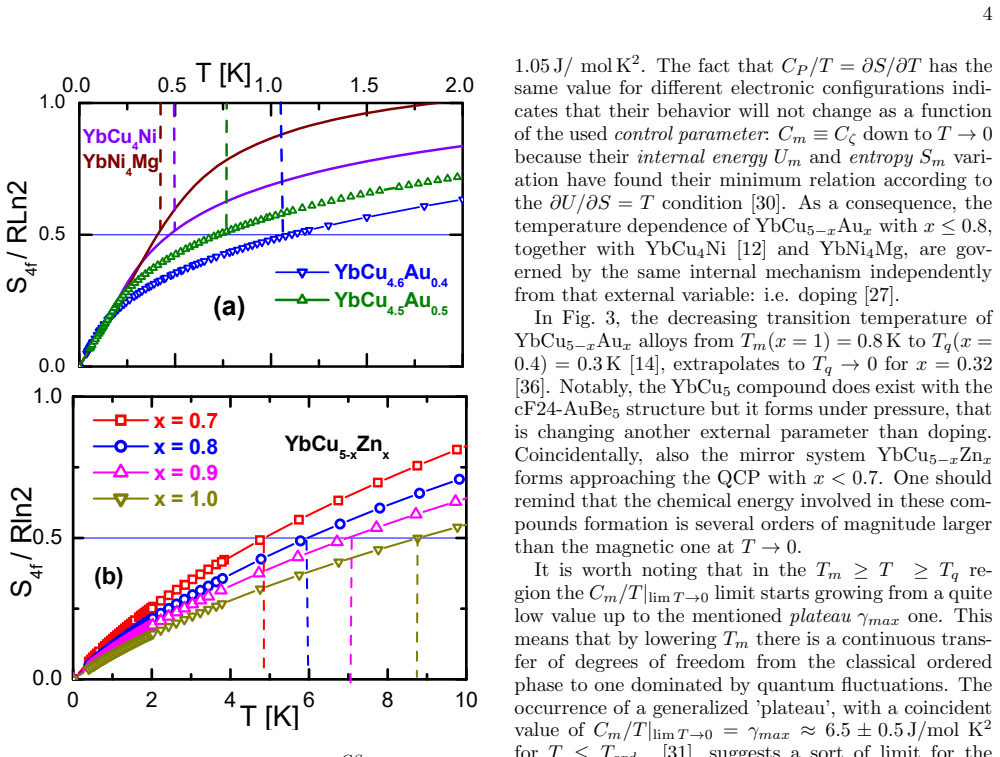
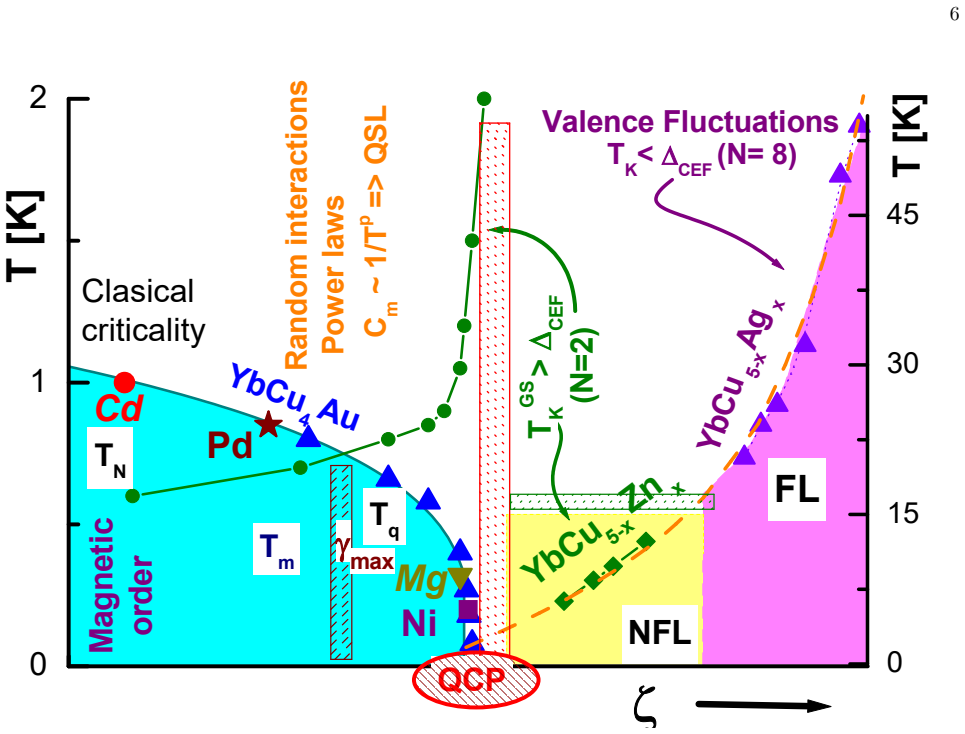
Very low temperature thermodynamic properties of the YbT4M family of compounds are analyzed in a broad range of behavior including a quantum critical point QCP between magnetic and Fermi-liquid ground states. Doniach-Lavagna phase diagram limitations are improved by taking into account crystal electric field CEF splittings. The studied alloys allow to gain insight into the evolution of the GS behavior undergoing the QCP region as a function of chemical doping as control parameter. Three types of behaviors are recognized: a magnetic one with weak interactions and quantum fluctuations showing T power law dependencies in C4f/T and a very heavy-fermion plateau, beyond the QCP the typical non-fer
What carries the argument
Crystal electric field splittings of the Yb 4f levels, which modify quantum fluctuations and ground-state behavior near the QCP when included in the phase diagram analysis.
If this is right
- Chemical doping as control parameter reveals three distinct regimes: magnetic with quantum fluctuations, non-Fermi liquid, and valence fluctuation.
- C4f/T shows T power-law dependencies between Tm and Tq with a heavy-fermion plateau below Tq in the magnetic regime.
- Beyond the QCP, C4f/T exhibits logarithmic dependence C4f/T proportional to ln(T/T0).
- At the non-magnetic limit, the system behaves as a valence-fluctuation system when TK overcomes the CEF splitting.
- The phase diagram around the QCP lacks C4f/T divergences at T to 0 but shows a clear drop in its value.
Where Pith is reading between the lines
- CEF modifications may explain the absence of expected divergences in other doped heavy-fermion systems near QCPs.
- Similar CEF considerations could be tested in related rare-earth compounds to see if they produce analogous drops in specific heat.
- Replacing chemical doping with hydrostatic pressure as the tuning parameter would help isolate intrinsic quantum fluctuation effects from doping-induced disorder.
Load-bearing premise
The observed T-power-law and logarithmic regimes in C4f/T are produced by quantum fluctuations modified by CEF splittings rather than by disorder, sample inhomogeneity, or other extrinsic effects from chemical doping.
What would settle it
If measurements on samples with reduced disorder or tuned by pressure instead of doping show a divergence in C4f/T as T approaches zero at the QCP, the claim that CEF splittings prevent such divergences would be falsified.
Figures

read the original abstract
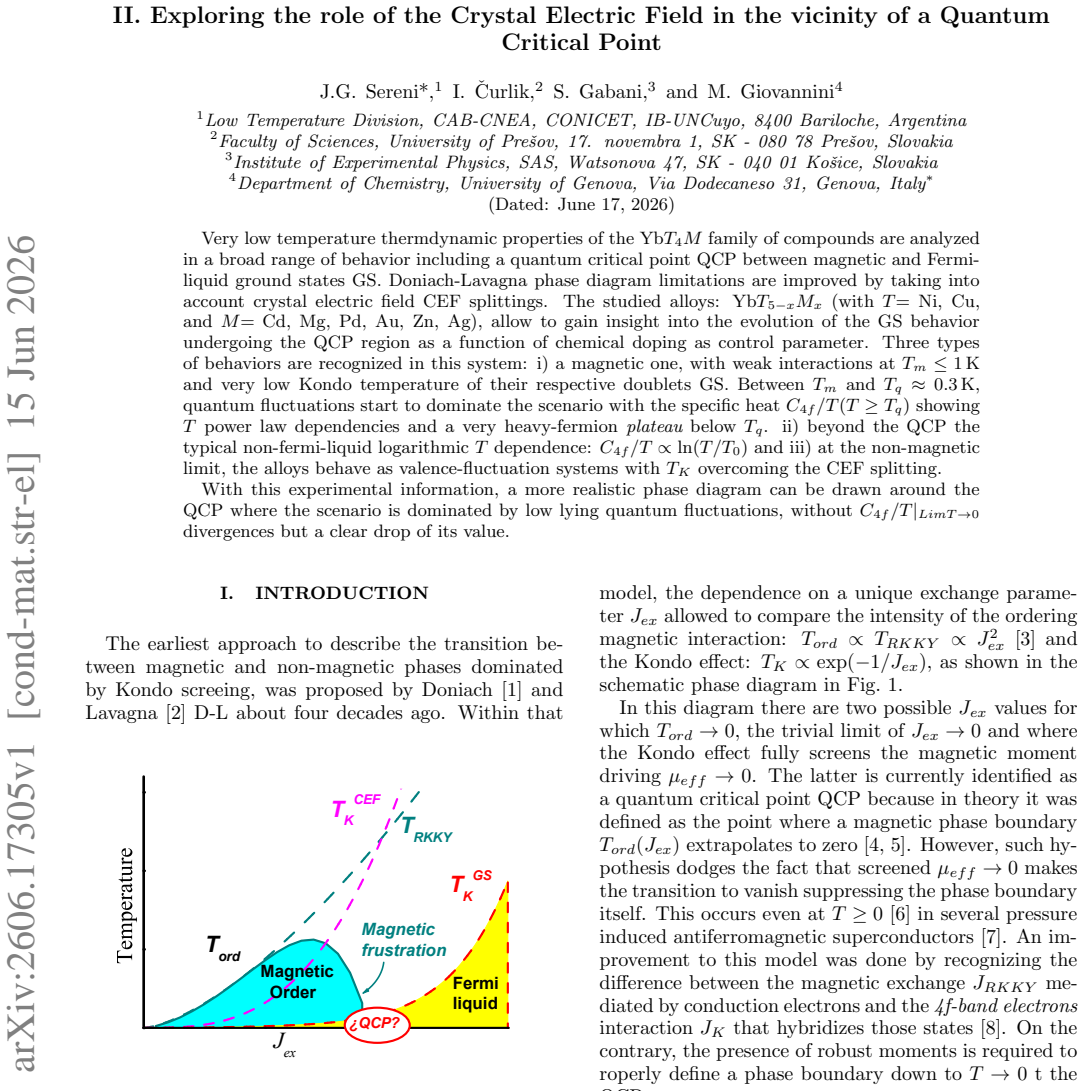
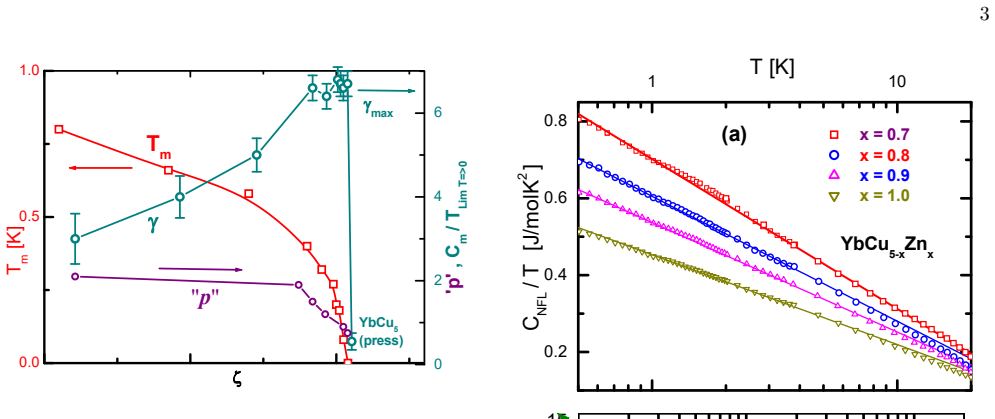
Very low temperature thermdynamic properties of the Yb$T_4M$ family of compounds are analyzed in a broad range of behavior including a quantum critical point QCP between magnetic and Fermi-liquid ground states GS. Doniach-Lavagna phase diagram limitations are improved by taking into account crystal electric field CEF splittings. The studied alloys: Yb$T_{5-x}M_x$ (with $T$= Ni, Cu, and $M$= Cd, Mg, Pd, Au, Zn, Ag), allow to gain insight into the evolution of the GS behavior undergoing the QCP region as a function of chemical doping as control parameter. Three types of behaviors are recognized in this system: i) a magnetic one, with weak interactions at $T_m\leq 1$\,K and very low Kondo temperature of their respective doublets GS. Between $T_m$ and $T_q\approx 0.3$\,K, quantum fluctuations start to dominate the scenario with the specific heat $C_{4f}/T(T\geq T_q)$ showing $T$ power law dependencies and a very heavy-fermion {\it plateau} below $T_q$. ii) beyond the QCP the typical non-fermi-liquid logarithmic $T$ dependence: $C_{4f}/T \propto \ln(T/T_0)$ and iii) at the non-magnetic limit, the alloys behave as valence-fluctuation systems with $T_K$ overcoming the CEF splitting. With this experimental information, a more realistic phase diagram can be drawn around the QCP where the scenario is dominated by low lying quantum fluctuations, without $C_{4f}/T|_{Lim T\to 0}$ divergences but a clear drop of its value.
Editorial analysis
A structured set of objections, weighed in public.
Referee Report
Summary. The manuscript analyzes very-low-temperature thermodynamic properties, primarily C_{4f}/T, of the YbT_{5-x}M_x family (T=Ni,Cu; M=Cd,Mg,Pd,Au,Zn,Ag) across a quantum critical point (QCP) tuned by chemical doping. It classifies three regimes: (i) magnetic ground states with weak interactions where quantum fluctuations dominate between T_m and T_q≈0.3 K, producing power-law C_{4f}/T followed by a heavy-fermion plateau; (ii) non-Fermi-liquid logarithmic behavior C_{4f}/T ∝ ln(T/T_0) beyond the QCP; and (iii) valence-fluctuation systems where T_K exceeds CEF splitting. The authors argue that incorporating CEF splittings yields a more realistic phase diagram around the QCP dominated by low-lying quantum fluctuations, featuring a drop in C_{4f}/T at T→0 without divergence.
Significance. If the intrinsic interpretation of the doping-dependent regimes holds, the work would refine the Doniach-Lavagna diagram by explicitly including CEF effects and provide experimental constraints on quantum-fluctuation scenarios in heavy-fermion systems without low-T divergences in C/T. The breadth of alloys examined offers a systematic view of the evolution across the QCP.
major comments (1)
- [Abstract] Abstract: The central claim that the reported power-law (T_m to T_q) and logarithmic regimes reflect CEF-modified quantum fluctuations (rather than extrinsic effects) is load-bearing for the proposed phase diagram, yet the manuscript provides no quantitative disorder metrics (e.g., residual resistivity, linewidth broadening, or direct comparison to pressure-tuned analogs) despite using chemical substitution as the sole control parameter; such characterization is required because doping-induced inhomogeneity is documented to generate similar NFL-like C/T forms without an intrinsic QCP.
minor comments (2)
- [Abstract] Abstract: The extraction procedure for the characteristic temperatures T_m, T_q, and T_0 (including any fitting windows or criteria for identifying the plateau) is not stated, preventing assessment of robustness against sample-to-sample variation.
- [Abstract] Abstract: Notation for the specific-heat quantity is introduced as C_{4f}/T without an explicit definition of the 4f contribution subtraction or phonon/electronic background removal method.
Simulated Author's Rebuttal
We thank the referee for the careful review and for raising the important issue of distinguishing intrinsic quantum critical behavior from possible doping-induced disorder effects. We address the major comment below.
read point-by-point responses
-
Referee: [Abstract] Abstract: The central claim that the reported power-law (T_m to T_q) and logarithmic regimes reflect CEF-modified quantum fluctuations (rather than extrinsic effects) is load-bearing for the proposed phase diagram, yet the manuscript provides no quantitative disorder metrics (e.g., residual resistivity, linewidth broadening, or direct comparison to pressure-tuned analogs) despite using chemical substitution as the sole control parameter; such characterization is required because doping-induced inhomogeneity is documented to generate similar NFL-like C/T forms without an intrinsic QCP.
Authors: We agree that chemical substitution can introduce inhomogeneity capable of producing NFL-like specific-heat forms, and that explicit quantitative characterization would strengthen the intrinsic interpretation. The manuscript's central argument rests on the systematic appearance of the same power-law (between T_m and T_q) and logarithmic regimes across six distinct dopant series, together with their correlation to independently estimated CEF splittings and the absence of low-T divergences. Nevertheless, we acknowledge the absence of resistivity ratios or linewidth data in the present work. We will revise the manuscript to incorporate available residual-resistivity information from the literature on these alloys, add a dedicated paragraph discussing possible disorder contributions, and explicitly note the lack of pressure-tuned comparisons as a limitation of the current study. revision: partial
Circularity Check
No circularity: experimental classification of regimes around QCP
full rationale
The manuscript is an experimental study classifying low-T specific-heat regimes in doped YbT4M alloys as a function of chemical substitution. It identifies three behaviors (magnetic with Tm and Tq, NFL logarithmic, valence-fluctuation) directly from measured C4f/T(T) curves and draws a phenomenological phase diagram. No equations, models, or derivations are presented that reduce a claimed prediction to a fitted input by construction, nor does any load-bearing step rely on self-citation chains or imported uniqueness theorems. The central claim rests on observed data patterns rather than any self-referential construction.
Axiom & Free-Parameter Ledger
Reference graph
Works this paper leans on
-
[1]
is YbCu5−xAux [14, 25], on theNon-Fermi-liquidNFL region YbCu5−xZnx [26], and YbCu5−xAgx [21, 28, 29] on the Fermi-liquid FL limit
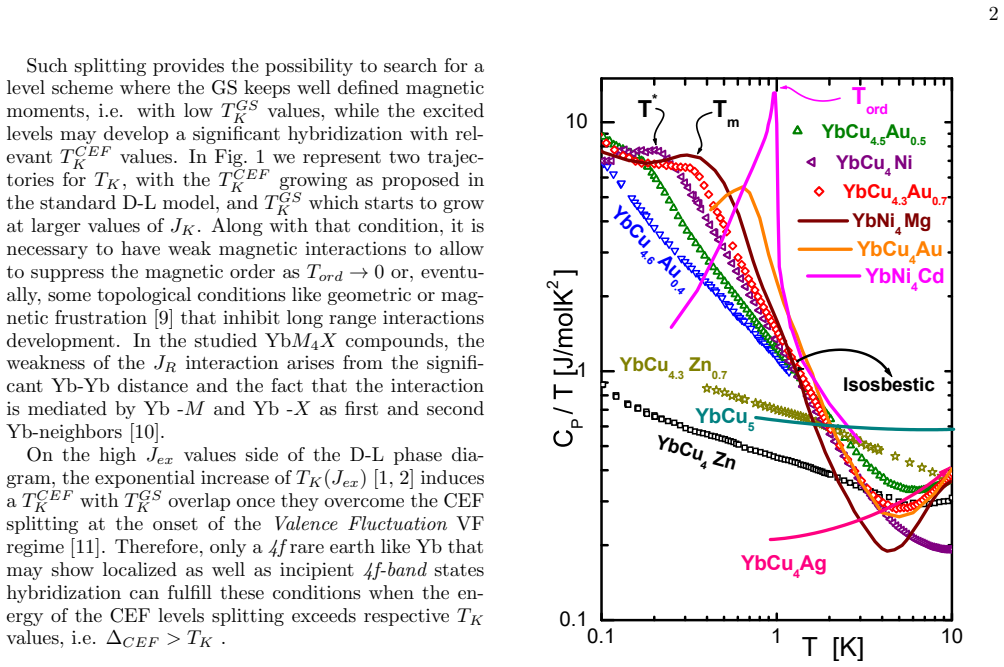
atT≈1.2 K: coincident temperature with the same en- tropy derivative. is YbCu5−xAux [14, 25], on theNon-Fermi-liquidNFL region YbCu5−xZnx [26], and YbCu5−xAgx [21, 28, 29] on the Fermi-liquid FL limit. In the following we ana- lyze the specific heat behavior in order to identify their respective GS character. A. Specific heat behavior Among the mentioned ...
-
[2]
Finally, a third region is represented in Fig
does not seem to be related to any singularity but more likely to a ’crossover’ between two different mag- netic regimes of the GS in a context dominated by quan- tum fluctuations. Finally, a third region is represented in Fig. 2 by YbCu 5−xAgx and YbCu 5 as examples of non-magnetic or VF behavior. Interestingly, there one can see in that figure that asT ...
-
[3]
The magnetic experimental limit is represented by YbNi4Cd that shows aC m jump ∆C m(Tord) = 3/2R, like a text book example of mean field theory
Systems approaching the QCP from the magnetic side Hereafter we will take into account only the magnetic contributionC m(T) instead of the total specific heatC P because forT≤2, Kthe phonon contribution is irrele- vant. The magnetic experimental limit is represented by YbNi4Cd that shows aC m jump ∆C m(Tord) = 3/2R, like a text book example of mean field ...
-
[4]
4a do not show any magnetic anomaly down to 50 mK even under magnetic field ofB= 9 T [48], therefore they are placed on thenon-magneticside of the QCP
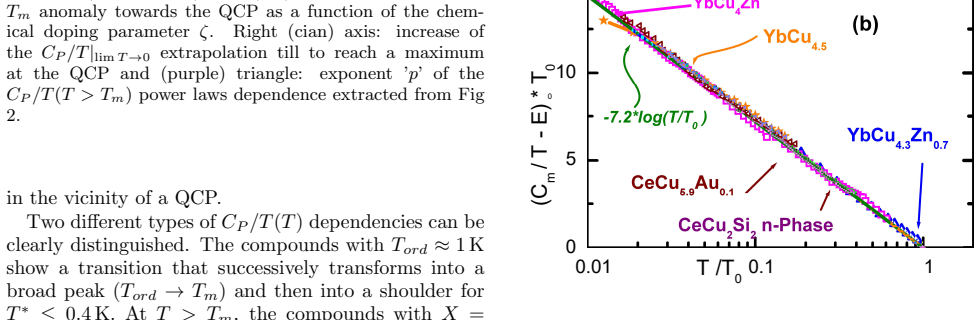
Systems located at the non-fermi-liquid region The YbCu 5−xZnx alloys included in Fig. 4a do not show any magnetic anomaly down to 50 mK even under magnetic field ofB= 9 T [48], therefore they are placed on thenon-magneticside of the QCP. This positioning is not arbitrary because it is supported by a NFLC m ∝ log(T /T0) dependence [47], whereT 0 is a char...
-
[5]
Systems within the Valence Fluctuation regime The compound YbCu 4Ag is also included as a text book example for Fermi-liquid FL behavior among these isotypic compounds. It is known that Yb atoms have access to two electronic configurations: Yb3+: [Xe(6s 25d1)4f 13] and the Lu 3+ like Yb 2+: [Xe(6s 15d1)4f 14], being the former magnetic and the latter non-...
-
[6]
In comparison, in the same system the magnetic field induces a polarization of the magnetic structure without any clear NFL region
that shows how a an allloy can be driven from a magnetic to a non-magnetic GS when major Au atoms are substituted by smaller isoelectronic Cu through the NFL region included in figure 4b. In comparison, in the same system the magnetic field induces a polarization of the magnetic structure without any clear NFL region. There one sees that the magnetic phas...
-
[7]
Doniach, Physica B & C91(1977) 231
S. Doniach, Physica B & C91(1977) 231
1977
-
[8]
Lavagna, C
M. Lavagna, C. Lacroix, M. Cyrot, Phys. Lett.90A (1982) 20 and Jour. Phys. F13A(1983) 1007
1982
-
[9]
Electronic mediate Ruderman-Kittel-Kasuya-Yoshida interaction
-
[10]
Vojta, Ann.Phys.9(2000) 403-
see for example: M. Vojta, Ann.Phys.9(2000) 403-
2000
-
[11]
andQuantum phase transitions, Rep. Prog. Phys. 66(2003) 2069–2110
2003
-
[12]
Quantum Criticality and the Kondo Lattice
Q. Si;Quantum Criticality and the Kondo Lattice; arXiv:1012.5440v1 [cond-mat.str-el], doi.org/10.48550/arXiv.1012.5440 and Q. Si;Is there more than one type of quantum critical points in heavy-fermion metls?; Jour. Magn. Magn. Mat. 226-230(2001) 30-34
work page internal anchor Pith review Pith/arXiv arXiv doi:10.48550/arxiv.1012.5440 2001
-
[13]
Sereni, Termodynamical analysis of the quantum critical behavior of Ce-lattice compounds, Philosophical Magazine.93(2013) 409-433
J.G. Sereni, Termodynamical analysis of the quantum critical behavior of Ce-lattice compounds, Philosophical Magazine.93(2013) 409-433
2013
-
[14]
see e.g. S. Raymond , D. Jaccard , H. Wilhelm , R. Cerny;Transport evidence for pressure-induced super- conductivity in CePd 2Si2; Solid State Commun.112 (1999) 617-620
1999
-
[15]
Iglesias, C
R.J. Iglesias, C. Lacroix, B. Coqblin,Revised Do- niach diagram: Influence of short-range antiferromag- netic correlations in the Kondo lattice, Phys. Rev. B56 (1997) 11820
1997
-
[16]
see for example: A.P.RamirezStrongly Geometrically Frustrated Magnets, Annu. Rev. Mtter Sci.24(1994) 453-480, and R. Moessner, A.P. Ramirez,Geometrical Frustration, Physics Today (February 2006) 24
1994
-
[17]
Dogan and R
A. Dogan and R. Poettgen;The Ordered Laves Phases CeNi4Cd and RECu 4Cd (RE = Ho, Er, Tm, Yb); Z. Naturforsch.60b(2005) 495 – 498
2005
-
[18]
Sereni; it on the Ce magnetic transformations induced by alloying Jour
J.G. Sereni; it on the Ce magnetic transformations induced by alloying Jour. of Alloys and Compounds bf 207/208 (1994) 229
1994
-
[19]
Sereni, I
J.G. Sereni, I. Curl´ ık, M. Giovannini, A. Strydom, M. Reiffers,Physical properties of the very heavy fermion YbCu4Ni; Phys. Rev. B98(2018) 094420
2018
-
[20]
Giovannini, I
M. Giovannini, I. Curlik, F. Gastaldo, M. Reiffers, J.G. Sereni,The role of crystal chemistry in YbCu 5−xAux, JALCO627(2015) 20-24
2015
-
[21]
ˇCurl´ ık, M
I. ˇCurl´ ık, M. Giovannini, J. G. Sereni;Extremely high density of magnetic excitations at T = 0 in YbCu5−xAux, Phys. Rev. B90(2014)
2014
-
[22]
J. L. Sarrao, C. D. Immer, Z. Fisk, C. H. Booth, E. Figueroa, J. M. Lawrence, R. Modler, A. L. Cor- nelius, M. F. Hundley, G. H. Kwei, J. D. Thompson, F. Bridges,Physical properties of YbCu 4X (X= Ag, Au, Cd, Mg, Tl, and Zn) compounds, Phys. Rev. B 59(1999) 6855
1999
-
[23]
Linsinger, M
S. Linsinger, M. Eul, C. Schwickert, R. Decourt, B. Chevalier, Ute Ch. Rodewald, J-L. Bobet, R. P¨ ottgen, Structure, homogeneity ranges, magnetic, and electrical properties of the ordered Laves phases RENi 4Mg with MgCu4Sn type structure, Intermetallics19(2011) 1579- 1585
2011
-
[24]
Zhang, Te Zhang, Z
X. Zhang, Te Zhang, Z. Zhuang, Z Leng, Z. Wei, X. Liu, J. Xiang, S. Zhang, P. Sun;YbNi4Mg: Superheavy fermion with enhanced Wilson ratio and magnetocaloric effect; Phys. Rev. M9(2025) 014402
2025
-
[25]
J. Lee, H. Park, N.R. Lee-Hone, D.M. Broun, E. Mun; Thermodynamic and transport properties of YbNi 4Cd; Phys. Rev. B97, 2018, 195144
2018
-
[26]
Rossel, K
C. Rossel, K. N. Yang, and M. B. Maple, Z. Fisk, E. Zirngiebl, and J. D. Thompson,Strong electronic corre- lations in a new class of Yb-based compounds: YbCu 4X (X=Ag,Au, Pd), Phys. Rev. B35(1987) 1914
1987
-
[27]
Tsujii, J
N. Tsujii, J. He, F. Amita, K. Yoshimura, K. Kosuge, H. Michor, G. Hilsher, T. Goto,Kondo-lattice formation in cubic-phase YbCu 5, Phys. Rev. B56(1997) 8103
1997
-
[28]
Hamdaoui,Magnetisme et effect Kondo dans des composes derives des systemes YbCu 5 at CeCu 5, PhD Thesis, University Louis Pasteur, Strasbourg I, France, 11 June 1997
N. Hamdaoui,Magnetisme et effect Kondo dans des composes derives des systemes YbCu 5 at CeCu 5, PhD Thesis, University Louis Pasteur, Strasbourg I, France, 11 June 1997
1997
-
[29]
Spendeler,Propietes de Transport d’YbC 4.5, PhD Thesis, University Joseph Fourier - Grenoble I, 23 Oc- tober 1992
L. Spendeler,Propietes de Transport d’YbC 4.5, PhD Thesis, University Joseph Fourier - Grenoble I, 23 Oc- tober 1992
1992
-
[30]
ˇCurl´ ık, M
I. ˇCurl´ ık, M. Reiffers, and M. Giovannini,Study of mag- netic contribution to the heat capacity of YbCu4Ni, Acta Phys. Polonica A122, 3 (2012)
2012
-
[31]
Giovannini, I
M. Giovannini, I. ˇCurl´ ık, F. Gastaldo, M. Reiffers, J. G. Sereni,The role of crystal chemistry in YbCu 5−xAux, JALCO627(2015) 2024
2015
-
[32]
Bauer, E
E. Bauer, E. Gratz, R. Hauser, Le Tuan, A. Galatanu, A. Kottar, H. Michor, W. Perthold, G. Hilscher, T. Ka- gayama, G. Oomi, N. Ichimiya and S. Endo,Pressure- and field- dependent behavior of YbCu 4Au, Phys. Rev. B50(1994) 9300
1994
- [33]
-
[34]
Vollhardt;Characteristic Crossing Points in Specific Heat curves of Correlatd systems; Phys
D. Vollhardt;Characteristic Crossing Points in Specific Heat curves of Correlatd systems; Phys. Rev. Lett.78 (1997) 1307
1997
-
[35]
Tsujii, J
N. Tsujii, J. He, K. Yoshimura, K. Kosuge, H. Michor, K. Kreiner, G. Hilsher, T. Goto,Hevy-fermion behavior in YbCu 5−xAgx, Phys. Rev. B35(1997) 1032
1997
-
[36]
Yoshimura, N
K. Yoshimura, N. Tsujii, J. He, M. Kato, ,K. Kosuge, H. Michor, K. Kreiner, G. Hilsher, T. Goto,Systematic change of physical properties in the YbCu 5−xAgx (0≤ x≤1) system, JALCO262-263(1997) 118-123
1997
-
[37]
Abriata and D.E
J.P. Abriata and D.E. Laughling;The Third Law of Thermodynamic and low temperature phase stability; Prog. Materials Sci.49(2004) 367-387
2004
-
[38]
Sereni,Entropy constraints in the Ground State formation of Magnetically frustrated systems, Jour
J.G. Sereni,Entropy constraints in the Ground State formation of Magnetically frustrated systems, Jour. Low Temp. Phys.190(2018) 1-19
2018
-
[39]
Sereni, J.G
J.G. Sereni, J.G. Huber, C.A. Luengo, M.B. Maple, Calorimetric study of the Magnetization of Ce impuri- ties in Superconducting Th-Y and Th-Sc alloys, J. Low Temp. Physics30(1978) 729
1978
-
[40]
Sereni, C
J.G. Sereni, C. Geibel, M.G-Berisso, P. Hellmann, O. Trovrelli, F. Steglich,Scaling of the ”C p ∝T lnTde- pendence in Ce systems, Physica B230(1997) 580 and reerences therein
1997
-
[41]
Scheidt, T
E.-W. Scheidt, T. Schreiner, K. Heuser, S. Ko- erner, G. R. Stewart;Low-temperature specific heat of 9 UCu5−xPdx: A test for non-Fermi-liquid theory; Phys. Rev. B58(1998) R10104
1998
-
[42]
M. B. Maple, E. D. Bauer, V. S. Zapf, P.-Ch. Ho;f- Electron materials: a reservoir of novel electronic states and phenomena; Physica B318(2002) 68–76
2002
- [43]
-
[44]
Balents;Spin liquids in frustrated magnets; Nature 464(2010) 199-208
L. Balents;Spin liquids in frustrated magnets; Nature 464(2010) 199-208
2010
-
[45]
Phillips,Tunneling States in Amorphous Solids; J
W.A. Phillips,Tunneling States in Amorphous Solids; J. Low temp. Phys.7(1972) 351
1972
-
[46]
H. -U. Desgranges, K.D. Schotte,Specific heat of the Kondo model, Phys. Lett.91A(1982) 240
1982
-
[47]
Shaginyan, A.Z
V.R. Shaginyan, A.Z. Msezane, G.S. Japaridze, S.A. Artamonov,Y.S. Leevik;Strongly Correlated Quantum Spin Liquids versus Heavy Fermion Metals; Materials 15(2022), 3901
2022
-
[48]
J.A.M. Paddison, M. Daum, Z. Dun, G. Ehlers, Y. Liu, M.B. Stone, H. Zhou, M. Mourigal;Continuous excitations of the triangular-lattice quantum spin liq- uid YbMgGaO 4; Nature Physics13(2017) 117-122; arXiv:1607.03231 [cond-mat.str-el]
Pith/arXiv arXiv 2017
-
[49]
Yaouanc, P
A. Yaouanc, P. Dalmas de Reotier, C. Marin, V. Glazkov;Single-crystal versus polycrystalline samples of magnetically frustrated Yb 2Ti2O7: Specific heat re- sults; Phys. Rev. B84(2011) 172408
2011
-
[50]
Loehneysen, M
H.v. Loehneysen, M. Sieck, O. Stockert, M. Waffem- schmidt,Ivestigation of non-Fermi-liquid behavior in CeCu6−xAux, Physica B222 & 224(1996) 471-474
1996
-
[51]
see for example: G. Knebel, D. Braithwaite, P.C. Canfield, G. Lapertot, J. Flouquet;Electronic prop- erties of CeIn 3 under high pressure near the quan- tum critical point; Phs. Rev B65(2001) 024425. DOI:10.1103/PhysRevB.65.024425
-
[52]
Sereni, G
see for example: J.G. Sereni, G. Schmerber, M. G- Berisso, B. Chevalier, J.P. Kappler;Tri-critical point and suppression of the Shastry-Sutherland phase in Ce 2 (Pd1−xNix)2Sn by Ni doping; Phys. Rev. B85(2012) 134404
2012
-
[53]
Colleman, A.J: Schofield;Quantum criticality; Na- ture433(2005) 226–229 and P
P. Colleman, A.J: Schofield;Quantum criticality; Na- ture433(2005) 226–229 and P. Coleman, A. H. Nev- idomsky;Frustration and the Kondo Effect in Heavy Fermion Materials; J Low Temp. Phys.161(2010) 182–202
2005
-
[54]
G. R. Stewart, Rev. Mod. Phys.73(2001) 797
2001
-
[55]
I. ˇCurlik, M. Reiffers, J.G. Sereni, M. Giovannini, S. Gabani,Searching for a quantum critical point in YbCu 5−xAux, arXiv: 1403.6004 [cond-mat.str-el] March 2024
Pith/arXiv arXiv 2024
-
[56]
L¨ ohneysen, M
H.v. L¨ ohneysen, M. Sieck, O. Stockert, M Waffen- schmidt;Investigation of non-Fermi-liquid behavior in CeCu6−xAu1−x; Physica B 223&224 (1996) 471-774
1996
-
[57]
Steglich, P
F. Steglich, P. Gegenwart, C. Geibel, R. Helfrich, P. Hellmann, M. Lang, A. Link, R. Modler, G. Sparn, N. B¨ uttgen, A. Loidl;New observations concerning mag- netism and superconductivity in heavy-fermion metals; Physica B: Condensed Matter223 & 224(1996) 1-8
1996
-
[58]
Tokiwa, B
Y. Tokiwa, B. Piening, H. S. Jeevan, S. L. Bud’ko, P.C. Canfield, P. Gegenwart;Super-heavy electron ma- terial as metallic refrigerant for adiabatic demagnetiza- tion cooling; Sci. Adv.2(2016) e1600835
2016
-
[59]
Akbar, I
F. Akbar, I. ˇCurl´ ık, M. Reiffers, M. Giovannini; Phase equilibria and crystal structures in the ytter- bium–copper–zinc system, Jour. of Alloys and Com- pounds976(2024) 173195
2024
-
[60]
Yoshimura, N
K. Yoshimura, N. Tsujii, J. He, M. Kato, K. Kosuge, H. Michor, K. Kreiner, G. Hilsher, T. Goto, JALCO 262-263(1997) 118-123
1997
-
[61]
Besnus, P
M.J. Besnus, P. Haen. N. Hamdaoui, A. Herr, A. Meyer, Kondo behavior of YbCu4Ag, Physica B163(1990) 571
1990
-
[62]
Trachenko, M
K. Trachenko, M. Turlakov;Tunneling and interaction effects in two level systems in glasses; Phys. Rev B73 (2006) 012203
2006
-
[63]
I. ˇCurlik, F. Akbar, S. Gabani, M. Giovannini, and J.G. Sereni;Magnetic thermal and transport properties of YbCu5−xZnx alloys; arXiv:2511.00277v1 [cond-mat.str- el] 31 Oct 2025
arXiv 2025
-
[64]
Sereni;Characteristic concentrations in Ce ground state transformation induced by alloying; Physica B215 (1995) 273
J.G. Sereni;Characteristic concentrations in Ce ground state transformation induced by alloying; Physica B215 (1995) 273
1995
-
[65]
Wohlleben, B
D. Wohlleben, B. Wittershagen,An empirical selection rule for valence fluctuations, Jour Magn Magn Materi- als,5232-36
-
[66]
Yatskar and W
A. Yatskar and W. P. Beyermann, R. Movshovich, P. C. Canfield;Possible Correlated-Electron Behavior from Quadrupolar Fluctuations in PrInAg 2;77(1996) 3637
1996
-
[67]
Sereni, Termodynamical properties of very heavy fermions suitable for adiabatic demagnetization refrig- eration; Philosophical Magazine B.101(2020) 1211- 1225
J.G. Sereni, Termodynamical properties of very heavy fermions suitable for adiabatic demagnetization refrig- eration; Philosophical Magazine B.101(2020) 1211- 1225
2020
-
[68]
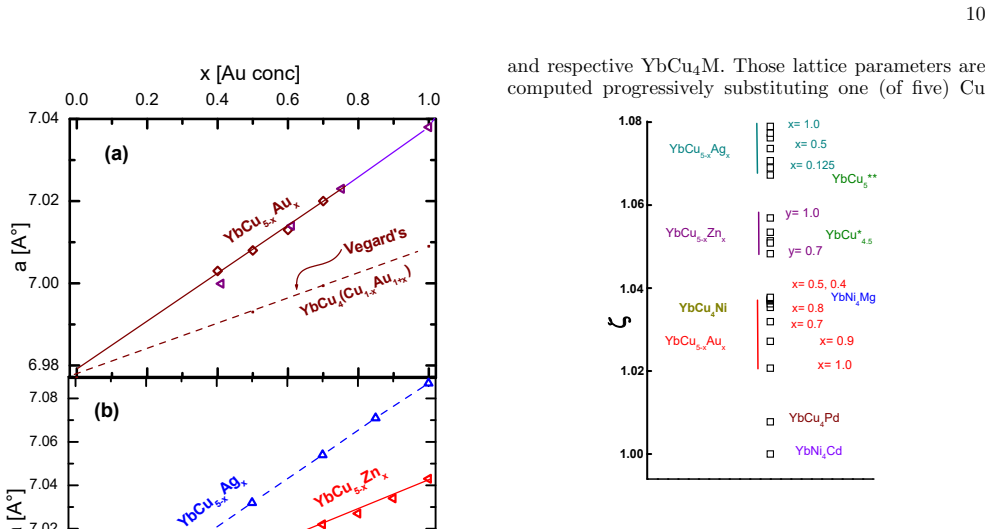
J. He, G. Ling, Z. Jia,Magnetic and transport properties of cubic AuBe5-type YbCu 5−x Gax system, Physica B: Condensed Matter301(2001) 196-202. 10 6.98 7.00 7.02 7.04 0.0 0.2 0.4 0.6 0.8 1.0 0.0 0.2 0.4 0.6 0.8 1.0 6.98 7.00 7.02 7.04 7.06 7.08 YbCu4(Cu1-xAu1+x )Vegard's (a) x [Au conc] a [A°] YbCu5-x Aux YbCu4(Cu1-xAg1+x ) x [ Zn, Ag conc.] (b) YbCu5-xAg...
2001
-
[69]
alloys. .... SUPPLEMENTARY MATERIAL A. Sturcture, lattice prameters, Vegard’s law Respective lattice parameters of the studied com- pounds are: a(YbCu 4Ni)=6.943 ˚A [12], a(YbCu 4Pd) = 7.039 ˚A, [19], a(YbCu 4Au) =7.046 ˚A[14, 25], a(YbCu4Zn) = 7.0399 ˚A [52], a(YbNi 4Mg) = 7.032 ˚A[16], a(YbNi 4Cd) =6.975 ˚A[18], a(YbCu 4Ag) =7.0828 ˚A[54] and a(cubic Yb...
discussion (0)
Sign in with ORCID, Apple, or X to comment. Anyone can read and Pith papers without signing in.