Mazur's knot and the Octahedron
Pith reviewed 2026-06-27 01:36 UTC · model grok-4.3
The pith
Mazur and Jester manifold boundaries are pairwise nonhomeomorphic regardless of orientation.
A machine-rendered reading of the paper's core claim, the machinery that carries it, and where it could break.
Core claim
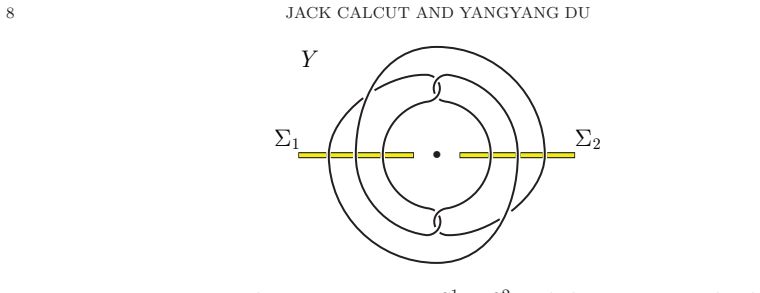
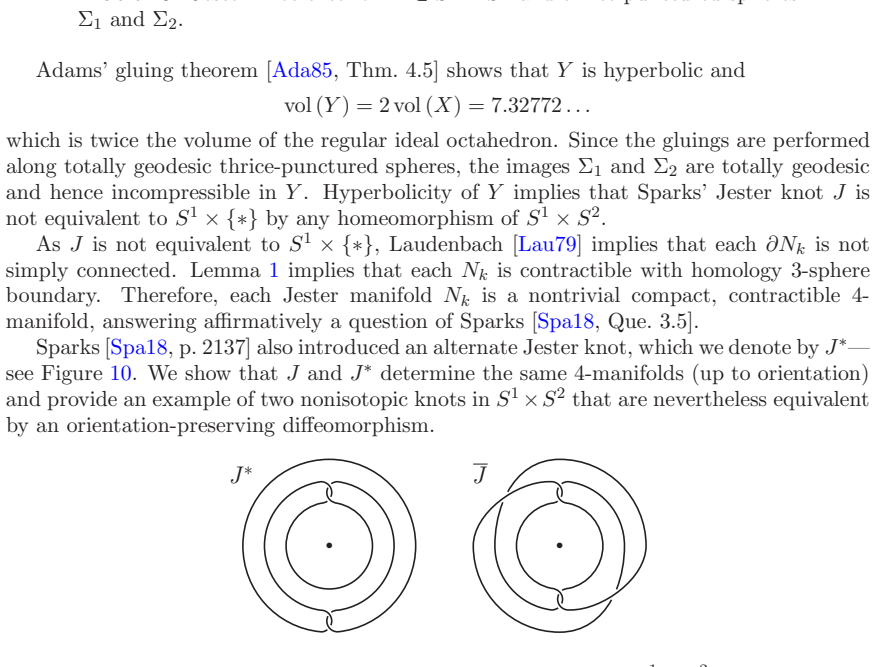
Mazur's knot exterior in S1×S2 admits a geometric description using a single regular ideal octahedron. The resulting hyperbolic structure is closely related to the Whitehead link exterior through Adams' theorem on thrice-punctured spheres. The same octahedral framework applies to the family of Jester manifolds introduced by Sparks. Using hyperbolic geometry, hyperbolic Dehn filling, and recent results on systolic geodesics, the boundaries of all Mazur and Jester manifolds are pairwise nonhomeomorphic, regardless of orientation. Consequently, the corresponding compact, contractible 4-manifolds are pairwise nonhomeomorphic.
What carries the argument
The regular ideal octahedral hyperbolic structure on the knot exteriors, which permits application of hyperbolic Dehn filling and systolic geodesic comparisons to distinguish the boundary surfaces.
If this is right
- The compact contractible 4-manifolds bounded by these surfaces are pairwise nonhomeomorphic.
- The distinction holds after reversing orientation on any boundary.
- Hyperbolic invariants of the boundaries (systolic geodesics after filling) separate every pair in the infinite family.
- The octahedral model supplies a uniform geometric reason that no two members of the family can bound homeomorphic 4-manifolds.
Where Pith is reading between the lines
- The method could be tested on other knot exteriors in S1×S2 to see whether similar octahedral structures exist and produce further families of distinct contractible 4-manifolds.
- If the octahedral description generalizes, it would give a practical way to decide homeomorphism questions for additional classes of contractible 4-manifolds whose boundaries arise from Dehn fillings.
- The pairwise distinction implies that the set of Mazur-type and Jester-type contractible 4-manifolds is infinite and fully separated by boundary topology.
Load-bearing premise
The knot exteriors admit the claimed regular ideal octahedral hyperbolic structures, and the cited results on systolic geodesics and hyperbolic Dehn filling suffice to distinguish the resulting boundary surfaces.
What would settle it
An explicit homeomorphism (or an isometry after hyperbolic Dehn filling) between the boundaries of any two distinct Mazur or Jester manifolds, or a direct computation showing two such boundaries share identical systolic geodesic lengths.
Figures
read the original abstract
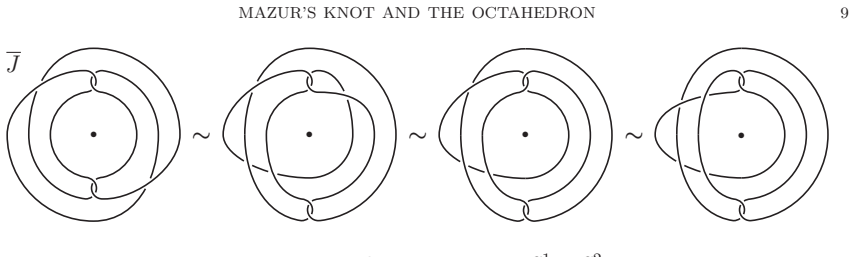
Mazur's knot exterior in $S^1\times S^2$ admits a geometric description using a single regular ideal octahedron. The resulting hyperbolic structure is closely related to the Whitehead link exterior through Adams' theorem on thrice-punctured spheres. The same octahedral framework applies to the family of Jester manifolds introduced by Sparks. Using hyperbolic geometry, hyperbolic Dehn filling, and recent results on systolic geodesics, we prove that the boundaries of all Mazur and Jester manifolds are pairwise nonhomeomorphic, regardless of orientation. Consequently, the corresponding compact, contractible $4$-manifolds are pairwise nonhomeomorphic.
Editorial analysis
A structured set of objections, weighed in public.
Referee Report
Summary. The manuscript claims that Mazur's knot exterior in S¹×S² admits a hyperbolic structure decomposed into a single regular ideal octahedron, related to the Whitehead link exterior via Adams' theorem on thrice-punctured spheres. The same octahedral framework is applied to the family of Jester manifolds. Using hyperbolic geometry, Dehn filling, and systolic geodesic invariants, the paper proves that the boundaries of all Mazur and Jester manifolds are pairwise nonhomeomorphic (including under orientation reversal), implying the associated compact contractible 4-manifolds are pairwise nonhomeomorphic.
Significance. If the central claim holds, the work supplies a uniform geometric method to distinguish these contractible 4-manifolds via their boundary 3-manifolds, extending known techniques from hyperbolic knot theory and systolic geometry. The approach builds directly on Adams' theorem and recent systolic results without introducing new ad-hoc parameters, which strengthens its applicability to classification questions in 4-manifold topology.
minor comments (3)
- The abstract and introduction should explicitly cite the specific recent papers on systolic geodesics invoked in the proof method (currently referred to only as 'recent results').
- Section 2 (or wherever the octahedral decomposition is constructed) would benefit from a diagram or explicit coordinate description of the regular ideal octahedron to make the relation to the Whitehead link via Adams' theorem easier to follow.
- The statement that the structures are 'closely related' to the Whitehead link should be quantified by stating the precise Dehn filling parameters or cusp identifications used.
Simulated Author's Rebuttal
We thank the referee for the positive summary and recommendation of minor revision. The report contains no enumerated major comments, so we have no specific points to address point-by-point. We note that the significance assessment aligns with the manuscript's goals.
Circularity Check
No significant circularity
full rationale
The derivation proceeds by assigning regular ideal octahedral hyperbolic structures to the knot exteriors (via Adams' thrice-punctured sphere theorem relating them to the Whitehead link), then applying hyperbolic Dehn filling and external systolic geodesic invariants to separate the resulting boundary 3-manifolds. All load-bearing distinctions rest on cited external results rather than any self-definition, fitted parameter renamed as prediction, or self-citation chain internal to the paper. The argument is therefore self-contained against independent mathematical benchmarks.
Axiom & Free-Parameter Ledger
axioms (1)
- standard math Adams' theorem on thrice-punctured spheres and recent results on systolic geodesics hold and apply to the manifolds in question.
Reference graph
Works this paper leans on
-
[1]
and Park, JungHwan and Ray, Arunima , title =
Aceto, Paolo and Bregman, Corey and Davis, Christopher W. and Park, JungHwan and Ray, Arunima , title =. arXiv preprint arXiv:2007.05796 , year =
Pith/arXiv arXiv 2007
-
[2]
Adams, Colin C. , TITLE =. Trans. Amer. Math. Soc. , FJOURNAL =. 1985 , NUMBER =. doi:10.2307/1999666 , URL =
-
[3]
Agol, Ian , TITLE =. Proc. Amer. Math. Soc. , FJOURNAL =. 2010 , NUMBER =. doi:10.1090/S0002-9939-10-10364-5 , URL =
-
[4]
Akbulut, Selman , TITLE =. Math. Proc. Cambridge Philos. Soc. , FJOURNAL =. 1977 , NUMBER =. doi:10.1017/S0305004100053718 , URL =
-
[5]
Akbulut, Selman , TITLE =. 2016 , PAGES =. doi:10.1093/acprof:oso/9780198784869.001.0001 , URL =
work page doi:10.1093/acprof:oso/9780198784869.001.0001 2016
-
[6]
Akbulut, Selman and Karakurt, Ca gri , TITLE =. Proc. Amer. Math. Soc. , FJOURNAL =. 2014 , NUMBER =. doi:10.1090/S0002-9939-2014-12149-6 , URL =
-
[7]
Michigan Math
Akbulut, Selman and Kirby, Robion , TITLE =. Michigan Math. J. , FJOURNAL =. 1979 , NUMBER =
1979
-
[8]
and Guilbault, Craig R
Ancel, Fredric D. and Guilbault, Craig R. , TITLE =. Pacific J. Math. , FJOURNAL =. 1995 , NUMBER =
1995
-
[9]
Ancel and Pete Sparks , title =
Fredric D. Ancel and Pete Sparks , title =. arXiv preprint arXiv:1803.00644 , year =
-
[10]
Dunfield, Nathan M. , TITLE =. Characters in low-dimensional topology , SERIES =. [2020] 2020 , ISBN =. doi:10.1090/conm/760/15289 , URL =
-
[11]
2012 , PAGES =
Farb, Benson and Margalit, Dan , TITLE =. 2012 , PAGES =
2012
-
[12]
and Schleimer, Saul , title =
Futer, David and Purcell, Jessica S. and Schleimer, Saul , title =. Journal of Computational Geometry , year =
-
[13]
Gabai, David , TITLE =. J. Topol. , FJOURNAL =. 2011 , NUMBER =. doi:10.1112/jtopol/jtr010 , URL =
-
[14]
Gompf, Robert E. and Stipsicz, Andr\'as I. , TITLE =. 1999 , PAGES =. doi:10.1090/gsm/020 , URL =
-
[15]
Hodgson, Craig D. and Kerckhoff, Steven P. , TITLE =. Ann. of Math. (2) , FJOURNAL =. 2005 , NUMBER =. doi:10.4007/annals.2005.162.367 , URL =
-
[16]
Hoste, Jim and Przytycki, J\'ozef H. , TITLE =. Math. Z. , FJOURNAL =. 1995 , NUMBER =. doi:10.1007/BF02572603 , URL =
-
[17]
, TITLE =
Laudenbach, F. , TITLE =. Compositio Math. , FJOURNAL =. 1979 , NUMBER =
1979
-
[18]
Matveev, Sergei and Polyak, Michael , TITLE =. J. Knot Theory Ramifications , FJOURNAL =. 2009 , NUMBER =. doi:10.1142/S021821650900721X , URL =
-
[19]
Mazur, Barry , TITLE =. Ann. of Math. (2) , FJOURNAL =. 1961 , PAGES =. doi:10.2307/1970288 , URL =
-
[20]
Neumann, Walter D. and Zagier, Don , TITLE =. Topology , FJOURNAL =. 1985 , NUMBER =. doi:10.1016/0040-9383(85)90004-7 , URL =
-
[21]
Newman, M. H. A. , TITLE =. Proc. Nat. Acad. Sci. U.S.A. , FJOURNAL =. 1948 , PAGES =. doi:10.1073/pnas.34.5.193 , URL =
-
[22]
Poenaru, Valentin , TITLE =. Bull. Soc. Math. France , FJOURNAL =. 1960 , PAGES =
1960
-
[23]
Ratcliffe, John G. , TITLE =. [2019] 2019 , PAGES =. doi:10.1007/978-3-030-31597-9 , URL =
-
[24]
Topology of low-dimensional manifolds (
Riley, Robert , TITLE =. Topology of low-dimensional manifolds (. 1979 , ISBN =
1979
-
[25]
Riley, Robert , TITLE =. Expo. Math. , FJOURNAL =. 2013 , NUMBER =. doi:10.1016/j.exmath.2013.01.003 , URL =
-
[26]
1990 , PAGES =
Rolfsen, Dale , TITLE =. 1990 , PAGES =
1990
-
[27]
Saveliev, Nikolai , TITLE =. Math. Res. Lett. , FJOURNAL =. 2003 , NUMBER =. doi:10.4310/MRL.2003.v10.n6.a5 , URL =
-
[28]
Sparks, Peter , TITLE =. Algebr. Geom. Topol. , FJOURNAL =. 2018 , NUMBER =. doi:10.2140/agt.2018.18.2131 , URL =
-
[29]
Thurston , title =
William P. Thurston , title =. 1980 , howpublished =
1980
-
[30]
Thurston, William P. , TITLE =. Bull. Amer. Math. Soc. (N.S.) , FJOURNAL =. 1982 , NUMBER =. doi:10.1090/S0273-0979-1982-15003-0 , URL =
-
[31]
, TITLE =
Thurston, William P. , TITLE =. 1997 , PAGES =
1997
-
[32]
Wielenberg, Norbert , TITLE =. Math. Proc. Cambridge Philos. Soc. , FJOURNAL =. 1978 , NUMBER =. doi:10.1017/S0305004100055250 , URL =
-
[33]
J. H. C. Whitehead , title =. The Quarterly Journal of Mathematics , volume =. 1935 , doi =
1935
-
[34]
Zeeman, E. C. , TITLE =. Ann. of Math. (2) , FJOURNAL =. 1962 , PAGES =. doi:10.2307/1970274 , URL =
-
[35]
Zeeman, E. C. , TITLE =. Topology , FJOURNAL =. 1964 , PAGES =. doi:10.1016/0040-9383(63)90014-4 , URL =
discussion (0)
Sign in with ORCID, Apple, or X to comment. Anyone can read and Pith papers without signing in.