AdaPT: Adaptive Lesson Plan Transformer for Cross-Regional and Differentiated Instruction
Pith reviewed 2026-06-26 22:58 UTC · model grok-4.3
The pith
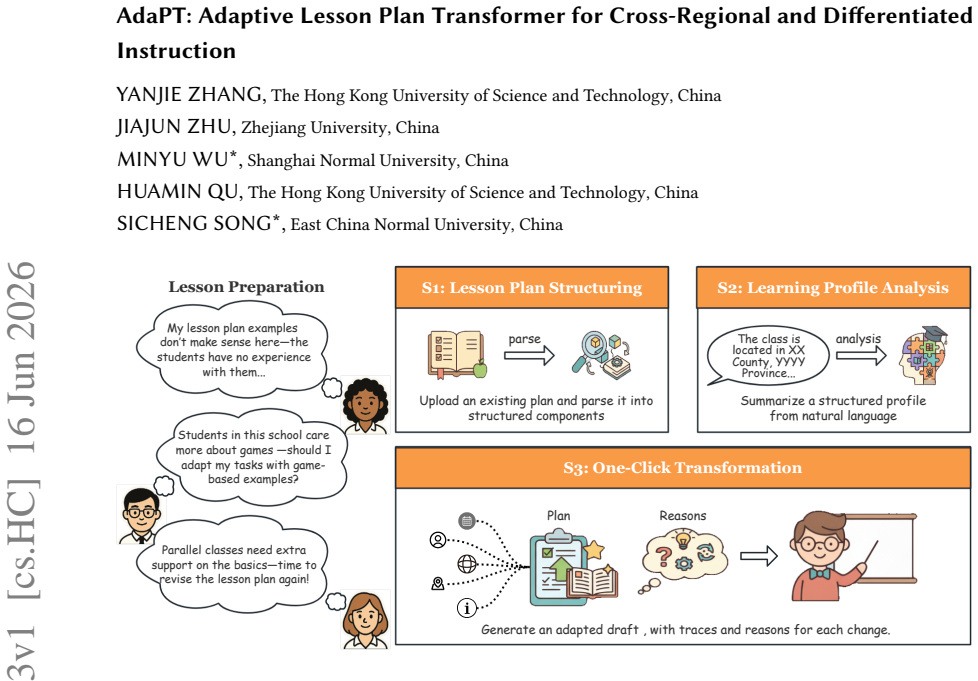
AdaPT adapts existing lesson plans with LLMs to match new regions and student profiles instead of generating content from scratch.
A machine-rendered reading of the paper's core claim, the machinery that carries it, and where it could break.
Core claim
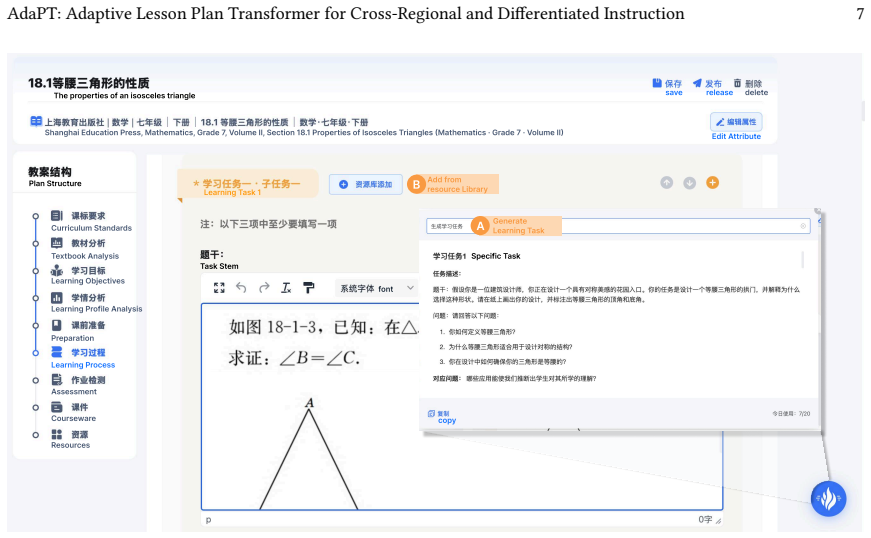
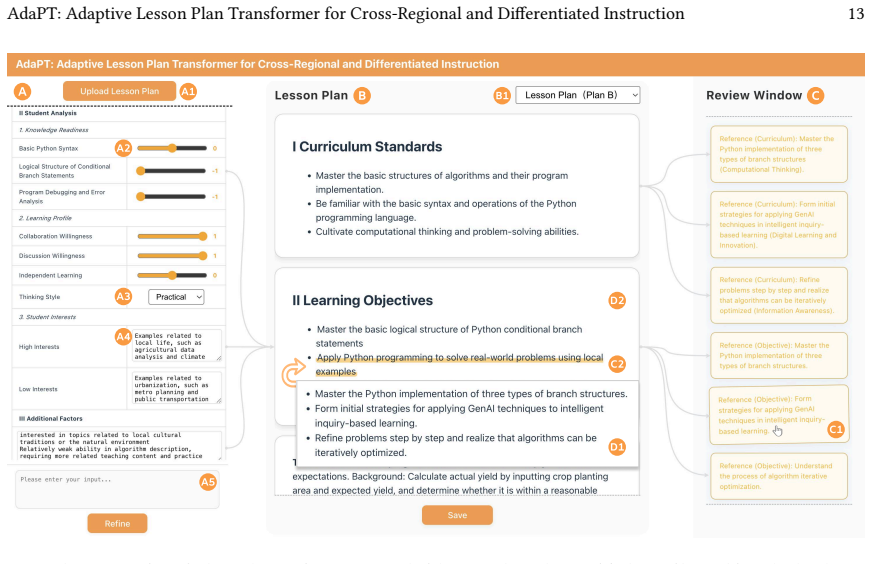
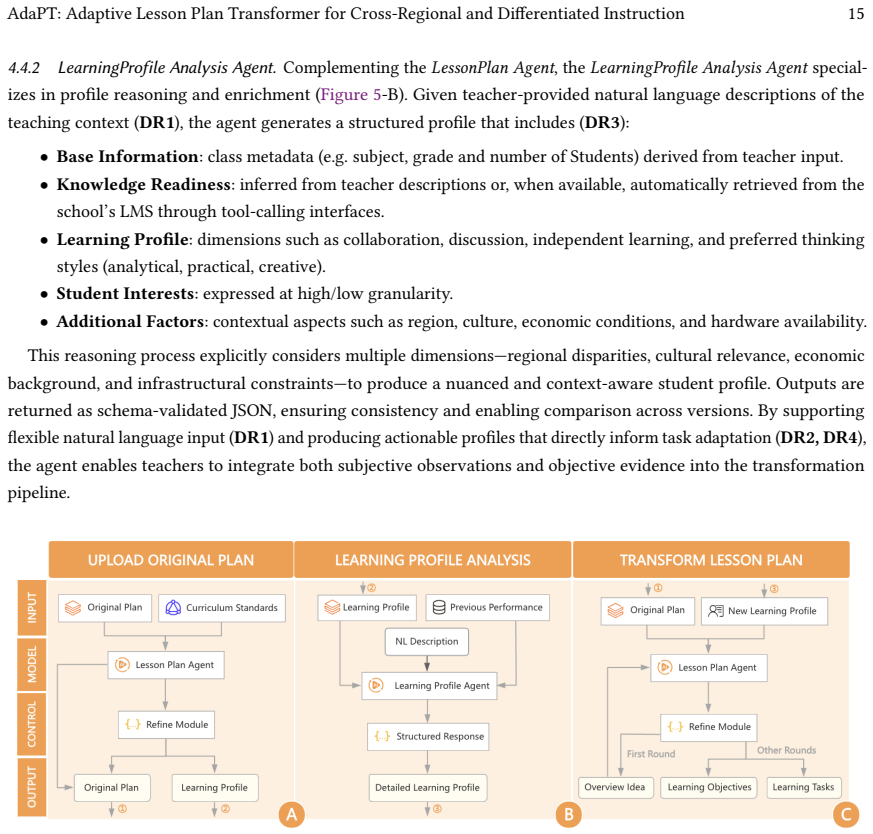
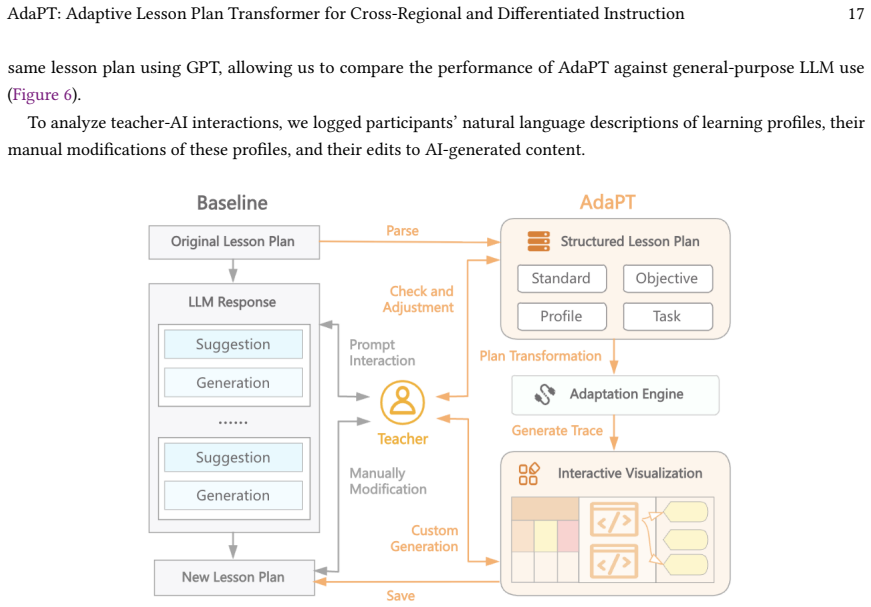
AdaPT is an interactive LLM-based system that transforms existing lesson plans for cross-regional and differentiated instruction by accepting student profiles as input, maintaining a structured lesson representation, generating explanations for transformations, performing automatic content adaptation, and enabling teacher-in-the-loop iterative refinement.
What carries the argument
AdaPT's interactive interface with LLM-driven transformation of structured lesson plans, including profile input, change explanations, automatic adaptation, and iterative refinement.
If this is right
- Teachers gain a way to reuse high-quality plans across regions without full recreation.
- Input of student profiles enables automatic adjustments for differentiated instruction.
- Explanations of transformations help teachers understand and trust the changes.
- Iterative refinement keeps teachers in control of final lesson quality.
- The approach reduces workload compared with generating new plans from scratch.
Where Pith is reading between the lines
- Wider deployment could shift teacher time from content creation toward in-class customization and student interaction.
- If adaptations prove consistent, the method might extend to other structured educational materials such as worksheets or assessments.
- Integration with existing school databases could allow profile data to drive adaptations at scale.
- Long-term classroom outcome data would be needed to confirm whether adapted plans improve equity in student learning results.
Load-bearing premise
The small sample of nine teachers and three experts represents typical teacher needs and the LLM adaptations remain educationally accurate without errors or biases.
What would settle it
A larger trial in which teachers report that AdaPT-adapted plans contain curriculum mismatches or require more revision time than manual adaptation would indicate the system does not support workflows as claimed.
Figures
read the original abstract
Due to educational inequality, high-quality lesson plans often mismatch the needs of disparate educational contexts. Teachers typically modify existing lesson plans to fit new contexts, but current tools instead focus on generating content from scratch, creating additional workload. Moreover, a critical gap remains in supporting teachers to quickly adapt to new learning profiles. To bridge these gaps, we present AdaPT, a system leverages LLMs to support transformation of existing lesson plans for cross-regional and differentiated instruction. AdaPT features an interactive interface that allows teachers to input student profiles, offers structured lesson representation, provides explanations for lesson-plan transformations, automatically adapts lesson content for new contexts, and supports iterative, teacher-in-the-loop refinement. We evaluated AdaPT through a user study with 9 teachers and an expert evaluation with 3 specialists. Results show that AdaPT supports workflows of teachers and offers a promising pathway toward promoting educational equity.
Editorial analysis
A structured set of objections, weighed in public.
Referee Report
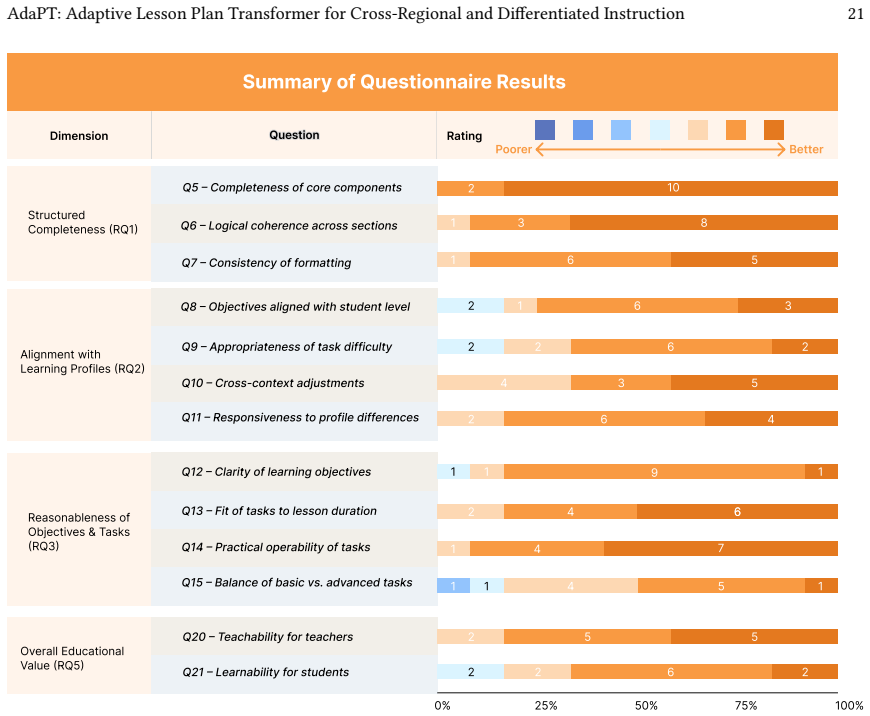
Summary. The paper presents AdaPT, an LLM-based system for transforming existing lesson plans to support cross-regional and differentiated instruction. Key features include an interactive interface for student profile input, structured lesson representations, explanations of transformations, automatic content adaptation, and iterative teacher-in-the-loop refinement. Evaluation consists of a user study with 9 teachers and an expert evaluation with 3 specialists; results are reported as showing that AdaPT supports teacher workflows and offers a promising pathway toward educational equity.
Significance. If the evaluation evidence were strengthened, the work would address a meaningful gap in educational HCI by prioritizing adaptation of existing plans over de novo generation, potentially lowering teacher workload while supporting context-specific and differentiated instruction. The teacher-in-the-loop design and emphasis on explanations are constructive elements for real-world deployment.
major comments (2)
- [Evaluation section (user study and expert evaluation)] Evaluation section (user study and expert evaluation): The reported results consist solely of subjective feedback from N=9 teachers and N=3 specialists. No quantitative metrics (e.g., adaptation correctness rates, inter-rater reliability, bias/error rates, or comparison to expert baselines), study design details, controls, or verification that LLM transformations are educationally accurate and free of biases are provided. This directly undermines the central claim that the system supports workflows and promotes equity, as the accuracy and soundness assumptions remain untested.
- [Abstract and Results summary] Abstract and Results summary: The headline assertion that AdaPT 'offers a promising pathway toward promoting educational equity' rests on the unverified assumption that adaptations are context-appropriate and error-free across regions. Without reported evidence on these points (e.g., correctness or bias assessments), generalization beyond the small sample is unsupported.
minor comments (1)
- [Abstract] Abstract contains a grammatical error: 'a system leverages LLMs' should read 'a system that leverages LLMs'.
Simulated Author's Rebuttal
We thank the referee for the constructive comments, which highlight important limitations in our evaluation. We address each major comment below and will make revisions to strengthen the manuscript.
read point-by-point responses
-
Referee: Evaluation section (user study and expert evaluation): The reported results consist solely of subjective feedback from N=9 teachers and N=3 specialists. No quantitative metrics (e.g., adaptation correctness rates, inter-rater reliability, bias/error rates, or comparison to expert baselines), study design details, controls, or verification that LLM transformations are educationally accurate and free of biases are provided. This directly undermines the central claim that the system supports workflows and promotes equity, as the accuracy and soundness assumptions remain untested.
Authors: We agree that the evaluation relies on qualitative feedback from a small sample and lacks quantitative metrics on correctness, reliability, or bias. The study was designed as an initial exploration of workflow support via semi-structured interviews and observations, not as a validation of LLM output accuracy (which would require expert-rated comparisons or controlled experiments). We will revise the Evaluation section to add details on recruitment, session structure, interview protocol, and analysis method. We will also insert a Limitations section explicitly noting the small N, subjective measures, absence of quantitative validation or bias checks, and the preliminary nature of equity-related claims. The workflow-support findings are grounded in participant reports, but we will moderate language to avoid implying untested accuracy. revision: yes
-
Referee: Abstract and Results summary: The headline assertion that AdaPT 'offers a promising pathway toward promoting educational equity' rests on the unverified assumption that adaptations are context-appropriate and error-free across regions. Without reported evidence on these points (e.g., correctness or bias assessments), generalization beyond the small sample is unsupported.
Authors: We agree that the abstract overstates the equity implications without supporting evidence on adaptation accuracy or bias. We will revise the abstract to remove the equity claim and focus on the demonstrated workflow support. Corresponding changes will be made in the Results and Discussion sections, with the new Limitations section providing context for readers. revision: yes
Circularity Check
No circularity: empirical system description with user study only
full rationale
The paper describes a system (AdaPT) for adapting lesson plans using LLMs and evaluates it via a small user study (9 teachers) and expert review (3 specialists). No equations, parameters, predictions, or derivations are present in the abstract or described content. Claims rest on subjective feedback rather than any self-referential mathematical chain or fitted-input prediction. No self-citation load-bearing steps or ansatz smuggling occur. This is a standard non-circular empirical HCI/systems paper; the small N and lack of quantitative metrics are validity concerns but not circularity.
Axiom & Free-Parameter Ledger
Reference graph
Works this paper leans on
-
[1]
d.].A Breakthrough in a Mountainous County: Netease ‘One-Screen’ Changes Their Fate
[n. d.].A Breakthrough in a Mountainous County: Netease ‘One-Screen’ Changes Their Fate. https://www.digitaling.com/projects/224727.html
-
[2]
d.].Smart Education Platform for Primary and Secondary Schools in China
[n. d.].Smart Education Platform for Primary and Secondary Schools in China. https://basic.smartedu.cn/
-
[3]
Mel Ainscow. 2020. Promoting inclusion and equity in education: lessons from international experiences.Nordic journal of studies in educational policy6, 1 (2020), 7–16
2020
-
[4]
2018.Creativity in context: Update to the social psychology of creativity
Teresa M Amabile. 2018.Creativity in context: Update to the social psychology of creativity. Routledge
2018
-
[5]
Neil Anderson. 2015. Digital technologies and equity: gender, digital divide and rurality.Teaching and digital technologies: Big issues and critical questions46 (2015)
2015
-
[6]
Alages Andre. 2011. The iLessonPlan: A lesson planning tool for the 21st century.ASCILITE Publications(2011), 93–105
2011
-
[7]
Jan Philip Bernius, Stephan Krusche, and Bernd Bruegge. 2022. Machine learning based feedback on textual student answers in large courses. Computers and Education: Artificial Intelligence3 (2022), 100081
2022
-
[8]
Nathan Burroughs, Jacqueline Gardner, Youngjun Lee, Siwen Guo, Israel Touitou, Kimberly Jansen, and William Schmidt. 2019. Teacher effectiveness and educational equity. InTeaching for excellence and equity: Analyzing teacher characteristics, behaviors and student outcomes with TIMSS. Springer, 101–136
2019
-
[9]
Brendan Calandra, Laurie Brantley-Dias, and Kezia McNeal. 2007. An electronic system to support novice teachers’ reflective lesson design. Multicultural Education & Technology Journal1, 2 (2007), 100–111
2007
-
[10]
Hung Chau, Jordan Barria-Pineda, and Peter Brusilovsky. 2017. Content wizard: concept-based recommender system for instructors of programming courses. InAdjunct Publication of the 25th Conference on User Modeling, Adaptation and Personalization. 135–140. Manuscript submitted to ACM 24 Trovato et al
2017
-
[11]
Chang Chen, Sicheng Song, Shuchang Xu, Zhicheng Li, Huamin Qu, and Yanna Lin. 2025. RhythmTA: A Visual-Aided Interactive System for ESL Rhythm Training via Dubbing Practice. InProceedings of the 38th Annual ACM Symposium on User Interface Software and Technology (UIST ’25). Association for Computing Machinery, New York, NY, USA, Article 206, 15 pages. doi...
-
[12]
Zixin Chen, Yuhang Zeng, Sicheng Song, Yanna Lin, Xian Xu, Huamin Qu, and Meng Xia. 2026. VizQStudio: Iterative Visualization Literacy MCQs Design with Simulated Students.IEEE Transactions on Visualization and Computer Graphics(2026), 1–18. doi:10.1109/TVCG.2026.3695959
-
[13]
Lay Kee Chng. 2023. How AI makes its mark on instructional design.Asian Journal of Distance Education18, 2 (2023), 32–41
2023
-
[14]
Rebecca J Collie and Andrew J Martin. 2025. Teachers’ early uptake of GenAI in teaching and learning: Important questions and answers.Social Psychology of Education28, 1 (2025), 1–14
2025
-
[15]
1997.Talented teenagers: The roots of success and failure
Mihaly Csikszentmihalyi, Kevin Rathunde, and Samuel Whalen. 1997.Talented teenagers: The roots of success and failure. Cambridge University Press
1997
-
[16]
Haoxiang Fan, Guanzheng Chen, Xingbo Wang, and Zhenhui Peng. 2024. LessonPlanner: Assisting novice teachers to prepare pedagogy-driven lesson plans with large language models. InProceedings of the 37th Annual ACM Symposium on User Interface Software and Technology. 1–20
2024
-
[17]
Alvis Fong, Ajay Gupta, Steve Carr, Shameek Bhattacharjee, and Michael Harnar. 2022. Modular experiential learning for secure, safe, and reliable AI: Curricular Initiative to Promote Education in Trustworthy AI. InProceedings of the 23rd Annual Conference on Information Technology Education. 9–15
2022
-
[18]
Dan Goldhaber, Lesley Lavery, and Roddy Theobald. 2015. Uneven playing field? Assessing the teacher quality gap between advantaged and disadvantaged students.Educational researcher44, 5 (2015), 293–307
2015
-
[19]
Shriyam Gupta, Chengfang Liu, Shaoping Li, Fang Chang, and Yaojiang Shi. 2023. Association between ability tracking and student’s academic and non-academic outcomes: Empirical evidence from junior high schools in rural China.International Journal of Educational Development103 (2023), 102927
2023
-
[20]
2007.Education and reform in China
Emily Hannum and Albert Park. 2007.Education and reform in China. Routledge London
2007
-
[21]
Don’t Forget the Teachers
Emma Harvey, Allison Koenecke, and Rene F Kizilcec. 2025. " Don’t Forget the Teachers": Towards an Educator-Centered Understanding of Harms from Large Language Models in Education. InProceedings of the 2025 CHI Conference on Human Factors in Computing Systems. 1–19
2025
-
[22]
Matthew J Irvin, Soo-yong Byun, Judith L Meece, Thomas W Farmer, and Bryan C Hutchins. 2012. Educational barriers of rural youth: Relation of individual and contextual difference variables.Journal of career assessment20, 1 (2012), 71–87
2012
-
[23]
Sharifullah Khan, Gwo-Jen Hwang, Muhammad Azeem Abbas, and Arshia Rehman. 2019. Mitigating the urban–rural educational gap in developing countries through mobile technology-supported learning.British Journal of Educational Technology50, 2 (2019), 735–749
2019
-
[24]
C Kridel and DA Breault. 2012. Instructional Design.Encyclopedia of Curriculum Studies. https://doi. org/10.4135/9781412958806258 (2012)
-
[25]
Xiaoyan Kui, Naiming Liu, Qiang Liu, Jingwei Liu, Xiaoqian Zeng, and Chao Zhang. 2022. A survey of visual analytics techniques for online education.Visual Informatics6, 4 (2022), 67–77
2022
-
[26]
2023.The impact of computer-assisted instruction on student performance: Evidence from the dual-teacher program
Haizheng Li, Zhiqiang Liu, Fanzheng Yang, and Li Yu. 2023.The impact of computer-assisted instruction on student performance: Evidence from the dual-teacher program. Technical Report. IZA Discussion Papers
2023
-
[27]
Hongbin Li, Prashant Loyalka, Scott Rozelle, and Binzhen Wu. 2017. Human capital and China’s future growth.Journal of Economic Perspectives31, 1 (2017), 25–48
2017
-
[28]
Chaeyeon Lim. 2025. DeBiasMe: De-biasing Human-AI Interactions with Metacognitive AIED (AI in Education) Interventions.arXiv preprint arXiv:2504.16770(2025)
arXiv 2025
-
[29]
Jason Cong Lin. 2024. The quest for educational equity in schools in Mainland China & Hong Kong.Dædalus153, 4 (2024), 234–251
2024
-
[30]
Yanna Lin, Liwenhan Xie, Leixian Shen, Zhuochen Jin, Sicheng Song, Zikun Deng, Huamin Qu, and Ke Xu. 2026. CAMV: A Framework for Context-Aware Multi-View Visualization of Data Analysis Results.Data Science and Engineering(2026), 1–17
2026
-
[31]
Yi Long and Yumei Zhou. 2020. Educational Inputs and Intra-county Education Inequality in a Western Province of China. In2020 6th International Conference on Social Science and Higher Education (ICSSHE 2020). Atlantis Press, 73–77
2020
-
[32]
Xinyi Lu, Simin Fan, Jessica Houghton, Lu Wang, and Xu Wang. 2023. ReadingQuizMaker: a human-NLP collaborative system that supports instructors to design high-quality reading quiz questions. InProceedings of the 2023 CHI Conference on Human Factors in Computing Systems. 1–18
2023
-
[33]
Di Mo, Weiming Huang, Yaojiang Shi, Linxiu Zhang, Matthew Boswell, and Scott Rozelle. 2015. Computer technology in education: Evidence from a pooled study of computer assisted learning programs among rural students in China.China economic review36 (2015), 131–145
2015
-
[34]
Reza Hadi Mogavi, Chao Deng, Justin Juho Kim, Pengyuan Zhou, Young D Kwon, Ahmed Hosny Saleh Metwally, Ahmed Tlili, Simone Bassanelli, Antonio Bucchiarone, Sujit Gujar, et al. 2023. Exploring user perspectives on chatgpt: Applications, perceptions, and implications for ai-integrated education.arXiv preprint arXiv:2305.13114(2023)
arXiv 2023
-
[35]
Hanna-Liisa Pender, Lennart Bohl, Marius Schönberger, and Julia Knopf. 2022. An AI-based lesson planning software to support competence-based learning. In8th International Conference on Higher Education Advances (HEAd’22). Editorial Universitat Politècnica de València, 1033–1041
2022
-
[36]
Prajish Prasad, Rishabh Balse, and Dhwani Balchandani. 2025. Exploring Multimodal Generative AI for Education through Co-design Workshops with Students. InProceedings of the 2025 CHI Conference on Human Factors in Computing Systems. 1–17
2025
-
[37]
Koen Salemink, Dirk Strijker, and Gary Bosworth. 2017. Rural development in the digital age: A systematic literature review on unequal ICT availability, adoption, and use in rural areas.Journal of rural studies54 (2017), 360–371
2017
-
[38]
Zekai Shao, Siyu Yuan, Lin Gao, Yixuan He, Deqing Yang, and Siming Chen. 2025. Unlocking Scientific Concepts: How Effective Are LLM-Generated Analogies for Student Understanding and Classroom Practice?. InProceedings of the 2025 CHI Conference on Human Factors in Computing Systems. Manuscript submitted to ACM AdaPT: Adaptive Lesson Plan Transformer for Cr...
2025
-
[39]
Sicheng Song, Juntong Chen, Chenhui Li, and Changbo Wang. 2023. GVQA: Learning to Answer Questions about Graphs with Visualizations via Knowledge Base. InProceedings of the 2023 CHI Conference on Human Factors in Computing Systems(Hamburg, Germany)(CHI ’23). Association for Computing Machinery, New York, NY, USA, Article 464, 16 pages. doi:10.1145/3544548.3581067
-
[40]
Sicheng Song, Chenhui Li, Yujing Sun, and Changbo Wang. 2023. VividGraph: Learning to Extract and Redesign Network Graphs From Visualization Images.IEEE Transactions on Visualization and Computer Graphics29, 7 (2023), 3169–3181. doi:10.1109/TVCG.2022.3153514
-
[41]
Sicheng Song, Yipeng Zhang, Yanna Lin, Huamin Qu, Changbo Wang, and Chenhui Li. 2024. GVVST: Image-driven style extraction from graph visualizations for visual style transfer.IEEE Transactions on Visualization and Computer Graphics31, 9 (2024), 5975–5989
2024
-
[42]
Sven Strickroth. 2019. PLATON: Developing a graphical lesson planning system for prospective teachers.Education Sciences9, 4 (2019), 254
2019
-
[43]
Yuling Sun, Jiaju Chen, Xiaomu Zhou, Xiaojuan Ma, Bingsheng Yao, Kai Zhang, Liang He, and Dakuo Wang. 2025. Live-Streaming-Based Dual-Teacher Classes for Equitable Education: Insights and Challenges From Local Teachers’ Perspective in Disadvantaged Areas. InProceedings of the 2025 CHI Conference on Human Factors in Computing Systems. 1–18
2025
-
[44]
Carol Ann Tomlinson, Catherine Brighton, Holly Hertberg, Carolyn M Callahan, Tonya R Moon, Kay Brimijoin, Lynda A Conover, and Timothy Reynolds. 2003. Differentiating instruction in response to student readiness, interest, and learning profile in academically diverse classrooms: A review of literature.Journal for the Education of the Gifted27, 2-3 (2003), 119–145
2003
-
[45]
Mun C Tsang and Yanqing Ding. 2005. Resource utilization and disparities in compulsory education in China.China Review(2005), 1–31
2005
-
[46]
Anastasia Tzirides, Michele Galla, Bill Cope, and Mary Kalantzis. 2025. Thinking Through AI: Advancing Cognitive and Collaborative Research for AI in Education. (2025)
2025
-
[47]
1978.Mind in society: The development of higher psychological processes
Lev S Vygotsky. 1978.Mind in society: The development of higher psychological processes. Vol. 86. Harvard university press
1978
-
[48]
Lev S Vygotsky. 1986. Thought and language (A. Kozulin, trans.)
1986
-
[49]
Qiaosi Wang, Ida Camacho, Shan Jing, and Ashok K Goel. 2022. Understanding the design space of AI-mediated social interaction in online learning: challenges and opportunities.Proceedings of the ACM on Human-Computer Interaction6, CSCW1 (2022), 1–26
2022
-
[50]
Qiaosi Wang, Koustuv Saha, Eric Gregori, David Joyner, and Ashok Goel. 2021. Towards mutual theory of mind in human-ai interaction: How language reflects what students perceive about a virtual teaching assistant. InProceedings of the 2021 CHI conference on human factors in computing systems. 1–14
2021
-
[51]
Ruiwei Xiao, Xinying Hou, Runlong Ye, Majeed Kazemitabaar, Nicholas Diana, Michael Liut, and John Stamper. 2025. Improving Student-AI Interaction Through Pedagogical Prompting: An Example in Computer Science Education.arXiv preprint arXiv:2506.19107(2025)
arXiv 2025
-
[52]
Shishi Xiao, Liangwei Wang, Xiaojuan Ma, and Wei Zeng. 2024. TypeDance: Creating Semantic Typographic Logos from Image through Personalized Generation. InProceedings of the 2024 CHI Conference on Human Factors in Computing Systems(Honolulu, HI, USA)(CHI ’24). Association for Computing Machinery, New York, NY, USA, Article 175, 18 pages. doi:10.1145/361390...
-
[53]
Harrison Hao Yang, Sha Zhu, and Jason MacLeod. 2018. Promoting education equity in rural and underdeveloped areas: Cases on computer-supported collaborative teaching in China.Eurasia Journal of Mathematics, Science and Technology Education14, 6 (2018), 2393–2405
2018
-
[54]
Yuan Yang. 2017. A research on the difference of education returns between urban and rural areas.Open Journal of Social Sciences5, 4 (2017), 59–67
2017
-
[55]
Ismail Md Zain. 2017. The Collaborative Instructional Design System (CIDS): Visualizing the 21st Century Learning.Universal Journal of Educational Research5, 12 (2017), 2259–2266
2017
-
[56]
Le-Xuan Zhang and Bo-Wah Leung. 2023. Context matters: adaptation of student-centred education in China school music classrooms.Music Education Research25, 4 (2023), 418–434
2023
-
[57]
Xiaobo Zhang and Ravi Kanbur. 2009. Spatial inequality in education and health care in China. InRegional inequality in China. Routledge, 92–110
2009
-
[58]
Chengbo Zheng, Kangyu Yuan, Bingcan Guo, Reza Hadi Mogavi, Zhenhui Peng, Shuai Ma, and Xiaojuan Ma. 2024. Charting the future of AI in project-based learning: a Co-design exploration with students. InProceedings of the 2024 CHI Conference on Human Factors in Computing Systems. 1–19
2024
-
[59]
Qingxiao Zheng, Yiliu Tang, Yiren Liu, Weizi Liu, and Yun Huang. 2022. UX research on conversational human-AI interaction: A literature review of the ACM digital library. InProceedings of the 2022 CHI Conference on Human Factors in Computing Systems. 1–24. Received 20 February 2007; revised 12 March 2009; accepted 5 June 2009 Manuscript submitted to ACM
2022
discussion (0)
Sign in with ORCID, Apple, or X to comment. Anyone can read and Pith papers without signing in.