Principle of Entangled-Photon Thermometry for Ultrafast Laser Processing
Pith reviewed 2026-06-26 23:51 UTC · model grok-4.3
The pith
Entangled photon pairs enable remote tracking of rapid temperature changes during femtosecond laser ablation through polarization anisotropy.
A machine-rendered reading of the paper's core claim, the machinery that carries it, and where it could break.
Core claim
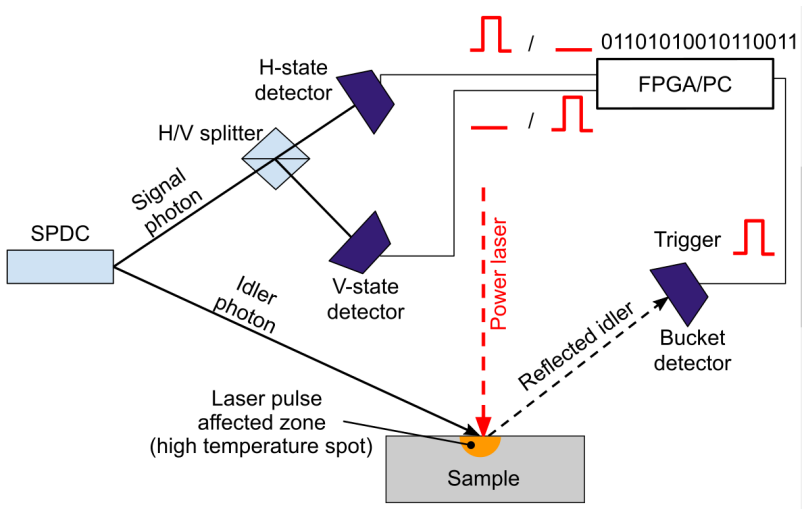
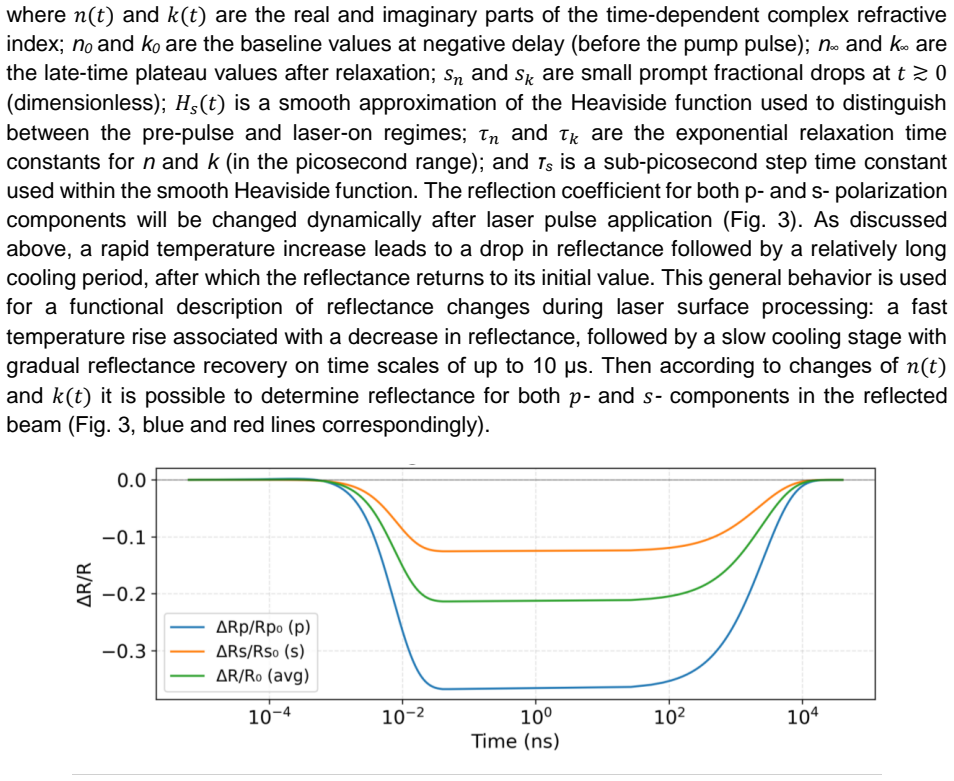
The method exploits polarization anisotropy in entangled photon pairs where the idler photon interacts with the laser-affected surface and temperature-dependent changes in complex refractive index modify p- and s-polarization reflectance, altering the coincidence-resolved polarization statistics of the signal photons. A Qiskit-based model with experimental pump-probe reflectometry data shows remote reconstruction of rapid thermal dynamics during femtosecond laser ablation. A multilayer perceptron regression network extracts implicit anisotropy information from the photon bitstream, outperforming classical sliding-window analysis by improving robustness, reducing temperature noise, enhancing
What carries the argument
entangled-photon polarization anisotropy combined with multilayer perceptron regression on photon bitstreams
If this is right
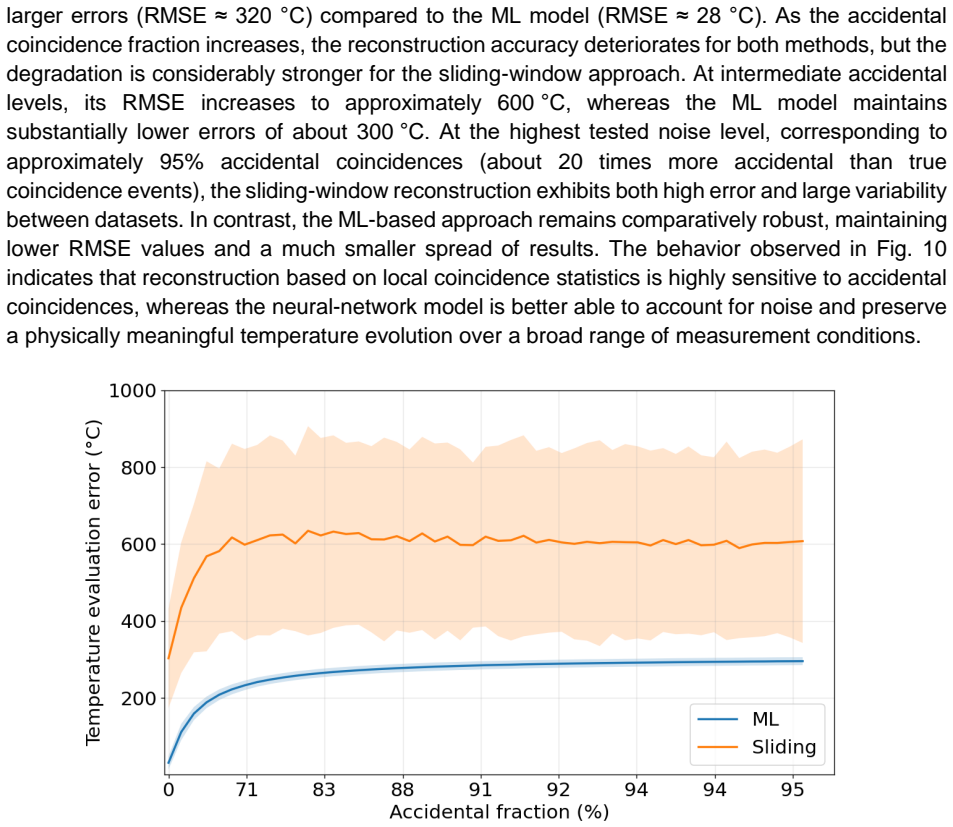
- The neural-network analysis reduces temperature noise and improves reconstruction robustness relative to classical sliding-window methods.
- Signal-to-noise ratio increases and nanosecond-scale tracking of thermal dynamics becomes feasible.
- The technique provides remote, background-rejected temperature diagnostics without requiring time-consuming pump-probe sequences for each measurement.
- The discrete single-photon nature is handled directly by the MLP rather than suffering shot noise in windowed analysis.
Where Pith is reading between the lines
- The same polarization-anisotropy readout might extend to monitoring other rapid surface changes such as phase transitions or stress in laser processing.
- Material-specific calibration of the MLP would likely be needed before deployment on new substrates.
- If the quantum advantage holds in lab experiments, it could reduce reliance on contact or emissive methods in high-speed laser machining diagnostics.
Load-bearing premise
The simulation model using literature data accurately captures the temperature-dependent changes in complex refractive index and polarization anisotropy that would occur in a real experiment.
What would settle it
Performing the entangled-photon coincidence measurement on an actual femtosecond-laser-ablated surface and comparing the MLP-reconstructed temperature trace against independent nanosecond thermometry would confirm or refute the reconstruction accuracy.
Figures
read the original abstract
A quantum-enhanced approach for fast temperature diagnostics in ultrashort laser surface processing is introduced. The goal is to overcome limitations of existing methods, such as plasma emission, emissivity changes during ablation, and the need for time-consuming pump-probe measurements. The proposed method exploits polarization anisotropy in entangled photon pairs. The idler photon interacts with the laser-affected material surface, while its entangled counterpart is detected in a remote optical arm. Temperature-dependent changes in the complex refractive index modify the reflectance of p- and s-polarizations on the idler path, altering the coincidence-resolved polarization statistics of the signal photons. Using a Qiskit-based model incorporating experimental pump-probe reflectometry data, remote reconstruction of rapid thermal dynamics during femtosecond laser ablation is demonstrated. Although based on simulation, the model employs literature data to represent realistic material behavior. Due to the discrete nature of single-photon events, classical sliding-window analysis suffers from shot noise and temporal inertia. To overcome this limitation, a multilayer perceptron (MLP) regression network is applied to extract implicit anisotropy information from the photon bitstream. Compared with the classical approach, the neural-network method improves reconstruction robustness, reduces temperature noise, enhances the signal-to-noise ratio (SNR), and enables nanosecond-scale tracking of thermal dynamics. The results indicate that entangled-photon polarization anisotropy combined with machine-learning analysis is a promising approach for remote, background-rejected, high-speed temperature diagnostics in laser-matter interaction studies.
Editorial analysis
A structured set of objections, weighed in public.
Referee Report
Summary. The paper introduces a quantum-enhanced thermometry technique for ultrafast laser processing that exploits polarization anisotropy in entangled photon pairs. The idler photon interacts with the laser-affected surface, modifying p/s reflectance via temperature-dependent complex refractive index changes drawn from literature pump-probe data; the resulting coincidence statistics are analyzed remotely. A Qiskit simulation combined with an MLP regression network is used to reconstruct nanosecond-scale thermal dynamics during femtosecond ablation, claiming improved robustness, lower temperature noise, and higher SNR relative to classical sliding-window analysis of photon bitstreams.
Significance. If the simulation fidelity holds, the method could provide remote, background-rejected temperature diagnostics that avoid emissivity uncertainties and time-consuming pump-probe scans. The use of external experimental reflectance data and a machine-learning extractor for discrete photon statistics is a concrete strength; however, the work remains a simulation demonstration rather than an experimental validation.
major comments (2)
- [Abstract] Abstract and model description: the reconstruction demonstration rests on the assumption that literature pump-probe reflectance anisotropy remains valid under the non-equilibrium conditions of femtosecond ablation (melting, vaporization, plasma formation). No cross-check or sensitivity analysis is provided to show that the temperature-to-anisotropy mapping stays unique when these additional dynamics alter the complex refractive index beyond the cited data.
- [Abstract] Simulation setup: because the MLP is trained and evaluated on idealized Qiskit-generated bitstreams derived from the same literature data used to define the forward model, it is unclear whether the reported SNR gains would survive when the input statistics are drawn from real single-photon detectors under actual ablation conditions.
minor comments (1)
- [Abstract] The abstract states that the model 'employs literature data to represent realistic material behavior' but does not specify which pump-probe datasets are used or how temperature sampling intervals map to the claimed nanosecond resolution.
Simulated Author's Rebuttal
We thank the referee for the constructive comments on our simulation-based manuscript. We address each major point below, maintaining the scope as a proof-of-principle demonstration using literature data.
read point-by-point responses
-
Referee: [Abstract] Abstract and model description: the reconstruction demonstration rests on the assumption that literature pump-probe reflectance anisotropy remains valid under the non-equilibrium conditions of femtosecond ablation (melting, vaporization, plasma formation). No cross-check or sensitivity analysis is provided to show that the temperature-to-anisotropy mapping stays unique when these additional dynamics alter the complex refractive index beyond the cited data.
Authors: We acknowledge the assumption inherent in using literature pump-probe data for the forward model. The manuscript already states that it is a simulation employing this data to represent realistic material behavior under the conditions where the data were obtained. We agree that uniqueness of the mapping may not hold under extreme non-equilibrium effects like plasma formation. We will add an explicit limitations paragraph in the discussion section noting this assumption and the need for future experimental checks, but no sensitivity analysis is feasible within the current simulation framework without additional external data. revision: partial
-
Referee: [Abstract] Simulation setup: because the MLP is trained and evaluated on idealized Qiskit-generated bitstreams derived from the same literature data used to define the forward model, it is unclear whether the reported SNR gains would survive when the input statistics are drawn from real single-photon detectors under actual ablation conditions.
Authors: The SNR and robustness gains are reported strictly within the controlled simulation, where both the classical sliding-window and MLP methods operate on identical idealized photon statistics generated from the forward model. This isolates the advantage of the neural network in extracting information from discrete events. We agree that performance under real detector statistics and ablation conditions cannot be claimed from this study and would require experimental implementation, which is identified as future work in the manuscript. revision: no
Circularity Check
No circularity: simulation draws on external literature pump-probe data and Qiskit model without self-referential reduction.
full rationale
The paper's core demonstration is a Qiskit simulation of entangled-photon polarization statistics that incorporates experimental pump-probe reflectometry data from the literature to model temperature-dependent refractive-index changes. The MLP is trained on simulated bitstreams to extract anisotropy; the claimed improvements in noise and SNR are measured against the classical sliding-window baseline within the same simulation. No equation or result is shown to equal its own fitted inputs by construction, and no self-citation chain is invoked to justify uniqueness or the ansatz. The derivation chain therefore remains self-contained against external benchmarks.
Axiom & Free-Parameter Ledger
Reference graph
Works this paper leans on
-
[1]
Heat accumulation temperature measurement in ultrashort pulse laser micromachining,
J. Martan, L. Prokešová, D. Moskal, B. C. Ferreira de Faria, M. Honner, and V. Lang, “Heat accumulation temperature measurement in ultrashort pulse laser micromachining,” Int. J. Heat Mass Transf., vol. 168, p. 120866, Apr. 2021, doi: 10.1016/j.ijheatmasstransfer.2020.120866
-
[2]
Fundamentals of ultrafast laser-material interaction,
M. V. Shugaev et al., “Fundamentals of ultrafast laser-material interaction,” MRS Bull., vol. 41, no. 12, pp. 960–968, 2016, doi: 10.1557/mrs.2016.274
-
[3]
Time-resolved temperature measurement during laser marking of stainless steel,
M. Kučera, J. Martan, and A. Franc, “Time-resolved temperature measurement during laser marking of stainless steel,” Int. J. Heat Mass Transf., vol. 125, pp. 1061–1068, Oct. 2018, doi: 10.1016/j.ijheatmasstransfer.2018.04.137
-
[4]
P. Hauschwitz et al., “LIPSS-based functional surfaces produced by multi-beam nanostructuring with 2601 beams and real-time thermal processes measurement,” Sci. Rep., vol. 11, no. 1, pp. 1– 10, 2021, doi: 10.1038/s41598-021-02290-3
-
[5]
D. Moskal, J. Martan, M. Honner, C. Beltrami, M.-J. Kleefoot, and V. Lang, “Inverse dependence of heat accumulation on pulse duration in laser surface processing with ultrashort pulses,” Int. J. Heat Mass Transf., vol. 213, p. 124328, Oct. 2023, doi: 10.1016/j.ijheatmasstransfer.2023.124328
-
[6]
High‐Speed Laser Surface Structuring for Thermal Spray Coating Preparation,
S. Kraft et al., “High‐Speed Laser Surface Structuring for Thermal Spray Coating Preparation,” Phys. status solidi, vol. 221, no. 15, Aug. 2024, doi: 10.1002/pssa.202300710
-
[7]
J. Martan, N. Semmar, and C. Boulmer-Leborgne, “IR radiometry optical system view factor and its application to emissivity investigations of solid and liquid phases,” Int. J. Thermophys., vol. 28, no. 4, pp. 1342–1352, 2007, doi: 10.1007/s10765-007-0264-1. 19
-
[8]
Detection of heat accumulation in laser surface texturing by fast infrared detectors,
J. Martan, D. Moskal, L. Prokešová, and M. Honner, “Detection of heat accumulation in laser surface texturing by fast infrared detectors,” in The Laser in Manufacturing (LiM2019), 2019, pp. 1– 7
2019
-
[9]
Correcting the Influence of the Angl e-Dependent Emissivity on Pyrometric Temperature Measurements for Laser Processes,
D. Traunecker, M. Jarwitz, and A. Michalowski, “Correcting the Influence of the Angl e-Dependent Emissivity on Pyrometric Temperature Measurements for Laser Processes,” pp. 98 –111, 2025
2025
-
[10]
Planck, M., Masius, The Theory of Heat Radiation
M. Planck, M., Masius, The Theory of Heat Radiation. Philadelphia: The Maple Press – York PA (P. Blakiston’s Son & Co.), 1914
1914
-
[11]
R. Mansmann, T. A. Sipkens, J. Menser, K. J. Daun, T. Dreier, and C. Schulz, “Detector calibration and measurement issues in multi-color time-resolved laser-induced incandescence,” Appl. Phys. B, vol. 125, no. 7, p. 126, Jul. 2019, doi: 10.1007/s00340-019-7235-7
-
[12]
Pyrometric temperature and emissivity determination from statistic of the broadband spectral ratio,
R. Schmitt, “Pyrometric temperature and emissivity determination from statistic of the broadband spectral ratio,” Procedia CIRP, vol. 124, no. September, pp. 768–771, 2024, doi: 10.1016/j.procir.2024.08.221
-
[13]
C. Chen et al., “Time-resolved probing and modeling of optical signatures of ultrashort-pulse laser spallation and phase explosion in iron-nickel targets,” Phys. Rev. B, vol. 111, no. 17, p. 174301, 2025, doi: 10.1103/PhysRevB.111.174301
-
[14]
J. Winter, S. Rapp, M. Spellauge, C. Eulenkamp, M. Schmidt, and H. P. Huber, “Ultrafast pump- probe ellipsometry and microscopy reveal the surface dynamics of femtosecond laser ablation of aluminium and stainless steel,” Appl. Surf. Sci., vol. 511, no. November 2019, p. 145514, 2020, doi: 10.1016/j.apsusc.2020.145514
-
[15]
S. Rapp, M. Kaiser, M. Schmidt, and H. P. Huber, “Ultrafast pump-probe ellipsometry setup for the measurement of transient optical properties during laser ablation,” Opt. Express, vol. 24, no. 16, p. 17572, 2016, doi: 10.1364/oe.24.017572
-
[16]
Quantum information processing and precise optnyical measurement with entangled-photon pairs,
A. V. Sergienko and G. S. Jaeger, “Quantum information processing and precise optnyical measurement with entangled-photon pairs,” Contemp. Phys., vol. 44, no. 4, pp. 341–356, 2003, doi: 10.1080/0010751031000102711
-
[17]
Entangled- photon ellipsometry,
A. V Sergienko, A. F. Abouraddy, K. C. Toussaint, Jr., B. E. A. Saleh, and M. C. Teich, “Entangled- photon ellipsometry,” G. C. Righini and A. Consortini, Eds., Nov. 2003, p. 286. doi: 10.1117/12.524615
-
[18]
Entangled-photon Fourier optics,
A. F. Abouraddy, B. E. A. Saleh, A. V. Sergienko, and M. C. Teich, “Entangled-photon Fourier optics,” J. Opt. Soc. Am. B, vol. 19, no. 5, p. 1174, 2002, doi: 10.1364/josab.19.001174
-
[19]
Quantum measurement with entangled-photon states,
A. Sergienko, “Quantum measurement with entangled-photon states,” Comput. Eng., no. January 2005, pp. 1–10, 2014
2005
-
[20]
Observation of simultaneity in parametric production of optical photon pairs,
D. C. Burnham and D. L. Weinberg, “Observation of simultaneity in parametric production of optical photon pairs,” Phys. Rev. Lett., vol. 25, no. 2, pp. 84–87, 1970, doi: 10.1103/PhysRevLett.25.84
-
[21]
On the Einstein Podolsky Rosen paradox*,
P. Vol, P. P. Co, and U. States, “On the Einstein Podolsky Rosen paradox*,” vol. 1, no. 3, pp. 195– 200, 1964
1964
-
[22]
New High-Intensity Source of Polarization-Entangled Photon Pairs,
P. G. Kwiat, K. Mattle, and A. Zeilinger, “New High-Intensity Source of Polarization-Entangled Photon Pairs,” vol. 75, no. 24, 1995
1995
-
[23]
Born and E
M. Born and E. Wolf, Principles of Optics: Electromagnetic Theory of Propagation, Interference and 20 Diffraction of Light, 4th ed. Oxford: Pergamon Press, 1970
1970
-
[24]
Quantum Bits, Gates, and Circuits,
K. Numata, “Quantum Bits, Gates, and Circuits,” 2024
2024
-
[25]
Introduction to Coding Quantum Algorithms: A Tutor ial Series Using Qiskit,
D. Koch, L. Wessing, and P. M. Alsing, “Introduction to Coding Quantum Algorithms: A Tutor ial Series Using Qiskit,” pp. 1–129, 2019
2019
-
[26]
Electron emission from metal surfaces exposed to ultrashort laser pulses,
S. I. Anisimov, “Electron emission from metal surfaces exposed to ultrashort laser pulses,” Sov. Phys.-JETP, vol. 39, pp. 375–377, 1975
1975
-
[27]
Large area picosecond photodetector ( LAPPD ) offers fast,
M. J. Minot, B. W. Adams, M. J. Aviles, and S. Butler, “Large area picosecond photodetector ( LAPPD ) offers fast,” pp. 1–11, 2020, doi: 10.1393/ncc/i2020-20011-x
-
[28]
A Large Area Picosecond Photodetector ( LAPPD TM ) - Pilot production and development status,
M. J. Minot et al., “A Large Area Picosecond Photodetector ( LAPPD TM ) - Pilot production and development status,” Nucl. Inst. Methods Phys. Res. A, vol. 936, no. June 2018, pp. 527–531, 2019, doi: 10.1016/j.nima.2018.11.137
-
[29]
Real-Time grid detection in sheet metal fiber laser cutting through coaxial monitoring,
S. Guerra et al., “Real-Time grid detection in sheet metal fiber laser cutting through coaxial monitoring,” Procedia CIRP, vol. 124, no. September, pp. 776–780, 2024, doi: 10.1016/j.procir.2024.08.223
-
[30]
H. Yagdjian and M. Gurka, “One-dimensional N-layer thermal modelling for effective machine learning training data generation for nondestructive testing of composite parts with infrared thermography,” Compos. Part B Eng., vol. 288, no. October 2024, p. 111902, 2025, doi: 10.1016/j.compositesb.2024.111902
-
[31]
Automated CFRP impact damage detection with statistical thermographic data and machine learning,
A. Moskovchenko and M. Švantner, “Automated CFRP impact damage detection with statistical thermographic data and machine learning,” Int. J. Therm. Sci., vol. 208, no. September 2024, 2025, doi: 10.1016/j.ijthermalsci.2024.109411
-
[32]
T. Chai, R. R. Draxler, and C. Prediction, “Root mean square error ( RMSE ) or mean absolute error ( MAE )? – Arguments against avoiding RMSE in the literature,” no. 2005, pp. 1247 –1250, 2014, doi: 10.5194/gmd-7-1247-2014
-
[33]
Measurement of Quantum Weak Values of Photon Polarization,
G. J. Pryde, J. L. O. Brien, A. G. White, T. C. Ralph, and H. M. Wiseman, “Measurement of Quantum Weak Values of Photon Polarization,” pp. 1–4, 2005, doi: 10.1103/PhysRevLett.94.220405
discussion (0)
Sign in with ORCID, Apple, or X to comment. Anyone can read and Pith papers without signing in.