Galaxy groups within voids
Pith reviewed 2026-06-27 00:18 UTC · model grok-4.3
The pith
Galaxy groups in voids are typically small and loose, pointing to an early stage of evolution.
A machine-rendered reading of the paper's core claim, the machinery that carries it, and where it could break.
Core claim
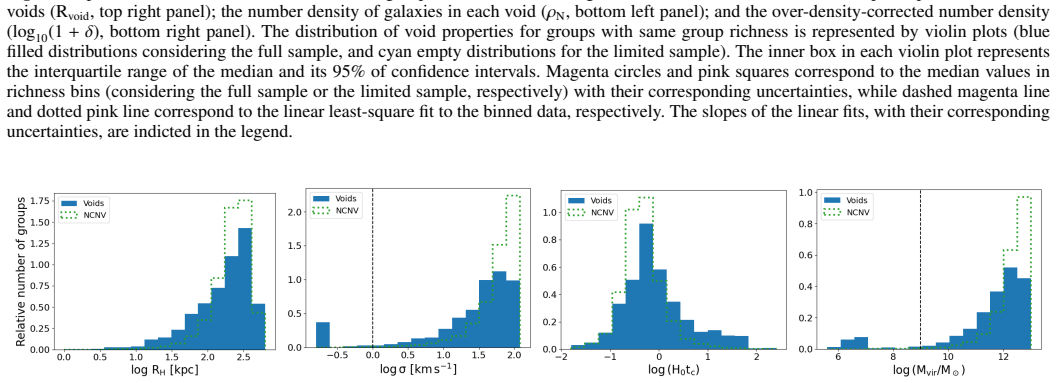
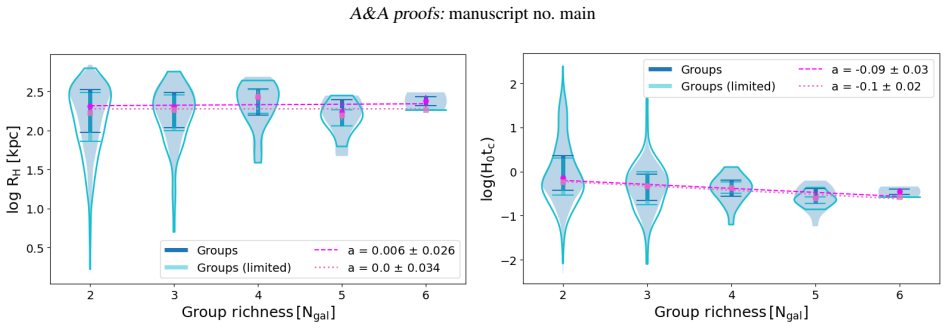
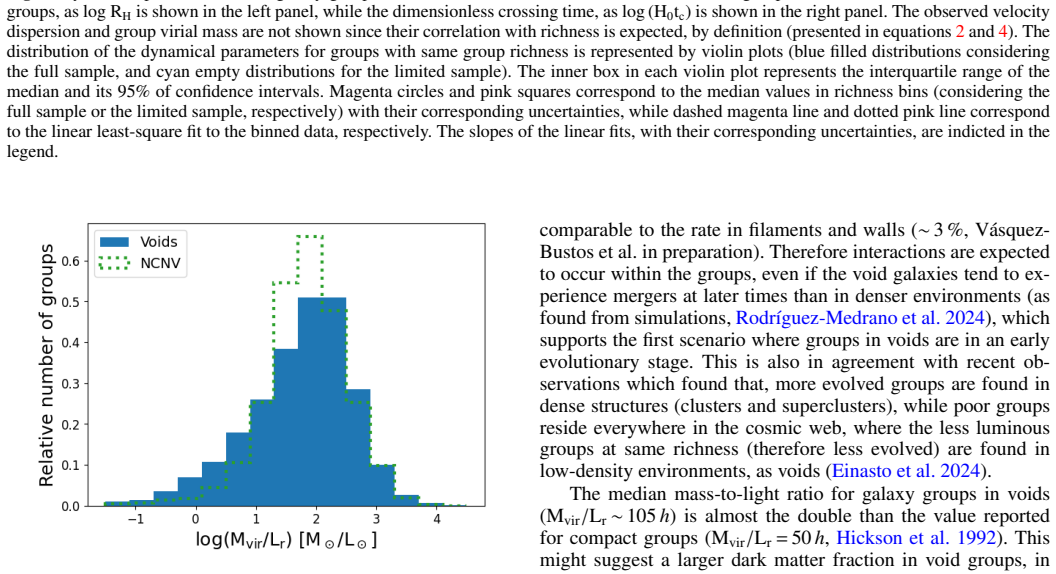
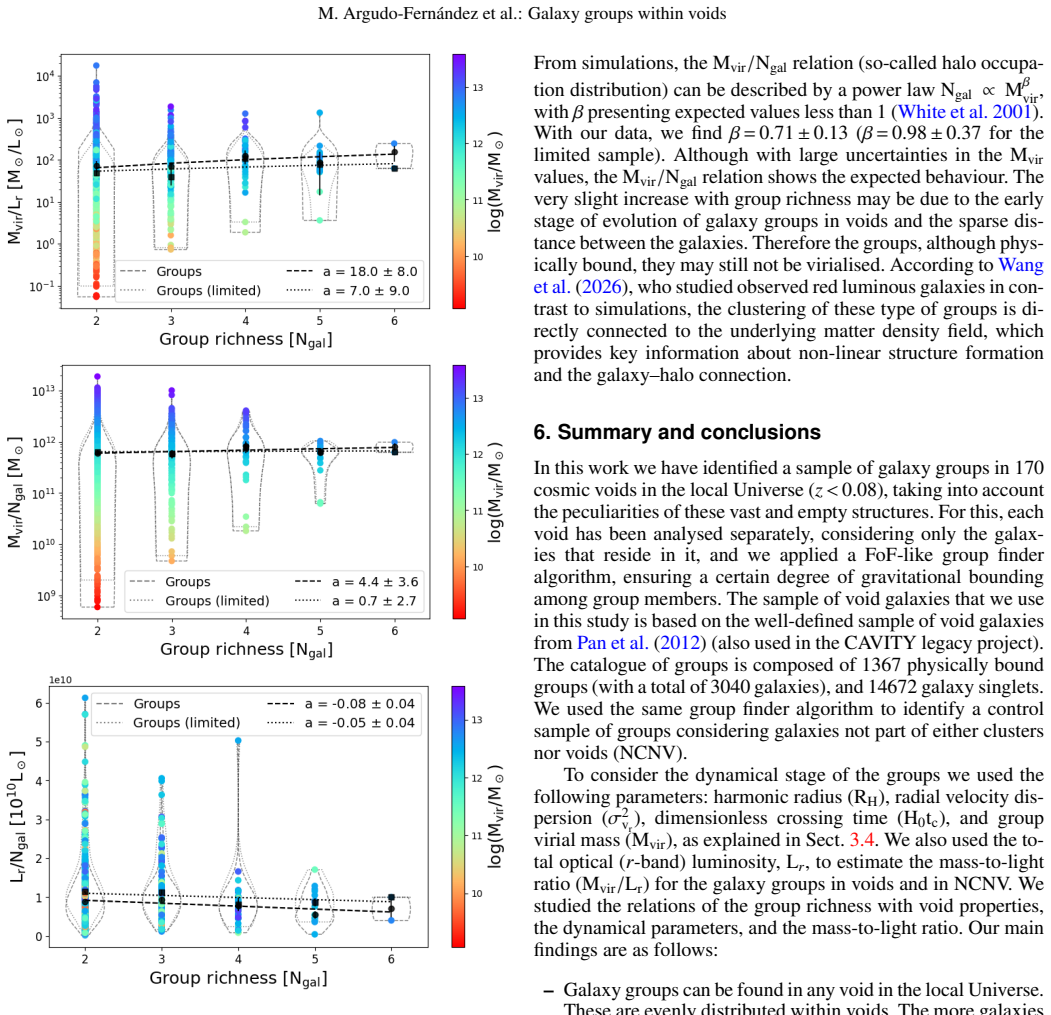
Galaxy groups within voids are typically loose groups in an early stage of their evolution. The groups are identified with a friends-of-friends algorithm that enforces gravitational binding, and the densest such groups contain only six galaxies. Parameters such as harmonic radius, radial velocity dispersion, dimensionless crossing time, virial mass, and mass-to-light ratio are used to establish that the systems have not yet reached virial equilibrium, unlike groups found in denser environments.
What carries the argument
Friends-of-friends group finder algorithm applied to void galaxies, together with the dynamical indicators harmonic radius, radial velocity dispersion, dimensionless crossing time, virial mass, and mass-to-light ratio used to assess evolutionary stage.
If this is right
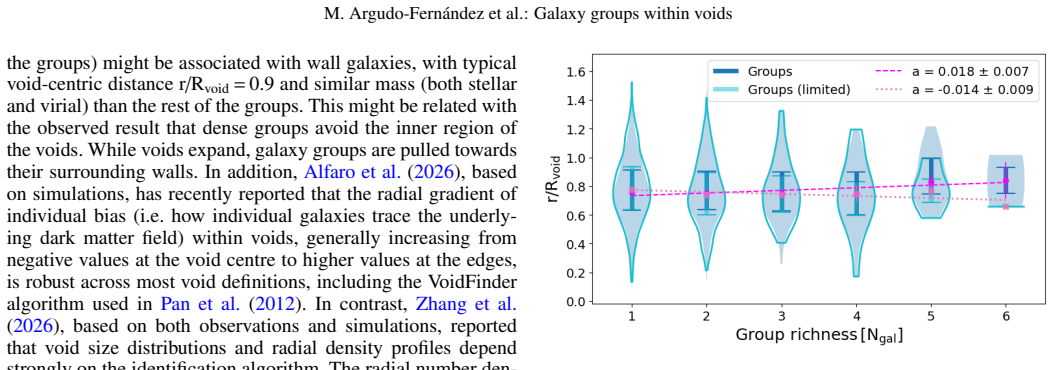
- Galaxy groups exist inside voids of every density, with no correlation between group richness and void density.
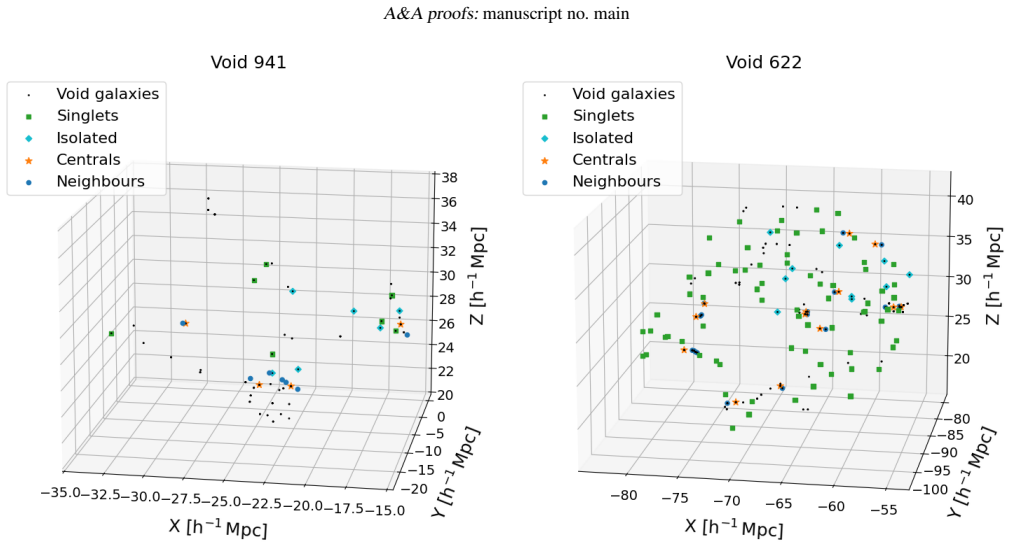
- The great majority of galaxies inside voids remain isolated singlets rather than members of groups.
- The richest groups found in voids contain only six galaxies, far smaller than groups in filaments, walls, or clusters.
- Void groups display larger harmonic radii and longer crossing times than groups outside voids, consistent with an early evolutionary stage.
Where Pith is reading between the lines
- The scarcity of groups and their loose character may indicate that gravitational collapse and merging proceed more slowly inside voids than in the rest of the cosmic web.
- Void groups could provide clean observational targets for studying the initial phases of group assembly with minimal subsequent environmental processing.
- The same selection method could be applied to higher-redshift void samples to test whether the preference for small, young groups persists across cosmic time.
Load-bearing premise
The friends-of-friends linking criteria, calibrated on the void sample, correctly identify physically bound groups rather than chance projections in these low-density regions.
What would settle it
Finding even one group with seven or more galaxies inside a void, or measuring crossing times for the identified groups that match those of virialized groups in denser regions, would falsify the claim that void groups are characteristically small and dynamically young.
Figures
read the original abstract
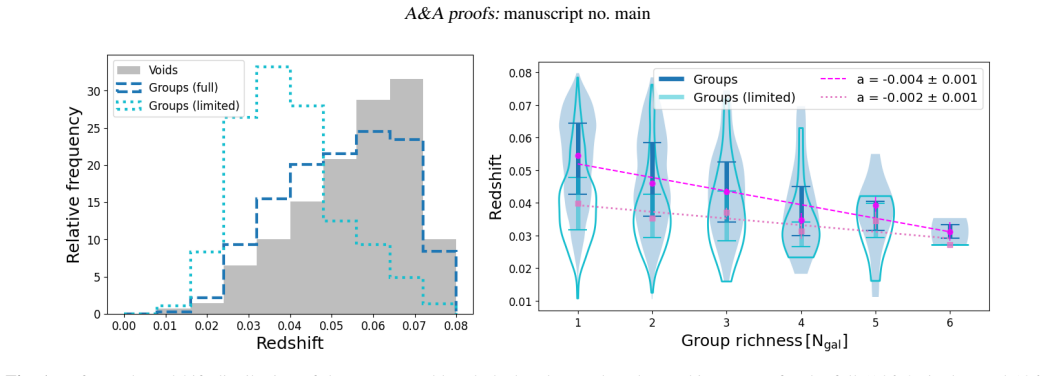
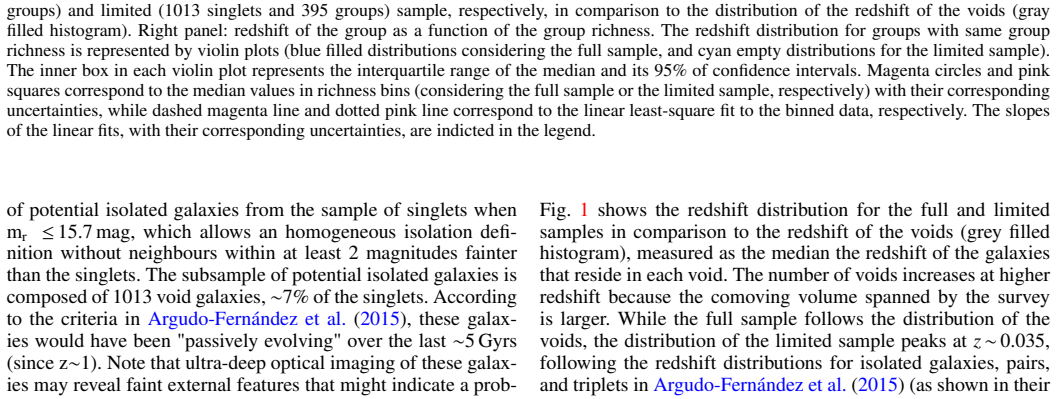
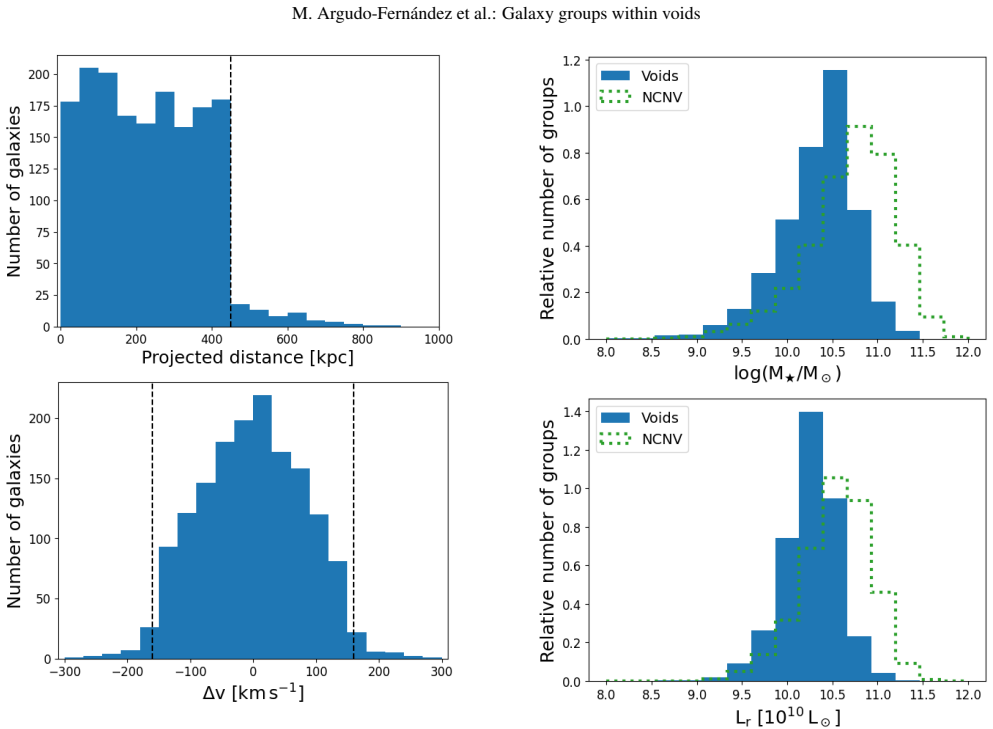
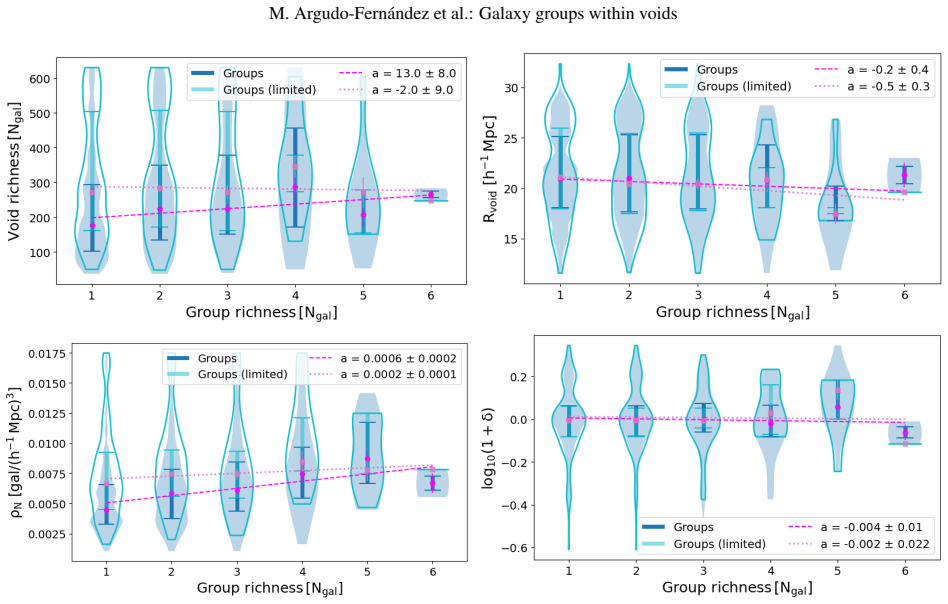
In this work, we aim to identify and characterise a sample of galaxy groups within voids in the local Universe (z\,<\,0.08), taking into account the peculiarities of these vast and empty structures. The void galaxies used in this study are selected from a well-defined void galaxy sample, from which the parent sample of the Calar Alto Void Integral-field Treasury surveY (CAVITY) legacy project was drawn. To identify galaxy groups, we applied a fiends-of-friends (FoF) like group finder algorithm to the selected sample, ensuring a certain degree of gravitational binding among group members. The same algorithm has been applied to identify a control sample of groups not in clusters nor voids, referred as NCNV groups. The catalogue of groups consists on 1367 physically bound groups, with a total of 3040 galaxies, plus 14672 galaxy singlets. Most of the galaxies in voids are singlets (59\%), in contrast, most of the NCNV galaxies in the control sample are in groups (60\%). To consider the dynamical stage of the groups we used the parameters harmonic radius ($\rm R_H$), radial velocity dispersion ($\rm \sigma_{v_r}^2$), dimensionless crossing time ($\rm H_0 t_c$), and group virial mass ($\rm M_{vir}$). We also used the total optical ($r$-band) luminosity, L$_r$, to estimate the mass-to-light ratio ($\rm M/L$) of the groups. We studied the relations of void properties and these parameters with the group richness. Galaxy groups can be found in any void in the local Universe, with no dependency of group richness on the density of voids. The densest groups in the studied sample of voids are composed of six galaxies, therefore, voids generally contain small groups, in comparison to denser structures such as filaments, walls, and galaxy clusters. Galaxy groups within voids are typically loose groups, in an early stage of their evolution.
Editorial analysis
A structured set of objections, weighed in public.
Referee Report
Summary. The paper applies a friends-of-friends (FoF) algorithm to a sample of void galaxies drawn from the CAVITY survey parent catalog at z<0.08 to identify 1367 galaxy groups containing 3040 galaxies (plus 14672 singlets). It constructs a control sample of NCNV groups and uses dynamical parameters (harmonic radius R_H, radial velocity dispersion σ_vr, dimensionless crossing time H0 t_c, virial mass M_vir) together with r-band luminosity to derive mass-to-light ratios. The main results are that most void galaxies are singlets (59%), void groups are small (maximum richness 6), show no richness dependence on void density, and are typically loose with short crossing times, indicating an early evolutionary stage.
Significance. If the group catalog is robust, the work supplies a statistically useful sample of groups in underdense environments and a direct contrast with the NCNV control sample, which could constrain models of group assembly and galaxy evolution as a function of large-scale density.
major comments (2)
- [Abstract] Abstract (paragraph on FoF application): the claim that the 1367 groups are 'physically bound' and that the reported trends in R_H, σ_vr, H0 t_c, M_vir and M/L demonstrate an 'early stage of evolution' is load-bearing, yet the manuscript provides no validation that the FoF linking lengths (tuned on the void sample) recover bound systems rather than projections in the low-density void regime; no mock-catalog tests, no comparison to independent mass estimators, and no assessment of interloper fraction are described.
- [Abstract] Abstract (counts and trends paragraph): no uncertainties or error bars are attached to the reported fractions (59% singlets, 60% grouped in NCNV), the richness distribution, or the dynamical-parameter trends with richness; without these the statistical significance of the void-versus-NCNV contrast cannot be evaluated.
minor comments (2)
- [Abstract] Abstract: 'fiends-of-friends' is a typographical error for 'friends-of-friends'.
- [Abstract] Abstract: 'The catalogue of groups consists on 1367' should read 'consists of 1367'.
Simulated Author's Rebuttal
We thank the referee for their constructive comments. We address each major comment below.
read point-by-point responses
-
Referee: [Abstract] Abstract (paragraph on FoF application): the claim that the 1367 groups are 'physically bound' and that the reported trends in R_H, σ_vr, H0 t_c, M_vir and M/L demonstrate an 'early stage of evolution' is load-bearing, yet the manuscript provides no validation that the FoF linking lengths (tuned on the void sample) recover bound systems rather than projections in the low-density void regime; no mock-catalog tests, no comparison to independent mass estimators, and no assessment of interloper fraction are described.
Authors: We agree the manuscript does not contain mock-catalog tests or explicit interloper assessments. The FoF implementation uses standard linking lengths in both projected separation and velocity difference, selected to identify systems with a degree of gravitational association as stated in the methods. The early-evolution inference rests on the observed short crossing times and loose configurations. In revision we will add an expanded methods discussion of the linking-length choice, note the lack of mock validation as a limitation, and moderate the abstract wording from 'physically bound groups' to 'identified groups'. revision: yes
-
Referee: [Abstract] Abstract (counts and trends paragraph): no uncertainties or error bars are attached to the reported fractions (59% singlets, 60% grouped in NCNV), the richness distribution, or the dynamical-parameter trends with richness; without these the statistical significance of the void-versus-NCNV contrast cannot be evaluated.
Authors: We agree that uncertainties are required to evaluate significance. The revised manuscript will attach Poisson or bootstrap uncertainties to the singlet/group fractions, the richness distribution, and the trends of dynamical parameters with richness. revision: yes
- Performing dedicated mock-catalog tests to validate the FoF groups in void environments and assess interloper fractions.
Circularity Check
No significant circularity; results are direct empirical counts and measurements from algorithm application
full rationale
The paper applies a friends-of-friends algorithm to the input void galaxy catalog to identify 1367 groups, then computes dynamical parameters (R_H, sigma_vr, H0 t_c, M_vir, M/L) directly from those groups and reports trends with richness. No equations, fitted parameters, or self-referential definitions are presented that would make any claim equivalent to its inputs by construction. The derivation chain consists of catalog processing followed by straightforward measurement; conclusions do not reduce to prior fits or self-citations. This matches the default expectation of a non-circular observational study.
Axiom & Free-Parameter Ledger
Reference graph
Works this paper leans on
-
[1]
N., Adelman-McCarthy, J
Abazajian, K. N., Adelman-McCarthy, J. K., & Agüeros. 2009, ApJS, 182, 543
2009
-
[2]
O., Corwin, Jr., H
Abell, G. O., Corwin, Jr., H. G., & Olowin, R. P. 1989, ApJS, 70, 1
1989
-
[3]
D., Allende Prieto, C., et al
Alam, S., Albareti, F. D., Allende Prieto, C., et al. 2015, ApJS, 219, 12
2015
-
[4]
Alfaro, I. G., Montero-Dorta, A. D., Bustillos, J. F., et al. 2026, arXiv e-prints, arXiv:2602.05117
arXiv 2026
-
[5]
G., Rodriguez, F., Ruiz, A
Alfaro, I. G., Rodriguez, F., Ruiz, A. N., & Lambas, D. G. 2020, A&A, 638, A60
2020
-
[6]
G., Rodriguez, F., Ruiz, A
Alfaro, I. G., Rodriguez, F., Ruiz, A. N., Luparello, H. E., & Lambas, D. G. 2022, A&A, 665, A44
2022
-
[7]
Szalay, A. S. 2010, MNRAS, 404, L89 Argudo-Fernández, M., Gómez Hernández, C., Verley, S., et al. 2024, A&A, 692, A258 Argudo-Fernández, M., Verley, S., Bergond, G., et al. 2015, A&A, 578, A110 Astropy Collaboration, Price-Whelan, A. M., Lim, P. L., et al. 2022, ApJ, 935, 167 Astropy Collaboration, Price-Whelan, A. M., Sip˝ocz, B. M., et al. 2018, AJ, 156...
2010
-
[8]
J., Hoyle, F., Torres, F., & V ogeley, M
Benson, A. J., Hoyle, F., Torres, F., & V ogeley, M. S. 2003, MNRAS, 340, 160
2003
-
[9]
Blanton, M. R. & Roweis, S. 2007, AJ, 133, 734
2007
-
[10]
R., Kofman, L., & Pogosyan, D
Bond, J. R., Kofman, L., & Pogosyan, D. 1996, Nature, 380, 603
1996
-
[11]
Cautun, M., van de Weygaert, R., Jones, B. J. T., & Frenk, C. S. 2014, MNRAS, 441, 2923
2014
-
[12]
Ceccarelli, L., Padilla, N., & Lambas, D. G. 2008, MNRAS, 390, L9
2008
-
[13]
Ceccarelli, L., Paz, D., Lares, M., Padilla, N., & Lambas, D. G. 2013, MNRAS, 434, 1435
2013
-
[14]
L., Alonso, S., & Garcia Lambas, D
Ceccarelli, M. L., Alonso, S., & Garcia Lambas, D. 2025, A&A, 700, A196
2025
-
[15]
M., González Delgado, R
Conrado, A. M., González Delgado, R. M., García-Benito, R., et al. 2024, A&A, 687, A98
2024
-
[16]
J., Farrar, G
Croton, D. J., Farrar, G. R., Norberg, P., et al. 2005, MNRAS, 356, 1155
2005
-
[17]
Curtis, O., McDonough, B., & Brainerd, T. G. 2024, ApJ, 962, 58
2024
-
[18]
2007, A&A, 474, 783
Deng, X.-F., He, J.-Z., Jiang, P., Luo, C.-H., & Wu, P. 2007, A&A, 474, 783
2007
-
[19]
J., & Ferrari, A
Diaferio, A., Ramella, M., Geller, M. J., & Ferrari, A. 1993, AJ, 105, 2035 Domínguez-Gómez, J., Pérez, I., Ruiz-Lara, T., et al. 2023a, A&A, 680, A111 Domínguez-Gómez, J., Pérez, I., Ruiz-Lara, T., et al. 2023b, Nature, 619, 269
1993
-
[20]
P., Hill, D
Driver, S. P., Hill, D. T., Kelvin, L. S., et al. 2011, MNRAS, 413, 971
2011
-
[21]
P., Norberg, P., Baldry, I
Driver, S. P., Norberg, P., Baldry, I. K., et al. 2009, Astronomy and Geophysics, 50, 5.12
2009
-
[22]
Einasto, M., Einasto, J., Müller, V ., Heinämäki, P., & Tucker, D. L. 2003, A&A, 401, 851
2003
-
[23]
2024, A&A, 681, A91
Einasto, M., Einasto, J., Tenjes, P., et al. 2024, A&A, 681, A91
2024
-
[24]
J., Weinberg, D
Eisenstein, D. J., Weinberg, D. H., Agol, E., et al. 2011, AJ, 142, 72
2011
-
[25]
El-Ad, H., Piran, T., & Dacosta, L. N. 1997, MNRAS, 287, 790
1997
-
[26]
& Thomas, D
Etherington, J. & Thomas, D. 2015, MNRAS, 451, 660
2015
-
[27]
2016, Research in Astronomy and As- trophysics, 16, 72
Feng, S., Shao, Z.-Y ., Shen, S.-Y ., et al. 2016, Research in Astronomy and As- trophysics, 16, 72
2016
-
[28]
Florez, J., Berlind, A. A., Kannappan, S. J., et al. 2021, ApJ, 906, 97 Galárraga-Espinosa, D., Garaldi, E., & Kauffmann, G. 2023, A&A, 671, A160 Galárraga-Espinosa, D., Kauffmann, G., Bonoli, S., et al. 2025, arXiv e-prints, arXiv:2506.15345
arXiv 2021
-
[29]
2011, ApJ, 728, 74 García-Benito, R., Jiménez, A., Sánchez-Menguiano, L., et al
Galaz, G., Herrera-Camus, R., Garcia-Lambas, D., & Padilla, N. 2011, ApJ, 728, 74 García-Benito, R., Jiménez, A., Sánchez-Menguiano, L., et al. 2024, A&A, 691, A161
2011
-
[30]
Grogin, N. A. & Geller, M. J. 1999, AJ, 118, 2561
1999
-
[31]
Grogin, N. A. & Geller, M. J. 2000, AJ, 119, 32
2000
-
[32]
2020, MNRAS, 493, 899
Habouzit, M., Pisani, A., Goulding, A., et al. 2020, MNRAS, 493, 899
2020
-
[33]
M., Porciani, C., & Dekel, A
Hahn, O., Carollo, C. M., Porciani, C., & Dekel, A. 2007, MNRAS, 381, 41
2007
-
[34]
1982, ApJ, 255, 382
Hickson, P. 1982, ApJ, 255, 382
1982
-
[35]
P., & Palumbo, G
Hickson, P., Mendes de Oliveira, C., Huchra, J. P., & Palumbo, G. G. 1992, ApJ, 399, 353
1992
-
[36]
& V ogeley, M
Hoyle, F. & V ogeley, M. S. 2002, ApJ, 566, 641
2002
-
[37]
S., & Pan, D
Hoyle, F., V ogeley, M. S., & Pan, D. 2012, MNRAS, 426, 3041
2012
-
[38]
Hunter, J. D. 2007, Computing In Science & Engineering, 9, 90
2007
-
[39]
A., Aragón-Calvo, M
Jaber, M., Peper, M., Hellwing, W. A., Aragón-Calvo, M. A., & Valenzuela, O. 2024, MNRAS, 527, 4087
2024
-
[40]
2020, A&A, 639, A71
Kuutma, T., Poudel, A., Einasto, M., et al. 2020, A&A, 639, A71
2020
-
[41]
E., Maldonado, V ., et al
Lares, M., Luparello, H. E., Maldonado, V ., et al. 2017, MNRAS, 470, 85
2017
-
[42]
2024, MNRAS, 527, 2663
Li, G., Ma, Y .-Z., Tramonte, D., & Li, G.-L. 2024, MNRAS, 527, 2663
2024
-
[43]
2012, A&A, 545, A104
Lietzen, H., Tempel, E., Heinämäki, P., et al. 2012, A&A, 545, A104
2012
-
[44]
C., Hao, L., et al
Liu, C.-X., Pan, D. C., Hao, L., et al. 2015, ApJ, 810, 165
2015
-
[45]
Mamon, G. A. 1987, ApJ, 321, 622
1987
-
[46]
A., Scherrer, R
Mao, Q., Berlind, A. A., Scherrer, R. J., et al. 2017, ApJ, 835, 161
2017
-
[47]
& Hudson, M
Marinoni, C. & Hudson, M. J. 2002, ApJ, 569, 101
2002
-
[48]
2020, MNRAS, 491, 5747 Merchán, M
Martizzi, D., V ogelsberger, M., Torrey, P., et al. 2020, MNRAS, 491, 5747 Merchán, M. & Zandivarez, A. 2002, MNRAS, 335, 216
2020
-
[49]
G., & González, R
Padilla, N., Lambas, D. G., & González, R. 2010, MNRAS, 409, 936
2010
-
[50]
C., V ogeley, M
Pan, D. C., V ogeley, M. S., Hoyle, F., Choi, Y .-Y ., & Park, C. 2012, MNRAS, 421, 926 pandas development team, T. 2020, pandas-dev/pandas: Pandas
2012
-
[51]
& Lee, J
Park, D. & Lee, J. 2009, MNRAS, 400, 1105
2009
-
[52]
S., Gupta, P., & Kumar, H
Paul, S., John, R. S., Gupta, P., & Kumar, H. 2017, MNRAS, 471, 2 Pérez, F. & Granger, B. E. 2007, Computing in Science and Engineering, 9, 21 Pérez, I., Gil, L., Ferré-Mateu, A., et al. 2025a, A&A, 695, A84 Pérez, I., Verley, S., Sánchez-Menguiano, L., et al. 2025b, in Highlights of Span- ish Astrophysics XII, ed. M. Manteiga, F. González-Galindo, A. Labiano-
2017
-
[53]
Yepes, C
Miguel, G. Yepes, C. Rodríguez-López, A. Gómez-García, & C. Dafonte, 93 Pérez, I., Verley, S., Sánchez-Menguiano, L., et al. 2024, A&A, 689, A213
2024
-
[54]
Pisani, A., Ramella, M., & Geller, M. J. 2003, AJ, 126, 1677
2003
-
[55]
2007, A&A, 464, 451
Popesso, P., Biviano, A., Böhringer, H., & Romaniello, M. 2007, A&A, 464, 451
2007
-
[56]
E., Holwerda, B
Porter, L. E., Holwerda, B. W., Kruk, S., et al. 2023, MNRAS, 524, 5768
2023
-
[57]
A., Martin, J
Pustilnik, S. A., Martin, J. M., Huchtmeier, W. K., et al. 2002, A&A, 389, 405
2002
-
[58]
2014, MNRAS, 445, 4045
Ricciardelli, E., Cava, A., Varela, J., & Quilis, V . 2014, MNRAS, 445, 4045
2014
-
[59]
2013, MNRAS, 435, 222 Rodríguez-Medrano, A
Rieder, S., van de Weygaert, R., Cautun, M., Beygu, B., & Portegies Zwart, S. 2013, MNRAS, 435, 222 Rodríguez-Medrano, A. M., Paz, D. J., Stasyszyn, F. A., et al. 2023, MNRAS, 521, 916 Rodríguez-Medrano, A. M., Springel, V ., Stasyszyn, F. A., & Paz, D. J. 2024, MNRAS, 528, 2822
2013
-
[60]
R., V ogeley, M
Rojas, R. R., V ogeley, M. S., Hoyle, F., & Brinkmann, J. 2004, ApJ, 617, 50
2004
-
[61]
Rosas-Guevara, Y ., Tissera, P., Lagos, C. d. P., Paillas, E., & Padilla, N. 2022, MNRAS, 517, 712 Sánchez-Alarcón, P. M., Román, J., Knapen, J. H., et al. 2023, A&A, 677, A117
2022
-
[62]
J., Finkbeiner, D
Schlegel, D. J., Finkbeiner, D. P., & Davis, M. 1998, ApJ, 500, 525
1998
-
[63]
P., Giovanelli, R., et al
Stierwalt, S., Haynes, M. P., Giovanelli, R., et al. 2009, AJ, 138, 338
2009
-
[64]
2008, A&A, 479, 927
Tago, E., Einasto, J., Saar, E., et al. 2008, A&A, 479, 927
2008
-
[65]
M., Daza-Perilla, I
Taverna, A., Salerno, J. M., Daza-Perilla, I. V ., et al. 2023, MNRAS, 520, 6367
2023
-
[66]
Tempel, E., Tuvikene, T., Kipper, R., & Libeskind, N. I. 2017, A&A, 602, A100
2017
-
[67]
Tikhonov, A. V . & Klypin, A. 2009, MNRAS, 395, 1915 Torres-Ríos, G., Pérez, I., Verley, S., et al. 2024, A&A, 691, A341 Torres-Ríos, G., Verley, S., Pérez, I., et al. 2026, arXiv e-prints, arXiv:2605.00982 van de Weygaert, R. & Platen, E. 2011, in International Journal of Modern Physics Conference Series, V ol. 1, International Journal of Modern Physics ...
Pith/arXiv arXiv 2009
-
[68]
2005, A&A, 436, 443
Verdes-Montenegro, L., Sulentic, J., Lisenfeld, U., et al. 2005, A&A, 436, 443
2005
-
[69]
E., et al
Virtanen, P., Gommers, R., Oliphant, T. E., et al. 2020, Nature Methods, 17, 261
2020
-
[70]
J., Aguilar, J
Wang, H., Eisenstein, D. J., Aguilar, J. N., et al. 2026, MNRAS, 545, staf2069
2026
-
[71]
L., Han, J
Wen, Z. L., Han, J. L., & Liu, F. S. 2009, ApJS, 183, 197 Wes McKinney. 2010, in Proceedings of the 9th Python in Science Conference, ed. Stéfan van der Walt & Jarrod Millman, 56 – 61
2009
-
[72]
2001, ApJ, 550, L129
White, M., Hernquist, L., & Springel, V . 2001, ApJ, 550, L129
2001
-
[73]
J., van den Bosch, F
Yang, X., Mo, H. J., van den Bosch, F. C., et al. 2007, ApJ, 671, 153
2007
-
[74]
2026, arXiv e-prints, arXiv:2603.29706 Article number, page 13 of 13
Zhang, Y ., Yang, X., Guo, H., Wang, P., & Shi, F. 2026, arXiv e-prints, arXiv:2603.29706 Article number, page 13 of 13
Pith/arXiv arXiv 2026
discussion (0)
Sign in with ORCID, Apple, or X to comment. Anyone can read and Pith papers without signing in.