Observational Evidence of Solar Spicules Associated with Microfilament Eruptions Using DKIST
Pith reviewed 2026-06-26 23:23 UTC · model grok-4.3
The pith
High-resolution DKIST observations show microfilament eruptions trigger solar spicules in the quiet Sun.
A machine-rendered reading of the paper's core claim, the machinery that carries it, and where it could break.
Core claim
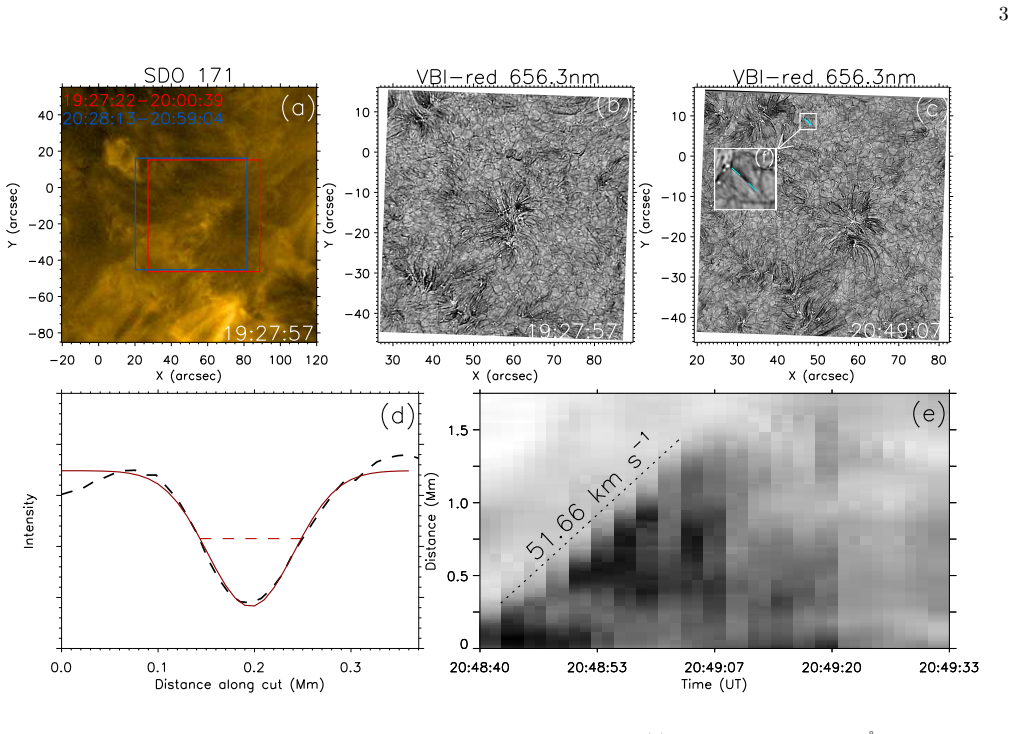
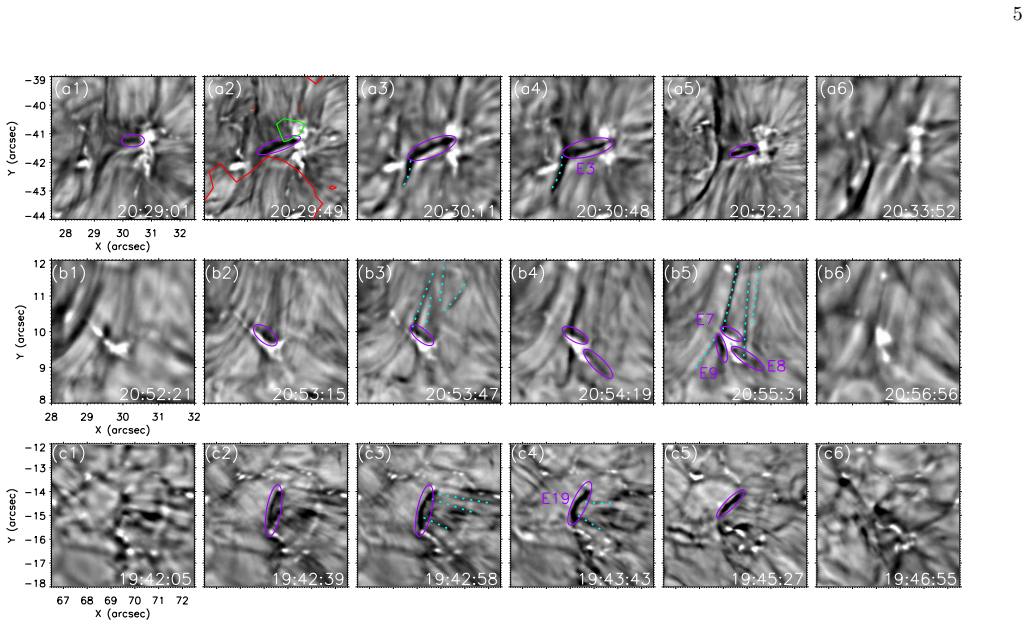
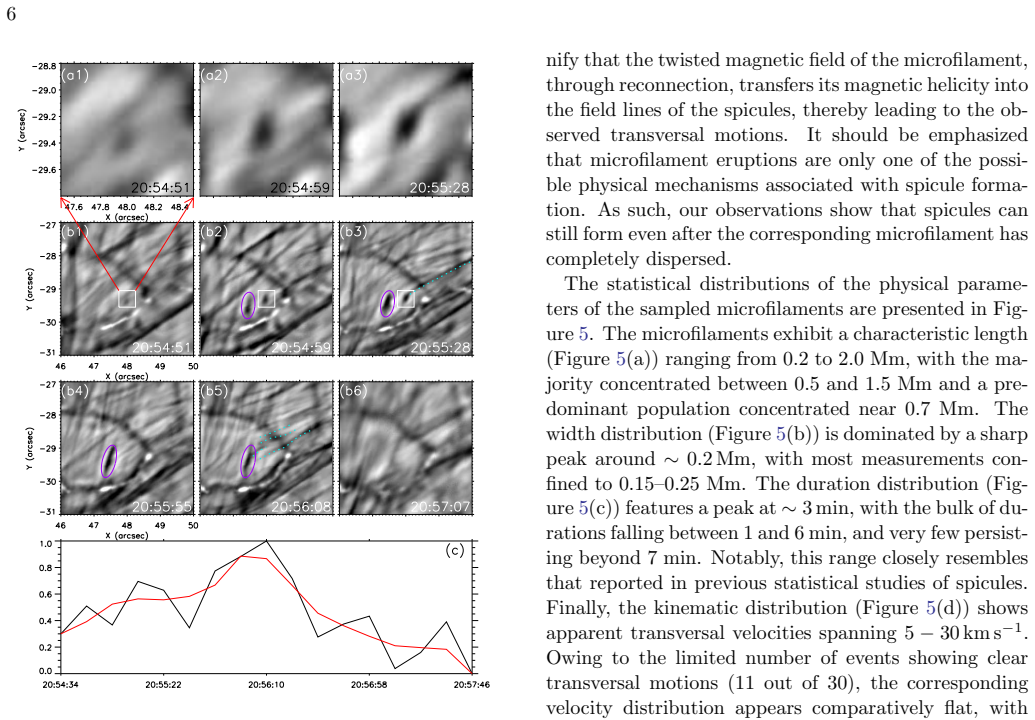
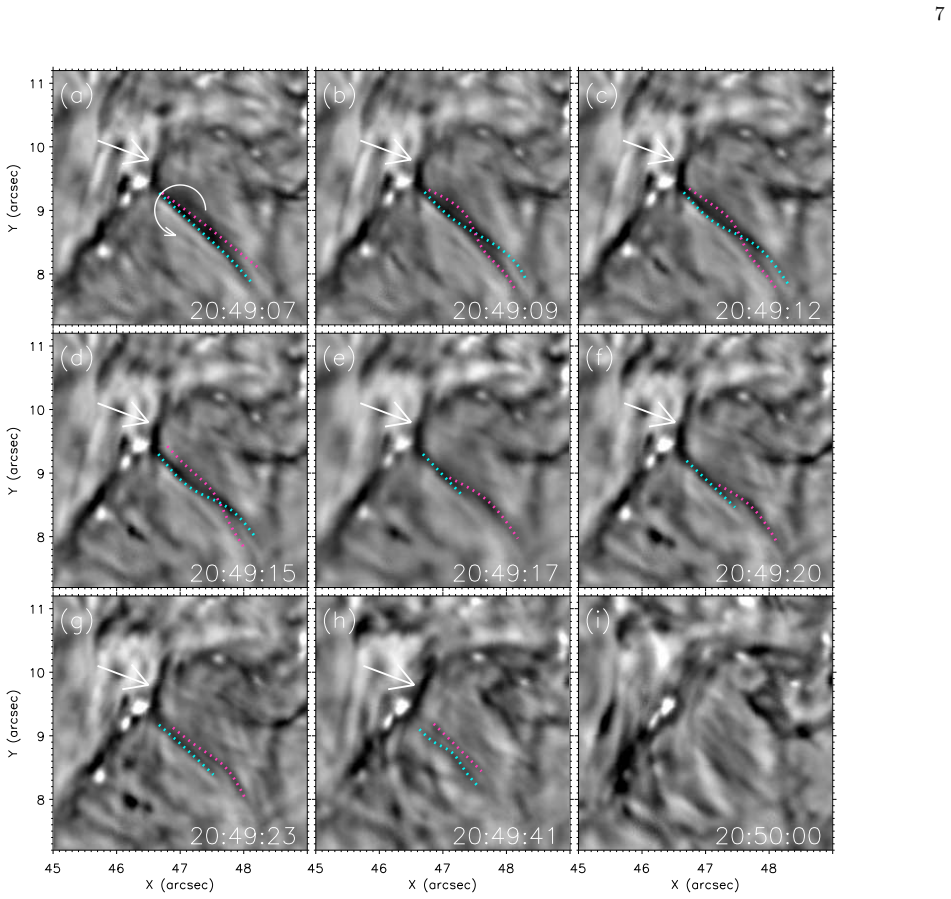
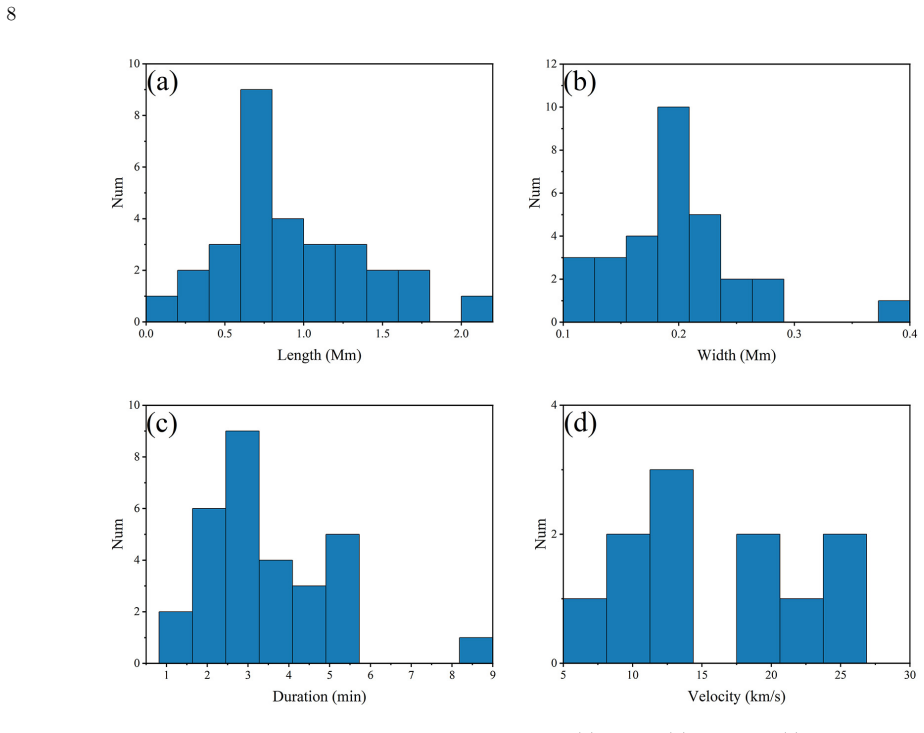
Using high-resolution Hα broadband observations from the Visible Broadband Imager onboard DKIST, 30 spicule events are identified as triggered by microfilament eruptions in a quiet-Sun region near disk center. The microfilaments have an average length of 0.93 Mm with a minimum of 0.17 Mm. Two classes of ejecta are distinguished—individual spicules from smaller microfilaments and enhanced spicular activity from larger ones—while some events display apparent twisting motions. These observations establish that spicules can be triggered by microfilament eruptions.
What carries the argument
Spatial and temporal coincidence between microfilament eruptions and the subsequent appearance of spicules in high-resolution Hα images, used to infer a triggering relationship.
If this is right
- Spicules fall into two distinct morphological classes depending on the size of the associated microfilament.
- Some spicule events linked to microfilaments exhibit apparent twisting motions.
- Microfilaments substantially smaller than previously reported minifilaments can still initiate spicular activity.
- The quiet-Sun chromosphere contains microfilament eruptions capable of driving mass and energy transport into the corona.
Where Pith is reading between the lines
- If the association holds across more regions, models of coronal heating may need to incorporate frequent small-scale filament eruptions as a standard driver of spicular mass loading.
- The minimum observed microfilament size suggests that even finer magnetic structures, below current resolution limits, could contribute to the same process.
- Statistical comparisons of eruption rates versus spicule density in different magnetic environments could test how universal the triggering mechanism is.
- The twisting motions noted in some events may point to a role for magnetic helicity injection in the spicule acceleration process.
Load-bearing premise
The assumption that observed spatial and temporal coincidence between microfilament eruptions and spicules indicates a causal triggering link rather than chance alignment or projection effects.
What would settle it
A survey of additional quiet-Sun regions that finds frequent microfilament eruptions without any corresponding spicules, or spicules appearing without preceding microfilament activity at the same locations.
Figures
read the original abstract
The formation mechanism of spicules is fundamentally important for understanding mass and energy transport from the chromosphere into the corona. Recent studies suggested that spicules may be powered by microfilament eruptions. However, direct observational evidence remains limited due to insufficient spatial resolution. Using high-resolution H$\alpha$ broadband observations from the Visible Broadband Imager (VBI) onboard the Daniel K. Inouye Solar Telescope (DKIST), we identify 30 spicule events triggered by microfilament eruptions in a quiet Sun region near the solar disk center on 2023 August 29. The detected microfilaments have an average length of $0.93\pm0.46$ Mm and a minimum length of 0.17 Mm, substantially smaller than previously reported minifilaments. We identify two distinct morphological classes of ejecta: individual spicules associated with smaller microfilaments, and enhanced spicular activities associated with larger microfilaments. Moreover, some events exhibit apparent twisting motions. All these high-resolution observations provide compelling evidence that spicules can be triggered by microfilament eruptions.
Editorial analysis
A structured set of objections, weighed in public.
Referee Report
Summary. The manuscript uses high-resolution DKIST VBI Hα broadband observations to identify 30 spicule events in a quiet-Sun region that are spatially and temporally associated with microfilament eruptions. The microfilaments have an average length of 0.93±0.46 Mm (minimum 0.17 Mm), smaller than prior reports; two morphological classes of ejecta are distinguished (individual spicules with smaller microfilaments, enhanced activity with larger ones), with some events showing apparent twisting. The work concludes that these observations supply compelling evidence that microfilament eruptions can trigger spicules.
Significance. If the reported associations are shown to exceed random coincidence, the result would strengthen the case for microfilament-driven spicule formation at sub-Mm scales and improve models of chromosphere-to-corona mass and energy transport. The DKIST data enabling detection of 0.17 Mm structures is a clear observational advance.
major comments (3)
- [Abstract] Abstract: the central claim that the 30 associations constitute 'compelling evidence' of triggering rests on spatial-temporal coincidence, yet no quantitative selection criteria, timing windows, or spatial proximity thresholds are stated, nor is any error analysis on measured lengths or timings reported; these omissions are load-bearing for reproducibility and for distinguishing signal from projection or selection effects.
- [Abstract] Abstract (final paragraph): the inference of causality from the 30 events lacks any estimate of the null hypothesis (expected number of chance alignments given spicule and microfilament occurrence rates, lifetimes, and the observed FOV), so the associations could be consistent with random overlap; this statistical control is required to support the triggering interpretation over mere co-occurrence.
- [Abstract] Abstract: no discussion of false-positive rates or projection effects is provided despite the disk-center quiet-Sun target, which directly affects the strength of the causal claim for the two morphological classes and the twisting motions.
minor comments (1)
- [Abstract] The abstract reports lengths with uncertainties but does not specify how the ±0.46 Mm error was derived or whether it includes measurement or projection contributions.
Simulated Author's Rebuttal
We thank the referee for their constructive comments. We address each major comment point by point below.
read point-by-point responses
-
Referee: [Abstract] Abstract: the central claim that the 30 associations constitute 'compelling evidence' of triggering rests on spatial-temporal coincidence, yet no quantitative selection criteria, timing windows, or spatial proximity thresholds are stated, nor is any error analysis on measured lengths or timings reported; these omissions are load-bearing for reproducibility and for distinguishing signal from projection or selection effects.
Authors: We agree the abstract omits explicit quantitative details on selection criteria, timing windows, spatial thresholds, and error analysis. The full manuscript describes the association criteria and reports measurement uncertainties. We will revise the abstract to summarize these elements. revision: yes
-
Referee: [Abstract] Abstract (final paragraph): the inference of causality from the 30 events lacks any estimate of the null hypothesis (expected number of chance alignments given spicule and microfilament occurrence rates, lifetimes, and the observed FOV), so the associations could be consistent with random overlap; this statistical control is required to support the triggering interpretation over mere co-occurrence.
Authors: We acknowledge that a quantitative null-hypothesis estimate is needed to strengthen the causal interpretation. The manuscript does not include such a calculation. We will add an estimate of expected random alignments using the observed rates and FOV, or qualify the claim accordingly in the revision. revision: yes
-
Referee: [Abstract] Abstract: no discussion of false-positive rates or projection effects is provided despite the disk-center quiet-Sun target, which directly affects the strength of the causal claim for the two morphological classes and the twisting motions.
Authors: We agree that false-positive rates and projection effects warrant explicit discussion. We will add a concise treatment of these issues to the revised abstract and discussion section, noting how disk-center viewing and the DKIST resolution affect the identified classes and motions. revision: yes
Circularity Check
Purely observational identification; no derivation chain present
full rationale
The paper reports direct visual identification of 30 spicule events from DKIST Hα observations and notes their spatial-temporal association with microfilaments. No equations, parameters, models, or fitted quantities appear in the provided text or abstract. The central claim rests on morphological classification and coincidence counts rather than any computed prediction or self-referential definition. Consequently no load-bearing step reduces to its own inputs by construction, and the circularity score is 0.
Axiom & Free-Parameter Ledger
Reference graph
Works this paper leans on
-
[1]
Antolin, P., Schmit, D., Pereira, T. M. D., De Pontieu, B., & De Moortel, I. 2018, ApJ, 856, 44, doi: 10.3847/1538-4357/aab34f
-
[2]
Bate, W., Jess, D. B., Nakariakov, V. M., et al. 2022, ApJ, 930, 129, doi: 10.3847/1538-4357/ac5c53 De Pontieu, B., De Moortel, I., Martinez-Sykora, J., &
-
[3]
McIntosh, S. W. 2017, ApJL, 845, L18, doi: 10.3847/2041-8213/aa7fb4 De Pontieu, B., Erd´ elyi, R., & James, S. P. 2004, Nature, 430, 536, doi: 10.1038/nature02749 De Pontieu, B., McIntosh, S. W., Carlsson, M., et al. 2007, Science, 318, 1574, doi: 10.1126/science.1151747 13 de Pontieu, B., McIntosh, S., Hansteen, V. H., et al. 2007, PASJ, 59, S655, doi: 1...
-
[4]
2023, ApJL, 942, L22, doi: 10.3847/2041-8213/acac2b Gonz´ alez-Avil´ es, J
Duan, Y., Shen, Y., Chen, H., et al. 2023, ApJL, 942, L22, doi: 10.3847/2041-8213/acac2b Gonz´ alez-Avil´ es, J. J., Guzm´ an, F. S., & Fedun, V. 2017, ApJ, 836, 24, doi: 10.3847/1538-4357/836/1/24
-
[5]
H., De Pontieu, B., Rouppe van der Voort, L., van Noort, M., & Carlsson, M
Hansteen, V. H., De Pontieu, B., Rouppe van der Voort, L., van Noort, M., & Carlsson, M. 2006, ApJL, 647, L73, doi: 10.1086/507452
-
[6]
Keenan, F. P. 2016, ApJ, 820, 124, doi: 10.3847/0004-637X/820/2/124
-
[7]
Hollweg, J. V. 1982, ApJ, 257, 345, doi: 10.1086/159993
-
[8]
2025, ApJ, 990, 77, doi: 10.3847/1538-4357/adf226
Huang, N., & Wang, H. 2025, ApJ, 990, 77, doi: 10.3847/1538-4357/adf226
-
[9]
2019, Solar-Terrestrial Physics, 5, 58, doi: 10.12737/stp-52201909
Huang, Z., Li, B., & Xia, L. 2019, Solar-Terrestrial Physics, 5, 58, doi: 10.12737/stp-52201909
-
[10]
2017, ApJ, 848, 38, doi: 10.3847/1538-4357/aa8ad1
Iijima, H., & Yokoyama, T. 2017, ApJ, 848, 38, doi: 10.3847/1538-4357/aa8ad1
-
[11]
Jibben, P., & Canfield, R. C. 2004, ApJ, 610, 1129, doi: 10.1086/421727
-
[12]
1999, ApJ, 514, 493, doi: 10.1086/306930
Kudoh, T., & Shibata, K. 1999, ApJ, 514, 493, doi: 10.1086/306930
-
[13]
Kuridze, D., Morton, R. J., Erd´ elyi, R., et al. 2012, ApJ, 750, 51, doi: 10.1088/0004-637X/750/1/51
-
[14]
2015, ApJ, 802, 136, doi: 10.1088/0004-637X/802/2/136
Leenaarts, J., Carlsson, M., & Rouppe van der Voort, L. 2015, ApJ, 802, 136, doi: 10.1088/0004-637X/802/2/136
-
[15]
Li, Z. F., Cheng, X., Ding, M. D., et al. 2023, A&A, 673, A83, doi: 10.1051/0004-6361/202245814 N´ obrega-Siverio, D., Joshi, R., Sola-Viladesau, E.,
-
[16]
2025, A&A, 702, A188, doi: 10.1051/0004-6361/202555357
Berghmans, D., & Lim, D. 2025, A&A, 702, A188, doi: 10.1051/0004-6361/202555357
-
[17]
Panesar, N. K., Sterling, A. C., & Moore, R. L. 2017, ApJ, 844, 131, doi: 10.3847/1538-4357/aa7b77
-
[18]
Panesar, N. K., Sterling, A. C., Moore, R. L., et al. 2025, ApJ, 994, 164, doi: 10.3847/1538-4357/ae0d90
-
[19]
Pereira, T. M. D., De Pontieu, B., & Carlsson, M. 2012, ApJ, 759, 18, doi: 10.1088/0004-637X/759/1/18
-
[20]
2025, A&A, 703, A281, doi: 10.1051/0004-6361/202556245
Qi, Y., Huang, Z., Xia, L., et al. 2025, A&A, 703, A281, doi: 10.1051/0004-6361/202556245
-
[21]
Rimmele, T. R., Warner, M., Keil, S. L., et al. 2020, SoPh, 295, 172, doi: 10.1007/s11207-020-01736-7 Rouppe van der Voort, L., Leenaarts, J., de Pontieu, B.,
-
[22]
2009, ApJ, 705, 272, doi: 10.1088/0004-637X/705/1/272
Carlsson, M., & Vissers, G. 2009, ApJ, 705, 272, doi: 10.1088/0004-637X/705/1/272
-
[23]
2019, A&A, 632, A96, doi: 10.1051/0004-6361/201936113
Pontieu, B. 2019, A&A, 632, A96, doi: 10.1051/0004-6361/201936113
-
[24]
2019, Science, 366, 890, doi: 10.1126/science.aaw2796
Samanta, T., Tian, H., Yurchyshyn, V., et al. 2019, Science, 366, 890, doi: 10.1126/science.aaw2796
-
[25]
1875, Le Soleil, doi: 10.3931/e-rara-14748
Secchi, A. 1875, Le Soleil, doi: 10.3931/e-rara-14748
-
[26]
H., Rouppe van der Voort, L., & De Pontieu, B
Sekse, D. H., Rouppe van der Voort, L., & De Pontieu, B. 2013, ApJ, 764, 164, doi: 10.1088/0004-637X/764/2/164
-
[27]
Skirvin, S., Verth, G., Gonz´ alez-Avil´ es, J. J., et al. 2023, Advances in Space Research, 71, 1866, doi: 10.1016/j.asr.2022.05.033
-
[28]
Pereira, T. M. D. 2015, ApJ, 806, 170, doi: 10.1088/0004-637X/806/2/170
-
[29]
Snow, B., Fedun, V., Gent, F. A., Verth, G., & Erd´ elyi, R. 2018, ApJ, 857, 125, doi: 10.3847/1538-4357/aab7f7
-
[30]
Sterling, A. C. 2000, SoPh, 196, 79, doi: 10.1023/A:1005213923962
-
[31]
Sterling, A. C. 2021, in Solar Physics and Solar Wind, ed. N. E. Raouafi & A. Vourlidas, Vol. 1, 221, doi: 10.1002/9781119815600.ch6
-
[32]
Sterling, A. C., & Moore, R. L. 2016, ApJL, 828, L9, doi: 10.3847/2041-8205/828/1/L9
-
[33]
Sterling, A. C., Moore, R. L., Falconer, D. A., & Adams, M. 2015, Nature, 523, 437, doi: 10.1038/nature14556
-
[34]
Sterling, A. C., Moore, R. L., Falconer, D. A., et al. 2016, ApJ, 821, 100, doi: 10.3847/0004-637X/821/2/100
-
[35]
Sterling, A. C., Moore, R. L., Samanta, T., & Yurchyshyn, V. 2020, ApJL, 893, L45, doi: 10.3847/2041-8213/ab86a5
-
[36]
Tian, H., DeLuca, E. E., Cranmer, S. R., et al. 2014, Science, 346, 1255711, doi: 10.1126/science.1255711
-
[37]
2024, ApJ, 974, 123, doi: 10.3847/1538-4357/ad74f3
Wang, J., Lee, J., Chae, J., Cao, W., & Wang, H. 2024, ApJ, 974, 123, doi: 10.3847/1538-4357/ad74f3
-
[38]
2000, ApJ, 530, 1071, doi: 10.1086/308377 W¨ oger, F., Rimmele, T., Ferayorni, A., et al
Wang, J., Li, W., Denker, C., et al. 2000, ApJ, 530, 1071, doi: 10.1086/308377 W¨ oger, F., Rimmele, T., Ferayorni, A., et al. 2021, SoPh, 296, 145, doi: 10.1007/s11207-021-01881-7 W¨ oger, F., von der L¨ uhe, O., & Reardon, K. 2008, A&A, 488, 375, doi: 10.1051/0004-6361:200809894
-
[39]
2023, ApJ, 942, 86, doi: 10.3847/1538-4357/aca66f
Yang, J., Hong, J., Yang, B., Bi, Y., & Xu, Z. 2023, ApJ, 942, 86, doi: 10.3847/1538-4357/aca66f
-
[40]
2024, ApJ, 976, 135, doi: 10.3847/1538-4357/ad84f9
Yang, L., Xue, Z., Wang, J., et al. 2024, ApJ, 976, 135, doi: 10.3847/1538-4357/ad84f9
discussion (0)
Sign in with ORCID, Apple, or X to comment. Anyone can read and Pith papers without signing in.