REVIEW 2 minor 1 cited by
Tridendriform algebras on hypergraph polytopes, the other way around
T0 review · 0 major / 2 minor · reviewed 2026-06-27 · grok-4.3
Pith's one-line read Anti-strict hypergraphs support natural (-1)-tridendriform algebras on the faces of their polytopes.
desk verdict They extend tridendriform algebras to cyclohedra via a new anti-strictness condition on hypergraphs, with the (-1) version agreeing on overlaps. read the letter →
The pith
A machine-rendered reading of the paper's core claim, the machinery that carries it, and where it could break.
The reading
What carries the argument
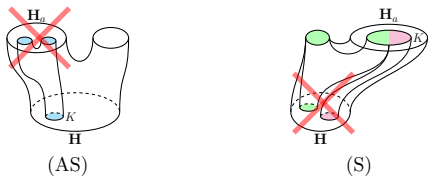
The anti-strictness connectedness condition on the hypergraph, which ensures the proposed face operations are well-defined and obey the tridendriform identities.
What would settle it
An anti-strict hypergraph for which the defined operations on two faces fail to satisfy one of the required tridendriform relations would disprove the claim.
Extended reading notes
Core claim
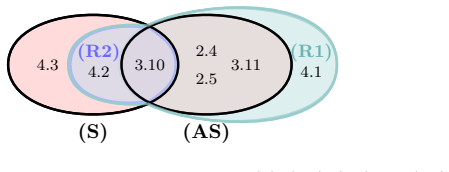
For hypergraphs satisfying the anti-strictness condition, there exist natural operations on the faces of the associated hypergraph polytope that turn the set of faces into a (-1)-tridendriform algebra, and these operations coincide with the previously defined ones on the overlap with strict hypergraphs.
Load-bearing premise
Anti-strictness of the hypergraph guarantees that the face operations are well-defined and satisfy the tridendriform identities.
Editorial extensions
If this is right
- Cyclohedra admit natural (-1)-tridendriform algebra structures on their faces.
- Associahedra and permutohedra continue to carry these structures under the new condition.
- The algebraic structures match the earlier tridendriform algebras where strict and anti-strict conditions both hold.
- The range of hypergraph polytopes with tridendriform algebra structures is extended.
Reading between the lines
- Similar constructions might apply to other algebraic structures like dendriform algebras on these polytopes.
- Anti-strict hypergraphs could correspond to dual or complementary combinatorial objects to strict ones.
- Explicit computations on small cyclohedra could verify the algebra identities directly.
Signed reviews
Editorial analysis
A structured set of objections, weighed in public.
Referee Report
Summary. The manuscript introduces the anti-strictness condition on hypergraphs, which is opposite to the earlier strictness condition and includes cyclohedra along with associahedra and permutohedra. It constructs natural (-1)-tridendriform algebras on the faces of the associated hypergraph polytopes and proves that these coincide with the q-tridendriform algebras from prior work in the overlap of the two classes, thereby extending the range of polytopes admitting such structures.
Significance. If the constructions and verifications hold, the result meaningfully enlarges the class of hypergraph polytopes carrying tridendriform algebra structures by covering cyclohedra and related examples. The explicit matching in the overlap and the parameter-free character of the (-1) case are clear strengths; the paper supplies the necessary definitions, operations, and identity verifications to support the central claim.
minor comments (2)
- The notation for the face operations in the anti-strict case could be aligned more closely with the earlier strict-case notation to ease comparison; a short table of correspondences would help.
- Several sentences in the introduction repeat the statement of the main result; condensing these would improve readability without altering content.
Simulated Author's Rebuttal
We thank the referee for their positive evaluation of the manuscript, including the recognition that the anti-strictness condition meaningfully extends the class of hypergraph polytopes admitting natural (-1)-tridendriform algebra structures, and for recommending minor revision. The report contains no specific major comments or requests for clarification or correction.
Circularity Check
No significant circularity; independent new condition extends prior work
full rationale
The paper introduces anti-strictness as a fresh connectedness condition on hypergraphs, explicitly opposite to the strictness used in the authors' earlier q-tridendriform constructions. The central result is a direct construction of natural (-1)-tridendriform algebras on faces under this new assumption, with matching only in the overlap region. No step reduces a claimed identity or well-definedness to a prior fitted parameter, self-defined quantity, or load-bearing self-citation chain; the algebraic verification is presented as following from the anti-strictness hypothesis itself. This is the typical non-circular case of extending a framework with an independent assumption.
Assumptions & free parameters
assumptions (1)
- standard math Standard definitions and properties of hypergraph polytopes and tridendriform algebras from prior literature
Cite this review
Pith. "Pith review of Tridendriform algebras on hypergraph polytopes, the other way around." pith.science (2026). https://pith.science/paper/DID3ZM6X
@misc{pith2026260617755,
  author       = {Pith},
  title        = {Pith review of: Tridendriform algebras on hypergraph polytopes, the other way around},
  year         = {2026},
  howpublished = {\url{https://pith.science/paper/DID3ZM6X}},
  note         = {Machine review of arXiv:2606.17755}
}
read the original abstract
Hypergraph polytopes (or nestohedra) form a broad class of polytopes obtained by truncating faces of a simplex according to a hypergraph. In earlier work, the authors constructed q-tridendriform algebras on the set of faces of certain families of hypergraph polytopes, including associahedra and permutohedra. The well-definedness of these structures relied on a connectedness property on the hypergraphs involved, called strictness. Nevertheless, notable examples of hypergraph polytopes such as cyclohedra fell outside this setting. We introduce a new connectedness condition, called anti-strictness, which goes opposite to strictness and captures a different class of hypergraph polytopes, including associahedra, permutohedra and cyclohedra. Our main result produces natural (-1)-tridendriform algebras in the anti-strict framework, which match previously introduced tridendriform algebras in the overlap of the two frameworks, thereby extending the range of hypergraph polytopes admitting such algebraic structures.
Figures

Figures from the paper (2 more)


Forward citations
Cited by 1 Pith paper
-
Generalised flip order on the faces of nestohedra
The shuffle product on faces of strict families of nestohedra equals a sum over intervals of the new generalized flip order, which also admits an inversion characterization.
Reference graph
Works this paper leans on
-
[1]
Tridendriform structure on combi- natorial Hopf algebras
Emily Burgunder and Mar´ ıa Ronco. “Tridendriform structure on combi- natorial Hopf algebras.” English. In:J. Algebra324.10 (2010), pp. 2860– 2883.issn: 0021-8693.doi:10.1016/j.jalgebra.2010.07.010
-
[2]
Alg` ebres de Hopf des permutah` edres, associah` edres et hypercubes
Fr´ ed´ eric Chapoton. “Alg` ebres de Hopf des permutah` edres, associah` edres et hypercubes.” French. In:Adv. Math.150.2 (2000), pp. 264–275.issn: 0001-8708.doi:10.1006/aima.1999.1868
-
[3]
Big` ebres diff´ erentielles gradu´ ees associ´ ees aux per- muto` edres, associa` edres et hypercubes
Frederic Chapoton. “Big` ebres diff´ erentielles gradu´ ees associ´ ees aux per- muto` edres, associa` edres et hypercubes”. In:Annales de l’Institut Fourier 50.4 (Jan. 2000), pp. 1127–1153
2000
-
[4]
Tri- dendriform algebras on hypergraph polytopes
Pierre-Louis Curien, B´ er´ enice Delcroix-Oger, and Jovana Obradovi´ c. “Tri- dendriform algebras on hypergraph polytopes”. en. In:Algebraic Combi- natorics8.1 (2025), pp. 201–234.doi:10.5802/alco.401.url:https: //alco.centre-mersenne.org/articles/10.5802/alco.401/
-
[5]
Syntactic aspects of hypergraph polytopes
Pierre-Louis Curien, Jovana Obradovi´ c, and Jelena Ivanovi´ c. “Syntactic aspects of hypergraph polytopes”. English. In:J. Homotopy Relat. Struct. 14.1 (2019), pp. 235–279.issn: 2193-8407.doi:10.1007/s40062- 018- 0211-9. 25
-
[6]
Hypergraph polytopes
Kosta Doˇ sen and Zoran Petri´ c. “Hypergraph polytopes”. English. In: Topology Appl.158.12 (2011), pp. 1405–1444.issn: 0166-8641.doi:10. 1016/j.topol.2011.05.015
2011
-
[7]
Geometric combinatorial algebras: cyclohedron and simplex
Stefan Forcey and Derriell Springfield. “Geometric combinatorial algebras: cyclohedron and simplex”. In:Journal of Algebraic Combinatorics32.4 (2010), pp. 597–627.issn: 1572-9192.doi:10.1007/s10801-010-0229- 5.url:https://doi.org/10.1007/s10801-010-0229-5
-
[8]
Trialgebras and families of poly- topes
Jean-Louis Loday and Mar´ ıa Ronco. “Trialgebras and families of poly- topes”. In:Contemp. Math.346 (June 2002).doi:10.1090/conm/346/ 06296
Show all 12 references
-
[9]
Simplex, associahedron, and cyclohedron
Martin Markl. “Simplex, associahedron, and cyclohedron”. In:arXiv e- prints, alg-geom/9707009 (July 1997), alg–geom/9707009.doi:10.48550/ arXiv.alg-geom/9707009. arXiv:alg-geom/9707009 [math.AG]
1997 arXiv
-
[10]
Permutohedra, associahedra, and beyond
Alexander Postnikov. “Permutohedra, associahedra, and beyond”. En- glish. In:Int. Math. Res. Not.2009.6 (2009), pp. 1026–1106.issn: 1073- 7928.doi:10.1093/imrn/rnn153
2009 doi
-
[11]
Generalized Tamari order
Mar´ ıa Ronco. “Generalized Tamari order”. English. In:Associahedra, Tamari lattices and related structures. Tamari memorial Festschrift. Basel: Birkh¨ auser, 2012, pp. 339–350.doi:10.1007/978-3-0348-0405-9_17
2012 doi
-
[12]
A type-B associahedron
Rodica Simion. “A type-B associahedron”. In:Advances in Applied Math- ematics30.1 (2003), pp. 2–25.issn: 0196-8858.doi:https://doi.org/ 10.1016/S0196-8858(02)00522-5.url:https://www.sciencedirect. com/science/article/pii/S0196885802005225. 26
2003 doi
Reviewed June 27, 2026 · model on record in the stance chip above.
Discussion (0). Continue with ORCID to comment.