REVIEW 1 minor 45 references
LUMEN: Coordinated Failure Recovery for Distributed LLM Serving
T0 review · 0 major / 1 minor · reviewed 2026-06-26 · grok-4.3
Pith's one-line read LUMEN improves recovery and serving times in distributed LLM clusters by coordinating load-aware decisions at three points in the failure process.
desk verdict LUMEN shows coordinated load-aware decisions on checkpoints, request rerouting, and reload capacity can cut recovery and serving times in LLM clusters, with prototype and simulation results supporting the gains. read the letter →
The pith
A machine-rendered reading of the paper's core claim, the machinery that carries it, and where it could break.
The reading
What carries the argument
Load-aware coordination across the three decision points of checkpoint placement, interrupted-request distribution, and serving capacity restoration during reload.
What would settle it
A controlled experiment on a multi-GPU cluster that injects worker failures, measures end-to-end serving latency and recovery duration with and without LUMEN, and checks whether the coordinated version yields shorter times or higher throughput; absence of improvement or net slowdown from coordination overhead would falsify the claim.
Extended reading notes
Core claim
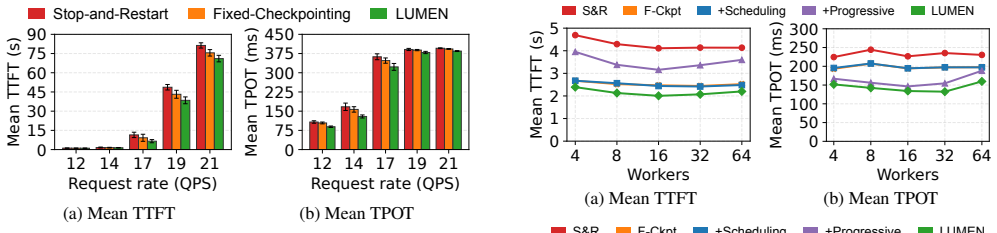
LUMEN is a fault-tolerant LLM serving system that treats recovery as a load-aware coordination problem across three decision points: checkpoint placement before failures, interrupted-request distribution at failure time, and serving capacity restoration during model reload. Prototype experiments and large-scale simulations demonstrate significant improvements in serving and recovery times over existing approaches that restart requests or use fixed checkpoint locations without considering load.
Load-bearing premise
The overhead of making and executing the three coordinated decisions remains low enough that the net effect improves recovery and serving times.
Editorial extensions
If this is right
- Interrupted requests get routed to workers according to current load instead of fixed neighboring workers, spreading the restart work.
- Checkpoints are placed with awareness of expected load so that recovery effort does not concentrate on already busy nodes.
- Serving capacity begins restoring while the model reloads rather than after, shortening the period the cluster runs at reduced capacity.
- Overall post-failure throughput stays closer to normal levels because recovery actions are aligned with observed load.
Reading between the lines
- The same three-point coordination pattern could be applied to other stateful distributed services that lose both data and capacity on node failure.
- Large-scale simulations indicate the method scales, yet production traces with bursty or correlated failures might expose new bottlenecks in decision timing.
- Dynamic addition or removal of workers could be folded into the same load-aware logic to handle elastic serving environments.
Signed reviews
Editorial analysis
A structured set of objections, weighed in public.
Referee Report
Summary. LUMEN is presented as a fault-tolerant LLM serving system that treats recovery as a load-aware coordination problem across three decision points: checkpoint placement before failures, interrupted-request distribution at failure time, and serving capacity restoration during model reload. The paper evaluates the system using prototype experiments and large-scale simulations, claiming significant improvements in serving and recovery times.
Significance. If the results hold, the work is significant because it addresses a practical challenge in scaling distributed LLM inference systems where failures are common. By coordinating recovery decisions based on load, it offers a more efficient alternative to existing methods that either restart requests or use fixed checkpoints. The dual evaluation approach with prototypes and simulations is a strength, providing both practical validation and scalability insights.
minor comments (1)
- [Abstract] Abstract: The claim of 'significant improvements in serving and recovery times' is stated without any quantitative metrics, error bars, baseline comparisons (e.g., to restart-from-scratch or fixed-neighbor checkpointing), or description of the coordination overhead. Adding one or two key results from the evaluation section would make the central claim more concrete and proportionate to the evidence presented later in the manuscript.
Simulated Author's Rebuttal
We thank the referee for their positive summary and significance assessment of LUMEN, as well as the recommendation for minor revision. We appreciate the recognition that coordinated, load-aware recovery addresses a practical challenge in distributed LLM serving.
Circularity Check
No significant circularity identified
full rationale
The paper is a systems design contribution describing LUMEN's load-aware coordination for failure recovery across three decision points, evaluated via prototype experiments and large-scale simulations. No equations, derivations, fitted parameters, predictions, or self-citations appear in the provided text that reduce any claim to its own inputs by construction. The central premise is supported by external empirical measurements rather than internal self-definition or renaming of known results.
Assumptions & free parameters
Cite this review
Pith. "Pith review of LUMEN: Coordinated Failure Recovery for Distributed LLM Serving." pith.science (2026). https://pith.science/paper/P45DUGOQ
@misc{pith2026260617787,
  author       = {Pith},
  title        = {Pith review of: LUMEN: Coordinated Failure Recovery for Distributed LLM Serving},
  year         = {2026},
  howpublished = {\url{https://pith.science/paper/P45DUGOQ}},
  note         = {Machine review of arXiv:2606.17787}
}
read the original abstract
Modern large language model (LLM) serving clusters distribute inference requests across multiple worker processes on different GPUs, but failures are prevalent at scale. When a worker fails, the cluster simultaneously loses the failed worker's GPU-resident key-value (KV) caches and serving capacity, leaving surviving workers to absorb the redirected traffic while re-running interrupted requests from scratch. Existing fault-tolerant systems either restart interrupted requests from scratch or restore KV caches from checkpoints stored on a fixed neighboring worker, but both approaches route recovery work without considering current cluster load and leave the recovering worker idle during model reload. We present LUMEN, a fault-tolerant LLM serving system that treats recovery as a load-aware coordination problem across three decision points: checkpoint placement before failures, interrupted-request distribution at failure time, and serving capacity restoration during model reload. We evaluate LUMEN using both prototype experiments and large-scale simulations and demonstrate significant improvements in serving and recovery times.
Figures


Figures from the paper (9 more)




Reference graph
Works this paper leans on
-
[1]
https:// docs.vllm.ai/en/stable/deployment/k8s/, 2026
Deploying vLLM on Kubernetes. https:// docs.vllm.ai/en/stable/deployment/k8s/, 2026
2026
-
[2]
https: //github.com/flashinfer-ai/flashinfer, 2026
FlashInfer: Kernel library for LLM serving. https: //github.com/flashinfer-ai/flashinfer, 2026
2026
-
[3]
gRPC: A high-performance, open-source universal RPC framework.https://grpc.io, 2026
2026
-
[4]
https: //huggingface.co/docs/text-generation- inference, 2026
Hugging Face text generation inference. https: //huggingface.co/docs/text-generation- inference, 2026
2026
-
[5]
https://github.com/kserve/kserve, 2026
KServe: Standardized model inference platform on Kubernetes. https://github.com/kserve/kserve, 2026
2026
-
[6]
https: //github.com/triton-inference-server/server, 2026
NVIDIA Triton inference server. https: //github.com/triton-inference-server/server, 2026
2026
-
[7]
https://pytorch.org, 2026
PyTorch: An open-source machine learning framework. https://pytorch.org, 2026
2026
-
[8]
https://zeromq.org, 2026
ZeroMQ: An open-source universal messaging library. https://zeromq.org, 2026
2026
Show all 45 references
-
[9]
Vidur: A large-scale simulation framework for LLM inference
Amey Agrawal, Nitin Kedia, Jayashree Mohan, Ashish Panwar, Nipun Kwatra, Bhargav S Gulavani, Ramachan- dran Ramjee, and Alexey Tumanov. Vidur: A large-scale simulation framework for LLM inference. InConfer- ence on Machine Learning and Systems (MLSys), 2024
2024
-
[10]
Taming throughput- latency tradeoff in LLM inference with Sarathi-Serve
Amey Agrawal, Nitin Kedia, Ashish Panwar, Jayashree Mohan, Nipun Kwatra, Bhargav Gulavani, Alexey Tu- manov, and Ramachandran Ramjee. Taming throughput- latency tradeoff in LLM inference with Sarathi-Serve. InUSENIX Symposium on Operating Systems Design and Implementation (OSDI), 2024
2024
-
[11]
Tom B. Brown, Benjamin Mann, Nick Ryder, Melanie Subbiah, Jared Kaplan, Prafulla Dhariwal, Arvind Neelakantan, Pranav Shyam, Girish Sastry, Amanda Askell, Sandhini Agarwal, Ariel Herbert-V oss, Gretchen Krueger, Tom Henighan, Rewon Child, Aditya Ramesh, Daniel M. Ziegler, Jeff...
2020
-
[12]
Accelerating large language model decoding with speculative sampling
Charlie Chen, Sebastian Borgeaud, Geoffrey Irving, Jean-Baptiste Lespiau, Laurent Sifre, and John Jumper. Accelerating large language model decoding with speculative sampling. https://arxiv.org/abs/ 2302.01318, 2023
2023 arXiv
-
[13]
Recycle: Resilient training of large DNNs using pipeline adaptation
Swapnil Gandhi, Mark Zhao, Athinagoras Skiadopoulos, and Christos Kozyrakis. Recycle: Resilient training of large DNNs using pipeline adaptation. InACM Sympo- sium on Operating Systems Principles (SOSP), 2024
2024
-
[14]
Cost-efficient large language model serving for multi-turn conversations with CachedAtten- tion
Bin Gao, Zhuomin He, Puru Sharma, Qingxuan Kang, Djordje Jevdjic, Junbo Deng, Xingkun Y ang, Zhou Y u, and Pengfei Zuo. Cost-efficient large language model serving for multi-turn conversations with CachedAtten- tion. InUSENIX Annual Technical Conference (ATC), 2024
2024
-
[15]
Characterization of large language model devel- opment in the datacenter
Qinghao Hu, Zhisheng Y e, Zerui Wang, Guoteng Wang, Meng Zhang, Qiaoling Chen, Peng Sun, Dahua Lin, Xi- aolin Wang, Yingwei Luo, Y onggang Wen, and Tianwei Liu. Characterization of large language model devel- opment in the datacenter. InUSENIX Symposium on Networked Systems De...
2024
-
[16]
Oobleck: Resilient distributed training of large models using pipeline templates
Insu Jang, Zhenning Y ang, Zhen Zhang, Xin Jin, and Mosharaf Chowdhury. Oobleck: Resilient distributed training of large models using pipeline templates. In ACM Symposium on Operating Systems Principles (SOSP), 2023. 13
2023
-
[17]
GhostServe: A lightweight checkpointing system in the shadow for fault-tolerant LLM serving
Shakya Jayakody, Y oupeng Zhao, Chinmay Nehate, and Jun Wang. GhostServe: A lightweight checkpointing system in the shadow for fault-tolerant LLM serving. In Conference on Machine Learning and Systems (MLSys), 2026
2026
-
[18]
MegaScale: Scaling large language model training to more than 10,000 GPUs
Ziheng Jiang, Haibin Lin, Yinmin Zhong, Qi Huang, Y angrui Chen, Zhi Zhang, Y anghua Peng, Xiang Li, Cong Xie, Shibiao Nong, Y ulu Jia, Sun He, Hongmin Chen, Zhihao Bai, Qi Hou, Shipeng Y an, Ding Zhou, Yiyao Sheng, Zhuo Jiang, Haohan Xu, Haoran Wei, Zhang Zhang, Pengfei Nie, ...
2024
-
[19]
Revisiting reliability in large-scale machine learning research clusters
Apostolos Kokolis, Michael Kuchnik, John Hoffman, Adithya Kumar, Parth Malani, Faye Ma, Zachary DeVito, Shubho Sengupta, Kalyan Saladi, and Carole-Jean Wu. Revisiting reliability in large-scale machine learning research clusters. InIEEE International Symposium on High-Performa...
2025
-
[20]
Efficient memory man- agement for large language model serving with Page- dAttention
Woosuk Kwon, Zhuohan Li, Siyuan Zhuang, Ying Sheng, Lianmin Zheng, Cody Hao Y u, Joseph Gonzalez, Hao Zhang, and Ion Stoica. Efficient memory man- agement for large language model serving with Page- dAttention. InACM Symposium on Operating Systems Principles (SOSP), 2023
2023
-
[21]
Fast inference from transformers via speculative decoding
Y aniv Leviathan, Matan Kalman, and Y ossi Matias. Fast inference from transformers via speculative decoding. In International Conference on Machine Learning (ICML), 2023
2023
-
[22]
PEARL: Parallel speculative decoding with adaptive draft length
Tianyu Liu, Y un Li, Qitan Lv, Kai Liu, Jianchen Zhu, Winston Hu, and Xiao Sun. PEARL: Parallel speculative decoding with adaptive draft length. InInternational Conference on Learning Representations (ICLR), 2025
2025
-
[23]
CacheGen: KV cache compression and streaming for fast large language model serving
Y uhan Liu, Hanchen Li, Yihua Cheng, Siddhant Ray, Y uyang Huang, Qizheng Zhang, Kuntai Liu, Shan Lu He, Ganesh Ananthanarayanan, and Junchen Jiang. CacheGen: KV cache compression and streaming for fast large language model serving. InACM SIGCOMM Conference (SIGCOMM), 2024
2024
-
[24]
The Llama 3 herd of models
Llama Team. The Llama 3 herd of models. https: //arxiv.org/abs/2407.21783, 2024
2024 arXiv
-
[25]
AMUSD: Asynchronous multi- device speculative decoding for LLM acceleration
Bradley McDanel. AMUSD: Asynchronous multi- device speculative decoding for LLM acceleration. In IEEE International Symposium on Circuits and Systems (ISCAS), 2025
2025
-
[26]
Splitwise: Efficient generative LLM inference using phase splitting
Pratyush Patel, Esha Choukse, Chaojie Zhang, Inigo Goiri, Aashaka Shah, Saeed Maleki, and Ricardo Bian- chini. Splitwise: Efficient generative LLM inference using phase splitting. InIEEE International Symposium on Computer Architecture (ISCA), 2024
2024
-
[27]
ECCheck: Enhancing in-memory check- point with erasure coding in distributed DNN training
Guicheng Qi, Zongpeng Li, Chuan Wu, Zhuwei Peng, and Yi Zheng. ECCheck: Enhancing in-memory check- point with erasure coding in distributed DNN training. InIEEE International Conference on Distributed Com- puting Systems (ICDCS), 2025
2025
-
[28]
Towards resiliency in large language model serving with KevlarFlow
Shangshu Qian, Kipling Liu, PC Sruthi, Lin Tan, and Y ongle Zhang. Towards resiliency in large language model serving with KevlarFlow. https://arxiv.org/ abs/2601.22438, 2026
2026
-
[29]
Mooncake: Trading more storage for less computation – a KVCache-centric architecture for serving LLM chat- bot
Ruoyu Qin, Zheming Li, Weiran He, Mingxing Wang, Jiaao Zeng, Y ongchao Zhang, Jian Shi, Chengruidong Bian, Lian Y ang, Fan Lv, Y ang Luo, and Zhongzhi Y ang. Mooncake: Trading more storage for less computation – a KVCache-centric architecture for serving LLM chat- bot. InUSENI...
2025
-
[30]
ShareGPT conversation dataset
ShareGPT. ShareGPT conversation dataset. https: //sharegpt.com/
-
[31]
FlexGen: High- throughput generative inference of large language mod- els with a single GPU
Ying Sheng, Lianmin Zheng, Binhang Y uan, Zhuohan Li, Max Ryabinin, Beidi Chen, Percy Liang, Christo- pher Ré, Ion Stoica, and Ce Zhang. FlexGen: High- throughput generative inference of large language mod- els with a single GPU. InInternational Conference on Machine Learning ...
2023
-
[32]
DéjàVu: KV-cache streaming for fast, fault-tolerant generative LLM serv- ing
Foteini Strati, Sara McAllister, Amar Phanishayee, Jakub Tarnawski, and Ana Klimovic. DéjàVu: KV-cache streaming for fast, fault-tolerant generative LLM serv- ing. InInternational Conference on Machine Learning (ICML), 2024
2024
-
[33]
Llumnix: Dy- namic scheduling for large language model serving
Biao Sun, Ziming Huang, Hanyu Zhao, Wencong Xiao, Xinyi Zhang, Y ong Li, and Wei Lin. Llumnix: Dy- namic scheduling for large language model serving. In USENIX Symposium on Operating Systems Design and Implementation (OSDI), 2024
2024
-
[34]
Bamboo: Making preemptible in- stances resilient for affordable training of large DNNs
John Thorpe, Pengzhan Zhao, Jonathan Eyolfson, Yi- fan Qiao, Zhihao Jia, Minjia Zhang, Ravi Netravali, and Guoqing Harry Xu. Bamboo: Making preemptible in- stances resilient for affordable training of large DNNs. InUSENIX Symposium on Networked Systems Design and Implementatio...
2023
-
[35]
Llama 2: Open foundation and fine-tuned chat models
Hugo Touvron, Louis Martin, Kevin Stone, Peter Al- bert, Amjad Almahairi, Y asmine Babaei, Nikolay Bash- lykov, Soumya Batra, Prajjwal Bhargava, Shruti Bhosale, 14 Dan Bikel, Lukas Blecher, Cristian Canton-Ferrer, Moya Chen, Guillem Cucurull, David Esiobu, Jude Fernan- des, Je...
2023 arXiv
-
[36]
Gomez, Lukasz Kaiser, and Illia Polosukhin
Ashish V aswani, Noam Shazeer, Niki Parmar, Jakob Uszkoreit, Llion Jones, Aidan N. Gomez, Lukasz Kaiser, and Illia Polosukhin. Attention is all you need. In Advances in Neural Information Processing Systems (NeurIPS), 2017
2017
-
[37]
ByteCheckpoint: A unified checkpointing system for large foundation model development
Borui Wan, Mingji Han, Yiyao Sheng, Y anghua Peng, Haibin Lin, Mofan Zhang, Zhichao Lai, Menghan Y u, Junda Zhang, Zuquan Song, Xin Liu, and Chuan Wu. ByteCheckpoint: A unified checkpointing system for large foundation model development. InUSENIX Sym- posium on Networked Syste...
2025
-
[38]
Zhuang Wang, Zhen Jia, Shuai Zheng, Zhen Zhang, Xin- wei Fu, T. S. Eugene Ng, and Yida Wang. Gemini: Fast failure recovery in distributed training with in-memory checkpoints. InACM Symposium on Operating Systems Principles (SOSP), 2023
2023
-
[39]
Fast distributed inference serving for large language models
Bingyang Wu, Yinmin Zhong, Zili Zhang, Shengyu Liu, Fangyue Liu, Y uanhang Sun, Gang Huang, Xuanzhe Liu, and Xin Jin. Fast distributed inference serving for large language models. InUSENIX Symposium on Networked Systems Design and Implementation (NSDI), 2026
2026
-
[40]
FailSafe: High-performance resilient serv- ing
Ziyi Xu, Zhiqiang Xie, Swapnil Gandhi, and Christos Kozyrakis. FailSafe: High-performance resilient serv- ing. InConference on Machine Learning and Systems (MLSys), 2026
2026
-
[41]
Qwen3 technical report
An Y ang, Anfeng Li, Baosong Y ang, Beichen Zhang, Binyuan Hui, Bo Zheng, Bowen Y u, Chang Gao, Chen- gen Huang, Chenxu Lv, Chujie Zheng, Dayiheng Liu, Fan Zhou, Fei Huang, Feng Hu, Hao Ge, Haoran Wei, Huan Lin, Jialong Tang, Jian Y ang, Jianhong Tu, Jian- wei Zhang, Jianxin Y...
2025 arXiv
-
[42]
Orca: A distributed serving system for transformer-based generative models
Gyeong-In Y u, Joo Seong Jeong, Geon-Woo Kim, Soo- jeong Kim, and Byung-Gon Chun. Orca: A distributed serving system for transformer-based generative models. InUSENIX Symposium on Operating Systems Design and Implementation (OSDI), 2022
2022
-
[43]
Gonzalez, Clark Bar- rett, and Ying Sheng
Lianmin Zheng, Liangsheng Yin, Zhiqiang Xie, Chuyue Sun, Jeff Huang, Cody Hao Y u, Shiyi Cao, Christos Kozyrakis, Ion Stoica, Joseph E. Gonzalez, Clark Bar- rett, and Ying Sheng. SGLang: Efficient execution of structured language model programs. InAdvances in Neural Informatio...
2024
-
[44]
Dist- Serve: Disaggregating prefill and decoding for goodput- optimized large language model serving
Yinmin Zhong, Shengyu Liu, Junda Chen, Jianbo Hu, Yibo Zhu, Xuanzhe Liu, Xin Jin, and Hao Zhang. Dist- Serve: Disaggregating prefill and decoding for goodput- optimized large language model serving. InUSENIX Symposium on Operating Systems Design and Imple- mentation (OSDI), 2024
2024
-
[45]
Resiliency at scale: Managing Google’s TPUv4 machine learning supercomputer
Y azhou Zu, Alireza Ghaffarkhah, Hoang-Vu Dang, Brian Towles, Steven Hand, Safeen Huda, Adekunle Bello, Alexander Kolbasov, Arash Rezaei, Dayou Du, Steve Lacy, Hang Wang, Aaron Wisner, Chris Lewis, and Henri Bahini. Resiliency at scale: Managing Google’s TPUv4 machine learning...
2024
Reviewed June 26, 2026 · model on record in the stance chip above.
Discussion (0). Continue with ORCID to comment.