Accountability in Autonomous Drone-Based Firefighting: Insights From a Field Trial
Pith reviewed 2026-06-27 01:16 UTC · model grok-4.3
The pith
Autonomous drones create substantial uncertainty in accountability when deployed in firefighting teams.
A machine-rendered reading of the paper's core claim, the machinery that carries it, and where it could break.
Core claim
Drawing on two real-life field trials in firefighting, the study reveals substantial uncertainty around accountability when drones are organizationally deployed. Using Bovens' accountability framework, two challenges are identified: uncertainty about the role of drones within hierarchical structures, leading to confused accountability ascriptions, and new forms of human-drone interactions introducing additional accountability-relevant issues. The paper proposes actionable recommendations to support responsible integration of autonomous drones into firefighting operations without undermining accountability.
What carries the argument
Bovens' accountability framework applied to the organizational placement of drones in firefighting hierarchies and interactions.
If this is right
- Firefighting organizations need explicit rules placing drones inside command hierarchies to reduce confused accountability ascriptions.
- Protocols governing human-drone interactions must be updated to handle the additional accountability issues they create.
- Policymakers can use the identified challenges to draft guidelines that preserve existing accountability structures during drone integration.
- Research on autonomous systems gains concrete field data on how accountability relationships shift when artificial agents enter established teams.
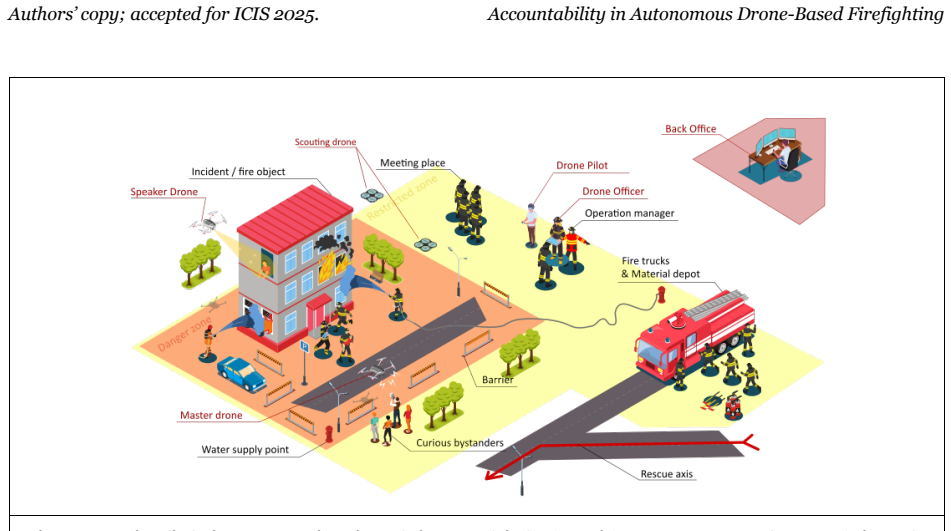
Where Pith is reading between the lines
- The same hierarchical and interaction issues are likely to appear when drones enter other emergency services such as medical response or search-and-rescue.
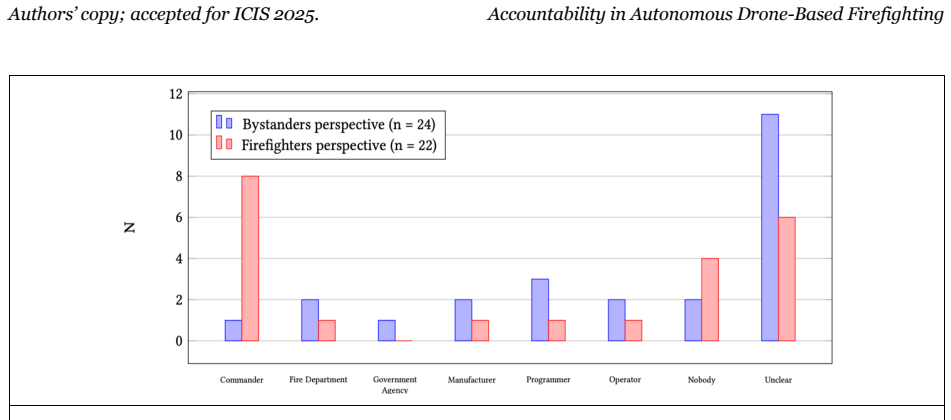
- Accountability audits conducted before large deployments could surface the same problems the trials revealed.
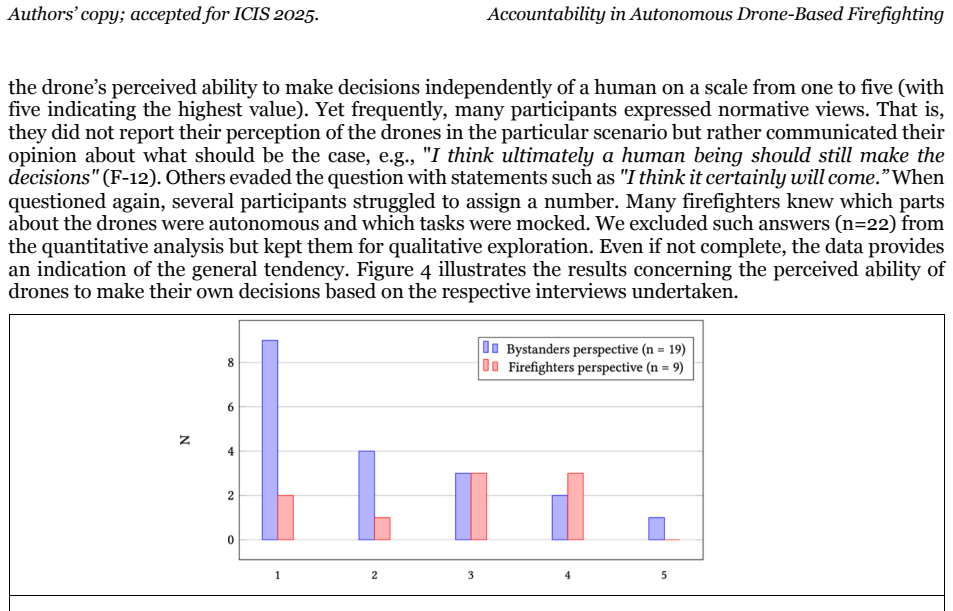
- Training programs for incident commanders may need modules that practice assigning responsibility when drones participate in operations.
Load-bearing premise
The accountability patterns observed in the two field trials represent the dynamics that would appear in wider organizational deployment of autonomous drones.
What would settle it
A subsequent large-scale deployment of drones across multiple firefighting organizations in which accountability ascriptions remain clear, consistent, and uncontested would falsify the claim of substantial uncertainty.
Figures

read the original abstract
There is a growing research field exploring how autonomous drones can enhance emergency response effectiveness. Integrating these (artificial) agents into existing emergency teams and workflows may significantly impact established accountability relationships. This paper examines how autonomous drones affect accountability attribution within complex socio-technical systems. Drawing on two real-life field trials in firefighting, the study reveals substantial uncertainty around accountability when drones are organizationally deployed. Using Bovens' accountability framework, two challenges are identified: (1) uncertainty about the role of drones within hierarchical structures, leading to confused accountability ascriptions; and (2) new forms of human-drone interactions introducing additional accountability-relevant issues. Based on these insights, the paper proposes actionable recommendations to support the responsible integration of autonomous drones into firefighting operations without undermining accountability. These findings offer practical guidance for policymakers and contribute to further research on accountability in autonomous systems.
Editorial analysis
A structured set of objections, weighed in public.
Referee Report
Summary. The paper claims that autonomous drones integrated into firefighting operations create substantial uncertainty around accountability attribution in socio-technical systems. Drawing on observations from two real-life field trials and applying Bovens' accountability framework, it identifies two challenges: (1) uncertainty about the role of drones within existing hierarchical structures, resulting in confused accountability ascriptions; and (2) novel human-drone interactions that introduce additional accountability-relevant issues. The paper concludes with actionable recommendations for policymakers to support responsible drone integration without undermining accountability.
Significance. If the empirical observations hold, the work supplies rare real-world evidence on accountability dynamics when autonomous agents are embedded in established emergency-response hierarchies. This directly informs practical guidance for fire services and contributes to the broader literature on socio-technical accountability in robotics by grounding an established framework (Bovens) in field data rather than purely theoretical analysis.
major comments (2)
- [§4] §4 (Field Trials description): The central claim that the two trials reveal accountability dynamics 'when drones are organizationally deployed' rests on the assumption that the observed role confusion and interaction issues are attributable to drone integration rather than firefighting-specific hierarchies. With only two trials, no reported variation in organizational context, autonomy level, or data-collection protocol, the evidence does not yet establish that these are general features under Bovens' framework.
- [Methods / Findings] Methods / Data Analysis (implicit in Abstract and Findings): The manuscript provides no detail on participant selection, observation protocols, coding procedures, or how the two challenges were derived from the raw observations. Because the identification of the challenges is load-bearing for both the empirical contribution and the subsequent recommendations, this omission prevents evaluation of whether the conclusions follow from the data.
minor comments (2)
- [Abstract] The abstract is written at a high level of generality; moving one or two concrete examples from the field trials into the abstract would improve immediate accessibility without lengthening it substantially.
- [Related Work / Framework] Notation for Bovens' framework dimensions is introduced without a brief recap table or diagram; a one-paragraph summary of the relevant accountability relations would aid readers unfamiliar with the framework.
Simulated Author's Rebuttal
We thank the referee for their thoughtful and constructive review. The comments identify important areas for strengthening the manuscript's empirical grounding and transparency. We address each major comment below, indicating revisions where appropriate.
read point-by-point responses
-
Referee: [§4] §4 (Field Trials description): The central claim that the two trials reveal accountability dynamics 'when drones are organizationally deployed' rests on the assumption that the observed role confusion and interaction issues are attributable to drone integration rather than firefighting-specific hierarchies. With only two trials, no reported variation in organizational context, autonomy level, or data-collection protocol, the evidence does not yet establish that these are general features under Bovens' framework.
Authors: We agree that the current presentation could be read as overstating generalizability. The manuscript frames the work as insights from two specific field trials rather than a claim of universal features under Bovens' framework. We will revise §4 to explicitly label the study as exploratory, state the limitations of two trials without cross-context variation, and clarify that the observed issues are presented as arising in the context of drone integration within existing hierarchies (while acknowledging that baseline firefighting hierarchies may contribute). We cannot add comparative data from additional trials at this stage. revision: partial
-
Referee: [Methods / Findings] Methods / Data Analysis (implicit in Abstract and Findings): The manuscript provides no detail on participant selection, observation protocols, coding procedures, or how the two challenges were derived from the raw observations. Because the identification of the challenges is load-bearing for both the empirical contribution and the subsequent recommendations, this omission prevents evaluation of whether the conclusions follow from the data.
Authors: We accept this criticism. The manuscript currently lacks a dedicated methods description. In the revision we will add a Methods section that details participant selection criteria, observation protocols during the field trials, the qualitative coding procedures applied to the data, and the analytical steps through which the two challenges were derived from the observations. This addition will directly address the concern about traceability from data to findings. revision: yes
Circularity Check
No circularity: external framework applied to independent field data
full rationale
The paper's central claims derive from applying Bovens' pre-existing accountability framework to fresh empirical observations collected in two firefighting field trials. No equations, fitted parameters, predictions, or self-citations are used to generate the reported challenges; the analysis introduces new socio-technical insights rather than reducing any result to its own inputs by construction. The derivation chain remains self-contained against external benchmarks.
Axiom & Free-Parameter Ledger
axioms (1)
- domain assumption Bovens' accountability framework is suitable for analyzing accountability in systems that include autonomous artificial agents.
Reference graph
Works this paper leans on
-
[1]
Integrating these (artificial) agents into existing emergency teams and workflows may significantly impact established accountability relationships
Accountability in Autonomous Drone-Based Firefighting Forty-Sixth International Conference on Information Systems, Nashville, Tennessee, USA 2025 1 Accountability in Autonomous Drone-Based Firefighting: Insights From a Field Trial Completed Research Paper Dzmitry Katsiuba University of Zurich Zurich, Switzerland katsiuba@ifi.uzh.ch Anna Katharina Boos Uni...
2025
-
[2]
Our study draws on two field trials with 95 participants along with in-depth interviews
to examine real-world accountability challenges arising from the use of autonomous drones in firefighting. Our study draws on two field trials with 95 participants along with in-depth interviews. Our findings reveal a variety of accountability challenges, predominantly concerning the role of drones within hierarchical structures and decision-making proces...
2025
-
[3]
Accountability in Autonomous Drone-Based Firefighting Forty-Sixth International Conference on Information Systems, Nashville, Tennessee, USA 2025 2 Based on these findings, we propose eight actionable guidelines to support the effective integration of autonomous drones into firefighting operations while strengthening accountability. Understanding these ac...
2025
-
[4]
Accountability in Autonomous Drone-Based Firefighting Forty-Sixth International Conference on Information Systems, Nashville, Tennessee, USA 2025 3 part of a project focused on exploring the potential applications of autonomous drones in firefighting, undertaken in close collaboration with University of Zurich and two Swiss fire departments. The project f...
2025
-
[5]
and professional adoption (Weidinger et al., 2018,
2018
-
[6]
Drones exemplify such on-site dynamic information systems
of emergency response information systems (ERIS), indicating, among other things, that systems supporting on-site dynamic information collection offer major advantages to first responders (Yang et al., 2009). Drones exemplify such on-site dynamic information systems. However, achieving this requires resolving multiple problems related to the public's acce...
2009
-
[7]
An important aspect is addressing issues around accountability and responsibility
or human-computer interaction (Boonyard et al., 2025; Dolata & Aleya, 2022; Wu et al., 2025), we assume that autonomous drones will become important element of ERIS and crucial for emergency processes. An important aspect is addressing issues around accountability and responsibility. Whereas IS has studied AI accountability extensively in the past (Denneh...
2025
-
[8]
the actor
defines accountability as “a relationship between an actor and a forum, in which the actor has an obligation to explain and to justify his or her conduct, the forum can pose questions and pass judgment, and the actor may face consequences” (see Figure 1). Bovens (2010) stresses that accountability should not be understood as a substantive ethical norm, bu...
2010
-
[9]
Oftentimes, the actors’ facing consequences also includes the duty to take effective measures to prevent events from reoccurring (Thompson, 2017)
Accountability in Autonomous Drone-Based Firefighting Forty-Sixth International Conference on Information Systems, Nashville, Tennessee, USA 2025 4 bystanders and the public in general, have a right to demand explanation and justification from the fire brigade, and call for consequences, such as sanctions or compensation. Oftentimes, the actors’ facing co...
2025
-
[10]
Visualization of the Boven’s (2007) understanding of accountability Authors’ copy; accepted for ICIS
2007
-
[11]
eroding accountability
Accountability in Autonomous Drone-Based Firefighting Forty-Sixth International Conference on Information Systems, Nashville, Tennessee, USA 2025 5 for undesired outcomes? There is the concern of “eroding accountability” in increasingly complex socio-technical systems, since it becomes ever more difficult to trace responsibility back to single parties and...
2025
-
[12]
There is, however, emerging research in police settings that provides empirically based guidelines for the integration of autonomous systems (Dolata & Schwabe, 2023)
associated with drone applications – at various levels of impact and probability – these studies typically do not draw a connection to the concept of accountability. There is, however, emerging research in police settings that provides empirically based guidelines for the integration of autonomous systems (Dolata & Schwabe, 2023). Building on this foundat...
2023
-
[13]
Following an evaluation of the technical capabilities of drones for a number of proposed applications, we have identified possible scenarios for a field trial
Accountability in Autonomous Drone-Based Firefighting Forty-Sixth International Conference on Information Systems, Nashville, Tennessee, USA 2025 6 discussions with firefighters using predefined questions to generate ideas and suggestions for deploying the autonomous drone system. Following an evaluation of the technical capabilities of drones for a numbe...
2025
-
[14]
Figure 2 shows the modified organization of the fire scene
Accountability in Autonomous Drone-Based Firefighting Forty-Sixth International Conference on Information Systems, Nashville, Tennessee, USA 2025 7 after all victims were rescued, the fire was extinguished, and all possible residual members were removed. Figure 2 shows the modified organization of the fire scene. The following preselected scenarios for hu...
2025
-
[15]
Directly after the field trial (within the first one to two hours), participants underwent a brief individual interview with a member of the research team on site
Accountability in Autonomous Drone-Based Firefighting Forty-Sixth International Conference on Information Systems, Nashville, Tennessee, USA 2025 8 approximately 2 hours of participation, bystanders received compensation equivalent to 80 USD, in line with the university practice. Directly after the field trial (within the first one to two hours), particip...
2025
-
[16]
good-will frees blame
Accountability in Autonomous Drone-Based Firefighting Forty-Sixth International Conference on Information Systems, Nashville, Tennessee, USA 2025 9 representative. Figure 3 summarizes the frequency of answers to the question of who is accountable if a firefighting operation results in a loss that can be linked to the drone’s actions. In particular, most f...
2025
-
[17]
I think ultimately a human being should still make the decisions
Accountability in Autonomous Drone-Based Firefighting Forty-Sixth International Conference on Information Systems, Nashville, Tennessee, USA 2025 10 the drone’s perceived ability to make decisions independently of a human on a scale from one to five (with five indicating the highest value). Yet frequently, many participants expressed normative views. That...
2025
-
[18]
meaningful human control
Accountability in Autonomous Drone-Based Firefighting Forty-Sixth International Conference on Information Systems, Nashville, Tennessee, USA 2025 11 individual humans, such as the commander, operator, or manufacturer. When respondents attributed independent decision-making capacity to the drone, they tended to shift accountability away from particular ind...
2025
-
[19]
Many autonomous drones are still operated under human supervision and control, contributing to the perception that autonomy is not absolute
Accountability in Autonomous Drone-Based Firefighting Forty-Sixth International Conference on Information Systems, Nashville, Tennessee, USA 2025 12 The reluctance to attribute independent decision-making capabilities to autonomous drones appears to be shaped by factors such as the inherent nature of drones and the development of autonomous technology. Ma...
2025
-
[20]
our study provides empirical evidence of the complex sociotechnical challenges that emerge when integrating truly autonomous agents into emergency operations. The field trials reveal that drones, as examples of on-site dynamic information collection systems (Yang et al., 2009), introduce unique coordination and communication challenges that extend beyond ...
2009
-
[21]
and advantages of dynamic and autonomous extensions to existing ERIS (Yang et al., 2009). Additionally, this study advances IS research on accountability and AI accountability by providing rare empirical evidence of how accountability is actually attributed in high-stakes human-AI collaborative scenarios. While previous IS accountability research has larg...
2009
-
[22]
our findings reveal the complex dynamics of accountability attribution when autonomous systems operate as organizational representatives in service contexts. The observation that participants consistently refused to attribute accountability to drones themselves, instead shifting responsibility to human actors or organizational entities, provides crucial e...
2023
-
[23]
– but from organizational ambiguity, role confusion, and inadequate communication of system capabilities. This also confirms prior conceptual research speculating that humans do not perceive AI as an individual, detached entity but rather as embedded in an activity system which embraces the social and material context as well (Dolata et al., 2023). Autono...
2023
-
[24]
To reduce such ambiguity, drones should be clearly branded or marked to signal their affiliation with the fire department
Accountability in Autonomous Drone-Based Firefighting Forty-Sixth International Conference on Information Systems, Nashville, Tennessee, USA 2025 13 flags them as part of an official institution promoting trust, but also reinforces their role as accountable actors in emergency operations Many participants in our study did not associate drones with the fir...
2025
-
[25]
Accountability in Autonomous Drone-Based Firefighting Forty-Sixth International Conference on Information Systems, Nashville, Tennessee, USA 2025 14 Internal handling of accountability: Fire services must establish internal processes to investigate failures and enforce accountability when necessary Robust internal procedures are critical for taking accoun...
2025
-
[26]
Accountability in Autonomous Drone-Based Firefighting Forty-Sixth International Conference on Information Systems, Nashville, Tennessee, USA 2025 15 Looking ahead, future studies could explore drone configurations that embody greater degrees of operational autonomy and evaluate how such designs affect perceptions of accountability and agency. Comparative ...
-
[27]
Boonyard, C., Jouffrais, C., Cauchard, J. R., & Brock, A. M. (2025). Firefighting with Drone Assistance: User Needs and Design Considerations for Thailand. Proceedings of the 2025 CHI Conference on Human Factors in Computing Systems, 1–18. https://doi.org/10.1145/3706598.3714172 Bovens, M. (2007). Analysing and Assessing Accountability: A Conceptual Frame...
-
[28]
Accountability in Autonomous Drone-Based Firefighting Forty-Sixth International Conference on Information Systems, Nashville, Tennessee, USA 2025 16 Cobbe, J., Lee, M. S. A., & Singh, J. (2021). Reviewable Automated Decision-Making: A Framework for Accountable Algorithmic Systems. Proceedings of the 2021 ACM Conference on Fairness, Accountability, and Tra...
-
[29]
Del-Real, C., & Díaz-Fernández, A. M. (2021). Lifeguards in the sky: Examining the public acceptance of beach-rescue drones. Technology in Society, 64, 101502. Dennehy, D., Griva, A., Pouloudi, N., Dwivedi, Y. K., Mäntymäki, M., & Pappas, I. O. (2023). Artificial Intelligence (AI) and Information Systems: Perspectives to Responsible AI. Information System...
-
[30]
Accountability in Autonomous Drone-Based Firefighting Forty-Sixth International Conference on Information Systems, Nashville, Tennessee, USA 2025 17 Merriam, S. B., & Grenier, R. S. (2019). Qualitative research in practice: Examples for discussion and analysis. John Wiley & Sons. Miron, M., Whetham, D., Auzanneau, M., & Hill, A. (2023). Public Drone Perce...
-
[31]
Saldana, J. (2021). The Coding Manual for Qualitative Researchers. SAGE. Santoni de Sio, F., & Mecacci, G. (2021). Four responsibility gaps with artificial intelligence: Why they matter and how to address them. Philosophy & Technology, 34(4), 1057–1084. Santoni de Sio, F., & van den Hoven, J. (2018). Meaningful Human Control over Autonomous Systems: A Phi...
2021
-
[32]
Sjöström, J., Ågerfalk, P., & Hevner, A. (2022). The Design of a System for Online Psychosocial Care: Balancing Privacy and Accountability in Sensitive Online Healthcare Environments. Journal of the Association for Information Systems, 23(1), 237–263. https://doi.org/10.17705/1jais.00717 Stebbins, R. A. (2001). Exploratory research in the social sciences ...
-
[33]
Yuan, C., Zhang, Y., & Liu, Z. (2015). A survey on technologies for automatic forest fire monitoring, detection, and fighting using unmanned aerial vehicles and remote sensing techniques. Canadian Journal of Forest Research, 45(7), 783–792
2015
discussion (0)
Sign in with ORCID, Apple, or X to comment. Anyone can read and Pith papers without signing in.