Kes 75 with IXPE: Detection of Nebular X-ray Polarization and Change in Pulsar Lightcurve
Pith reviewed 2026-06-26 23:30 UTC · model grok-4.3
The pith
The second IXPE observation of Kes 75 detects significant 2-8 keV polarization from the PWN, implying a toroidal magnetic field aligned with its symmetry axis.
A machine-rendered reading of the paper's core claim, the machinery that carries it, and where it could break.
Core claim
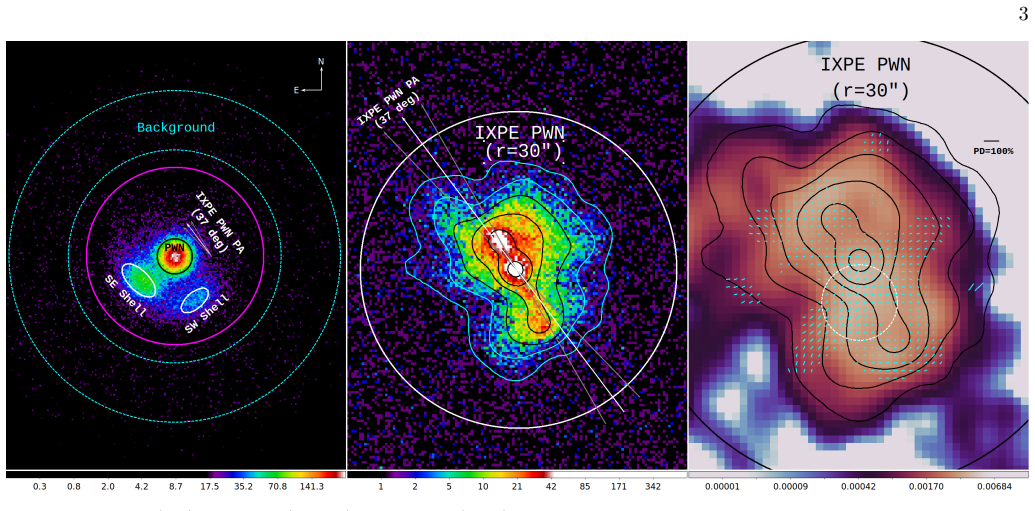
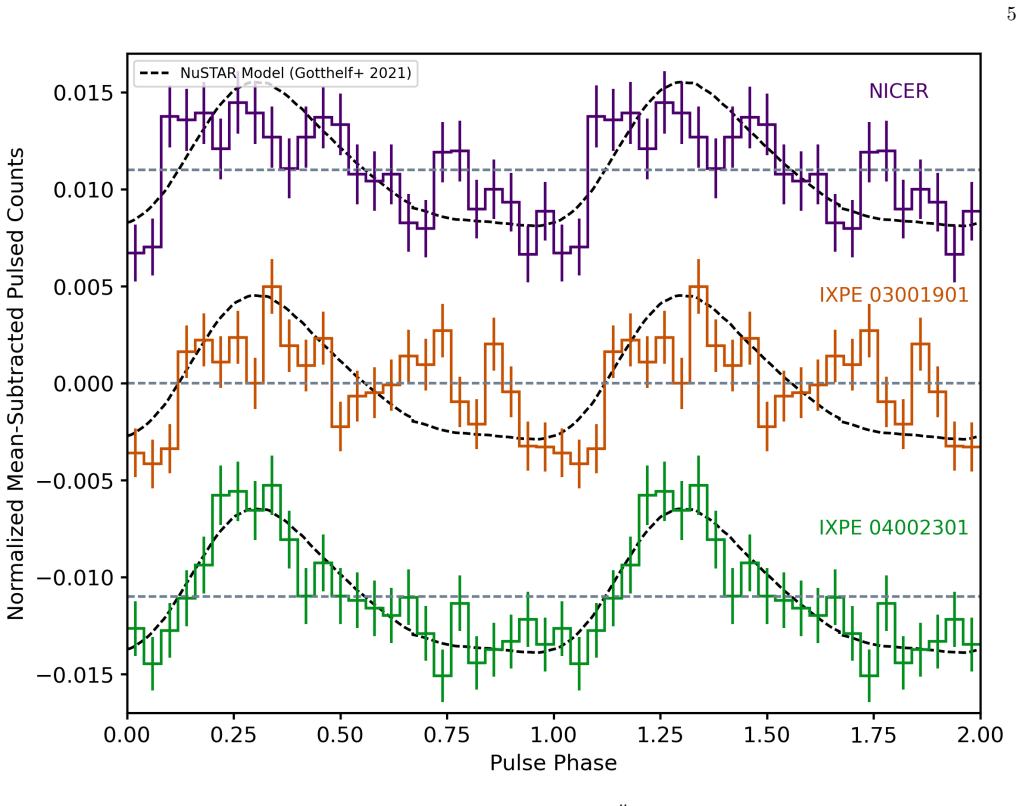
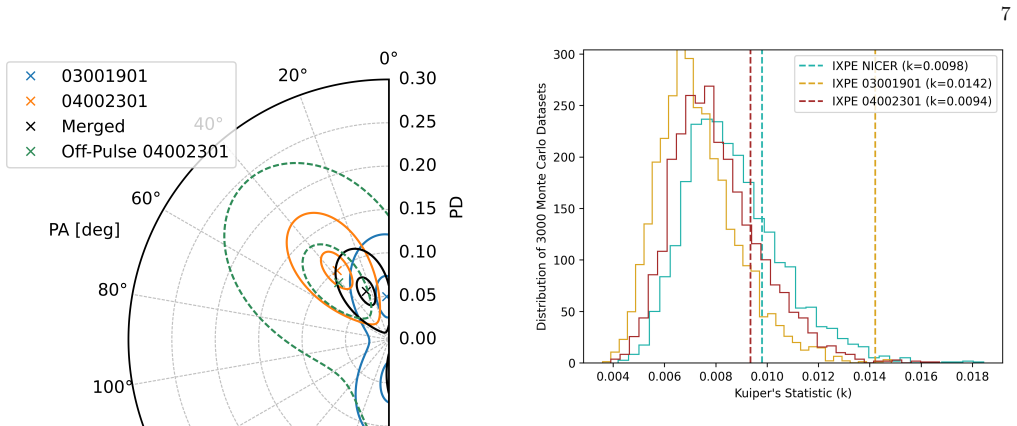
The second observation yields a significant phase-average 2-8 keV polarization degree PD = 9.9% ± 2.5% at PA=36.8° ± 7.3°, implying a toroidal field aligned with the PWN symmetry axis. The first epoch has only a polarization upper limit but shows an additional pulsed component at Δφ ≈ 0.5 detected at ~3.7σ. An unbinned phase-resolved analysis reveals a high-PD rotating vector model PA sweep at the ~99.5% confidence level with angles fixed at those inferred from the PWN morphology; this can explain the loss of phase-average polarization.
What carries the argument
The phase-average polarization measurement from IXPE combined with a rotating vector model for phase-resolved polarization angles fixed to PWN morphology values.
Load-bearing premise
The polarization angles in the rotating vector model are exactly those inferred from the PWN morphology images and this model fully explains the absence of phase-average polarization in the first epoch.
What would settle it
Detection of the same polarization degree and angle in a new observation without the extra pulse, or failure to detect the extra pulse in a follow-up observation with measurable polarization.
Figures
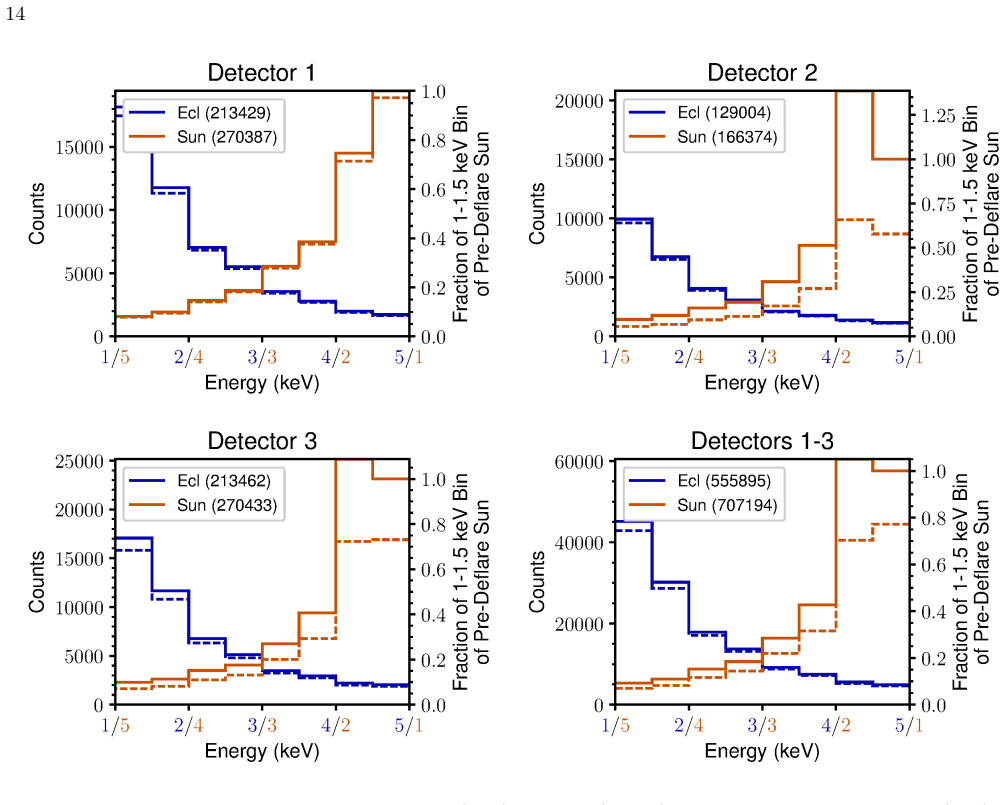
read the original abstract
We present the first X-ray polarization measurements of the PSR/PWN complex within SNR Kes 75. Two $\rm {\sim}\,500\,ks$ IXPE observations were conducted in October/November 2024 and April 2025. The second observation yields a significant phase-average 2-8 keV polarization degree $\rm PD = 9.9\% \pm 2.5\%$ at $\rm PA=36.8^\circ \pm 7.3^\circ$, implying a toroidal field aligned with the PWN symmetry axis. The first epoch, however, has only a polarization upper limit. During this epoch, an additional pulsed component is visible at $\Delta \phi \approx 0.5$, detected at ${\sim}\,3.7\sigma$. An unbinned phase-resolved analysis reveals a high-PD rotating vector model PA sweep at the ${\sim}\,99.5\%$ confidence level, with angles fixed at those inferred from the PWN morphology; this can explain the loss of phase-average polarization. Additional observations are needed to pin down the nature of the anomalous pulse.
Editorial analysis
A structured set of objections, weighed in public.
Referee Report
Summary. The manuscript reports the first X-ray polarization measurements of the PSR/PWN system in SNR Kes 75 from two ~500 ks IXPE pointings. The second epoch yields a phase-averaged 2-8 keV detection of PD = 9.9% ± 2.5% at PA = 36.8° ± 7.3°, interpreted as evidence for a toroidal field aligned with the PWN symmetry axis. The first epoch shows only a polarization upper limit but reveals an additional pulsed component at Δφ ≈ 0.5 (~3.7σ). An unbinned phase-resolved analysis of the first epoch finds support for a high-PD rotating-vector-model PA sweep at ~99.5% confidence when angles are fixed to values inferred from PWN morphology; this is invoked to explain the absence of phase-averaged polarization.
Significance. If the results hold, this constitutes the first X-ray polarization constraint on magnetic-field geometry in Kes 75 and adds to the small sample of polarized PWNe. The quantified detection significance, the reported epoch-to-epoch change, and the direct tie to PWN morphology are strengths. The work also demonstrates IXPE's capability for combined imaging, timing, and polarimetry on a young, compact PWN.
major comments (1)
- [unbinned phase-resolved analysis] Unbinned phase-resolved analysis (described in the abstract and §3): the rotating-vector-model fit fixes polarization angles exactly to the values inferred from PWN morphology images and reports ~99.5% confidence for that specific model. No test is described in which the angles are allowed to vary freely or in which the morphology-derived angles are replaced by a data-driven prior; if the true projected field deviates modestly from the adopted direction, the fixed-angle construction does not demonstrate that the RVM accounts for the observed loss of phase-averaged signal. This assumption is load-bearing for the claim that the first-epoch non-detection is explained by the model rather than by other depolarization mechanisms.
minor comments (2)
- [abstract] The abstract states the second-epoch PA = 36.8° ± 7.3° but does not specify whether this is the equatorial or magnetic axis convention or how the uncertainty is propagated from the Stokes parameters.
- [results] The ~3.7σ detection of the additional pulsed component at Δφ ≈ 0.5 should be accompanied by the exact trial-corrected significance and the energy band used for the timing analysis.
Simulated Author's Rebuttal
We thank the referee for their constructive review and for recognizing the significance of the first X-ray polarization constraints on Kes 75. We address the single major comment below.
read point-by-point responses
-
Referee: [unbinned phase-resolved analysis] Unbinned phase-resolved analysis (described in the abstract and §3): the rotating-vector-model fit fixes polarization angles exactly to the values inferred from PWN morphology images and reports ~99.5% confidence for that specific model. No test is described in which the angles are allowed to vary freely or in which the morphology-derived angles are replaced by a data-driven prior; if the true projected field deviates modestly from the adopted direction, the fixed-angle construction does not demonstrate that the RVM accounts for the observed loss of phase-averaged signal. This assumption is load-bearing for the claim that the first-epoch non-detection is explained by the model rather than by other depolarization mechanisms.
Authors: The angles were fixed to the morphology-inferred values because the second epoch independently measures PA = 36.8° ± 7.3°, which aligns with the PWN symmetry axis; this supplies a physically motivated prior validated by the data rather than derived from the lower-signal first epoch. The specific test performed is whether an RVM sweep with this toroidal geometry can quantitatively account for the observed suppression of phase-averaged polarization. A free-angle or data-driven-prior variant would address a broader question but is not required to evaluate the morphology-based explanation we advance. Given the first epoch's statistics, such a fit would likely remain underconstrained. We therefore see no need to alter the reported analysis or claims. revision: no
Circularity Check
No significant circularity; direct observational measurements
full rationale
The paper reports direct polarization measurements (PD and PA) extracted from IXPE photon counts in the second epoch, with the first-epoch upper limit likewise data-driven. The phase-resolved unbinned fit imposes PA values taken from independent PWN morphology images (not derived from the polarization data itself) and reports a confidence level for that specific model; this is an external assumption rather than a self-definitional loop, fitted-input prediction, or self-citation chain. No equations reduce the claimed toroidal-field implication to prior results by construction, and the central claims remain falsifiable against the raw counts. This is the expected outcome for an observational report.
Axiom & Free-Parameter Ledger
free parameters (1)
- Polarization degree and angle
axioms (2)
- domain assumption Rotating vector model describes the phase-dependent polarization angle sweep
- domain assumption PWN morphological symmetry axis provides the correct reference angle for the toroidal field
Reference graph
Works this paper leans on
-
[1]
Archibald, R. F., Kaspi, V. M., Tendulkar, S. P., & Scholz, P. 2016, ApJL, 829, L21, doi: 10.3847/2041-8205/829/1/L21
-
[2]
2025, ApJ, 979, 122, doi: 10.3847/1538-4357/ada3c4
Bai, J., Wang, N., Dai, S., et al. 2025, ApJ, 979, 122, doi: 10.3847/1538-4357/ada3c4
-
[3]
arXiv , author =:2203.06384 , journal =
Baldini, L., Bucciantini, N., Lalla, N. D., et al. 2022, SoftwareX, 19, 101194, doi: 10.1016/j.softx.2022.101194
-
[4]
Becker, R. H., Helfand, D. J., & Szymkowiak, A. E. 1983, ApJL, 268, L93, doi: 10.1086/184036
-
[5]
Blumer, H., Safi-Harb, S., McLaughlin, M. A., & Fiore, W. 2021, ApJL, 911, L6, doi: 10.3847/2041-8213/abf11d
-
[6]
2023, Nature Astronomy, 7, 602, doi: 10.1038/s41550-023-01936-8
Bucciantini, N., Ferrazzoli, R., Bachetti, M., et al. 2023, Nature Astronomy, 7, 602, doi: 10.1038/s41550-023-01936-8
-
[7]
Bucciantini, N., Wong, J., Romani, R. W., et al. 2025, A&A, 699, A33, doi: 10.1051/0004-6361/202554216 Di Lalla, N., Omodei, N., Bucciantini, N., et al. 2025, ApJ, 991, 67, doi: 10.3847/1538-4357/adf6b5 Di Marco, A., Soffitta, P., Costa, E., et al. 2023, AJ, 165, 143, doi: 10.3847/1538-3881/acba0f
-
[8]
Dinsmore, J. T., & Romani, R. W. 2024, ApJ, 962, 183, doi: 10.3847/1538-4357/ad2065
-
[9]
Dinsmore, J. T., & Romani, R. W. 2025, ApJ, 993, 173, doi: 10.3847/1538-4357/ae0f95
-
[10]
Gavriil, F. P., Gonzalez, M. E., Gotthelf, E. V., et al. 2008, Science, 319, 1802, doi: 10.1126/science.1153465
-
[11]
Gonzalez, M. E., Kaspi, V. M., Camilo, F., Gaensler, B. M., & Pivovaroff, M. J. 2005, ApJ, 630, 489, doi: 10.1086/432032 Gonz´ alez Caniulef, D., Zane, S., Taverna, R., Turolla, R., &
-
[12]
2016, MNRAS, 459, 3585, doi: 10.1093/mnras/stw804
Wu, K. 2016, MNRAS, 459, 3585, doi: 10.1093/mnras/stw804
-
[13]
Gotthelf, E. V., Safi-Harb, S., Straal, S. M., & Gelfand, J. D. 2021, ApJ, 908, 212, doi: 10.3847/1538-4357/abd32b
-
[14]
V., Vasisht, G., Boylan-Kolchin, M., & Torii, K
Gotthelf, E. V., Vasisht, G., Boylan-Kolchin, M., & Torii, K. 2000, ApJL, 542, L37, doi: 10.1086/312923
-
[15]
Guest, B. T., & Safi-Harb, S. 2020, MNRAS, 498, 821, doi: 10.1093/mnras/staa2364
-
[16]
Helfand, D. J., Collins, B. F., & Gotthelf, E. V. 2003, ApJ, 582, 783, doi: 10.1086/344725
-
[17]
Hu, C.-P., Kuiper, L., Harding, A. K., et al. 2023, ApJ, 952, 120, doi: 10.3847/1538-4357/acd850
-
[18]
Kaspi, V. M., & Beloborodov, A. M. 2017, ARA&A, 55, 261, doi: 10.1146/annurev-astro-081915-023329
-
[19]
2015, Astroparticle Physics, 68, 45, doi: 10.1016/j.astropartphys.2015.02.007
Kislat, F., Clark, B., Beilicke, M., & Krawczynski, H. 2015, Astroparticle Physics, 68, 45, doi: 10.1016/j.astropartphys.2015.02.007
-
[20]
2009, A&A, 501, 1031, doi: 10.1051/0004-6361/200811580
Kuiper, L., & Hermsen, W. 2009, A&A, 501, 1031, doi: 10.1051/0004-6361/200811580
-
[21]
Livingstone, M. A., Ng, C.-Y., Kaspi, V. M., Gavriil, F. P., & Gotthelf, E. V. 2011, ApJ, 730, 66, doi: 10.1088/0004-637X/730/2/66
-
[22]
Ng, C.-Y., Kaspi, V. M., Ho, W. C. G., et al. 2012, ApJ, 761, 65, doi: 10.1088/0004-637X/761/1/65
-
[23]
Ng, C. Y., Slane, P. O., Gaensler, B. M., & Hughes, J. P. 2008, ApJ, 686, 508, doi: 10.1086/591146
-
[24]
Peirson, A. L., Romani, R. W., Marshall, H. L., Steiner, J. F., & Baldini, L. 2021, Nuclear Instruments and Methods in Physics Research A, 986, 164740, doi: 10.1016/j.nima.2020.164740
-
[25]
Reynolds, S. P., Borkowski, K. J., & Gwynne, P. H. 2018, ApJ, 856, 133, doi: 10.3847/1538-4357/aab3d3
-
[26]
2025, ApJL, 985, L34, doi: 10.3847/2041-8213/adbffb 5.4
Rigoselli, M., Taverna, R., Mereghetti, S., et al. 2025, ApJL, 985, L34, doi: 10.3847/2041-8213/adbffb
-
[27]
2024, ApJ, 976, 56, doi: 10.3847/1538-4357/ad8226
Sathyaprakash, R., Rea, N., Coti Zelati, F., et al. 2024, ApJ, 976, 56, doi: 10.3847/1538-4357/ad8226
-
[28]
Stewart, R., Younes, G. A., Harding, A. K., et al. 2025, ApJL, 985, L35, doi: 10.3847/2041-8213/adbffa 16
-
[29]
Taverna, R., Turolla, R., Suleimanov, V., Potekhin, A. Y., & Zane, S. 2020, MNRAS, 492, 5057, doi: 10.1093/mnras/staa204
-
[30]
2024, Galaxies, 12, 53, doi: 10.3390/galaxies12050053
Turolla, R., Taverna, R., Zane, S., & Heyl, J. 2024, Galaxies, 12, 53, doi: 10.3390/galaxies12050053
-
[31]
Verbiest, J. P. W., Weisberg, J. M., Chael, A. A., Lee, K. J., & Lorimer, D. R. 2012, ApJ, 755, 39, doi: 10.1088/0004-637X/755/1/39
-
[32]
The Imaging X-Ray Polarimetry Explorer (IXPE): Pre-Launch.J
Weisskopf, M. C., Soffitta, P., Baldini, L., et al. 2022, Journal of Astronomical Telescopes, Instruments, and Systems, 8, 026002, doi: 10.1117/1.JATIS.8.2.026002
-
[33]
2024, ApJ, 973, 172, doi: 10.3847/1538-4357/ad6309
Wong, J., Mizuno, T., Bucciantini, N., et al. 2024, ApJ, 973, 172, doi: 10.3847/1538-4357/ad6309
-
[34]
2022, Nature, 612, 658, doi: 10.1038/s41586-022-05476-5
Xie, F., Di Marco, A., La Monaca, F., et al. 2022, Nature, 612, 658, doi: 10.1038/s41586-022-05476-5
-
[35]
2023, ApJL, 944, L27, doi: 10.3847/2041-8213/acb703 1, 3.3, 3.3, 4, 5.4
Zane, S., Taverna, R., Gonz´ alez-Caniulef, D., et al. 2023, ApJL, 944, L27, doi: 10.3847/2041-8213/acb703
discussion (0)
Sign in with ORCID, Apple, or X to comment. Anyone can read and Pith papers without signing in.