Understanding and Quantifying Banana Coil Magnetic Fields and Forces for Enhanced Optimisation
Pith reviewed 2026-06-26 22:20 UTC · model grok-4.3
The pith
Optimizing banana coils with force constraints produces shapes that reduce forces while reproducing hybrid magnetic configurations.
A machine-rendered reading of the paper's core claim, the machinery that carries it, and where it could break.
Core claim
The paper claims that when banana coils are optimized including force and other engineering metrics, they develop characteristic non-planar geometries. These geometries generate fields that reproduce the optimized tokamak-stellarator hybrid configurations from prior work, and the fields permit analysis of the mechanisms by which the optimization reduces forces.
What carries the argument
The optimization of banana coils under expanded engineering objectives including forces, which produces reproducible magnetic configurations and allows quantification of force reduction.
If this is right
- Characteristic shapes emerge in force-optimized banana coils.
- The generated magnetic fields support analysis of force-reduction mechanisms.
- Prior hybrid configurations remain reproducible under the expanded optimization.
- Force reduction occurs through specific modifications to coil geometry.
Where Pith is reading between the lines
- Similar optimization strategies could apply to other non-planar coil designs in stellarators.
- Quantified force mechanisms might inform material choices or support structures in fusion devices.
- Extending this to include additional constraints like stress or heat could further improve coil practicality.
Load-bearing premise
The previously demonstrated reproducibility of hybrid magnetic configurations by banana coils holds when the optimization objective is broadened to include force minimization and other engineering metrics.
What would settle it
Demonstrating that no set of force-optimized banana coils can generate the magnetic field needed to match the target hybrid configuration from earlier studies.
Figures
read the original abstract
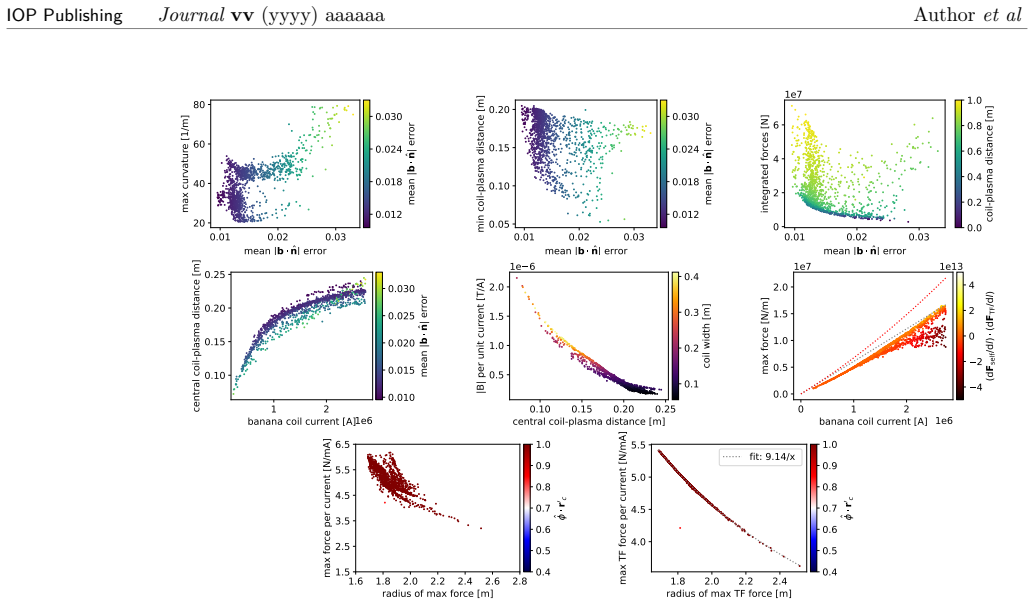
The optimised tokamak-stellarator hybrid concept (Henneberg and Plunk 2024) has the potential to combine tokamak and stellarator advantages to achieve magnetically confined fusion. These compact quasi-axisymmetric designs can have a low aspect ratio and large plasma volume, good particle confinement, and relatively simple coils. Previous work showed that such magnetic configurations can in principle be reproduced by a single type of non-planar "banana coil" alongside the conventional tokamak coilset (Henneberg and Plunk 2025). In this work, we optimise banana coils while also considering engineering constraints beyond simple geometric measures. We quantify the characteristic geometries of force-optimised banana coils and the magnetic fields they generate, and analyse the mechanisms by which forces may be reduced through optimisation.
Editorial analysis
A structured set of objections, weighed in public.
Referee Report
Summary. The manuscript extends prior work on tokamak-stellarator hybrid concepts by optimizing non-planar banana coils under expanded engineering constraints (including forces) beyond pure geometry, quantifies the resulting coil shapes and generated fields, and analyzes force-reduction mechanisms while claiming to reproduce the quasi-axisymmetric hybrid configurations of Henneberg and Plunk 2025.
Significance. If substantiated, the results would provide a concrete route to engineering-constrained coil sets for compact QA hybrids, directly addressing the gap between idealized magnetic configurations and practical force/engineering limits.
major comments (1)
- [Abstract] Abstract: the central claim that force-optimized banana coils 'reproduce prior hybrid configurations' is unsupported by any reported quantitative metrics (field-error norms, iota profiles, quasi-axisymmetry measures, or residual error comparisons to the 2025 reference); this directly undermines the premise that the subsequent force-reduction analysis applies to the same magnetic configurations.
minor comments (1)
- The optimization objective function (weighting of force terms versus field-reproduction terms) is not explicitly defined; adding this would clarify how the expanded constraints affect the solution space.
Simulated Author's Rebuttal
We thank the referee for their constructive review and the recommendation for major revision. We address the single major comment point-by-point below.
read point-by-point responses
-
Referee: [Abstract] Abstract: the central claim that force-optimized banana coils 'reproduce prior hybrid configurations' is unsupported by any reported quantitative metrics (field-error norms, iota profiles, quasi-axisymmetry measures, or residual error comparisons to the 2025 reference); this directly undermines the premise that the subsequent force-reduction analysis applies to the same magnetic configurations.
Authors: We agree that the abstract does not provide quantitative metrics demonstrating that the force-optimized banana coils reproduce the target quasi-axisymmetric hybrid configurations from Henneberg and Plunk 2025. While the optimization procedure is initialized from and constrained toward those configurations, the absence of explicit comparisons (e.g., field-error norms, iota profiles, or QA measures) leaves the claim unsubstantiated in the current text. In the revised manuscript we will add a dedicated subsection or figure with these metrics, including direct residual-error comparisons to the 2025 reference, to confirm that the force-optimized coils retain the essential magnetic properties before presenting the force-reduction analysis. revision: yes
Circularity Check
No significant circularity; optimization and analysis are independent of cited baseline.
full rationale
The paper conducts a new optimization of banana coils that incorporates force and engineering metrics beyond the geometric measures of the 2025 reference, then quantifies the resulting coil shapes and generated fields. The citation to Henneberg and Plunk 2025 supplies only the starting hybrid configuration that the prior geometry-only coils could reproduce; the present work does not treat reproduction under the expanded objective as given by that citation or by any fitted parameter. No equation or claim reduces a derived field property or force-reduction mechanism to a quantity defined from the same data or prior result by construction. The self-citation is background and does not carry the central claims.
Axiom & Free-Parameter Ledger
Reference graph
Works this paper leans on
-
[1]
Physica D: Nonlinear Phenomena , author =
Stellarator symmetry , volume =. Physica D: Nonlinear Phenomena , author =. 1998 , keywords =. doi:10.1016/S0167-2789(97)00216-9 , abstract =
-
[2]
Henneberg, S. A. and Plunk, G. G. , month = jun, year =. Compact stellarator-tokamak hybrid , volume =. Physical Review Research , publisher =. doi:10.1103/PhysRevResearch.6.L022052 , abstract =
-
[3]
Physical Review Research , author =
Exploring novel compact quasi-axisymmetric stellarators , volume =. Physical Review Research , author =. 2024 , keywords =. doi:10.1103/PhysRevResearch.6.L042052 , language =
-
[4]
Journal of Plasma Physics , volume =
Perturbing an axisymmetric magnetic equilibrium to obtain a quasi-axisymmetric stellarator , volume =. Journal of Plasma Physics , author =. 2020 , keywords =. doi:10.1017/S0022377820000902 , abstract =
-
[5]
Journal of Plasma Physics , author =
Representing the boundary of stellarator plasmas , volume =. Journal of Plasma Physics , author =. 2021 , keywords =. doi:10.1017/S0022377821000891 , abstract =
-
[6]
Theory of plasma confinement in non-axisymmetric magnetic fields , volume =
Helander, Per , month = jul, year =. Theory of plasma confinement in non-axisymmetric magnetic fields , volume =. Reports on Progress in Physics , publisher =. doi:10.1088/0034-4885/77/8/087001 , abstract =
-
[7]
Plasma Physics and Controlled Fusion , author =
The virtual-casing principle and. Plasma Physics and Controlled Fusion , author =. 2015 , keywords =. doi:10.1088/0741-3335/57/11/115006 , abstract =
-
[8]
Use of the virtual-casing principle in calculating the containing magnetic field in toroidal plasma systems , volume =. Nuclear Fusion , author =. 1972 , keywords =. doi:10.1088/0029-5515/12/5/009 , language =
-
[9]
Wiedman, A and Buller, Stefan and Landreman, Matt , doi =. Coil. Journal of Plasma Physics , volume=. 2024 , publisher=
2024
-
[10]
An improved current potential method for fast computation of stellarator coil shapes , volume =. Nuclear Fusion , author =. 2017 , note =. doi:10.1088/1741-4326/aa57d4 , abstract =
-
[11]
Design of. Nuclear Fusion , author =. 2025 , keywords =. doi:10.1088/1741-4326/ada2a9 , abstract =
-
[12]
Journal of Plasma Physics , author =
Quasi-axisymmetric magnetic fields: weakly non-axisymmetric case in a vacuum , volume =. Journal of Plasma Physics , author =. 2018 , keywords =. doi:10.1017/S0022377818000259 , abstract =
-
[13]
Optimization of quasi-symmetric stellarators with self-consistent bootstrap current and energetic particle confinement , volume =. Physics of Plasmas , author =. 2022 , keywords =. doi:10.1063/5.0098166 , abstract =
-
[14]
Journal of Plasma Physics , author =
Optimization of finite-build stellarator coils , volume =. Journal of Plasma Physics , author =. 2020 , keywords =. doi:10.1017/S0022377820000756 , abstract =
-
[15]
Journal of Mathematical Physics , author =
Some mathematics for quasi-symmetry , volume =. Journal of Mathematical Physics , author =. 2020 , keywords =. doi:10.1063/1.5142487 , abstract =
-
[16]
Plasma Physics and Controlled Fusion , volume =
The magnetic gradient scale length explains why certain plasmas require close external magnetic coils , volume =. Plasma Physics and Controlled Fusion , author =. 2024 , keywords =. doi:10.1088/1361-6587/ad1a3e , abstract =
-
[17]
Kaptanoglu, Alan A. and Wiedman, Alexander and Halpern, Jacob and Hurwitz, Siena and Paul, Elizabeth J. and Landreman, Matt , month = apr, year =. Reactor-scale stellarators with force and torque minimized dipole coils , volume =. Nuclear Fusion , publisher =. doi:10.1088/1741-4326/adc318 , abstract =
-
[18]
Journal of Plasma Physics , volume =
Combined plasma–coil optimization algorithms , volume =. Journal of Plasma Physics , author =. 2021 , keywords =. doi:10.1017/S0022377821000271 , abstract =
-
[19]
Plasma Physics and Controlled Fusion , author =
Optimization of compact quasi-axisymmetric stellarators , volume =. Plasma Physics and Controlled Fusion , author =. 2025 , pages =. doi:10.1088/1361-6587/add598 , abstract =
-
[20]
The Physics of Fluids , volume =
Steepest-descent moment method for three-dimensional magnetohydrodynamic equilibria , volume =. The Physics of Fluids , author =. 1983 , pages =. doi:10.1063/1.864116 , abstract =
-
[21]
Plasma Physics and Controlled Fusion , author =
Physics in the magnetic configuration space of. Plasma Physics and Controlled Fusion , author =. 2015 , pages =. doi:10.1088/0741-3335/57/1/014004 , abstract =
-
[22]
Low edge safety factor operation and passive disruption avoidance in current carrying plasmas by the addition of stellarator rotational transform , volume =. Physics of Plasmas , author =. 2015 , pages =. doi:10.1063/1.4935396 , abstract =
-
[23]
Plasma Physics and Controlled Fusion , volume =
Variety of coil sets for the compact stellarator-tokamak hybrid , volume =. Plasma Physics and Controlled Fusion , author =. 2025 , pages =. doi:10.1088/1361-6587/add763 , abstract =
-
[24]
Plasma Physics and Controlled Fusion , author =
Back to the figure-8 stellarator , volume =. Plasma Physics and Controlled Fusion , author =. 2025 , pages =. doi:10.1088/1361-6587/adb64b , abstract =
-
[25]
Magnetic. Physical Review Letters , author =. 2022 , pages =. doi:10.1103/PhysRevLett.128.035001 , language =
-
[26]
Nonaxisymmetric shaping of tokamaks preserving quasiaxisymmetry , volume =. Physics of Plasmas , author =. 2009 , pages =. doi:10.1063/1.3207010 , abstract =
-
[27]
The Physics of Fluids , author =
Transport and isomorphic equilibria , volume =. The Physics of Fluids , author =. 1983 , pages =. doi:10.1063/1.864166 , abstract =
-
[28]
Byrd, R. H. and Peihuang, L. and Nocedal, J. , month = mar, year =. A limited-memory algorithm for bound-constrained optimization , doi =. UNT Digital Library , publisher =
-
[29]
Mathematical Programming , author =
On the limited memory. Mathematical Programming , author =. 1989 , keywords =. doi:10.1007/BF01589116 , abstract =
-
[30]
Bosch, H.-S. and Wolf, R.C. and Andreeva, T. and Baldzuhn, J. and Birus, D. and Bluhm, T. and Bräuer, T. and Braune, H. and Bykov, V. and Cardella, A. and Durodié, F. and Endler, M. and Erckmann, V. and Gantenbein, G. and Hartmann, D. and Hathiramani, D. and Heimann, P. and Heinemann, B. and Hennig, C. and Hirsch, M. and Holtum, D. and Jagielski, J. and J...
-
[31]
, year = 2024, month = nov, journal =
Efficient. IEEE Transactions on Magnetics , author =. 2024 , keywords =. doi:10.1109/TMAG.2024.3455946 , number =
-
[32]
Electromagnetic Coil Optimization for Reduced
Hurwitz, Siena and Landreman, Matt and Huslage, Paul and Kaptanoglu, Alan , month = apr, year =. Electromagnetic coil optimization for reduced. Nuclear Fusion , publisher =. doi:10.1088/1741-4326/adc9bf , language =
-
[33]
Extreme low aspect ratio stellarators , volume =. Physics Letters A , author =. 1998 , pages =. doi:10.1016/S0375-9601(98)00215-1 , abstract =
-
[34]
Moroz, Paul E. , month = jul, year =. Spherical. Physical Review Letters , publisher =. doi:10.1103/PhysRevLett.77.651 , abstract =
-
[35]
Stabilization of the (2, 1) tearing mode and of the current disruption in the. Nuclear Fusion , author =. 1980 , pages =. doi:10.1088/0029-5515/20/9/008 , abstract =
-
[36]
Stellarators and the Path from
Stellarators and the path from. Plasma Physics and Controlled Fusion , author =. 2008 , pages =. doi:10.1088/0741-3335/50/12/124005 , abstract =
-
[37]
Journal of Open Source Software , volume =
Landreman, Matt and Giuliani, Andrew and Dudt, Daniel and others , title =. Journal of Open Source Software , volume =. 2022 , doi =
2022
-
[38]
Nuclear Fusion , volume=
Efficient calculation of self magnetic field, self-force, and self-inductance for electromagnetic coils with rectangular cross-section , author=. Nuclear Fusion , volume=. 2025 , publisher=
2025
-
[39]
doi:10.21105/joss.03525 , urldate =
Landreman, Matt and Medasani, Bharat and Wechsung, Florian and Giuliani, Andrew and Jorge, Rogerio and Zhu, Caoxiang , title =. doi:10.21105/joss.03525 , year =
-
[40]
Gruber, O. and Kaufmann, M. and Köppendörfer, W. and Lackner, K. and Neuhauser, J. , month = may, year =. Physics background of the. doi:10.1016/0022-3115(84)90153-3 , journal =
-
[41]
Plasma Physics and Controlled Fusion , author =
Major results from the stellarator. Plasma Physics and Controlled Fusion , author =. 2008 , pages =. doi:10.1088/0741-3335/50/5/053001 , language =
-
[42]
doi:10.1137/1.9781611978223 , urldate =
Imbert-Gérard, Lise-Marie and Paul, Elizabeth J. and Wright, Adelle M. , year =. An. doi:10.1137/1.9781611978223 , publisher =
-
[43]
W7-. Physics of Plasmas , author =. 2005 , pages =. doi:10.1063/1.1927100 , number =
-
[44]
G. J. Hartwell and S. F. Knowlton and J. D. Hanson and D. A. Ennis and D. A. Maurer , title =. Fusion Science and Technology , volume =. 2017 , publisher =. doi:10.1080/15361055.2017.1291046 , eprint =
-
[45]
Plasma Physics and Controlled Fusion , author =
Overview of the. Plasma Physics and Controlled Fusion , author =. 2000 , pages =. doi:10.1088/0741-3335/42/11/303 , number =
-
[46]
1999 , publisher=
Numerical Optimization , author=. 1999 , publisher=
1999
-
[47]
Effect of the magnetic field ripple on diffusion in. Nuclear Fusion , author =. 1972 , pages =. doi:10.1088/0029-5515/12/6/010 , abstract =
-
[48]
1962 , publisher=
Classical Electrodynamics , author=. 1962 , publisher=
1962
-
[49]
1972 , publisher=
Handbook of Mathematical Functions with Formulas, Graphs, and Mathematical Tables , author=. 1972 , publisher=
1972
-
[50]
1987 , month =
Wesson, J , title =. 1987 , month =
1987
-
[51]
and Abe, Y
Yamazaki, K. and Abe, Y. and Physics, Nagoya Univ (Japan) Inst of Plasma , month = feb, year =
-
[52]
Fusion Engineering and design , volume=
Design of the national compact stellarator experiment (NCSX) , author=. Fusion Engineering and design , volume=. 2003 , publisher=
2003
-
[53]
Theory of Fusion Plasmas: Proceedings of the Joint Varenna-Lausanne International Workshop , pages=
Quasi-axisymmetric tokamaks , author=. Theory of Fusion Plasmas: Proceedings of the Joint Varenna-Lausanne International Workshop , pages=. 1994 , organization=
1994
-
[54]
Plasma Physics and Controlled Fusion , volume=
Physics of the compact advanced stellarator NCSX , author=. Plasma Physics and Controlled Fusion , volume=
-
[55]
Physical Review Letters , volume=
Magnetic fields with precise quasisymmetry for plasma confinement , author=. Physical Review Letters , volume=. 2022 , publisher=
2022
-
[56]
Nuclear Fusion , volume=
Properties of a new quasi-axisymmetric configuration , author=. Nuclear Fusion , volume=. 2019 , publisher=
2019
-
[57]
Plasma physics and controlled fusion , volume=
The ITER design , author=. Plasma physics and controlled fusion , volume=
-
[58]
arXiv preprint arXiv:2606.04122 , year=
Compact quasiaxisymmetric stellarators, a near axisymmetric theory , author=. arXiv preprint arXiv:2606.04122 , year=
-
[59]
arXiv preprint arXiv:2605.21814 , year=
Optical analogy for stellarators: Ridges as caustics and coils as singularities , author=. arXiv preprint arXiv:2605.21814 , year=
-
[60]
arXiv preprint arXiv:2604.12339 , year=
Estimating coil features from an equilibrium , author=. arXiv preprint arXiv:2604.12339 , year=
-
[61]
Journal of Plasma Physics , volume=
A comprehensive exploration of quasisymmetric stellarators and their coil sets , author=. Journal of Plasma Physics , volume=. 2025 , publisher=
2025
-
[62]
Journal of Plasma Physics , volume=
Constructing precisely quasi-isodynamic magnetic fields , author=. Journal of Plasma Physics , volume=. 2023 , publisher=
2023
-
[63]
Journal of Plasma Physics , volume=
Exploration of the parameter space of quasisymmetric stellarator vacuum fields through adjoint optimisation , author=. Journal of Plasma Physics , volume=. 2024 , publisher=
2024
discussion (0)
Sign in with ORCID, Apple, or X to comment. Anyone can read and Pith papers without signing in.