Quartic Lyapunov functions for global fluid stability
Pith reviewed 2026-06-26 22:22 UTC · model grok-4.3
The pith
A three-parameter family of quartic polynomials serves as Lyapunov functions to prove global stability of two-dimensional shear flows at Reynolds numbers beyond the reach of the energy method.
A machine-rendered reading of the paper's core claim, the machinery that carries it, and where it could break.
Core claim
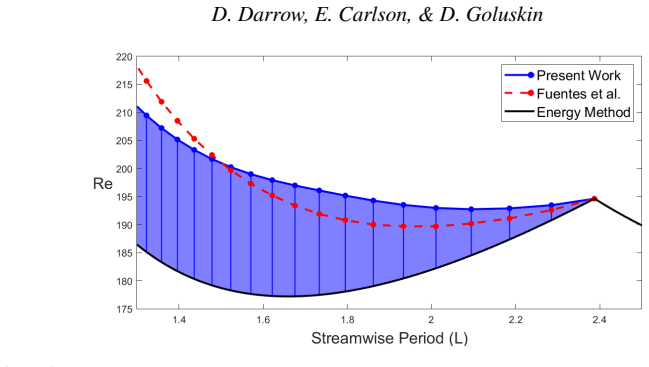
We show how to exploit symmetries of shear flows via convenient complex variable representations, greatly reducing the problem size. We then refine key inequalities, replace several expensive computational steps with simpler analytical alternatives, and show how to prove global stability over a range of Reynolds numbers. Our analysis identifies the simplest class of non-quadratic Lyapunov functions for two-dimensional parallel shear flows: a three-parameter family of quartic polynomials. Using these Lyapunov functions, we verify global stability of 2-D plane Couette flow and plane Poiseuille flow up to higher Reynolds numbers than possible with the energy method.
What carries the argument
three-parameter family of quartic polynomials that serve as Lyapunov functions, constructed via complex variable representations of shear flows
Load-bearing premise
The three-parameter family of quartic polynomials remains a valid Lyapunov function across the claimed Reynolds number ranges without parameter tuning that would invalidate the analytical proof.
What would settle it
An explicit initial condition at one of the claimed stable Reynolds numbers for which a 2-D Couette or Poiseuille flow fails to return to the base state would falsify the stability claim.
Figures
read the original abstract
A fluid system is 'globally stable' if all initial conditions eventually converge to the same state. Since Reynolds (1895) and Orr (1907), the standard way to show global stability has been the energy method, which uses the fluctuation energy as a Lyapunov function. However, the energy method fails whenever transient energy growth is possible, so it often yields overly strict stability criteria. The first broadly applicable alternative has recently been introduced (Goulart & Chernyshenko 2012; Fuentes et al. 2022), using polynomial optimization to construct non-quadratic Lyapunov functions. Unlike the energy method, however, this approach is highly technical, computationally expensive, and hard to interpret physically. Moreover, it treats only one set of parameters at a time; in particular, if it verifies global stability at a certain Reynolds number, it does not imply the same for smaller values. The present work makes progress by connecting this numerical program with new analytical and physical insights. We show how to exploit symmetries of shear flows via convenient complex variable representations, greatly reducing the problem size. We then refine key inequalities, replace several expensive computational steps with simpler analytical alternatives, and show how to prove global stability over a range of Reynolds numbers. Our analysis identifies the simplest class of non-quadratic Lyapunov functions for two-dimensional parallel shear flows: a three-parameter family of quartic polynomials. Using these Lyapunov functions, we verify global stability of 2-D plane Couette flow and plane Poiseuille flow up to higher Reynolds numbers than possible with the energy method. Our work takes a step towards an analytical theory of global fluid stability beyond the energy method, and offers structural insights that should significantly improve future numerical investigations of global stability.
Editorial analysis
A structured set of objections, weighed in public.
Referee Report
Summary. The manuscript claims that a three-parameter family of quartic polynomial Lyapunov functions, after reduction via complex-variable symmetries of shear flows and replacement of some SOS steps by refined analytical inequalities, certifies global asymptotic stability for 2-D plane Couette and plane Poiseuille flows at Reynolds numbers beyond the classical energy-method threshold, and moreover does so uniformly over intervals of Re rather than at isolated points.
Significance. If the range proofs hold with fixed parameters, the work supplies the simplest known non-quadratic Lyapunov functions for these flows together with an explicit route from numerical polynomial optimization to analytical verification, which could guide future constructions and reduce reliance on per-Re black-box solves.
major comments (2)
- [Abstract and the section presenting the range proofs] The central claim that stability is proved 'over a range of Reynolds numbers' with the same three-parameter family rests on the passage from discrete verification to uniform negativity of dV/dt. The manuscript must exhibit an explicit continuity or monotonicity argument showing that the analytical bounds remain strictly negative for all Re in each claimed interval once the three parameters are frozen; without this, the range statement does not follow from pointwise checks.
- [The section defining the three-parameter family and the subsequent stability theorems] The three free parameters of the quartic family are listed as the only free parameters. The text must state unambiguously whether these parameters are chosen once per flow (independent of Re) or re-optimized inside each interval; if the latter, the 'prove over a range' assertion requires additional justification that the chosen values remain valid throughout the interval.
minor comments (2)
- Add a short table comparing the highest Re for which global stability is now certified against the energy-method limit for both Couette and Poiseuille cases.
- Clarify the precise form of the refined inequalities that replace the SOS steps; a one-paragraph derivation or reference to the inequality used would aid reproducibility.
Simulated Author's Rebuttal
We thank the referee for the careful reading and constructive suggestions. We respond point-by-point to the major comments below, clarifying the structure of the range proofs and the selection of the three parameters. We agree that certain aspects of the presentation can be made more explicit.
read point-by-point responses
-
Referee: [Abstract and the section presenting the range proofs] The central claim that stability is proved 'over a range of Reynolds numbers' with the same three-parameter family rests on the passage from discrete verification to uniform negativity of dV/dt. The manuscript must exhibit an explicit continuity or monotonicity argument showing that the analytical bounds remain strictly negative for all Re in each claimed interval once the three parameters are frozen; without this, the range statement does not follow from pointwise checks.
Authors: The range proofs in the manuscript rely on the refined analytical inequalities (replacing certain SOS steps) that produce explicit rational bounds on dV/dt whose negativity can be verified uniformly once the parameters are fixed. These bounds are constructed to be monotonic in Re, so that negativity at the endpoints of each interval together with the absence of interior roots suffices for the entire interval. We acknowledge that the continuity/monotonicity step is not isolated as a separate lemma and will add an explicit statement of this argument in the revised section on range proofs. revision: yes
-
Referee: [The section defining the three-parameter family and the subsequent stability theorems] The three free parameters of the quartic family are listed as the only free parameters. The text must state unambiguously whether these parameters are chosen once per flow (independent of Re) or re-optimized inside each interval; if the latter, the 'prove over a range' assertion requires additional justification that the chosen values remain valid throughout the interval.
Authors: The three parameters are chosen once per flow (independent of Re) to maximize the certified stability interval; they are not re-optimized inside any interval. This choice is already implicit in the definition of the family and in the subsequent theorems, but we agree the wording can be made unambiguous. We will revise the relevant section to state explicitly that the parameters are fixed for each flow and that the range proofs hold with these fixed values. revision: yes
Circularity Check
No circularity: analytical reductions and range proofs are independent of fitted inputs
full rationale
The derivation introduces a three-parameter quartic family via symmetry reductions and analytical inequality refinements that replace SOS steps. Global stability over Re intervals is obtained by freezing parameters and verifying the negativity condition analytically, without the verification reducing to a fit or self-citation chain. Prior numerical work is cited only for context; the load-bearing steps (complex-variable reformulation, refined bounds, range extension) are self-contained and externally falsifiable. No self-definitional, fitted-prediction, or uniqueness-imported circularity is present.
Axiom & Free-Parameter Ledger
free parameters (1)
- three parameters of the quartic family
axioms (1)
- domain assumption Symmetries of shear flows can be exploited via complex variable representations to reduce problem size
Reference graph
Works this paper leans on
-
[1]
Journal of Applied Mathematics and Mechanics , author =
Example of the generation of a secondary stationary or periodic flow when there is loss of stability of the laminar flow of a viscous incompressible fluid , volume =. Journal of Applied Mathematics and Mechanics , author =. 1965 , pages =. doi:10.1016/0021-8928(65)90062-6 , number =
-
[2]
, year =
Henry, D. , year =. Geometric
-
[3]
P. J. Olver , title =. 1993 , doi =
1993
-
[4]
Geometric and Functional Analysis , author =
Local. Geometric and Functional Analysis , author =. 2012 , pages =. doi:10.1007/s00039-012-0149-8 , number =
-
[5]
Izosimov, Anton and Khesin, Boris , month = nov, year =. Characterization of. doi:10.1093/imrn/rnw230 , journal =
-
[6]
and Goluskin, D
Oeri, H. and Goluskin, D. , journal =. Convex computation of maximal. 2023 , doi =
2023
-
[7]
Drazin, P. G. and Reid, W. H. , year =. Hydrodynamic
-
[8]
Internal waves in sheared flows: Lower bound of the vorticity growth and propagation discontinuities in the parameter space , author =. Physical Review E , volume =. 2018 , month =. doi:10.1103/PhysRevE.97.063102 , url =
-
[9]
Two-dimensional nonlinear plane. Physics of Fluids , author =. 2008 , pages =. doi:10.1063/1.2943675 , number =
-
[10]
On the existence of two-dimensional nonlinear steady states in plane. Physics of Fluids , author =. 2007 , pages =. doi:10.1063/1.2753982 , number =
-
[11]
Journal of Fluid Mechanics , author =
Transition to turbulence in plane. Journal of Fluid Mechanics , author =. 1980 , pages =. doi:10.1017/S0022112080002066 , number =
-
[12]
Curtain, R. F. and Zwart, H. , year =. An
-
[13]
Physica D: Nonlinear Phenomena , author =
Les invariants du premier ordre de l'equation d'euler en dimension trois , volume =. Physica D: Nonlinear Phenomena , author =. 1984 , pages =. doi:https://doi.org/10.1016/0167-2789(84)90273-2 , abstract =
-
[14]
Folland, G. B. , year =. A
-
[15]
Parrilo, P. , month = mar, year =. Semidefinite Programming Relaxations for Semialgebraic Problems , volume =. doi:10.1007/s10107-003-0387-5 , journal =
-
[16]
Mathematical Programming , author =
Some. Mathematical Programming , author =. 1987 , pages =. doi:10.1007/BF02592948 , abstract =
-
[17]
SIAM Journal on Applied Algebra and Geometry , author =. 2019 , note =. doi:10.1137/18M118935X , abstract =
-
[18]
SIAM Journal on Mathematics of Data Science , author =
Scalable. SIAM Journal on Mathematics of Data Science , author =. 2021 , note =. doi:10.1137/19M1305045 , abstract =
-
[19]
Annual Reviews in Control , author =
Chordal and factor-width decompositions for scalable semidefinite and polynomial optimization , volume =. Annual Reviews in Control , author =. 2021 , keywords =. doi:https://doi.org/10.1016/j.arcontrol.2021.09.001 , abstract =
-
[20]
Proceedings of the Royal Irish Academy
The Stability or Instability of the Steady Motions of a Perfect Liquid and of a Viscous Liquid. Proceedings of the Royal Irish Academy. Section A: Mathematical and Physical Sciences , author =. 1907 , pages =
1907
-
[21]
Philosophical Transactions of the Royal Society of London. (A.) , author =. 1895 , pages =. doi:10.1098/rsta.1895.0004 , abstract =
-
[22]
Archive for Rational Mechanics and Analysis , author =
Nonlinear stability of the. Archive for Rational Mechanics and Analysis , author =. 1966 , pages =. doi:10.1007/BF00266474 , number =
-
[23]
Quarterly of Applied Mathematics , author =
Stability of. Quarterly of Applied Mathematics , author =. 1969 , pages =
1969
-
[24]
Archive for Rational Mechanics and Analysis , author =
A. Archive for Rational Mechanics and Analysis , author =. 1972 , pages =. doi:10.1007/BF00252186 , number =
-
[25]
Joseph, D. D. , year =. Stability of
-
[26]
1997 , publisher=
Inequalities for Differential and Integral Equations , author=. 1997 , publisher=
1997
-
[27]
Philosophical Transactions: Mathematical, Physical and Engineering Sciences , author =
Experimental and. Philosophical Transactions: Mathematical, Physical and Engineering Sciences , author =. 2008 , pages =
2008
-
[28]
Journal of Fluid Mechanics , author =
Nonlinear cellular motions in. Journal of Fluid Mechanics , author =. 1974 , pages =. doi:10.1017/S0022112074002424 , number =
-
[29]
Nagata, M. , year =. Three-dimensional finite-amplitude solutions in plane. doi:10.1017/S0022112090000829 , journal =
-
[30]
Homotopy of exact coherent structures in plane shear flows , volume =. Physics of Fluids , author =. 2003 , pages =. doi:10.1063/1.1566753 , abstract =
-
[31]
, year =
Straughan, B. , year =. The Energy Method, Stability, and Nonlinear Convection , isbn =
-
[32]
SIAM Journal on Mathematical Analysis , author =
A Generalized Energy Functional for Plane. SIAM Journal on Mathematical Analysis , author =. 2005 , pages =. doi:10.1137/S0036141004442604 , abstract =
-
[33]
, title =
Meyer, Carl D. , title =. 2023 , doi =
2023
-
[34]
, year =
Kearfott, R. , year =. Interval Computations: Introduction, Uses, and Resources , volume =
-
[35]
2012 , publisher=
The Navier-Stokes Equations: An Elementary Functional Analytic Approach , author=. 2012 , publisher=
2012
-
[36]
Archive for Rational Mechanics and Analysis , author =
A new approach to energy theory in the stability of fluid motion , volume =. Archive for Rational Mechanics and Analysis , author =. 1990 , pages =. doi:10.1007/BF00375129 , number =
-
[37]
Journal of Differential Equations , author =
Non-coercive. Journal of Differential Equations , author =. 2019 , keywords =. doi:https://doi.org/10.1016/j.jde.2018.11.026 , abstract =
-
[38]
Archive for Rational Mechanics and Analysis , author =
On the stability of viscous fluid motions , volume =. Archive for Rational Mechanics and Analysis , author =. 1959 , pages =. doi:10.1007/BF00284160 , number =
-
[39]
Physica D: Nonlinear Phenomena , author =
Global stability analysis of fluid flows using sum-of-squares , volume =. Physica D: Nonlinear Phenomena , author =. 2012 , pages =. doi:10.1016/j.physd.2011.12.008 , number =
-
[40]
Proceedings: Mathematical, Physical and Engineering Sciences , author =
Sum-of-squares of polynomials approach to nonlinear stability of fluid flows: an example of application , volume =. Proceedings: Mathematical, Physical and Engineering Sciences , author =. 2015 , pages =
2015
-
[41]
Physical Review Letters , author =
Global Stability of Fluid Flows Despite Transient Growth of Energy , volume =. Physical Review Letters , author =. 2022 , pages =. doi:10.1103/PhysRevLett.128.204502 , number =
-
[42]
Ordinary. Technometrics , author =. 1975 , pages =. doi:10.1080/00401706.1975.10489355 , number =
-
[43]
Annals of Mathematics , author =
Note on the. Annals of Mathematics , author =. 1919 , pages =
1919
-
[44]
and Arnold, V.I
Cooke, R. and Arnold, V.I. , year =. Ordinary
-
[45]
2013 , publisher=
Geophysical Fluid Dynamics , author=. 2013 , publisher=
2013
-
[46]
Physical Review Letters , author =
Subcritical transition to turbulence in plane. Physical Review Letters , author =. 1992 , pages =. doi:10.1103/PhysRevLett.69.2511 , number =
-
[47]
Functional Analysis and Its Applications , author =
Stability of plane-parallel. Functional Analysis and Its Applications , author =. 1973 , pages =. doi:10.1007/BF01078886 , number =
-
[48]
The MOSEK Python Fusion API manual
MOSEK ApS. The MOSEK Python Fusion API manual. Version 11.0
-
[49]
Foundations and Trends in Optimization , author =
Chordal. Foundations and Trends in Optimization , author =. 2015 , pages =. doi:10.1561/2400000006 , number =
-
[50]
Pringle, C. C. T. and Kerswell, R. R. , year=. Asymmetric, Helical, and Mirror-Symmetric Traveling Waves in Pipe Flow , volume=. Physical Review Letters , publisher=. doi:10.1103/physrevlett.99.074502 , number=
-
[51]
Soibelman, I. and Meiron, D. I. , year=. Finite-amplitude bifurcations in plane Poiseuille flow: two-dimensional Hopf bifurcation , volume=. doi:10.1017/S0022112091003075 , journal=
-
[52]
Parker, J. P. , title =. 2024 , month =. doi:10.1088/1361-6544/ad68bb , url =
-
[53]
Casas, P. S. and Jorba, \`. Hopf bifurcations to quasi-periodic solutions for the two-dimensional plane. Communications in Nonlinear Science and Numerical Simulation , publisher=. 2012 , month=jul, pages=. doi:10.1016/j.cnsns.2011.11.008 , number=
-
[54]
Iligaray, V. and Aballay, D. and Fuentes, F. , DOI=. arXiv:2604.23915v2 , year=
-
[55]
Pre- and post-processing sum-of-squares programs in practice , volume =
L. Pre- and post-processing sum-of-squares programs in practice , volume =. IEEE Transactions on Automatic Control , pages =
-
[56]
Existence and smoothness of the Navier-Stokes equation , journal =
Fefferman, Charles , year =. Existence and smoothness of the Navier-Stokes equation , journal =
-
[57]
1963 , number=
The Mathematical Theory of Viscous Incompressible Flow , author=. 1963 , number=
1963
discussion (0)
Sign in with ORCID, Apple, or X to comment. Anyone can read and Pith papers without signing in.