Archetypal Microbiome Profiles as Indicators of Nitrous Oxide Emission States in Activated Sludge
Pith reviewed 2026-06-27 01:56 UTC · model grok-4.3
The pith
Archetypal analysis of activated sludge microbiomes identifies a community profile linked to high nitrous oxide emissions across two plants without using emission labels in training.
A machine-rendered reading of the paper's core claim, the machinery that carries it, and where it could break.
Core claim
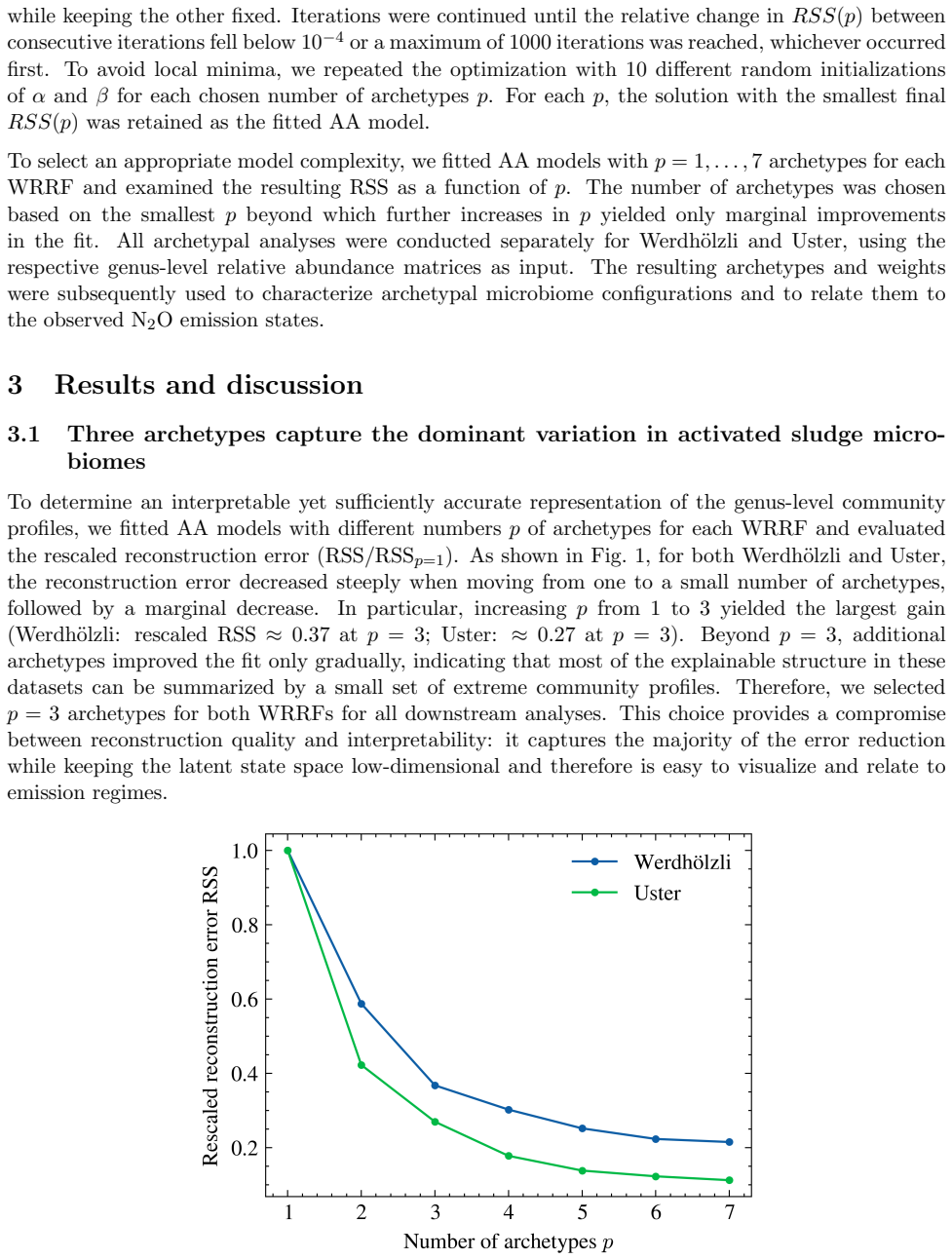
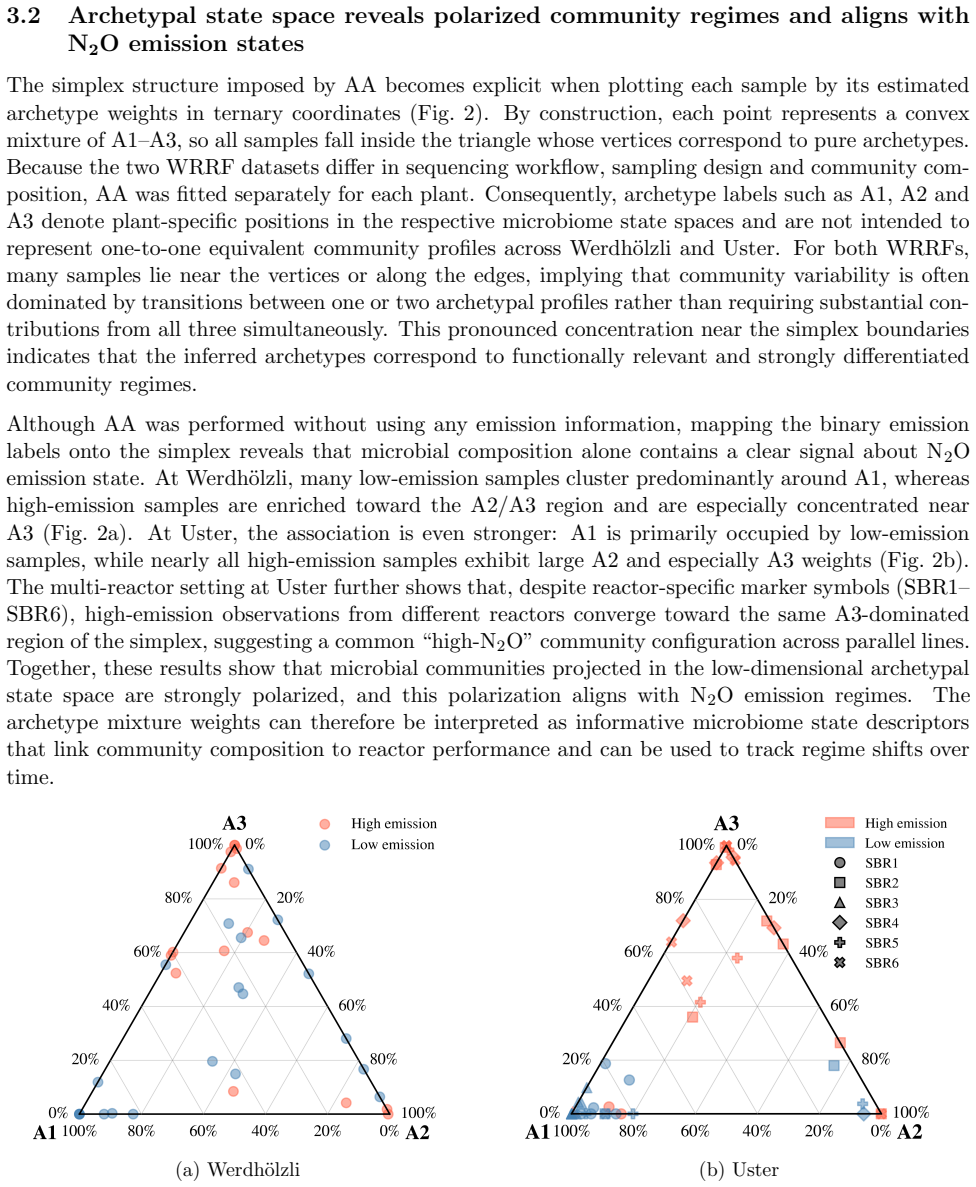
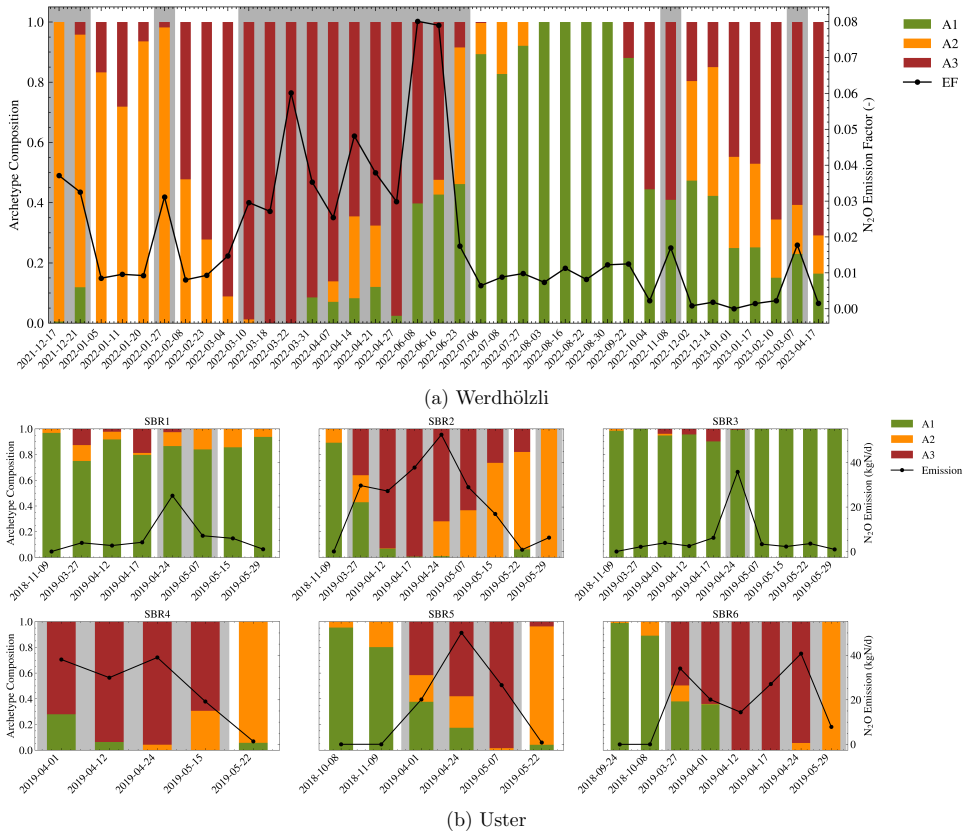
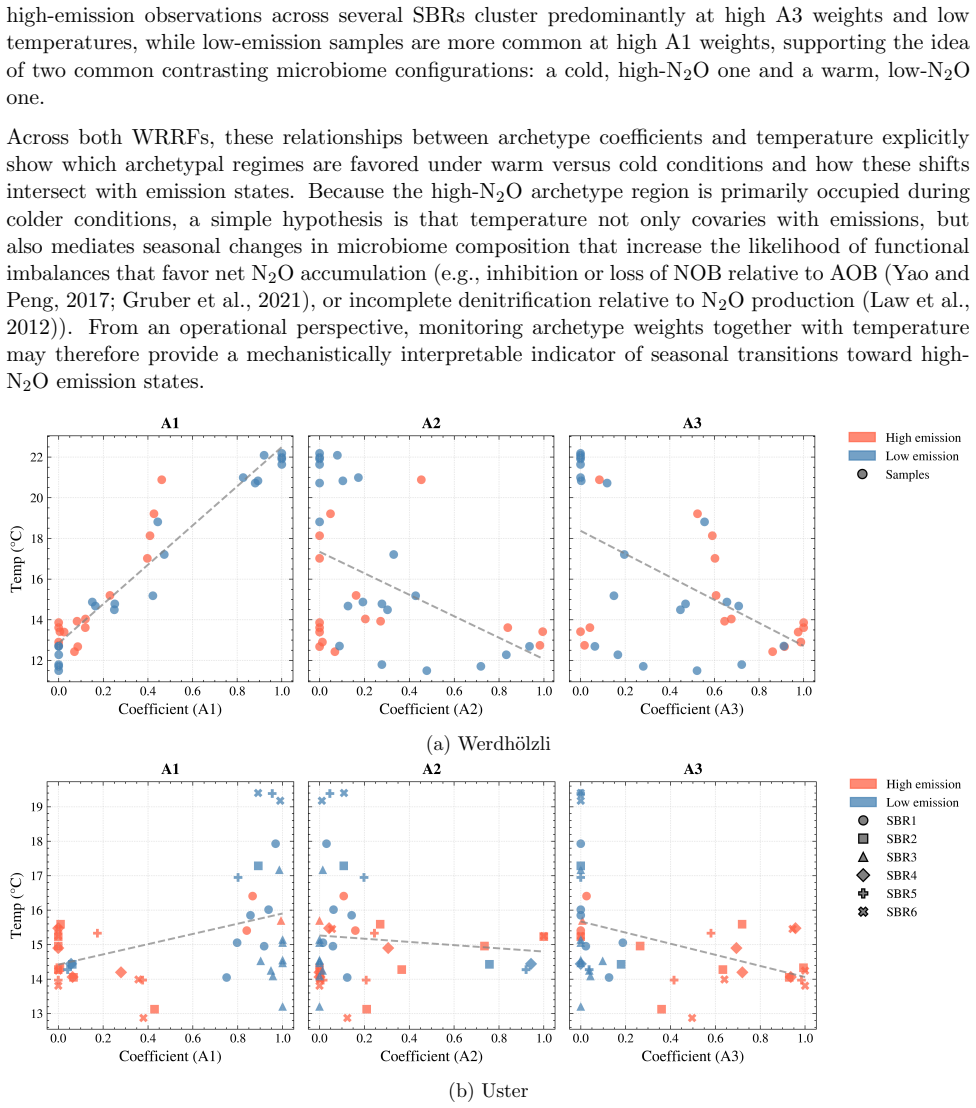
In both WRRFs, three archetypes captured most explainable variation in community composition (63%--73%) and defined a simplex state space in which samples clustered near vertices and edges. Without using emission labels while training, the archetypal state space aligned strongly with binary N2O emission states: high-emission observations in both plants concentrated around a specific archetype, and temporal trajectories showed consistent high weights of this archetype during high-emission periods. Functional summaries suggested site-specific but pathway-relevant interpretations of the high-N2O archetype. Temperature further structured the archetypal state space, indicating seasonal forcing of
What carries the argument
Archetypal analysis, which expresses each microbiome sample as a convex combination of a small set of extremal community profiles that serve as vertices of a simplex state space.
If this is right
- The high-N2O archetype weight can serve as a real-time indicator of emission regime shifts in operating plants.
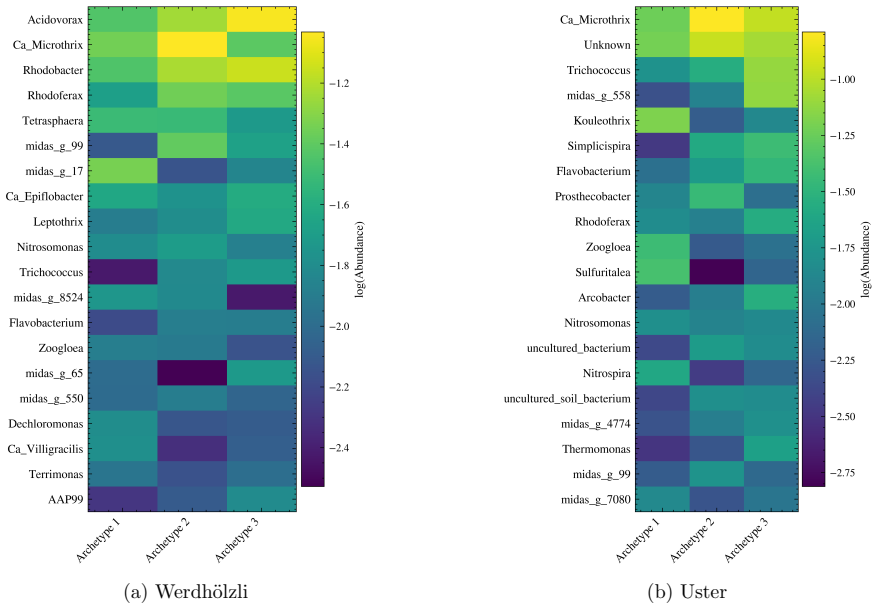
- Functional gene summaries attached to the archetype point to site-dependent microbial pathways driving the emissions.
- Seasonal temperature changes move samples within the archetype space in ways that predict periods of elevated risk.
- The low-dimensional simplex supplies a compact description that could be tracked alongside routine process variables.
Where Pith is reading between the lines
- The same unsupervised approach could be applied to other microbial processes in environmental systems where labeled outcome data are scarce.
- If the high-emission archetype proves consistent across more sites, it could reduce reliance on continuous N2O sensors for risk screening.
- Combining archetype weights with existing process models might improve short-term emission forecasts without requiring new labeled training sets.
Load-bearing premise
The post-training alignment between the three unsupervised archetypes and binary N2O states reflects a stable biological relationship rather than plant-specific artifacts or the particular number of archetypes and emission threshold chosen.
What would settle it
Repeating the analysis on data from additional plants or with four or more archetypes and finding that the same single archetype no longer concentrates high-emission samples or that its weight no longer tracks emission spikes.
Figures
read the original abstract
Nitrous oxide (N2O) emissions from water resource recovery facilities (WRRFs) fluctuate over time and can arise from multiple microbial pathways, making source attribution and full-scale prediction difficult. The difficulty is compounded by the high dimensionality of activated sludge microbiomes, whose complex and dynamic community structure can obscure relationships with N2O emission patterns. This study evaluated whether interpretable, low-dimensional representations of activated sludge microbiomes can be correlated with N2O emission states. Temporal 16S rRNA gene amplicon profiles and N2O emission metrics were collected from two full-scale WRRFs in Switzerland. Genus-level relative-abundance profiles were summarized using archetypal analysis (AA), which represents each sample as a convex combination of a small number of interpretable community profiles. In both WRRFs, three archetypes captured most explainable variation in community composition (63%--73%) and defined a simplex state space in which samples clustered near vertices and edges, indicating that community compositions were organized around distinct archetypal states and their mixtures. Without using emission labels while training, the archetypal state space aligned strongly with binary N2O emission states: high-emission observations in both plants concentrated around a specific archetype, and temporal trajectories showed consistent high weights of this archetype during high-emission periods. Functional summaries suggested site-specific but pathway-relevant interpretations of the high-N2O archetype. Temperature further structured the archetypal state space, indicating seasonal forcing of microbiome configurations associated with elevated N2O. Overall, AA provides an interpretable framework to track microbiome regime shifts and may support operational tracking of high-N2O emission states in full-scale WRRFs.
Editorial analysis
A structured set of objections, weighed in public.
Referee Report
Summary. The manuscript claims that archetypal analysis of temporal genus-level 16S rRNA profiles from two full-scale Swiss WRRFs produces a three-archetype simplex capturing 63-73% of variance, and that this unsupervised state space aligns with binary N2O emission states (high-emission samples concentrate around one archetype; trajectories track its weight), with temperature additionally structuring the space and site-specific functional interpretations for the high-N2O archetype.
Significance. If the alignment is shown to be robust, the work would demonstrate a useful label-free, interpretable dimensionality-reduction approach for linking microbiome configurations to emission states across plants; the unsupervised training followed by post-hoc observation of alignment and the multi-plant design are strengths that could support operational monitoring applications.
major comments (3)
- [Abstract] Abstract: the claim that the archetypal state space 'aligned strongly' with binary N2O emission states is presented without any quantitative measure of concentration (e.g., proportion of high-emission samples near the vertex or distance statistics) or statistical test of the alignment.
- [Abstract] Abstract: temperature is explicitly noted to further structure the same simplex, yet no regression, stratification, or partial-correlation analysis is described to evaluate whether the archetype-N2O association is independent of temperature or potentially mediated by seasonal forcing on both community and emissions.
- [Abstract] Abstract: the number of archetypes is fixed at three on the basis of variance explained (63-73%), but the manuscript reports neither cross-validation, stability across the two plants, nor sensitivity of the emission alignment to the choice of k or to the (unspecified) binary emission threshold.
minor comments (1)
- [Abstract] The abstract refers to 'functional summaries' of the high-N2O archetype without indicating the underlying data or methods (e.g., which functional databases or inference tools were used).
Simulated Author's Rebuttal
We thank the referee for their thoughtful review and constructive comments on our manuscript. We address each of the major comments below and indicate the revisions we will make to strengthen the presentation.
read point-by-point responses
-
Referee: [Abstract] Abstract: the claim that the archetypal state space 'aligned strongly' with binary N2O emission states is presented without any quantitative measure of concentration (e.g., proportion of high-emission samples near the vertex or distance statistics) or statistical test of the alignment.
Authors: We agree that the abstract would benefit from explicit quantitative support for the alignment claim. The full manuscript presents this via figures showing sample clustering and trajectories, but we will revise the abstract to report specific metrics such as the proportion of high-emission samples near the relevant vertex and reference a supporting statistical assessment (e.g., a distance-based or permutation test) performed on the data. revision: yes
-
Referee: [Abstract] Abstract: temperature is explicitly noted to further structure the same simplex, yet no regression, stratification, or partial-correlation analysis is described to evaluate whether the archetype-N2O association is independent of temperature or potentially mediated by seasonal forcing on both community and emissions.
Authors: This is a fair point; while the manuscript notes temperature's structuring effect, it does not include formal tests of independence. We will add a partial-correlation analysis (archetype weights vs. N2O emissions, controlling for temperature) and report the results in the revised manuscript to clarify the relationship. revision: yes
-
Referee: [Abstract] Abstract: the number of archetypes is fixed at three on the basis of variance explained (63-73%), but the manuscript reports neither cross-validation, stability across the two plants, nor sensitivity of the emission alignment to the choice of k or to the (unspecified) binary emission threshold.
Authors: The choice of k=3 follows the standard elbow criterion in variance explained for archetypal analysis, and the manuscript already demonstrates consistent patterns across both plants. To strengthen the claim, we will incorporate cross-validation, sensitivity analyses for alternative k values, and robustness checks with respect to the emission threshold in the methods and results of the revision. revision: yes
Circularity Check
No significant circularity; derivation is self-contained
full rationale
Archetypal analysis is applied unsupervised to genus-level microbiome profiles alone (no emission labels used in training), producing a simplex state space that is then inspected post-hoc for alignment with binary N2O states. The central claim is an observed correlation after the fact, not a reduction of any equation or parameter to a fitted input from the same emissions data. No self-citations, uniqueness theorems, or ansatzes from prior author work are invoked as load-bearing steps. The method is standard unsupervised dimensionality reduction followed by external correlation, which is independently verifiable and does not reduce to its inputs by construction.
Axiom & Free-Parameter Ledger
free parameters (1)
- Number of archetypes =
3
axioms (2)
- standard math Archetypal analysis yields interpretable extreme profiles whose convex combinations accurately summarize high-dimensional community data.
- domain assumption Binary N2O emission states derived from continuous metrics are meaningful for alignment testing.
Reference graph
Works this paper leans on
-
[1]
Gruber, Wenzel and Niederdorfer, Robert and Ringwald, J. Linking Seasonal. Water Research X , volume =. doi:10.1016/j.wroa.2021.100098 , urldate =
-
[2]
Dueholm, Morten Kam Dahl and Andersen, Kasper Skytte and Korntved, Anne-Kirstine C. and Rudkj. Nature Communications , volume =. doi:10.1038/s41467-024-49641-y , urldate =
-
[3]
IPCC Guidelines for National Greenhouse Gas Inventories , pages=
Volume 5, Chapter 6 Wastewater treatment and discharge , author=. IPCC Guidelines for National Greenhouse Gas Inventories , pages=. 2006 , publisher=
2006
-
[4]
Cutler, Adele and Breiman, Leo , year = 1994, month = nov, journal =. Archetypal. doi:10.2307/1269949 , urldate =. 1269949 , eprinttype =
-
[5]
Alcacer, Aleix and Epifanio, Irene and Mair, Sebastian and M. A. doi:10.48550/arXiv.2504.12392 , urldate =. arXiv , keywords =:2504.12392 , primaryclass =
-
[6]
Ravishankara, A. R. and Daniel, John S. and Portmann, Robert W. , year = 2009, month = oct, journal =. Nitrous. doi:10.1126/science.1176985 , urldate =
-
[7]
Vasilaki, V. and Massara, T.M. and Stanchev, P. and Fatone, F. and Katsou, E. , year = 2019, month = sep, journal =. A Decade of Nitrous Oxide (. doi:10.1016/j.watres.2019.04.022 , urldate =
-
[8]
Water Science and Technology , volume =
Methane and Nitrous Oxide Emissions from Municipal Wastewater Treatment -- Results from a Long-Term Study , author =. Water Science and Technology , volume =. doi:10.2166/wst.2013.109 , urldate =
-
[9]
Daelman, Matthijs R.J. and Van Voorthuizen, Ellen M. and Van Dongen, Udo G.J.M. and Volcke, Eveline I.P. and Van Loosdrecht, Mark C.M. , year = 2015, month = dec, journal =. Seasonal and Diurnal Variability of. doi:10.1016/j.scitotenv.2015.06.122 , urldate =
-
[10]
doi:10.1016/j.scitotenv.2019.134157 , urldate =
Gruber, Wenzel and Villez, Kris and Kipf, Marco and Wunderlin, Pascal and Siegrist, Hansruedi and Vogt, Liliane and Joss, Adriano , year = 2020, month = jan, journal =. doi:10.1016/j.scitotenv.2019.134157 , urldate =
-
[11]
Wunderlin, Pascal and Mohn, Joachim and Joss, Adriano and Emmenegger, Lukas and Siegrist, Hansruedi , year = 2012, month = mar, journal =. Mechanisms of. doi:10.1016/j.watres.2011.11.080 , urldate =
-
[12]
Mitigating Nitrous Oxide Emissions at a Full-Scale Wastewater Treatment Plant , author =. Water Research , volume =. doi:10.1016/j.watres.2020.116196 , urldate =
-
[13]
Hallin, Sara and Philippot, Laurent and L. Genomics and. Trends in Microbiology , volume =. doi:10.1016/j.tim.2017.07.003 , urldate =
-
[14]
and Mitrovic, Ivan and Zeyer, Kerstin and Vogel, Michael and Von K
Gruber, Wenzel and Magyar, Paul M. and Mitrovic, Ivan and Zeyer, Kerstin and Vogel, Michael and Von K. Tracing. Water Research X , volume =. doi:10.1016/j.wroa.2022.100130 , urldate =
-
[15]
doi:10.2166/9781789060461 , urldate =
Quantification and. doi:10.2166/9781789060461 , urldate =
-
[16]
Nature Sustainability , volume =
Oversimplification and Misestimation of Nitrous Oxide Emissions from Wastewater Treatment Plants , author =. Nature Sustainability , volume =. doi:10.1038/s41893-024-01420-9 , urldate =
-
[17]
Exploring the Microbial Influence on Seasonal Nitrous Oxide Concentration in a Full-Scale Wastewater Treatment Plant Using Metagenome Assembled Genomes , author =. Water Research , volume =. doi:10.1016/j.watres.2022.118563 , urldate =
-
[18]
Roothans, Nina and Pabst, Martin and Van Diemen, Menno and Herrera Mexicano, Claudia and Zandvoort, Marcel and Abeel, Thomas and Van Loosdrecht, Mark C. M. and Laureni, Michele , year = 2025, month = may, journal =. Long-Term Multi-Meta-Omics Resolves the Ecophysiological Controls of Seasonal. doi:10.1038/s44221-025-00430-x , urldate =
-
[19]
doi:10.3389/fbioe.2023.1247711 , urldate =
Xie, Yawen and Jiang, Cancan and Kuai, Benhai and Xu, Shengjun and Zhuang, Xuliang , year = 2023, month = nov, journal =. doi:10.3389/fbioe.2023.1247711 , urldate =
-
[20]
Organic Carbon Determines Nitrous Oxide Consumption Activity of Clade
Qi, Chuang and Zhou, Yiwen and Suenaga, Toshikazu and Oba, Kohei and Lu, Jilai and Wang, Guoxiang and Zhang, Limin and Yoon, Sukhwan and Terada, Akihiko , year = 2022, month = feb, journal =. Organic Carbon Determines Nitrous Oxide Consumption Activity of Clade. doi:10.1016/j.watres.2021.117910 , urldate =
-
[21]
Schacksen, Patrick Skov and Nielsen, Jeppe Lund , editor =. Unraveling the Genetic Potential of Nitrous Oxide Reduction in Wastewater Treatment: Insights from Metagenome-Assembled Genomes , shorttitle =. Applied and Environmental Microbiology , volume =. doi:10.1128/aem.02177-23 , urldate =
-
[22]
Selective Enrichment of High-Affinity Clade
Laureni, Michele and. Selective Enrichment of High-Affinity Clade. ISME Communications , volume =. doi:10.1093/ismeco/ycaf022 , urldate =
-
[23]
Seshan, Siddharth and Poinapen, Johann and Zandvoort, Marcel H. and Van Lier, Jules B. and Kapelan, Zoran , year = 2025, month = jan, journal =. Forecasting Nitrous Oxide Emissions from a Full-Scale Wastewater Treatment Plant Using. doi:10.1016/j.watres.2024.122754 , urldate =
-
[24]
Linking Nitrous Oxide Emissions to Population Dynamics of Nitrifying and Denitrifying Prokaryotes in Four Full-Scale Wastewater Treatment Plants , author =. Chemosphere , volume =. doi:10.1016/j.chemosphere.2018.02.102 , urldate =
-
[25]
Vieira, A. and Galinha, C.F. and Oehmen, A. and Carvalho, G. , year = 2019, month = feb, journal =. The Link between Nitrous Oxide Emissions, Microbial Community Profile and Function from Three Full-Scale. doi:10.1016/j.scitotenv.2018.10.132 , urldate =
-
[26]
Environmental Science and Pollution Research , volume =
Nitrous Oxide Emissions and Microbial Communities Variation in Low Dissolved Oxygen and Low Carbon-to-Nitrogen Ratio Anoxic--Oxic Wastewater Treatment Plant , author =. Environmental Science and Pollution Research , volume =. doi:10.1007/s11356-024-33749-1 , urldate =
-
[27]
Nitrous Oxide Emission in a Laboratory Anoxic-Oxic Process at Different Influent
Guo, Jingbo and Cong, Qiwei and Zhang, Jun and Zhang, Lanhe and Meng, Lingwei and Liu, Mingwei and Ma, Fang , year = 2021, month = may, journal =. Nitrous Oxide Emission in a Laboratory Anoxic-Oxic Process at Different Influent. doi:10.1016/j.biortech.2021.124844 , urldate =
-
[28]
Environmental Research , volume =
Shift in Activated Sludge Microbiomes Associated with Nitrite Accumulation and High Nitrous Oxide Emissions , author =. Environmental Research , volume =. doi:10.1016/j.envres.2025.121591 , urldate =
-
[29]
Kim, Daehyun D and Han, Heejoo and Yun, Taeho and Song, Min Joon and Terada, Akihiko and Laureni, Michele and Yoon, Sukhwan , year = 2022, month = sep, journal =. Identification of. doi:10.1038/s41396-022-01260-5 , urldate =
-
[30]
Kim, Daehyun D. and Park, Doyoung and Yoon, Hyun and Yun, Taeho and Song, Min Joon and Yoon, Sukhwan , year = 2020, month = oct, journal =. Quantification of. doi:10.1016/j.watres.2020.116261 , urldate =
-
[31]
Statistical Analysis and Data Mining: The ASA Data Science Journal , volume =
Archetypal Analysis for Data-driven Prototype Identification , author =. Statistical Analysis and Data Mining: The ASA Data Science Journal , volume =. doi:10.1002/sam.11325 , urldate =
-
[32]
Thomas , year = 2023, month = aug, journal =
Hes, Cecilia and Jagoe, R. Thomas , year = 2023, month = aug, journal =. Gut Microbiome and Nutrition-Related Predictors of Response to Immunotherapy in Cancer: Making Sense of the Puzzle , shorttitle =. doi:10.1038/s44276-023-00008-8 , urldate =
-
[33]
Functional Archetypes in the Human Gut Microbiome Reveal Metabolic Diversity, Stability, and Influence Disease-Associated Signatures , author =. Microbiome , volume =. doi:10.1186/s40168-025-02240-5 , urldate =
-
[34]
Journal of Hazardous Materials , volume =
Short- and Long-Term Effects of Temperature on Partial Nitrification in a Sequencing Batch Reactor Treating Domestic Wastewater , author =. Journal of Hazardous Materials , volume =. doi:10.1016/j.jhazmat.2010.03.027 , urldate =
-
[35]
doi:10.1007/s00253-015-6742-7 , urldate =
Poh, Leong Soon and Jiang, Xie and Zhang, Zhongbo and Liu, Yu and Ng, Wun Jern and Zhou, Yan , year = 2015, month = nov, journal =. doi:10.1007/s00253-015-6742-7 , urldate =
-
[36]
The Impact of Temperature and Dissolved Oxygen (
Wang, Jiawei and Yang, Hong and Liu, Xuyan and Wang, Jiawei and Chang, Jiang , year = 2020, journal =. The Impact of Temperature and Dissolved Oxygen (. doi:10.1039/D0RA05908K , urldate =
-
[37]
Yao, Qian and Peng, Dang-Cong , year = 2017, month = dec, journal =. Nitrite Oxidizing Bacteria (. doi:10.1186/s13568-017-0328-y , urldate =
-
[38]
Philosophical Transactions of the Royal Society B: Biological Sciences , volume =
Nitrous Oxide Emissions from Wastewater Treatment Processes , author =. Philosophical Transactions of the Royal Society B: Biological Sciences , volume =. doi:10.1098/rstb.2011.0317 , urldate =
-
[39]
Keller, Sebastian Mathias and Samarin, Maxim and Arend Torres, Fabricio and Wieser, Mario and Roth, Volker , year = 2021, month = apr, journal =. Learning. doi:10.1007/s11263-020-01390-3 , urldate =
-
[40]
The Effect of Temperature Shifts on
Bao, Zhiyuan and. The Effect of Temperature Shifts on. Chemosphere , volume =. doi:10.1016/j.chemosphere.2018.08.090 , urldate =
-
[41]
Alcacer, Aleix and Epifanio, Irene and. Biarchetype. IEEE Transactions on Pattern Analysis and Machine Intelligence , volume =. doi:10.1109/TPAMI.2024.3400730 , urldate =
-
[42]
Inferring Biological Tasks Using
Hart, Yuval and Sheftel, Hila and Hausser, Jean and Szekely, Pablo and. Inferring Biological Tasks Using. Nature Methods , volume =. doi:10.1038/nmeth.3254 , urldate =
-
[43]
Towards an Online Mitigation Strategy for
Bellandi, Giacomo and Weijers, Stefan and Gori, Riccardo and Nopens, Ingmar , year = 2020, month = may, journal =. Towards an Online Mitigation Strategy for. doi:10.1016/j.jenvman.2020.110219 , urldate =
-
[44]
Vasilaki, V. and Conca, V. and Frison, N. and Eusebi, A.L. and Fatone, F. and Katsou, E. , year = 2020, month = jul, journal =. A Knowledge Discovery Framework to Predict the. doi:10.1016/j.watres.2020.115799 , urldate =
-
[45]
Pattern Recognition of Operational States Leading to
Froemelt, Andreas and Zueger, Leon and Von Kaenel, Luzia and Braun, Daniel and Gruber, Wenzel , year = 2025, month = dec, journal =. Pattern Recognition of Operational States Leading to. doi:10.1016/j.wroa.2025.100336 , urldate =
-
[46]
and Mohn, Joachim and Joss, Adriano and Froemelt, Andreas , year = 2026, month = may, journal =
Strubbe, Laurence and Keck, Hannes and Magyar, Paul M. and Mohn, Joachim and Joss, Adriano and Froemelt, Andreas , year = 2026, month = may, journal =. Activating Specific. doi:10.1016/j.watres.2026.125580 , urldate =
discussion (0)
Sign in with ORCID, Apple, or X to comment. Anyone can read and Pith papers without signing in.