Short-Duration Gamma-ray Burst and Afterglow Rates in the Rubin and Roman Era
Pith reviewed 2026-06-26 22:42 UTC · model grok-4.3
The pith
LSST may detect enough short GRB afterglows each year to constrain jet beaming in neutron star mergers.
A machine-rendered reading of the paper's core claim, the machinery that carries it, and where it could break.
Core claim
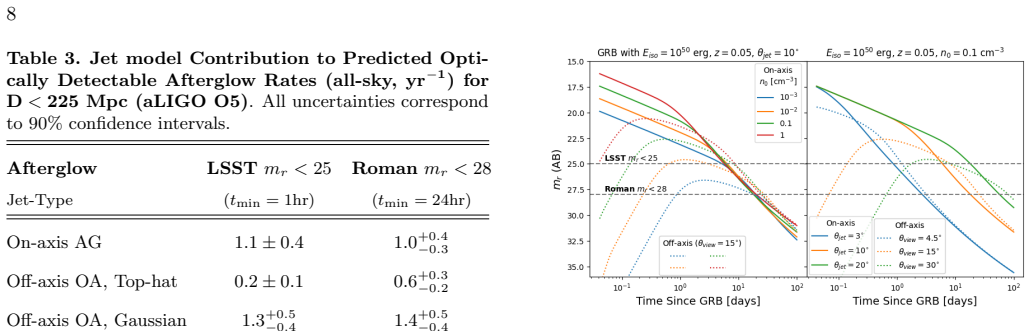
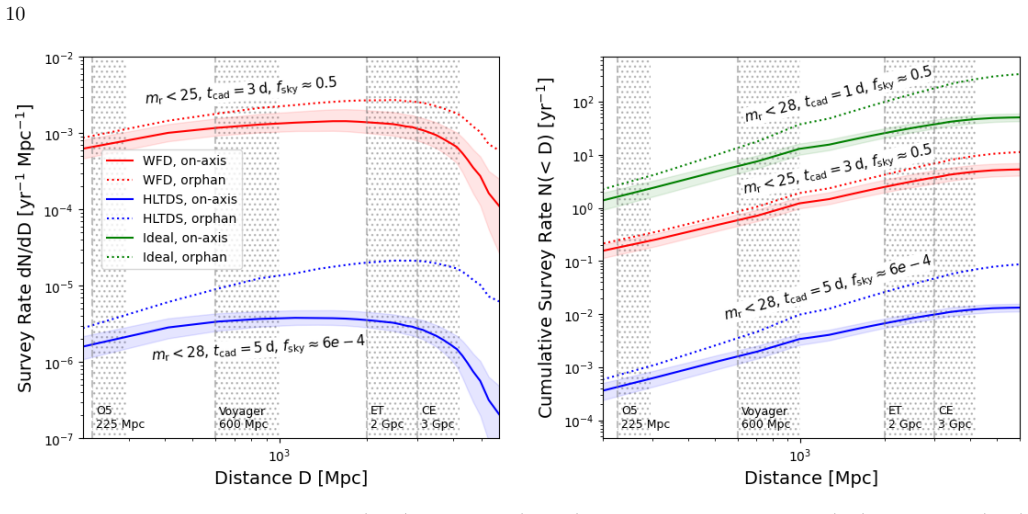
Using a probabilistic sGRB world model derived from a source BNS merger population, simulations show that LSST may detect 5.3 on-axis afterglows and 11 orphan afterglows per year, sufficient to constrain sGRB jetting, while Roman appears promising for the faint end in targeted follow-up and fewer than 1.4 LSST or Roman discoverable events per year are expected within the projected aLIGO O5 BNS range.
What carries the argument
Probabilistic sGRB world model derived from a BNS merger population, used to simulate afterglow detection rates across jet models and survey strategies.
If this is right
- An LSST sample of 5.3 on-axis and 11 orphan afterglows per year would allow constraints on sGRB beaming.
- Roman Space Telescope observations can reach the faint end of afterglow events in targeted follow-up.
- Fewer than 1.4 discoverable events per year are expected within the aLIGO O5 BNS range across jet models.
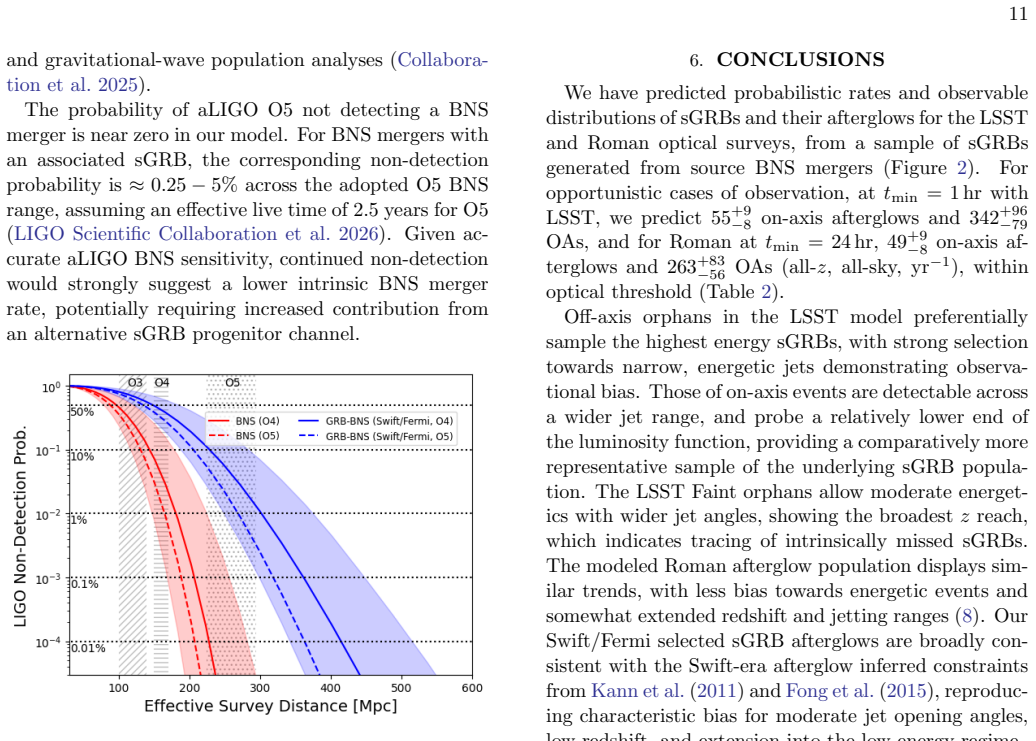
- Continued non-detection of a BNS merger in O5 would require revisiting assumptions in sGRB-BNS models.
Where Pith is reading between the lines
- Orphan afterglow counts would directly measure the fraction of off-axis bursts missed by gamma-ray instruments.
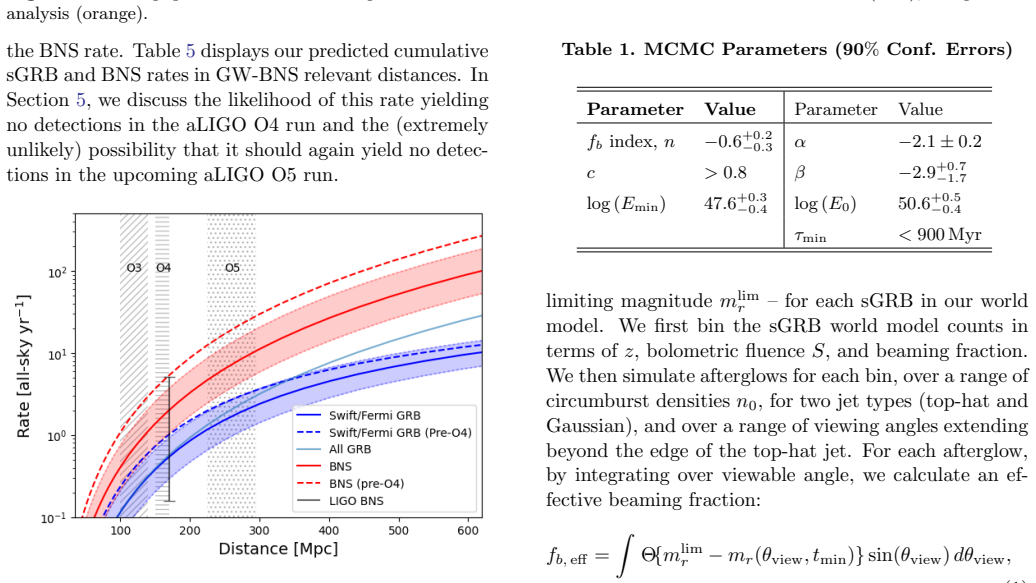
- The predicted rates offer a way to test whether the observed tension between sGRB and BNS rates stems from beaming or from association efficiency.
- Actual LSST survey data starting in the next few years can serve as an immediate check on the model outputs.
Load-bearing premise
The probabilistic sGRB world model derived from a source BNS merger population accurately represents the true distribution of jet properties, afterglow luminosities, and association efficiency.
What would settle it
Observed LSST afterglow counts that fall well outside the predicted 5 on-axis plus 11 orphan range per year, or continued absence of BNS events throughout aLIGO O5.
Figures
read the original abstract
Short-duration gamma-ray burst (sGRB) afterglows that follow BNS-gravitational wave (GW) events are essential for understanding the tension between the observed sGRB rate and BNS merger rate, heightened by the recent conclusion of aLIGO O4 with no new confirmed BNS detections. Using a probabilistic sGRB world model derived from a source BNS merger population, we simulate afterglow emission with AfterglowPy to investigate detection prospects of afterglows in the new era of optical surveys, and probe their multi-messenger implications. The predicted sGRB/BNS association is strongly dependent on sGRB beaming, which may be constrained by orphan afterglows (OA) - that arise from events with no prompt $\gamma$-ray detection. We conclude that the Vera C. Rubin Observatory's Large Synoptic Survey Telescope (LSST) may detect an afterglow sample sufficient in constraining sGRB jetting, with an estimated $5.3^{+1.7}_{-1.2}$ on-axis afterglow and $11^{+5}_{-3}$ OA detections per year; while the deep sensitivity of the Roman Space Telescope appears promising for probing the faint end of afterglow events in targeted follow-up strategies. The detection of afterglows in upcoming LIGO runs is possible but challenging, as we predict fewer than $\approx 1.4$ LSST or Roman discoverable events per year within the projected aLIGO O5 BNS range across all considered jet models and observing scenarios. We update previous sGRB-BNS rate predictions, finding that continued non-detection of a BNS in O5 would require revisiting key assumptions underlying sGRB-BNS models.
Editorial analysis
A structured set of objections, weighed in public.
Referee Report
Summary. The manuscript constructs a probabilistic sGRB world model from a BNS merger population, uses AfterglowPy to simulate afterglow light curves, and reports LSST detection rates of 5.3^{+1.7}_{-1.2} on-axis afterglows and 11^{+5}_{-3} orphan afterglows per year. It concludes that this sample size would suffice to constrain sGRB jet opening angles, that Roman is promising for faint events, that O5 detections remain rare (<1.4 per year), and that continued non-detection of BNS events in O5 would require revisiting core sGRB-BNS assumptions.
Significance. If the underlying BNS-to-sGRB mapping is robust, the work supplies concrete, survey-specific forecasts that directly address the observed tension between sGRB and BNS rates and could guide observing strategies for Rubin and Roman. The explicit dependence on jet models is acknowledged, which is a strength for transparency.
major comments (2)
- [Abstract, §3] Abstract and §3 (Methods): The quoted detection rates and the claim that LSST afterglows can constrain jetting rest entirely on the probabilistic mapping from BNS population to jet angles, luminosities, and association efficiency. No independent observational anchor for the joint distribution of these quantities is provided; the Monte Carlo outputs therefore inherit the same fitted parameters used to build the model rather than testing them.
- [Abstract] Abstract: The uncertainties (±1.7, ±5) are presented as arising from the simulations, yet the manuscript does not detail how the jet opening angle distribution and afterglow luminosity function parameters are sampled or how their uncertainties are propagated through AfterglowPy; without this, the robustness of the central numerical claims cannot be assessed.
minor comments (1)
- [Abstract] The abstract refers to 'all considered jet models' without listing them; a short table or explicit enumeration in the main text would improve clarity.
Simulated Author's Rebuttal
We thank the referee for their careful reading and insightful comments on our manuscript. We address each of the major comments below and have revised the manuscript accordingly to improve clarity on the model assumptions and uncertainty quantification.
read point-by-point responses
-
Referee: [Abstract, §3] Abstract and §3 (Methods): The quoted detection rates and the claim that LSST afterglows can constrain jetting rest entirely on the probabilistic mapping from BNS population to jet angles, luminosities, and association efficiency. No independent observational anchor for the joint distribution of these quantities is provided; the Monte Carlo outputs therefore inherit the same fitted parameters used to build the model rather than testing them.
Authors: We agree that our detection rate predictions are derived from a probabilistic model that maps BNS merger properties to sGRB jet parameters and association efficiencies, with parameters informed by existing sGRB observations rather than providing an independent test. This is the nature of the forward-modeling approach used to generate survey forecasts. The manuscript's primary aim is to quantify expected yields under these assumptions to address the sGRB-BNS rate tension and to demonstrate how orphan afterglow detections could statistically constrain jet opening angles. We have revised §3 to include an explicit discussion of the model construction and its dependence on prior fits, and updated the abstract to note the model-dependent nature of the predictions. Future data from LSST could indeed be used to test the underlying assumptions. revision: partial
-
Referee: [Abstract] Abstract: The uncertainties (±1.7, ±5) are presented as arising from the simulations, yet the manuscript does not detail how the jet opening angle distribution and afterglow luminosity function parameters are sampled or how their uncertainties are propagated through AfterglowPy; without this, the robustness of the central numerical claims cannot be assessed.
Authors: The referee is correct that the details of uncertainty propagation were insufficiently described. The reported uncertainties come from Monte Carlo sampling where jet opening angles are drawn from a distribution fitted to sGRB data, and luminosity function parameters are varied according to their posterior uncertainties; these are then propagated by simulating light curves with AfterglowPy for each realization and applying detection thresholds. To address this, we have added a new paragraph in §3 detailing the sampling method, the number of realizations (1000), and how the percentiles are computed for the detection rates. revision: yes
Circularity Check
No significant circularity; forward model predictions are independent of inputs
full rationale
The paper derives a probabilistic sGRB world model from an existing BNS merger population (drawn from prior literature) and feeds it into AfterglowPy simulations to generate new numerical forecasts for LSST/Roman detection rates under future observing conditions. These outputs (e.g., 5.3 on-axis and 11 OA detections per year) are extrapolations to instruments and time periods not present in the input data; they do not re-predict or redefine the input BNS rates, jet parameters, or association efficiencies. No equations, self-citations, or fitted quantities are shown to reduce to the target results by construction. The derivation chain therefore remains self-contained against external benchmarks.
Axiom & Free-Parameter Ledger
free parameters (2)
- sGRB jet opening angle distribution
- afterglow luminosity function parameters
axioms (1)
- domain assumption Short-duration gamma-ray bursts arise from binary neutron star mergers with a fixed but unknown efficiency and jet structure
Reference graph
Works this paper leans on
-
[1]
The Afterglows of Swift-era Gamma-Ray Bursts. II. Type I GRB versus Type II GRB Optical Afterglows. , keywords =. doi:10.1088/0004-637X/734/2/96 , archivePrefix =. 0804.1959 , primaryClass =
work page internal anchor Pith review Pith/arXiv arXiv doi:10.1088/0004-637x/734/2/96 1959
-
[2]
Dimitrova, Tzvetelina A. and Butler, Nathaniel R. and Ravi, Srihari , title =. The Astrophysical Journal , abstract =. 2023 , month =. doi:10.3847/1538-4357/acc383 , url =
-
[3]
Unveiling the population of orphan γ-ray bursts , DOI= "10.1051/0004-6361/201526112", url= "https://doi.org/10.1051/0004-6361/201526112", journal =
-
[5]
Ryan, Geoffrey and Eerten, Hendrik van and Piro, Luigi and Troja, Eleonora , title =. The Astrophysical Journal , abstract =. 2020 , month =. doi:10.3847/1538-4357/ab93cf , url =
-
[6]
2019 , month = jul, howpublished =
2019
-
[7]
Weizmann and Farah, Amanda M
Kiendrebeogo, R. Weizmann and Farah, Amanda M. and Foley, Emily M. and Gray, Abigail and Kunert, Nina and Puecher, Anna and Toivonen, Andrew and VandenBerg, R. Oliver and Anand, Shreya and Ahumada, Tomás and Karambelkar, Viraj and Coughlin, Michael W. and Dietrich, Tim and Kam, S. Zacharie and Pang, Peter T. H. and Singer, Leo P. and Sravan, Niharika , ti...
2024
-
[8]
2023 , doi =
GWTC-3: Compact Binary Coalescences Observed by LIGO and Virgo During the Second Part of the Third Observing Run , journal =. 2023 , doi =
2023
-
[9]
Butler, Nathaniel R. and Bloom, Joshua S. and Poznanski, Dovi , title =. The Astrophysical Journal , abstract =. 2010 , month =. doi:10.1088/0004-637X/711/1/495 , url =
-
[10]
and Kocevski, Daniel and Bloom, Joshua S
Butler, Nathaniel R. and Kocevski, Daniel and Bloom, Joshua S. and Curtis, Jason L. , title =. The Astrophysical Journal , abstract =. 2007 , month =. doi:10.1086/522492 , url =
-
[11]
The Astrophysical Journal Letters , abstract =
Safarzadeh, Mohammadtaher and Berger, Edo , title =. The Astrophysical Journal Letters , abstract =. 2019 , month =. doi:10.3847/2041-8213/ab24df , url =
-
[12]
Lien, Amy and Sakamoto, Takanori and Barthelmy, Scott D. and Baumgartner, Wayne H. and Cannizzo, John K. and Chen, Kevin and Collins, Nicholas R. and Cummings, Jay R. and Gehrels, Neil and Krimm, Hans A. and Markwardt, Craig. B. and Palmer, David M. and Stamatikos, Michael and Troja, Eleonora and Ukwatta, T. N. , title =. The Astrophysical Journal , abstr...
-
[13]
and Gehrels, Neil and Baltay, Charles and Dor
Spergel, David N. and Gehrels, Neil and Baltay, Charles and Dor. Cosmology with the Nancy Grace Roman Space Telescope and the Rubin Observatory , journal =. 2021 , volume =. doi:10.1093/mnras/stab2223 , url =
-
[14]
Roman Wide Field Instrument Reference Information , year =
-
[15]
and Covino, Stefano and Nappo, Francesco and Vergani, Susanna D
Ghirlanda, Giancarlo and Burlon, Davide and Ghisellini, Gabriele and Salvaterra, Ruben and Tagliaferri, Gianpiero and Campana, Sergio and D'Avanzo, Paolo and Melandri, Andrea and Bernardini, Maria G. and Covino, Stefano and Nappo, Francesco and Vergani, Susanna D. , title =. Publications of the Astronomical Society of Australia , year =. doi:10.1017/pasa....
-
[16]
The Astrophysical Journal , abstract =
Wang, Xiang-Gao and Zhang, Bing and Liang, En-Wei and Lu, Rui-Jing and Lin, Da-Bin and Li, Jing and Li, Long , title =. The Astrophysical Journal , abstract =. 2018 , month =. doi:10.3847/1538-4357/aabc13 , url =
-
[17]
doi:10.1086/186969 , keywords =
Kouveliotou, C. and Meegan, C. A. and Fishman, G. J. and Bhat, N. P. and Briggs, M. S. and Koshut, T. M. and Paciesas, W. S. and Pendleton, G. N. , title =. The Astrophysical Journal Letters , year =. doi:10.1086/186969 , url =
-
[18]
and Fonnesbeck, Christopher , title =
Salvatier, John and Wiecki, Thomas V. and Fonnesbeck, Christopher , title =. PeerJ Computer Science , year =. doi:10.7717/peerj-cs.55 , url =
-
[19]
Monthly Notices of the Royal Astronomical Society , volume =
Lamb, Gavin P and Tanaka, Masaomi and Kobayashi, Shiho , title =. Monthly Notices of the Royal Astronomical Society , volume =. 2018 , month =. doi:10.1093/mnras/sty484 , url =
-
[20]
Monthly Notices of the Royal Astronomical Society , volume =
Leung, James K and Murphy, Tara and Lenc, Emil and Edwards, Philip G and Ghirlanda, Giancarlo and Kaplan, David L and O’Brien, Andrew and Wang, Ziteng , title =. Monthly Notices of the Royal Astronomical Society , volume =. 2023 , month =. doi:10.1093/mnras/stad1670 , url =
-
[21]
The Astrophysical Journal , volume=
Detectability of orphan afterglows , author=. The Astrophysical Journal , volume=. 2002 , doi=
2002
-
[22]
Rouco Escorial, A. and Fong, W. and Berger, E. and Laskar, T. and Margutti, R. and Schroeder, G. and Rastinejad, J. C. and Cornish, D. and Popp, S. and Lally, M. and Nugent, A. E. and Paterson, K. and Metzger, B. D. and Chornock, R. and Alexander, K. and Cendes, Y. and Eftekhari, T. , title =. The Astrophysical Journal , abstract =. 2023 , month =. doi:10...
-
[23]
Short gamma-ray bursts at the dawn of the gravitational wave era , DOI= "10.1051/0004-6361/201628993", url= "https://doi.org/10.1051/0004-6361/201628993", journal =
-
[24]
Monthly Notices of the Royal Astronomical Society , volume =
Lamb, Gavin P and Kann, D Alexander and Fernández, Joseph John and Mandel, Ilya and Levan, Andrew J and Tanvir, Nial R , title =. Monthly Notices of the Royal Astronomical Society , volume =. 2021 , month =. doi:10.1093/mnras/stab2071 , url =
-
[25]
Annual Review of Astronomy and Astrophysics , year =
Berger, Edo , title =. Annual Review of Astronomy and Astrophysics , year =. doi:10.1146/annurev-astro-081913-035926 , url =
-
[26]
The Astrophysical Journal , volume =
Nakar, Ehud and Piran, Tsvi , title =. The Astrophysical Journal , volume =. 2021 , doi =
2021
-
[27]
Monthly Notices of the Royal Astronomical Society , volume =
O’Connor, Brendan and Beniamini, Paz and Kouveliotou, Chryssa , title =. Monthly Notices of the Royal Astronomical Society , volume =. 2020 , month =. doi:10.1093/mnras/staa1433 , url =
-
[28]
The Wide Field Infrared Survey Telescope: 100 Hubbles for the 2020s
The Wide Field Infrared Survey Telescope: 100 Hubbles for the 2020s. arXiv e-prints , keywords =. doi:10.48550/arXiv.1902.05569 , archivePrefix =. 1902.05569 , primaryClass =
work page internal anchor Pith review Pith/arXiv arXiv doi:10.48550/arxiv.1902.05569 1902
-
[29]
LSST Science Collaboration and Abell, P. A. and others , title =. arXiv e-prints , eprint =
-
[30]
Bellm, E. C. and Kulkarni, S. R. and Graham, M. J. and et al. , title =. Publications of the Astronomical Society of the Pacific , volume =. 2019 , doi =
2019
-
[31]
, title =
Rhoads, James E. , title =. The Astrophysical Journal , volume =. 1999 , doi =
1999
-
[32]
Frail, D. A. and Kulkarni, S. R. and Sari, R. and Djorgovski, S. G. and Bloom, J. S. and Galama, T. J. and Reichart, D. E. and Berger, E. and Harrison, F. A. and Price, P. A. and Yost, S. A. and Diercks, A. and Goodrich, R. W. and Chaffee, F. , title =. The Astrophysical Journal Letters , volume =. 2001 , doi =
2001
-
[33]
Living Reviews in Relativity , year =
Prospects for observing and localizing gravitational‑wave transients with Advanced LIGO, Advanced Virgo and KAGRA , author =. Living Reviews in Relativity , year =
-
[34]
LSST Science Book, Version 2.0 , year =. 0805.2366 , archivePrefix =
-
[35]
and Dahlen, T
Melinder, J. and Dahlen, T. and Mencía Trinchant, L. and Östlin, G. and Mattila, S. and Sollerman, C. and Fransson, C. and Hayes, M. and Kankare, E. and Nasoudi-Shoar, S. , title =. Astronomy & Astrophysics , volume =. 2012 , doi =
2012
-
[36]
2026 , eprint=
Searching for Neutron Star Mergers in the Absence of Gravitational Waves with Optical Afterglow Emission , author=. 2026 , eprint=
2026
-
[37]
and Coughlin, Michael W
Perkins, Scott E. and Coughlin, Michael W. and Anand, Shreya and Ahumada, Tom\'as and Andreoni, Igor and Bulla, Mattia and Dietrich, Tim and Kasliwal, Mansi M. and Singer, Leo P. and others , title =. The Astrophysical Journal , volume =. 2024 , doi =
2024
-
[38]
2023, ApJL, 955, L6, doi: 10.3847/2041-8213/acf216
Yao, Yuhan and Ravi, Vikram and Gezari, Suvi and van Velzen, Sjoert and Lu, Wenbin and Schulze, Steve and Somalwar, Jean J. and Kulkarni, S. R. and Hammerstein, Erica and Nicholl, Matt and Graham, Matthew J. and Perley, Daniel A. and Cenko, S. Bradley and Stein, Robert and Ricarte, Angelo and Chadayammuri, Urmila and Quataert, Eliot and Bellm, Eric C. and...
-
[39]
A Search for Extragalactic Fast Blue Optical Transients in ZTF and the Rate of AT2018cow-like Transients , author =. 2023 , month =. doi:10.3847/1538-4357/acc533 , journal =
-
[40]
and Afle, Chaitanya and Ballmer, Stefan W
Evans, Matthew and Adhikari, Rana X. and Afle, Chaitanya and Ballmer, Stefan W. and Biscoveanu, Sylvia and Borhanian, Ssohrab and Brown, Duncan A. and Chen, Yanbei and Eisenstein, Robert and Gruson, Alexandra and Gupta, Anuradha and Hall, Evan D. and Huxford, Rachael and Kamai, Brittany and Kashyap, Rahul and Kissel, Jeff S. and Kuns, Kevin and Landry, Ph...
-
[41]
2019 , number =
The LIGO Voyager Upgrade , author =. 2019 , number =
2019
-
[42]
2022 , number =
Exploring the Sensitivity of Next Generation Gravitational Wave Detectors , author =. 2022 , number =
2022
-
[43]
2012 , volume =
Mock Data Challenge for the Einstein Gravitational-Wave Telescope , journal =. 2012 , volume =
2012
-
[44]
2025 , eprint=
GWTC-4.0: Population Properties of Merging Compact Binaries , author=. 2025 , eprint=
2025
-
[45]
and Lightman, Alan P
Rybicki, George B. and Lightman, Alan P. , title =
-
[46]
The population of merging compact binaries inferred using gravitational waves through GWTC-3
Abbott, R. and others (LIGO Scientific Collaboration and Virgo Collaboration and KAGRA Collaboration) , title =. Physical Review X , year =. doi:10.1103/PhysRevX.13.011048 , archivePrefix =. 2111.03634 , primaryClass =
work page internal anchor Pith review Pith/arXiv arXiv doi:10.1103/physrevx.13.011048
-
[47]
, title =
Nakar, E. , title =. Physics Reports , year =
-
[48]
and others , title =
Belczynski, K. and others , title =. Astronomy & Astrophysics , year =
-
[49]
and others , title =
Dominik, M. and others , title =. The Astrophysical Journal , year =
-
[50]
The Astrophysical Journal , volume =
Gehrels, Neil and Chincarini, Guido and Giommi, Paolo and others , title =. The Astrophysical Journal , volume =. 2004 , doi =
2004
-
[51]
Monthly Notices of the Royal Astronomical Society , volume =
Matsumoto, Tatsuya and Nakar, Ehud and Piran, Tsvi , title =. Monthly Notices of the Royal Astronomical Society , volume =. 2019 , month =. doi:10.1093/mnras/stz923 , eprint =
-
[52]
2024 , note =
High Latitude Time Domain Survey (HLTDS) , howpublished =. 2024 , note =
2024
-
[53]
Roman Observations Time Allocation Committee Report , year =
-
[54]
LSST: From Science Drivers to Reference Design and Anticipated Data Products , journal =
Ivezi\'c,. LSST: From Science Drivers to Reference Design and Anticipated Data Products , journal =. 2019 , doi =
2019
-
[55]
Modeling, Systems Engineering, and Project Management for Astronomy VI , year = 2014, editor =
The LSST operations simulator. Modeling, Systems Engineering, and Project Management for Astronomy VI , year = 2014, editor =. doi:10.1117/12.2056898 , adsurl =
-
[56]
2015 , eprint=
Wide-Field InfrarRed Survey Telescope-Astrophysics Focused Telescope Assets WFIRST-AFTA 2015 Report , author=. 2015 , eprint=
2015
-
[57]
, title =
Hounsell, Rebekah and Scolnic, Dan and Brout, Dillon and et al. , title =. 2023 , eprint =
2023
-
[58]
The Astrophysical Journal , year =
Meegan, Charles and others , title =. The Astrophysical Journal , year =
-
[59]
Lynne and Yoachim, Peter and Ivezi
Jones, R. Lynne and Yoachim, Peter and Ivezi. Survey Strategy and Cadence Choices for the Vera C. Rubin Observatory Legacy Survey of Space and Time (LSST) , year =. doi:10.71929/rubin/2584084 , howpublished =
-
[60]
, title =
Metzger, Brian D. , title =. Living Reviews in Relativity , volume =. 2017 , doi =
2017
-
[61]
Annual Review of Astronomy and Astrophysics , volume =
Gezari, Suvi , title =. Annual Review of Astronomy and Astrophysics , volume =. 2021 , doi =
2021
-
[62]
Ho, Anna Y. Q. and others , title =. ApJ , volume =. 2020 , doi =
2020
-
[63]
Ho, Anna Y. Q. and Perley, Daniel A. and Gal-Yam, Avishay and Lunnan, Ragnhild and Sollerman, Jesper and et al. , title =. The Astrophysical Journal , volume =. 2023 , doi =
2023
-
[64]
, title =
Filippenko, Alexei V. , title =. Annual Review of Astronomy and Astrophysics , volume =. 1997 , doi =
1997
-
[65]
and others , title =
Anderson, Joseph P. and others , title =. ApJ , volume =. 2014 , doi =
2014
-
[66]
Supernovae in the Rubin Legacy Survey of Space and Time , year =
-
[67]
2021 , volume =
Projected Cosmological Constraints from Strongly Lensed Supernovae with the Roman Space Telescope , journal =. 2021 , volume =
2021
-
[68]
2026 , eprint=
Tidal disruption event rates across cosmic time: forecasts for LSST, Roman, and JWST and their constraints on the supermassive black hole mass function , author=. 2026 , eprint=
2026
-
[69]
LIGO/Virgo Public Alerts User Guide: Observing Capabilities , year =
-
[70]
and others (LIGO Scientific Collaboration and Virgo Collaboration) , title =
Abbott, R. and others (LIGO Scientific Collaboration and Virgo Collaboration) , title =. Physical Review X , volume =. 2021 , doi =
2021
-
[71]
2023 , note =
The LIGO-Virgo-KAGRA Observing Run 4 (O4) , howpublished =. 2023 , note =
2023
-
[72]
Gravitational-Wave Observing Scenarios Timeline , institution =
-
[73]
2020 , doi =
Prospects for observing and localizing gravitational-wave transients with Advanced LIGO, Advanced Virgo and KAGRA , journal =. 2020 , doi =
2020
-
[74]
2025 , url =
LIGO–Virgo–KAGRA Observing Scenarios (Updated) , institution =. 2025 , url =
2025
-
[75]
2020 , doi =
Prospects for Observing and Localizing Gravitational-Wave Transients with Advanced LIGO, Advanced Virgo and KAGRA , journal =. 2020 , doi =
2020
-
[76]
Kiendrebeogo, R. Weizmann and Farah, Amanda M. and Foley, Emily M. and Gray, Abigail and Kunert, Nina and Puecher, Anna and Toivonen, Andrew and VandenBerg, R. Oliver and Anand, Shreya and Ahumada, Tom\'as and Karambelkar, Viraj and Coughlin, Michael W. and Dietrich, Tim and Kam, S. Zacharie and Pang, Peter T. H. and Singer, Leo P. and Sravan, Niharika , ...
arXiv 2023
-
[77]
The Legacy Survey of Space and Time (LSST): Wide-Fast-Deep Survey Strategy , year =
-
[78]
High Latitude Time-Domain Survey , year =
-
[79]
High Latitude Time Domain Survey Technical Information , year =
-
[80]
2024 , url =
LIGO--Virgo--KAGRA ahiObserving Scenarios , institution =. 2024 , url =
2024
-
[81]
2023 , eprint=
Roman CCS White Paper: Optimizing the HLTDS Cadence at Fixed Depth , author=. 2023 , eprint=
2023
discussion (0)
Sign in with ORCID, Apple, or X to comment. Anyone can read and Pith papers without signing in.