Electromagnetic Shower Reconstruction and Identification in FASER's Emulsion Detector for LHC Forward Neutrino Measurements
Pith reviewed 2026-06-26 21:32 UTC · model grok-4.3
The pith
A multi-level identification chain reconstructs and identifies electromagnetic showers in the FASERnu emulsion detector with 99.99% background rejection at 100 GeV.
A machine-rendered reading of the paper's core claim, the machinery that carries it, and where it could break.
Core claim
The paper establishes that a clustering-based shower-axis algorithm without energy-dependent tuning, followed by a multi-level identification chain of track pre-selection, cut-based selection, and a BDT classifier, reaches background rejection rates of 99.99% (100 GeV) and 99.94% (200 GeV) together with total efficiencies of 58.9% (100 GeV) and 70.8% (200 GeV) when evaluated on simulated samples; the same chain yields energy reconstruction with relative biases of +0.6% and -0.8% and resolutions of 25.4% and 22.6% using the total number of reconstructed segments as the calorimetric estimator, with systematics dominated by emulsion film detection efficiency variations of roughly 10%.
What carries the argument
The multi-level identification chain of track pre-selection, cut-based selection, and BDT classifier, paired with a clustering-based shower-axis algorithm that requires no energy-dependent tuning.
If this is right
- The validated chain supplies a framework for electron neutrino identification with the FASERnu detector at the LHC.
- Energy reconstruction from total reconstructed segments carries relative biases below 1% and resolutions of 22-25%.
- Systematic uncertainties on energy scale are dominated by variations in emulsion film detection efficiency, reaching approximately +10%/-8% at 100 GeV.
- The reconstruction algorithm operates without energy-dependent tuning across the tested range.
- Combined performance meets the requirements stated for forward neutrino measurements.
Where Pith is reading between the lines
- The same chain could be applied to measure the electron neutrino component of the forward flux and thereby test predictions of neutrino production in the LHC forward region.
- Adaptation of the segment-counting energy estimator to other energies or detector configurations would require only re-calibration of the BDT rather than redesign of the axis finder.
- Pairing the emulsion shower tag with timing or muon-veto information from the rest of the FASER apparatus could further reduce residual neutral-hadron background.
- Running the identical selection on simulated samples at additional beam energies would test whether the quoted efficiencies and resolutions scale as expected.
Load-bearing premise
The simulated samples used to evaluate efficiencies and the test-beam data at the CERN SPS H4 beamline accurately represent the shower development, backgrounds, and detector response expected from electron neutrinos in the FASERnu detector during LHC operation.
What would settle it
Observation of background rejection or efficiency values in actual LHC neutrino data that lie well outside the 99.94-99.99% rejection and 58.9-70.8% efficiency ranges reported from the test-beam validation would falsify readiness of the method for physics use.
Figures
read the original abstract
We present methods for electromagnetic shower reconstruction and identification in the FASERnu emulsion detector using 100 GeV and 200 GeV electron test-beam data from the CERN SPS H4 beamline. The reconstruction employs a clustering-based algorithm without energy-dependent tuning to determine shower axes. A multi-level identification chain comprising track pre-selection, a cut-based selection, and a BDT classifier achieves combined background rejection rates of 99.99% (100 GeV) and 99.94% (200 GeV). The method reaches total reconstruction and identification efficiencies of 58.9% (100 GeV) and 70.8% (200 GeV) evaluated from simulated samples. Energy reconstruction using the total number of reconstructed segments as the calorimetric estimator yields relative biases of +0.6% (100 GeV) and -0.8% (200 GeV), with resolutions of 25.4% and 22.6%, respectively. Systematic uncertainties on the energy reconstruction are dominated by variations in emulsion film detection efficiency, contributing (+10.9%/-8.2%) at 100 GeV and (+10.3%/-6.9%) at 200 GeV. The methodology provides a validated framework for electron neutrino identification with the FASERnu detector at the LHC.
Editorial analysis
A structured set of objections, weighed in public.
Referee Report
Summary. The manuscript presents a multi-level electromagnetic shower reconstruction and identification method for the FASERnu emulsion detector, developed and tested with 100 GeV and 200 GeV electron test-beam data at CERN SPS H4. It employs a clustering algorithm for shower axis determination without energy-dependent tuning, followed by track pre-selection, cut-based selection, and a BDT classifier. Background rejection reaches 99.99% (100 GeV) and 99.94% (200 GeV). Total reconstruction and identification efficiencies of 58.9% (100 GeV) and 70.8% (200 GeV) are reported from simulated samples. Energy reconstruction via total reconstructed segments shows relative biases of +0.6% and -0.8% with resolutions 25.4% and 22.6%, respectively. Systematic uncertainties are dominated by emulsion film detection efficiency variations. The work claims to provide a validated framework for electron neutrino identification in FASERnu at the LHC.
Significance. If the reported performance holds under LHC conditions, the method supplies a practical, high-rejection tool for isolating electron neutrino interactions in the forward region, directly supporting FASERnu's goals of measuring neutrino cross sections and searching for beyond-Standard-Model physics. The test-beam validation of the reconstruction chain is a concrete strength, and the parameter-free clustering approach plus calorimetric energy estimator offer reproducible elements that could be adopted by similar emulsion-based experiments.
major comments (2)
- [Abstract and performance evaluation sections] Abstract and performance evaluation sections: The headline efficiencies (58.9% at 100 GeV, 70.8% at 200 GeV) and background rejection rates (99.99%/99.94%) are evaluated exclusively on simulated samples, yet the manuscript provides no quantitative comparison of simulated shower development, segment multiplicity, or background composition against the test-beam data or any other independent benchmark. This assumption is load-bearing for the central claim that the method constitutes a validated framework for LHC neutrino measurements.
- [BDT classifier description (likely §4)] BDT classifier description (likely §4): The manuscript does not specify BDT training and validation procedures, feature list, hyperparameter choices, or data exclusion criteria. Without these, the robustness of the combined rejection rates cannot be assessed, and the quoted performance numbers remain difficult to reproduce or extrapolate.
minor comments (1)
- [Systematic uncertainties paragraph] The systematic uncertainty estimation for emulsion film detection efficiency (contributing +10.9%/-8.2% at 100 GeV) is stated to dominate but lacks a description of how the variations were sampled or propagated through the reconstruction chain.
Simulated Author's Rebuttal
We thank the referee for the careful and constructive review of our manuscript. We address the major comments point by point below, agreeing that additional details and comparisons are required to strengthen the presentation.
read point-by-point responses
-
Referee: [Abstract and performance evaluation sections] Abstract and performance evaluation sections: The headline efficiencies (58.9% at 100 GeV, 70.8% at 200 GeV) and background rejection rates (99.99%/99.94%) are evaluated exclusively on simulated samples, yet the manuscript provides no quantitative comparison of simulated shower development, segment multiplicity, or background composition against the test-beam data or any other independent benchmark. This assumption is load-bearing for the central claim that the method constitutes a validated framework for LHC neutrino measurements.
Authors: We thank the referee for identifying this key point. The test-beam data provide pure electron showers and were used to develop and optimize the clustering algorithm, pre-selection, cuts, and BDT. Efficiencies and rejection rates were evaluated on simulation to incorporate the mixed backgrounds expected in neutrino interactions at the LHC, which are absent from the test-beam sample. We agree that a direct quantitative comparison is needed to support the validation claim. In the revised manuscript we will add a dedicated subsection comparing data and simulation for shower axis resolution, segment multiplicity distributions, and background composition, thereby demonstrating simulation fidelity and strengthening the applicability to FASERnu. revision: yes
-
Referee: [BDT classifier description (likely §4)] BDT classifier description (likely §4): The manuscript does not specify BDT training and validation procedures, feature list, hyperparameter choices, or data exclusion criteria. Without these, the robustness of the combined rejection rates cannot be assessed, and the quoted performance numbers remain difficult to reproduce or extrapolate.
Authors: We acknowledge that the BDT description is incomplete for reproducibility. The revised manuscript will expand the relevant section to include the complete list of input features, the composition of the training sample and the train/validation split, the validation procedure (including any cross-validation), the hyperparameter optimization method and final values, and the criteria used for data exclusion during training. revision: yes
Circularity Check
No significant circularity; derivation is self-contained
full rationale
The paper develops a clustering-based reconstruction algorithm, cut-based selection, and BDT classifier using 100/200 GeV test-beam electron data, then reports efficiencies and background rejection evaluated on independent simulated samples. No step reduces by construction to its own inputs: the segment-count energy estimator is a direct observable, not a fitted parameter renamed as a prediction; no load-bearing self-citations or uniqueness theorems are invoked; and the multi-level identification chain is described without self-definitional loops. Standard separation of development data from evaluation samples keeps the chain non-circular.
Axiom & Free-Parameter Ledger
free parameters (2)
- BDT classifier thresholds and training parameters
- Clustering algorithm parameters
axioms (1)
- domain assumption Test beam conditions at CERN SPS H4 with 100 and 200 GeV electrons accurately mimic electromagnetic showers from electron neutrinos in the FASERnu detector at the LHC.
Reference graph
Works this paper leans on
-
[1]
Located 480 m downstream of the ATLAS interaction point along the beam collision axis, FASER accesses a kinematic region not covered by the main LHC detectors
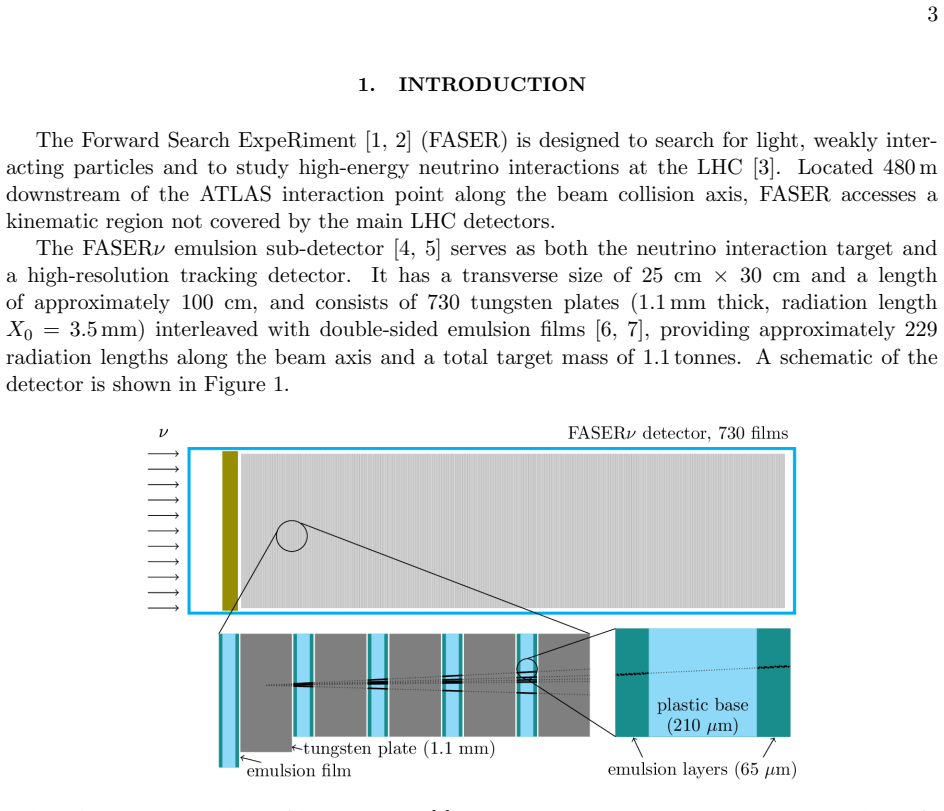
INTRODUCTION The Forward Search ExpeRiment [1, 2] (FASER) is designed to search for light, weakly inter- acting particles and to study high-energy neutrino interactions at the LHC [3]. Located 480 m downstream of the ATLAS interaction point along the beam collision axis, FASER accesses a kinematic region not covered by the main LHC detectors. The FASERνem...
-
[2]
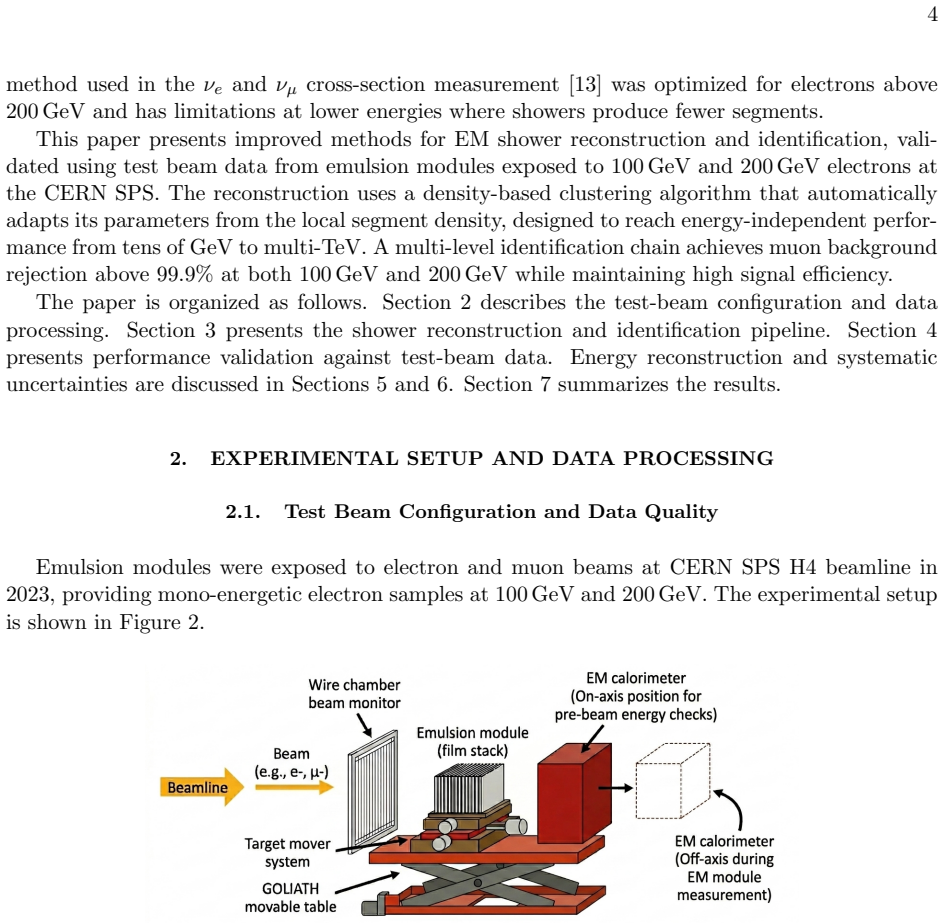
EXPERIMENTAL SETUP AND DATA PROCESSING 2.1. Test Beam Configuration and Data Quality Emulsion modules were exposed to electron and muon beams at CERN SPS H4 beamline in 2023, providing mono-energetic electron samples at 100 GeV and 200 GeV. The experimental setup is shown in Figure 2. FIG. 2. Experimental setup at the H4 beamline of the CERN SPS. The emul...
2023
-
[3]
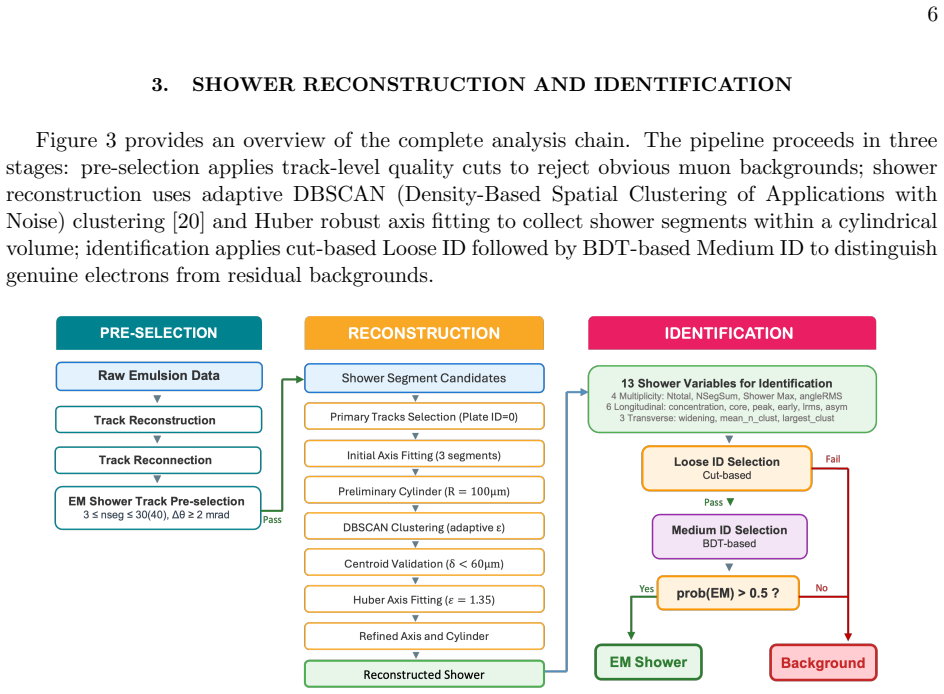
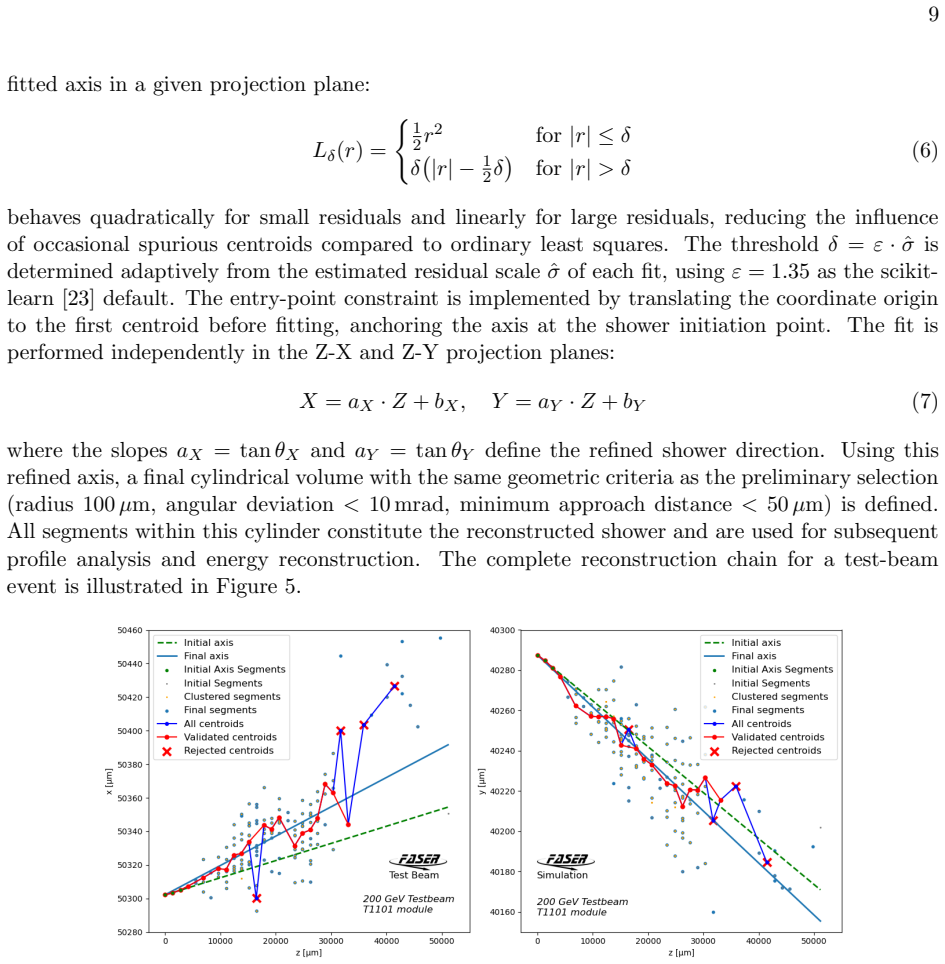
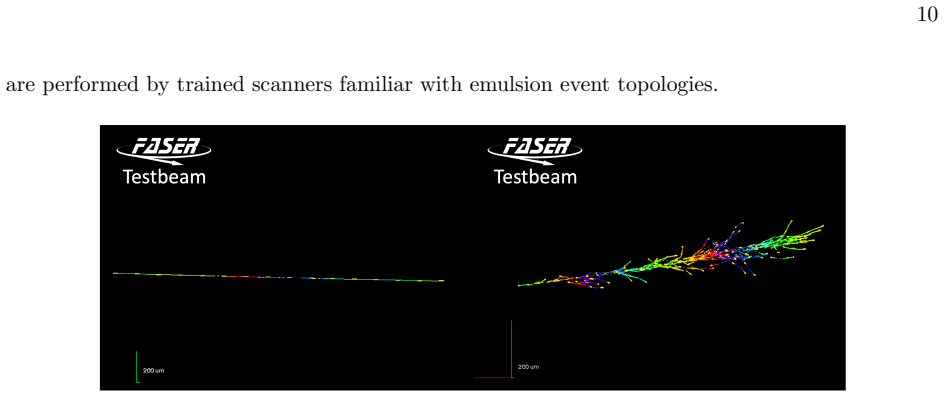
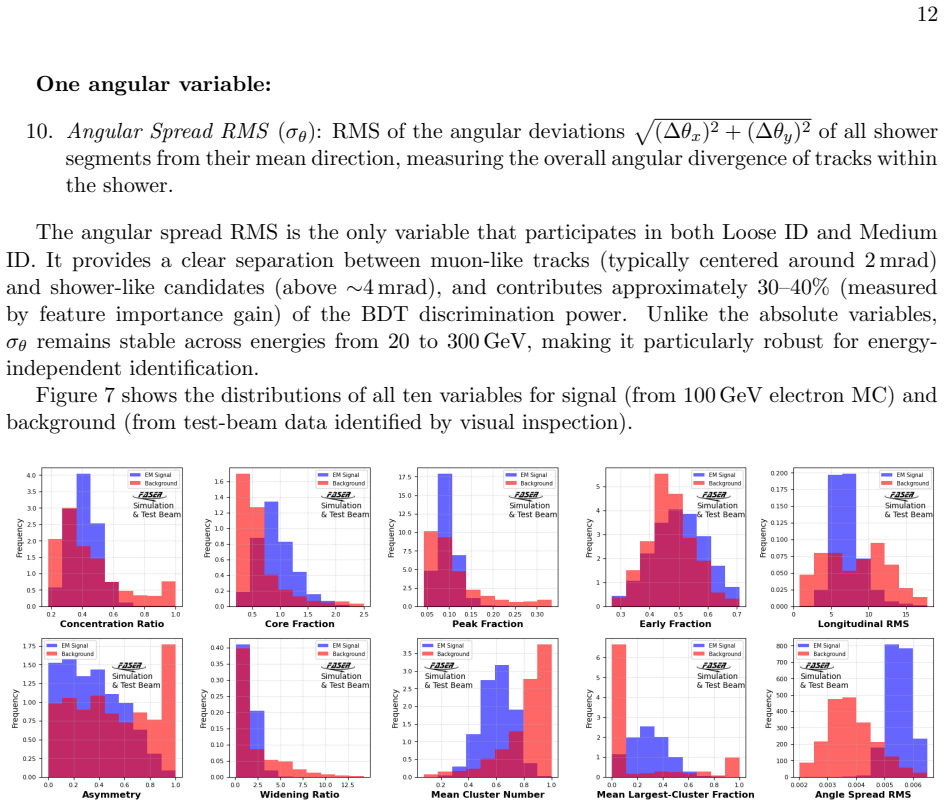
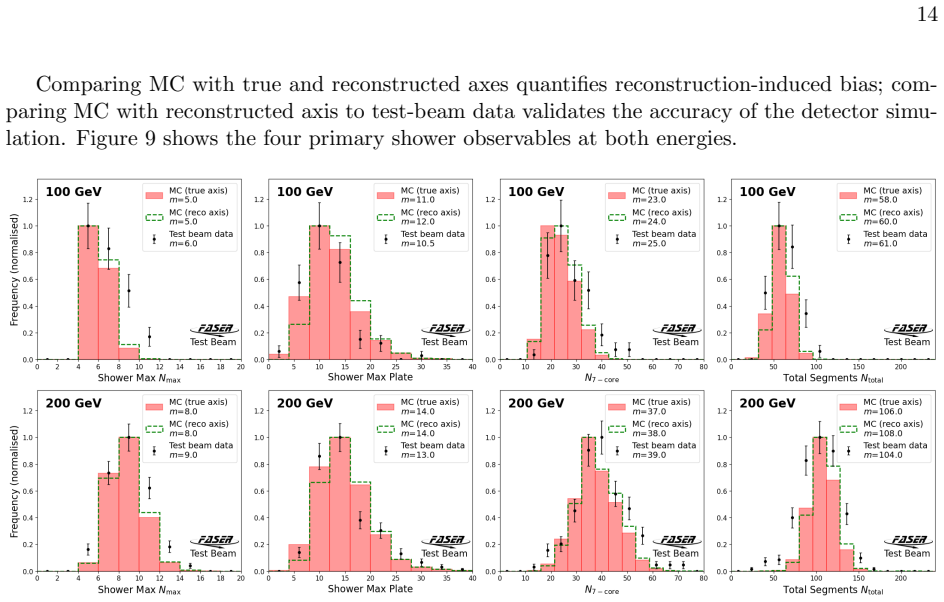
SHOWER RECONSTRUCTION AND IDENTIFICATION Figure 3 provides an overview of the complete analysis chain. The pipeline proceeds in three stages: pre-selection applies track-level quality cuts to reject obvious muon backgrounds; shower reconstruction uses adaptive DBSCAN (Density-Based Spatial Clustering of Applications with Noise) clustering [20] and Huber r...
-
[4]
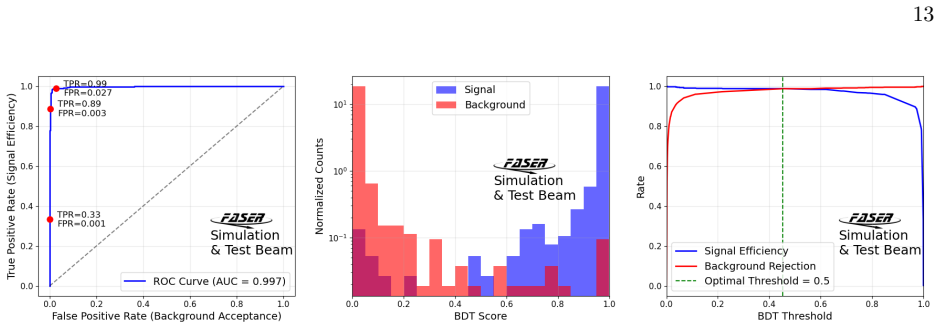
PERFORMANCE VALIDATION Tables 3 and 4 summarize the step-by-step efficiency of the full reconstruction and identification chain, where each entry is the fraction of events passing that step relative to all events entering it. Background rejection rates are measured directly from test beam data: since the sample is>99% muons, the rejection rate is well def...
-
[5]
This observable captures the full shower development and provides more robust energy estimation than localized estimators such asN 7-core
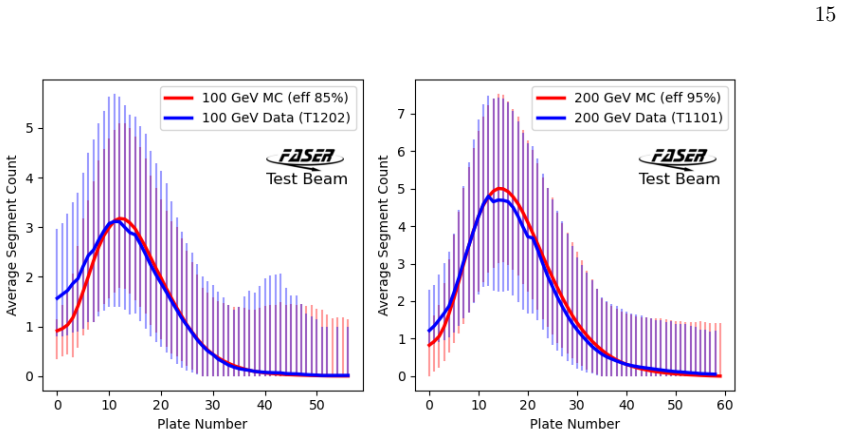
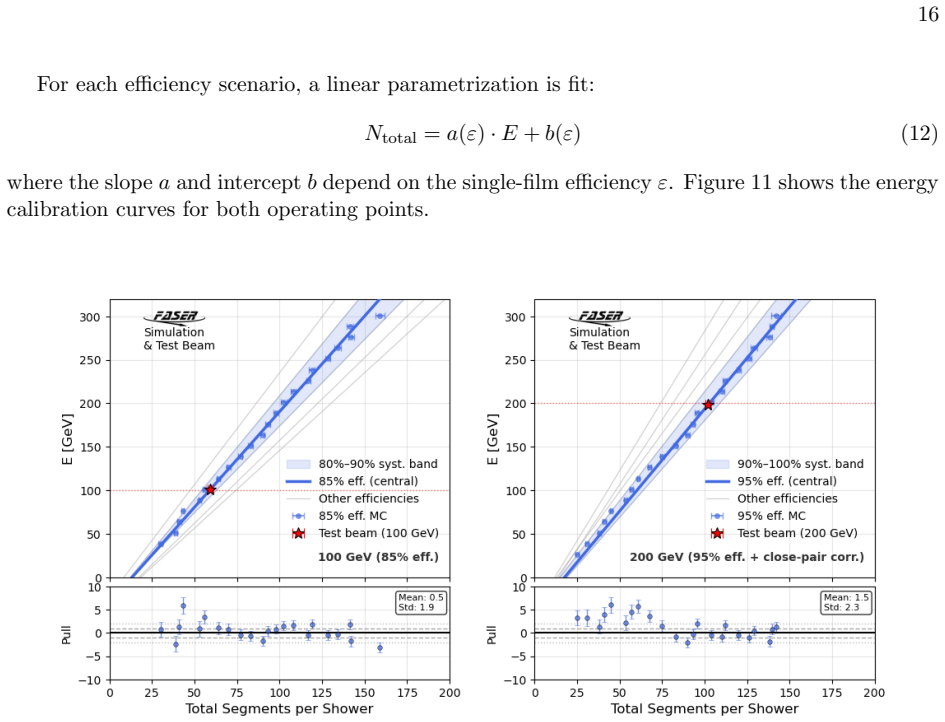
ENERGY RECONSTRUCTION The total number of segments across all plates in the reconstructed shower,N total, is used as the calorimetric energy estimator. This observable captures the full shower development and provides more robust energy estimation than localized estimators such asN 7-core. SinceN total depends directly on the single-film reconstruction ef...
-
[6]
The beam energy spreadat the SPS H4 beamline is ∆p/p≈1.4% [25], which propagates directly to a∼1.4% uncertainty on the reconstructed energy
SYSTEMATIC UNCERTAINTIES The systematic uncertainties in this analysis are dominated by three sources: the beam energy spread, background contamination, and single-film efficiency fluctuations. The beam energy spreadat the SPS H4 beamline is ∆p/p≈1.4% [25], which propagates directly to a∼1.4% uncertainty on the reconstructed energy. The beam has a transve...
-
[7]
Detecting and studying high-energy collider neutrinos with FASER at the LHC,
CONCLUSION We have presented and validated methods for electromagnetic shower reconstruction and identi- fication in the FASERνemulsion detector using 100 GeV and 200 GeV electron test-beam data from the CERN SPS H4 beamline. The reconstruction algorithm combines adaptive DBSCAN cluster- ing, sequential centroid validation with a 60µm deviation threshold,...
-
[8]
L. Evans and P. Bryant, “LHC machine,”JINST3(2008) S08001. [4]FASERCollaboration, “The FASER detector,”JINST19(2024) P05066,arXiv:2207.11427. [5]FASERCollaboration, “Technical proposal of FASERνneutrino detector,” Tech. Rep. CERN-LHCC-2019-017, CERN, 2019.arXiv:2001.03073. [6]OPERACollaboration, “The OPERA experiment in the CERN to Gran Sasso neutrino bea...
-
[9]
Nuclear emulsions,
A. Ariga, T. Ariga, G. D. Lellis, A. Ereditato, and K. Niwa, “Nuclear emulsions,”Particle Physics Reference Library: Volume 2: Detectors for Particles and Radiation(2020) 383–438
2020
-
[10]
M. Yoshimoto, T. Nakano, R. Komatani, and H. Kawahara, “Hyper track selector nuclear emulsion readout system aimed at scanning an area of one thousand square meters,”Prog. Theor. Exp. Phys. 2017(2017) 103H01. [9]FASERCollaboration, “Neutrino rate predictions for FASER,”Phys. Rev. D110(2024) 012009, arXiv:2402.13318
-
[11]
Particle Data Group, “Review of particle physics,”Prog. Theor. Exp. Phys.2022(2022) 083C01. [11]FASERCollaboration, “First neutrino interaction candidates at the LHC,”Phys. Rev. D104(2021) L091101,arXiv:2105.06197. [12]FASERCollaboration, “First direct observation of collider neutrinos with FASER at the LHC,” Phys. Rev. Lett.131(2023) 031801,arXiv:2303.14...
-
[12]
A density-based algorithm for discovering clusters in large spatial databases with noise,
M. Ester, H.-P. Kriegel, J. Sander, and X. Xu, “A density-based algorithm for discovering clusters in large spatial databases with noise,” inProceedings of the 2nd International Conference on Knowledge Discovery and Data Mining (KDD’96), pp. 226–231. AAAI Press, 1996
1996
-
[13]
A K-means clustering algorithm,
J. A. Hartigan and M. A. Wong, “A K-means clustering algorithm,”J. R. Stat. Soc. C28(1979) no. 1, 100–108
1979
-
[14]
Robust estimation of a location parameter,
P. J. Huber, “Robust estimation of a location parameter,” inBreakthroughs in Statistics, pp. 492–518. Springer, 1992
1992
-
[15]
Scikit-learn: Machine learning in python,
F. Pedregosa, G. Varoquaux, A. Gramfort, V. Michel, B. Thirion, O. Grisel, M. Blondel, P. Prettenhofer, R. Weiss, V. Dubourg, J. Vanderplas, A. Passos, D. Cournapeau, M. Brucher, M. Perrot, and ´Edouard Duchesnay, “Scikit-learn: Machine learning in python,”Journal of Machine Learning Research12(2011) no. 85, 2825–2830.http://jmlr.org/papers/v12/pedregosa11a.html
2011
-
[16]
XGBoost: A Scalable Tree Boosting System
T. Chen and C. Guestrin, “XGBoost: A scalable tree boosting system,”arXiv(2016) , arXiv:1603.02754
work page internal anchor Pith review Pith/arXiv arXiv 2016
-
[17]
H4 beam line
“H4 beam line.”https://be-dep-ea.web.cern.ch/experimental-areas/north-area/h4
discussion (0)
Sign in with ORCID, Apple, or X to comment. Anyone can read and Pith papers without signing in.