Onsite Calibration of the Shear-Shear Correlation
Pith reviewed 2026-06-26 20:14 UTC · model grok-4.3
The pith
Field-distortion signals saved in the shear catalog enable onsite calibration of real shear biases in HSCpdr3 data, producing consistent shear-shear correlations and cosmology across selections.
A machine-rendered reading of the paper's core claim, the machinery that carries it, and where it could break.
Core claim
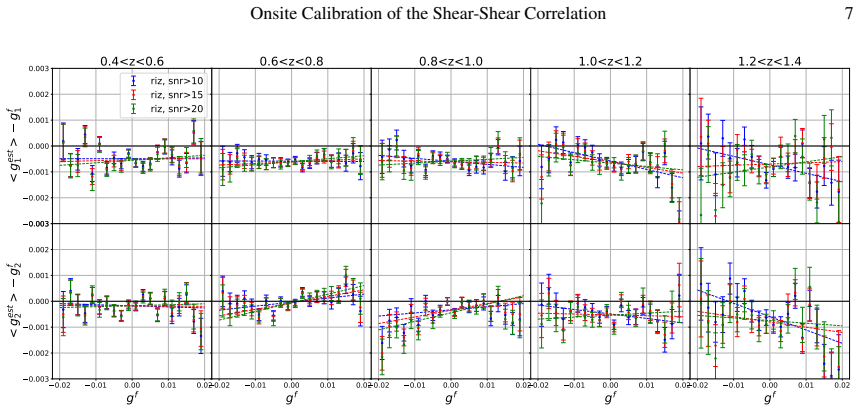
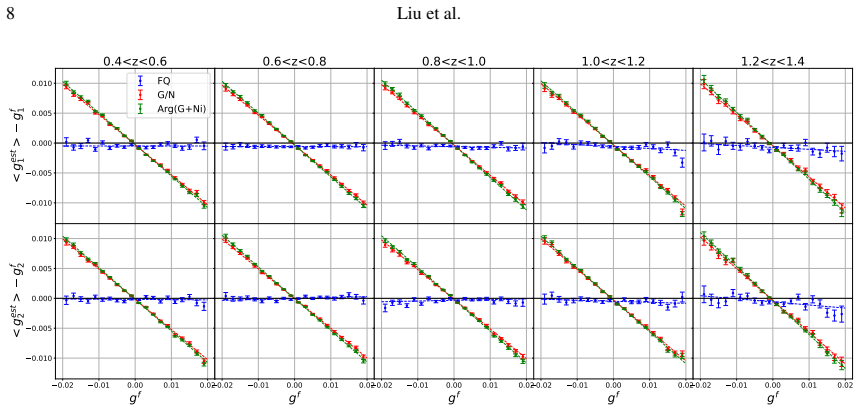
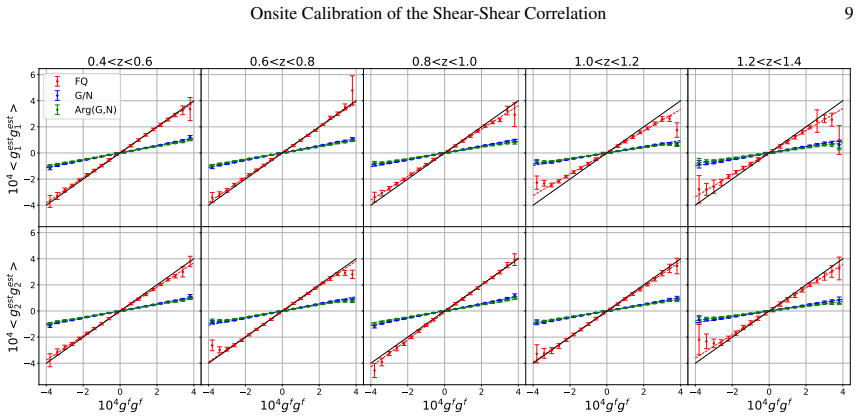
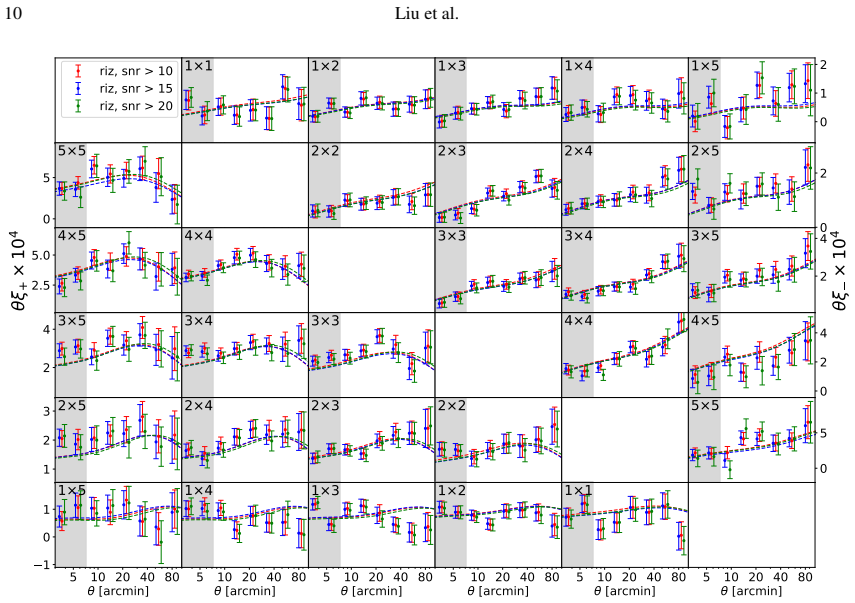
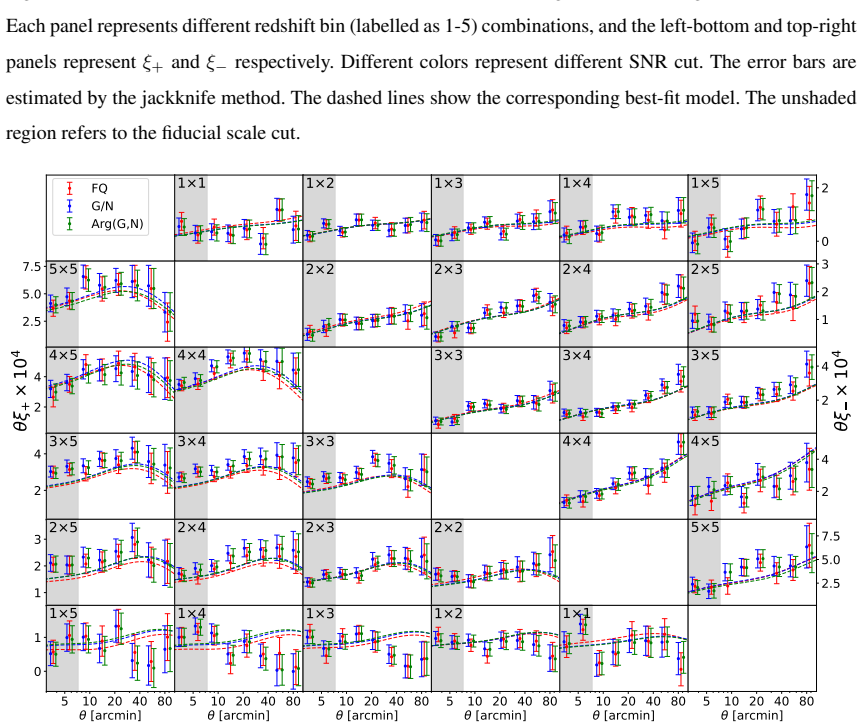
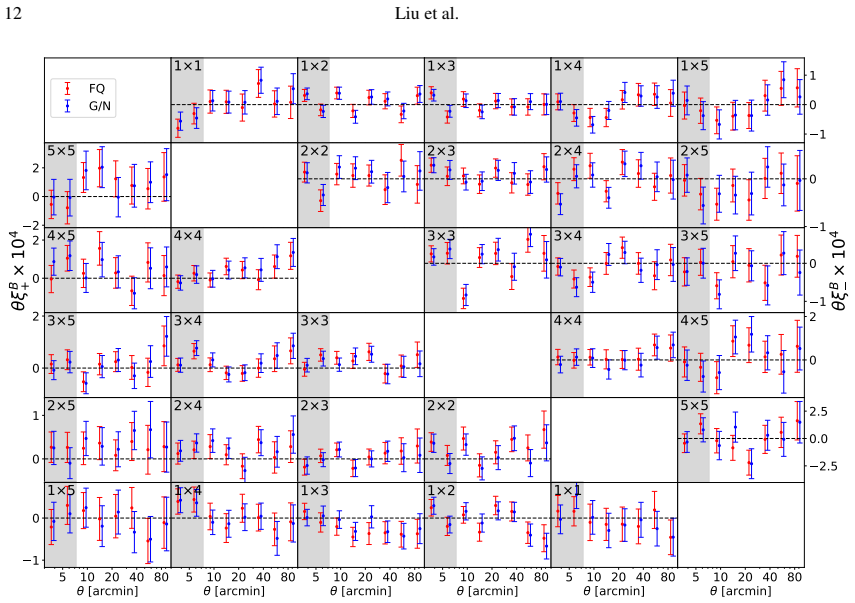
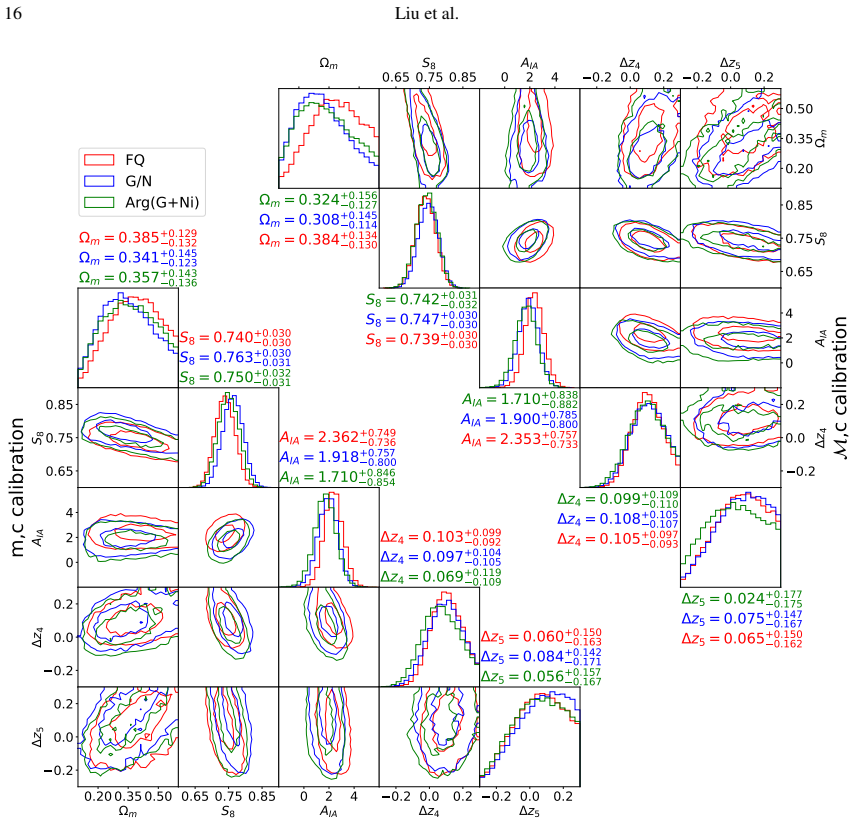
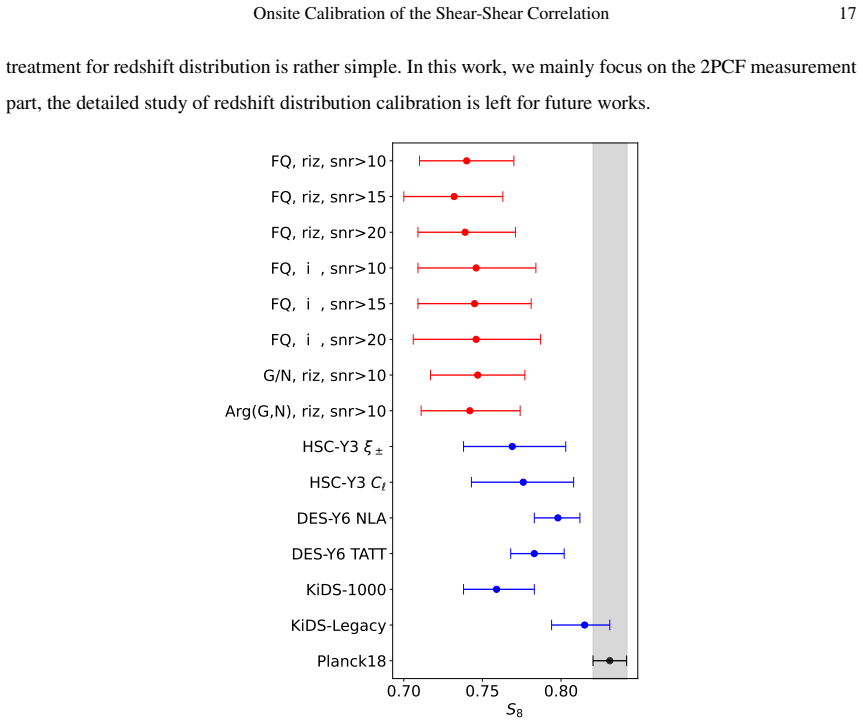
The central claim is that the onsite calibration method, which saves the field-distortion signal associated with each galaxy image in the shear catalog, captures real instrumental shear biases beyond those reproduced in simulations. When this calibration is applied to the HSCpdr3 shear catalog produced by the Fourier_Quad method, shear biases are found to vary with photo-z bin selections, SNR cuts, optical bands, and alternative shear estimator forms, yet the calibrated shear-shear correlation functions and cosmological parameter constraints remain consistent across all tested cases.
What carries the argument
The field-distortion signal saved with each galaxy image in the shear catalog, used to provide onsite calibration of shear bias for shear-shear correlation measurements.
If this is right
- Shear biases change with choices of photo-z bins, SNR cuts, optical bands, and forms of the shear estimators.
- After onsite calibration the shear-shear correlation functions become consistent across all such choices.
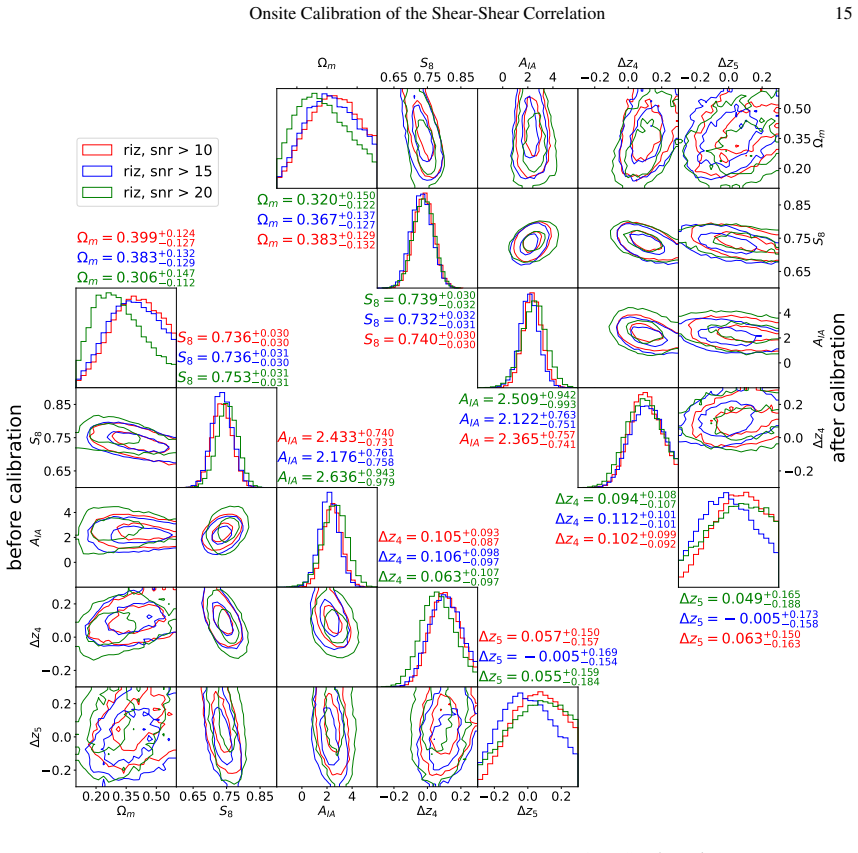
- Cosmological parameter constraints derived from the calibrated correlations are likewise consistent across selections.
- The fiducial catalog from r/i/z bands with SNR greater than 10 produces S8 equal to 0.740 plus or minus 0.030 and Omega_m equal to 0.383 plus or minus 0.132.
Where Pith is reading between the lines
- The same field-distortion signals could be used to check whether simulation-calibrated results systematically under- or over-correct biases in other weak-lensing surveys that also store per-galaxy distortion information.
- If the onsite corrections alter the inferred S8 value relative to simulation-only results, this would indicate that real-data effects contribute measurably to the current tension between weak-lensing and CMB constraints.
- Extending the method to galaxy-galaxy lensing statistics on the same catalog would test whether the calibration also stabilizes cross-correlation measurements.
Load-bearing premise
The field-distortion signal recorded in the shear catalog accurately reflects the true shear bias caused by instrumental effects that are not captured in simulated images.
What would settle it
A test in which the shear-shear correlation functions or cosmological constraints obtained after onsite calibration differ by more than the reported uncertainties from those obtained with only simulation-based calibration, when both are applied to the same HSCpdr3 catalog selections.
Figures
read the original abstract
Calibration of the cosmic shear bias is crucial for justifying the cosmological results. However, it is still unclear to what extent calibrations based on simulated galaxy images, as what is commonly done in the weak lensing community, can capture the real shear bias, especially given the complicated instrumental effects. On the other hand, selections of the source galaxies (magnitude cut, redshift binning, etc.) made in real measurement, as well as stochastic but possibly correlated shear biases, may introduce errors to the shear-shear correlations that are hard to calibrate apriori. In our previous few papers, we have shown that the field-distortion signal associated with each galaxy image can be saved in the shear catalog to provide onsite calibrations of shear bias for both galaxy-galaxy lensing and shear-shear correlation. In this paper, we apply this method to the HSCpdr3 shear catalog generated by the Fourier\_Quad shear measurement method. Using our onsite calibration method, we find that the shear biases vary with the selections of photo-z bins, SNR cuts, optical bands, as well as alternative forms of the shear estimators. Nevertheless, after calibrations, the shear-shear correlation functions and cosmological parameter constraints show consistent results in all the cases considered. The fiducial results from the r/i/z bands shear catalog with $\mathrm{SNR}>10$ cut yield: $S_8=0.740^{+0.030}_{-0.030}$ and $\Omega_m=0.383^{+0.129}_{-0.132}$
Editorial analysis
A structured set of objections, weighed in public.
Referee Report
Summary. The manuscript applies an onsite calibration technique, previously developed by the authors, to the HSC PDR3 shear catalog produced with the Fourier_Quad estimator. The calibration uses per-galaxy field-distortion signals to correct multiplicative shear biases that depend on photo-z bin, SNR cut, band, and estimator variant. Post-calibration, the shear-shear correlation functions ξ± and the resulting cosmological constraints on S8 and Ωm are reported to be consistent across these variations, with fiducial values S8 = 0.740^{+0.030}_{-0.030} and Ωm = 0.383^{+0.129}_{-0.132}.
Significance. If the onsite method correctly maps field-distortion signals to unbiased multiplicative corrections for the two-point functions, the work would supply a useful data-driven complement to image simulations for capturing real instrumental effects in weak-lensing catalogs. The reported consistency across multiple selections would then strengthen in the quoted cosmological parameters. No machine-checked derivations or reproducible code are supplied.
major comments (2)
- [Abstract] Abstract: the central claim that field-distortion signals saved in the catalog furnish unbiased onsite corrections to the shear-shear correlation rests on an unstated linear mapping from the per-galaxy distortion signal to the multiplicative bias m that is applied to ξ+ and ξ−. Without the explicit conversion (or its derivation in the main text), it is impossible to verify that residual additive terms or selection-induced correlations are absent after averaging.
- [Abstract] Abstract: the reported post-calibration consistency is presented without an error budget, a test against known input shears, or a direct comparison to the simulation-based m values that are standard in the field. This omission is load-bearing for the assertion that the onsite method captures effects beyond those in simulated images.
minor comments (1)
- [Abstract] Abstract: the fiducial S8 error is quoted symmetrically while the Ωm error is asymmetric; state whether this reflects the shape of the posterior or a reporting convention.
Simulated Author's Rebuttal
We thank the referee for the careful review and constructive feedback. We respond to each major comment below, indicating where revisions will be made to address the concerns raised.
read point-by-point responses
-
Referee: [Abstract] Abstract: the central claim that field-distortion signals saved in the catalog furnish unbiased onsite corrections to the shear-shear correlation rests on an unstated linear mapping from the per-galaxy distortion signal to the multiplicative bias m that is applied to ξ+ and ξ−. Without the explicit conversion (or its derivation in the main text), it is impossible to verify that residual additive terms or selection-induced correlations are absent after averaging.
Authors: The linear mapping between the per-galaxy field-distortion signals and the multiplicative bias m for the two-point shear correlations was derived in our prior works on the onsite calibration technique. To make the present manuscript self-contained, we will add an explicit statement of the conversion formula together with a short discussion of the averaging assumptions that suppress residual additive terms and selection-induced correlations. revision: yes
-
Referee: [Abstract] Abstract: the reported post-calibration consistency is presented without an error budget, a test against known input shears, or a direct comparison to the simulation-based m values that are standard in the field. This omission is load-bearing for the assertion that the onsite method captures effects beyond those in simulated images.
Authors: We will expand the text to include a clearer error budget for the quoted consistency across selections. A direct test against known input shears is not feasible on real data, as the true shear is unknown by definition; the onsite approach is intended precisely for this regime. A side-by-side comparison with simulation-derived m values is outside the scope of the current work, which instead demonstrates internal consistency on the actual catalog. We therefore revise partially by adding the error-budget discussion while retaining the focus on the real-data consistency test. revision: partial
Circularity Check
Self-citation of onsite calibration method; new data application adds independent consistency tests
specific steps
-
self citation load bearing
[Abstract]
"In our previous few papers, we have shown that the field-distortion signal associated with each galaxy image can be saved in the shear catalog to provide onsite calibrations of shear bias for both galaxy-galaxy lensing and shear-shear correlation. In this paper, we apply this method to the HSCpdr3 shear catalog generated by the Fourier_Quad shear measurement method."
The validity of the onsite calibration procedure (the load-bearing premise enabling all subsequent bias corrections and consistency claims) is asserted solely via self-citation to the authors' earlier work, without an independent derivation or external verification presented in this manuscript.
full rationale
The paper's core technique for using field-distortion signals to calibrate shear bias is justified by reference to the authors' prior papers rather than re-derived here. However, the manuscript's new contributions consist of applying the method to the HSCpdr3 catalog, measuring variations across photo-z bins/SNR cuts/bands/estimators, and demonstrating post-calibration consistency in correlation functions and cosmological constraints (S8 and Ωm). This application and cross-checks constitute independent content. No self-definitional loops, fitted inputs renamed as predictions, or ansatz smuggling are exhibited in the provided text. The self-citation is load-bearing for the method's validity but does not reduce the reported results to tautology.
Axiom & Free-Parameter Ledger
Reference graph
Works this paper leans on
-
[1]
Abbott, T. M. C., Aguena, M., Alarcon, A., et al. 2022, prd, 105, 023520 2
2022
-
[2]
2018, PASJ, 70, S4 2
Aihara, H., Arimoto, N., Armstrong, R., et al. 2018, PASJ, 70, S4 2
2018
-
[3]
2022, PASJ, 74, 247 4
Aihara, H., AlSayyad, Y ., Ando, M., et al. 2022, PASJ, 74, 247 4
2022
-
[4]
2023, ApJ, 947, 19 3
Alonso, P., Wang, W., Zhang, J., et al. 2023, ApJ, 947, 19 3
2023
-
[5]
2021, A&A, 645, A104 2, 16 18 Liu et al
Asgari, M., Lin, C.-A., Joachimi, B., et al. 2021, A&A, 645, A104 2, 16 18 Liu et al
2021
-
[6]
J., Refregier, A
Bacon, D. J., Refregier, A. R., & Ellis, R. S. 2000, MNRAS, 318, 625 1
2000
-
[7]
2018, PASJ, 70, S5 4
Bosch, J., Armstrong, R., Bickerton, S., et al. 2018, PASJ, 70, S5 4
2018
-
[8]
2007, New Journal of Physics, 9, 444 12
Bridle, S., & King, L. 2007, New Journal of Physics, 9, 444 12
2007
-
[9]
L., Taylor, A
Brown, M. L., Taylor, A. N., Hambly, N. C., & Dye, S. 2002, MNRAS, 333, 501 13
2002
-
[10]
E., Alonso, D., Krause, E., et al
Chisari, N. E., Alonso, D., Krause, E., et al. 2019, ApJS, 242, 2 13
2019
-
[11]
Dalal, R., Li, X., Nicola, A., et al. 2023, Phys. Rev. D, 108, 123519 16 Dark Energy Survey Collaboration, Abbott, T., Abdalla, F. B., et al. 2016, MNRAS, 460, 1270 2 de Jong, J. T. A., Verdoes Kleijn, G. A., Kuijken, K. H., & Valentijn, E. A. 2013, Experimental Astronomy, 35, 25 2 DES Collaboration, Abbott, T. M. C., Aguena, M., et al. 2026, arXiv e-prin...
arXiv 2023
-
[12]
2019, ApJ, 874, 7 1
Dong, F., Zhang, J., Yu, Y ., et al. 2019, ApJ, 874, 7 1
2019
-
[13]
2022, MNRAS, 513, 4754 3
Fong, M., Han, J., Zhang, J., et al. 2022, MNRAS, 513, 4754 3
2022
-
[14]
W., Lang, D., & Goodman, J
Foreman-Mackey, D., Hogg, D. W., Lang, D., & Goodman, J. 2013, PASP, 125, 306 14
2013
-
[15]
2007, A&A, 464, 399 13
Hartlap, J., Simon, P., & Schneider, P. 2007, A&A, 464, 399 13
2007
-
[16]
M., & Seljak, U
Hirata, C. M., & Seljak, U. 2004, Phys. Rev. D, 70, 063526 11
2004
-
[17]
2008, Annual Review of Nuclear and Particle Science, 58, 99 1
Hoekstra, H., & Jain, B. 2008, Annual Review of Nuclear and Particle Science, 58, 99 1
2008
-
[18]
C., & Yee, H
Hsieh, B. C., & Yee, H. K. C. 2014, ApJ, 792, 102 5, 12
2014
-
[19]
2000, ApJ, 537, 555 1
Kaiser, N. 2000, ApJ, 537, 555 1
2000
-
[20]
2022, PASJ, 74, 421 2
Li, X., Miyatake, H., Luo, W., et al. 2022, PASJ, 74, 421 2
2022
-
[21]
2023b, arXiv e-prints, arXiv:2304.00702 2, 13, 16
Li, X., Zhang, T., Sugiyama, S., et al. 2023b, arXiv e-prints, arXiv:2304.00702 2, 13, 16
-
[22]
2025, ApJ, 993, 182 2, 4, 6, 14
Liu, C., Zhang, J., Li, H., Alonso, P., & Wang, W. 2025, ApJ, 993, 182 2, 4, 6, 14
2025
-
[23]
2026, arXiv e-prints, arXiv:2606.00553 4
Liu, Z., Sun, J., Zhang, J., & Liu, C. 2026, arXiv e-prints, arXiv:2606.00553 4
Pith/arXiv arXiv 2026
-
[24]
R., McCullough, J., et al
MacCrann, N., Becker, M. R., McCullough, J., et al. 2022, MNRAS, 509, 3371 2
2022
-
[25]
Moore, E. H. 1920, Bulletin of the american mathematical society, 26, 294 13
1920
-
[26]
J., Hsieh, B.-C., Tanaka, M., & Takata, T
Nishizawa, A. J., Hsieh, B.-C., Tanaka, M., & Takata, T. 2020, arXiv e-prints, arXiv:2003.01511 5, 12
arXiv 2020
-
[27]
1955, Mathematical Proceedings of the Cambridge Philosophical Society, 51, 406–413 13 Planck Collaboration, Aghanim, N., Akrami, Y ., et al
Penrose, R. 1955, Mathematical Proceedings of the Cambridge Philosophical Society, 51, 406–413 13 Planck Collaboration, Aghanim, N., Akrami, Y ., et al. 2020, A&A, 641, A6 14, 16
1955
-
[28]
2002, A&A, 389, 729 11
Schneider, P., van Waerbeke, L., & Mellier, Y . 2002, A&A, 389, 729 11
2002
-
[29]
Shen, Z., Zhang, J., Liu, C., et al. 2025, J. Cosmol. Astropart. Phys., 2025, 068 2, 3, 5
2025
-
[30]
E., Peacock, J
Smith, R. E., Peacock, J. A., Jenkins, A., et al. 2003, MNRAS, 341, 1311 13
2003
-
[31]
2012, ApJ, 761, 152 13
Takahashi, R., Sato, M., Nishimichi, T., Taruya, A., & Oguri, M. 2012, ApJ, 761, 152 13
2012
-
[32]
A., & Ishak, M
Troxel, M. A., & Ishak, M. 2015, Phys. Rep., 558, 1 11 van Uitert, E., Hoekstra, H., Joachimi, B., et al. 2017, MNRAS, 467, 4131 1
2015
-
[33]
2023, ApJ, 954, 193 3
Wang, H., Zhang, J., Li, H., & Liu, C. 2023, ApJ, 954, 193 3
2023
-
[34]
2022, ApJ, 936, 161 3
Wang, J., Yang, X., Zhang, J., et al. 2022, ApJ, 936, 161 3
2022
-
[35]
H., St¨olzner, B., Asgari, M., et al
Wright, A. H., St¨olzner, B., Asgari, M., et al. 2025, A&A, 703, A158 16
2025
-
[36]
A., et al
Zhang, J., Liu, C., Vaquero, P. A., et al. 2022, AJ, 164, 128 2
2022
-
[37]
Zhang, J., Luo, W., & Foucaud, S. 2015, J. Cosmol. Astropart. Phys., 2015, 024 3 Onsite Calibration of the Shear-Shear Correlation 19
2015
-
[38]
2017, ApJ, 834, 8 3
Zhang, J., Zhang, P., & Luo, W. 2017, ApJ, 834, 8 3
2017
-
[39]
2019, ApJ, 875, 48 2, 5
Zhang, J., Dong, F., Li, H., et al. 2019, ApJ, 875, 48 2, 5
2019
discussion (0)
Sign in with ORCID, Apple, or X to comment. Anyone can read and Pith papers without signing in.