EH-FedSAG: Variance-Reduced Federated Learning with Energy-Aware Participation in Energy-Harvesting IoT
Pith reviewed 2026-06-26 19:48 UTC · model grok-4.3
The pith
EH-FedSAG achieves higher test accuracy and lower variance than EH-FedAvg in energy-harvesting IoT federated learning.
A machine-rendered reading of the paper's core claim, the machinery that carries it, and where it could break.
Core claim
The central claim is that EH-FedSAG, a server-memory-based variance-reduced method, consistently achieves higher test accuracy than EH-FedAvg while exhibiting substantially lower training variance. This holds for both homogeneous and heterogeneous data distributions, with the advantage being more pronounced under scarce energy availability and non-IID data.
What carries the argument
EH-FedSAG, the server-memory-based variance-reduced federated learning method with energy-aware participation.
If this is right
- EH-FedSAG achieves higher test accuracy than EH-FedAvg.
- EH-FedSAG exhibits substantially lower training variance than EH-FedAvg.
- The performance advantage of EH-FedSAG is more pronounced under scarce energy availability.
- The performance advantage of EH-FedSAG is more pronounced under non-IID data distributions.
Where Pith is reading between the lines
- Implementing EH-FedSAG could enable federated learning in environments where devices rely solely on harvested energy without batteries.
- Further work might explore adapting the method to different energy harvesting models or network topologies.
- The lower variance could reduce the number of training rounds needed to reach a target accuracy in energy-constrained settings.
Load-bearing premise
The unified simulation framework that captures battery charging, local computation cost, and transmission cost under different energy-arrival probabilities accurately represents real energy-harvesting IoT devices.
What would settle it
Deploying EH-FedSAG and EH-FedAvg on physical energy-harvesting IoT hardware and measuring if the accuracy and variance differences persist.
Figures


read the original abstract
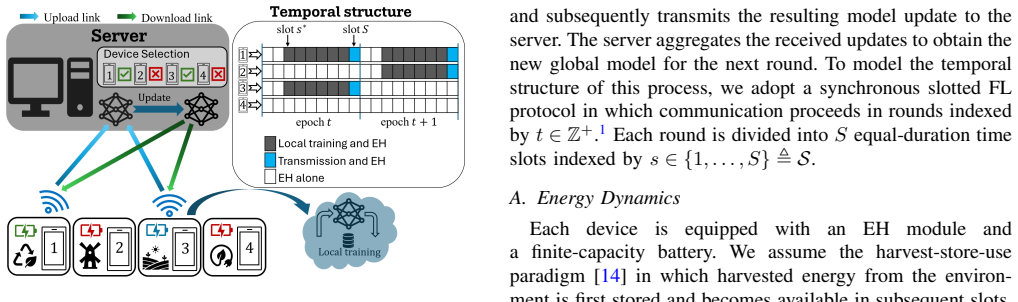
Federated learning (FL) in energy-harvesting (EH) networks is challenged by intermittent and stochastic energy arrivals that lead to unstable device participation across training rounds, and by high communication costs under limited energy budgets, reducing overall training efficiency. This paper studies FL under a slot-based EH model and proposes EH-FedSAG, a server-memory-based variance-reduced method. We compare EH-FedSAG with vanilla EH-FedAvg under the same multi-channel orthogonal multiple-access uplink model and within a unified simulation framework that captures battery charging, local computation cost, and transmission cost under different energy-arrival probabilities. Performance is assessed in terms of test accuracy over training rounds for both homogeneous and heterogeneous data distributions. The results show that EH-FedSAG consistently achieves higher test accuracy than EH-FedAvg in the considered settings, while exhibiting substantially lower training variance. The advantage of EH-FedSAG is more pronounced under scarce energy availability and non-independent/identically-distributed data.
Editorial analysis
A structured set of objections, weighed in public.
Referee Report
Summary. The paper proposes EH-FedSAG, a server-memory-based variance-reduced federated learning method for energy-harvesting IoT networks. It compares this method to EH-FedAvg within a unified simulation framework that models battery charging, local computation and transmission costs, and multi-channel orthogonal multiple-access uplink under varying energy-arrival probabilities. The results claim that EH-FedSAG achieves higher test accuracy with lower training variance than EH-FedAvg, with the advantage being more pronounced under scarce energy and non-IID data distributions.
Significance. If the simulation results are reliable, this work provides evidence that variance reduction techniques can mitigate the effects of unstable device participation in federated learning for energy-harvesting networks. This could have practical significance for designing efficient FL protocols in IoT systems with intermittent energy sources. The empirical nature without theoretical bounds or hardware experiments limits the immediate impact.
major comments (2)
- [Simulation Setup and Results] The performance comparison lacks error bars, statistical significance tests, and details on the number of simulation runs or dataset sizes, making it difficult to assess whether the reported accuracy gains are statistically meaningful or consistent across runs.
- [Method Description] The specific implementation of the variance reduction in EH-FedSAG, including how the server memory is used and the update rule, is not sufficiently detailed to allow reproduction or verification of the claimed variance reduction effect.
minor comments (1)
- [Abstract] The abstract could benefit from a brief mention of the specific datasets or models used in the simulations for better context.
Simulated Author's Rebuttal
We thank the referee for the constructive comments. We address the two major comments point by point below and will revise the manuscript to improve clarity and reproducibility.
read point-by-point responses
-
Referee: [Simulation Setup and Results] The performance comparison lacks error bars, statistical significance tests, and details on the number of simulation runs or dataset sizes, making it difficult to assess whether the reported accuracy gains are statistically meaningful or consistent across runs.
Authors: We agree that the current presentation would benefit from these additions. In the revised manuscript we will report results averaged over multiple independent runs with error bars (standard deviation), explicitly state the number of runs and the dataset sizes employed, and include statistical significance tests comparing EH-FedSAG and EH-FedAvg. revision: yes
-
Referee: [Method Description] The specific implementation of the variance reduction in EH-FedSAG, including how the server memory is used and the update rule, is not sufficiently detailed to allow reproduction or verification of the claimed variance reduction effect.
Authors: We will expand the algorithmic description in the revised version. We will add explicit pseudocode showing the server-memory update, the precise variance-reduced local and global update rules, and a step-by-step explanation of how the memory is maintained and applied under the energy-harvesting participation model. revision: yes
Circularity Check
Empirical simulation result with no load-bearing derivation or self-citation chain
full rationale
The paper proposes EH-FedSAG as a variance-reduced FL method and reports its performance via controlled simulations against EH-FedAvg under a unified energy-harvesting model. No equations, fitted parameters, or theoretical derivations are presented that reduce to their own inputs by construction. The central claim is an empirical observation strictly within the described simulation framework; no uniqueness theorems, ansatzes, or self-citations are invoked as load-bearing support for the accuracy or variance results. This is a standard self-contained empirical comparison.
Axiom & Free-Parameter Ledger
Reference graph
Works this paper leans on
-
[1]
Federated learning of deep networks using model averaging,
H. B. McMahan, E. Moore, D. Ramage, S. Hampson, and B. A. y Arcas, “Communication-efficient learning of deep networks from decentralized data,” 2023. [Online]. Available: https://arxiv.org/abs/1602.05629
-
[2]
FedPAQ: A communication-efficient federated learning method with periodic averaging and quantization,
A. Reisizadeh, A. Mokhtari, H. Hassani, A. Jadbabaie, and R. Pedarsani, “FedPAQ: A communication-efficient federated learning method with periodic averaging and quantization,” inProceedings of the Twenty Third International Conference on Artificial Intelligence and Statistics, ser. Proceedings of Machine Learning Research, S. Chiappa and R. Calandra, Eds....
2020
-
[3]
On the convergence of FedAvg on Non-IID data,
X. Li, K. Huang, W. Yang, S. Wang, and Z. Zhang, “On the convergence of FedAvg on Non-IID data,” inInternational Conference on Learning Representations, 2020. [Online]. Available: https://openreview.net/forum?id=HJxNAnVtDS
2020
-
[4]
Q. Yang, X. Du, X. Wu, W. Wang, A. Liu, and S. Wang, “Fedrtid: an efficient shuffle federated learning via random participation and adaptive time constraint,”Cybersecurity, 2024. [Online]. Available: https://doi.org/10.1186/s42400-024-00293-x
-
[5]
A comprehensive survey on client selection strategies in federated learning,
J. Li, T. Chen, and S. Teng, “A comprehensive survey on client selection strategies in federated learning,”Computer Networks, vol. 251, p. 110663, 2024. [Online]. Available: https://www.sciencedirect. com/science/article/pii/S138912862400495X
2024
-
[6]
A systematic literature review on client selection in federated learning,
C. Smestad and J. Li, “A systematic literature review on client selection in federated learning,” inProceedings of the 27th International Conference on Evaluation and Assessment in Software Engineering, ser. EASE ’23. New York, NY , USA: Association for Computing Machinery, 2023, p. 2–11. [Online]. Available: https://doi.org/10.1145/ 3593434.3593438
-
[7]
FedV ARP: Tackling the variance due to partial client participation in federated learning,
D. Jhunjhunwala, P. Sharma, A. Nagarkatti, and G. Joshi, “FedV ARP: Tackling the variance due to partial client participation in federated learning,” inThe 38th Conference on Uncertainty in Artificial Intelligence, 2022. [Online]. Available: https://openreview.net/forum? id=HlWLLdUocx5
2022
-
[8]
SAGA: A fast incremental gradient method with support for non-strongly convex composite objectives,
A. Defazio, F. Bach, and S. Lacoste-Julien, “SAGA: A fast incremental gradient method with support for non-strongly convex composite objectives,” inAdvances in Neural Information Processing Systems, vol. 27. Curran Associates, Inc., 2014. [Online]. Available: https://proceedings.neurips.cc/paper files/paper/ 2014/file/937964195d6fb3a55cd7cc578165f058-Paper.pdf
-
[9]
Energy-aware federated learning with distributed user sampling and multichannel ALOHA,
R. Valente da Silva, O. L. A. L ´opez, and R. D. Souza, “Energy-aware federated learning with distributed user sampling and multichannel ALOHA,”IEEE Communications Letters, vol. 27, no. 10, pp. 2867– 2871, 2023
2023
-
[10]
On federated learning with energy harvesting clients,
C. Shen, J. Yang, and J. Xu, “On federated learning with energy harvesting clients,” 2022. [Online]. Available: https://arxiv.org/abs/2202. 06105
2022
-
[11]
Battery-aware cyclic scheduling in energy- harvesting federated learning,
E. Jeong and N. Pappas, “Battery-aware cyclic scheduling in energy- harvesting federated learning,” in2025 IEEE 26th International Work- shop on Signal Processing and Artificial Intelligence for Wireless Communications (SPAWC), 2025, pp. 1–5
2025
-
[12]
Fedseq: A hybrid federated learning framework based on sequential in-cluster training,
Z. Chen, D. Li, R. Ni, J. Zhu, and S. Zhang, “Fedseq: A hybrid federated learning framework based on sequential in-cluster training,” IEEE Systems Journal, vol. 17, no. 3, pp. 4038–4049, 2023
2023
-
[13]
Federated learning over energy harvesting wireless networks,
R. Hamdi, M. Chen, A. B. Said, M. Qaraqe, and H. V . Poor, “Federated learning over energy harvesting wireless networks,”IEEE Internet of Things Journal, vol. 9, no. 1, p. 92–103, Jan. 2022. [Online]. Available: http://dx.doi.org/10.1109/JIOT.2021.3089054
-
[14]
Energy harvesting sensor nodes: Survey and implications,
S. Sudevalayam and P. Kulkarni, “Energy harvesting sensor nodes: Survey and implications,”IEEE Communications Surveys & Tutorials, vol. 13, no. 3, pp. 443–461, 2011
2011
-
[15]
Accounting for variance in machine learning benchmarks,
X. Bouthillier and et al, “Accounting for variance in machine learning benchmarks,” inProceedings of Machine Learning and Systems, A. Smola, A. Dimakis, and I. Stoica, Eds., vol. 3, 2021, pp. 747–769. [Online]. Available: https://proceedings.mlsys.org/paper files/ paper/2021/file/0184b0cd3cfb185989f858a1d9f5c1eb-Paper.pdf
2021
discussion (0)
Sign in with ORCID, Apple, or X to comment. Anyone can read and Pith papers without signing in.