Controlled Out-of-Band Device-to-Device Communication in Cellular Networks Using a Backup Channel in Television White Space
Pith reviewed 2026-06-26 19:43 UTC · model grok-4.3
The pith
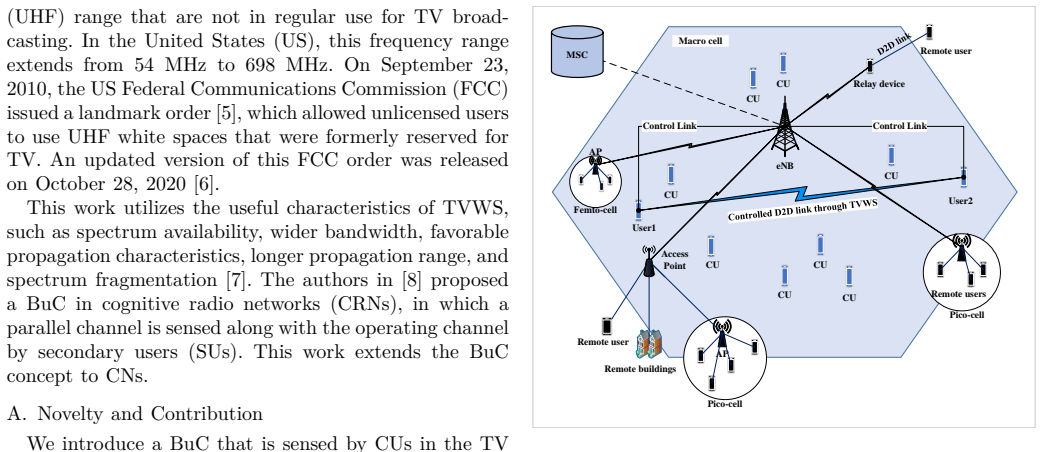
When regular cellular channels are full, users in the same cell can use a sensed backup channel in television white space to form direct device-to-device links that bypass the base station.
A machine-rendered reading of the paper's core claim, the machinery that carries it, and where it could break.
Core claim
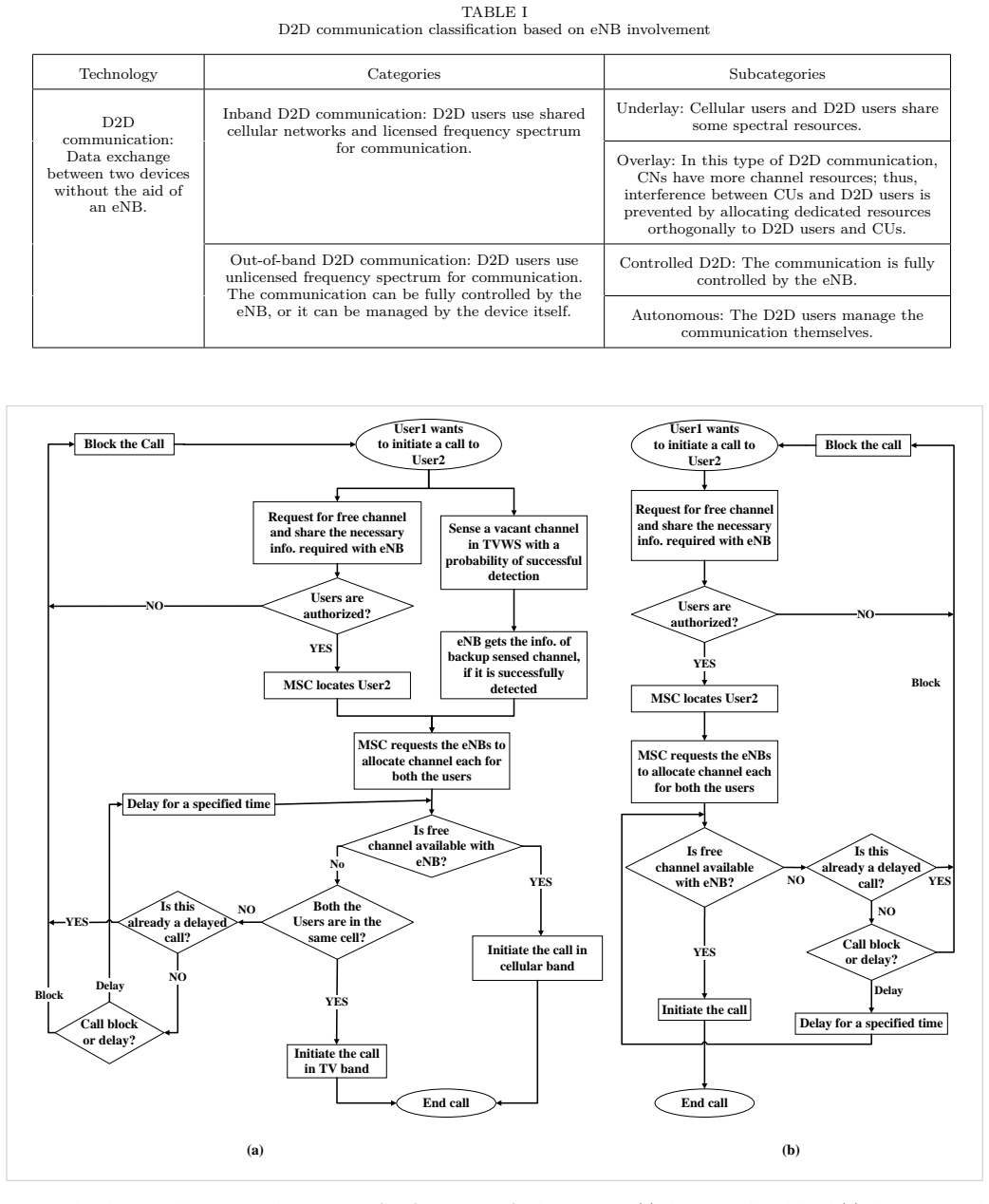
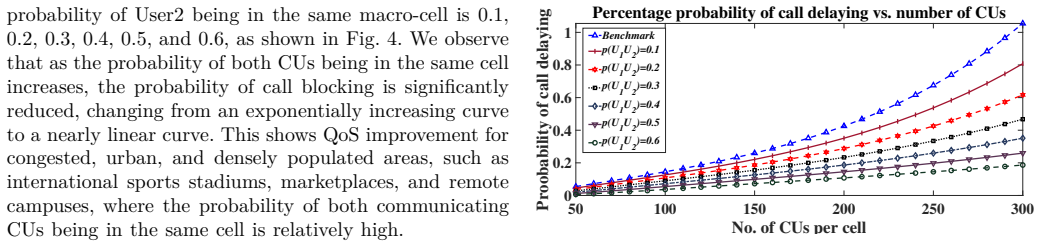
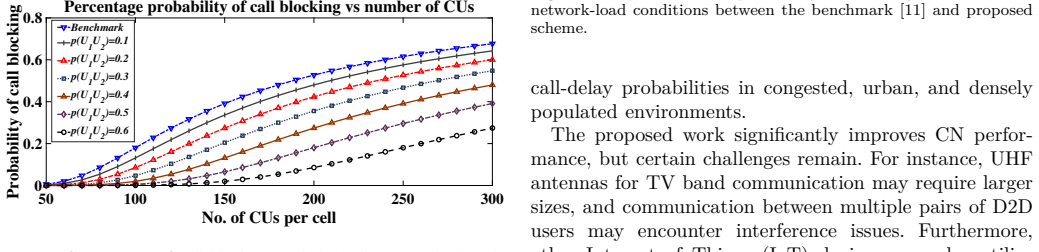
The paper claims that a backup channel in television white space, detected with a stated probability of success by cognitive radio energy-detection sensing, allows cellular users inside the same macro-cell to establish controlled out-of-band device-to-device links once every regular channel to the eNB is occupied. Each cellular user and the eNB carries two antennas so that the cellular and television bands remain separate. The resulting links bypass the eNB for data transfer, reduce load on the network core, and raise effective eNB capacity, which the simulations quantify through drops in blocking probability and call-delay probability.
What carries the argument
The backup channel (BuC) in television white space, sensed by cognitive radio energy detection and used for controlled out-of-band device-to-device links.
If this is right
- Blocking probability for new calls drops when the backup channel is available.
- Probability of call delay drops under the same conditions.
- Capacity at the cellular eNB increases because fewer calls route through it.
- Load on the core network decreases because data stays local to the device-to-device link.
Where Pith is reading between the lines
- The same sensing-plus-backup approach could be tested on other white-space bands if the energy detector performs similarly.
- Network operators would need to measure real-world sensing success rates before scaling the scheme.
- Protocol changes could be added to let devices fall back to the backup channel without user intervention.
- End-to-end latency comparisons between routed and direct paths would clarify whether the bypass always helps time-sensitive traffic.
Load-bearing premise
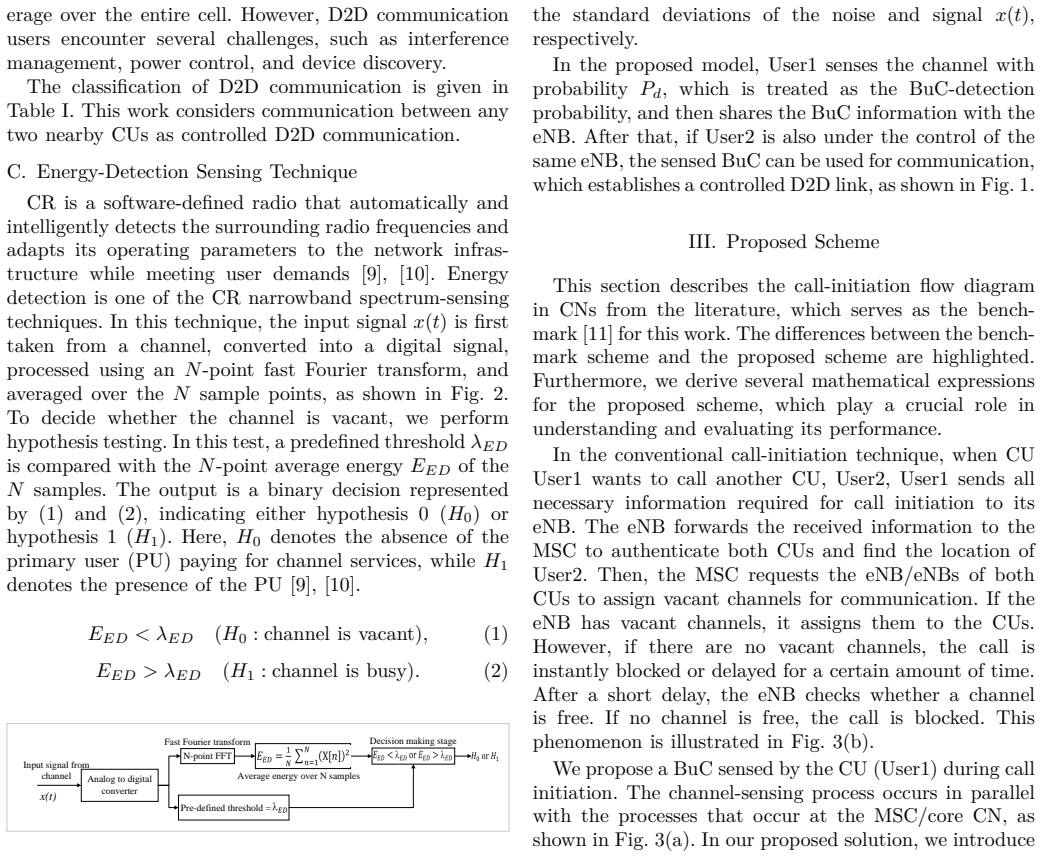
The energy-detection sensing must succeed often enough to locate the backup channel reliably, and the dual-antenna hardware must prevent interference between the cellular and television bands.
What would settle it
A set of simulations or field measurements in which the measured blocking probability stays the same or rises after the backup channel is added, or in which sensing failures make the device-to-device links unusable.
Figures
read the original abstract
In this article, we address the problem of spectrum scarcity in cellular networks (CNs). We propose a backup channel (BuC) for cellular users (CUs) located in the same macro-cell under the control of a single macro base station (eNB). This BuC operates in television white space and is detected by the CUs through a cognitive radio energy-detection channel-sensing technique with a certain probability of success. When all regular channels with the cellular eNB are occupied, the CUs within the same coverage area of the macro eNB can utilize the sensed BuC to establish a controlled out-of-band device-to-device link for communication. The BuC bypasses the eNB for data communication and reduces the burden on the core of the CN. This leads to improved cellular eNB capacity. In the proposed system model, each CU and eNB is equipped with two antennas for communication in two separate bands, i.e., cellular and TV bands. Simulations show significant reductions in the blocking probability and probability of call delay.
Editorial analysis
A structured set of objections, weighed in public.
Referee Report
Summary. The manuscript proposes a backup channel (BuC) in television white space for controlled out-of-band D2D communication among cellular users (CUs) under a single macro eNB. When regular cellular channels are occupied, CUs sense the BuC via cognitive radio energy detection (with some success probability) and use dual-antenna equipment to form D2D links that bypass the eNB. The approach is claimed to reduce the load on the cellular core network and improve eNB capacity; simulations are stated to demonstrate significant reductions in blocking probability and call-delay probability.
Significance. If the simulation results can be validated with explicit sensing-error modeling and reproducible parameters, the work would provide a concrete mechanism for opportunistic spectrum relief in cellular systems by leveraging TV white space for controlled D2D. The dual-band antenna assumption and centralized control distinguish it from purely ad-hoc TVWS approaches and could inform practical offloading strategies.
major comments (2)
- [Abstract] Abstract: the claim that 'Simulations show significant reductions in the blocking probability and probability of call delay' is unsupported by any description of simulation parameters, traffic model, number of Monte-Carlo runs, sensing-success probability value, or comparison baseline. This is load-bearing because the performance gains constitute the primary evidence offered for the proposal.
- [System model] System model (sensing description): the energy-detection technique is asserted to succeed 'with a certain probability of success' and to enable 'interference-free communication in separate bands,' yet no miss-detection/false-alarm probabilities, fading statistics, or macro-eNB interference model on the TV band are supplied. Because the central claim requires reliable BuC detection when cellular channels are full, the absence of this quantitative characterization prevents assessment of whether the reported reductions would materialize.
minor comments (1)
- The acronym 'BuC' and the phrase 'controlled out-of-band' should be defined on first use; the dual-antenna requirement is mentioned only in the abstract and would benefit from an explicit statement in the system-model section.
Simulated Author's Rebuttal
We thank the referee for the constructive comments. We address each major point below and will revise the manuscript to incorporate the requested details on simulation parameters and the sensing model.
read point-by-point responses
-
Referee: [Abstract] Abstract: the claim that 'Simulations show significant reductions in the blocking probability and probability of call delay' is unsupported by any description of simulation parameters, traffic model, number of Monte-Carlo runs, sensing-success probability value, or comparison baseline. This is load-bearing because the performance gains constitute the primary evidence offered for the proposal.
Authors: We agree that the abstract lacks sufficient detail on the simulation setup. In the revised version we will expand the abstract to briefly state the traffic model (Poisson arrivals with given load), number of Monte-Carlo runs, the specific sensing-success probability employed, and the baseline (standard cellular system without BuC) against which the reductions in blocking and call-delay probability are measured. revision: yes
-
Referee: [System model] System model (sensing description): the energy-detection technique is asserted to succeed 'with a certain probability of success' and to enable 'interference-free communication in separate bands,' yet no miss-detection/false-alarm probabilities, fading statistics, or macro-eNB interference model on the TV band are supplied. Because the central claim requires reliable BuC detection when cellular channels are full, the absence of this quantitative characterization prevents assessment of whether the reported reductions would materialize.
Authors: We acknowledge that the current system-model description uses a simplified success-probability abstraction. In the revision we will replace this with an explicit energy-detection model that includes miss-detection and false-alarm probabilities derived from standard ROC curves, Rayleigh fading statistics on the TV band, and a path-loss-plus-shadowing interference model from the macro-eNB. These additions will allow readers to evaluate the robustness of the reported performance gains. revision: yes
Circularity Check
No significant circularity detected
full rationale
The paper presents a system model for using a sensed backup channel in TV white space to enable out-of-band D2D links when cellular channels are occupied. The energy-detection success probability is introduced as an explicit modeling assumption rather than derived from other quantities in the paper. Simulations are used to show performance improvements, but no equations, parameters, or results are shown to reduce by construction to fitted inputs or self-citations. No load-bearing uniqueness theorems, ansatzes smuggled via citation, or renaming of known results appear. The central claims rest on the stated system assumptions and simulation outcomes, which are independent of the target metrics.
Axiom & Free-Parameter Ledger
invented entities (1)
-
Backup Channel (BuC)
no independent evidence
Reference graph
Works this paper leans on
-
[1]
A. R. Mishra, Ed., Advanced Cellular Network Planning and Optimisation: 2G/2.5G/3G…Evolution to 4G. Chichester, U.K.: John Wiley & Sons, 2007, doi: 10.1002/9780470057629
-
[2]
Handoff scheme for 5G mobile networks based on Markovian queuing model,
A. M. Anwar, M. Shehata, S. M. Gasser, and H. El Badawy, “Handoff scheme for 5G mobile networks based on Markovian queuing model,” Journal of Advanced Research in Applied Sciences and Engineering Technology, vol. 30, no. 3, pp. 348– 361, 2023, doi: 10.37934/araset.30.3.348361
-
[3]
Survey of network selec- tion and vertical handover techniques in heterogeneous wire- less networks,
I. Stanić, D. Drajić, and Z. Čića, “Survey of network selec- tion and vertical handover techniques in heterogeneous wire- less networks,” in Proc. 2023 22nd International Symposium INFOTEH-JAHORINA (INFOTEH), East Sarajevo, Bosnia and Herzegovina, Mar. 15–17, 2023, pp. 1–6, doi: 10.1109/IN- FOTEH57020.2023.10094090
work page doi:10.1109/in- 2023
-
[4]
M. S. M. Gismalla, A. I. Azmi, M. R. B. Salim, M. F. L. Abdullah, F. Iqbal, W. A. Mabrouk, M. B. Othman, A. Y. I. Ashyap, and A. S. M. Supa’at, “Survey on device-to-device (D2D) communication for 5GB/6G networks: Concept, applica- tions, challenges, and future directions,” IEEE Access, vol. 10, pp. 30792–30821, 2022, doi: 10.1109/ACCESS.2022.3160215
-
[5]
White space,
Federal Communications Commission, “White space,” 2010. [Online]. A vailable: https://www.fcc.gov/general/white-space. Accessed: Jul. 22, 2023
2010
-
[6]
Unlicensed white space device operations in the television bands,
Federal Communications Commission, “Unlicensed white space device operations in the television bands,” Report and Order, FCC 20-156, ET Docket No. 20-36, adopted Oct. 27, 2020, released Oct. 28, 2020. [Online]. A vailable: https://docs.fcc. gov/public/attachments/FCC-20-156A1.pdf . Accessed: Jul. 22, 2023
2020
-
[7]
A. Arteaga, S. Céspedes, and C. A. Azurdia-Meza, “Toward the coexistence of cognitive networks for vehicular communi- cations on TVWS for IEEE Std. 802.22,” IEEE Transactions on Cognitive Communications and Networking, vol. 8, no. 3, pp. 1316–1331, Sep. 2022, doi: 10.1109/TCCN.2022.3173671
-
[8]
Energy- efficient channel handoff for sensor network-assisted cognitive radio network,
M. Usman, M. S. Khan, H. Vu-Van, and I. Koo, “Energy- efficient channel handoff for sensor network-assisted cognitive radio network,” Sensors, vol. 15, no. 8, pp. 18012–18039, Jul. 2015, doi: 10.3390/s150818012
-
[9]
K. Arshid, Z. Jianbiao, I. Hussain, M. S. Pathan, M. Yaqub, A. Jawad, R. Munir, and F. Ahmad, “Energy efficiency in cognitive radio network using cooperative spectrum sens- ing based on hybrid spectrum handoff,” Egyptian Infor- matics Journal, vol. 23, no. 4, pp. 77–88, Dec. 2022, doi: 10.1016/j.eij.2022.06.008
-
[10]
An energy detection-based spectrum-sensing method for cognitive radio,
J. Luo, G. Zhang, and C. Yan, “An energy detection-based spectrum-sensing method for cognitive radio,” Wireless Com- munications and Mobile Computing, vol. 2022, Art. no. 3933336, pp. 1–10, Feb. 2022, doi: 10.1155/2022/3933336
-
[11]
S. F. Nawaf, M. O. Salih, and M. H. Dervish, “Reduce the probability of blocking for handoff and calls in cellular systems based on fixed and dynamic channel assignment,” TELKOMNIKA (Telecommunication Computing Electronics and Control), vol. 18, no. 4, pp. 1731–1737, Aug. 2020, doi: 10.12928/telkomnika.v18i4.15729
-
[12]
T. S. Rappaport, Wireless Communications: Principles and Practice, 2nd ed. Upper Saddle River, NJ, USA: Prentice Hall PTR, 2002
2002
discussion (0)
Sign in with ORCID, Apple, or X to comment. Anyone can read and Pith papers without signing in.