Improved prediction of extreme random effects in joint models: WRaPs
Pith reviewed 2026-06-26 20:16 UTC · model grok-4.3
The pith
Weighted random effect predictors in joint models better identify extreme poor outcomes like death combined with substandard repeated measures by penalizing tail prediction errors.
A machine-rendered reading of the paper's core claim, the machinery that carries it, and where it could break.
Core claim
We extend optimally weighted random effect estimation from mixed models to joint models with shared random effects for longitudinal and survival data. Random effects are estimated by minimizing squared weighted prediction errors given available survival and repeated measures data, with weights chosen to more heavily penalize errors in the tails. For basic models closed-form solutions are derived from the usual joint model parameters; for complex settings MCMC methods in rjags are used. Finite sample properties are illustrated in simulations with random intercept and slope, and the approach is applied to predict future outcomes and survival in a glioblastoma randomized study.
What carries the argument
WRaPs, the weighted random effect predictors obtained by minimizing squared weighted prediction errors with tail-penalizing weights in joint models.
If this is right
- Closed-form solutions exist for basic joint models with random intercept and slope.
- MCMC computation via rjags enables application to more complex joint models.
- Simulations demonstrate improved finite-sample tail prediction properties.
- The method can be applied to predict individual future outcomes and survival in clinical trials such as glioblastoma studies.
Where Pith is reading between the lines
- The weighting approach might be adapted to other joint modeling settings such as reliability or ecology data where extremes matter.
- Different weight functions could be compared systematically to optimize tail emphasis for specific outcome definitions.
- Integration with existing joint modeling software could make WRaPs routinely available for risk prediction tasks.
Load-bearing premise
The usual joint model parameters can be estimated separately and suitable tail-penalizing weights can be chosen without introducing extra bias.
What would settle it
A new simulation or dataset in which the proportion of correctly identified subjects in the lower tail of the outcome distribution is no higher for WRaPs than for standard random effect predictors.
Figures
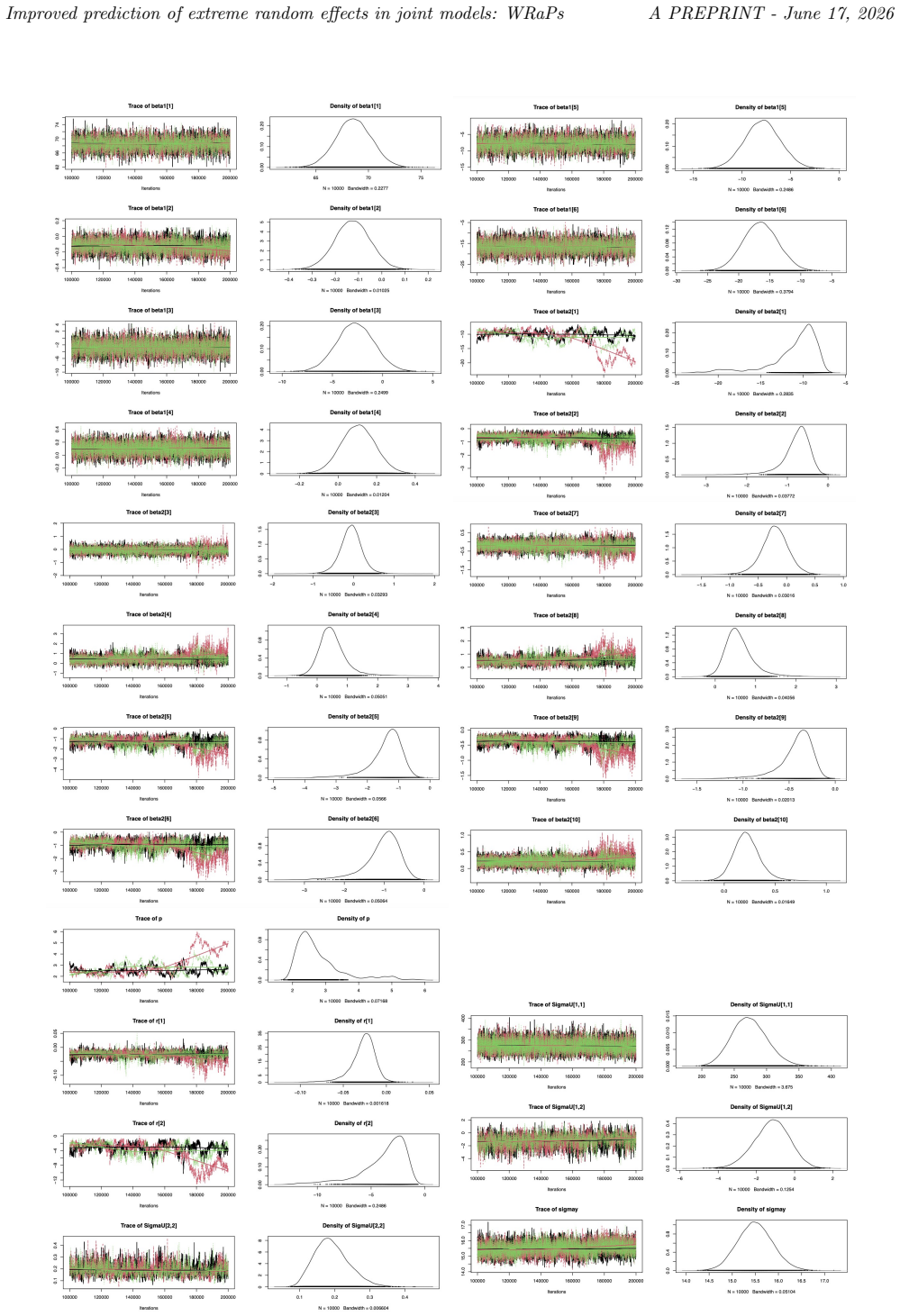
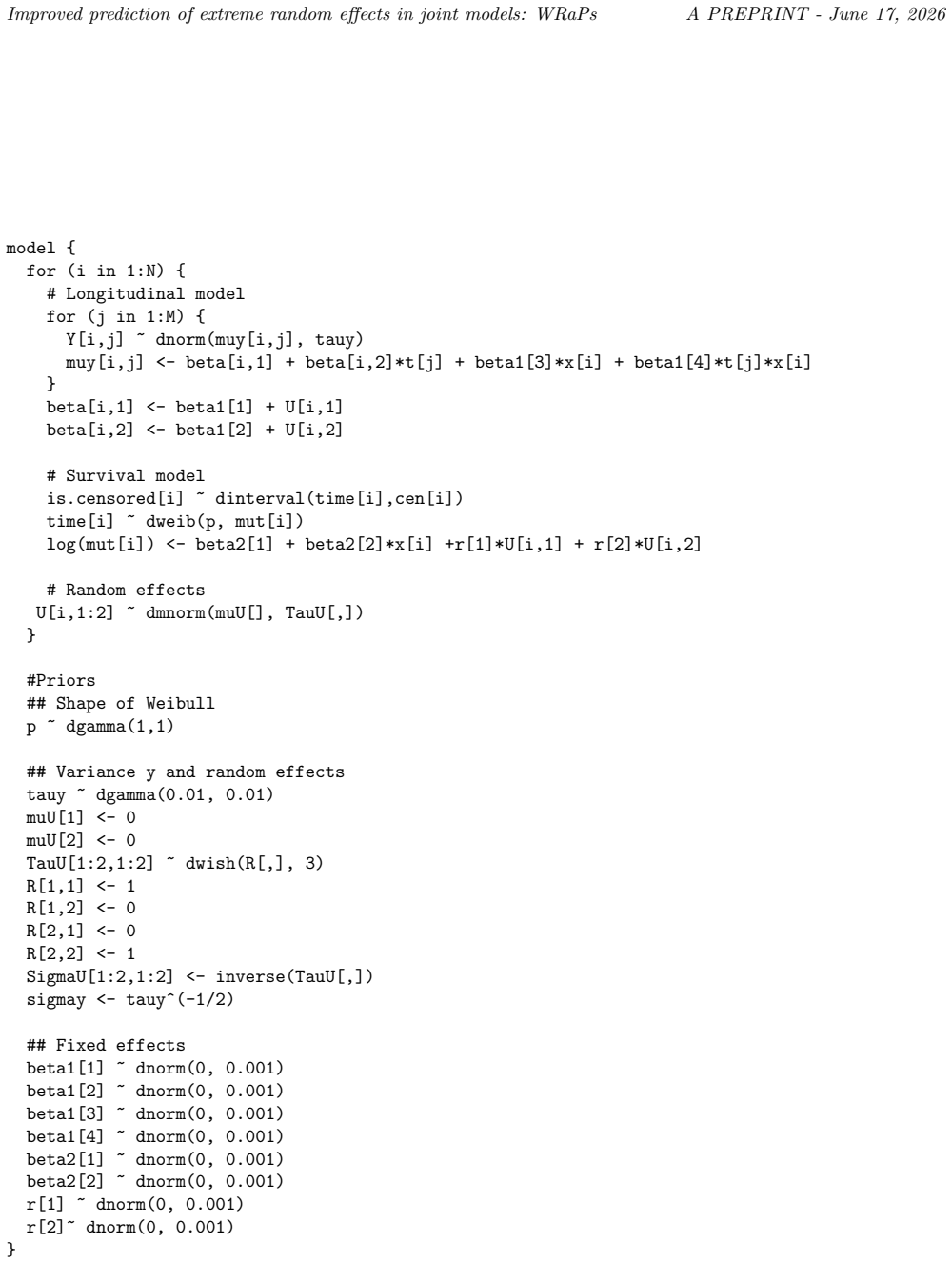
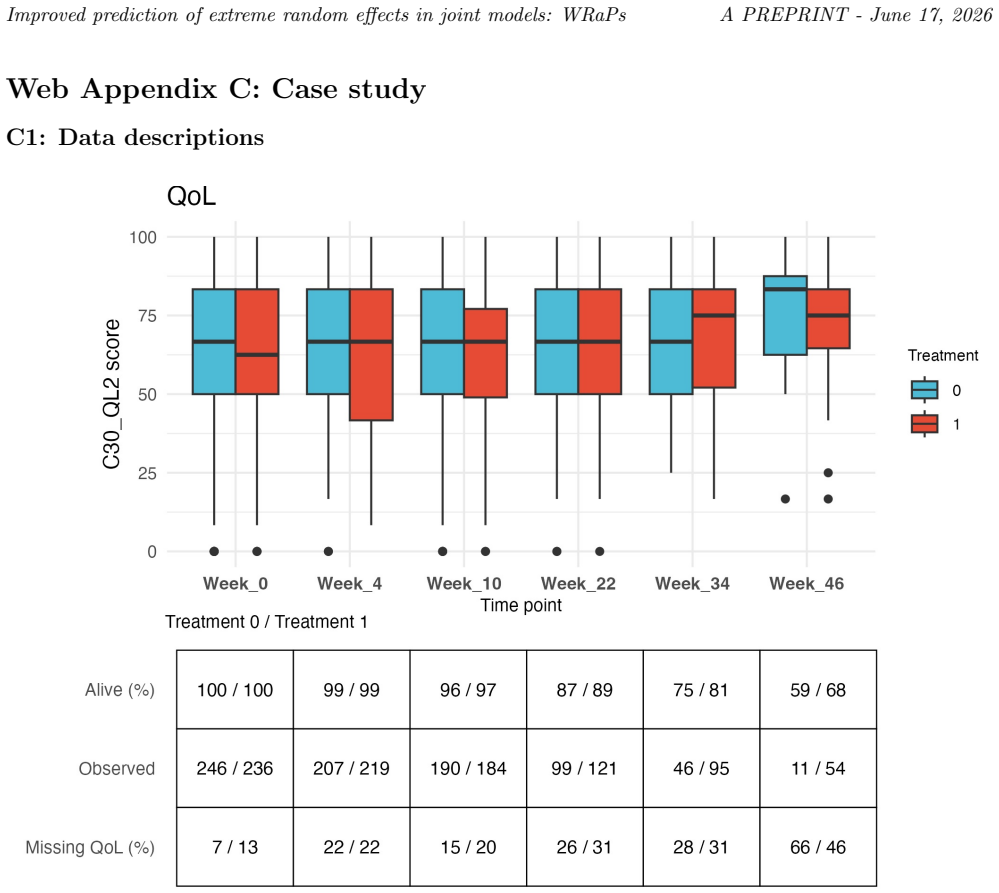
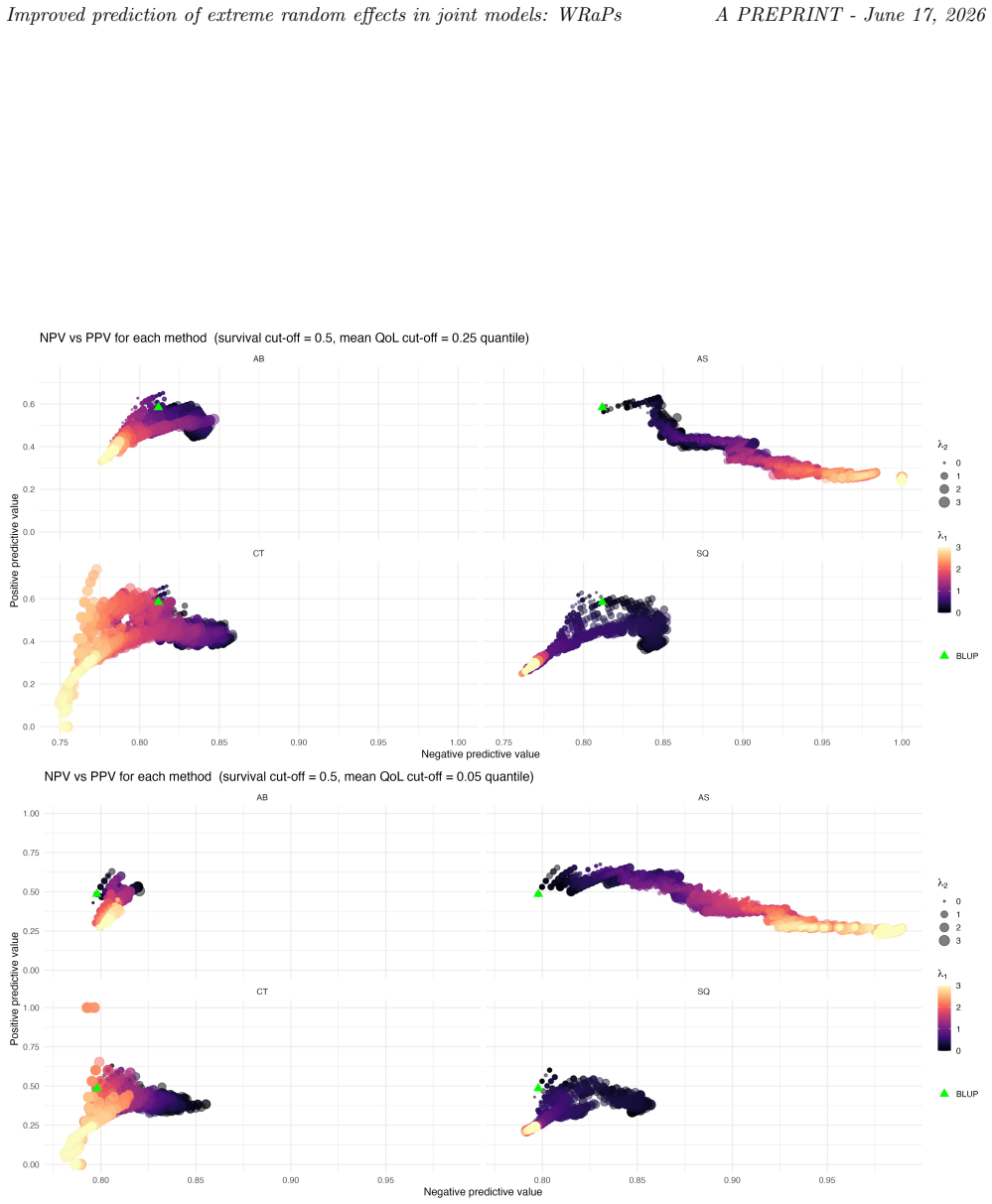
read the original abstract
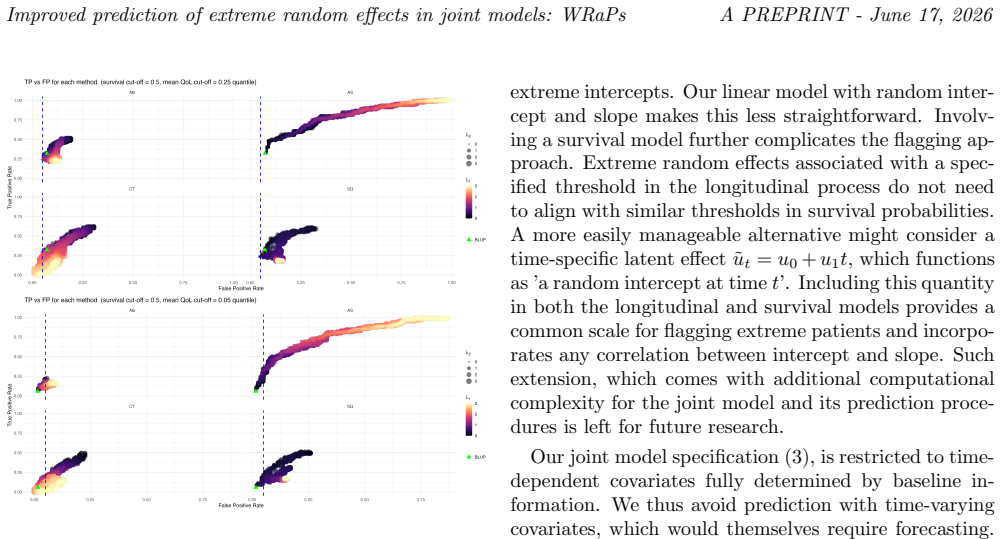
Mixed models are popular for the prediction of subject-specific repeated outcomes or center performance among many centers. When the goal is to identify extreme or poor outcomes, standard random effects predictions may, however, suffer from regression to the mean and underestimate values in the tail of their distribution. Optimally weighted random effect estimators have recently been proposed to mitigate this. Motivated by clinical settings where repeated outcomes may end in death, we extend that method to predict poor outcome defined as 'death or substandard repeated measures'. We start from joint models with shared random effects for the longitudinal and survival outcome and estimate their random effects by minimizing squared weighted prediction errors given available data on survival and repeated measures. As for mixed models, weights are chosen to more heavily penalize errors in the tails. We call the results WRaPs: Weighted Random effect Predictors. For basic models and a select set of weights analytical closed form solutions are derived from the usual joint model parameters. For the more complex setting, computational solutions are developed in rjags using MCMC methods within the Bayesian paradigm. We illustrate finite sample properties of the proposed method in Type I simulations with random intercept and slope; and apply the new approach to predict individual future outcomes and survival in a randomized study with glioblastoma patients.
Editorial analysis
A structured set of objections, weighed in public.
Referee Report
Summary. The manuscript extends optimally weighted random-effect predictors from mixed models to joint models with shared random effects for longitudinal and survival data. The proposed WRaPs method estimates subject-specific random effects by minimizing a weighted squared prediction error criterion that places greater penalty on tail errors; closed-form solutions are derived when the joint-model parameters are treated as fixed, and MCMC implementations are provided for more general cases. Finite-sample behavior is examined in Type I simulations for random-intercept-and-slope models, and the method is illustrated on glioblastoma data to predict future outcomes and survival.
Significance. If the weighting demonstrably improves tail accuracy without compromising central predictions or introducing bias, the approach could aid clinical identification of patients at risk of poor outcomes (death or substandard trajectories) in joint-model settings. The provision of both analytic expressions and an rjags implementation, together with simulations and a real-data example, supplies concrete tools for users.
major comments (2)
- [§3.1, Eq. (8)] §3.1, Eq. (8): the claim that the weighted predictor is obtained by simply re-weighting the usual BLUP is not accompanied by an explicit derivation showing that the resulting estimator remains consistent for the true random effect under the joint-model likelihood; the weighting matrix is treated as fixed, yet its dependence on the estimated association parameter is not analyzed for propagation of estimation error.
- [§4] §4, simulation design: the Type I simulations report lower MSE for extreme random effects under WRaPs versus standard predictors, but the tables do not include coverage probabilities or calibration checks for the predicted tails, leaving open whether the improvement is specific to the chosen weight functions or generalizes.
minor comments (2)
- The notation for the weighting matrix W is introduced without a clear statement of its dimension or dependence on the number of repeated measures per subject.
- Figure 3 (glioblastoma application) would benefit from an overlay of the standard joint-model predictor for direct visual comparison of tail behavior.
Simulated Author's Rebuttal
We thank the referee for the careful review and constructive comments. We address the major comments point by point below.
read point-by-point responses
-
Referee: [§3.1, Eq. (8)] the claim that the weighted predictor is obtained by simply re-weighting the usual BLUP is not accompanied by an explicit derivation showing that the resulting estimator remains consistent for the true random effect under the joint-model likelihood; the weighting matrix is treated as fixed, yet its dependence on the estimated association parameter is not analyzed for propagation of estimation error.
Authors: We agree that an explicit derivation of consistency under the joint-model likelihood was omitted. In the revised manuscript we will insert a step-by-step derivation in §3.1 establishing consistency of the weighted predictor when the joint-model parameters are regarded as fixed. We will also add a short paragraph noting that the weighting matrix depends on the estimated association parameter and briefly discuss the resulting finite-sample implications; a complete asymptotic analysis of estimation-error propagation lies outside the present scope. revision: yes
-
Referee: [§4] the Type I simulations report lower MSE for extreme random effects under WRaPs versus standard predictors, but the tables do not include coverage probabilities or calibration checks for the predicted tails, leaving open whether the improvement is specific to the chosen weight functions or generalizes.
Authors: The simulation study focused on point-prediction accuracy measured by MSE. We accept that coverage probabilities and calibration diagnostics would strengthen the presentation. The revised tables will therefore report empirical coverage of the predicted random effects. The weight functions employed are those previously shown to be optimal in the mixed-model setting; we will add clarifying text stating that the WRaPs construction applies to any admissible weight function and that the reported results are not claimed to be exhaustive across all possible weights. revision: yes
Circularity Check
No significant circularity detected
full rationale
The paper starts from externally estimated joint-model parameters (MLEs or posteriors for fixed effects, variances, and association) obtained by standard methods, then defines WRaPs as the argmin of a user-specified weighted quadratic criterion applied to those fixed quantities. This is a transparent re-weighting procedure whose closed-form or MCMC solution is derived directly from the supplied joint-model likelihood and chosen weights; the weighting step is an explicit modeling choice, not a fitted quantity renamed as a prediction. No self-citation chain is load-bearing for the joint-model extension, no uniqueness theorem is invoked to force the form, and the derivation does not reduce any claimed predictor to an algebraic identity with its own inputs. The construction is therefore self-contained against external benchmarks.
Axiom & Free-Parameter Ledger
free parameters (1)
- tail-penalizing weights
axioms (1)
- domain assumption Joint models with shared random effects link longitudinal and survival outcomes appropriately
Reference graph
Works this paper leans on
-
[1]
Taphoorn, M. J. B. and Stupp, R. and Coens, C. and Osoba, D. and Kortmann, R. and van den Bent, M. J. and Mason, W. and Mirimanoff, R. O. and Baumert, B. G. and Eisenhauer, E. and Forsyth, P. and Bottomley, A. , title =. The Lancet Oncology , year =
-
[2]
Evaluating treatment effects on longitudinal outcomes with attrition due to death: Methods for a two-dimensional estimand with a case study in Quality of Life , author =. 2025 , journal =. 2509.25548 , archivePrefix=
arXiv 2025
-
[3]
and Jordhøy, M
Ahlner-Elmqvist, M. and Jordhøy, M. S. and Bjordal, K. and Kaasa, S. and Jannert, M. , title =. Supportive Care in Cancer , year =
-
[4]
Tomer, A. and Nieboer, D. and Roobol, M. J. and Steyerberg, E. W. and Rizopoulos, D. , title =. Biometrics , year =. doi:10.1111/biom.12940 , url =
-
[5]
Rizopoulos, D. , title =. Biometrics , year =. doi:10.1111/j.1541-0420.2010.01546.x , url =
-
[6]
Rizopoulos, D. , title =. Journal of Statistical Software , year =. doi:10.18637/jss.v035.i09 , url =
-
[7]
Wulfsohn, M. S. and Tsiatis, A. A. , title =. Biometrics , year =
-
[8]
Henderson, C. R. , title =. Biometrics , year =
-
[9]
Robinson, G. K. , title =. Statistical Science , year =
-
[10]
McCulloch, C. E. and Neuhaus, J. M. , title =. Journal of the American Statistical Association , year =. doi:10.1080/01621459.2021.1938583 , url =
-
[11]
McCulloch, C. E. and Neuhaus, J. M. and Boylan, R. D. , title =. Biometrics , year =. doi:10.1093/biomtc/ujae022 , url =
-
[12]
Taylor, J. M. G. and Yu, M. and Sandler, H. M. , title =. Journal of Clinical Oncology , year =. doi:10.1200/JCO.2005.12.156 , url =
-
[13]
Schafer, J. L. and Graham, J. W. , title =. Psychological Methods , year =
-
[14]
and Mason, W
Stupp, R. and Mason, W. P. and van den Bent, M. J. and Weller, M. and Fisher, B. and Taphoorn, M. J. B. and Belanger, K. and Brandes, A. A. and Marosi, C. and Bogdahn, U. and Curschmann, J. and Janzer, R. C. and Ludwin, S. K. and Gorlia, T. and Allgeier, A. and Lacombe, D. and Cairncross, J. G. and Eisenhauer, E. and Mirimanoff, R. O. , title =. The New E...
-
[15]
and Helmer, C
Rouanet, A. and Helmer, C. and Dartigues, J.-F. and Jacqmin-Gadda, H. , title =. Statistical Methods in Medical Research , volume =. 2019 , doi =
2019
-
[16]
and Kuppens, P
Liu, S. and Kuppens, P. and Bringmann, L. , title =. Assessment , year =
-
[17]
Journal of the Royal Statistical Society: Series B (Statistical Methodology) , volume =
Rizopoulos, D. and Verbeke, G. and Lesaffre, E. , title =. Journal of the Royal Statistical Society: Series B (Statistical Methodology) , year =. doi:10.1111/j.1467-9868.2008.00699.x , url =
-
[18]
2025 , version =
JMbayes2: Extended Joint Models for Longitudinal and Time-to-Event Data , author =. 2025 , version =
2025
-
[19]
, journal =
Rizopoulos, D. , journal =. The. 2016 , doi =
2016
-
[20]
Joint Modeling of Longitudinal Measurements and Time-to-event Outcomes Using BUGS , author =. arXiv preprint , year =. 2403.07778 , archivePrefix=
-
[21]
Benoit,D.D. and Soares,M. and Azoulay,E. , title =. Intensive Care Medicine , year =. doi:10.1007/s00134-014-3480-8 , pmid =
-
[22]
Gelman, A. and Hwang, J. and Vehtari, A. , title =. Statistics Surveys , year =. doi:10.1214/12-SS102 , url =
-
[23]
The American Statistician , volume =
Separate and Joint Modeling of Longitudinal and Event Time Data Using Standard Computer Packages , author =. The American Statistician , volume =. 2004 , publisher =
2004
-
[24]
and Boulesteix, A
Heinze, G. and Boulesteix, A. and Kammer, M. and Morris, T. P. and White, I. R. and the Simulation Panel of the STRATOS initiative , title =. Biometrical Journal , volume =. 2024 , doi =
2024
-
[25]
2025 , note =
rjags: Bayesian Graphical Models using MCMC , author =. 2025 , note =
2025
-
[26]
2025 , note =
runjags: Interface Utilities, Model Templates, Parallel Computing Methods and Additional Distributions for MCMC Models in JAGS , author =. 2025 , note =
2025
-
[27]
Thomassen,D. and Roychoudhury,S. and Amdal,C.D. and Reynders,D. and Musoro,J.Z. and Sauerbrei,W. and Goetghebeur,E. and le Cessie,S. , title =. BMC Medical Research Methodology , year =. doi:10.1186/s12874-025-02510-8 , url =
-
[28]
Rubin, D. B. , title =. Biometrika , year =. doi:10.2307/2335739 , url =
-
[29]
Griswold,M. E. and Talluri,R. and Zhu,X. and Su,D. and Tingle,J. and Gottesman,R. F. and Deal,J. and Rawlings, A. M. and Mosley, T. H. and B. Windham,G. and Bandeen-Roche,K. , title =. International Journal of Epidemiology , year =. doi:10.1093/ije/dyab086 , url =
-
[30]
McCulloch, C. E. and Searle, S. R. and Neuhaus, J. M. , title =. 2008 , address =
2008
-
[31]
Amdal, C. D. and Falk, R. S. and Alanya, A. and others , title =. The Lancet Oncology , year =. doi:10.1016/S1470-2045(25)00520-0 , issn =
-
[32]
Fitzmaurice, G. M. and Laird, N.M. and Ware, J. H. , title =. 1962 , isbn =
1962
-
[33]
Intensive Care Medicine , volume=
Discussing expected long-term quality of life in the ICU: effect on experiences and outcomes of patients, family, and clinicians—a randomized clinical trial , author=. Intensive Care Medicine , volume=. 2025 , doi=
2025
-
[34]
Journal of Cancer Survivorship , volume=
Fear of cancer recurrence and adverse cancer treatment outcomes: predicting 2- to 5-year fear of recurrence from post-treatment symptoms and functional problems in uveal melanoma survivors , author=. Journal of Cancer Survivorship , volume=. 2023 , doi=
2023
-
[35]
Intensive Care Medicine , volume=
Understanding patient preferences: a crucial component of caring for older adults with critical conditions , author=. Intensive Care Medicine , volume=. 2025 , doi=
2025
-
[36]
JAMA Oncology , volume=
Patient-Reported Outcomes in Cancer Drug Development and US Regulatory Review: Perspectives From Industry, the Food and Drug Administration, and the Patient , author=. JAMA Oncology , volume=. 2015 , doi=
2015
discussion (0)
Sign in with ORCID, Apple, or X to comment. Anyone can read and Pith papers without signing in.