REVIEW 2 major objections 1 minor 49 references
Regularized covariance estimation from partially observed interferometric data
T0 review · 2 major / 1 minor · reviewed 2026-06-26 · grok-4.3
Pith's one-line read Covariance from partially observed 2D interferometric data is recovered by Laplacian-regularized matrix completion without stationarity assumptions.
desk verdict The paper defines a fragmented missingness regime for 2D functional data and estimates covariance via Laplacian-regularized matrix completion without stationarity assumptions. read the letter →
The pith
A machine-rendered reading of the paper's core claim, the machinery that carries it, and where it could break.
The reading
What carries the argument
Laplacian-regularized matrix completion applied to the covariance matrix of fragmented functional data on a 2D domain.
What would settle it
Apply the estimator to synthetic data generated from a known covariance that cannot be well approximated by Laplacian regularization and check whether the recovered matrix deviates substantially from the generating covariance in Frobenius norm.
Extended reading notes
Core claim
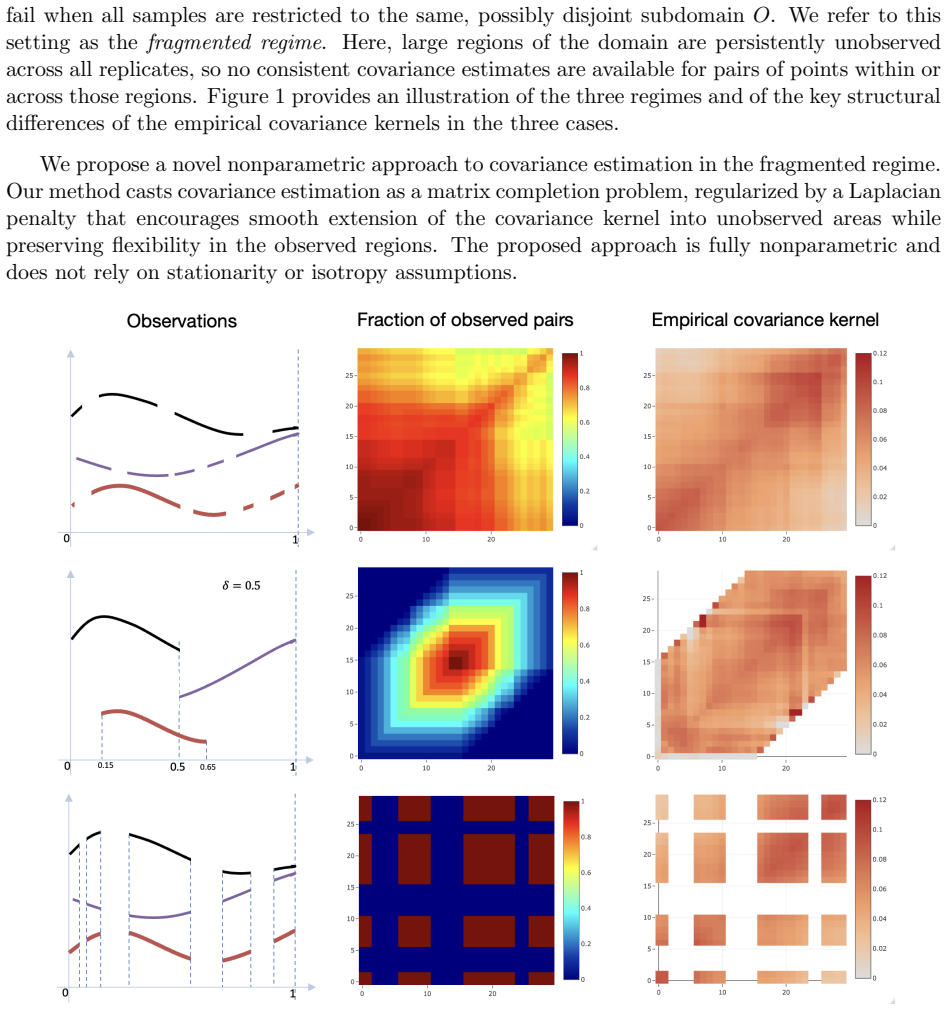
The paper establishes a nonparametric covariance estimator for functional data observed under the fragmented regime of partial observation. The estimator is obtained by solving a matrix completion problem whose objective includes a Laplacian regularization term; this term is shown to recover the true spatial dependence structure of the data-generating process on the two-dimensional domain.
Load-bearing premise
The true spatial dependence structure is recoverable by Laplacian regularization when the missingness follows the fragmented regime of systematic partial observation.
Editorial extensions
If this is right
- The estimator produces low error for a wide range of covariance structures in simulation studies.
- Application to real interferometric data yields spatial dependence patterns that align with geophysical expectations.
- The approach supports downstream analysis of geophysical processes without requiring stationarity or isotropy.
- The method extends covariance estimation tools to functional data with systematic large-scale missingness.
Reading between the lines
- The same matrix-completion framing could be tested on other remote-sensing modalities that exhibit block-wise missingness.
- Performance comparisons against kriging or other spatial covariance estimators would clarify when the Laplacian term adds value.
- If the fragmented regime accurately describes additional data sources, the estimator could be reused directly in those domains.
Editorial analysis
A structured set of objections, weighed in public.
Referee Report
Summary. The paper introduces the fragmented regime of systematic partial observation for 2D functional data arising from InSAR measurements. It formulates covariance estimation as a matrix-completion problem regularized by the graph Laplacian on the spatial domain, claiming the resulting estimator is nonparametric and free of stationarity or isotropy assumptions. Simulations are reported to yield consistently low error across covariance structures, and the method is applied to Phlegraean Fields displacement data to recover spatial dependence patterns.
Significance. If the Laplacian regularizer recovers the true second-order structure without systematic bias under the fragmented regime, the approach would supply a practical, assumption-light tool for covariance estimation in geophysical remote-sensing applications where large contiguous blocks of data are missing.
major comments (2)
- [Simulation study] Simulation study: the claim of low error 'across a range of covariance structures' does not include deliberate stress tests against covariances whose eigenstructure is misaligned with the low-frequency modes of the domain Laplacian (e.g., rough or spatially localized dependence). Without such cases the nonparametric claim remains unverified and the bias concern raised by the regularizer is unaddressed.
- [Methods / estimator definition] Estimator definition: the regularization parameter appears as a free hyper-parameter whose selection procedure is not shown to preserve the nonparametric character of the estimator; any data-driven choice must be demonstrated not to re-introduce implicit parametric assumptions.
minor comments (1)
- [Introduction / setup] The precise mathematical definition of the 'fragmented regime' should be stated explicitly with a diagram or equation before the estimator is introduced.
Simulated Author's Rebuttal
We thank the referee for their detailed and constructive report. We address each major comment below and outline the revisions we will make to the manuscript.
read point-by-point responses
-
Referee: [Simulation study] Simulation study: the claim of low error 'across a range of covariance structures' does not include deliberate stress tests against covariances whose eigenstructure is misaligned with the low-frequency modes of the domain Laplacian (e.g., rough or spatially localized dependence). Without such cases the nonparametric claim remains unverified and the bias concern raised by the regularizer is unaddressed.
Authors: We agree that the existing simulations, while spanning multiple covariance structures, do not contain explicit stress tests for eigenstructures deliberately misaligned with the low-frequency modes of the Laplacian (e.g., rough or spatially localized dependence). To verify the nonparametric claim and directly address potential bias introduced by the regularizer, we will add new simulation scenarios with such covariance structures in the revised manuscript. These additions will include quantitative error comparisons under the fragmented observation regime. revision: yes
-
Referee: [Methods / estimator definition] Estimator definition: the regularization parameter appears as a free hyper-parameter whose selection procedure is not shown to preserve the nonparametric character of the estimator; any data-driven choice must be demonstrated not to re-introduce implicit parametric assumptions.
Authors: The regularization parameter is treated as a hyper-parameter whose value is chosen via cross-validation on the observed entries. We acknowledge that the manuscript does not explicitly demonstrate that this data-driven procedure preserves the nonparametric character of the estimator. In the revision we will expand the methods section with a clearer description of the selection algorithm together with additional empirical checks (and, if feasible, a brief theoretical argument) showing that the procedure does not implicitly re-introduce stationarity or other parametric assumptions. revision: yes
Circularity Check
No significant circularity; estimator is a proposed modeling choice
full rationale
The paper proposes a covariance estimator by formulating the task as matrix completion with Laplacian regularization on the 2D domain under a newly defined fragmented missingness regime. This is presented as a nonparametric modeling decision free from stationarity or isotropy assumptions, with performance assessed via simulations across covariance structures and a real-data application. No equations, derivations, or self-citations are described that reduce the estimator to a fitted quantity by construction, invoke a uniqueness theorem from prior author work, or rename a known result. The central claim rests on the modeling choice and empirical validation rather than any self-referential reduction, making the derivation self-contained.
Assumptions & free parameters
free parameters (1)
- regularization parameter
assumptions (1)
- domain assumption Observations can be modeled as partially observed functional data with two-dimensional domain under the fragmented regime
invented entities (1)
-
fragmented regime
Cite this review
Pith. "Pith review of Regularized covariance estimation from partially observed interferometric data." pith.science (2026). https://pith.science/paper/III6GBUQ
@misc{pith2026260619065,
  author       = {Pith},
  title        = {Pith review of: Regularized covariance estimation from partially observed interferometric data},
  year         = {2026},
  howpublished = {\url{https://pith.science/paper/III6GBUQ}},
  note         = {Machine review of arXiv:2606.19065}
}
read the original abstract
The Small BAseline Subset technique provides remote measurements of ground displacement with high spatial resolution, making it a key tool for monitoring geophysical processes in hazard-prone areas. An effective analysis of this type of data requires reliable estimation of their second-order structure, which is difficult to achieve because the measurements are systematically missing over relatively large portions of the investigated areas. We tackle the problem from a functional data analysis perspective and treat the observations as partially observed functional data with two-dimensional domain. To properly characterize the data, we introduce the fragmented regime of partial observation, where parts of the curves are systematically missing across replicates. For this regime, we propose a novel method for covariance estimation, formulating the task as a matrix completion problem with Laplacian regularization. The estimator is nonparametric and free from stationarity or isotropy assumptions. Extensive simulations show that our method achieves consistently low estimation error across a range of covariance structures. Application to ground displacement data relative to the Phlegraean Fields demonstrates its ability to recover meaningful spatial dependence patterns, highlighting its potential for environmental risk assessment and monitoring.
Figures


Figures from the paper (9 more)


Reference graph
Works this paper leans on
-
[1]
2005 , publisher=
Functional Data Analysis , author=. 2005 , publisher=
2005
-
[2]
2012 , publisher=
Inference for functional data with applications , author=. 2012 , publisher=
2012
-
[3]
2003 , publisher=
Hierarchical modeling and analysis for spatial data , author=. 2003 , publisher=
2003
-
[4]
2000 , publisher=
Linear processes in function spaces: theory and applications , author=. 2000 , publisher=
2000
-
[5]
2015 , publisher=
Statistics for spatial data , author=. 2015 , publisher=
2015
-
[6]
2012 , publisher=
Geostatistics: modeling spatial uncertainty , author=. 2012 , publisher=
2012
-
[7]
2006 , publisher=
Numerical mathematics , author=. 2006 , publisher=
2006
-
[8]
2007 , publisher=
Finite difference methods for ordinary and partial differential equations: steady-state and time-dependent problems , author=. 2007 , publisher=
2007
Show all 49 references
-
[9]
2004 , publisher=
Convex optimization , author=. 2004 , publisher=
2004
-
[10]
Horn and Charles R
Roger A. Horn and Charles R. Johnson , title =. 2012 , publisher =
2012
-
[11]
Computational Statistics & Data Analysis , pages=
Estimating a Smooth Covariance for Functional Data , author=. Computational Statistics & Data Analysis , pages=. 2025 , publisher=
2025
-
[12]
Journal of the American Statistical Association , volume=
Estimating the covariance of fragmented and other related types of functional data , author=. Journal of the American Statistical Association , volume=. 2021 , publisher=
2021
-
[13]
Biometrika , volume=
Recovering covariance from functional fragments , author=. Biometrika , volume=. 2019 , publisher=
2019
-
[14]
The Annals of Statistics , volume=
Functional data analysis by matrix completion , author=. The Annals of Statistics , volume=
-
[15]
Panaretos, Victor M and Tavakoli, Shahin , journal=. Cram. 2013 , publisher=
2013
-
[16]
and Liebl, D
Kneip, A. and Liebl, D. On the optimal reconstruction of partially observed functional data. The Annals of Statistics. 2020
2020
-
[17]
2007 , publisher=
Introduction to State Space Time Series Analysis , author=. 2007 , publisher=
2007
-
[18]
Annals of Statistics , volume=
Evaluation of the Cooling Trend in the Ionosphere Using Functional Regression with Incomplete Curves , author=. Annals of Statistics , volume=. 2017 , publisher=
2017
-
[19]
and M \"u ller, H.-G
Yao, F. and M \"u ller, H.-G. and Wang, J.-L. Functional Data Analysis for Sparse Longitudinal Data. Journal of the American Statistical Association. 2005
2005
-
[20]
Journal of the American Statistical Association , volume=
On consistency and sparsity for principal components analysis in high dimensions , author=. Journal of the American Statistical Association , volume=. 2009 , publisher=
2009
-
[21]
Journal of the Royal Statistical Society , volume=
Components and completion of partially observed functional data , author=. Journal of the Royal Statistical Society , volume=. 2015 , publisher=
2015
-
[22]
and Stefanucci, M
Kraus, D. and Stefanucci, M. , title = ". Biometrika , volume =
-
[23]
and Sangalli, L
Stefanucci, M. and Sangalli, L. and Brutti, P. , title = ". Statistica Neerlandica , volume =
-
[24]
Statistics & Probability Letters , volume=
Ridge Reconstruction of Partially Observed Functional Data is Asymptotically Optimal , author=. Statistics & Probability Letters , volume=. 2020 , publisher=
2020
-
[25]
RNA Biology , volume=
Dual Laplacian Regularized Matrix Completion for MicroRNA-Disease Associations Prediction , author=. RNA Biology , volume=. 2019 , publisher=
2019
-
[26]
Remote Sensing of Environment , volume=
A Quantitative Assessment of the SBAS Algorithm Performance for Surface Deformation Retrieval from DInSAR Data , author=. Remote Sensing of Environment , volume=. 2006 , publisher=
2006
-
[27]
Sankhya A , volume=
Inference on Covariance Operators via Concentration Inequalities: k-sample Tests, Classification, and Clustering via Rademacher Complexities , author=. Sankhya A , volume=. 2019 , publisher=
2019
-
[28]
Biometrika , volume=
Distances and Inference for Covariance Operators , author=. Biometrika , volume=. 2014 , publisher=
2014
-
[29]
2023 International Conference on Sampling Theory and Applications (SampTA) , year=
First-Order Algorithms for Optimization over Graph Laplacians , author=. 2023 International Conference on Sampling Theory and Applications (SampTA) , year=
2023
-
[30]
IEEE Transactions on Image Processing , volume=
Graph Laplacian Regularization for Image Denoising: Analysis in the Continuous Domain , author=. IEEE Transactions on Image Processing , volume=. 2017 , publisher=
2017
-
[31]
Journal of the American Statistical Association , volume=
Weighted functional data analysis for the calibration of a ground motion model in Italy , author=. Journal of the American Statistical Association , volume=. 2024 , publisher=
2024
-
[32]
IEEE Transactions on geoscience and remote sensing , volume=
Permanent scatterers in SAR interferometry , author=. IEEE Transactions on geoscience and remote sensing , volume=. 2001 , publisher=
2001
-
[33]
IEEE Transactions on geoscience and remote sensing , volume=
A new algorithm for surface deformation monitoring based on small baseline differential SAR interferograms , author=. IEEE Transactions on geoscience and remote sensing , volume=. 2002 , publisher=
2002
-
[34]
Geophysical Research Letters , volume=
Satellite radar interferometry time series analysis of surface deformation for Los Angeles, California , author=. Geophysical Research Letters , volume=. 2004 , publisher=
2004
-
[35]
Mathematical Geosciences , volume=
On the use of interferometric synthetic aperture radar data for monitoring and forecasting natural hazards , author=. Mathematical Geosciences , volume=. 2021 , publisher=
2021
-
[36]
Mathematical geology , volume=
Production of conditional simulations via the LU triangular decomposition of the covariance matrix , author=. Mathematical geology , volume=. 1987 , publisher=
1987
-
[37]
Water Resources Research , volume=
A fast and exact method for multidimensional Gaussian stochastic simulations , author=. Water Resources Research , volume=. 1993 , publisher=
1993
-
[38]
Computers & Geosciences , volume=
Gstat: a program for geostatistical modelling, prediction and simulation , author=. Computers & Geosciences , volume=. 1998 , publisher=
1998
-
[39]
Remote sensing , volume=
A covariance-based approach to merging InSAR and GNSS displacement rate measurements , author=. Remote sensing , volume=. 2020 , publisher=
2020
-
[40]
Geoenvironmental Disasters , volume=
Investigating the spatial correlations in univariate random fields of peak ground velocity and peak ground displacement considering anisotropy , author=. Geoenvironmental Disasters , volume=. 2021 , publisher=
2021
-
[41]
Journal of Geophysical Research: Solid Earth , volume=
Mapping small elevation changes over large areas: Differential radar interferometry , author=. Journal of Geophysical Research: Solid Earth , volume=. 1989 , publisher=
1989
-
[42]
, author=
The Parallel SBAS Approach for Sentinel-1 Interferometric Wide Swath Deformation Time-Series Generation: Algorithm Description and Products Quality Assessment. , author=. IEEE Trans. Geosci. Remote. Sens. , volume=
-
[43]
International Journal of Remote Sensing , volume=
Long-term ERS/ENVISAT deformation time-series generation at full spatial resolution via the extended SBAS technique , author=. International Journal of Remote Sensing , volume=. 2012 , publisher=
2012
-
[44]
Biometrika , volume=
Testing for serial correlation in least squares regression: I , author=. Biometrika , volume=. 1950 , publisher=
1950
-
[45]
Remote Sensing of Environment , volume=
Sentinel-1 imagery for wide-scale quantitative landslide vulnerability assessment of buildings , author=. Remote Sensing of Environment , volume=. 2026 , publisher=
2026
-
[46]
Remote Sensing of Environment , volume=
Joint exploitation of space-borne and ground-based multitemporal InSAR measurements for volcano monitoring: The Stromboli volcano case study , author=. Remote Sensing of Environment , volume=. 2021 , publisher=
2021
-
[47]
Geophysical Research Letters , volume=
Surface displacements associated with the L'Aquila 2009 Mw 6.3 earthquake (central Italy): New evidence from SBAS-DInSAR time series analysis , author=. Geophysical Research Letters , volume=. 2010 , publisher=
2009
-
[48]
ISPRS Journal of Photogrammetry and Remote Sensing , volume=
Nation-wide mapping and classification of ground deformation phenomena through the spatial clustering of P-SBAS InSAR measurements: Italy case study , author=. ISPRS Journal of Photogrammetry and Remote Sensing , volume=. 2022 , publisher=
2022
-
[49]
Remote Sensing , volume=
A global archive of coseismic DInSAR products obtained through unsupervised sentinel-1 data processing , author=. Remote Sensing , volume=. 2020 , publisher=
2020
Reviewed June 26, 2026 · model on record in the stance chip above.
Discussion (0). Continue with ORCID to comment.