Introduction to Quantum Ophthalmology
Pith reviewed 2026-06-26 17:58 UTC · model grok-4.3
The pith
Quantum methods enable retinal imaging with fewer photons and new tools to study vision at detection limits.
A machine-rendered reading of the paper's core claim, the machinery that carries it, and where it could break.
Core claim
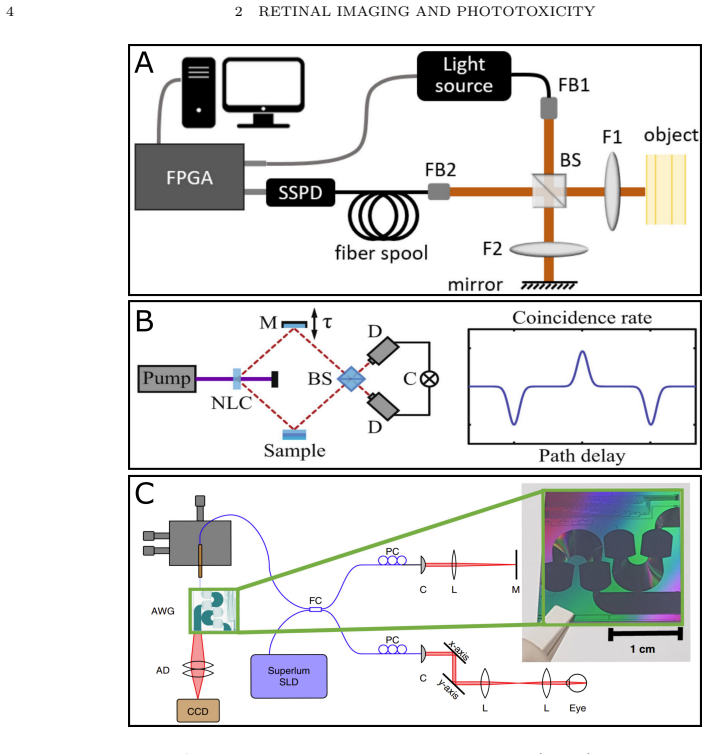
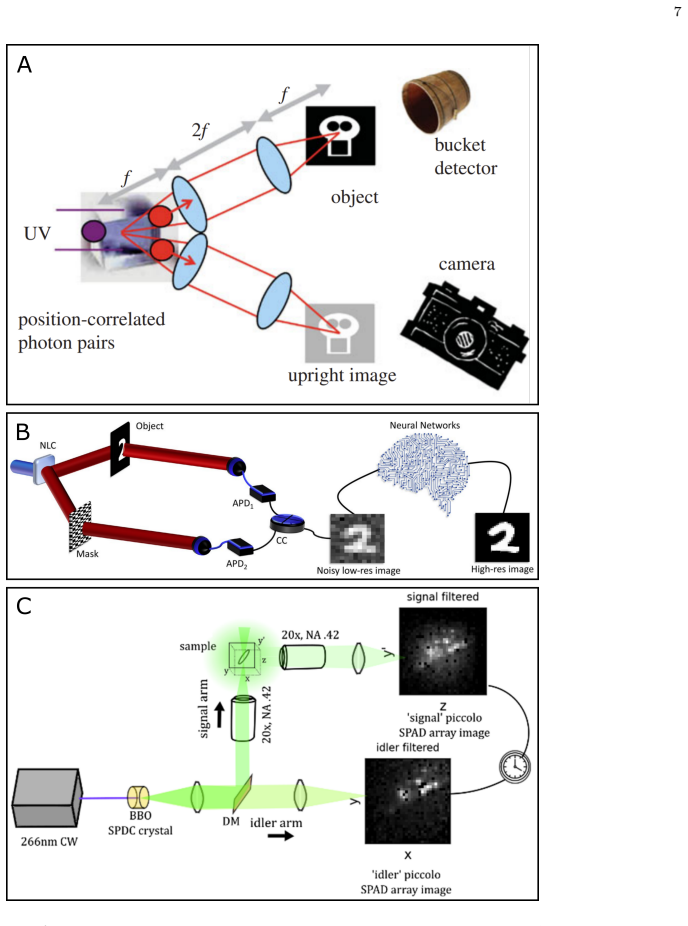
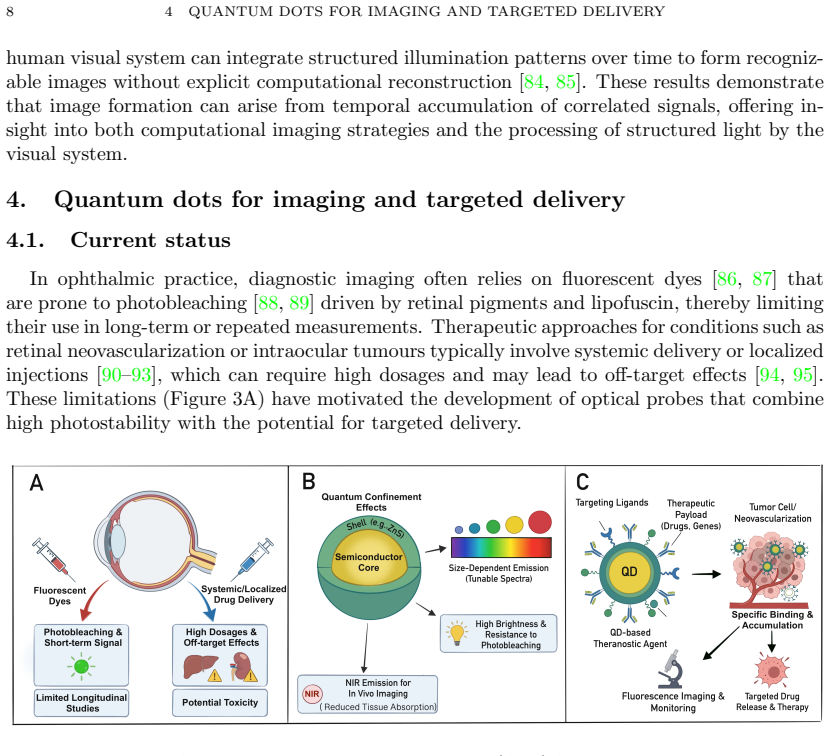
Quantum technologies advance ophthalmology through photon-limited retinal imaging, correlation-based imaging, nanoscale optical probes, and quantum-limited visual perception. Optical coherence tomography and single-photon detection together allow image formation under strict photon budgets that reduce phototoxicity. Correlation techniques offer image reconstruction in scattering or low-light settings. Quantum-dot platforms supply photostable, wavelength-tunable contrast with targeted delivery potential. Experiments with single-photon states and structured light demonstrate that the eye operates close to physical detection limits, providing new experimental access to visual function under wel
What carries the argument
Photon-budget-constrained imaging via optical coherence tomography and single-photon detection, together with correlation-based reconstruction and quantum-dot probes, that collectively reduce light exposure and enable studies near physical detection limits.
If this is right
- Retinal imaging becomes feasible at photon counts low enough to reduce phototoxicity while retaining image quality.
- Ghost imaging supplies an alternative route to form images when conventional methods struggle with scattering or low light.
- Quantum-dot probes deliver photostable contrast and targeted delivery that conventional dyes cannot match.
- Controlled single-photon and structured-light experiments allow direct probing of visual perception at its physical limits.
Where Pith is reading between the lines
- Successful translation would allow existing OCT hardware to be upgraded with single-photon detectors rather than replaced.
- The same photon-budget logic could be tested in other scattering tissues such as skin or brain for broader medical imaging gains.
- Single-photon visual-perception experiments open a route to measure the eye's quantum efficiency directly rather than through indirect psychophysics.
Load-bearing premise
Practical barriers such as detection efficiency, acquisition time, and biocompatibility can be overcome sufficiently for the listed approaches to move from laboratory demonstrations to useful ophthalmic tools.
What would settle it
A side-by-side test in which a quantum-enhanced OCT or ghost-imaging system fails to produce diagnostically usable retinal images at photon levels low enough to show measurably lower phototoxicity than standard clinical OCT.
Figures

read the original abstract
Quantum technologies are rapidly advancing across multiple research domains, with a growing impact on biomedical imaging and sensing. We examine their emerging role in ophthalmology through four complementary directions: photon-limited retinal imaging, correlation based imaging, nanoscale optical probes, and quantum-limited visual perception. Advances in optical coherence tomography and single-photon detection enable imaging under strict photon budget constraints, reducing phototoxicity while preserving image quality. Correlation-based approaches, including ghost imaging, offer alternative strategies for image formation in low-light and scattering environments, although practical implementation remains limited by detection efficiency and acquisition time. In parallel, nanoscale optical platforms such as quantum dots provide tunable and photostable probes for enhanced contrast and targeted delivery, with ongoing challenges related to biocompatibility and clinical translation. Finally, experiments at the single-photon level and with structured light fields demonstrate how the visual system itself operates near physical detection limits and can be probed using controlled optical states. While many of these approaches remain at an early stage, they collectively illustrate how quantum and quantum-inspired methods may augment current ophthalmic imaging and diagnostic technologies while providing new tools for studying visual function under well-defined physical constraints.
Editorial analysis
A structured set of objections, weighed in public.
Referee Report
Summary. The manuscript is an introductory review of the emerging applications of quantum technologies in ophthalmology. It surveys four complementary directions: photon-limited retinal imaging (via advances in optical coherence tomography and single-photon detection to enable low-phototoxicity imaging), correlation-based imaging (including ghost imaging for low-light and scattering conditions), nanoscale optical probes (such as quantum dots for tunable contrast and targeted delivery), and quantum-limited visual perception (via single-photon experiments and structured light to probe visual function near physical limits). The text repeatedly qualifies its statements with references to early-stage status, ongoing challenges in detection efficiency, acquisition time, and biocompatibility, and concludes that these approaches may augment current ophthalmic imaging and diagnostic technologies.
Significance. If the overview holds, the manuscript provides a balanced, accessible entry point into an interdisciplinary niche at the intersection of quantum optics and ophthalmology. Its explicit early-stage framing and emphasis on limitations constitute a strength, as they accurately reflect the current laboratory-demonstration status without overstating readiness for clinical use. The review draws on established techniques (OCT, single-photon detection, quantum dots) and correctly notes their stated constraints, offering a foundation for researchers entering the area.
minor comments (2)
- [Abstract] Abstract, sentence 3: 'correlation based imaging' lacks the hyphen used elsewhere in the manuscript; standardize terminology for consistency.
- The manuscript would benefit from a short concluding paragraph that explicitly synthesizes common themes (e.g., photon-budget constraints) across the four directions and identifies the most pressing open experimental questions.
Simulated Author's Rebuttal
We thank the referee for the positive assessment of the manuscript as a balanced and accessible introductory review. The recognition that our explicit early-stage framing accurately reflects the current status is appreciated. No specific major comments were raised in the report.
Circularity Check
No circularity; purely descriptive review with no derivations or predictions
full rationale
The manuscript is an introductory review summarizing four existing research directions in quantum ophthalmology. It contains no equations, no parameter fitting, no new predictions, and no derivation chain. All statements are qualified with phrases such as 'may augment' and 'early stage,' and the central claim is simply that laboratory demonstrations exist and can be grouped under quantum-inspired themes. No self-citation is load-bearing, and no result reduces to its own inputs by construction. The text is therefore self-contained as a literature survey.
Axiom & Free-Parameter Ledger
Reference graph
Works this paper leans on
-
[1]
In: Chattopadhyay A, editor
Upadhyay S, Alam M, Ghosh S. In: Chattopadhyay A, editor. Architectures for Quantum Information Processing. Singapore: Springer; 2025
2025
-
[2]
Quantum Computing: Foundations, Architecture and Applications
Chinnappan CC, Krishnan PT, Elamaran E, Arul R, Kumar TS. Quantum Computing: Foundations, Architecture and Applications. Engineering Reports. 2025;7(8):e70337
2025
-
[3]
From quantum communication fundamentals to decoherence mitigation strategies: Addressing global quantum network challenges and projected applications
Khan MA, Ghafoor S, Zaidi SMH, Khan H, Ahmad A. From quantum communication fundamentals to decoherence mitigation strategies: Addressing global quantum network challenges and projected applications. Heliyon. 2024;10(14):e34331
2024
-
[4]
Quantum Computing Approaches for Vector Quantiza- tion—Current Perspectives and Developments
Engelsberger A, Villmann T. Quantum Computing Approaches for Vector Quantiza- tion—Current Perspectives and Developments. Entropy. 2023;25(3):540
2023
-
[5]
Atomic Quantum Technologies for Quantum Matter and Fundamental Physics Applications
Yago Malo J, Lepori L, Gentini L, Chiofalo ML. Atomic Quantum Technologies for Quantum Matter and Fundamental Physics Applications. Technologies. 2024;12(5):64
2024
-
[6]
Perspectives for Applications of Quantum Imaging
Gilaberte Basset M, Setzpfandt F, Steinlechner F, Beckert E, Pertsch T, Gr¨ afe M. Perspectives for Applications of Quantum Imaging. Laser and Photonics Reviews. 2019;13:1900097
2019
-
[7]
Quantum Machine Learning for Next-G Wireless Communications: Fundamentals and the Path Ahead
Narottama B, Mohamed Z, A¨ ıssa S. Quantum Machine Learning for Next-G Wireless Communications: Fundamentals and the Path Ahead. IEEE Open Journal of the Com- munications Society. 2023;4:2204-24
2023
-
[8]
From Pre-Quantum to Post-Quantum IoT Security: A Survey on Quantum-Resistant Cryptosystems for the Internet of Things
Fern´ andez-Caram´ es TM. From Pre-Quantum to Post-Quantum IoT Security: A Survey on Quantum-Resistant Cryptosystems for the Internet of Things. IEEE Internet of Things Journal. 2020;7(7):6457-80
2020
-
[9]
Review: Quantum metrology and sensing with many-body systems
Montenegro V, Mukhopadhyay C, Yousefjani R, Sarkar S, Mishra U, Paris MGA, et al. Review: Quantum metrology and sensing with many-body systems. Physics Reports. 2025;1134:1-62
2025
-
[10]
Quantum metrology for gravitational wave astronomy
Schnabel R, Mavalvala N, McClelland DE, Lam PK. Quantum metrology for gravitational wave astronomy. Nature Communications. 2010;1:121
2010
-
[11]
Quantum sensors for biomedical applications
Aslam N, Zhou H, Urbach EK, Turner MJ, Walsworth RL, Lukin MD, et al. Quantum sensors for biomedical applications. Nature Reviews Physics. 2023;5:157-69
2023
-
[12]
Quantum sensing
Degen CL, Reinhard F, Cappellaro P. Quantum sensing. Reviews of Modern Physics. 2017;89(3):035002
2017
-
[13]
Simulating physics with computers
Feynman RP. Simulating physics with computers. International Journal of Theoretical Physics. 1982;21:467-88
1982
-
[14]
Quantum theory, the Church–Turing principle and the universal quantum computer
Deutsch D. Quantum theory, the Church–Turing principle and the universal quantum computer. Proceedings of the Royal Society of London Series A Mathematical and Phys- ical Sciences. 1985;400(1818):97-117
1985
-
[15]
Quantum computing: A taxonomy, systematic review and future directions
Gill SS, Kumar A, Singh H, Singh M, Kaur K, Usman M, et al. Quantum computing: A taxonomy, systematic review and future directions. Software: Practice and Experience. 2022;52(1):66-114. 14 6 CONCLUSION
2022
-
[16]
Magnetic Resonance Imaging: Principles and Techniques: Lessons for Clinicians
Grover VP, Tognarelli JM, Crossey MME, Cox IJ, Taylor-Robinson SD, McPhail MJW. Magnetic Resonance Imaging: Principles and Techniques: Lessons for Clinicians. Journal of Clinical and Experimental Hepatology. 2015;5(3):246-55. Corresponds to Ref 14
2015
-
[17]
Image Formation by Induced Local Interactions: Examples Employing Nuclear Magnetic Resonance
Lauterbur PC. Image Formation by Induced Local Interactions: Examples Employing Nuclear Magnetic Resonance. Nature. 1973;242:190-1. Corresponds to Ref 15
1973
-
[18]
Nuclear Magnetic Resonance Spectroscopy for Medical and Dental Applications: A Comprehensive Review
Zia K, Siddiqui T, Ali S, Farooq I, Zafar MS, Khurshid Z. Nuclear Magnetic Resonance Spectroscopy for Medical and Dental Applications: A Comprehensive Review. European Journal of Dentistry. 2019;13(1):124-8. Corresponds to Ref 16
2019
-
[19]
The Development of the Electron Microscope and of Electron Microscopy (Nobel Lecture)
Ruska E. The Development of the Electron Microscope and of Electron Microscopy (Nobel Lecture). Angewandte Chemie International Edition in English. 1987;26(7):595-
1987
-
[20]
Corresponds to Ref 17
-
[21]
Quantum Limits of Transmission Electron Microscopy
Dwyer C. Quantum Limits of Transmission Electron Microscopy. Physical Review Letters. 2023;130(5):056101. Corresponds to Ref 18
2023
-
[22]
Advancing Nanomedicine Through Electron Microscopy: Insights Into Nanoparticle Cellular Interactions and Biomedical Applications
Akhtar S, Zuhair F. Advancing Nanomedicine Through Electron Microscopy: Insights Into Nanoparticle Cellular Interactions and Biomedical Applications. International Jour- nal of Nanomedicine. 2025;20:2847-78. Corresponds to Ref 19
2025
-
[23]
Electron microscopy of pharmaceutical systems
Klang V, Valenta C, Matsko NB. Electron microscopy of pharmaceutical systems. Micron. 2013;44:45-74. Corresponds to Ref 20
2013
-
[24]
Superconducting Quantum Mag- netometers for Brain Investigations
Bonavolont` a C, Vettoliere A, Sorrentino P, Granata C. Superconducting Quantum Mag- netometers for Brain Investigations. Sensors (Basel, Switzerland). 2025;25(15):4625
2025
-
[25]
Quantum enabled functional neuroimaging: the why and how of magnetoencephalography using optically pumped magnetometers
Schofield H, Boto E, Shah V, Hill RM, Osborne J, Rea M, et al. Quantum enabled functional neuroimaging: the why and how of magnetoencephalography using optically pumped magnetometers. Contemporary Physics. 2022;63(3):161-79
2022
-
[26]
Ren J, Ding M, Peng Y, Sun C, Yang C, Zhou S, et al. A comparative study on the detection and localization of interictal epileptiform discharges in magnetoencephalogra- phy using optically pumped magnetometers versus superconducting quantum interference devices. NeuroImage. 2025;312:121232
2025
-
[27]
Single-photon detection by rod cells of the retina
Rieke F, Baylor DA. Single-photon detection by rod cells of the retina. Reviews of Modern Physics. 1998;70(3):1027-36
1998
-
[28]
Interaction of Fixed Number of Photons with Retinal Rod Cells
Phan NM, Cheng MF, Bessarab DA, Krivitsky LA. Interaction of Fixed Number of Photons with Retinal Rod Cells. Physical Review Letters. 2014;112(21):213601
2014
-
[29]
Conditions on detecting tripartite en- tangled state in psychophysical experiments
Gassab L, Pedram A, M¨ ustecaplıo˘ glu ¨OE. Conditions on detecting tripartite en- tangled state in psychophysical experiments. The European Physical Journal Plus. 2024;139(5):379
2024
-
[30]
Direct detection of a single photon by humans
Tinsley JN, Molodtsov MI, Prevedel R, Wartmann D, Espigul´ e-Pons J, Lauwers M, et al. Direct detection of a single photon by humans. Nature Communications. 2016;7(1):12172
2016
-
[31]
Characterizing the circularly oriented macular pigment using spatiotemporal sensitivity to structured light entoptic phenomena
Pushin DA, Garrad DV, Kapahi C, Silva AE, Chahal P, Cory DG, et al. Characterizing the circularly oriented macular pigment using spatiotemporal sensitivity to structured light entoptic phenomena. Journal of Vision. 2025;25(6):11
2025
-
[32]
Structured light enhanced entoptic stimuli for vision science applications
Pushin DA, Cory DG, Kapahi C, Kulmaganbetov M, Mungalsingh M, Silva AE, et al. Structured light enhanced entoptic stimuli for vision science applications. Frontiers in Neuroscience. 2023;17:1232532
2023
-
[33]
Psychophysical discrimination of radially varying polarization-based entoptic phenomena
Pushin DA, Kapahi C, Silva AE, Cory DG, Kulmaganbetov M, Mungalsingh M, et al. Psychophysical discrimination of radially varying polarization-based entoptic phenomena. Physical Review Applied. 2024;21(1):L011002. 15
2024
-
[34]
Comparative quantum-classical dynamics of natural and synthetic molecular rotors show how vibrational synchroniza- tion modulates the photoisomerization quantum efficiency
Blanco-Gonzalez A, Manathunga M, Yang X, Olivucci M. Comparative quantum-classical dynamics of natural and synthetic molecular rotors show how vibrational synchroniza- tion modulates the photoisomerization quantum efficiency. Nature Communications. 2024;15:3499
2024
-
[35]
Determining the Photoisomerization Quantum Yield of Photo- switchable Molecules in Solution and in the Solid State
Stranius K, B¨ orjesson K. Determining the Photoisomerization Quantum Yield of Photo- switchable Molecules in Solution and in the Solid State. Scientific Reports. 2017;7:41145
2017
-
[36]
The steric trigger in rhodopsin activation
Shieh T, Han M, Sakmar TP, Smith SO. The steric trigger in rhodopsin activation. Journal of Molecular Biology. 1997;269(3):373-84
1997
-
[37]
Optome- chanical Control of Quantum Yield in Trans-Cis Ultrafast Photoisomerization of a Retinal Chromophore Model
Valentini A, Rivero D, Zapata F, Garc´ ıa-Iriepa C, Marazzi M, Palmeiro R, et al. Optome- chanical Control of Quantum Yield in Trans-Cis Ultrafast Photoisomerization of a Retinal Chromophore Model. Angewandte Chemie International Edition. 2017;56(14):3842-6
2017
-
[38]
Evidence for wavelike energy transfer through quantum coherence in photosynthetic systems
Engel GS, Calhoun TR, Read EL, Ahn TK, et al. Evidence for wavelike energy transfer through quantum coherence in photosynthetic systems. Nature. 2007;446:782-6
2007
-
[39]
Hydrogen tunneling links protein dynamics to enzyme catalysis
Klinman JP, Kohen A. Hydrogen tunneling links protein dynamics to enzyme catalysis. Annual Review of Biochemistry. 2013;82:471-96
2013
-
[40]
Optical coherence tomography: an emerging technology for biomedical imaging and optical biopsy
Fujimoto JG, Pitris C, Boppart SA, Brezinski ME. Optical coherence tomography: an emerging technology for biomedical imaging and optical biopsy. Neoplasia. 2000;2(1-2):9- 25
2000
-
[41]
In-vivo corneal confocal mi- croscopy: Imaging analysis, biological insights and future directions
Chiang JCB, Roy M, Kim J, Markoulli M, Krishnan AV. In-vivo corneal confocal mi- croscopy: Imaging analysis, biological insights and future directions. Communications Biology. 2023;6(1):652
2023
-
[42]
Fluorescence lifetime imaging ophthalmoscopy
Dysli C, Wolf S, Berezin MY, Sauer L, Hammer M, Zinkernagel MS. Fluorescence lifetime imaging ophthalmoscopy. Progress in Retinal and Eye Research. 2017;60:120-43
2017
-
[43]
Light-induced retinal changes observed with high-resolution autofluorescence imaging of the retinal pigment epithelium
Morgan JIW, Hunter JJ, Masella B, Wolfe R, Gray DC, Merigan WH, et al. Light-induced retinal changes observed with high-resolution autofluorescence imaging of the retinal pigment epithelium. Investigative Ophthalmology & Visual Science. 2008;49(8):3715-29
2008
-
[44]
Fundus Camera- Delivered Light-Induced Retinal Degeneration in Mice With the RPE65 Leu450Met Vari- ant is Associated With Oxidative Stress and Apoptosis
Zhong X, Aredo B, Ding Y, Zhang K, Zhao CX, Ufret-Vincenty RL. Fundus Camera- Delivered Light-Induced Retinal Degeneration in Mice With the RPE65 Leu450Met Vari- ant is Associated With Oxidative Stress and Apoptosis. Investigative Ophthalmology & Visual Science. 2016;57(13):5558-67
2016
-
[45]
Advances in quantum imaging
Defienne H, Bowen WP, Chekhova M, Barreto Lemos G, Oron D, Ramelow S, et al. Advances in quantum imaging. Nature Photonics. 2024;18:1024-36
2024
-
[46]
Superresolution mi- croscopy with quantum emitters
Schwartz O, Levitt JM, Tenne R, Itzhakov S, Deutsch Z, Oron D. Superresolution mi- croscopy with quantum emitters. Nano Letters. 2013;13(12):5832-6
2013
-
[47]
Quantum imaging of bi- ological organisms through spatial and polarization entanglement
Zhang Y, He Z, Tong X, Garrett DC, Cao R, Wang LV. Quantum imaging of bi- ological organisms through spatial and polarization entanglement. Science Advances. 2024;10(10):eadk1495
2024
-
[48]
Quantum-enhanced imaging and metrology with undetected photons via squeezed-light homodyne detection
Samimi S, Ghasemi Z, Mohammadi H. Quantum-enhanced imaging and metrology with undetected photons via squeezed-light homodyne detection. Scientific Reports. 2025;15(1):42966
2025
-
[49]
Imaging quantum correlations using a camera
Aarav S. Imaging quantum correlations using a camera. Nature Reviews Physics. 2025;7:282
2025
-
[50]
Solid-state single-photon emitters
Aharonovich I, Englund D, Toth M. Solid-state single-photon emitters. Nature Photonics. 2016;10:631-41
2016
-
[51]
Solid-State Single-Photon Sources: Re- cent Advances for Novel Quantum Materials
Esmann M, Wein SC, Ant´ on-Solanas C. Solid-State Single-Photon Sources: Re- cent Advances for Novel Quantum Materials. Advanced Functional Materials. 2024;34(23):2315936. 16 6 CONCLUSION
2024
-
[52]
Single-photon detection for long-range imaging and sensing
Hadfield RH, Leach J, Fleming F, Paul DJ, Tan CH, Ng JS, et al. Single-photon detection for long-range imaging and sensing. Optica. 2023;10(9):1124-41
2023
-
[53]
Single-Photon Detectors for Quantum Integrated Photonics
Dao TH, Amanti F, Andrini G, Armani F, Barbato F, Bellani V, et al. Single-Photon Detectors for Quantum Integrated Photonics. Photonics. 2025;12(1):8
2025
-
[54]
In vivo ultrahigh- resolution optical coherence tomography
Drexler W, Morgner U, K¨ artner FX, Pitris C, Boppart SA, Li XD, et al. In vivo ultrahigh- resolution optical coherence tomography. Optics Letters. 1999;24(17):1221-3
1999
-
[55]
SVM-Based Optical Detection of Retinal Ganglion Cell Apoptosis [Article]
Kulmaganbetov M, Bevan R, Want A, Anantrasirichai N, Achim A, Albon J, et al. SVM-Based Optical Detection of Retinal Ganglion Cell Apoptosis [Article]. Photonics. 2025;12(2)
2025
-
[56]
Quantum-inspired detection for spectral domain optical coherence tomography
Kolenderska SM, Vanholsbeeck F, Kolenderski P. Quantum-inspired detection for spectral domain optical coherence tomography. Optics Letters. 2020;45(13):3443-6
2020
-
[57]
Avalanche amplification of a single exciton in a semiconductor nanowire
Bulgarini G, Reimer ME, Hocevar M, Bakkers EPAM, Kouwenhoven LP, Zwiller V. Avalanche amplification of a single exciton in a semiconductor nanowire. Nature Pho- tonics. 2012;6:455-8
2012
-
[58]
Interference effects in quantum-optical coherence tomography using spectrally engineered photon pairs
Graciano PY, Mart´ ınez AMA, Lopez-Mago D, Castro-Olvera G, Rosete-Aguilar M, Gardu˜ no-Mej´ ıa J, et al. Interference effects in quantum-optical coherence tomography using spectrally engineered photon pairs. Scientific Reports. 2019;9(1):8954
2019
-
[59]
Toward optical coherence tomography on a chip: in vivo three-dimensional human retinal imaging using photonic integrated circuit-based arrayed waveguide gratings
Rank EA, Sentosa R, Harper DJ, Salas M, Gaugutz A, Seyringer D, et al. Toward optical coherence tomography on a chip: in vivo three-dimensional human retinal imaging using photonic integrated circuit-based arrayed waveguide gratings. Light: Science & Applications. 2021;10:6
2021
-
[60]
Variations on the theme of quantum optical coherence tomography: a review
Teich MC, Saleh BE, Wong FN, Shapiro JH. Variations on the theme of quantum optical coherence tomography: a review. Quantum Information Processing. 2012;11(4):903-23
2012
-
[61]
Classical model of spon- taneous parametric down-conversion
Kulkarni G, Rioux J, Braverman B, Chekhova MV, Boyd RW. Classical model of spon- taneous parametric down-conversion. Physical Review Research. 2022;4(3):033098
2022
-
[62]
Ultra- broadband coherence-domain imaging using parametric downconversion and supercon- ducting single-photon detectors at 1064 nm
Mohan N, Minaeva O, Goltsman GN, Saleh MF, Nasr MB, Sergienko AV, et al. Ultra- broadband coherence-domain imaging using parametric downconversion and supercon- ducting single-photon detectors at 1064 nm. Applied Optics. 2009;48(20):4009-17
2009
-
[63]
Pixel super- resolution with spatially entangled photons
Defienne H, Cameron P, Ndagano B, Lyons A, Reichert M, Zhao J, et al. Pixel super- resolution with spatially entangled photons. Nature Communications. 2022;13(1):3566
2022
-
[64]
Quantum Correlation Enhanced Optical Imaging
Vernekar S, Xavier J. Quantum Correlation Enhanced Optical Imaging. Quantum Beam Science. 2024;8(3):19
2024
-
[65]
Quantum double-double-slit experiment with momentum entangled photons
Kaur M, Singh M. Quantum double-double-slit experiment with momentum entangled photons. Scientific Reports. 2020;10(1):11427
2020
-
[66]
Optical co- herence tomography system mass-producible on a silicon photonic chip
Schneider S, Lauermann M, Dietrich PI, Weimann C, Freude W, Koos C. Optical co- herence tomography system mass-producible on a silicon photonic chip. Optics Express. 2016;24(2):1573-86
2016
-
[67]
Silicon Photonics Interfaced with Microelectronics for Integrated Photonic Quantum Technologies: A New Era in Advanced Quantum Computers and Quantum Communications? Nanoscale
Gupta R, Singh R, Gehlot A, Akram SV, Yadav N, Brajpuriya R, et al. Silicon Photonics Interfaced with Microelectronics for Integrated Photonic Quantum Technologies: A New Era in Advanced Quantum Computers and Quantum Communications? Nanoscale. 2022;15:4682-93
2022
-
[68]
Broadband nanowire quan- tum dot cavity design for the efficient extraction of entangled photons
Gangopadhyay S, Grayli SV, Kokilathasan S, Reimer ME. Broadband nanowire quan- tum dot cavity design for the efficient extraction of entangled photons. Optics Express. 2026;34(9):16565-74
2026
-
[69]
Deter- ministic Integration of Single Photon Sources in Silicon Based Photonic Circuits
Esmaeil Zadeh I, Elshaari AW, J¨ ons KD, Fognini A, Dalacu D, Poole PJ, et al. Deter- ministic Integration of Single Photon Sources in Silicon Based Photonic Circuits. Nano Letters. 2016;16(4):2289-94. 17
2016
-
[70]
Design and realization of retina-like three-dimensional imaging based on a MOEMS mirror
Cao J, Hao Q, Xia W, Peng Y, Cheng Y, Mu J, et al. Design and realization of retina-like three-dimensional imaging based on a MOEMS mirror. Optics and Lasers in Engineering. 2016;82:1-13
2016
-
[71]
Three- dimensional and high-speed swept-source optical coherence tomography for in vivo inves- tigation of human anterior eye segments
Yasuno Y, Madjarova VD, Makita S, Akiba M, Morosawa A, Chong C, et al. Three- dimensional and high-speed swept-source optical coherence tomography for in vivo inves- tigation of human anterior eye segments. Optics Express. 2005;13(26):10652-64
2005
-
[72]
Low limit for effective signal strength in the Stratus OCT in imperative low signal strength cases
Ha MM, Kim JM, Kim HJ, Park KH, Kim M, Choi CY. Low limit for effective signal strength in the Stratus OCT in imperative low signal strength cases. Korean Journal of Ophthalmology. 2012 Jun;26(3):182-8
2012
-
[73]
Phototoxicity of low doses of light and influence of the spectral composition on human RPE cells
Fran¸ con A, Delaunay K, Jaworski T, Lebon C, Picard E, Youale J, et al. Phototoxicity of low doses of light and influence of the spectral composition on human RPE cells. Scientific Reports. 2024;14(1):6839
2024
-
[74]
Non-line-of-sight imaging with arbitrary illumination and detection pattern
Liu X, Wang J, Xiao L, Shi Z, Fu X, Qiu L. Non-line-of-sight imaging with arbitrary illumination and detection pattern. Nature Communications. 2023;14:3230
2023
-
[75]
The physics of ghost imaging
Shapiro JH, Boyd RW. The physics of ghost imaging. Quantum Information Processing. 2012;11(4):949-93
2012
-
[76]
Fast quantum ghost imaging with a single-photon- sensitive time-stamping camera
Mavian A, Xu Y, Li C, Boyd RW. Fast quantum ghost imaging with a single-photon- sensitive time-stamping camera. Optics Letters. 2025;50(2):594-7
2025
-
[77]
An introduction to ghost imaging: quantum and classical
Padgett MJ, Boyd RW. An introduction to ghost imaging: quantum and classical. Philo- sophical Transactions of the Royal Society A: Mathematical, Physical and Engineering Sciences. 2017;375(2099):20160233
2017
-
[78]
Super-resolved quantum ghost imaging
Moodley C, Forbes A. Super-resolved quantum ghost imaging. Scientific Reports. 2022;12(1):10346
2022
-
[79]
3D quantum ghost imaging microscope
Eshun A, Davenport D, Demory B, Kiannejad S, Mos P, Lin Y, et al. 3D quantum ghost imaging microscope. Optica. 2025;12(7):1109-12
2025
-
[80]
Improving efficiency of ghost imaging by tapping into the obtained data
Chang C, Du LK, Sun S, Liu WT. Improving efficiency of ghost imaging by tapping into the obtained data. Optics Express. 2025;33(7):15561-71
2025
discussion (0)
Sign in with ORCID, Apple, or X to comment. Anyone can read and Pith papers without signing in.