Suppression of ionization stabilization in a driven Morse-Soft-Coulomb system
Pith reviewed 2026-06-26 18:42 UTC · model grok-4.3
The pith
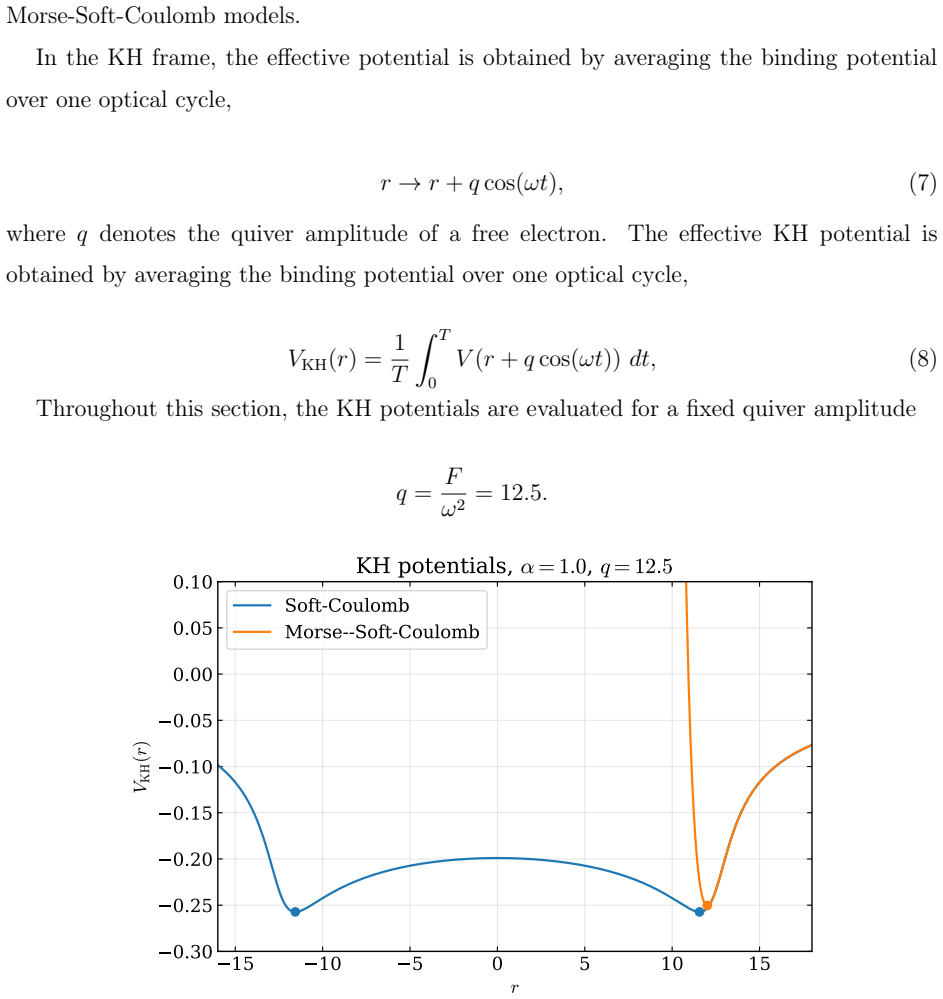
Adding a repulsive Morse branch to the Soft-Coulomb potential suppresses the ionization stabilization window by breaking left-right symmetry.
A machine-rendered reading of the paper's core claim, the machinery that carries it, and where it could break.
Core claim
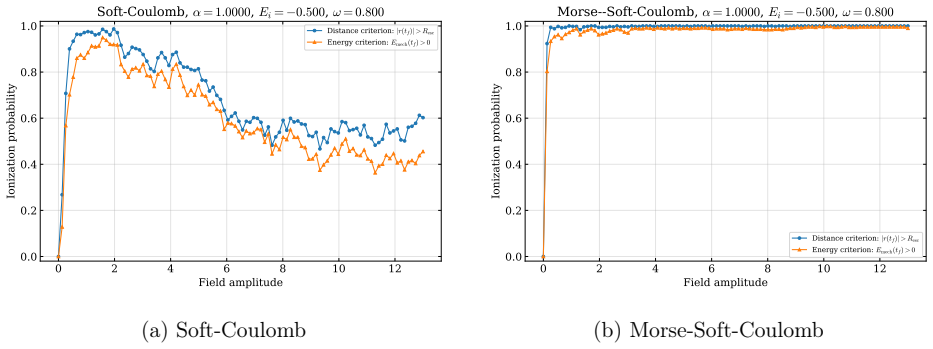
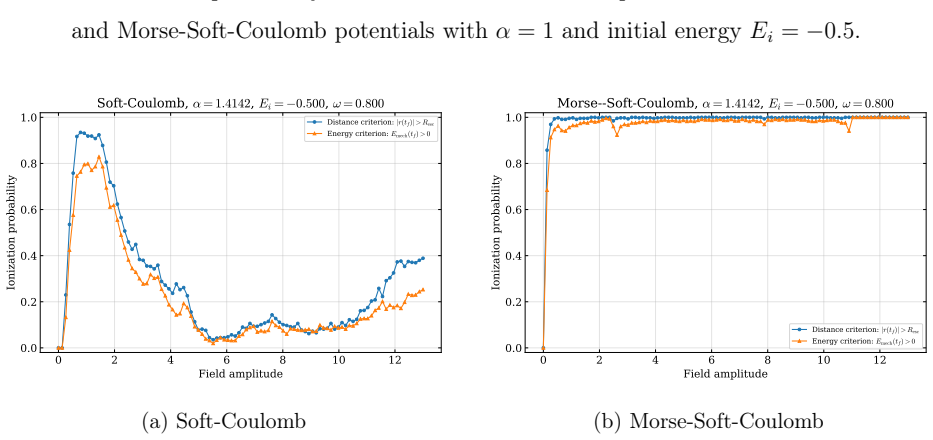
The stabilization window observed in the Soft-Coulomb model is strongly suppressed in the Morse-Soft-Coulomb system as a consequence of the broken left-right symmetry introduced by the Morse branch, which converts the Kramers-Henneberger effective potential from a symmetric double-well into a single-minimum structure and thereby reduces the effective trapping region.
What carries the argument
The Kramers-Henneberger effective potential (the cycle-averaged potential experienced by the driven electron), which forms two symmetric trapping wells in the Soft-Coulomb model but only a single minimum in the Morse-Soft-Coulomb model due to the broken left-right symmetry from the Morse branch.
If this is right
- Ionization probabilities stay high across a broad range of field amplitudes once the Morse barrier is present.
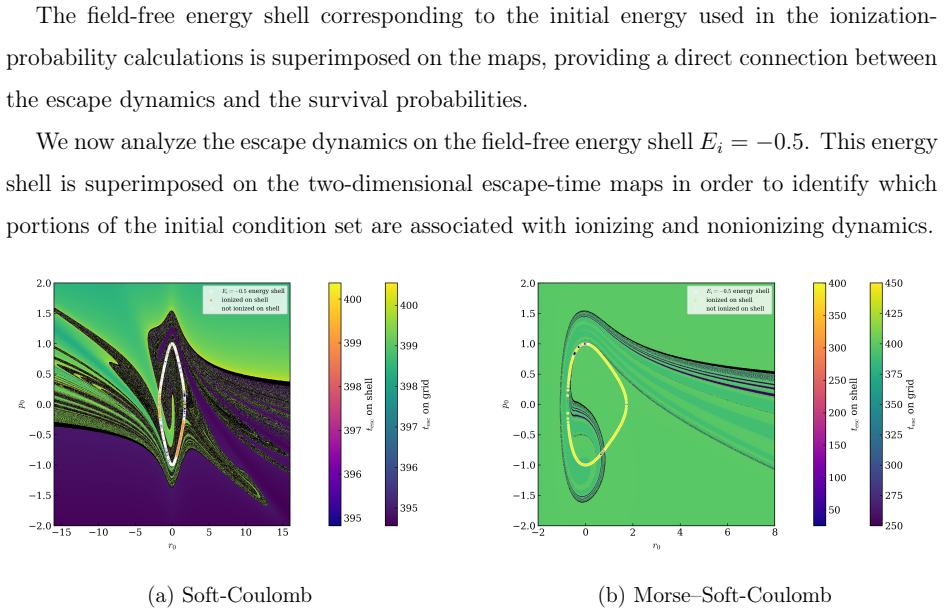
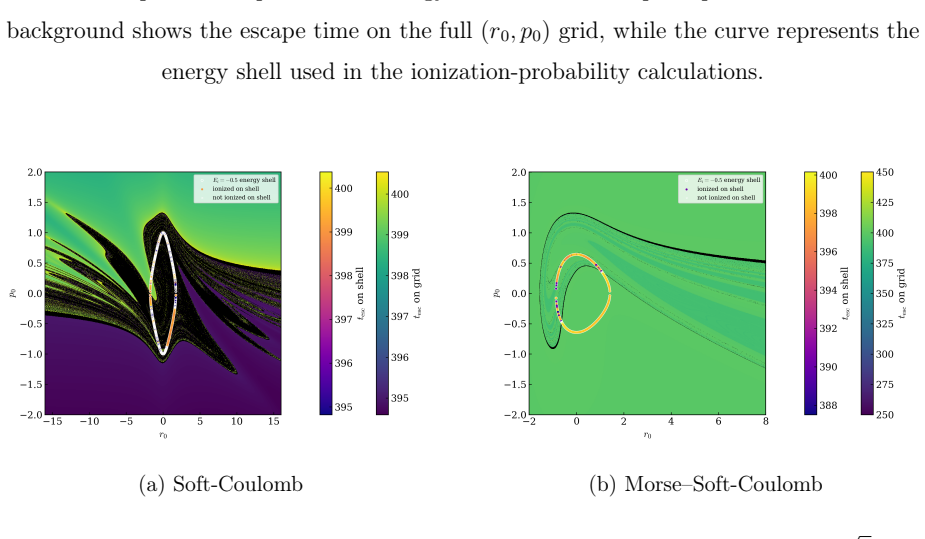
- Escape-time maps on the energy shell show shorter residence times near the nucleus in the Morse-Soft-Coulomb system.
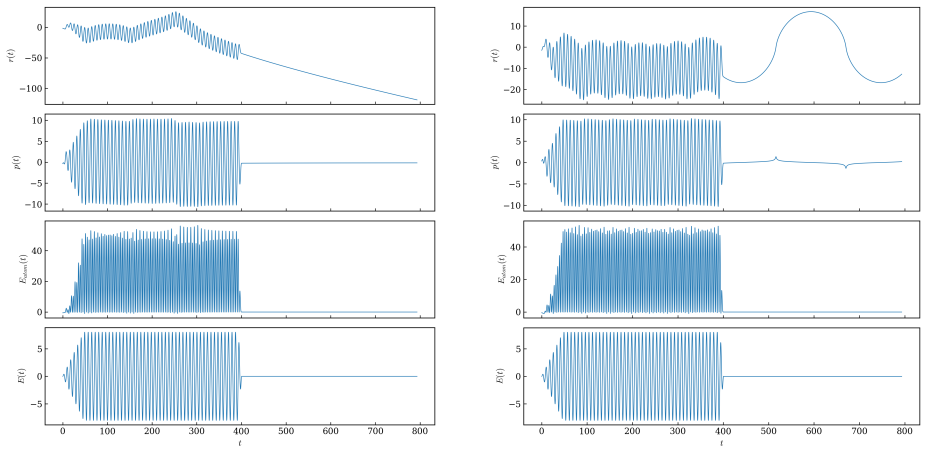
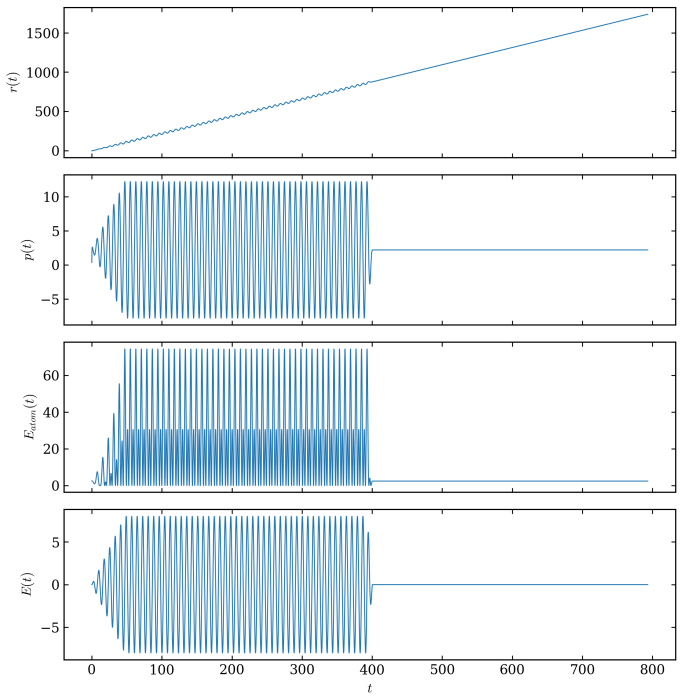
- Representative trajectories exhibit less long-term trapping once the double-well structure is lost.
- The suppression persists across the range of softening parameters examined.
Where Pith is reading between the lines
- The same symmetry-breaking approach could be applied to other one-dimensional atomic models to test whether stabilization requires symmetric wells.
- In experiments, adding an asymmetric barrier might provide a way to maintain high ionization rates even at very strong fields.
- Extending the comparison to two-dimensional or three-dimensional versions of the potential would check whether the single-minimum effect survives in higher dimensions.
Load-bearing premise
The reduction from two trapping wells to one in the effective potential is the direct cause of the lost stabilization rather than other changes in the driven dynamics.
What would settle it
Numerical integration of the Morse-Soft-Coulomb equations of motion that recovers a clear decrease in ionization probability with rising field amplitude, for the same softening parameters used in the paper, would falsify the suppression result.
Figures
read the original abstract
Ionization stabilization is a well-known phenomenon in strongly driven Soft-Coulomb atomic models, where the ionization probability decrease as the field amplitude increases. In this work, we investigate how this mechanism is affected by introducing a repulsive Morse barrier into the binding potential, leading to a Morse-Soft-Coulomb (MsC) model. A systematic comparison between the Soft-Coulomb and Morse-Soft-Coulomb systems is performed for different values of the softening parameter. Ionization probabilities, escape-time maps computed on the field-free energy shell and representative trajectories reveal that the stabilization window observed in the Soft-Coulomb model is strongly suppressed in the Morse-Soft-Coulomb system. To elucidate the origin of this behavior, we analyze the corresponding Kramers-Henneberger effective potentials. While the Soft-Coulomb model develops a symmetric double-well structure supporting two equivalent trapping regions, the Morse-Soft-Coulomb potential exhibits a single effective minimum as a consequence of the broken left-right symmetry introduced by the Morse branch. The combined analysis of ionization probabilities, escape dynamics, representative trajectories, and Kramers-Henneberger potentials indicates that the suppression of stabilization is closely associated with the modification of the phase-space transport structures and the reduction of the effective trapping region induced by the Morse
Editorial analysis
A structured set of objections, weighed in public.
Referee Report
Summary. The manuscript claims that ionization stabilization in strongly driven Soft-Coulomb (SC) models is strongly suppressed upon introduction of a repulsive Morse branch, yielding a Morse-Soft-Coulomb (MsC) potential. Systematic comparisons for varying softening parameters show this via ionization probabilities, escape-time maps on the field-free energy shell, representative trajectories, and Kramers-Henneberger (KH) effective potentials. The suppression is attributed to broken left-right symmetry producing a single KH minimum (versus the symmetric double-well in SC), which reduces the effective trapping region and modifies phase-space transport.
Significance. If the numerical results hold, the work demonstrates how asymmetry and repulsive cores in model potentials can suppress stabilization, providing a phase-space perspective via KH structures and escape maps that complements probability data. The multi-diagnostic approach and parameter variation add value for understanding driven ionization beyond symmetric models.
major comments (1)
- [KH potential analysis and escape dynamics] The central attribution of suppression 'as a consequence of the broken left-right symmetry' (KH analysis paragraph) is not isolated from other Morse-induced effects. The escape-time maps and trajectories correlate with the single-minimum KH structure, but the Morse branch also introduces a repulsive core whose range and shape differ from pure asymmetry; no control comparison (e.g., an asymmetric potential lacking the Morse core) is described to test whether symmetry breaking dominates over altered transport or escape pathways.
minor comments (1)
- [Abstract] The final sentence of the abstract is truncated mid-phrase ('induced by the Morse'); ensure the submitted manuscript completes all sentences and conclusions.
Simulated Author's Rebuttal
We thank the referee for the careful reading and constructive feedback. We address the single major comment below.
read point-by-point responses
-
Referee: [KH potential analysis and escape dynamics] The central attribution of suppression 'as a consequence of the broken left-right symmetry' (KH analysis paragraph) is not isolated from other Morse-induced effects. The escape-time maps and trajectories correlate with the single-minimum KH structure, but the Morse branch also introduces a repulsive core whose range and shape differ from pure asymmetry; no control comparison (e.g., an asymmetric potential lacking the Morse core) is described to test whether symmetry breaking dominates over altered transport or escape pathways.
Authors: We agree that the Morse branch simultaneously breaks left-right symmetry and introduces a repulsive core, so the two effects are not fully decoupled in the MsC model. Our attribution rests on the Kramers-Henneberger analysis, which shows that the resulting effective potential changes from a symmetric double well (SC) to a single minimum (MsC) precisely because of the asymmetry; the escape-time maps and sample trajectories are then shown to be consistent with the reduced trapping region of that single-minimum structure. While an auxiliary asymmetric potential lacking the Morse core would allow a stricter separation, the present work is deliberately focused on the concrete MsC potential that arises when a repulsive Morse branch is added to the Soft-Coulomb form. We will revise the KH-analysis paragraph and the concluding discussion to state this limitation explicitly and to emphasize that the observed suppression is tied to the modified KH landscape produced by the full Morse-Soft-Coulomb interaction. revision: partial
Circularity Check
No circularity; numerical model comparison is self-contained
full rationale
The paper conducts direct numerical comparisons of ionization probabilities, escape-time maps, trajectories, and Kramers-Henneberger potentials between the Soft-Coulomb and Morse-Soft-Coulomb systems. The central claim associates stabilization suppression with the single-minimum KH structure arising from Morse-induced asymmetry. No equations or steps reduce a derived quantity to a fitted input by construction, no predictions are statistically forced from the same data, and no load-bearing self-citations or uniqueness theorems are invoked. The analysis rests on independent simulations and potential computations that can be reproduced externally without reference to the target result.
Axiom & Free-Parameter Ledger
Reference graph
Works this paper leans on
-
[1]
The external field is written as F(t) =F 0f(t) sin(ωt),(4) whereF 0 is the field amplitude,ωis the carrier frequency, andf(t)is the pulse envelope. The envelope consists of a linear turn-on, a constant plateau, and a linear turn-off, f(t) = ωt 12π ,0≤t≤t on, 1, t on < t≤t on +t flat, 102π−ωt 2π , t on +t flat < t≤t total, 0, t ...
-
[2]
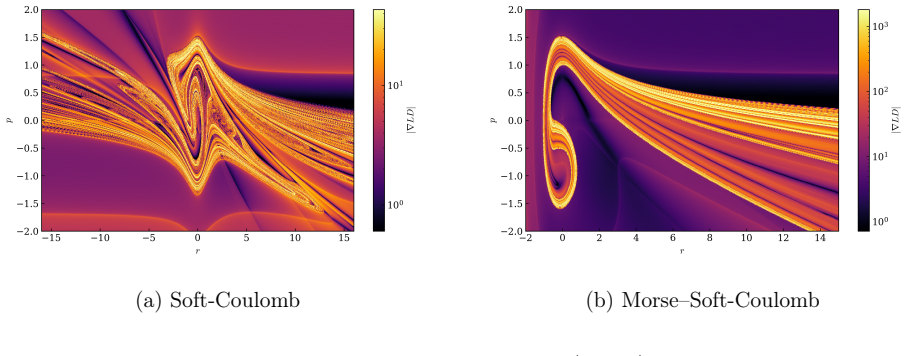
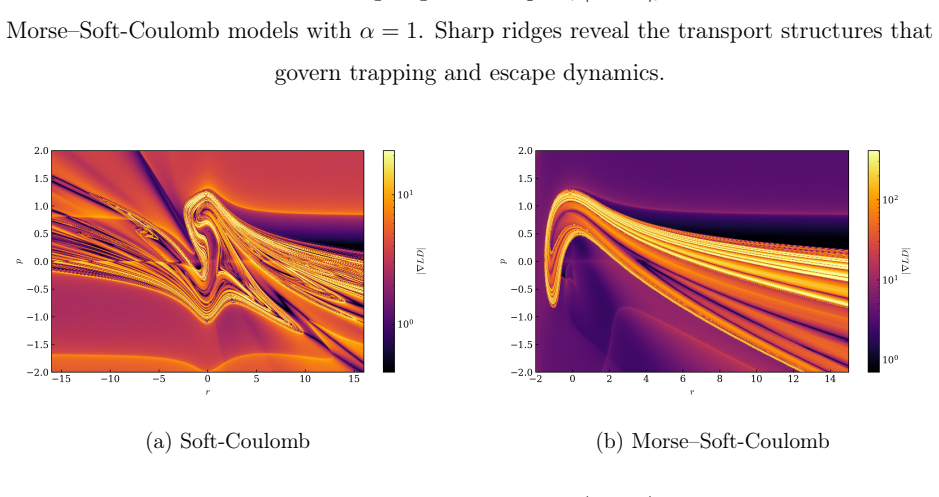
8 Figures 3 and 4 show the escape-time maps for the Soft-Coulomb and Morse–Soft- Coulomb potentials
The background shows the escape time on the full(r0, p0)grid, while the curve represents the energy shell used in the ionization-probability calculations. 8 Figures 3 and 4 show the escape-time maps for the Soft-Coulomb and Morse–Soft- Coulomb potentials. The background color represents the escape time computed on the full(r 0, p0)grid, whereas the superi...
-
[3]
of the energy shell intersect these structures, indicating that trajectories initialized on the shell are strongly influenced by the underlying transport skeleton
The reduction of the filamentary transport structures in the Morse–Soft-Coulomb model is consistent with the suppression of long trapping times and ionization stabilization. of the energy shell intersect these structures, indicating that trajectories initialized on the shell are strongly influenced by the underlying transport skeleton. The presence of the...
-
[4]
Pont and M
M. Pont and M. Gavrila, Physical Review Letters65, 2362 (1990)
1990
-
[5]
Gavrila, Journal of Physics B: Atomic, Molecular and Optical Physics35, R147 (2002)
M. Gavrila, Journal of Physics B: Atomic, Molecular and Optical Physics35, R147 (2002)
2002
-
[6]
Gavrila and J
M. Gavrila and J. Kamiński, Physical review letters52, 613 (1984)
1984
-
[7]
Gavrila, M
M. Gavrila, M. Pont, and J. van de Ree, inFundamentals of Laser Interactions II: Proceedings of the Fourth Meeting on Laser Phenomena Held at the Bundessportheim in Obergurgl, Austria 26 February–4 March 1989(Springer, 2005) pp. 245–263
1989
-
[8]
R. M. Potvliege and P. H. G. Smith, Physical Review A40, 3061 (1989)
1989
-
[9]
Joachain, inLaser Interactions with Atoms, Solids and Plasmas(Springer, 1994) pp
C. Joachain, inLaser Interactions with Atoms, Solids and Plasmas(Springer, 1994) pp. 39–94
1994
-
[10]
Grobe and C
R. Grobe and C. K. Law, Phys. Rev. A44, R4114(R) (1991)
1991
-
[11]
K. C. Kulander, K. J. Schafer, and J. L. Krause, Phys. Rev. Lett.66, 2601 (1991)
1991
-
[12]
F. H. M. Faisal,Theory of Multiphoton Processes(Plenum Press, 1987)
1987
-
[13]
C. J. Joachain, N. J. Kylstra, and R. M. Potvliege,Atoms in Intense Laser Fields(Cambridge University Press, 2012)
2012
-
[14]
Becker, X
W. Becker, X. Liu, P. J. Ho, and J. H. Eberly, Reviews of Modern Physics84, 1011 (2012)
2012
-
[15]
M. J. Norman, C. Chandre, T. Uzer, and P. Wang, Phys. Rev. A91, 023406 (2015)
2015
-
[16]
E. F. De Lima, R. E. De Carvalho, and M. Forlevesi, Physical Review E101, 022207 (2020)
2020
-
[17]
Forlevesi, R
M. Forlevesi, R. E. De Carvalho, and E. F. De Lima, Physical Review E104, 014206 (2021)
2021
-
[18]
W. C. Henneberger, Physical Review Letters21, 838 (1968)
1968
-
[19]
Gavrila, Journal of Physics B35, R147 (2002)
M. Gavrila, Journal of Physics B35, R147 (2002). 19
2002
-
[20]
Davier, I
M. Davier, I. Derado, D. Drickey, D. Fries, R. Mozley, A. Odian, F. Villa, D. Yount, and R. Zdanis, Physical Review Letters21, 841 (1968)
1968
-
[21]
A. W. Bray, U. Eichmann, and S. Patchkovskii, Phys. Rev. Lett.124, 233202 (2020)
2020
-
[22]
Mauger, C
F. Mauger, C. Chandre, and T. Uzer, Journal of Physics B: Atomic, Molecular and Optical Physics42, 165602 (2009)
2009
-
[23]
Grossmann, inTheoretical Femtosecond Physics: Atoms and Molecules in Strong Laser Fields(Springer, 2018) pp
F. Grossmann, inTheoretical Femtosecond Physics: Atoms and Molecules in Strong Laser Fields(Springer, 2018) pp. 113–172
2018
-
[24]
Cvitanovic, R
P. Cvitanovic, R. Artuso, R. Mainieri, G. Tanner, G. Vattay, N. Whelan, and A. Wirzba, ChaosBook. org (Niels Bohr Institute, Copenhagen 2005)69, 25 (2005)
2005
-
[25]
Richter, S
M. Richter, S. Patchkovskii, F. Morales, O. Smirnova, and M. Ivanov, New Journal of Physics 15, 083012 (2013)
2013
-
[26]
Floriani, J
E. Floriani, J. Dubois, and C. Chandre, The European Physical Journal D78, 152 (2024)
2024
-
[27]
Floriani, J
E. Floriani, J. Dubois, and C. Chandre, Physica D: Nonlinear Phenomena431, 133124 (2022)
2022
-
[28]
Ivanov, A
I. Ivanov, A. Kheifets, and K. T. Kim, Scientific Reports12, 17048 (2022)
2022
-
[29]
Su and J
Q. Su and J. H. Eberly, Physical Review A44, 5997 (1991)
1991
-
[30]
Dziubak and J
T. Dziubak and J. Matulewski, European Physical Journal D59, 321 (2010)
2010
-
[31]
G. A. Amici, A. Guzmán, and E. F. de Lima, Phys. Rev. E112, 014211 (2025)
2025
-
[32]
Ménis, R
T. Ménis, R. Taieb, V. Véniard, and A. Maquet, Journal of Physics B: Atomic, Molecular and Optical Physics25, L263 (1992)
1992
-
[33]
M. J. Norman, C. Chandre, T. Uzer, and P. Wang, Physical Review A91, 023406 (2015). 20
2015
discussion (0)
Sign in with ORCID, Apple, or X to comment. Anyone can read and Pith papers without signing in.