REVIEW 3 major objections 2 minor 26 references
Accelerating Network-Agent Dispersion: Territorial Behavior and Directionally Biased Lazy Random Walks
T0 review · 3 major / 2 minor · reviewed 2026-06-26 · grok-4.3
Pith's one-line read Territorial behavior and directional bias in lazy random walks cut expected agent dispersion time by up to 99 percent on large networks.
desk verdict Territorial behavior cuts dispersion time on graphs, but the directional bias likely needs pre-shared direction that undercuts the pure local-rules claim. read the letter →
The pith
A machine-rendered reading of the paper's core claim, the machinery that carries it, and where it could break.
The reading
What carries the argument
An absorbing Markov chain whose transition matrix incorporates local repulsion upon node claim and a shared directional preference on edges.
What would settle it
Monte Carlo simulations on an L100 or C100 network showing that the expected number of steps to absorption with territorial behavior equals or exceeds the baseline lazy random walk expectation.
Extended reading notes
Core claim
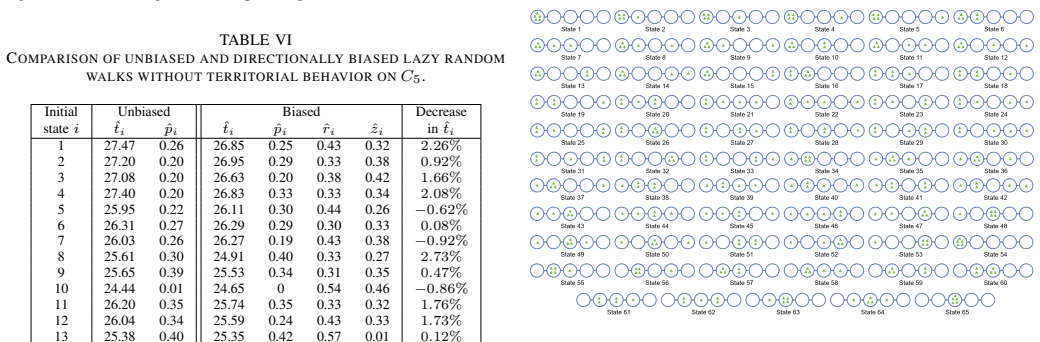
In the dispersion problem, m autonomous agents follow lazy random walks on a connected graph until each node holds exactly one agent. Territorial behavior modifies the process so that an isolated agent claims its node and repels others, while directional bias adds a shared preferred movement direction on paths and cycles. These local changes turn the baseline process into a faster-absorbing Markov chain whose expected absorption time is lower, with the speedup from territory alone increasing as graph size grows and with further large gains when bias is added.
Load-bearing premise
Agents can detect whether they are alone at a node to claim it and repel others, and they can maintain a consistent preferred direction using only local information.
Editorial extensions
If this is right
- Territorial behavior alone produces larger relative reductions in expected dispersion time as network size grows.
- Directional bias adds substantial further speedup only when combined with territorial behavior.
- Reductions reach 99.22 percent on L100 and 97.48 percent on C100 when all agents start at one node.
- Simple local rules can strongly affect global absorption time in the decentralized setting.
Reading between the lines
- The same local rules might produce comparable speedups on random or grid graphs not examined in the paper.
- Real implementations could test whether limited sensing range still allows agents to claim nodes effectively.
- The model suggests that adding occupancy detection hardware to agents could be more valuable than adding long-range communication.
Editorial analysis
A structured set of objections, weighed in public.
Referee Report
Summary. The paper studies dispersion of m=n agents on a connected graph to one-per-node configurations using lazy random walks (laziness p) as baseline, modeled as absorbing Markov chains with expected absorption time as metric. It introduces two local extensions—territorial behavior (claiming nodes and repelling arrivals) and directional bias (shared preferred direction on paths/cycles)—and reports that territorial behavior reduces expected time (with larger relative gains on bigger networks), while the combination yields further speedups including 99.22% on L100 and 97.48% on C100 from single-node starts, via exact calculations on small 3-agent paths/cycles and Monte Carlo on larger instances.
Significance. If the Monte Carlo results are statistically validated, the work shows that simple local behavioral rules can produce order-of-magnitude improvements in decentralized multi-agent dispersion on networks, extending standard Markov-chain absorption analysis with concrete scaling observations. The exact small-case solutions provide a verifiable foundation and the reported size-dependent gains are potentially useful for applications in distributed systems. The absence of simulation methodology details and ambiguity around the locality of directional bias currently limit the strength of these conclusions.
major comments (3)
- [§5] §5 (Monte Carlo simulations on L100 and C100): the headline reductions of 99.22% and 97.48% rest on simulations whose number of replications, variance estimation, convergence criteria, and sensitivity to p are not reported, undermining confidence in the large claimed speedups and the scaling-with-size assertion.
- [§3.2] §3.2 (directional bias definition): the model requires agents to share a consistent preferred direction, yet the text does not demonstrate that this sharing occurs via purely local detection without pre-assignment or extra communication; this is load-bearing for the central claim that the speedups arise from simple decentralized local rules.
- [§4] §4 (exact calculations on three-agent paths/cycles): while the baseline absorption times follow directly from the Markov chain, the paper should explicitly verify that the territorial and bias rules preserve the absorbing property and do not introduce new transient classes, with at least one worked small example.
minor comments (2)
- [Abstract] Abstract: the laziness parameter p used in the reported simulations is not stated, preventing direct replication of the baseline.
- [Notation] Notation: the precise construction of the L100 and C100 graphs (e.g., edge directions for bias) should be stated explicitly rather than assumed standard.
Simulated Author's Rebuttal
We thank the referee for the constructive feedback and for recognizing the potential impact of our results on decentralized multi-agent systems. We address each major comment below and will revise the manuscript accordingly to improve clarity, rigor, and completeness.
read point-by-point responses
-
Referee: [§5] §5 (Monte Carlo simulations on L100 and C100): the headline reductions of 99.22% and 97.48% rest on simulations whose number of replications, variance estimation, convergence criteria, and sensitivity to p are not reported, undermining confidence in the large claimed speedups and the scaling-with-size assertion.
Authors: We agree that the simulation methodology requires fuller documentation to support the reported speedups. In the revised manuscript we will add a dedicated paragraph in §5 specifying the Monte Carlo protocol: 10,000 independent replications per configuration, variance estimated via sample standard deviation with reported standard errors, convergence verified by stabilization of the running mean within 1% over the final 2,000 runs, and results shown for a range of laziness values p to confirm robustness. These additions will substantiate the 99.22% and 97.48% reductions and the observed size-dependent gains. revision: yes
-
Referee: [§3.2] §3.2 (directional bias definition): the model requires agents to share a consistent preferred direction, yet the text does not demonstrate that this sharing occurs via purely local detection without pre-assignment or extra communication; this is load-bearing for the central claim that the speedups arise from simple decentralized local rules.
Authors: The directional bias is intended as a fixed local preference (clockwise or counterclockwise on cycles; forward on paths) that each agent applies independently once chosen. We acknowledge that the original text does not explicitly demonstrate purely local acquisition of this preference. In revision we will expand §3.2 with a paragraph clarifying that the bias can be realized locally—for example by agents adopting a direction based on an initial local observation or a graph-inherent orientation—without requiring ongoing communication or global pre-assignment after initialization. This preserves the decentralized character while addressing the concern. revision: partial
-
Referee: [§4] §4 (exact calculations on three-agent paths/cycles): while the baseline absorption times follow directly from the Markov chain, the paper should explicitly verify that the territorial and bias rules preserve the absorbing property and do not introduce new transient classes, with at least one worked small example.
Authors: We concur that an explicit verification strengthens the Markov-chain foundation. Territorial repulsion only alters transition probabilities among states with co-located agents and leaves the fully dispersed configurations absorbing; directional bias merely reweights existing edge probabilities without creating new cycles. In the revised §4 we will insert a short verification subsection together with a worked example on the three-node path (showing the modified transition matrix, confirming the same absorbing states, and verifying that all transient states remain transient). revision: yes
Circularity Check
No significant circularity; results follow from defined Markov chains
full rationale
The paper defines a baseline lazy random walk as a finite absorbing Markov chain and computes expected absorption time via standard theory. Territorial behavior and directional bias are introduced as explicit new local rules that alter transition probabilities. Exact calculations and Monte Carlo simulations then evaluate the resulting chains on paths and cycles. No step renames a fitted quantity as a prediction, no output reduces to an input by construction, and no load-bearing self-citation or imported uniqueness theorem is invoked. The dispersion-time reductions are direct consequences of the stated behavioral modifications applied to the defined process.
Assumptions & free parameters
free parameters (1)
- laziness parameter p
assumptions (1)
- standard math The movement process defines a finite absorbing Markov chain whose absorption time measures dispersion efficiency.
Cite this review
Pith. "Pith review of Accelerating Network-Agent Dispersion: Territorial Behavior and Directionally Biased Lazy Random Walks." pith.science (2026). https://pith.science/paper/BY6CXRAZ
@misc{pith2026260619294,
  author       = {Pith},
  title        = {Pith review of: Accelerating Network-Agent Dispersion: Territorial Behavior and Directionally Biased Lazy Random Walks},
  year         = {2026},
  howpublished = {\url{https://pith.science/paper/BY6CXRAZ}},
  note         = {Machine review of arXiv:2606.19294}
}
read the original abstract
Territorial behavior can greatly accelerate decentralized agent dispersion on networks. This paper studies a network-agent dispersion problem in which m autonomous agents move in discrete time on a connected graph and seek a configuration in which no two agents occupy the same node. We focus on the dispersion case m = n, where successful configurations contain exactly one agent per node. In the baseline model, each agent follows a lazy random walk with a common laziness parameter p. This process defines a finite absorbing Markov chain, and the expected absorption time is used to measure dispersion efficiency. We introduce two local behavioral extensions: territorial behavior, in which an agent that is alone at a node claims that node and repels later arrivals, and directional bias, in which agents share a preferred direction of movement on paths and cycles. Exact calculations on three-agent path and cycle networks and Monte Carlo simulations on larger instances show that territorial behavior substantially reduces expected dispersion time, with larger relative reductions as network size increases. Directional bias alone has limited effect in most small-network cases, but when combined with territorial behavior it can produce large additional speedups. In particular, the simulations show reductions of 99.22% on L100 and 97.48% on C100 when all agents start from one node. These results show how simple local movement rules can strongly affect global dispersion time in decentralized networked multi-agent systems.
Figures


Figures from the paper (6 more)




Reference graph
Works this paper leans on
-
[1]
Consensus and cooper- ation in networked multi-agent systems,
R. Olfati-Saber, J. A. Fax, and R. M. Murray, “Consensus and cooper- ation in networked multi-agent systems,”Proceedings of the IEEE, vol. 95, no. 1, pp. 215–233, 2007
2007
-
[2]
Coordination of groups of mobile autonomous agents using nearest neighbor rules,
A. Jadbabaie, J. Lin, and A. S. Morse, “Coordination of groups of mobile autonomous agents using nearest neighbor rules,”IEEE Transactions on Automatic Control, vol. 48, no. 6, pp. 988–1001, 2003
2003
-
[3]
Bullo, J
F. Bullo, J. Cort ´es, and S. Mart ´ınez,Distributed Control of Robotic Networks. Princeton, NJ, USA: Princeton University Press, 2009
2009
-
[4]
Novel type of phase transition in a system of self-driven particles,
T. Vicsek, A. Czir ´ok, E. Ben-Jacob, I. Cohen, and O. Shochet, “Novel type of phase transition in a system of self-driven particles,”Physical Review Letters, vol. 75, no. 6, pp. 1226–1229, 1995
1995
-
[5]
Bonabeau, M
E. Bonabeau, M. Dorigo, and G. Theraulaz,Swarm Intelligence: From Natural to Artificial Systems. New York, NY , USA: Oxford University Press, 1999
1999
-
[6]
Spatial dispersion as a dynamic coordi- nation problem,
S. Alpern and D. J. Reyniers, “Spatial dispersion as a dynamic coordi- nation problem,”Theory and Decision, vol. 53, no. 1, pp. 29–59, 2002
2002
-
[7]
Dispersion games: General definitions and some specific learning results,
T. Grenager, R. Powers, and Y . Shoham, “Dispersion games: General definitions and some specific learning results,” inProc. 18th Nat. Conf. Artificial Intelligence, 2002, pp. 398–403
2002
-
[8]
Decentralized learning from failure,
A. Blume and A. M. Franco, “Decentralized learning from failure,” Journal of Economic Theory, vol. 133, no. 1, pp. 504–523, 2007
2007
Show all 26 references
-
[9]
Social distancing, gathering, search games: Mobile agents on simple networks,
S. Alpern and L. Zeng, “Social distancing, gathering, search games: Mobile agents on simple networks,”Dynamic Games and Applications, vol. 12, no. 1, pp. 288–311, 2022
2022
-
[10]
Social distancing by autonomous, possibly territorial, agents on networks,
S. Alpern and L. Zeng, “Social distancing by autonomous, possibly territorial, agents on networks,” inProc. Autonomous Agents for Social Good 2023, London, U.K., May 29–Jun. 2, 2023
2023
-
[11]
On non- cooperativeness in social distance games,
A. Balliu, M. Flammini, G. Melideo, and D. Olivetti, “On non- cooperativeness in social distance games,”Journal of Artificial Intel- ligence Research, vol. 66, pp. 625–653, 2019
2019
-
[12]
On Pareto optimality in social distance games,
A. Balliu, M. Flammini, G. Melideo, and D. Olivetti, “On Pareto optimality in social distance games,”Artificial Intelligence, vol. 312, p. 103768, 2022
2022
-
[13]
Random walks and diffusion on networks,
N. Masuda, M. A. Porter, and R. Lambiotte, “Random walks and diffusion on networks,”Physics Reports, vols. 716–717, pp. 1–58, 2017
2017
-
[14]
Random walks on weighted networks: A survey of local and non-local dynamics,
A. P. Riascos and J. L. Mateos, “Random walks on weighted networks: A survey of local and non-local dynamics,”Journal of Complex Networks, vol. 9, no. 5, p. cnab032, 2021
2021
-
[15]
Ergodic limits, relaxations, and geometric properties of random walk node embeddings,
C. Lin, D. L. Sussman, and P. Ishwar, “Ergodic limits, relaxations, and geometric properties of random walk node embeddings,”IEEE Transactions on Network Science and Engineering, vol. 10, no. 1, pp. 346–359, Jan.–Feb. 2023
2023
-
[16]
Coupling fear and contagion for modeling epidemic dynamics,
K. Jain, V . Bhatnagar, S. Prasad, and S. Kaur, “Coupling fear and contagion for modeling epidemic dynamics,”IEEE Transactions on Network Science and Engineering, vol. 10, no. 1, pp. 20–34, Jan.–Feb. 2023
2023
-
[17]
A polarized temporal network model to study the spread of recurrent epidemic diseases in a partially vaccinated population,
K. Frieswijk, L. Zino, and M. Cao, “A polarized temporal network model to study the spread of recurrent epidemic diseases in a partially vaccinated population,”IEEE Transactions on Network Science and Engineering, vol. 10, no. 6, pp. 3732–3743, Nov.–Dec. 2023
2023
-
[18]
Cooperation and competition coupled diffusion of multi-feature on multiplex networks and its control,
D. Zhao, S. Li, Z. Wang, and H. Peng, “Cooperation and competition coupled diffusion of multi-feature on multiplex networks and its control,” IEEE Transactions on Network Science and Engineering, vol. 10, no. 4, pp. 2307–2318, Jul.–Aug. 2023
2023
-
[19]
On territorial behavior and other factors influencing habitat distribution in birds. I. Theoretical development,
S. D. Fretwell and H. L. Lucas, “On territorial behavior and other factors influencing habitat distribution in birds. I. Theoretical development,” Acta Biotheoretica, vol. 19, no. 1, pp. 16–36, 1969
1969
-
[20]
Animal interactions and the emergence of territoriality,
L. Giuggioli, J. R. Potts, and S. Harris, “Animal interactions and the emergence of territoriality,”PLOS Computational Biology, vol. 7, no. 3, p. e1002008, 2011
2011
-
[21]
A mechanistic, stigmergy model of territory formation in solitary animals: Territorial behavior can dampen disease prevalence but increase persistence,
L. A. White, S. VandeWoude, and M. E. Craft, “A mechanistic, stigmergy model of territory formation in solitary animals: Territorial behavior can dampen disease prevalence but increase persistence,”PLOS Computational Biology, vol. 16, no. 6, p. e1007457, 2020
2020
-
[22]
Models and measures of animal aggregation and dispersal,
M. Broom, I. V . Erovenko, J. T. Rowell, and J. Rycht ´aˇr, “Models and measures of animal aggregation and dispersal,”Journal of Theoretical Biology, vol. 484, p. 110002, 2020
2020
-
[23]
Characteristic times of biased random walks on complex networks,
M. Bonaventura, V . Nicosia, and V . Latora, “Characteristic times of biased random walks on complex networks,”Physical Review E, vol. 89, no. 1, p. 012803, 2014
2014
-
[24]
Patrolling games,
S. Alpern, A. Morton, and K. Papadaki, “Patrolling games,”Operations Research, vol. 59, no. 5, pp. 1246–1257, 2011
2011
-
[25]
A competitive search game with a moving target,
B. Duvocelle, J. Flesch, M. Staudigl, and D. Vermeulen, “A competitive search game with a moving target,”European Journal of Operational Research, vol. 303, no. 2, pp. 945–957, 2022
2022
-
[26]
Adversarial patrolling with spatially uncertain alarm signals,
N. Basilico, G. De Nittis, and N. Gatti, “Adversarial patrolling with spatially uncertain alarm signals,”Artificial Intelligence, vol. 246, pp. 220–257, 2017
2017
Reviewed June 26, 2026 · model on record in the stance chip above.
Discussion (0). Continue with ORCID to comment.