Norm inflation for the cubic hyperbolic NLS on mathbb T²
Pith reviewed 2026-06-26 19:54 UTC · model grok-4.3
The pith
The cubic hyperbolic NLS on the torus exhibits norm inflation in H^s for every s ≤ 1/2 except s=0.
A machine-rendered reading of the paper's core claim, the machinery that carries it, and where it could break.
Core claim
We prove norm inflation for the cubic hyperbolic nonlinear Schrödinger equation in H^s(T²) for every s∈(−∞,0)∪(0,1/2]. The scaling-critical point s=0 is excluded by conservation of the L² norm. The strong ill-posedness below and above the scaling-critical point arises from two completely different mechanisms. Particularly in the scaling-subcritical regime, this dynamical instability stems from the hyperbolic nature. Together with the local well-posedness result, this gives a sharp dichotomy away from the mass space L²(T²): local well-posedness holds for s>1/2, whereas norm inflation occurs for all s≤1/2 with s≠0.
What carries the argument
Dynamical instability constructed from the hyperbolic dispersion in the scaling-subcritical regime.
Load-bearing premise
The local well-posedness result for s > 1/2 stated in the cited reference holds.
What would settle it
An explicit sequence of solutions whose H^s norm remains bounded for some s=1/4 initial datum would disprove the claimed norm inflation.
Figures
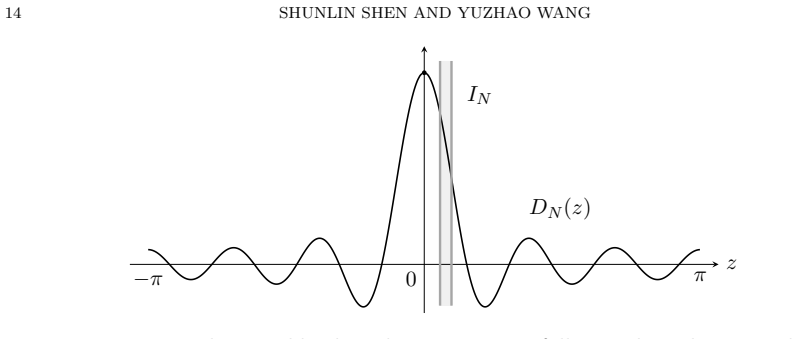
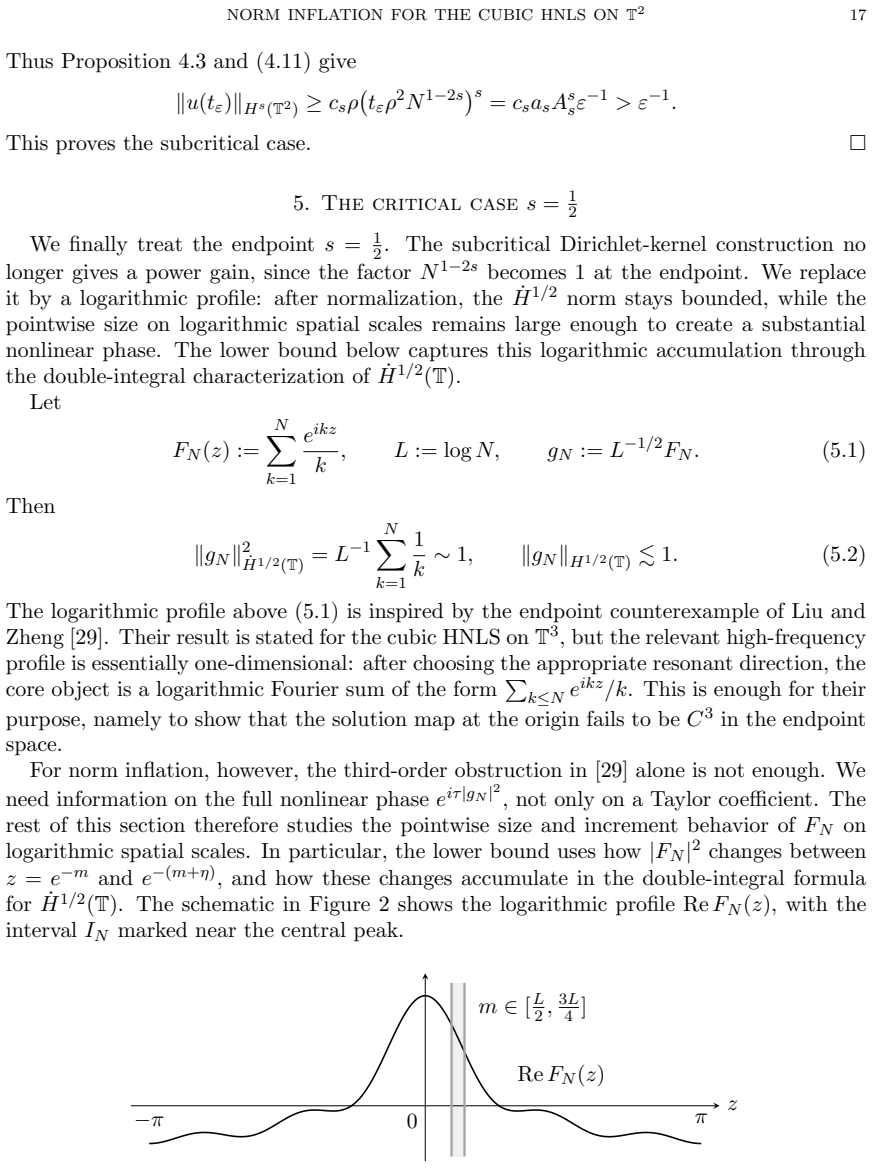
read the original abstract
We prove norm inflation for the cubic hyperbolic nonlinear Schr\"odinger equation in $H^s(\mathbb T^2)$ for every $s\in(-\infty,0)\cup(0,\frac12]$. The scaling-critical point $s=0$ is excluded by conservation of the $L^2$ norm. The strong ill-posedness below and above the scaling-critical point arises from two completely different mechanisms. Particularly in the scaling-subcritical regime, this dynamical instability stems from the hyperbolic nature. Together with the local well-posedness result in \cite{WangHNLS}, this gives a sharp dichotomy away from the mass space $L^2(\mathbb T^2)$: local well-posedness holds for $s>\frac12$, whereas norm inflation occurs for all $s\le \frac12$ with $s\ne0$.
Editorial analysis
A structured set of objections, weighed in public.
Referee Report
Summary. The paper proves norm inflation for the cubic hyperbolic nonlinear Schrödinger equation on T² in H^s(T²) for all s ∈ (−∞,0) ∪ (0,1/2], with s=0 excluded by L²-mass conservation. It asserts that the result, combined with a cited local well-posedness theorem, yields a sharp dichotomy: LWP for s > 1/2 and norm inflation for s ≤ 1/2 (s ≠ 0). The abstract emphasizes that the ill-posedness mechanisms differ above and below the scaling-critical index s=0.
Significance. If the norm-inflation construction is rigorous, the result supplies a concrete dynamical instability for a hyperbolic dispersive equation both below and above scaling, driven by the hyperbolic structure in the subcritical regime. This would sharpen the known well-posedness threshold for the equation and illustrate how hyperbolicity can produce norm inflation even in scaling-subcritical spaces.
major comments (1)
- [Abstract] Abstract, final paragraph: the claim that the norm-inflation result 'gives a sharp dichotomy' together with the LWP theorem in <cite>WangHNLS</cite> is load-bearing for the paper's stated conclusion, yet the manuscript supplies no verification, adaptation, or compatibility check of the external LWP statement (e.g., the precise range of s, the function space, or the time of existence). The dichotomy assertion therefore rests entirely on the correctness and applicability of the cited reference.
minor comments (1)
- [Abstract] The abstract refers to 'two completely different mechanisms' for ill-posedness above and below s=0 but does not preview the distinct constructions used in each regime; a brief sentence indicating the respective techniques would improve readability.
Simulated Author's Rebuttal
We thank the referee for the careful reading of our manuscript and for highlighting this point about the cited local well-posedness result. We address the major comment below.
read point-by-point responses
-
Referee: [Abstract] Abstract, final paragraph: the claim that the norm-inflation result 'gives a sharp dichotomy' together with the LWP theorem in <cite>WangHNLS</cite> is load-bearing for the paper's stated conclusion, yet the manuscript supplies no verification, adaptation, or compatibility check of the external LWP statement (e.g., the precise range of s, the function space, or the time of existence). The dichotomy assertion therefore rests entirely on the correctness and applicability of the cited reference.
Authors: We agree that the manuscript would benefit from an explicit statement confirming the applicability of the cited LWP result. The reference \cite{WangHNLS} establishes local well-posedness for the cubic hyperbolic NLS on \mathbb{T}^2 precisely in H^s for s > 1/2, with the local existence time depending on the H^s norm of the data. In the revised version we will insert a brief clarifying paragraph in the introduction (and a corresponding adjustment to the abstract) that quotes the relevant statement from \cite{WangHNLS} and notes its direct compatibility with the setting of our norm-inflation construction. This makes the dichotomy self-contained while leaving the main theorems unchanged. revision: yes
Circularity Check
Dichotomy combines new norm-inflation result with cited LWP from WangHNLS; no reduction by construction
full rationale
The manuscript's core derivation establishes norm inflation for the cubic hyperbolic NLS in H^s(T^2) for the stated range of s via mechanisms tied to the hyperbolic structure. This part of the argument is presented as self-contained. The abstract's final sentence invokes the LWP theorem from the external reference WangHNLS solely to obtain the combined dichotomy statement; the present paper supplies neither a reproduction nor an adaptation of that LWP result. No equation, ansatz, or prediction in the supplied text reduces to a fitted input or self-definition. The citation, even if overlapping in authorship, functions as external support rather than a load-bearing premise that collapses the new result. Hence the finding remains within the 0-2 band of normal non-circularity.
Axiom & Free-Parameter Ledger
axioms (2)
- standard math Standard properties of Sobolev spaces H^s on the torus T^2
- domain assumption Local well-posedness for s > 1/2 from the cited paper WangHNLS
Reference graph
Works this paper leans on
-
[1]
M. J. Ablowitz and H. Segur,On the evolution of packets of water waves, J. Fluid Mech.92(1979), no. 4, 691–715
1979
-
[2]
Ba¸ sako˘ glu, C
E. Ba¸ sako˘ glu, C. Sun, N. Tzvetkov, and Y. Wang. Local well-posedness for the periodic Boltzmann equation with constant collision kernel.J. Funct. Anal., 290(6):Paper No. 111288, 2026
2026
-
[3]
E. Ba¸ sako˘ glu and Y. Wang,Well-posedness for the periodic hyperbolic nonlinear Schr¨ odinger equations, arXiv:2510.03211
-
[4]
Berg´ e,Wave collapse in physics: principles and applications to light and plasma waves, Phys
L. Berg´ e,Wave collapse in physics: principles and applications to light and plasma waves, Phys. Rep. 303(1998), no. 5–6, 259–370
1998
-
[5]
Berg´ e, E
L. Berg´ e, E. A. Kuznetsov, J. J. Rasmussen, E. G. Shapiro, and S. K. Turitsyn,Self-focusing of optical pulses in media with normal dispersion, Phys. Scr. T67(1996), 17–20
1996
-
[6]
Berg´ e and J
L. Berg´ e and J. Rasmussen,Multi-splitting and collapse of self-focusing anisotropic beams in normal/ anomalous dispersive media, Phys. Plasmas3(1996), 824–843
1996
-
[7]
Bejenaru and T
I. Bejenaru and T. Tao,Sharp well-posedness and ill-posedness results for a quadratic non-linear Schr¨ odinger equation, J. Funct. Anal.233(2006), no. 1, 228–259
2006
-
[8]
B´ enyi and T
´A. B´ enyi and T. Oh,The Sobolev inequality on the torus revisited, Publ. Math. Debrecen83(2013), no. 3, 359–374
2013
-
[9]
Bourgain and C
J. Bourgain and C. Demeter,The proof of theℓ 2 decoupling conjecture, Ann. of Math. 182 (2015), no. 1, 351—389
2015
-
[10]
Bourgain and C
J. Bourgain and C. Demeter,Decouplings for curves and hypersurfaces with nonzero Gaussian curvature, J. Anal. Math. 133 (2017), 279–311
2017
-
[11]
N. Burq, P. G´ erard, and N. Tzvetkov,Multilinear eigenfunction estimates and global existence for the three dimensional nonlinear Schr¨ odinger equations, Ann. Sci. ´Ecole Norm. Sup. (4)38(2005), no. 2, 255–301
2005
-
[12]
Carles and T
R. Carles and T. Kappeler,Norm-inflation with Infinite Loss of Regularity for Periodic NLS Equations in Negative Sobolev Spaces, Bull. Soc. Math. France145(2017), no. 4, 623–642
2017
-
[13]
T. Chen, R. Denlinger, and N. Pavlovi’c,Local well-posedness for Boltzmann’s equation and the Boltz- mann hierarchy via Wigner transform, Comm. Math. Phys.368(2019), no. 1, 427–465
2019
-
[14]
Chen and J
X. Chen and J. Holmer,Well/ill-posedness bifurcation for the Boltzmann equation with constant colli- sion kernel, Ann. PDE10(2024), no. 2, Paper No. 14, 44 pp
2024
-
[15]
X. Chen, S. Shen, and Z. Zhang,Well/ill-posedness of the Boltzmann equation with soft potential, Comm. Math. Phys.405(2024), no. 12, Paper No. 283, 51 pp
2024
-
[16]
X. Chen, S. Shen, and Z. Zhang,ℓ 2-decoupling and the unconditional uniqueness for the Boltzmann equation, Comm. Math. Phys.407(2026), no. 6, Paper No. 115, 31 pp
2026
-
[17]
Ill-posedness for nonlinear Schrodinger and wave equations
M. Christ, J. Colliander, and T. Tao,Ill-posedness for nonlinear Schr¨ odinger and wave equations, arXiv:math/0311048
work page internal anchor Pith review Pith/arXiv arXiv
- [18]
-
[19]
J. M. Ghidaglia and J. C. Saut,Nonelliptic Schr¨ odinger equations, J. Nonlinear Sci.3(1993), 169–195
1993
-
[20]
J. M. Ghidaglia and J. C. Saut,On the initial value problem for the Davey–Stewartson systems, Non- linearity3(1990), 475–506
1990
-
[21]
J. M. Ghidaglia and J. C. Saut,Nonexistence of travelling wave solutions to nonelliptic nonlinear Schr¨ odinger equations, J. Nonlinear Sci.6(1996), 139–145
1996
-
[22]
Godet,A lower bound on the blow-up rate for the Davey–Stewartson system on the torus, Ann
N. Godet,A lower bound on the blow-up rate for the Davey–Stewartson system on the torus, Ann. Inst. H. Poincar´ e C Anal. Non Lin´ eaire30(2013), no. 4, 691–703. 22 SHUNLIN SHEN AND YUZHAO WANG
2013
-
[23]
Godet and N
N. Godet and N. Tzvetkov,Strichartz estimates for the periodic non-elliptic Schr¨ odinger equation, C. R. Math.350(2012), no. 21–22, 955–958
2012
-
[24]
Hayashi and J
N. Hayashi and J. C. Saut,Global existence of small solutions to the Davey–Stewartson and the Ishimori systems, Differential Integral Equations8(1995), no. 7, 1657–1675
1995
-
[25]
H¨ ormander,The analysis of linear partial differential operators I: Distribution theory and Fourier analysis, Classics in Mathematics, Springer-Verlag, Berlin, 2003
L. H¨ ormander,The analysis of linear partial differential operators I: Distribution theory and Fourier analysis, Classics in Mathematics, Springer-Verlag, Berlin, 2003
2003
-
[26]
Iwabuchi and T
T. Iwabuchi and T. Ogawa,Ill-posedness for the nonlinear Schr¨ odinger equation with quadratic non- linearity in low dimensions, Trans. Amer. Math. Soc.367(2015), no. 4, 2613–2630
2015
-
[27]
C. E. Kenig, G. Ponce, and L. Vega,On the ill-posedness of some canonical dispersive equations, Duke Math. J.106(2001), no. 3, 617–633
2001
-
[28]
Kishimoto,A remark on norm inflation for nonlinear Schr¨ odinger equations, Commun
N. Kishimoto,A remark on norm inflation for nonlinear Schr¨ odinger equations, Commun. Pure Appl. Anal.18(2019), no. 3, 1375–1402
2019
- [29]
- [30]
-
[31]
Mizutani and N
H. Mizutani and N. Tzvetkov,Strichartz estimates for non-elliptic Schr¨ odinger equations on compact manifolds, Commun. Partial Differ. Equ.40(2015), no. 6, 1182–1195
2015
-
[32]
Oh and Y
T. Oh and Y. Wang,On the ill-posedness of the cubic nonlinear Schr¨ odinger equation on the circle, An. S ¸tiint ¸. Univ. Al. I. Cuza Ia¸ si. Mat. (N.S.) 64 (2018), no. 1, 53–84
2018
-
[33]
J. C. Saut and Y. Wang,On the hyperbolic nonlinear Schr¨ odinger equations, Adv. Cont. Discr. Mod. 2024(2024), no. 1, 15 pp
2024
-
[34]
Totz,Global well-posedness of 2D non-focusing Schr¨ odinger equations via rigorous modulation ap- proximation, J
N. Totz,Global well-posedness of 2D non-focusing Schr¨ odinger equations via rigorous modulation ap- proximation, J. Differential Equations261(2016), 2251–2299
2016
-
[35]
Totz,A justification of the modulation approximation to the 3d full water wave problem, Comm
N. Totz,A justification of the modulation approximation to the 3d full water wave problem, Comm. Math. Phys.335(2015), no. 1, 369–443
2015
-
[36]
Totz and S
N. Totz and S. Wu,A rigorous justification of the modulation approximation to the 2d full water wave problem, Comm. Math. Phys.310(2012), 817–883
2012
-
[37]
Wang,Periodic cubic hyperbolic Schr¨ odinger equation onT 2, J
Y. Wang,Periodic cubic hyperbolic Schr¨ odinger equation onT 2, J. Funct. Anal.265(2013), no. 3, 424–434. Shunlin Shen, School of Mathematical Sciences, University of Science and Technology of China, Hefei, 230026, China Email address:slshen@ustc.edu.cn Yuzhao W ang, School of Mathematical Sciences, Dalian University of Technology, Dalian, 116024, China;,...
2013
discussion (0)
Sign in with ORCID, Apple, or X to comment. Anyone can read and Pith papers without signing in.