On Epimorphisms of Hypergraphic Automata and Input Symbol Semigroups
Pith reviewed 2026-06-26 21:40 UTC · model grok-4.3
The pith
Epimorphisms of universal hypergraphic automata are characterized by necessary and sufficient conditions on maps between their state and output hypergraphs.
A machine-rendered reading of the paper's core claim, the machinery that carries it, and where it could break.
Core claim
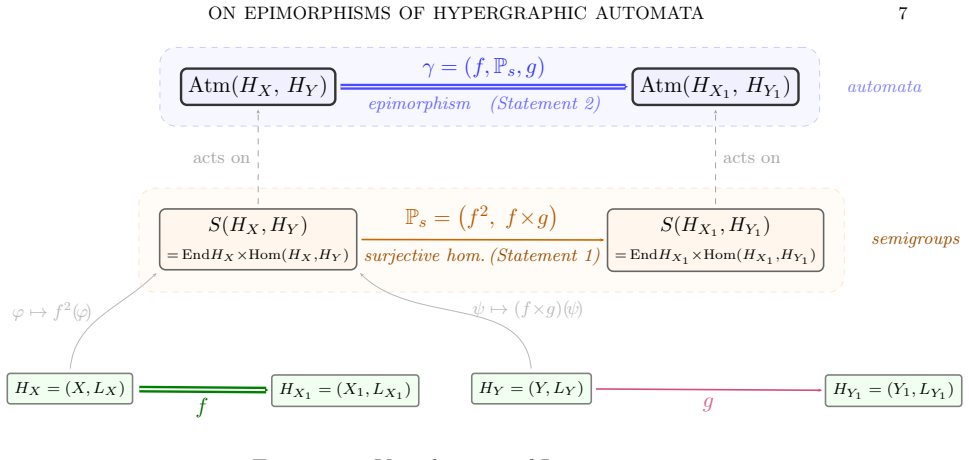
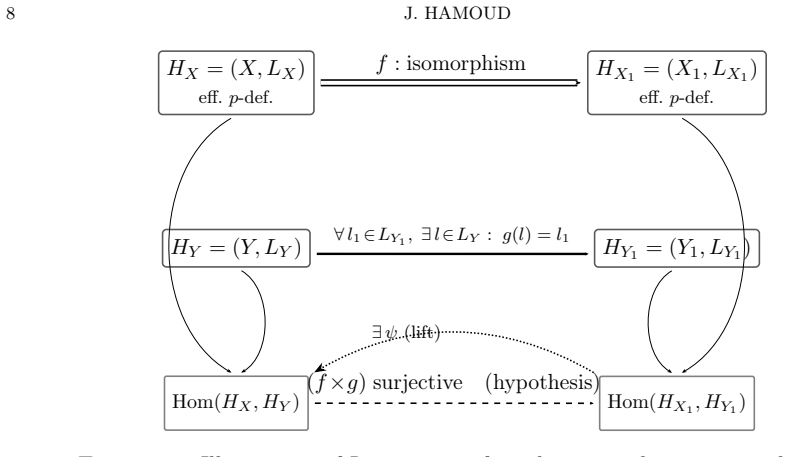
The paper introduces weak and strong epimorphisms for hypergraphs and proves that the two notions diverge in general but coincide for every p*-hypergraph. It then states necessary and sufficient conditions for a triple (f, P_s, g) to be an epimorphism of universal hypergraphic automata; these conditions are expressed directly in terms of the action of f on the state hypergraph and of g on the output hypergraph. The same conditions characterize epimorphisms of the associated semigroups of input symbols.
What carries the argument
The triple (f, P_s, g) consisting of a map f on state hypergraphs, a map g on output hypergraphs, and a map P_s on the input-symbol semigroup; the triple is an epimorphism precisely when f and g satisfy the stated compatibility conditions derived from the weak or strong hypergraph epimorphism notions.
If this is right
- The algebraic structure of the input-symbol semigroup is completely determined once the epimorphisms of the automata are known.
- When the state and output hypergraphs are projective or affine planes, the weak and strong epimorphism notions become identical, so a single set of conditions suffices.
- Every epimorphism of universal hypergraphic automata must preserve the universal attracting property through the component maps on the hypergraphs.
- The characterization extends directly to epimorphisms of the semigroups of input symbols.
Where Pith is reading between the lines
- The divergence between weak and strong hypergraph epimorphisms outside the p*-class may produce distinct categories of automata whose input semigroups behave differently.
- The explicit conditions on hypergraph maps could be used to construct new universal hypergraphic automata by transporting known examples along suitable maps.
- The link between hypergraph geometry and semigroup algebra suggests that combinatorial designs such as planes may yield automata whose input semigroups have previously unrecognized properties.
Load-bearing premise
The state sets and output symbol sets of the automata are hypergraphs that remain invariant under the actions of the transition and output functions.
What would settle it
A pair of universal hypergraphic automata together with a triple of maps that meets every stated condition on the state and output hypergraphs yet fails to be an epimorphism of the automata would falsify the claimed characterization.
Figures
read the original abstract
Hypergraphic automata are automata whose state sets and output symbol sets are hypergraphs invariant under the actions of the transition and output functions. Universally attracting objects in the category of such automata are called universal hypergraphic automata; their semigroups of input symbols are algebras of mappings whose properties are tightly linked to the algebraic structure of the automata themselves. This paper establishes a complete characterisation of epimorphisms of universal hypergraphic automata and of their semigroups of input symbols. A central contribution is the introduction of two distinct notions of epimorphism for hypergraphs including weak, strong and the proof that these notions diverge in general but necessarily coincide for the important subclass of $p^*$-hypergraphs, which includes automata whose state hypergraphs and output hypergraphs are projective or affine planes. The main results give necessary and sufficient conditions for a triple $(f, \mathbb{P}_s, g)$ to be an epimorphism of universal hypergraphic automata, expressed in terms of the component maps on the state and output hypergraphs.
Editorial analysis
A structured set of objections, weighed in public.
Referee Report
Summary. The paper claims to establish a complete characterisation of epimorphisms of universal hypergraphic automata and of their semigroups of input symbols. It introduces two notions of epimorphism (weak and strong) for hypergraphs, proves that these coincide on the subclass of p*-hypergraphs (including those whose state and output hypergraphs are projective or affine planes), and supplies necessary and sufficient conditions for a triple (f, ℙ_s, g) to be an epimorphism, expressed via the component maps on the state and output hypergraphs.
Significance. If the stated characterisation is correct, the work supplies a concrete link between the categorical structure of hypergraphic automata and the algebraic properties of their input-symbol semigroups. The coincidence result for p*-hypergraphs is a useful technical contribution that applies directly to geometrically defined automata.
minor comments (1)
- [Abstract] The abstract asserts a 'complete characterisation' but does not display the explicit conditions; a one-sentence summary of the main criterion would improve readability.
Simulated Author's Rebuttal
We thank the referee for their careful reading and for the accurate summary of our contributions. The positive assessment of significance is appreciated. No specific major comments were raised in the report, despite the 'uncertain' recommendation. We have therefore prepared no point-by-point responses and no revisions. If the uncertainty stems from particular aspects of the characterisation or proofs, we would welcome the opportunity to address them in a revised submission.
Circularity Check
No circularity; characterisation is independent
full rationale
The paper defines hypergraphic automata and universal objects, then proves weak/strong epimorphisms coincide on the subclass of p*-hypergraphs and states necessary and sufficient conditions for the triple (f, P_s, g) to be an epimorphism directly in terms of the component maps on state and output hypergraphs. No equations reduce a claimed prediction or result to a fitted parameter or prior self-citation by construction; the conditions are external to the input data and the derivation remains self-contained against the category-theoretic definitions.
Axiom & Free-Parameter Ledger
Reference graph
Works this paper leans on
-
[1]
InProceedings of the 15th ACM SIGPLAN-SIGACT symposium on Principles of programming languages
A. Bretto,Hypergraph Theory: An Introduction, (Springer, Cham, 2013).doi: 10.1007/978-3-319- 00080-0
- [2]
-
[3]
A. Dennunzio, E. Formenti, D. Grinberg, and L. Margara,From linear to additive cellular automata, in Proc. 47th Int. Colloquium on Automata, Languages, and Programming (ICALP 2020), LIPIcs 168(2020), 125:1–125:13.doi: 10.4230/LIPIcs.ICALP.2020.125
-
[4]
A. Dennunzio, E. Formenti, D. Grinberg, and L. Margara,An efficiently computable characterization of stability and instability for linear cellular automata, J. Comput. Syst. Sci.119(2021), 63–71.doi: 10.1016/j.jcss.2021.03.003
-
[5]
Eilenberg,Automata, Languages, and Machines, Vol
S. Eilenberg,Automata, Languages, and Machines, Vol. A, (Academic Press, New York, 1974)
1974
-
[6]
N. Fijalkow, C. Riveros, and J. Worrell,Probabilistic automata of bounded ambiguity, Information and Computation282(2022), 104648.doi: 10.1016/j.ic.2020.104648
-
[7]
D. Geißler and T. Winkler,Weighted automata for exact inference in discrete probabilistic programs, in Theoretical Aspects of Computing – ICTAC 2025, Lecture Notes in Computer Science16237 (2025).doi: 10.1007/978-3-032-11176-016
-
[8]
Hartshorne,Foundations of Projective Geometry, (Ishi Press, New York, 2009)
R. Hartshorne,Foundations of Projective Geometry, (Ishi Press, New York, 2009)
2009
-
[9]
C. Hensel, S. Junges, J.-P. Katoen, T. Quatmann, and M. Volk,The probabilistic model checker Storm, Int. J. Softw. Tools Technol. Transfer24(2022), no. 4, 589–610.doi: 10.1007/S10009-021- 00633-Z
-
[10]
T. A. Henzinger, A. Prakash, and K. S. Thejaswini,Resolving nondeterminism with randomness, in Proc. 50th Int. Symp. Mathematical Foundations of Computer Science (MFCS 2025), LIPIcs (2025). doi: 10.4230/LIPIcs.MFCS.2025.57
-
[11]
Karteszi,Introduction to Finite Geometries, (North Holland, 2014)
F. Karteszi,Introduction to Finite Geometries, (North Holland, 2014)
2014
-
[12]
E. V. Khvorostukhina and V. A. Molchanov,On problem of concrete characterization of universal automata, Lobachevskii J. Math.38(2017), 664–669.doi: 10.1134/S1995080217040114
-
[13]
E. V. Khvorostukhina,On monomorphisms of universal hypergraphic automata, Lobachevskii J. Math. (2025).doi: 10.1134/S1995080225614109
-
[14]
Lallement,Semigroups and Combinatorial Applications, (Wiley, New York, 1979)
G. Lallement,Semigroups and Combinatorial Applications, (Wiley, New York, 1979)
1979
-
[15]
A. I. Malcev,Algebraic Systems, (Springer, Berlin, 1973).doi: 10.1007/978-3-642-65374-2
-
[16]
V. A. Molchanov and E. V. Khvorostukhina,On problem of abstract definability of universal hy- pergraphic automata by input symbol semigroup, Chebyshev. Sb.20(2019), no. 2, 251–264.doi: 10.22405/2226-8383-2019-20-2-251-264
-
[17]
B.I.Plotkin, L.Ja.Geenglaz, andA.A.Gvaramija,Algebraic Structures in Automata and Databases Theory, (World Scientific, Singapore, 1992)
1992
-
[18]
Béaur, J
P. Béaur, J. KariDecidability in group shifts and group cellular automata, in Proc. 45th Int. Symp. Mathematical Foundations of Computer Science (MFCS 2020), LIPIcs170(2020), 72:1–72:13
2020
-
[19]
V. V. Vagner,The theory of relations and the algebra of partial mappings, in The Theory of Semi- groups and Their Applications, Vol. 1, 3–178 (Saratov University, Saratov, 1965)
1965
-
[20]
Zykov,Hypergraphs, Uspekhi Mat
A. Zykov,Hypergraphs, Uspekhi Mat. Nauk29(1974), no. 6, 89–156.doi: 10.1070/RM1974v029n06ABEH001303. Jasem Hamoud:Department of Discrete Mathematics, Moscow Institute of Physics and Technology Email address:hamoud.math@gmail.com
discussion (0)
Sign in with ORCID, Apple, or X to comment. Anyone can read and Pith papers without signing in.