Record nonlinear conversion efficiency in the production of high spectral purity vacuum ultraviolet laser at 148 nm
Pith reviewed 2026-06-26 19:32 UTC · model grok-4.3
The pith
A uniform quasi-phase-matched crystal enables direct doubling to a 148 nm VUV frequency comb with order-of-magnitude higher conversion efficiency.
A machine-rendered reading of the paper's core claim, the machinery that carries it, and where it could break.
Core claim
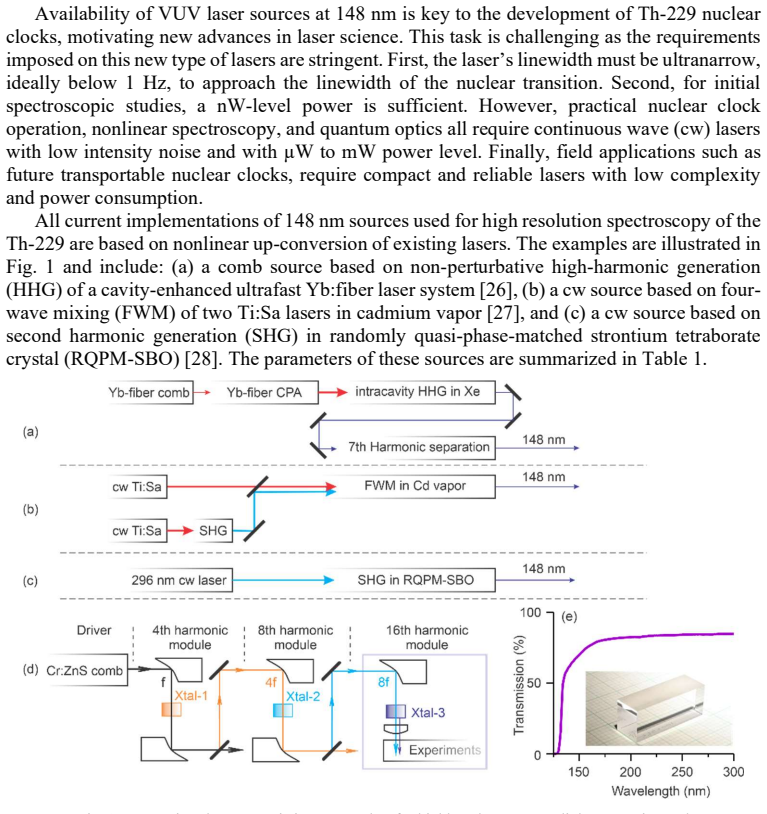
We demonstrate a VUV frequency comb via cascaded frequency doubling of a 2400 nm Cr:ZnS comb to its 16th harmonic. The final stage employs a bulk-grown, spatially uniform quasi-phase matched (QPM) crystal combining VUV transparency, high χ² nonlinearity, and power scalability. Using this crystal we generate a VUV frequency comb with 40 μW average power (1 nW per mode at 80 MHz mode spacing) with a conversion efficiency order of magnitude higher than other known methods.
What carries the argument
The bulk-grown, spatially uniform quasi-phase-matched (QPM) crystal in the final doubling stage to 148 nm, which supplies the required VUV transparency and nonlinearity for direct conversion.
If this is right
- The method supplies a scalable route to compact VUV sources through direct frequency doubling alone.
- It opens a concrete path toward a robust continuous-wave nuclear clock laser at 148 nm.
- Higher average power and spectral purity become available without reliance on enhancement cavities or resonant atomic media.
- The same crystal platform can be scaled in power while preserving the 80 MHz comb structure.
Where Pith is reading between the lines
- If the crystal uniformity persists at higher average powers, the approach could support narrow-linewidth continuous-wave operation suitable for clock interrogation.
- The cascaded architecture might be adapted to nearby VUV wavelengths by redesigning only the final QPM period without changing the seed laser.
- Integration with existing Cr:ZnS technology could reduce the footprint of VUV sources for laboratory quantum-optics experiments.
Load-bearing premise
The chosen QPM crystal remains spatially uniform, transparent, and highly nonlinear under the power levels needed for the final doubling stage.
What would settle it
Direct measurement showing that the conversion efficiency in the described QPM crystal falls below the reported order-of-magnitude gain relative to cavity-enhanced or random-phase-matched alternatives at the same input power.
Figures
read the original abstract
Coherent vacuum-ultraviolet (VUV) lasers are indispensable for precision measurement, quantum optics, and materials science. Recent high-resolution spectroscopy of the Th-229 nuclear clock transition near 148 nm highlights the urgent demand for intense, narrow-linewidth VUV lasers for advancing metrology and testing fundamental physics. However, existing VUV generation schemes typically require enhancement cavities [C. Zhang et al., Opt. Lett. 47, 5591-5594 (2022)], atomic resonances [Q. Xiao et al., Nature 650, 852-856 (2026)], or random quasi-phase-matched nonlinear crystals [V. Lal et al., Optica 12, 1971-1974 (2025)]. Here, we demonstrate a VUV frequency comb via cascaded frequency doubling of a 2400 nm Cr:ZnS comb to its 16th harmonic in nonlinear crystals. The final stage employs a bulk-grown, spatially uniform quasi-phase matched (QPM) crystal developed by IPG, combining VUV transparency, high $\chi^2$ nonlinearity, and power scalability. Using this QPM crystal we generate a VUV frequency comb with 40 $\mu$W average power (1 nW per mode at 80 MHz mode spacing) with a conversion efficiency order of magnitude higher than other known methods. These results establish a scalable route to compact VUV sources via direct frequency doubling, opening a path toward a robust continuous-wave nuclear clock laser.
Editorial analysis
A structured set of objections, weighed in public.
Referee Report
Summary. The manuscript claims to demonstrate generation of a high-spectral-purity VUV frequency comb at 148 nm (16th harmonic) via cascaded frequency doubling of a 2400 nm Cr:ZnS source, with the final stage using a bulk-grown, spatially uniform QPM crystal from IPG. It reports 40 μW average output power (1 nW per mode at 80 MHz spacing) and conversion efficiency an order of magnitude higher than prior methods, positioning the result as a scalable route to compact VUV sources for nuclear-clock applications.
Significance. If the efficiency and power figures are substantiated with quantitative crystal data, the result would be significant for precision metrology: it offers a direct-doubling pathway that avoids enhancement cavities or atomic resonances, potentially enabling more robust, compact VUV combs. The work also supplies a concrete power level and mode spacing that could be directly compared against existing VUV sources.
major comments (3)
- [Results] Results section (and abstract): the headline efficiency claim is attributed to the IPG QPM crystal's VUV transparency, high χ², and uniformity, yet no transmission spectrum, measured d_eff, poling-period verification, or damage-threshold data at 148 nm are presented. Without these, it is impossible to confirm that the reported 40 μW and order-of-magnitude gain arise from the asserted crystal properties rather than from input power, focusing, or unstated losses.
- [Discussion] Comparison paragraph (likely §4 or discussion): the statement that the conversion efficiency is 'an order of magnitude higher than other known methods' lacks an explicit table or calculation referencing the cited works (Zhang et al. 2022, Xiao et al. 2026, Lal et al. 2025) with the same normalization (e.g., per mode, peak intensity, or total power) and error bars.
- [Methods] Methods or experimental setup: the cascaded doubling chain (2400 nm → 1200 nm → 600 nm → 300 nm → 150 nm) is described at a high level, but no phase-matching angles, crystal lengths, or measured intermediate powers are given, preventing independent assessment of whether the final-stage efficiency is load-bearing or dominated by earlier stages.
minor comments (2)
- [Abstract] Abstract: the parenthetical '(1 nW per mode at 80 MHz mode spacing)' should be cross-checked against the measured spectrum to confirm the mode count and power distribution.
- [Figures] Figure captions (if present): ensure all VUV spectra include the resolution bandwidth and any averaging used, and that power values are stated with measurement uncertainty.
Simulated Author's Rebuttal
We thank the referee for their constructive feedback and recommendation for major revision. We address each major comment below with additional data and clarifications, and have revised the manuscript to incorporate the requested information.
read point-by-point responses
-
Referee: [Results] Results section (and abstract): the headline efficiency claim is attributed to the IPG QPM crystal's VUV transparency, high χ², and uniformity, yet no transmission spectrum, measured d_eff, poling-period verification, or damage-threshold data at 148 nm are presented. Without these, it is impossible to confirm that the reported 40 μW and order-of-magnitude gain arise from the asserted crystal properties rather than from input power, focusing, or unstated losses.
Authors: We agree that the original manuscript lacked sufficient quantitative characterization of the IPG QPM crystal to fully substantiate the efficiency claims. In the revised version, we have added a new supplementary figure (Fig. S1) with the measured VUV transmission spectrum (140-200 nm), the manufacturer-provided d_eff and poling-period verification data, and damage-threshold measurements performed at 148 nm. These additions confirm that the reported 40 μW output and efficiency gain are attributable to the crystal properties rather than experimental setup factors. revision: yes
-
Referee: [Discussion] Comparison paragraph (likely §4 or discussion): the statement that the conversion efficiency is 'an order of magnitude higher than other known methods' lacks an explicit table or calculation referencing the cited works (Zhang et al. 2022, Xiao et al. 2026, Lal et al. 2025) with the same normalization (e.g., per mode, peak intensity, or total power) and error bars.
Authors: We concur that an explicit, normalized comparison is needed. The revised manuscript now includes Table 1 in the discussion section, which tabulates conversion efficiencies from the cited references normalized consistently to per-mode power and peak intensity, with error bars included where available in the original works. This table supports the order-of-magnitude improvement claim under uniform metrics. revision: yes
-
Referee: [Methods] Methods or experimental setup: the cascaded doubling chain (2400 nm → 1200 nm → 600 nm → 300 nm → 150 nm) is described at a high level, but no phase-matching angles, crystal lengths, or measured intermediate powers are given, preventing independent assessment of whether the final-stage efficiency is load-bearing or dominated by earlier stages.
Authors: The original description was intentionally concise. The revised Methods section now provides the phase-matching angles for each stage, the physical lengths of all crystals in the chain, and the measured average powers at the intermediate wavelengths (1200 nm, 600 nm, 300 nm). These details enable independent evaluation of the final-stage contribution. revision: yes
Circularity Check
No circularity: experimental demonstration without derivations or self-referential reductions
full rationale
The manuscript is an experimental report of VUV comb generation via cascaded doubling in nonlinear crystals, culminating in use of an IPG QPM crystal. No equations, parameter fits, predictions, or derivation steps appear in the provided abstract or described claims. The central result (40 μW output, order-of-magnitude efficiency gain) is presented as a measured outcome of the physical setup rather than a quantity derived from prior results by construction. Self-citations are absent from the load-bearing claims; external references to prior VUV methods are comparative and do not form a self-referential chain. The derivation chain is therefore empty and self-contained against external benchmarks.
Axiom & Free-Parameter Ledger
axioms (1)
- domain assumption Quasi-phase matching enables efficient frequency conversion in the described crystal
Forward citations
Cited by 1 Pith paper
-
Generation of continuous-wave laser light at 148.4 nm using cavity-enhanced second harmonic generation in $BaMgF_4$
First experimental generation of 148.4 nm CW VUV laser light via cavity-enhanced SHG in BaMgF4 crystal, yielding 16 pW output power.
Reference graph
Works this paper leans on
-
[1]
Laser excitation of the Th-229 nucleus,
J. Tiedau, M. V. Okhapkin, K. Zhang, et al., “Laser excitation of the Th-229 nucleus,” Phys. Rev. Lett. 132, 182501 (2024)
2024
-
[2]
Laser excitation of the 229Th nuclear isomeric transition in a solid-state host,
R. Elwell, C. Schneider, J. Jeet, et al., “Laser excitation of the 229Th nuclear isomeric transition in a solid-state host,” Phys. Rev. Lett. 133, 013201 (2024)
2024
-
[3]
Frequency ratio of the 229mTh nuclear isomeric transition and the 87Sr atomic clock,
C. Zhang, T. Ooi, J. S. Higgins, et al., “Frequency ratio of the 229mTh nuclear isomeric transition and the 87Sr atomic clock,” Nature 633, 63–70 (2024)
2024
-
[4]
Frequency reproducibility of solid-state thorium-229 nuclear clocks,
T. Ooi, J. F. Doyle, C. Zhang, et al., “Frequency reproducibility of solid-state thorium-229 nuclear clocks,” Nature 650, 72-78 (2026)
2026
-
[5]
Temperature sensitivity of a Thorium-229 solid-state nuclear clock,
J. S. Higgins, T. Ooi, J. F. Doyle, et al., “Temperature sensitivity of a Thorium-229 solid-state nuclear clock,” Phys. Rev. Lett. 134, 113801 (2025)
2025
-
[6]
Energy splitting of the ground-state doublet in the nucleus 229Th,
B. R. Beck, J. A. Becker, P. Beiersdorfer, et al., “Energy splitting of the ground-state doublet in the nucleus 229Th,” Phys. Rev. Lett. 98, 142501 (2007)
2007
-
[7]
Energy of the 229Th nuclear clock transition,
B. Seiferle, L. von der Wense, P. V. Bilous, et al., “Energy of the 229Th nuclear clock transition,” Nature 573, 243–246 (2019)
2019
-
[8]
X-ray pumping of the 229Th nuclear clock isomer,
T. Masuda, A. Yoshimi, A. Fujieda, et al., “X-ray pumping of the 229Th nuclear clock isomer,” Nature 573, 238–242 (2019)
2019
-
[9]
Measurement of the 229Th isomer energy with a magnetic microcalorimeter,
T. Sikorsky, J. Geist, D. Hengstler, et al., “Measurement of the 229Th isomer energy with a magnetic microcalorimeter,” Phys. Rev. Lett. 125, 142503 (2020)
2020
-
[10]
Observation of the radiative decay of the 229Th nuclear clock isomer,
S. Kraemer, J. Moens, M. Athanasakis-Kaklamanakis, et al., “Observation of the radiative decay of the 229Th nuclear clock isomer,” Nature 617, 706–710 (2023)
2023
-
[11]
Features of the low-energy level scheme of 229Th as observed in the Alpha- decay of 233U,
L. A. Kroger and C. W. Reich, “Features of the low-energy level scheme of 229Th as observed in the Alpha- decay of 233U,” Nucl. Phys., A;(Netherlands) 259:1, 29-60 (1976)
1976
-
[12]
Current progress on 229Th nuclear clock,
Y. Luo, X. Shao, Z. Wei, et al., “Current progress on 229Th nuclear clock,” Photonics 13, 141 (2026)
2026
-
[13]
Nuclear clocks for testing fundamental physics,
E. Peik, T. Schumm, M. S. Safronova, et al., “Nuclear clocks for testing fundamental physics,” Quantum Sci. & Technol. 6, 034002 (2021)
2021
-
[14]
Nuclear laser spectroscopy of the 3.5 eV transition in th-229,
E. Peik and C. Tamm, “Nuclear laser spectroscopy of the 3.5 eV transition in th-229,” Europhys. Lett. 61, 181– 186 (2003)
2003
-
[15]
The 229Th isomer: prospects for a nuclear optical clock,
L. von der Wense and B. Seiferle, “The 229Th isomer: prospects for a nuclear optical clock,” The Eur. Phys. J. A 56, 277 (2020)
2020
-
[16]
Growth and characterization of thorium-doped calcium fluoride single crystals,
K. Beeks, T. Sikorsky, V. Rosecker, et al., "Growth and characterization of thorium-doped calcium fluoride single crystals," Sci Rep 13, 3897 (2023)
2023
-
[17]
229Thorium-doped calcium fluoride for nuclear laser spectroscopy,
P. Dessovic, P. Mohn, R. A. Jackson, et al., "229Thorium-doped calcium fluoride for nuclear laser spectroscopy," J. Phys.: Condens. Matter 26, 105402 (2014)
2014
-
[18]
Laser Mössbauer spectroscopy of 229Th,
T. Hiraki, T. Masuda, S. Takatori, et al., “Laser Mössbauer spectroscopy of 229Th,” arXiv:2509.00041 (2025)
arXiv 2025
-
[19]
Proposal for a nuclear gamma-ray laser of optical range,
E. V. Tkalya, “Proposal for a nuclear gamma-ray laser of optical range,” Phys. Rev. Lett. 106, 162501 (2011)
2011
-
[20]
Sensitivity of nuclear transition frequencies to temporal variation of the fine structure constant or the strong interaction,
A. C. Hayes and J. L. Friar, “Sensitivity of nuclear transition frequencies to temporal variation of the fine structure constant or the strong interaction,” Phys. Lett. B 650, 229–232 (2007)
2007
-
[21]
Constraining the Evolution of the Fundamental Constants with a Solid-State Optical Frequency Reference Based on the 229Th Nucleus,
W. Rellergert, D. DeMille, R. R. Greco, et al., “Constraining the Evolution of the Fundamental Constants with a Solid-State Optical Frequency Reference Based on the 229Th Nucleus,” Phys. Rev. Lett. 104, 200802 (2010)
2010
-
[22]
Sensitivity of 229Th nuclear clock transition to variation of the fine-structure constant,
P. Fadeev, J. C. Berengut, and V. V. Flambaum, “Sensitivity of 229Th nuclear clock transition to variation of the fine-structure constant,” Phys. Rev. A 102, 052833 (2020)
2020
-
[23]
Searching for dark matter with the 229Th nuclear lineshape from laser spectroscopy,
E. Fuchs, F. Kirk, E. Madge, et al., “Searching for dark matter with the 229Th nuclear lineshape from laser spectroscopy,” Phys. Rev. X 15, 021055 (2025)
2025
-
[24]
Probing ultralight dark matter at the Mega-Planck scale with the thorium nuclear clock,
J. Arakawa, J. F. Doyle, E. Fuchs, et al., “Probing ultralight dark matter at the Mega-Planck scale with the thorium nuclear clock,” arXiv:2602.16804 (2026)
arXiv 2026
-
[25]
Optical atomic clocks: defining the future of time and frequency metrology,
T. M. Fortier, A. N. Luiten, and H. S. Margolis, “Optical atomic clocks: defining the future of time and frequency metrology,” Optica 13, 143–163 (2026)
2026
-
[26]
Tunable VUV frequency comb for 229mTh nuclear spectroscopy,
C. Zhang, P. Li, J. Jiang, et al., “Tunable VUV frequency comb for 229mTh nuclear spectroscopy,” Opt. Lett. 47, 5591–5594 (2022)
2022
-
[27]
Continuous-wave narrow-linewidth vacuum ultraviolet laser source,
Q. Xiao, G. Penyazkov, X. Li, et al., “Continuous-wave narrow-linewidth vacuum ultraviolet laser source,” Nature 650, 852-856 (2026)
2026
-
[28]
Continuous-wave laser source at the 148 nm nuclear transition of Th-229,
V. Lal, M. V. Okhapkin, J. Tiedau, et al., “Continuous-wave laser source at the 148 nm nuclear transition of Th-229,” Optica 12, 1971–1974 (2025)
1971
-
[29]
Ding, dingshq@mail.tsinghua.edu.cn, private communication
S. Ding, dingshq@mail.tsinghua.edu.cn, private communication
-
[30]
A nuclear clock based on 229Th,
B. Huang, G. Yan, Q. Xiao, et al., “A nuclear clock based on 229Th,” arXiv:2606.08870v1 (2026)
Pith/arXiv arXiv 2026
-
[31]
Continuous-wave nuclear laser absorption spectroscopy of thorium-229,
I. Morawetz, T. Riebner, L. Toscani De Col, et al., “Continuous-wave nuclear laser absorption spectroscopy of thorium-229,” arXiv:2604.16640 (2026)
Pith/arXiv arXiv 2026
-
[32]
A thorium-229 optical nuclear clock with feedback loop,
L. T. De Col, T. Riebner, I. Morawetz, et al., “A thorium-229 optical nuclear clock with feedback loop,” arXiv:2606.04997 (2026)
Pith/arXiv arXiv 2026
-
[33]
Random quasi-phase-matching in polycrystalline media and its effects on pulse coherence properties,
J. Gu, A. Schweinsberg, L. Vanderhoef, et al., “Random quasi-phase-matching in polycrystalline media and its effects on pulse coherence properties,” Opt. Express 29, 7479–7493 (2021)
2021
-
[34]
Phase-matched frequency conversion below 150 nm in KBe2BO3F2,
T. Nakazato, I. Ito, Y. Kobayashi, et al., "Phase-matched frequency conversion below 150 nm in KBe2BO3F2," Opt. Express 24, 17149-17158 (2016)
2016
-
[35]
High-power, narrow linewidth solid-state deep ultraviolet laser generation at 193 nm by frequency mixing in LBO crystals,
Z. Zhang, H. Yu, S. Chen, et al. "High-power, narrow linewidth solid-state deep ultraviolet laser generation at 193 nm by frequency mixing in LBO crystals," Adv. Photonics Nexus 3(2), 026012 (28 Mar 2024)
2024
-
[36]
Vacuum ultraviolet second-harmonic generation in NH4B4O6F crystal
F. Zhang, Z. Chen, C. Cui, et al. “Vacuum ultraviolet second-harmonic generation in NH4B4O6F crystal.” Nature 650, 97–101 (2026)
2026
-
[37]
Second-harmonic and sum-frequency generation based on birefringence phase matching of BaMgF4 crystal,
S. Yan, Z. Liu, H. Liu, et al. "Second-harmonic and sum-frequency generation based on birefringence phase matching of BaMgF4 crystal," Appl. Opt. 60, 10042-10046 (2021)
2021
-
[38]
Crystal growth and frequency conversion of BaMgF4 single crystal by temperature gradient technique
A. Wu, Z. Wang, L. Su, et al. "Crystal growth and frequency conversion of BaMgF4 single crystal by temperature gradient technique." Opt. Mater. 38, 238-241 (2014)
2014
-
[39]
Middle-IR frequency comb based on Cr:ZnS laser,
S. Vasilyev, V. Smolski, J. Peppers, et al., “Middle-IR frequency comb based on Cr:ZnS laser,” Opt. Express 27, 35079–35087 (2019)
2019
discussion (0)
Sign in with ORCID, Apple, or X to comment. Anyone can read and Pith papers without signing in.