Networks of agglomeration: how population density rewires social networks and reshapes contagion dynamics
Pith reviewed 2026-06-26 18:34 UTC · model grok-4.3
The pith
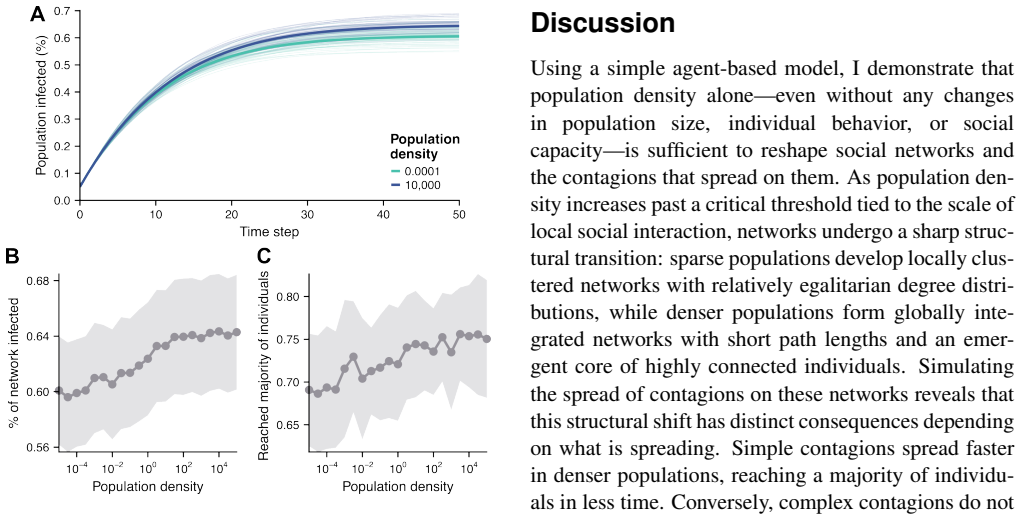
Population density alone reorganizes social networks from local clusters to global cores with popular hubs, altering how simple and complex contagions spread.
A machine-rendered reading of the paper's core claim, the machinery that carries it, and where it could break.
Core claim
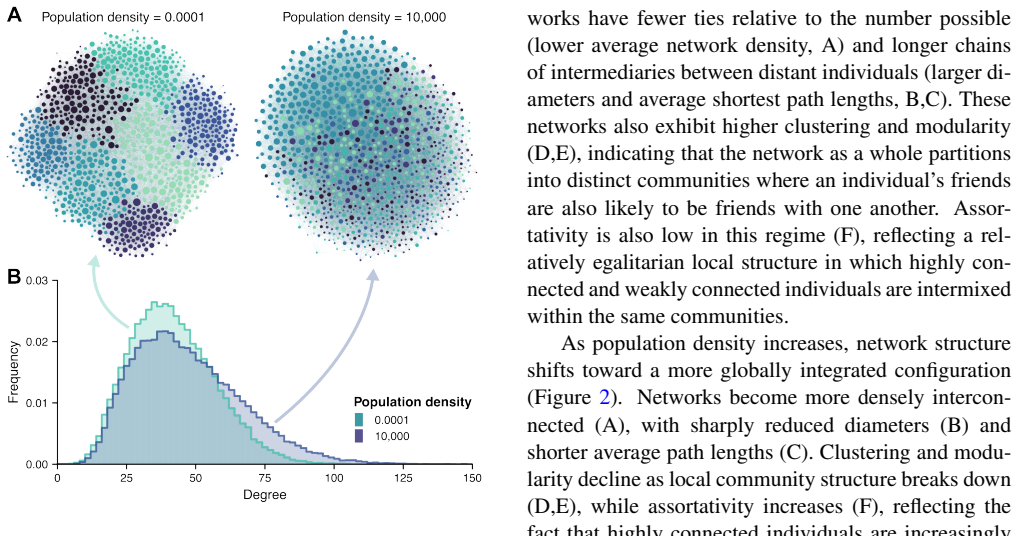
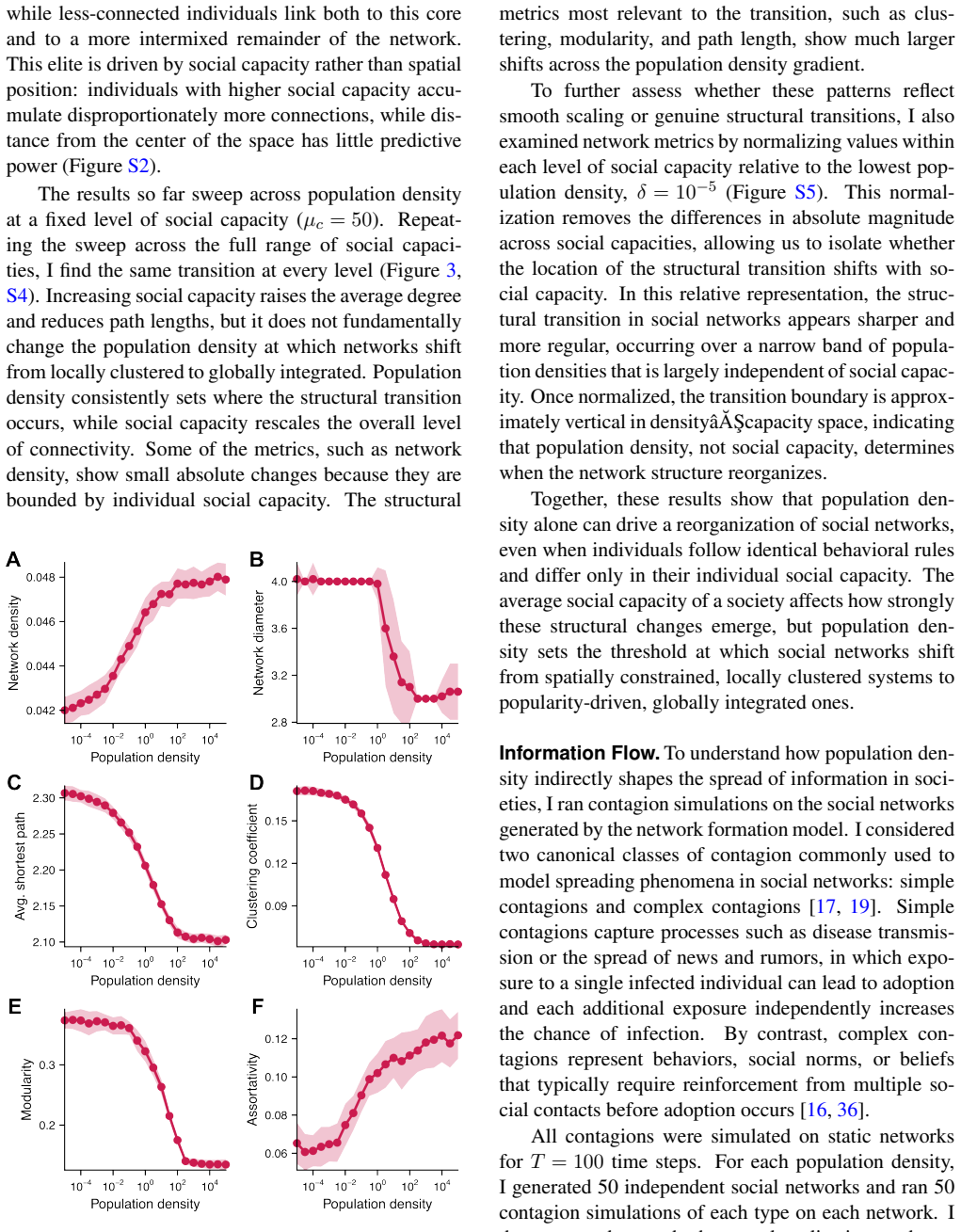
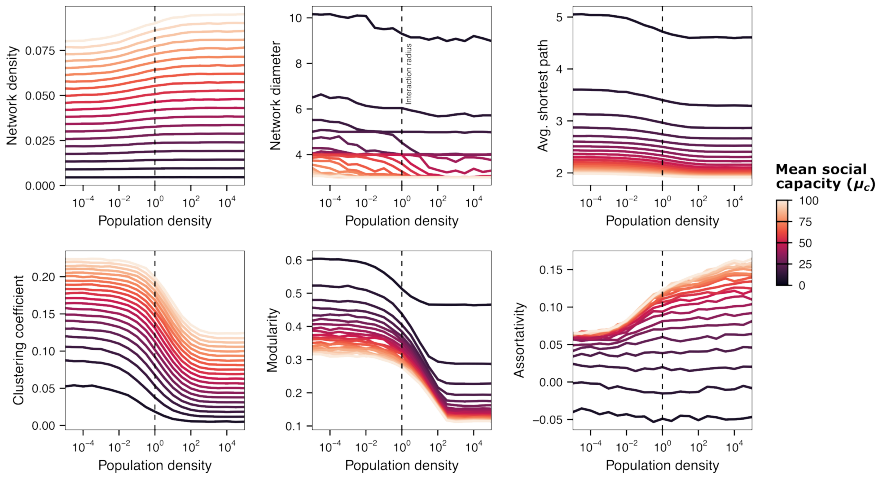
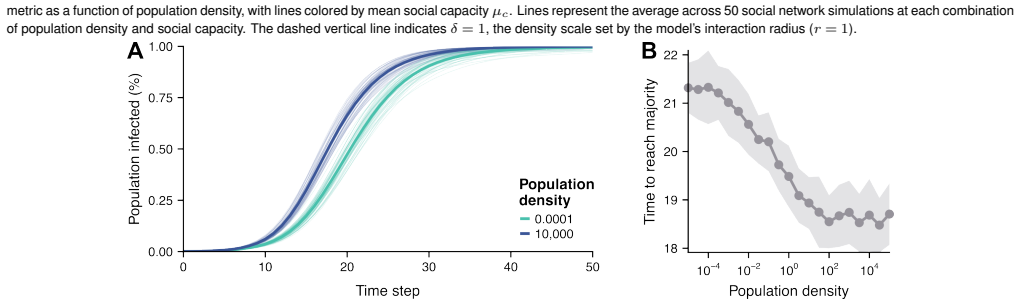
In the model, individuals form social ties gradually by favoring those nearby and those already well-connected. Varying population density alone is sufficient to reorganize network structure: sparse populations develop locally clustered communities, while denser ones form globally integrated networks with shorter social distances and a tightly interconnected core of popular individuals. This structural transition occurs sharply over a narrow range of densities and is governed by whether physical proximity or social popularity dominates tie formation. Simple contagions reach a majority of individuals more quickly in denser populations, while complex contagions achieve broader and more reliabl
What carries the argument
The agent-based tie-formation rule that gradually favors physical proximity and existing social popularity, which isolates density as the sole variable driving the shift between local clustering and global integration.
If this is right
- Simple contagions such as information or disease reach a majority of individuals more quickly in denser populations.
- Complex contagions such as social norms or collective behaviors achieve broader and more reliable adoption as density increases, without necessarily spreading faster.
- The transition between clustered and integrated network structures occurs sharply over a narrow range of densities.
- Whether physical proximity or social popularity dominates tie formation determines the structural outcome at a given density.
Where Pith is reading between the lines
- Density could serve as an independent structural driver of urban productivity and innovation even when economic or behavioral factors are held constant.
- Urban planning that alters effective density might shift contagion thresholds without changing individual contact rates.
- The model suggests that interventions targeting tie-formation biases could counteract or amplify density effects on collective behavior.
Load-bearing premise
The rules that individuals form ties gradually by favoring those nearby and those already well-connected are sufficient to capture the dominant mechanisms of real tie formation and that holding all other factors fixed isolates a pure density effect.
What would settle it
Mapping real-world social networks across matched populations at different densities and checking whether the fraction of local clusters versus global cores and popular hubs changes sharply as predicted when other variables are controlled.
Figures
read the original abstract
From ancient Mesopotamia to modern cities, dense human settlements coincide with bursts of economic productivity, cultural innovation, and social change. But how does packing people more tightly together alter social organization in ways that reshape collective outcomes? Here, I use a minimal agent-based model to isolate the effect of population density, holding population size and individual behavior fixed while varying only how closely individuals are placed in space. In the model, individuals form social ties gradually, favoring those nearby and those already well-connected. Under these simple rules, varying population density alone is sufficient to reorganize social network structure: sparse populations develop locally clustered communities, while denser ones form globally integrated networks with shorter social distances and a tightly interconnected core of popular individuals. This structural transition occurs sharply over a narrow range of densities and is governed by whether physical proximity or social popularity dominates tie formation. Simulating contagions on these networks reveals that the consequences of this shift depend on what is spreading. Simple contagions (e.g., information or disease) reach a majority of individuals more quickly in denser populations. Complex contagions (e.g., social norms or collective behaviors) do not spread faster, but instead achieve broader and more reliable adoption as density increases. Together, these results show that population density can act as a structural force independent of the economic and behavioral mechanisms typically invoked to explain why cities are engines of change.
Editorial analysis
A structured set of objections, weighed in public.
Referee Report
Summary. The manuscript presents a minimal agent-based model in which agents form social ties by favoring nearby individuals and those already well-connected (high degree). Holding population size N and the tie-formation rule fixed while varying only spatial density (by changing the area), the model produces a sharp structural transition: sparse populations yield locally clustered communities, while denser populations produce globally integrated networks with shorter paths and a densely interconnected core of popular agents. This transition is governed by the relative dominance of proximity versus popularity. Simulations of contagions on the emergent networks show that simple contagions reach a majority faster in dense settings, whereas complex contagions achieve broader and more reliable adoption as density increases.
Significance. If the central isolation of a pure density effect holds, the work would be significant for providing a mechanistic account of how spatial packing alone can reorganize social structure and differentially affect collective dynamics. The minimal model with explicit, fixed behavioral rules is a clear strength, as is the distinction between simple and complex contagion outcomes. The approach avoids fitting to target statistics and instead derives structure from forward simulation.
major comments (2)
- [Model section (tie-formation rule)] Model section (tie-formation rule): the proximity term is defined via an absolute Euclidean distance kernel without rescaling by local mean spacing. With N fixed and area decreased to raise density, typical inter-agent distances shrink, automatically raising the effective weight of proximity even when the functional form and any explicit weights remain unchanged. This makes the balance between proximity and popularity density-dependent by construction, undermining the claim that individual behavior is held fixed while isolating a pure density effect.
- [Results on structural transition] Results on structural transition: the reported sharp transition and its governance by proximity vs. popularity dominance are presented as emergent, yet no explicit check (e.g., rescaled relative-distance kernel or fixed absolute-distance control) is shown to confirm that the transition survives when the effective balance is prevented from shifting with density. This is load-bearing for the central claim that density alone reorganizes networks.
minor comments (2)
- [Abstract and Model] The abstract and model description would benefit from an explicit equation for the tie-formation probability, including how the two preferences are combined and whether any normalization depends on density.
- [Figures] Figure captions for the network visualizations and contagion curves should state the exact parameter values used (proximity weight, popularity weight, area values) and the number of independent realizations.
Simulated Author's Rebuttal
We thank the referee for the careful reading and constructive comments on the model implementation. The points raised about the proximity kernel and the need for additional controls are well taken. We address each below and will revise the manuscript to incorporate explicit checks that clarify the role of absolute versus effective distances.
read point-by-point responses
-
Referee: Model section (tie-formation rule): the proximity term is defined via an absolute Euclidean distance kernel without rescaling by local mean spacing. With N fixed and area decreased to raise density, typical inter-agent distances shrink, automatically raising the effective weight of proximity even when the functional form and any explicit weights remain unchanged. This makes the balance between proximity and popularity density-dependent by construction, undermining the claim that individual behavior is held fixed while isolating a pure density effect.
Authors: We agree that absolute distances cause the effective weight of proximity to increase with density, since a fixed proximity kernel encompasses more agents at higher densities. This is inherent to the model design: the behavioral rule (functional form and fixed parameters) remains unchanged while the spatial configuration varies. We view this as capturing how density alters tie-formation opportunities under constant individual preferences, rather than a violation of fixed behavior. To strengthen the analysis, the revised manuscript will add a control using a relative-distance kernel normalized by mean inter-agent spacing at each density, allowing direct comparison of whether the structural transition persists when the effective proximity-popularity balance is held constant. revision: yes
-
Referee: Results on structural transition: the reported sharp transition and its governance by proximity vs. popularity dominance are presented as emergent, yet no explicit check (e.g., rescaled relative-distance kernel or fixed absolute-distance control) is shown to confirm that the transition survives when the effective balance is prevented from shifting with density. This is load-bearing for the central claim that density alone reorganizes networks.
Authors: The absence of an explicit rescaled-kernel control is a valid limitation for fully isolating the density effect. In the revision we will include simulations with a relative-distance kernel (distances divided by local mean spacing) and report how the transition threshold and network properties change. This will allow us to quantify the contribution of the shifting effective balance versus other density-driven mechanisms, and we will update the results and discussion sections to present these controls alongside the original findings. revision: yes
Circularity Check
No circularity: forward simulation from fixed tie-formation rules with density as sole exogenous input
full rationale
The abstract and description present an agent-based model in which individuals form ties according to explicit, fixed rules (favoring nearby and well-connected agents) while only spatial density is varied with N and behavior held constant. Outcomes (clustering, path lengths, core-periphery structure, contagion thresholds) are generated by simulation rather than fitted to target statistics or defined in terms of those statistics. No equations, self-citations, or uniqueness theorems are supplied that would reduce any claimed prediction to a tautology or to a parameter tuned on the same data. The derivation chain is therefore self-contained against external benchmarks.
Axiom & Free-Parameter Ledger
free parameters (2)
- proximity preference weight
- popularity preference weight
axioms (1)
- domain assumption Individuals form social ties gradually, favoring those nearby and those already well-connected.
Reference graph
Works this paper leans on
-
[1]
R. M. Adams.The Uruk countryside: The natural setting of urban societies. Chicago: Chicago University Press„ 1972
1972
-
[2]
L. M. Aiello, A. Vybornova, S. Juhà ˛ asz, M. Szell, and E. Bokà ˛ anyi. Urban highways are barriers to social ties.Proceedings of the National Academy of Sciences, 122(10):e2408937122, Mar. 2025. doi:10.1073/pnas.2408937122. URLhttps://www.pnas.org/ doi/10.1073/pnas.2408937122
-
[3]
R. Albert and A.-L. Barabà ˛ asi. Statistical mechanics of complex networks.Reviews of Modern Physics, 74(1):47–97, Jan. 2002. ISSN 0034-6861. doi:10.1103/RevModPhys.74.47. URLhttps: //link.aps.org/doi/10.1103/RevModPhys.74.47
-
[4]
Alexander, S
C. Alexander, S. Ishikawa, M. Silverstein, M. Jacobson, I. Fiksdahl- King, and S. Angel.A pattern language: towns, buildings, construc- tion. Oxford University Press, New Y ork, NY , USA, 1977
1977
-
[5]
G. Algaze. The End of Prehistory and The Uruk Period. InThe Sumerian World. Routledge, 2013. Num Pages: 27
2013
-
[6]
G. Algaze, B. Brenties, A. B. Knapp, P . L. Kohl, W. R. Kotter, C. C. Lamberg-Karlovsky, G. M. Schwartz, H. Weiss, R. J. Wenke, R. P . Wright, and A. Zagarell. The Uruk Expansion: Cross-cultural Ex- change in Early Mesopotamian Civilization [with Comments and Re- ply].Current Anthropology, 30(5):571–608, 1989. ISSN 0011-3204. URLhttps://www.jstor.org/stab...
arXiv 1989
-
[7]
Amador-Vargas, W
S. Amador-Vargas, W. Gronenberg, W. T. Wcislo, and U. Mueller. Specialization and group size: brain and behavioural correlates of colony size in ants lacking morphological castes.Proceedings. Bi- ological sciences, 282(1801):20142502, Feb. 2015. ISSN 1471-
2015
-
[8]
doi:10.1098/rspb.2014.2502. URLhttp://www.ncbi. nlm.nih.gov/pubmed/25567649
-
[9]
Arvidsson, N
M. Arvidsson, N. LovsjÃ˝ u, and M. Keuschnigg. Urban scal- ing laws arise from within-city inequalities.Nature Human Be- haviour, 7(3):365–374, Mar. 2023. ISSN 2397-3374. doi:10. 1038/s41562-022-01509-1. URLhttps://www.nature.com/ articles/s41562-022-01509-1
2023
-
[10]
Barabà ˛ asi and R
A.-L. Barabà ˛ asi and R. Albert. Emergence of scaling in random networks.Science, 286(5439):509–512, 1999. ISBN: 0036-8075
1999
-
[11]
M. BarthÃl’lemy. Spatial networks.Physics Reports, 499(1-3):1– 101, Feb. 2011. ISSN 03701573. doi:10.1016/j.physrep.2010. 11.002. URLhttp://www.sciencedirect.com/science/ article/pii/S037015731000308X. arXiv: 1010.0302 ISBN: 0370-1573
work page internal anchor Pith review Pith/arXiv arXiv doi:10.1016/j.physrep.2010 2011
-
[12]
T. W. Beale. Bevelled Rim Bowls and Their Implications for Change and Economic Organization in the Later Fourth Millennium B. C. Journal of Near Eastern Studies, 37(4):289–313, 1978. ISSN 0022-
1978
-
[13]
URLhttps://www.jstor.org/stable/544044
-
[14]
K. B. Beck, D. R. Farine, J. A. Firth, and B. C. Sheldon. Variation in local population size predicts social network structure in wild songbirds.Journal of Animal Ecology, 92 (12):2348–2362, 2023. ISSN 1365-2656. doi:10.1111/ 1365-2656.14015. URLhttps://onlinelibrary.wiley. com/doi/abs/10.1111/1365-2656.14015. _eprint: https://besjournals.onlinelibrary.wi...
-
[15]
L. M. A. Bettencourt. The Origins of Scaling in Cities.Sci- ence, 340(6139):1438–1441, June 2013. doi:10.1126/science. 1235823. URLhttps://www.science.org/doi/10.1126/ science.1235823
-
[16]
L. M. A. Bettencourt, J. Lobo, D. Helbing, C. KÃijhnert, and G. B. West. Growth, innovation, scaling, and the pace of life in cities. Proceedings of the National Academy of Sciences, 104(17):7301– 7306, Apr. 2007. doi:10.1073/pnas.0610172104. URLhttps:// www.pnas.org/doi/10.1073/pnas.0610172104
-
[17]
Bourke. Colony size, social complexity and reproductive conflict in social insects.Journal of Evolutionary Biology, 12(2):245–257, Mar. 1999. ISSN 1010-061X. doi:10.1046/j.1420-9101.1999.00028. x. URLhttps://doi.org/10.1046/j.1420-9101.1999. 00028.x
-
[18]
D. Centola. The spread of behavior in an online social net- work experiment.Science, 329(5996):1194–1197, Sept. 2010. ISSN 10959203. doi:10.1126/science.1185231. URLhttps: //science.sciencemag.org/content/329/5996/1194
-
[19]
Centola.How behavior spreads: The science of complex conta- gions, volume 3
D. Centola.How behavior spreads: The science of complex conta- gions, volume 3. Princeton University Press Princeton, NJ, 2018
2018
-
[20]
Centola and M
D. Centola and M. Macy. Complex contagions and the weakness of long ties.American Journal of Sociology, 113(3):702–734, Nov
- [21]
-
[22]
Centola, V
D. Centola, V. M. Eguà luz, and M. W. Macy. Cas- cade dynamics of complex propagation.Physica A: Sta- tistical Mechanics and its Applications, 374(1):449–456, Jan
-
[23]
ISSN 03784371. doi:10.1016/j.physa.2006.06
-
[24]
URLhttps://www.sciencedirect.com/science/ article/pii/S0378437106007679
-
[25]
Conover, J
M. Conover, J. Ratkiewicz, M. R. Francisco, B. Gonà ˘galves, F . Menczer, and A. Flammini. Political polarization on twitter. ICWSM, 133:89–96, 2011
2011
-
[26]
I. D. Couzin, J. Krause, N. R. Franks, and S. A. Levin. Effec- tive leadership and decision-making in animal groups on the move. Nature, 433(7025):513–516, Feb. 2005. ISSN 00280836. doi: 10.1038/nature03236. URLwww.nature.com/nature
-
[27]
CrÃijsemann, M
N. CrÃijsemann, M. van Ess, M. Hilgert, B. Salje, and T. Potts.Uruk: first city of the ancient world. Getty Publications, 2019
2019
-
[28]
Cutler and G
D. Cutler and G. Miller. The role of public health improvements in health advances: the twentieth-century United States.Demogra- phy, 42(1):1–22, 2005
2005
-
[29]
De Vries.European Urbanization, 1500-1800
J. De Vries.European Urbanization, 1500-1800. Routledge, 2013
2013
-
[30]
M. C. Donaldson-Matasci, G. DeGrandi-Hoffman, and A. Dorn- haus. Bigger is better: honeybee colonies as distributed information-gathering systems.Animal Behaviour, 85(3):585–592, Mar. 2013. ISSN 0003-3472. doi:10.1016/j.anbehav.2012.12
-
[31]
URLhttps://www.sciencedirect.com/science/ article/pii/S0003347212005702
-
[32]
R. I. Dunbar. Neocortex size as a constraint on group size in pri- mates.Journal of human evolution, 22(6):469–493, 1992
1992
-
[33]
Duranton and D
G. Duranton and D. Puga. Micro-foundations of urban agglomer- ation economies. InHandbook of regional and urban economics, volume 4, pages 2063–2117. Elsevier, 2004
2063
-
[34]
Duranton and D
G. Duranton and D. Puga. The Economics of Urban Density.Jour- nal of Economic Perspectives, 34(3):3–26, Aug. 2020. ISSN 0895-
2020
-
[35]
doi:10.1257/jep.34.3.3. URLhttps://www.aeaweb. org/articles?id=10.1257/jep.34.3.3
-
[36]
M. A. Elgar. Predator Vigilance and Group Size in Mam- mals and Birds: A Critical Review of the Empirical Ev- idence.Biological Reviews, 64(1):13–33, 1989. ISSN 1469-185X. doi:10.1111/j.1469-185X.1989.tb00636.x. URLhttps://onlinelibrary.wiley.com/doi/ abs/10.1111/j.1469-185X.1989.tb00636.x. _eprint: https://onlinelibrary.wiley.com/doi/pdf/10.1111/j.1469- ...
-
[37]
R. K. Englund. Proto-cuneiform account-books and journals.Cre- ating economic order: Record-keeping, standardization and the de- velopment of accounting in the ancient Near East, pages 23–46, 2004
2004
-
[38]
R. K. Englund. Accounting in Proto-Cuneiform. In K. Rad- ner and E. Robson, editors,The Oxford Handbook of Cuneiform Culture, page 0. Oxford University Press, Sept. 2011. ISBN 978-0-19-955730-1. doi:10.1093/oxfordhb/9780199557301. 013.0002. URLhttps://doi.org/10.1093/oxfordhb/ 9780199557301.013.0002
-
[39]
J. H. Fewell and J. F . Harrison. Scaling of work and energy use in social insect colonies.Behavioral Ecology and Sociobiology, 70(7):1047–1061, July 2016. ISSN 03405443. doi:10.1007/ s00265-016-2097-z. URLhttp://link.springer.com/10. 1007/s00265-016-2097-z
2016
-
[40]
N. R. Franks, A. Dornhaus, C. S. Best, and E. L. Jones. De- cision making by small and large house-hunting ant colonies: one size fits all.Animal Behaviour, 72(3):611–616, Sept
-
[41]
ISSN 00033472. doi:10.1016/j.anbehav.2005.11
-
[42]
ISBN: 0003-3472
URLhttps://www.sciencedirect.com/science/ article/pii/S0003347206002168. ISBN: 0003-3472
-
[43]
B. M. Gagliardi, N. St-Amant, and R. Dakin. Social network struc- ture scales with group size in a multi-species analysis.bioRxiv, pages 2023–08, 2023
2023
-
[44]
Glaeser.Agglomeration economics
E. Glaeser.Agglomeration economics. University of Chicago Press, 2010
2010
-
[45]
Information Propagation in Clustered Multilayer Networks
M. Granovetter. Threshold Models of Collective Behavior.Amer- ican Journal of Sociology, 83(6):1420–1443, May 1978. ISSN 0002-9602. doi:10.1086/226707. URLhttp://www.journals. uchicago.edu/doi/10.1086/226707. arXiv: 1509.03909 ISBN: 0002-9602
work page internal anchor Pith review Pith/arXiv arXiv doi:10.1086/226707 1978
-
[46]
Hazarie, D
S. Hazarie, D. Soriano-Paà ´sos, A. Arenas, J. Gø smez-Gardeôses, and G. Ghoshal. Interplay between population density and mobil- ity in determining the spread of epidemics in cities.Communica- tions Physics, 4(1):191, Aug. 2021. ISSN 2399-3650. doi:10. 1038/s42005-021-00679-0. URLhttps://www.nature.com/ articles/s42005-021-00679-0
2021
-
[47]
Herrera-Y agÃije, C
C. Herrera-Y agÃije, C. M. Schneider, T. CouronnÃl’, Z. Smoreda, R. M. Benito, P . J. Zufiria, and M. C. Gonzà ˛ alez. The anatomy of urban social networks and its implications in the searchability problem.Scientific Reports, 5(1):10265, June 2015. ISSN 2045-
2015
-
[48]
doi:10.1038/srep10265. URLhttps://www.nature. com/articles/srep10265
-
[49]
C. T. Holbrook, P . M. Barden, and J. H. Fewell. Division of labor increases with colony size in the harvester ant Pogonomyrmex cali- fornicus.Behavioral Ecology, page arr075, 2011. ISBN: 1045-2249
2011
-
[50]
C.-T. Hsieh and E. Moretti. Housing Constraints and Spatial Mis- allocation.American Economic Journal: Macroeconomics, 11(2): 1–39, Apr. 2019. ISSN 1945-7707. doi:10.1257/mac.20170388. URLhttps://www.aeaweb.org/articles?id=10.1257/ mac.20170388
-
[51]
Jacobs.The death and life of great American cities
J. Jacobs.The death and life of great American cities. Random House, New Y ork, 1961
1961
-
[52]
Jeanson, J
R. Jeanson, J. H. Fewell, R. Gorelick, and S. M. Bertram. Emer- gence of increased division of labor as a function of group size. Behavioral Ecology and Sociobiology, 62(2):289–298, 2007. ISBN: 0340-5443
2007
-
[53]
S. D. Leonhardt, F . Menzel, V. Nehring, and T. Schmitt. Ecology and Evolution of Communication in Social Insects.Cell, 164(6):1277– 1287, Mar. 2016. ISSN 0092-8674. doi:10.1016/j.cell.2016.01
-
[54]
URLhttps://www.sciencedirect.com/science/ article/pii/S0092867416300496
-
[55]
D. Liben-Nowell, J. Novak, R. Kumar, P . Raghavan, and A. Tomkins. Geographic routing in social networks.Proceedings of the Na- tional Academy of Sciences, 102(33):11623–11628, Aug. 2005. doi:10.1073/pnas.0503018102. URLhttps://www.pnas.org/ doi/abs/10.1073/pnas.0503018102
-
[56]
A. Liker and V. Bokony. Larger groups are more successful in in- novative problem solving in house sparrows.Proceedings of the National Academy of Sciences, 106(19):7893–7898, May 2009. ISSN 0027-8424. doi:10.1073/pnas.0900042106. URLhttp:// www.ncbi.nlm.nih.gov/pubmed/19416834. ISBN: 1091- 6490 (Electronic)\r0027-8424 (Linking)
-
[57]
F . T. Lima, N. C. Brown, and J. P . Duarte. Understanding the Impact of Walkability, Population Density, and Population Size on COVID-19 Spread: A Pilot Study of the Early Contagion in the United States.Entropy, 23(11):1512, Nov. 2021. ISSN 1099-
2021
-
[58]
URLhttps://www.mdpi.com/ 1099-4300/23/11/1512
doi:10.3390/e23111512. URLhttps://www.mdpi.com/ 1099-4300/23/11/1512
-
[59]
J. McCorriston. The Fiber Revolution: Textile Extensification, Alien- ation, and Social Stratification in Ancient Mesopotamia.Current Anthropology, 38(4):517–535, Aug. 1997. ISSN 0011-3204. doi: 10.1086/204643. URLhttps://www.journals.uchicago. edu/doi/10.1086/204643
-
[60]
D. P . Mersch, A. Crespi, and L. Keller. Tracking individuals shows spatial fidelity is a key regulator of ant social organization.Science, 340(6136):1090–1093, 2013. ISBN: 0036-8075
2013
-
[61]
J. Morand-Ferron and J. L. Quinn. Larger groups of passer- ines are more efficient problem solvers in the wild.Pro- ceedings of the National Academy of Sciences, 108(38):15898– 15903, Sept. 2011. ISSN 0027-8424. doi:10.1073/ pnas.1111560108. URLhttp://www.ncbi.nlm.nih.gov/ pubmed/21930936. ISBN: 9780387734118
arXiv 2011
-
[62]
Moretti.The New Geography of Jobs
E. Moretti.The New Geography of Jobs. Houghton Mifflin Harcourt, 2012. ISBN 978-0-547-75011-8. Google-Books-ID: br0S54w0u_sC
2012
-
[63]
Moussaid, S
M. Moussaid, S. Garnier, G. Theraulaz, and D. Helbing. Collective information processing and pattern formation in swarms, flocks, and crowds.Topics in Cognitive Science, 1(3):469–497, 2009. ISBN: 1756-8765
2009
-
[64]
D. Naug. Structure and resilience of the social network in an in- sect colony as a function of colony size.Behavioral Ecology and Sociobiology, 63(7):1023–1028, 2009. ISBN: 0340-5443
2009
-
[65]
H. J. Nissen. Urbanization and the techniques of commu- nication: the Mesopotamian city of Uruk during the fourth millenniumBCE. In N. Y offee, editor,The Cambridge World History: Volume 3: Early Cities in Comparative Perspec- tive, 4000 BCEâ ˘A ¸ S1200 CE, volume 3 ofThe Cambridge World History, pages 113–130. Cambridge University Press, Cambridge, 2015....
2015
-
[66]
H.-J. Nissen. Uruk: Early Administration Practices and the Develop- ment of Proto-Cuneiform Writing.ArchÃl’o-Nil, 26(1):33–48, 2016. doi:10.3406/arnil.2016.1102. URLhttps://www.persee.fr/ doc/arnil_1161-0492_2016_num_26_1_1102
-
[67]
S. G. Ortman, A. H. F . Cabaniss, J. O. Sturm, and L. M. A. Bet- tencourt. Settlement scaling and increasing returns in an ancient society.Science Advances, 1(1):e1400066, Feb. 2015. doi:10. 1126/sciadv.1400066. URLhttps://www.science.org/doi/ 10.1126/sciadv.1400066
-
[68]
W. Pan, G. Ghoshal, C. Krumme, M. Cebrian, and A. Pentland. Ur- ban characteristics attributable to density-driven tie formation.Na- ture Communications, 4(1):1961, June 2013. ISSN 2041-1723. doi:10.1038/ncomms2961. URLhttps://www.nature.com/ articles/ncomms2961
-
[69]
Pinter-Wollman
N. Pinter-Wollman. Nest architecture shapes the collective be- haviour of harvester ants.Biology Letters, 11(10):20150695, 2015. ISBN: 1744-9561
2015
-
[70]
H. R. Pulliam. On the advantages of flocking.Journal of Theoretical Biology, 38(2):419–422, Feb. 1973. ISSN 0022-5193. doi:10.1016/ 0022-5193(73)90184-7. URLhttps://www.sciencedirect. com/science/article/pii/0022519373901847
arXiv 1973
-
[71]
S. G. Roberts, R. I. Dunbar, T. V. Pollet, and T. Kuppens. Exploring variation in active network size: Constraints and ego characteristics. Social Networks, 31(2):138–146, 2009
2009
-
[72]
S. S. Rosenthal and W. C. Strange. Evidence on the nature and sources of agglomeration economies. InHandbook of regional and Tokita | Population Density Networks urban economics, volume 4, pages 2119–2171. Elsevier, 2004
2004
-
[73]
SchlÃd’pfer, L
M. SchlÃd’pfer, L. M. A. Bettencourt, S. Grauwin, M. Raschke, R. Claxton, Z. Smoreda, G. B. West, and C. Ratti. The scal- ing of human interactions with city size.Journal of The Royal Society Interface, 11(98):20130789, Sept. 2014. ISSN 1742-
2014
-
[74]
doi:10.1098/rsif.2013.0789. URLhttps://doi.org/10. 1098/rsif.2013.0789
-
[75]
M. M. Sosna, C. R. Twomey, J. Bak-Coleman, W. Poel, B. C. Daniels, P . Romanczuk, and I. D. Couzin. Individual and col- lective encoding of risk in animal groups.Proceedings of the National Academy of Sciences of the United States of Amer- ica, 116(41):20556–20561, Oct. 2019. ISSN 10916490. doi: 10.1073/pnas.1905585116. URLhttp://www.ncbi.nlm.nih. gov/pub...
-
[76]
Storper and A
M. Storper and A. J. Venables. Buzz: face-to-face contact and the urban economy.Journal of economic geography, 4(4):351–370, 2004
2004
-
[77]
A. Strandburg-Peshkin, D. R. Farine, I. D. Couzin, and M. C. Crofoot. Shared decision-making drives collective movement in wild baboons.Science, 348(6241):1358–1361, June 2015. ISSN 10959203. doi:10.1126/science.aaa5099
-
[78]
A. C. Swanson, L. Schwendenmann, M. F . Allen, E. L. Aron- son, A. Artavia-Leø sn, D. Dierick, A. S. Fernandez-Bou, T. C. Harmon, C. Murillo-Cruz, S. F . Oberbauer, A. A. Pinto- Tomà ˛ as, P . W. Rundel, and T. J. Zelikova. Welcome to the Atta world: A framework for understanding the effects of leaf-cutter ants on ecosystem functions.Functional Ecol- ogy...
-
[79]
C. K. Tokita and C. E. Tarnita. Social influence and interaction bias can drive emergent behavioural specialization and modular social networks across systems.Journal of the Royal Society Interface, 17(162):20190564, Jan. 2020. ISSN 17425662. doi:10.1098/rsif. 2019.0564. URLhttps://royalsocietypublishing.org/ doi/10.1098/rsif.2019.0564
-
[80]
Tø sth, J
G. Tø sth, J. Wachs, R. Di Clemente, Ã. Jakobi, B. Sà ˛ agvà ˛ ari, J. KertÃl’sz, and B. Lengyel. Inequality is rising where social net- work segregation interacts with urban topology.Nature Commu- nications, 12(1):1143, Feb. 2021. ISSN 2041-1723. doi:10. 1038/s41467-021-21465-0. URLhttps://www.nature.com/ articles/s41467-021-21465-0
2021
discussion (0)
Sign in with ORCID, Apple, or X to comment. Anyone can read and Pith papers without signing in.